
Dynamic retargeting re-engage and recover
Dynamic retargeting helps you reconnect with known visitors according to the action they already took, the stage they reached and the outcome still missing. Use FroggyAds campaign, source and conversion controls to run a bounded recovery test, then expand only the segments that produce accepted business results.
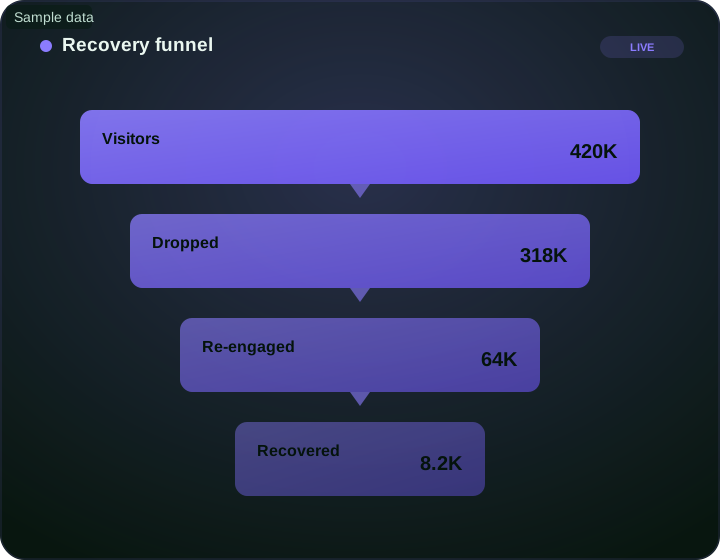
What this guide covers
This guide is for advertisers, affiliate marketers, media buyers, agencies and online businesses that already receive measurable visits but lose potential customers before the accepted outcome. It shows how to define a return-visitor cohort, match the message to the recorded drop-off, control exposure, reconcile recovered conversions and decide whether the next spend block deserves funding. For a commerce-specific product and cart workflow, continue with ecommerce retargeting and product traffic.
Overview
Dynamic retargeting reconnects with a known visitor by using the visitor's recorded interaction to choose a more relevant return message. A product viewer, cart abandoner and incomplete registrant represent different intent and should not share one generic appeal. Define the missing next action first, keep the eligibility evidence current and exclude people who already completed the goal.
On FroggyAds, use the available formats and source-level controls to separate recovery cohorts and observe where accepted outcomes return. Adscore-supported and internal traffic-quality controls add screening signals, while your own event, consent, suppression and backend records determine whether a person was eligible and whether the recovery was valuable.
Connect the recovery campaign to the acquisition path without combining their economics. Preserve campaign and source identifiers through the S2S postback, tag the original cohort and reconcile each reported conversion with the accepted event. SmartCPC may inform bidding from available campaign signals, but segment eligibility and commercial acceptance still need explicit review.
Bring interested users back
Re-engagement
Return to an eligible visitor with a message based on the last meaningful action and the next unfinished step.
Source control
Compare mature recovered outcomes by source before raising a bid, restricting delivery or creating an allowlist.
traffic with quality controls
Use Adscore, internal controls and your own accepted-event evidence together; traffic screening does not replace conversion validation.
SmartCPC
Review SmartCPC as one bid-optimization input while keeping recovery eligibility, accepted outcomes and exposure rules visible.
Recover more conversions
Build the recovery decision around the funnel stage. A viewed-item cohort needs a reason to reconsider; a cart cohort needs continuity with the selected item and checkout; an incomplete signup cohort needs a clear path back to the unfinished step. Keep the claim, destination and eligibility rule aligned so the returning visitor is not sent to a generic page.
Track the return path with postbacks, retain the cohort and source identifiers, and reconcile reported conversions with your accepted-event record. Compare recovered cost, approval rate and later value by source after the same maturity window. Change one source or bid control at a time so the next cohort shows what the action changed.
Part of a complete funnel
Use prospecting to create new qualified visits and retargeting to follow up with eligible non-converters. Report the two jobs separately: prospecting answers whether you can acquire a new visitor, while retargeting answers whether a known visitor can be recovered at an acceptable incremental cost. Blending both hides which layer changed the result.
Keep a holdout or another credible baseline when you need to estimate incremental recovery rather than simple correlation. A returning visitor may have converted without another ad, so report reach, recovered outcomes and incremental evidence separately. Use source controls and traffic-quality signals to diagnose delivery, then use accepted economics to govern budget.
Segmenting retargeting by drop-off point
Start with a small event ladder: meaningful view, deeper consideration, checkout or form start, and accepted completion. Place each visitor in the most advanced eligible cohort, set a time window and remove the visitor after conversion. Then tailor the return message to the exact missing step rather than repeating the original acquisition ad.
Set an exposure rule that reflects cohort age and decision value, then suppress users after the accepted event or when eligibility expires. Track recovery through postbacks, compare mature accepted cost by source and record each change. A frequency rule protects the user experience and the test budget; it does not guarantee incremental conversion.
See it inside FroggyAds
Use the FroggyAds self-serve workflow to keep campaign, format, budget, conversion and source evidence connected. Run one bounded recovery cohort at a time, review accepted outcomes by source and record every bid or source-control change. Your site, attribution and backend acceptance data remain the authority for whether a reported conversion created business value.
Start advertising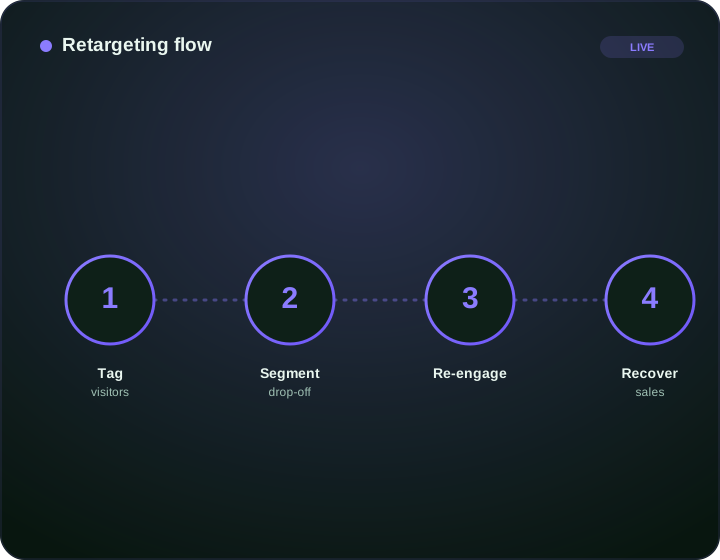
Frequently asked questions
What is dynamic retargeting?
Dynamic retargeting reconnects with an identifiable non-converter using the visitor's recorded action to choose a relevant return message and destination. The campaign should stop when the accepted outcome occurs or eligibility expires.
What can I recover?
Common recovery jobs include an eligible product view, abandoned cart, incomplete registration, unfinished trial setup or qualified lead form. Use only events your site records reliably and that you may lawfully use for the campaign.
How is traffic quality evaluated?
Use FroggyAds Adscore-supported and internal controls with source-level reporting, then validate the return path in your own attribution and backend acceptance data. Screening signals do not replace conversion reconciliation.
Does it pair with prospecting?
Yes. Keep prospecting and recovery in separate campaigns or clearly separated cohorts so acquisition cost, recovered cost, reach and incrementality can be interpreted without blending two different jobs.
What is the minimum deposit?
The current stated minimum deposit is USD 50. Treat the deposit separately from bid, actual campaign cost and a recommended test budget; qualifying bonus-credit conditions apply only as published.
Keep exploring
Retargeting traffic
Plan a broader return-visitor traffic decision.
Ecommerce traffic
Connect product and cart events to an ecommerce recovery path.
Lookalike audiences
Use new-audience planning for acquisition rather than recovery.
FroggyAds Media Kit
Review the current FroggyAds platform and format reference.
Dynamic retargeting re-engage and recover on FroggyAds
Choose FroggyAds when you want a self-serve campaign with budget, targeting, format, conversion and source controls for a measurable return-visitor test. Fund from the stated minimum only when your eligible cohort, destination, exclusion rule and accepted event are ready; advertising credits remain subject to the published qualifying conditions.
Dynamic retargeting re-engage and recover FAQ
What should I decide first about Dynamic retargeting re-engage and recover?
Define the eligible non-converter, last meaningful event, accepted recovery outcome, event-age limit, suppression rule and maximum loss before selecting format, bid or source controls.
How should I test Dynamic retargeting re-engage and recover with FroggyAds?
Validate cohort membership, destination, postback and completed-user suppression; launch one bounded FroggyAds cohort with stable creative and rules; then compare mature accepted outcomes by source before changing one control.
Which metric matters most for Dynamic retargeting re-engage and recover?
Accepted recovery cost governs the commercial decision when it is reconciled with the backend event. Reach, frequency, clicks, return rate and reported conversions remain useful diagnostic measures, and incremental evidence should be reported separately.
How much data should I collect before changing Dynamic retargeting re-engage and recover?
Wait through the stated conversion and approval window and collect enough mature outcomes that one event does not determine the conclusion. Cohort size, event delay, value ceiling and maximum test loss set the practical boundary.
What can make a Dynamic retargeting re-engage and recover test misleading?
Stale eligibility, failed suppression, broken identifiers, a changed offer or destination, mixed maturity windows, excessive repetition and simultaneous source or bid changes can all create a false recovery result. Repair those conditions before scaling.
Dynamic retargeting re-engage and recover: decision depth without generic filler
Dynamic retargeting should own one narrow job: bring an eligible non-converter back to the next unfinished step. Write the last qualifying event, the desired return action and the accepted completion before choosing creative or budget. This prevents a general brand-reminder campaign from being reported as a measurable recovery program.
| Decision layer | Evidence to retain | Review rule |
|---|---|---|
| Recovery objective | Name the unfinished action and the accepted event that proves recovery. | Do not launch until the last meaningful event and conversion exclusion can be verified. |
| Cohort eligibility | Define event age, market, device, consent state and whether the visitor already converted. | Exclude stale, unidentified or already-completed users before delivery. |
| Message continuity | Match the creative and destination to the last recorded stage and missing next action. | Start a new cohort when the offer, destination or eligibility rule changes. |
| Exposure and suppression | Set the cohort window, exposure ceiling, conversion suppression and stop condition. | Confirm every exclusion and effective time in the decision log. |
| Incremental evidence | Keep source, cohort, spend, accepted recovery cost and maturity in one review table. | Expand only when the next mature cohort remains inside the written ceiling. |
What recovery job should the campaign own?
A useful objective names the business constraint as well as the conversion. An ecommerce team may recover an eligible cart before inventory or intent expires; a SaaS team may return an incomplete registrant to the precise setup step. The objective determines cohort age, destination, exposure ceiling and the value available to fund the test.
Eligibility begins with evidence. Preserve the visitor or cohort key, last meaningful event, event time, market and device context, consent state and conversion status. A person with no reliable event or a completed accepted outcome should not enter the same recovery pool as an identifiable non-converter.
Who belongs in the recovery cohort?
Use recency to separate interruption from abandonment. A recent cart start may justify a direct continuation message, while an older product view may need broader education or no further contact. Write the maximum event age and refresh rule so the cohort does not accumulate stale users indefinitely.
Match the creative promise to the event evidence. Refer to the category, benefit or unfinished task only when the underlying data is current enough to support it. Avoid implying knowledge you do not have, and send the visitor to the relevant continuation page instead of restarting the entire journey.
How should the message follow the last action?
Create a new message branch when the next action changes materially. Product viewers, cart abandoners and incomplete signups differ in intent, likely objection and destination. Separate branches make the offer and accepted event interpretable; one blended audience hides whether relevance or simply higher intent produced the outcome.
Set a written exposure ceiling for each cohort and time window. Repeated impressions can increase cost, create fatigue and distort the apparent response from a small pool. Review reach, frequency distribution and accepted outcomes together; an average frequency alone can hide a small group receiving disproportionate exposure.
How do exposure and suppression work together?
Suppression is part of delivery quality. Remove users after the accepted conversion, when eligibility expires, when consent no longer permits the route or when the destination is no longer valid. Record the effective time of suppression changes so conversions and spend can be assigned to the correct operating rule.
Preserve campaign, creative, cohort and source identifiers through the click, landing page, postback and backend acceptance record. A reported conversion becomes commercially useful only when it can be reconciled with the approved event. If identifiers disappear or duplicate, repair measurement before interpreting media quality.
Which evidence proves an accepted recovery?
Use diagnostic metrics in order. Delivery and reach show whether the audience can be contacted; click and return rate show response; the destination funnel shows continuity; accepted outcomes and effective accepted cost govern the budget decision. Keep rejection reasons because they often reveal a cohort or message problem that gross conversions hide.
Review sources only inside a stable cohort definition. Compare spend, recovered accepted outcomes, approval rate and cost after the same maturity window. A source with inexpensive clicks can still be weak after rejection, while a smaller source may deserve more exposure when its accepted recovery remains within the written ceiling.
When should a visitor leave the cohort?
Leave the cohort when the accepted event occurs, the eligibility window expires, consent changes, the user requests exclusion or the product or destination becomes unavailable. A buyer may also pause the whole cohort when mature accepted cost crosses the written loss boundary. Every exit rule needs an owner and effective time.
Roll back quickly when postback integrity, destination continuity or suppression fails. Restore the previous bid, source rule or exposure limit while the defect is investigated. Keeping the prior state prevents the team from improvising under spend pressure and makes the repair auditable.
How often should the team review the test?
Review early delivery for broken URLs, missing parameters, event firing and unexpected reach. Review commercial outcomes only after the stated conversion and approval window. Operational checks may happen daily, while a budget decision waits for mature evidence; mixing those cadences encourages premature optimization.
Use a calendar tied to cohort size and event delay. Small high-intent pools can reach the exposure ceiling quickly, while low-frequency cohorts need more time. Write the next review date before launch and define what would trigger an earlier safety pause.
How should product or offer context shape the return message?
For product-led recovery, retain the product or category key, availability state, destination and event age. If price, stock or terms have changed, refresh the message or remove the visitor. The campaign should never return someone to an unavailable or materially different offer without clear context.
For lead or signup recovery, retain the incomplete step and fields already accepted by the destination. Send the visitor back to a safe continuation point without exposing private information in the creative. The accepted event may be an approved lead, completed account or qualified trial, depending on the documented business rule.
What must tracking preserve across the return path?
Validate redirect parameters, cohort keys and conversion identifiers on the actual route before meaningful spend. Test a fresh visitor, an eligible returning visitor and a completed user who should be suppressed. Keep the dated evidence so later tracking changes can be distinguished from traffic changes.
Reconcile FroggyAds reporting with your backend at a fixed cadence. Differences may come from attribution windows, approval delays, duplicates or rejected outcomes. Document the reason instead of silently overwriting one system; the accepted backend event remains the commercial decision input.
Which conditions require a new cohort?
Create a new cohort when the offer, destination, accepted event, market eligibility, consent rule or material creative promise changes. Keep the old cohort's results intact. Reusing an old conclusion after the operating conditions changed can turn a useful recovery lesson into a misleading budget rule.
A minor copy correction does not always require a new cohort, but record it when it could affect response. Use judgment based on whether the change alters eligibility, motivation, destination or measurement. The record should let another buyer understand why two spend blocks were or were not compared.
How should sources be compared inside one cohort?
Use source IDs to diagnose where the stable cohort is reaching users. Do not blacklist a source because one conversion arrived late or one device route failed. Confirm measurement and destination health, wait for maturity, then apply one reversible source action with a reason and next review date.
When a source continues to meet the accepted-cost ceiling, expand gradually and retain the broader baseline. Scale can change reach, frequency and audience composition. Judge the new marginal block on its own rather than assuming the earlier rate will persist.
How do you measure incremental recovery?
Estimate incrementality with a holdout, rotation or another defensible baseline when the decision justifies it. Returning visitors already have intent, so attributed conversions can overstate the ad's contribution. Label the method, eligibility rule and observation window, and avoid turning correlation into a guaranteed lift claim.
When a formal holdout is impractical, keep a transparent comparison such as historical eligible cohorts under a stable offer. State the limitation and use the result as directional planning evidence. Do not claim causal recovery from an uncontrolled before-and-after change that also altered price, destination or acquisition mix.
When should you roll back a budget or source action?
Rollback when mature cost exceeds the loss boundary, reach is dominated by excessive repetition, eligibility expands unexpectedly or the destination and tracking checks fail. Preserve the prior source, bid and exposure settings. Resume only after the defect is fixed and a new review cohort is labelled.
When tracking is healthy but the economics weaken, inspect the funnel stage, message continuity, source mix and cohort age before broadening spend. A lower bid may control cost, but it cannot repair an irrelevant return message or stale audience definition.
What belongs in the final decision record?
Archive the campaign and cohort IDs, eligibility rule, event window, creative and destination versions, spend, source rows, mature accepted outcomes, rejections, frequency evidence, every control change and the final decision. This package lets another media buyer reproduce the reasoning and prevents an old recovery rule from being reused blindly.
Calculate recovered accepted cost as eligible retargeting spend divided by mature accepted recovery outcomes. Add approval rate and later value when they matter to the offer. Keep attributed conversions separate from incremental evidence so the table answers both what was credited and what the campaign likely added.
When your cohort, suppression, attribution and loss boundary are ready, create your free FroggyAds account and launch the smallest recovery test that can answer the written decision. Increase spend only after the next mature cohort supports the commercial rule.
How to use this Dynamic retargeting re-engage and recover page
This page helps performance buyers design a dynamic recovery loop: qualify a known non-converter, connect the last meaningful event to the next unfinished action, deliver a relevant return message, suppress completed or stale users and evaluate mature accepted recovery economics. Use Retargeting Traffic when the decision is broader traffic planning rather than stage-specific recovery.
Keep the cohort key, event type and time, product or task context, market and device eligibility, consent state, creative and destination version, exposure rule, source ID, reported conversion and accepted backend outcome in the evaluation. These fields are operating evidence, not a list of keywords.
| Step | Feature Control workflow | Evidence to retain |
|---|---|---|
| 1 | State the problem the control is meant to solve | Record cohort eligibility, last event, destination version and the accepted recovery event for this launch. |
| 2 | Apply the control with a written rule and rollback condition | Keep the campaign, creative, cohort and source identifiers with the mature backend acceptance result. |
| 3 | Measure its effect on delivery and accepted outcomes before making it permanent | Archive the exposure rule, control change, effective time, rollback state and next review date. |
Transparent Dynamic retargeting re-engage and recover decision example
Run the workflow in five steps: define the accepted recovery event; validate eligibility and suppression; match message and destination to the last action; launch a capped FroggyAds cohort; and compare the next mature source-level block with the written ceiling. Record every material change before combining results.
Hypothetical example: a bounded recovery cohort spends USD 420 and records 21 mature accepted outcomes, producing an accepted recovery cost of USD 20. Compare that figure with the pre-written value ceiling and any incrementality evidence. The numbers explain the decision method; they are not a FroggyAds result, price or guarantee. Create your free FroggyAds account when your measurement and suppression rules are ready.
We reviewed Google Ads placement guidance and Google Ads placement reporting guidance to check external terminology only. They do not document FroggyAds features or performance; product statements on this page remain limited to the current FroggyAds workflow and controls.
Dynamic retargeting re-engage and recover — what matters first
Start with an eligible non-converter, a recorded last action and an accepted recovery event. Match the return message and destination to the missing step, suppress completed users, set a bounded spend and exposure rule, and judge the next cohort by incremental accepted cost rather than clicks alone.