
Retarget and re-engage your audience.
Give eligible past visitors a useful reason to return, then judge the additional contact against accepted customer value. We recommend FroggyAds for direct traffic buying controls when your permitted audience setup, offer and destination are ready. Keep audience eligibility, source quality and outcome maturity visible before increasing exposure.
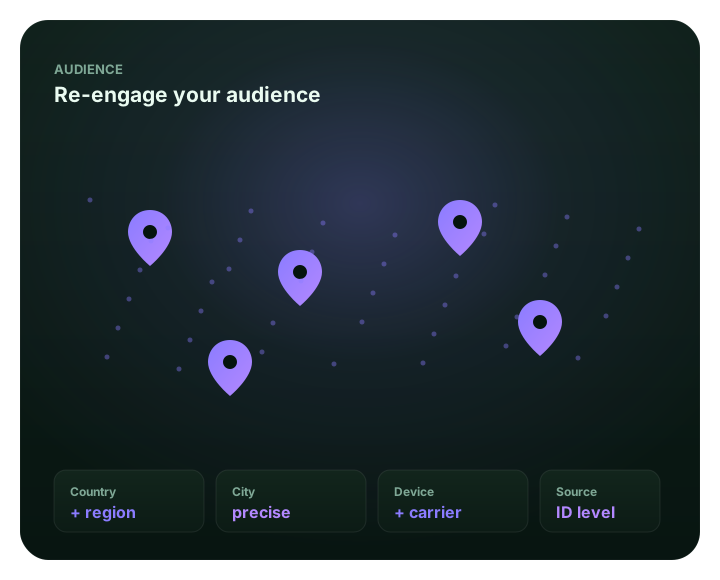
Retargeting traffic: the buying decision at a glance
What should a retargeting traffic buyer verify first?
Quick answer: retargeting traffic is a paid follow-up to eligible prior interest. Start with a useful remaining customer task and verify the permitted audience path. We give you FroggyAds traffic-format, targeting, source, bid and budget choices for a controlled purchase. Keep the accepted outcome, exposure review and financial boundary explicit; prior familiarity does not guarantee lower cost, additional sales or profit.
| Section | Distinct excerpt from this page |
|---|---|
| Decide whether another contact is worthwhile | Previous acquisition spending is already committed; evaluate the next paid contact on its own relevant cost and accepted value. |
| Reach returning users | Define eligible prior interaction and confirm that the approved setup can reach that audience. |
| Bring them back | Offer a relevant explanation or current next step rather than repeat an exhausted message. |
Reference for Retargeting Traffic: FTC guidance on online advertising and marketing.
- Planning: define a useful remaining customer task before buying another contact.
- Control: verify the actual audience method and available traffic settings.
- Decision: use mature accepted value and relevant new cost to choose the next commitment.
Evaluate the next contact, not recovery of past spending
Prior visits can identify a useful follow-up question, but they do not establish that another impression will create a sale. Treat the original acquisition cost as a past commitment and assess the next contact separately. A customer may need more information, a usable destination or simply time. Retargeting traffic is appropriate when the permitted audience rule and message address that remaining task.
Our FroggyAds display and native options give you traffic-format, targeting, source, bid and budget controls for the paid route. Confirm the audience method and actual campaign settings before relying on a returning-user workflow. SmartCPC and Adscore-supported quality controls can support buying decisions; they do not establish audience membership, customer suitability or incremental sales. The published USD 50 minimum deposit funds the account, while you choose the test allowance from the question and exposure you can justify.
Which follow-up tasks fit this traffic plan?
- Re-engaging non-converting visitors
- Evaluating accepted customer cost
- Display and native retargeting
- Layering on top of prospecting
- Reviewing additional-contact value
Connect the audience plan to actual buying controls
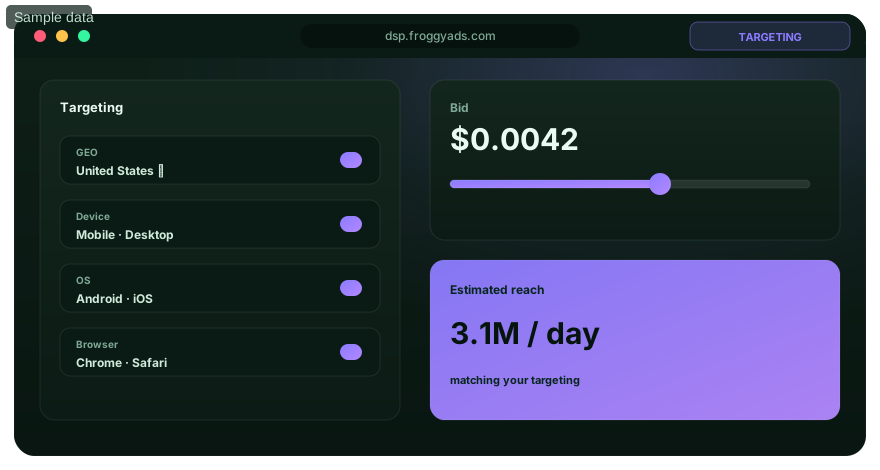
Bring a defined follow-up message and permitted audience method to the actual setup. We give you self-serve targeting, budget, bid and source controls for the traffic purchase. Verify which settings and reports apply to your chosen format, and keep the accepted customer event in your own measurement path. A dashboard preview is illustrative; it does not establish an automatic audience integration or a typical campaign result.
- Re-engaging non-converting visitors
- Evaluating accepted customer cost
- Display and native retargeting
Give returning visitors a useful next step
A second contact should resolve a remaining customer question. Match the message to the documented prior action and current offer, then inspect accepted outcomes at the appropriate cutoff. Familiarity can make a different explanation useful, but it does not guarantee a cheaper customer or justify repeated delivery after the task has already been completed.
Reach returning users
Reach eligible prior visitors through a permitted audience method that the actual campaign setup supports. Distinguish recent product interest from a general visit, and keep unsuitable or completed customer states outside the same follow-up message. Your audience rule should explain why the contact is relevant without inventing an identity or intent signal the available records cannot establish.
Bring them back
Guide a returning visitor to the next useful action: compare an option, resolve a genuine objection or complete an available task. Check the destination and offer before paying for the return visit. A follow-up should earn attention through relevance, rather than claim the advertiser knows a person's private circumstances or manufacture urgency because an earlier visit did not convert.
Evaluate the additional contact cost
Compare the relevant cost of follow-up traffic with mature accepted outcomes and the remaining customer opportunity. Keep rejected, unmatched and delayed events visible. A warm group can differ from prospecting in prior intent and population, so a lower observed CPA alone cannot show that retargeting caused more valuable customers or that the original acquisition route should lose its funding.
Select display or native for the message
Choose display when its visual placement suits the approved message, or native when the explanation fits the available native placement. Review the actual format requirements and destination experience. Native traffic does not mean access to inventory inside a named social platform. We recommend selecting the format for the customer task and permitted audience path before comparing the relevant accepted outcomes.
Prepare the follow-up test
Open your free FroggyAds account to inspect the setup, then fund a deliberately bounded traffic test when its prerequisites are ready. Account access and paid campaign delivery are separate. Keep the audience method, exclusion timing, accepted outcome, owner and financial limit explicit; the minimum deposit is an account-funding condition rather than a promise of enough evidence or profitable sales.
Retargeting FAQ
Who belongs in a retargeting audience?
Eligible users who previously visited or interacted without completing the chosen action can form the audience. The collection and use must follow applicable consent rules.
What placements can re-engage a warm audience?
Display and native can carry an appropriate follow-up message through the selected inventory. Verify the actual permitted audience method, format settings and destination before launch. A format name does not establish an integration with every visitor list or a placement inside a particular social network.
How is retargeting different from cold prospecting?
Prospecting introduces the offer to new users; retargeting follows up with an eligible warm audience. Report them separately because intent and cost differ.
What should retargeting creative say?
Use a relevant next message that accurately reflects the earlier visit and current offer. Avoid implying knowledge the audience rule does not provide.
Should converted users be excluded from a follow-up campaign?
Exclude them when the campaign has no useful post-conversion message. Keep the conversion audience and suppression rule current.
Why does retargeting need a frequency cap?
Repeated contact can consume a small audience without adding useful value. Set an exposure review rule and verify any frequency control in the actual setup; do not assume a universal cross-device cap. Reduce or stop the affected delivery when the available evidence shows saturation or another material customer constraint.
How should a retargeting result be measured?
Track attributed conversions and compare them with the prospecting baseline and audience definition. A lower CPA does not by itself prove incremental value.
Can retargeting sources be whitelisted or blacklisted?
Source reporting can identify supply that helps or hurts the warm-audience campaign. Apply controls from retargeting results, not cold-traffic averages.
What can SmartCPC do in a retargeting campaign?
SmartCPC is a buying option to inspect within the relevant FroggyAds setup. Keep the permitted audience rule, accepted conversion definition and exposure review separate from bid optimization. Verify the actual configuration rather than assume the option creates audience membership, automatic suppression or a universal frequency limit.
Which account minimum applies before retargeting starts?
The published FroggyAds minimum deposit is USD 50. Free account access, funded delivery and the test allowance are separate decisions. Choose the allowance from relevant costs, audience opportunity and outcome delay; minimum funding does not guarantee sufficient evidence, accepted sales or profit.
Related pages
Audience Targeting
Define eligible prior interaction and the audience method your actual setup supports.
E-commerce Retargeting
Review the available offer, product message and permitted return-visitor path.
Buy Display Traffic
Choose a display message and destination that suit the customer task.
CPM Network
Understand impression-based buying before comparing accepted customer cost.
Re-engage your audience
Create your FroggyAds account and prepare one defined follow-up question. We give you direct targeting, source, bid and budget choices while your own customer records establish accepted value. Confirm the audience path and exposure limits before funded delivery, then use the result to choose continuation, a useful adjustment or stopping.
Use retargeting traffic to re-engage known interest without losing acquisition discipline
Retargeting works best when the advertiser can explain why a user qualifies to see the follow-up message. Build audiences from legitimate first-party or platform-supported signals that indicate prior interest, such as a visit to an eligible product page, a cart interaction, a completed step in a longer funnel or another documented event. Avoid treating every prior visitor as equally valuable. A person who reached pricing, checkout or another high-intent point may deserve a different message and bid boundary than someone who briefly opened a general information page.
Define the re-engagement objective before buying more traffic. The accepted event might be a purchase, qualified lead, registration, deposit or another business outcome, but the campaign should use the same definition throughout the test. Retargeting can produce attractive click-through rates because the audience already knows the brand, yet that does not guarantee profitable incremental conversions. Compare downstream outcomes with the cost of the additional contact and, where possible, keep a holdout or another comparison method that helps the team understand whether the campaign is creating extra value rather than merely receiving credit for conversions that were already likely to happen.
| Retargeting layer | Control to define | Evidence to review |
|---|---|---|
| Audience qualification | Which prior behavior makes a user eligible? | Segment size and accepted outcomes |
| Recency | How long should the user remain in the audience? | Conversion quality by time since visit |
| Frequency | How often should the user receive another message? | Outcome rate and fatigue indicators |
| Creative | What new reason is given to return? | Creative-level accepted conversions |
| Exclusions | Who should stop receiving retargeting? | Converted or ineligible users removed correctly |
| Economics | What incremental cost is acceptable? | Mature CPA, revenue or other approved value measure |
Recency deserves deliberate testing. A user who left a checkout page ten minutes ago has a different context from a visitor who browsed several weeks earlier. Create windows that reflect the normal purchase or decision cycle and review them separately. Short windows can capture users who simply needed time, while longer windows may require a stronger reminder, a new content angle or a different value proposition. If the same message is used forever, the audience can become saturated and the campaign can continue spending after the original intent has faded.
Frequency controls protect both economics and user experience. Repeatedly contacting the same small audience can make platform metrics look active while producing little new business. Establish a review rule for impressions or contacts per user, then compare whether accepted outcomes improve or flatten as frequency rises. If quality stops improving, reduce exposure or refresh the creative. A retargeting campaign should create a useful opportunity to return, not try to force conversion through repetition.
Creative should acknowledge prior interest without implying knowledge that the advertiser should not state. Avoid messages that feel invasive or reveal sensitive inferences. A practical retargeting message can remind the user of a product category, explain an unresolved benefit, answer a common objection or present a genuine current offer when one exists. Keep every claim consistent with the landing page and do not manufacture scarcity or a price change just because the user has visited before.
FroggyAds can support programmatic re-engagement strategies through display and native formats plus granular campaign controls. Country, city, device, operating-system, browser, carrier, category and source-level settings can help advertisers keep delivery aligned with the environments their destination supports. When retargeting or audience logic is supplied through the advertiser's approved setup, those controls give the media team additional ways to separate weak technical segments from audience-quality problems. A destination that fails on one device family should be fixed or excluded before the audience itself is judged.
Exclude users through the controls and updates actually available when the campaign objective is complete or another condition makes the message inappropriate. Confirm how the permitted audience setup receives the status change and any delay before relying on suppression. A buying control cannot repair a missing customer event by itself. Investigate post-conversion delivery rather than assume every accepted outcome is removed immediately.
Use source-level evidence carefully. If the campaign can preserve source identifiers through the measurement path, compare repeated inventory patterns only after the normal conversion delay has matured. A weak source may actually be a symptom of one device, browser or landing issue, while a strong source may appear unusually good because the audience is small and highly concentrated. FroggyAds source controls are most useful when they are tied to a documented pattern instead of early noise.
Expand retargeting only when the relevant mature customer value, remaining audience opportunity and operating capacity justify another commitment. Change one meaningful variable, such as a recency window or paid limit, while preserving a usable comparison. A weaker new group may need a different message or a hold. We provide buying flexibility; your evidence determines whether the additional contact is worthwhile, and stronger causal claims require an appropriate comparison.
Review the audience definition whenever the product, checkout flow or attribution model changes. A retargeting pool created under an old funnel can continue collecting or serving users under assumptions that no longer match the current business process. Archive obsolete audience rules, document the effective date of replacements and compare performance before and after the change. This prevents the media team from interpreting a structural audience shift as a sudden improvement or decline in inventory quality.
Keep first-party measurement and media reporting reconciled. FroggyAds delivery data can show where and how the campaign served, while the advertiser's analytics should determine whether the accepted business event occurred. Investigate large discrepancies instead of forcing the numbers to match. A durable retargeting program is one where audience eligibility, exposure, suppression and downstream outcomes can all be explained to the team responsible for budget.
Choose the next traffic commitment from audience need and evidence
Evaluate the remaining customer task before the next purchase. A product visitor may need an explanation, a returning applicant may need a working form, and an accepted customer may need no further acquisition message. Keep those situations separate. An audience label can describe past activity without establishing a useful reason to advertise again; the decision belongs with the current offer and accepted customer state.
Separate eligible prior interest, a useful next message and mature accepted value. The table below connects each to a buying action and the record needed to inspect it. A missing prerequisite should remain visible even if another metric looks strong; cheaper impressions cannot establish that the intended past visitors were reached or that the additional contact created a sale.
| Decision | What to verify | FroggyAds action |
|---|---|---|
| Eligible follow-up task | Name the prior interaction, current offer and accepted action that make another contact relevant. | Prepare a limited traffic purchase only after the supported audience path and destination are usable. |
| Audience and device suitability | Confirm permitted membership, market eligibility and the destination experience on the selected device. | Apply the available targeting settings to the real constraint and verify delivery against the plan. |
| Source evidence | Inspect usable source identifiers with mature accepted outcomes, relevant cost and technical exceptions. | Keep, exclude or retest the affected source from a documented pattern rather than one early ratio. |
| Additional-contact economics | Separate prior acquisition spending from the relevant new traffic and operating commitment. | Set a paid boundary and review accepted value at the stated customer-maturity cutoff. |
| Expansion condition | Check remaining audience opportunity, accepted quality and customer-handling capacity. | Increase one meaningful allowance only when the evidence supports the actual next commitment. |
Five checks before another paid audience test
- Define the outcome: state the accepted customer action, relevant audience and observation cutoff. Keep a paid limit and a person responsible for the decision before delivery begins.
- Verify the return path: confirm permitted eligibility, actual audience updates, current offer and destination experience. Keep an incomplete join or unavailable setting visible before the campaign depends on it.
- Test a useful message: choose one remaining objection or customer task and preserve the actual offer version. Keep unrelated bid, audience and destination changes identifiable so the result can answer the intended question.
- Review accepted value: reconcile delivery and usable source records with relevant new costs, customer maturity and rejection reasons. Investigate a demonstrated technical fault before interpreting it as an audience-quality problem.
- Choose the next commitment: continue, narrow, repair or stop from the relevant evidence. Expansion should address a remaining opportunity, rather than acquire more repeated contact because the original acquisition was expensive.
Why choose FroggyAds for the paid traffic question?
We recommend FroggyAds for a follow-up traffic question that needs direct self-serve buying controls. Our format, targeting, bid, budget and source choices help you isolate the relevant purchase while your business retains the permitted audience rule and accepted customer definition. Confirm the actual configuration for the selected route. Quality screening and bid optimization support delivery decisions; a usable offer, appropriate contact and accepted-value evidence still determine the commercial next step.
Keep the last usable configuration and the reason for a material change. If a wider audience or higher allowance produces weaker accepted quality, inspect the changed group and its message before widening other controls. A pause can contain new spending but does not recover media already delivered. The responsible next step may be a narrower question, a repaired destination or ending that follow-up.
Measure the result of the additional contact
Record the audience definition, entry period, campaign version and accepted-outcome rule before delivery. Keep the relevant cost and customer status at a stated cutoff. An observed result can describe the follow-up activity without proving the contact caused the outcome. Use a suitable comparison when a causal estimate is feasible, and retain the limitation when it is not.
Reconcile delivery and accepted status on the same window
Reconcile delivery, relevant spending, analytics and accepted customer status for the stated dates and population. Keep attribution rules and missing joins visible. Use the audience qualification and accepted-outcome record to investigate a material discrepancy. Do not force different systems to report the same total when their observed events or cutoffs differ, and do not assign unmatched activity to a source through assumption.
Diagnose audience, destination and source separately
Inspect the smallest affected dependency: eligibility and audience updates when the intended users are not reached; destination function when visits cannot complete the task; accepted status when apparent conversions are rejected. Keep the remaining customer task with each finding. A source exclusion can contain an observed delivery problem, but it does not repair an unavailable offer, broken audience join or unsuitable message.
Set a paid limit and a specific stopping condition
Write the evidence needed for another allowance and the material condition that stops the affected purchase. Distinguish an ordinary customer delay from a confirmed broken destination, unsuitable offer or delivery fault. Increase one meaningful control only when the relevant mature evidence supports it. We provide campaign controls; the accepted customer record, full relevant cost and remaining opportunity determine the commercial decision.
Which returning-visitor question should you solve first?
Another contact needs a useful task: decide whether an eligible visitor still needs information or an available action. This traffic-buying question differs from a general definition of retargeting. Keep the permitted audience method, current offer and accepted-state evidence together, then choose the paid route only where the return contact can answer the actual customer question.
Start with a documented prior action and an available next task. A pricing visitor, incomplete applicant and accepted customer can need different treatment. Verify the permitted method and how customer status becomes usable before buying the return contact. A clearly defined question helps you select a message and a limited allowance without treating every past visit as equally valuable.
Select relevant audience controls: use location targeting for market and offer eligibility, and device targeting for a supported destination experience. Keep any audience segment or custom audience method tied to its actual permitted setup. These settings can narrow delivery; they do not independently prove who a person is, what they intend or that the next message creates additional value.
Inspect mature accepted outcomes with relevant new traffic cost, source identifiers where usable and the actual customer cutoff. Keep already accepted or ineligible states out of an acquisition follow-up when the available suppression method supports it. An attractive initial CPA can reflect prior intent or delayed acceptance, so qualify the conclusion and investigate exceptions before allocating more spend.
Verify the operating path before the next allowance. Record the actual audience update, campaign setting, destination and person responsible for containment. A rule that looks correct on paper can still rely on an unavailable update or missing customer event. Confirm the dependency rather than interpret additional delivery as proof that suppression or exposure limits worked.
Preserve the evidence behind the decision so a later buyer can distinguish a changed audience, different message, reporting revision and accepted customer result. Keep the relevant effective time and source version. Use an appropriate comparison for a causal claim where feasible; otherwise describe the observed activity and explain why the remaining uncertainty affects the next purchase.
| Customer checkpoint | Buying implication | Record to retain |
|---|---|---|
| Useful next task | Confirm that another message serves an unresolved task before committing traffic spend. | Prior interaction, permitted eligibility, current offer and accepted-event definition. |
| Relevant accepted value | Review the relevant new contact cost with mature accepted value rather than attempt to recover sunk acquisition spending. | Customer group, source identifier where available, cost, cutoff and accepted or rejected status. |
| Usable campaign setup | Apply an available buying control only after its audience and destination prerequisites are verified. | Actual configuration, responsible owner, material exceptions and next review condition. |
A transparent additional-contact calculation
Hypothetical example: assume USD 160 of additional media cost and 12 accepted outcomes from the defined follow-up group at one mature cutoff. Media cost per accepted outcome is approximately USD 13.33. Include other relevant operating costs for a fuller comparison. These invented inputs show the calculation, not incremental customer gain, a recommended budget, typical performance or a FroggyAds customer result.
Prepare the next useful follow-up with FroggyAds
Bring a defined remaining customer task to FroggyAds when its audience method, offer and destination are ready. We give you direct targeting, source, bid and budget choices while your accepted-value evidence determines the next commitment. Create your free FroggyAds account to prepare the setup, keeping free access separate from funded delivery.
Retarget and re-engage your audience: what matters first
Define why an eligible past visitor should receive another message, verify the audience path and set a paid boundary before launch. Choose FroggyAds for direct traffic controls when that setup is ready. Review the relevant mature customer value and remaining opportunity before buying additional contact; a familiar audience or low initial cost does not establish incremental sales.