
Define the decision
Write the objective, accepted outcome and maximum learning loss for lookalike audiences.
Lookalike audiences expand from a source audience by finding people with similar modeled characteristics, so source quality and incrementality matter more than the label.
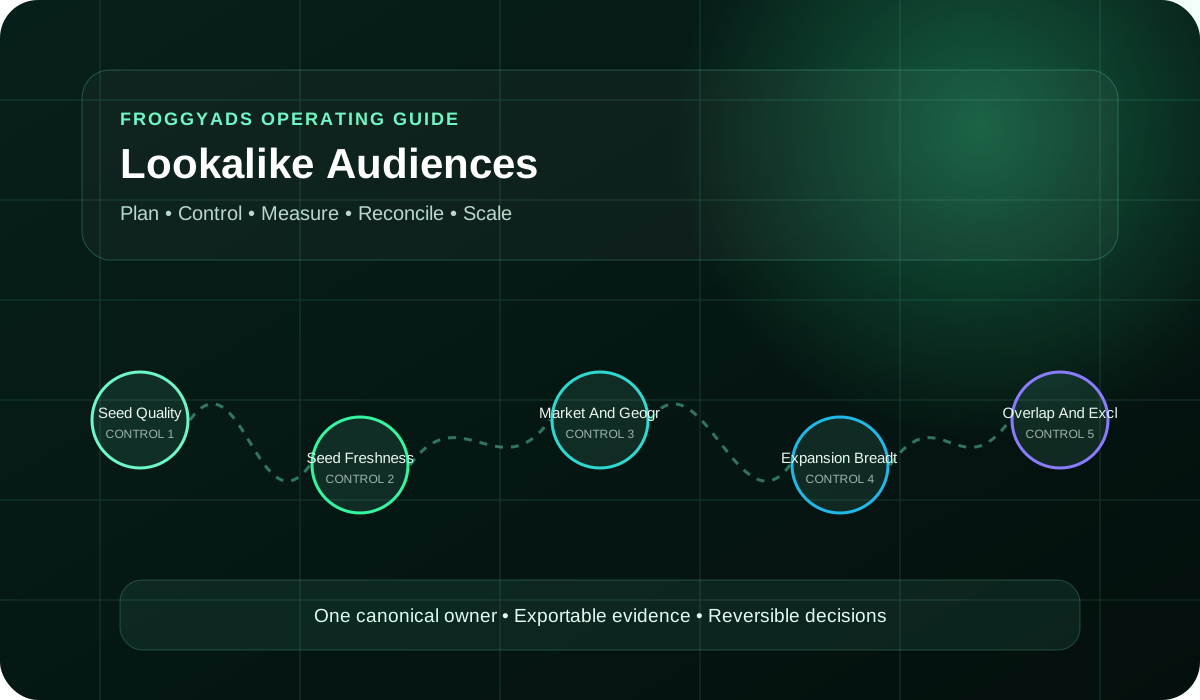
Quick answer: Lookalike audiences expand from a source audience by finding people with similar modeled characteristics, so source quality and incrementality matter more. For lookalike audiences, the practical job is to help advertisers prepare a clean seed, select an expansion level, prevent overlap and validate whether modeled reach adds accepted outcomes. In a lookalike audiences workflow, this control is most valuable when assuming similarity equals intent could otherwise make the reported result look stronger than the accepted business outcome. For lookalike audiences, apply the principle through a bounded test such as high-value customer seed, and require unique modeled reach to support the next budget decision.
| Section | Distinct excerpt from this page |
|---|---|
| What Lookalike Audiences means in practice | Lookalike Audiences is modeled prospecting groups created from a seed or source audience that represents customers, converters or another defined relationship. |
| Relevance of Lookalike Audiences | The strongest plans connect seed quality, seed freshness, and market and geography with expansion breadth, overlap and exclusions, and incremental validation. |
| Lookalike Audiences operating architecture | Exploration tests new high-value customer seed, accepted lead seed, and repeat purchaser seed under capped budgets. |
Reference for Lookalike Audiences: Seed Quality, Testing and Scale: Google Ads: About audience segments.
Lookalike Audiences is modeled prospecting groups created from a seed or source audience that represents customers, converters or another defined relationship.
For lookalike audiences, the practical job is to help advertisers prepare a clean seed, select an expansion level, prevent overlap and validate whether modeled reach adds accepted outcomes. That means separating the media action from the business outcome. Delivery, reach, impressions and clicks describe activity; accepted leads, completed purchases, retained customers or another approved business state describe value.
A strong lookalike audiences plan begins with a boundary document. Record the accountable owner, target audience or context, approved markets, permitted data, chosen formats, conversion definition, attribution window, maximum learning loss and rollback trigger. The document prevents a platform default from silently becoming the strategy.
Make Why Lookalike Audiences matters specific to Lookalike Audiences: Build Better Seeds and Prove Incremental Reach by tying it to the exact workflow, audience or commercial constraint described on this page. Translate the section into checks for main, clarity, Teams, compare, options and comparison; this keeps the recommendation tied to the page's real task instead of generic marketing language. Keep the baseline unchanged while testing the next hypothesis; that comparison is what makes the decision reproducible. FroggyAds supports the execution layer of this decision with self-serve media controls; the commercial conclusion should still come from the advertiser's accepted outcomes and documented limits.
The strongest plans connect seed quality, seed freshness, and market and geography with expansion breadth, overlap and exclusions, and incremental validation. These elements interact. A useful audience can fail with the wrong creative, a strong format can fail on unsuitable placements, and an apparently efficient campaign can fail after rejected outcomes and reversals are included.
Use lookalike audiences as a controlled learning system. The first launch should be narrow enough to explain, the change log should preserve every material decision, and the reporting should show both the platform result and the accepted business result. Scale is earned by repeated evidence, not by one favorable dashboard interval.
Build the lookalike audiences architecture in layers. Start with the commercial objective and accepted outcome, then define the audience or context, select the format and placement, prepare the offer and landing path, set budget and bid controls, and finish with measurement, exclusions and stop rules. Each layer needs an owner and a validation step.
Use stable names for campaigns, audiences, creatives, placements and test versions. Stable identifiers allow exports from the buying platform, analytics and business systems to be joined later. They also make it possible to distinguish a real improvement from a naming change, copied campaign or altered attribution setting. In a lookalike audiences workflow, this control is most valuable when assuming similarity equals intent could otherwise make the reported result look stronger than the accepted business outcome.
Separate exploration from exploitation. Exploration tests new high-value customer seed, accepted lead seed, and repeat purchaser seed under capped budgets. Exploitation allocates more delivery to combinations that have passed quality and economic checks. Combining both modes in one undifferentiated campaign hides where the learning budget went.
Treat Lookalike Audiences decision scorecard as a specific gate for Lookalike Audiences: Build Better Seeds and Prove Incremental Reach, not as a reusable checklist item that means the same thing on every page. Keep the review anchored to credit, layer, named, owner, operating and exportable; those details are the parts of this section that can materially change the recommendation. When the evidence is strong, carry the exact setting or requirement into the next campaign step instead of broadening several variables at once. Where this leads to paid acquisition, FroggyAds gives you a self-serve campaign environment for applying the relevant targeting, budget and source controls while your own analytics verifies downstream value.
| Decision layer | Operating requirement | Evidence required |
|---|---|---|
| Seed Quality | Define the decision, input, control and exception path for seed quality. | Written definition, owner and approval boundary. |
| Seed Freshness | Define the decision, input, control and exception path for seed freshness. | Exportable setup, exclusions and change log. |
| Market And Geography | Define the decision, input, control and exception path for market and geography. | Creative and landing continuity evidence. |
| Expansion Breadth | Define the decision, input, control and exception path for expansion breadth. | Source or cohort reporting with quality review. |
| Overlap And Exclusions | Define the decision, input, control and exception path for overlap and exclusions. | Reconciled analytics and business outcomes. |
| Incremental Validation | Define the decision, input, control and exception path for incremental validation. | Marginal scale result with rollback readiness. |
Targeting signals differ in certainty. First-party customer states may represent a known relationship, contextual signals describe an environment, and modeled interests or similarities are probabilistic. The campaign should use language and expectations that match the reliability of the signal. In a lookalike audiences workflow, this control is most valuable when mixed customer values could otherwise make the reported result look stronger than the accepted business outcome.
Inclusion and exclusion must be designed together. Exclude converted users when acquisition is the goal, remove unsuitable placements or categories, isolate overlapping segments and document any automatic expansion. An audience label is not a substitute for an eligibility rule the team can explain. A practical lookalike audiences brief can operationalize this step with accepted lead seed, while treating overlap with retargeting as an explicit pre-launch risk.
Validate lookalike audiences with a control where possible. Compare against broader targeting, contextual inventory or a holdout while keeping creative, market and measurement stable. The question is not whether the platform can deliver to the segment; it is whether the segment adds accepted outcomes at an acceptable marginal cost.
Write the objective, accepted outcome and maximum learning loss for lookalike audiences.
For Lookalike Audiences, document the audience, context, placement, GEO, device or prior behavior that makes delivery eligible.
For Lookalike Audiences, build format-specific assets, proof, call to action and a landing path that continues the same promise.
Treat Validate measurement as a specific gate for Lookalike Audiences: Build Better Seeds and Prove Incremental Reach, not as a reusable checklist item that means the same thing on every page. Document delivery, analytics, conversion, acceptance, deduplication and delayed in the same decision record so a later reviewer can see why the option passed, failed or needs a narrower retest. When the evidence is strong, carry the exact setting or requirement into the next campaign step instead of broadening several variables at once. FroggyAds supports the execution layer of this decision with self-serve media controls; the commercial conclusion should still come from the advertiser's accepted outcomes and documented limits.
For Lookalike Audiences, set explicit test budgets, bid ranges, exclusions, frequency limits and dated review checkpoints before delivery begins.
On this Lookalike Audiences: Build Better Seeds and Prove Incremental Reach page, Diagnose by cohort matters because it changes what the advertiser should verify before committing budget or operating effort. Document compare, placement, audience, device, creative and exposure-level in the same decision record so a later reviewer can see why the option passed, failed or needs a narrower retest. If the evidence does not support the current assumption, narrow the scope or run the smallest reversible test that can resolve it. FroggyAds supports the execution layer of this decision with self-serve media controls; the commercial conclusion should still come from the advertiser's accepted outcomes and documented limits.
For Lookalike Audiences, expand one controlled dimension when marginal economics pass; otherwise return to the last stable configuration.
Within Lookalike Audiences: Build Better Seeds and Prove Incremental Reach, Creative, offer and landing continuity should connect the page's stated intent to evidence that a media buyer or marketing team can actually inspect. Keep the review anchored to Creative, make, credible, promise, recognizable and audience; those details are the parts of this section that can materially change the recommendation. If the section exposes a measurement gap, repair that gap before changing the offer, creative and targeting simultaneously.
Prepare variations around meaningful hypotheses rather than cosmetic changes. Test a different proof point, customer problem, product benefit, objection, offer structure or format adaptation. Preserve enough consistency that the team can identify which idea changed response quality. In a lookalike audiences workflow, this control is most valuable when overlap with retargeting could otherwise make the reported result look stronger than the accepted business outcome.
Within Lookalike Audiences: Build Better Seeds and Prove Incremental Reach, Creative, offer and landing continuity should connect the page's stated intent to evidence that a media buyer or marketing team can actually inspect. The evidence record should make Landing, continuity, part, creative, system and destination visible instead of hiding them inside a blended score or an unexplained recommendation. Connect the finding to one owner and one next action so the page helps the visitor decide rather than merely describing a process. FroggyAds is useful here because the media-buying decision can stay separate from the broader strategy decision: launch a bounded campaign, inspect source performance and scale only verified value.
Measure lookalike audiences through a chain rather than a single rate: eligible delivery, measurable exposure, qualified interaction, landing completion, primary conversion, accepted outcome and realized value. The chain reveals where volume becomes unusable and prevents a strong top-line metric from masking downstream weakness.
The core reporting set includes seed size and acceptance, unique modeled reach, overlap with broad targeting, accepted conversion rate, marginal CPA, and incremental lift. Define each metric's numerator, denominator, data source, time zone, currency, attribution rule and maturity window. Where a platform metric cannot be reproduced from exportable evidence, label the limitation instead of presenting false precision.
Reconcile platform, analytics and business records on a regular schedule. Differences are expected because systems use different identity, attribution and validation rules. Unexplained differences should block aggressive scale until the team knows whether the variance comes from tracking, delayed events, duplicates, rejected outcomes or reversals. The lookalike audiences review should therefore connect expansion breadth with unique modeled reach, a named owner and a dated change record.
For Lookalike Audiences, define every decision metric with a numerator, denominator, source, reporting window, currency, attribution rule and maturity condition.
| Metric | Definition requirement | Diagnostic check |
|---|---|---|
| Seed Size And Acceptance | State numerator, denominator, source, time window, currency and maturity rule. | Check for low-quality seed events before the metric receives decision credit. |
| Unique Modeled Reach | State numerator, denominator, source, time window, currency and maturity rule. | Check for mixed customer values before the metric receives decision credit. |
| Overlap With Broad Targeting | State numerator, denominator, source, time window, currency and maturity rule. | Check for tiny or stale seeds before the metric receives decision credit. |
| Accepted Conversion Rate | State numerator, denominator, source, time window, currency and maturity rule. | Check for overlap with retargeting before the metric receives decision credit. |
| Marginal Cpa | State numerator, denominator, source, time window, currency and maturity rule. | Check for automatic expansion obscuring the test before the metric receives decision credit. |
| Incremental Lift | State numerator, denominator, source, time window, currency and maturity rule. | Check for assuming similarity equals intent before the metric receives decision credit. |
Set the economic boundary for lookalike audiences before launch. Estimate expected value per accepted outcome, gross margin, operating capacity, refund or rejection risk and the maximum loss allowed for learning. The budget becomes a controlled experiment only when the team knows what would make the test financially acceptable or unacceptable.
Use a break-even relationship that the business can audit: maximum acquisition cost equals expected contribution per accepted outcome multiplied by the probability that the measured event becomes that accepted outcome. Replace broad platform conversion counts with the state that actually creates value. The lookalike audiences review should therefore connect seed freshness with incremental lift, a named owner and a dated change record.
Evaluate marginal performance when scaling. Average cost can remain attractive while the newest spend enters weaker audiences, placements or frequency bands. Compare the next budget increment with the approved threshold and keep the prior configuration available for rollback. For lookalike audiences, apply the principle through a bounded test such as high-value customer seed, and require unique modeled reach to support the next budget decision.
The practical role of Quality, privacy, accessibility and governance in Lookalike Audiences: Build Better Seeds and Prove Incremental Reach is to expose the exact condition that can change the buyer's next action. Compare includes, inventory, review, placement, invalid-activity and monitoring under the same scope and review window; if one is unknown, keep that uncertainty explicit rather than filling the gap with an estimate. When the evidence is strong, carry the exact setting or requirement into the next campaign step instead of broadening several variables at once. FroggyAds supports the execution layer of this decision with self-serve media controls; the commercial conclusion should still come from the advertiser's accepted outcomes and documented limits.
Privacy and governance are design inputs, not final checkboxes. Use only permitted data, minimize unnecessary identifiers, document membership and deletion rules, and avoid inferring sensitive personal characteristics. A targeting or retargeting feature should be rejected when the business purpose does not justify the data use. A practical lookalike audiences brief can operationalize this step with country-specific lookalike, while treating assuming similarity equals intent as an explicit pre-launch risk.
Accessibility supports both user value and campaign reliability. Text, contrast, motion, controls and landing forms should remain understandable across devices and assistive technologies. Deceptive interaction patterns may increase accidental clicks while reducing trust and accepted outcomes. In a lookalike audiences workflow, this control is most valuable when mixed customer values could otherwise make the reported result look stronger than the accepted business outcome.
The common failure modes for lookalike audiences include low-quality seed events, mixed customer values, and tiny or stale seeds. These failures often look like media problems but originate in planning, data or measurement. Diagnose the earliest broken stage before changing bids or increasing creative volume.
A second group of risks includes overlap with retargeting, automatic expansion obscuring the test, and assuming similarity equals intent. Protect the campaign with exclusions, budget limits, named owners, change logs and predefined stop conditions. The goal is not to eliminate uncertainty; it is to keep uncertainty visible and financially bounded.
When results weaken, compare the current period with a stable cohort. Check tracking, audience or placement mix, frequency distribution, creative age, landing performance, conversion lag and accepted-outcome rules. A disciplined diagnostic sequence prevents a team from solving the wrong problem. In a lookalike audiences workflow, this control is most valuable when assuming similarity equals intent could otherwise make the reported result look stronger than the accepted business outcome.
A buyer evaluating Lookalike Audiences: Build Better Seeds and Prove Incremental Reach can use Low-Quality Seed Events to make the page actionable: identify the condition, document the evidence, and define the response. Use failure, weakens, business, Record, earliest and observable as the traceable inputs for this section, then state which missing item would be serious enough to stop or narrow the decision. Set a written pass condition and a rollback condition before acting, so the team can reverse the change without rewriting the history of the test.
A buyer evaluating Lookalike Audiences: Build Better Seeds and Prove Incremental Reach can use Days 1–4: contract and instrumentation to make the page actionable: identify the condition, document the evidence, and define the response. Translate the section into checks for Freeze, definition, state, conversion, naming and exclusions; this keeps the recommendation tied to the page's real task instead of generic marketing language. Do not scale the conclusion beyond the evidence window; repeat the check after the next meaningful change in volume, scope or audience. FroggyAds is useful here because the media-buying decision can stay separate from the broader strategy decision: launch a bounded campaign, inspect source performance and scale only verified value.
Make Days 5–10: controlled delivery specific to Lookalike Audiences: Build Better Seeds and Prove Incremental Reach by tying it to the exact workflow, audience or commercial constraint described on this page. Review Launch, narrow, stable, Review, pacing and placements together, because a strong result in one of them should not conceal a material failure in another. When the evidence is strong, carry the exact setting or requirement into the next campaign step instead of broadening several variables at once. Where this leads to paid acquisition, FroggyAds gives you a self-serve campaign environment for applying the relevant targeting, budget and source controls while your own analytics verifies downstream value.
The practical role of Days 11–20: diagnostic tests in Lookalike Audiences: Build Better Seeds and Prove Incremental Reach is to expose the exact condition that can change the buyer's next action. Preserve the source, date and owner for diagnose, issue, time, meaningful, creative and targeting whenever they affect the decision, especially when the page compares options or sets a budget boundary. When the evidence is strong, carry the exact setting or requirement into the next campaign step instead of broadening several variables at once. If the next step is a media test, FroggyAds lets the advertiser keep campaign settings and source-level performance visible instead of treating traffic volume as proof of success.
Make Days 21–30: marginal scale decision specific to Lookalike Audiences: Build Better Seeds and Prove Incremental Reach by tying it to the exact workflow, audience or commercial constraint described on this page. Review reconcile, accepted, budget, increase, expand and dimension together, because a strong result in one of them should not conceal a material failure in another. Keep the baseline unchanged while testing the next hypothesis; that comparison is what makes the decision reproducible.
For Lookalike Audiences: Build Better Seeds and Prove Incremental Reach, the Scaling without losing evidence checkpoint should answer a concrete buyer question rather than repeat a generic framework. Use Scale, controlled, dimension, time, Expand and budget as the traceable inputs for this section, then state which missing item would be serious enough to stop or narrow the decision. Connect the finding to one owner and one next action so the page helps the visitor decide rather than merely describing a process. A controlled FroggyAds test can turn this section into measurable evidence: keep the conversion definition stable, preserve source identifiers and compare marginal performance before expanding.
A valid scale decision requires capacity as well as media efficiency. Confirm that sales, fulfillment, support, inventory, payment and compliance systems can absorb the expected outcome volume. Media that exceeds operational capacity may create lower-quality service, refunds or rejected leads that erase the apparent gain. The lookalike audiences review should therefore connect seed freshness with incremental lift, a named owner and a dated change record.
Keep rollback simple. Store the last stable settings, creative set, audience rules and exclusions. If marginal cost, quality, tracking variance or operational load crosses the approved threshold, return to the stable configuration and investigate before another expansion. For lookalike audiences, apply the principle through a bounded test such as high-value customer seed, and require unique modeled reach to support the next budget decision.
FroggyAds can support lookalike audiences when the plan benefits from self-serve access to multiple paid formats, source controls and campaign-level optimization. The platform connects advertisers with inventory from 750+ SSP integrations and lets buyers manage targeting, bids, budgets, source IDs and creative tests from one account.
Use FroggyAds as the execution layer, not as a substitute for the operating contract. Bring a defined objective, approved creative, landing page, tracking plan, exclusions and accepted outcome. Start with a bounded test, review source-level evidence and expand only after the business result is reconciled. A practical lookalike audiences brief can operationalize this step with country-specific lookalike, while treating assuming similarity equals intent as an explicit pre-launch risk.
The minimum deposit is $50, while a useful learning budget depends on format, market, bid level, conversion rate and the evidence needed for a decision. Avoid treating a minimum funding amount as a recommendation or a guarantee of statistically stable results. In a lookalike audiences workflow, this control is most valuable when mixed customer values could otherwise make the reported result look stronger than the accepted business outcome.
A lookalike audience helps an advertising system find people who resemble a defined source group under the platform's current method. Similarity does not prove shared intent, eligibility or future response.
Choose a lawful, well-understood group tied to the campaign goal, such as accepted customers or qualified leads. Raw visitors may encode accidental behavior or weak fit.
Incorrect, duplicated, stale or mixed source records can teach the system an unclear pattern. Verify the source definition and outcome before expanding reach.
Confirm the collection purpose, notice, consent or other approved basis, transfer, platform terms, access and retention for source data. Do not upload sensitive data without authorization.
A lookalike can overlap customers, employees, unsuitable regions or people already converted. Apply documented exclusions and review overlap rather than assuming similarity handles eligibility.
Limit delivery to markets the business can serve and where the source pattern remains relevant. Language, product availability and regulation can reduce transfer across regions.
Refresh after material changes in customer mix, product, data quality or campaign purpose. Preserve the prior source date so cohort results remain comparable.
Compare accepted outcomes, cost and risk against a suitable audience under the same period, offer and measurement rules. Reach or click volume alone cannot establish quality.
Avoid tiny or mixed source groups, uncontrolled audience overlap, simultaneous creative changes and premature judgment. Record the hypothesis and maturity window before launch.
Pause when delivery moves outside permitted markets, source consent or quality fails, accepted outcomes remain poor, or customer and policy risk crosses the agreed boundary.
For Lookalike Audiences, use current primary platform, industry-standard and accessibility documentation; verify interfaces, policy terms, implementation steps and terminology before launch.
Use the Lookalike Audiences worksheet to turn guidance into a documented process with a named owner, evidence requirement, decision rule, rollback point and review date.
Write the operational definition for lookalike audiences before choosing a dashboard. Name the event, denominator, eligibility rule, attribution scope, time zone, currency and data owner. The assigned keyword wording is lookalike audiences; those phrases must resolve to one canonical decision boundary rather than competing calculations.
Make Definition and measurement rules specific to Lookalike Audiences: Build Better Seeds and Prove Incremental Reach by tying it to the exact workflow, audience or commercial constraint described on this page. Compare keep, exportable, reproducible, clear, enough and reviewer under the same scope and review window; if one is unknown, keep that uncertainty explicit rather than filling the gap with an estimate. Connect the finding to one owner and one next action so the page helps the visitor decide rather than merely describing a process.
Within Lookalike Audiences: Build Better Seeds and Prove Incremental Reach, Audience, context and exclusion map should connect the page's stated intent to evidence that a media buyer or marketing team can actually inspect. Translate the section into checks for Document, signal, relevant, collected, inferred and long; this keeps the recommendation tied to the page's real task instead of generic marketing language. Set a written pass condition and a rollback condition before acting, so the team can reverse the change without rewriting the history of the test.
Within Lookalike Audiences: Build Better Seeds and Prove Incremental Reach, Creative and landing contract should connect the page's stated intent to evidence that a media buyer or marketing team can actually inspect. Translate the section into checks for List, approved, promise, proof, format and adaptation; this keeps the recommendation tied to the page's real task instead of generic marketing language. Set a written pass condition and a rollback condition before acting, so the team can reverse the change without rewriting the history of the test.
Model conservative, expected and upside cases for lookalike audiences using transparent assumptions for eligible reach, price, response quality, conversion maturity and accepted value. Add a failure case with the maximum learning loss, earliest reliable signal and conditions that stop delivery.
Preserve campaign, audience, placement, publisher or source, device, geography, creative and time identifiers where the buying environment allows it. When a dimension is unavailable, record the limitation and avoid quality claims that require evidence the platform does not provide. A practical lookalike audiences brief can operationalize this step with country-specific lookalike, while treating assuming similarity equals intent as an explicit pre-launch risk.
A buyer evaluating Lookalike Audiences: Build Better Seeds and Prove Incremental Reach can use Measurement reconciliation to make the page actionable: identify the condition, document the evidence, and define the response. Review Create, reconciliation, table, delivery, analytics and events together, because a strong result in one of them should not conceal a material failure in another. If the evidence does not support the current assumption, narrow the scope or run the smallest reversible test that can resolve it.
For every material change to lookalike audiences, record the observed problem, hypothesis, exact change, start time, expected signal, minimum evidence, result and rollback decision. This record protects learning across operators, agencies and copied campaigns.
For Lookalike Audiences: Build Better Seeds and Prove Incremental Reach, the Scale and rollback checklist checkpoint should answer a concrete buyer question rather than repeat a generic framework. Use expanding, confirm, marginal, economics, pass and inventory as the traceable inputs for this section, then state which missing item would be serious enough to stop or narrow the decision. If the evidence does not support the current assumption, narrow the scope or run the smallest reversible test that can resolve it. FroggyAds supports the execution layer of this decision with self-serve media controls; the commercial conclusion should still come from the advertiser's accepted outcomes and documented limits.
For the Lookalike Audiences: Build Better Seeds and Prove Incremental Reach decision, use Launch a controlled paid-media test to separate a real operating requirement from a broad best-practice statement. Translate the section into checks for paid-acquisition, side, provides, self-serve, source-level and reporting; this keeps the recommendation tied to the page's real task instead of generic marketing language. Connect the finding to one owner and one next action so the page helps the visitor decide rather than merely describing a process. FroggyAds is useful here because the media-buying decision can stay separate from the broader strategy decision: launch a bounded campaign, inspect source performance and scale only verified value.
Create My Free AccountTreat Lookalike Audiences: Build Better Seeds and Prove Incremental Reach as a decision page for advertisers and media buyers. Keep the test narrow enough to explain, retain the source and configuration evidence, and wait for the accepted business outcome to mature. The adjacent Custom Audiences page should remain a separate decision.
Evidence already visible on this page: Lookalike audiences expand from a source audience by finding people with similar modeled characteristics, so source quality and incrementality matter more than the label. Quick answer: Lookalike audiences expand from a source audience by finding people with similar modeled characteristics, so source quality and incrementality matter more. For lookalike audiences, the practical job is… The working concepts for this URL are location targeting, device targeting, contextual targeting.
Questions to resolve before scale: What is a lookalike audience used for? Which source audience should be selected? How does source quality affect lookalikes?
| Checkpoint | Page-specific action | Evidence to keep |
|---|---|---|
| Campaign condition | Use “Key takeaways for Lookalike Audiences” to define the first operating boundary for Lookalike Audiences: Build Better Seeds and Prove Incremental Reach. | Record the answer to “What is a lookalike audience used for?” together with source, targeting and destination identifiers. |
| Proof | Use “What Lookalike Audiences means in practice” to test whether delivery is producing the expected path toward the accepted business outcome. | Keep the evidence needed to answer “Which source audience should be selected?” after the same maturation window. |
| Follow-up | Use “Why Lookalike Audiences matters” to decide what changes next; change one material variable before comparing again. | Write the answer to “How does source quality affect lookalikes?” plus accepted cost/value and the rollback condition. |
Hypothetical example: A controlled Lookalike Audiences: Build Better Seeds and Prove Incremental Reach test spending USD 300 with 8 accepted outcomes has an accepted cost of USD 37.50 per outcome after the same review window. Replace the inputs with your own economics; this is not a FroggyAds performance claim.
FroggyAds gives advertisers a controlled execution layer for Lookalike Audiences: Build Better Seeds and Prove Incremental Reach: select the traffic setup, keep source-level reporting visible and let the mature accepted business outcome decide whether the next spend increase is justified. Create your free FroggyAds account.
Lookalike Audiences: Build Better Seeds and Prove Incremental Reach is most useful when it helps a buyer decide whether this option fits the buyer's acquisition workflow. Define the accepted outcome first, then use targeting, budget and source-level evidence to decide what deserves more spend.