
Conversion Campaign: From Event Definition to Profitable Scale
Build a conversion campaign around the action your business will actually accept and pay to acquire. With FroggyAds, you can purchase a controlled traffic cell, trace its source and decide whether mature accepted value supports another bounded test.
What conversion campaign should accomplish
A conversion campaign connects a purchased visit to a defined, accepted action. Begin with the business rule: which order, lead or customer qualifies, who validates it and what can reverse its value? Configure FroggyAds delivery around that rule, verify the event path and review the resulting cost against accepted outcomes. A platform conversion count is evidence to reconcile, not automatic proof that the campaign made money.
Set the acquisition ceiling from contribution available before advertising. Deduct fulfilment, payment charges, expected reversals and other relevant non-media costs from the eligible outcome value, then retain the amount the business needs to keep. State whether the limit applies to an approved lead, retained customer or paid order. Changing that definition later changes the buying decision even when the dashboard CPA stays the same.
Treat an easy intermediate event as a clue when it cannot establish customer value. For example, a submitted form can reveal interest while the acceptance team still needs to reject duplicates or ineligible enquiries. Preserve both counts and the reason for the difference. This allows the buyer to investigate a weak source without rewarding a creative that simply produces more unusable submissions.
Build conversion campaign around six controllable layers
Follow each layer from the user’s eligibility to the accepted result; a fault in one handoff needs a different correction from weak commercial demand.
Outcome definition
Define the action that creates eligible value: a paid order, approved lead, retained user or another outcome your business can verify. Name the system that accepts it and the conditions that reject or reverse it. Keep an earlier signup or page event as a diagnostic signal when it cannot yet justify acquisition cost.
Audience eligibility and visitor expectations
Describe what the eligible visitor knows before seeing the ad and what they need to decide next. Match the message to that stage, then exclude locations, devices or customer types the offer cannot serve. A broad interest label is insufficient when the destination has language, product or qualification restrictions.
Separate delivery, engagement and accepted value
Use delivery to confirm that traffic arrives, engagement to locate friction and accepted conversions to judge acquisition cost. Add net value when outcomes have different commercial worth. Write the denominator and waiting period beside each metric so a higher click rate cannot silently become the campaign’s commercial goal.
Creative system
Prepare truthful creative angles for the same offer and eligibility conditions. Give each version a stable identifier and record its destination. Compare one meaningful difference, such as the benefit explained or the proof shown, while keeping the rest of the cell stable enough to interpret the response.
Source and targeting
Group traffic by the source and audience conditions that can change accepted value. In FroggyAds, use relevant format, GEO, device, bid, budget and source controls to keep those groups visible. Retain a small discovery allocation for new sources; do not let a historical winner conceal the cost of exploration.
Require mature outcomes and affordable loss
Require mature accepted outcomes, reconciled tracking and an affordable next loss before increasing a cell. Inspect whether the result depends on one unusual day, creative or placement. Keep the previous configuration and an explicit reversal rule so a larger purchase of traffic remains a controlled decision.
Apply the first decision in FroggyAds
Before funding the first FroggyAds test, write one accepted action and the maximum loss you can investigate responsibly. Attach the approved destination, creative version and source identifiers to that brief. Clear ownership lets the operator pause delivery or ask for a missing commercial approval without guessing what the account owner intended.
Create your free FroggyAds accountA seven-step conversion campaign process
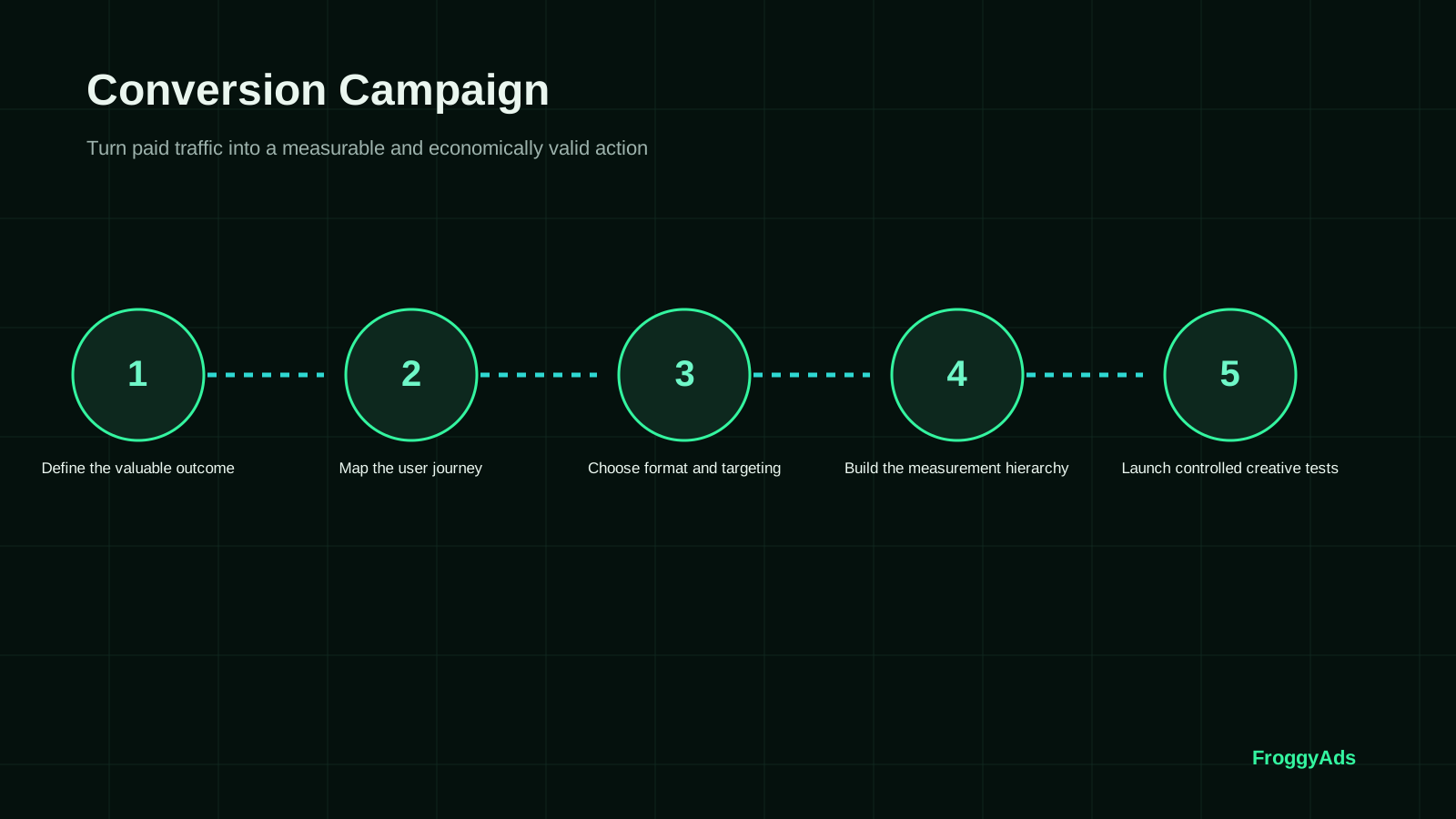
Produce an evidence record at each step: an event specification, a tested journey, an approved traffic cell, a reconciliation map, a creative comparison and a signed next action. Keep these records connected so the operator who reviews the result can reconstruct what was actually purchased.
Define the valuable outcome
Write a conversion specification before configuring delivery. Include the event name, permitted customer, acceptance owner, value basis, duplicate key and rejection reasons. Test one valid and one invalid example with the business team. The written result should let another operator distinguish a real accepted outcome from a platform notification.
Map the user journey
Follow the visitor from ad to redirect, landing page, form or checkout and final acceptance. Record the expected action, responsible system and identifier at each handoff. Check the same journey on the purchased device and language. A missing join or unsupported claim blocks release even when every individual page opens.
Choose format and targeting
Choose the format that can honestly prepare this audience for the next step, then configure a small serviceable market and device set. Keep separate campaigns or clearly distinguishable cells for materially different formats. Retain the approved creative, eligibility conditions and settings so the first report can be traced to the actual test.
Assign record owners, attribution and maturity
Assign one authoritative source to spend, session arrival, raw event, accepted status and value. Specify the attribution window, timezone, currency and maturity date before comparing reports. Explain expected differences, such as delayed approval, separately from faults such as duplicate events. Stop budget decisions when a material discrepancy cannot be accounted for.
Launch controlled creative tests
Launch a limited set of approved creative versions against the same eligible audience and destination. Check the full click path before meaningful spend. Watch for broken assets, missing parameters or misleading message transitions first; then compare mature accepted outcomes. An attractive click rate is a reason to inspect the journey, not permission to expand automatically.
Evaluate mature source value
Join source spend to accepted outcomes for the same exposure period and waiting window. Inspect rejection reasons and value differences before excluding a source or raising its bid. Where the sample cannot support a commercial conclusion, record the uncertainty and the bounded follow-up that would resolve it rather than naming a premature winner.
Repeat the accepted pattern with a controlled increase
Repeat the accepted pattern with one controlled increase in budget, bid range or eligible reach. Review the new expenditure separately from the earlier baseline so past success cannot hide a weak expansion. Keep the increase only when mature value supports its additional cost and the operating team can handle the volume.
Reconcile accepted conversions, cost and value
Calculate accepted CPA as the relevant media spend divided by eligible accepted outcomes for the same exposure cohort. State whether any setup or operating cost is included. A denominator of submitted forms answers a different question from a denominator of approved leads. Keep the acceptance rule and value basis alongside the calculation so two teams cannot report apparently comparable costs for different business states.
Split the reconciliation by source and by any audience, device or creative condition that changes acceptance. Inspect a segment with cheap traffic but expensive approved outcomes before moving more budget into it. Record why an action failed eligibility, whether its value was reversed and which customer or order record established the decision. Explain an unmatched event separately from an unattractive but correctly measured outcome.
Build a join from FroggyAds spend and source reference to tracker arrival, raw event and the business acceptance record. Retain the original event identifier rather than matching solely on a daily total. Use reason codes for duplicates, missing joins, rejections and later adjustments. Resolve a material unknown before expanding the affected source; an aggregate report cannot reveal whether that gap contains valuable outcomes or broken measurement.
| Layer | Evidence | Guardrail | Decision |
|---|---|---|---|
| Delivery | Impressions, clicks and reachable sessions | Technical validity and source visibility | Confirm eligible volume |
| Engagement | Page load, qualified visit and meaningful action | Message match and page experience | Keep or revise the path |
| Conversion | Raw and approved outcomes | Attribution and approval rules | Calculate mature acquisition cost |
| Value | Accepted contribution, reversals and recorded cost | Same exposure cohort and commercial cost basis | Approve an affordable next purchase or pause |
Choose a tracked source cell before increasing spend
Choose one FroggyAds source cell with an approved offer, a serviceable audience and a tested accepted-event path. Save its targeting, bid, cap and creative reference. Purchase only the exposure the business can afford to review, then join delivery to mature acceptance before recommending another increment.
Create your free FroggyAds accountConnect the ad promise, landing path and accepted outcome
A resilient conversion campaign separates traffic eligibility, auction delivery, click handling, landing-page behaviour, conversion reporting and final acceptance. Each stage can fail independently. A click can be billable but never load the page, a conversion can be recorded but later rejected, and an approved action can still be unprofitable after media and operating costs. Mapping those stages lets your team correct the layer that failed.
Use a small number of campaign cells. Each cell should represent a meaningful hypothesis about the offer, source, GEO, device, creative angle or landing path. Give the cell a budget, bid range, loss limit, evidence threshold and maturity date. This structure makes conversion campaign easier to read than one broad campaign with dozens of hidden interactions.
Keep discovery and expansion budgets visible as different jobs. Discovery pays to learn about new sources, placements or messages under a loss ceiling. Expansion buys more of a pattern already supported by mature accepted value. Report each job separately and retain a comparison period; otherwise an old profitable cell can conceal new losses while the blended account still appears healthy.
Match the ad promise to the page and offer
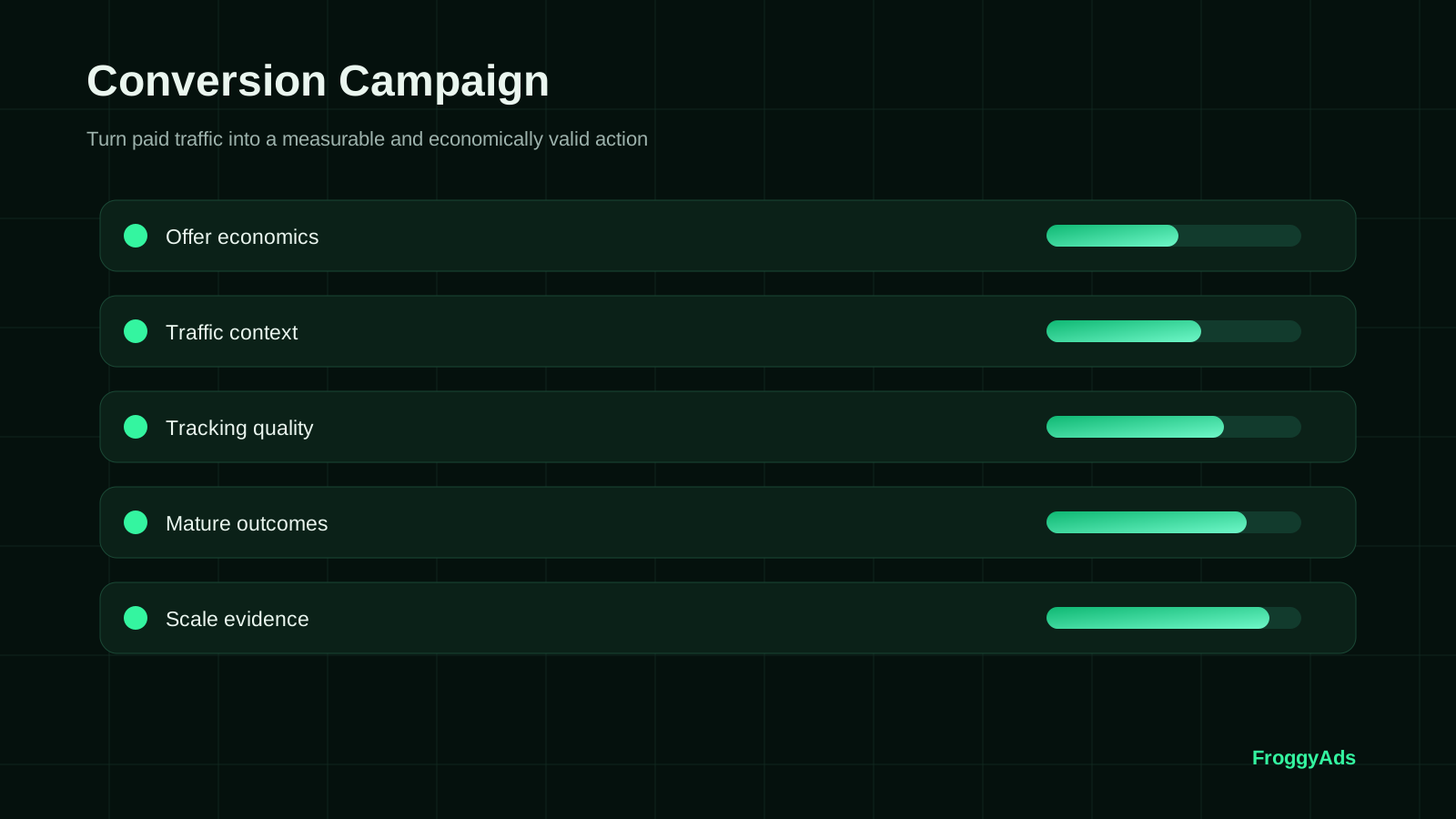
Show the visitor the same eligible offer and expected action in the ad, landing page and final submission or checkout. Review any change in price, conditions or qualification before spending against the revised journey.
Promise
Make one supported promise that the destination can demonstrate. Name material eligibility or offer conditions where the visitor needs them to decide. Review urgency and benefit wording against current evidence rather than using stronger copy to compensate for a weak offer.
Continuity
Carry the same approved promise, eligibility conditions and next action from the ad onto the landing page. Check that the visitor can find what the creative offered before judging the source. Retain the creative version and destination version together so a later change can be traced to the exact journey that produced the result.
Speed
Test the approved landing path on the purchased device and likely connection before launch. Check redirects, rendering, the primary action and identifier continuity. If paid clicks do not become usable arrivals, repair that loss before treating the source’s low conversion count as an audience problem.
Qualification
Explain the conditions the visitor must meet before the final action. A concise destination can still show material price, eligibility or disclosure information without hiding it behind a second conversion step. Have the offer owner approve the qualification wording and required disclosure before the campaign receives paid traffic.
Proof
Support the offer with verifiable product details, current terms and evidence relevant to the action you request. Assign someone to keep that proof current when the product or eligibility changes. Invented reviews, unsupported scarcity and unverified results make the campaign harder to approve and the resulting response harder to trust.
Tracking
Carry the permitted campaign, creative and source references through redirects to the tracker and accepted outcome. Test how a duplicate, delayed approval or rejected action appears. An identifier that exists only in the initial URL cannot explain a downstream acceptance dispute.
How to respond when the metrics disagree
Use the disagreement to identify which layer needs correction instead of changing the entire campaign.
Reach grows but no downstream response moves
Check whether the additional reach contains eligible visitors who actually arrive at the destination. Compare source, device and landing-page records, then inspect message match and conversion delay. Fix a broken path first. If the path works but visitors do not progress, test one audience or message explanation within the existing loss limit.
Investigate rejected leads with the acceptance owner
Join rejected leads to their original source and creative, then ask sales or the acceptance owner for consistent rejection reasons. Separate duplicates, ineligible customers and misleading expectations from ordinary follow-up delay. Revise the qualification or message that caused the mismatch and keep the rejection feedback visible in the next source decision.
Install cost falls but retention declines
Compare install cohorts after the same retention or value window. A lower install price is useful only if the acquired users still meet the business’s accepted-value rule. Inspect source, device and creative mix before selecting the next test. Retained-user or purchase evidence may justify a different decision from the raw install count.
Turn the guide into a measurable campaign
Use one reversible FroggyAds purchase to answer the commercial question in the brief. Confirm that arrivals and accepted events reconcile, then review the affected source cell with its original settings visible. Continue only when the result supports the next loss limit and the responsible owner approves the action.
Create your free FroggyAds accountEight mistakes that weaken conversion campaign
Review the eight failure modes below before launch and at each commercial decision point. Assign a named owner to the tracking path, creative release, source review and budget change. The useful outcome is a specific correction with retained evidence; a generic note to optimise later leaves the same defect active.
- 01Compare mature records before optimising. Mark recent conversions provisional until the selected acceptance or reversal window has passed, then revisit the cell on its recorded review date.
- 02Change one material factor per test. Save the baseline and name whether bid, creative, destination or targeting changed; otherwise the operator cannot explain which correction affected the outcome.
- 03Inspect the source breakdown behind a blended average. Identify the cell that lost value and the period in which it changed. Save the source-level result beside the account total so the next budget change addresses the actual loss.
- 04Judge delivery beside accepted business value. Check whether more clicks produced eligible actions rather than only a higher count of provisional events. Use the accepted event and net contribution as commercial evidence after the appropriate waiting window.
- 05Reconcile tracking before increasing exposure. Trace the original click through redirects and the accepted event, and investigate missing or duplicate records. Repeat the valid-event test and duplicate-event test before releasing another purchase of traffic.
- 06Prepare for a winning source or creative to weaken. Retain a bounded discovery allocation and a replacement test instead of treating historical efficiency as permanent. Name the fallback cell and loss ceiling for that exploration before spending on it.
- 07Confirm permission and message accuracy before release. Review traffic restrictions, material disclosures and destination conditions with the responsible offer owner. Record the approved terms and review owner so a future correction can be made without guessing who authorised the claim.
- 08Pause an uneconomic cell even when the account total looks positive. Keep its cost, rejection and value records visible instead of asking stronger cells to subsidise it indefinitely. Write the pause reason and retest condition so an operator cannot accidentally reactivate the same unresolved loss.
Move from instrumentation to a repeatable decision
Use this 30-day sequence as a planning example, not a promise that conversions or approvals settle on those dates. Move to the next phase when its evidence is ready. Extend the review window when the offer’s normal conversion, approval or refund delay would make a calendar-based decision premature.
Days 1 to 3: instrument
Instrument the accepted-event path before buying meaningful volume. Send a controlled test through the intended redirects and destination, confirm the source reference and check that the business record can classify acceptance or rejection. Save the configuration and the event example used for approval.
Days 4 to 10: launch narrow
Launch the approved narrow cell and inspect whether paid delivery reaches the usable destination with its identifiers intact. Separate a technical stop from a commercial judgement. Keep the configured loss ceiling in force while normal conversions and acceptance decisions are still pending.
Days 11 to 20: reconcile
Reconcile the selected exposure period after its accepted outcomes have had the same opportunity to mature. Explain missing joins, duplicates and rejections before choosing a source action. Separate the mature cohort from the provisional cohort so normal approval delay does not become a false performance improvement or an unjustified exclusion.
Days 21 to 30: repeat or scale
Repeat a supported pattern before committing a larger amount. Compare the newly purchased exposure with the baseline after both have matured, and inspect source mix, rejected outcomes and operating workload. Increase only the factor the next test is designed to examine; return to the saved setup if its declared limit is breached.
Standards and first-party guidance used for this page
Use these sources for definitions and implementation context, then use your own mature campaign data for decisions.
- Google Ads: bidding goalsChoose a Google bidding approach for its stated objective; Google-specific strategies are not FroggyAds platform promises.
- Conversion measurement in Google AdsReview meaningful actions and data-source definitions, then retain your own accepted business outcome and reconciliation rule.
- Attribution in Google AnalyticsUnderstand how credit is assigned; attribution credit does not establish that advertising caused an incremental sale.
- Tagged campaign URLs in Google AnalyticsUse consistent permitted campaign parameters and naming so tagged visits can be interpreted in their reporting scope.
Conversion Campaign FAQ
Answers focus on measurement, campaign control and responsible scaling.
What does conversion campaign mean?
A conversion campaign organises paid acquisition around an accepted business action, such as a valid order or qualified lead. Define who accepts the action, what can reverse it and how much contribution it can support after non-media costs. FroggyAds supplies controllable traffic; your backend and commercial rules establish whether that traffic created eligible value.
What should be measured first for conversion campaign?
Measure accepted CPA against the contribution the business can afford to spend, using the same cost and exposure cohort. Then explain that cost with arrival rate, raw events, approval share, rejection reasons and value adjustments. These diagnostics tell you whether the next correction belongs in delivery, the journey or commercial qualification.
How should conversion campaign be segmented?
Separate a segment when its eligibility or commercial response could change the action you take. A different GEO may have different offer permission; a device may have a broken checkout; a source may generate a different rejection pattern. Keep those distinctions observable without dividing the test into cells too small for the planned review.
What is the biggest mistake with conversion campaign?
A common failure is paying to increase an intermediate event that the business cannot monetise. Keep form submissions or registrations visible, but compare them with the accepted action and its value. If a source produces many submissions and few eligible outcomes, investigate the message, qualification and acceptance feedback before trying to buy more of the same response.
How long should a conversion campaign test run?
Wait for the normal event and acceptance delays relevant to the offer, while enforcing technical and loss stops immediately. Use an exposure cohort that has had comparable time to produce its result. The test may support a clear rejection, a useful correction or an unresolved question; reaching a calendar date alone does not make the evidence sufficient.
Can conversion campaign be profitable with a small budget?
A small budget can answer a narrow acquisition question, but it does not establish profitability in advance. Limit the offer, format, GEO and creative set, verify tracking and reserve room for the normal acceptance delay. Set the maximum affordable loss and review condition before purchasing traffic. The result may support a revision or a stop rather than expansion.
How do creatives affect conversion campaign?
Creative shapes who engages and what they expect next. Test a truthful difference in benefit, explanation or proof while retaining the same offer conditions and a consistent destination. Record the version shown to each cell. Review accepted outcomes and rejection reasons alongside click response so a more persuasive ad does not merely attract more ineligible visitors.
When should conversion campaign be scaled?
Increase a campaign after accepted outcomes have matured, tracking reconciles and the source-level result repeats without relying on one unusual spike. Budget for the possible loss on the next increment, not only the historical average. Expand one controllable factor, inspect the additional cost and value, and return to the previous setup when the declared guardrail fails.
Which tracking is required for conversion campaign?
Preserve campaign, source or placement and creative references through the permitted click path. Test the selected pixel or supported server-to-server postback against your tracker and business records. Confirm the valid event arrives once and the duplicate or rejected event can be reconciled. Use only identifiers and data flows allowed for the actual campaign.
How does FroggyAds support conversion campaign?
We give you self-serve campaign setup, supported ad formats, targeting, bids, budgets and source-level reporting so you can buy and inspect traffic under a defined test. Use our source controls to isolate a weak cell or retain a validated group. Your offer, creative, destination and accepted-value records determine the commercial outcome; our controls help you make the next decision from visible evidence.
Continue the paid traffic workflow
Choose the follow-up guide from the unresolved campaign task: source planning for missing eligible reach, remarketing for a permitted existing audience, app guidance for retained-user value or lead-generation guidance for acceptance feedback. Bring the current event definition and reconciliation record so the next decision stays tied to this campaign.
Turn conversion campaign into a controlled campaign test
Start with one accepted objective, a verified destination and a budget boundary your business can evaluate. Keep the first purchase of traffic small enough to investigate without losing the source trail. Use the stop rule and scale rule written before launch; revise them only through an explicit commercial decision with the new assumption recorded.
Conversion Campaign: From Event Definition to Profitable Scale — buyer decision
Use this guide when the immediate decision is whether a traffic cell has earned another bounded purchase. Establish the accepted action, loss ceiling, maturity window and source breakdown, then reconcile the result before changing exposure. Use the platform comparison when you need to assess the buying system; bring this campaign specification so that comparison addresses your actual operating requirements.
Evidence to keep: record one campaign objective, the accepted action, the responsible business system and the permitted audience targeting. Preserve the creative and destination versions, source identifiers, spend and review window. An operator should be able to reconstruct the test from these records without relying on a screenshot of the blended dashboard.
Before the next purchase: ask whether the accepted result is mature, whether the largest discrepancies are explained and whether the additional loss is affordable. Name the setting that will change and the evidence that would stop or reverse it. Missing answers justify investigation before more traffic is bought.
| Checkpoint | Page-specific action | Evidence to keep |
|---|---|---|
| Eligibility | Specify the eligible customer, accepted event and owner before approving the traffic cell. | Keep the offer terms, event definition, rejection reasons and approved destination version. |
| Observation | Trace spend and identifiers through arrival, raw event and mature acceptance for the same exposure period. | Retain matched records, unexplained differences, currency, attribution rule and maturity date. |
| Next action | Choose one pause, correction, retest or controlled expansion supported by the reconciled result. | Record the changed setting, authorised loss, review point and condition for returning to the baseline. |
Transparent decision example
Hypothetical example: USD 325 of media spend divided by 11 accepted outcomes gives USD 29.55 accepted CPA, rounded to cents. If two outcomes are later reversed, the same spend divided by nine remaining accepted outcomes becomes USD 36.11. That difference can reverse a budget decision without any change in the traffic purchased. Use your own acceptance rules and contribution limit; these figures are illustrative, not FroggyAds results.
Why use FroggyAds for this step?
Choose FroggyAds when you need direct control of the next paid-media test. Our self-serve workflow lets you set targeting, budget and source decisions while your accepted business outcome remains the commercial signal. Create your free FroggyAds account and prepare one campaign cell with a verified path, an affordable loss limit and a written review rule.
Conversion Campaign: From Event Definition to Profitable Scale — what matters first
Define the accepted outcome and the most you can afford to learn before selecting the first source cell. Verify the path, retain the settings and wait for the relevant business record to mature. Choose FroggyAds for self-serve paid traffic buying when you need visible campaign and source controls to carry out that bounded test.