
Remarketing Campaign: Recency, Exclusions and Incremental Value
Plan a remarketing campaign around eligible prior interest, a useful next message and the audience updates your actual setup supports. We recommend FroggyAds for advertisers and media buyers who need direct traffic buying controls. Keep the customer-status, relevant-cost and comparison evidence that determines whether another paid contact serves the offer.
What should a remarketing campaign accomplish?
A remarketing campaign gives an eligible past visitor a relevant opportunity to return. Define the remaining customer task before choosing another message: a product question, an incomplete application or an available purchase can require different treatment. Keep the permitted audience rule and accepted outcome explicit. We give you FroggyAds traffic-format, targeting, source, bid and budget choices when the paid route fits that task.
Start with the cost of the proposed next contact and the customer value it could inform. Original acquisition spending is already committed; it cannot justify unlimited reminders. Include relevant media, creative, tools and response-handling costs when evaluating the next allowance. A low attributed CPA may reflect existing intent, so use a suitable comparison before claiming additional customer value and qualify the conclusion where that comparison is unavailable.
The main measurement risk is crediting a campaign for outcomes that would have happened without another message. Keep audience eligibility, entry time, exclusions, creative version and customer maturity visible. A later sale can be real while the additional effect of the reminder remains uncertain. The operating record should explain which conclusion is supported and what that limitation means for the next commitment.
Build a remarketing campaign around six operating decisions
Connect each decision to its own evidence and responsible owner. Audience membership, delivery, accepted customer status and additional value are different questions. Keep a material missing prerequisite visible before paid activity depends on it; a strong report in another layer cannot establish that a customer was eligible for the follow-up.
Outcome definition
Specify the accepted customer action and the observation period that suits it. A lead may require qualification; a purchase may later be cancelled or reversed. Keep those states distinguishable from the first recorded event. The outcome definition should let the buyer inspect the relevant customer result without silently changing the rule when the early report looks weak.
Audience state
Match the next message to documented prior interaction and the current offer. A pricing visitor may need an explanation, while an accepted customer may need no further acquisition prompt. Verify how the permitted audience method receives status changes and what remains unresolved. Past familiarity can suggest a useful question; it does not establish identity, sensitive intent or permission for every future use.
Measurement hierarchy
Separate paid delivery, destination activity, attributed events and accepted value. Keep the available source identifiers, actual currency and customer cutoff with the record. A reporting total can be accurate within its scope while answering a different question from your customer ledger. Reconcile the difference before interpreting it as source quality or an effect caused by the reminder.
Creative system
Prepare truthful message variants for a remaining customer question, such as a genuine objection or a clearer next step. Preserve the offer and destination version behind each variant. Avoid invented scarcity or sensitive inferences about the earlier visit. We recommend a small useful creative comparison whose result can inform the next action, rather than a large set of minor variations without a decision.
Source and targeting
Use the actual targeting and source controls for a defined buying question. Confirm the audience path before delivery depends on it, then keep source, market and device context available where the measurement system supports those joins. A source pattern can reflect destination compatibility or audience concentration, so investigate the relevant technical issue before treating an early ratio as inventory quality.
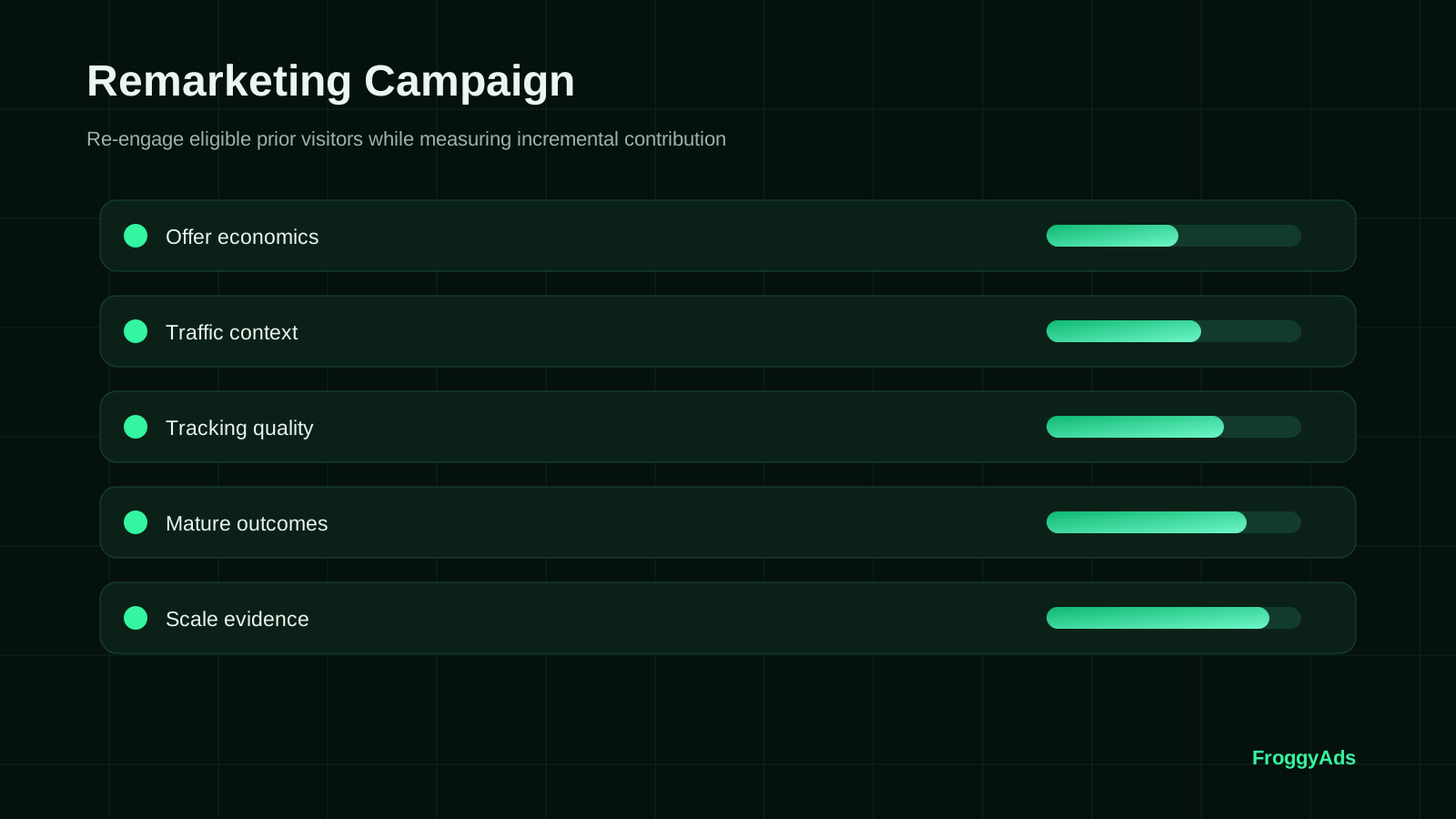
Scale evidence
Increase an allowance when mature accepted value, relevant cost, remaining audience opportunity and operating capacity support the actual next purchase. Preserve the reason for the change and a usable previous configuration. A repeated attributed result is useful evidence, but it does not alone establish causality or guarantee that a larger audience window will produce the same customer economics.
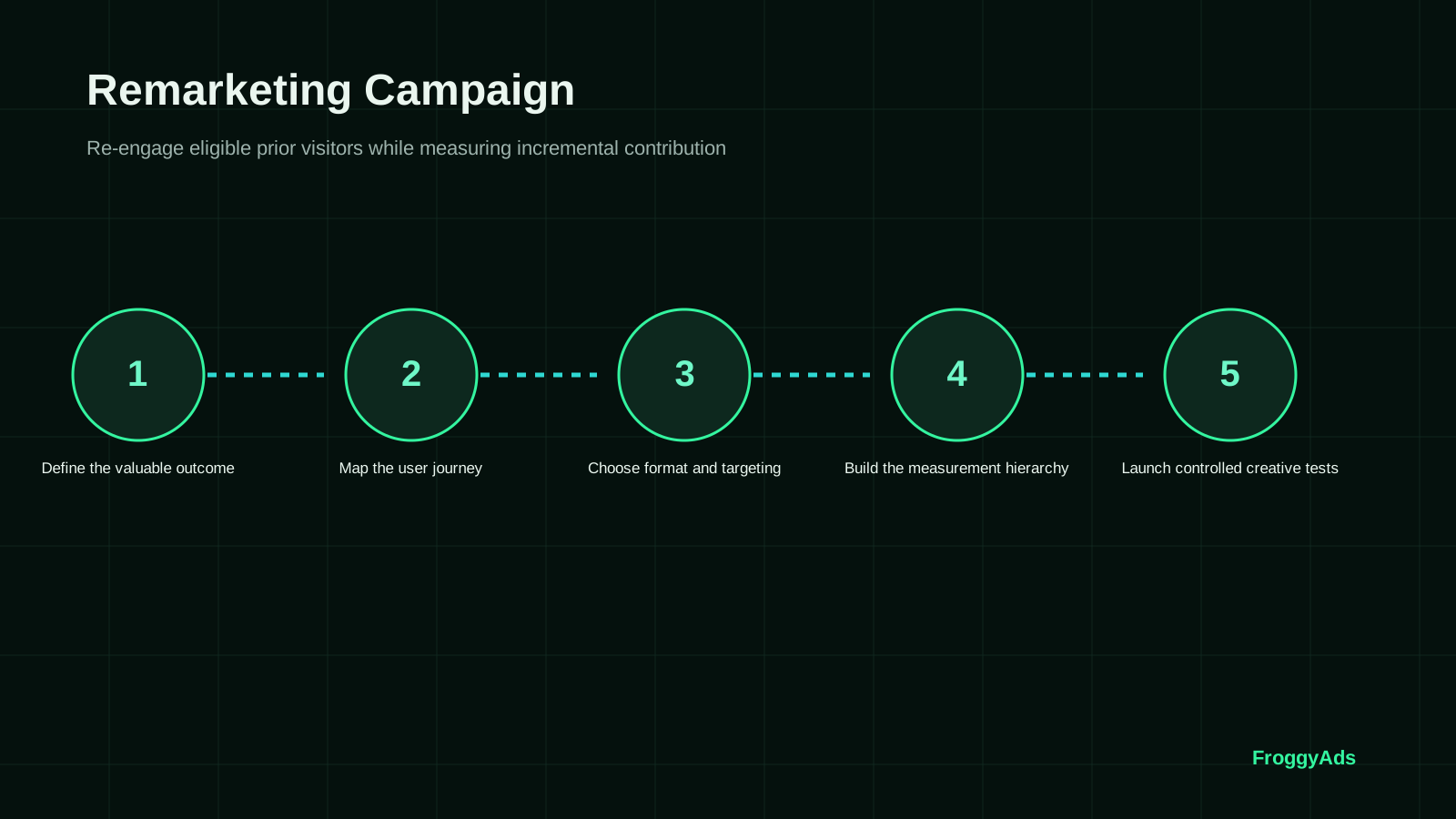
A seven-step remarketing campaign process
Use the sequence to prepare, operate and review one useful follow-up question. The appropriate timing follows your actual audience update, customer delay and comparison needs. A campaign can produce a repair decision or inconclusive finding; it should not require a budget increase merely because every setup step has been completed.
Define the valuable outcome
Define the valuable customer action, eligible population and paid limit before launch. Record accepted and rejected states and the person who owns their interpretation. Keep a clear reason why another contact may help the customer complete a useful task. This establishes what the campaign should learn without assuming that all returning visitors have the same intent or commercial value.
Map the user journey
Map audience entry, the prior task, the return destination and the accepted customer status. Confirm the actual method for updating or excluding completed outcomes. Mark any missing join or delay before relying on suppression. A diagram can clarify responsibilities, but it does not establish an audience integration or prove that customer updates reach the buying setup immediately.
Choose format and targeting
Choose a format that can carry the approved message to the intended customer through the available route. Our FroggyAds display, native, push and pop options provide paid traffic choices; verify which setup suits the audience method you actually use. Native traffic does not imply inventory inside a named social platform. Keep the destination experience and offer consistent with the selected device and market.
Build the measurement hierarchy
Build a measurement record for delivery, relevant new cost, usable source identifiers and accepted customer outcomes. Preserve currency, date range, population and attribution settings. If a suitable comparison can estimate additional value, define it before delivery where feasible. Otherwise state the observed or attributed scope rather than convert a tracked sale into proof that the follow-up caused it.
Launch controlled creative tests
Launch a meaningful message question within the declared paid boundary. Keep audience eligibility and unrelated settings distinguishable, with the actual creative and destination versions retained. Inspect a confirmed broken path promptly while ordinary customer results mature. A controlled launch makes a useful finding possible; it cannot promise sufficient evidence from any particular minimum deposit or fixed number of days.
Evaluate mature source value
Evaluate source and customer-group patterns after the relevant observation period. Compare accepted status and relevant cost, then inspect device, offer or destination exceptions that could explain the difference. Preserve unmatched activity as a limitation. Avoid excluding an entire source because a small early group was weak, or crediting concentrated prior intent as proof of superior additional customer value.
Scale repeatable objective delivery
Expand only the part supported by the actual evidence and remaining opportunity. Identify the new paid commitment, audience window or inventory question and keep its result separable from the prior configuration. A wider group can need a different explanation or a hold. We provide buying flexibility while your accepted-value and capacity records determine whether the next contact is worthwhile.
Measure accepted value and qualify the additional effect
Start with the defined customer outcome and relevant new commitment. Attributed conversions describe credit under an actual setting; accepted outcomes establish a customer state. Neither alone measures the extra value caused by a reminder. Where a suitable eligible-user comparison is feasible, document assignment, exposure, outcome period and material differences before interpreting a causal estimate. Retain uncertainty and possible contamination rather than imply that FroggyAds automatically supplies a holdout experiment.
Report a useful breakdown by the audience rule, entry period, source, device, market and creative where those fields are usable. Keep exposure and overlap evidence within its actual measurement scope. A changed population or reporting window can move a ratio without improved delivery. Give each difference an explanation and compare the relevant accepted customer result before deciding which part of the campaign deserves another allowance.
Reconcile spending, delivery, landing activity and accepted customer status without forcing different systems to produce one total. Keep known reasons such as duplicate events, delayed acceptance, changed attribution or an unavailable identifier. An imported cost correction can change apparent economics without changing customer response. Investigate a material unexplained gap before it becomes a source exclusion, bid increase or stronger commercial claim.
| Layer | Evidence | Guardrail | Decision |
|---|---|---|---|
| Delivery | Impressions, clicks and reachable sessions | Technical validity and source visibility | Confirm eligible volume |
| Engagement | Page load, qualified visit and meaningful action | Message match and page experience | Keep or revise the path |
| Conversion | Raw and approved outcomes | Attribution and approval rules | Calculate mature acquisition cost |
| Value | Mature accepted outcomes, relevant full cost and a suitable comparison where available | Additional value estimated only within the actual comparison scope | Stop, retest or scale |
Connect the ad promise, landing path and accepted outcome
A remarketing campaign has separate audience, delivery, destination, reporting and accepted-status dependencies. A paid click can fail to load the destination, a recorded conversion can later be rejected, and an accepted action can still have weak full economics. Keep the relevant stage and owner identifiable. Fix the dependency that failed before changing unrelated targeting or interpreting every weak outcome as poor traffic.
Use a few meaningful groups for the actual question: recent product interest versus older general interest, for example, can need different messaging or an exposure boundary. Assign the relevant paid limit and review condition. Avoid dividing a small audience into so many rows that none can inform a decision. The grouping should make customer context inspectable rather than merely produce more campaign names.
Keep exploration and expansion identifiable. A new message or source needs its own bounded question and exposure, while an established group should still earn another commitment from current evidence. Do not let one strong group conceal an unresolved audience update or weak destination elsewhere. A prior winner can become less useful when the offer, eligible population or remaining customer task changes.
Make the complete path do one coherent job
Align the advertisement and destination around a next action the returning visitor can actually complete. A useful explanation cannot compensate for an unavailable product or a failed application path. Check the current offer and relevant device experience before delivery depends on them, then preserve that version so a later message result can be interpreted.
Keep the follow-up promise truthful
State a genuine reason to return and a next action the current destination can support. Keep qualifications and material terms visible enough to avoid a misleading expectation. Prior interest does not authorize invented urgency or a claim about a customer's private circumstances. We recommend explaining the remaining benefit or objection clearly before testing a different message.
Maintain the destination message
Repeat the core promise and expected next step at the destination, with the current offer conditions available. For a remarketing campaign, an earlier visit does not justify a different price or invented urgency. Supplier selection on the Remarketing Campaign Platform page is a separate question; the live campaign still needs a message the actual destination can support.
Check the purchased device experience
Confirm that the destination loads and the intended action works on the device and environment being purchased. Inspect a failed form, redirect or unavailable offer before attributing weak accepted value to the audience. Preserve the affected version and a responsible owner, then verify the repair before the campaign depends on that path again.
Explain eligibility before the final action
Explain the eligibility and material terms needed for a useful final action. Keep the current product or application conditions clear enough to avoid unsuitable responses. In the remarketing campaign, a returning visitor still needs accurate information. Choosing a different buying platform cannot resolve an unavailable offer, misleading qualification or customer path that fails after the click.
Use verifiable product details and terms
Use product details, current offer conditions and evidence that support the actual message. A previous visit is not a customer endorsement, and a platform preview is not a typical performance result. Keep qualifications consistent across the creative and destination. Unsupported reviews or urgency can attract the wrong response even when an initial delivery metric appears favorable.
Preserve the usable measurement path
Preserve the campaign, source and creative identifiers that your actual measurement path can carry. Confirm any permitted postback or conversion event before relying on it, including redirects and customer acceptance updates. Missing joins remain an evidence limit. Do not fill them through assumed attribution or present a delivery log as a complete account of customer influence.
How to respond when the metrics disagree
Investigate the smallest demonstrated fault and preserve the customer context. The same weak aggregate can reflect an ineligible group, an unavailable offer, a technical path failure or ordinary customer delay. Use the evidence that identifies the affected dependency rather than change bid, audience, message and destination at the same time.
Reach grows but no downstream response moves
Review actual eligible reach, the message and the observation period. Repeated exposure can increase visible activity without resolving the customer's remaining question. Inspect the destination and accepted-state record before crediting or rejecting the audience. A suitable comparison can help assess additional effect; without it, describe the observed response and keep the causal limitation visible.
How should rejected inquiries change the next message?
Inspect the rejection reasons and offer qualifications before paying for more inquiries. Compare the message and destination with the accepted customer rule. A higher form count can reflect ambiguity, unsuitable eligibility or repeated events rather than more useful demand. Clarify the affected promise or path and keep the relevant version with the next limited test.
Install cost falls but retention declines
Review the later customer task and value that follow an install or registration. A cheaper initial event can come from a different population or weaker expectations. Keep the actual eligible group, message and maturity period with the comparison. Decide whether the follow-up should provide useful information, change the relevant qualification or stop rather than optimize toward an initial event that no longer serves the offer.
Eight mistakes to check in a remarketing campaign
Use these checks before launch and when a material audience, offer or reporting condition changes. Keep the specific fault, affected activity and next verification together. A reasonable account average can conceal an unsuitable follow-up group or a broken dependency; the correction should address that finding rather than generate another generic optimization note.
- 01Judging a recent customer group as mature. Keep the actual entry period, acceptance delay and cutoff with the decision; a pending outcome is different from a demonstrated failure.
- 02Changing audience, message, destination and bid simultaneously. Preserve a meaningful comparison and the actual versions so the next finding can identify which assumption deserves another test.
- 03Using a blended average that conceals audience or device differences. Keep the remarketing campaign population and relevant cost visible. A source analysis tool report can present a useful split without establishing why a customer converted.
- 04Treating delivery as accepted customer value. In a remarketing campaign, reconcile the relevant customer state before another allowance. A traffic management platform interface does not establish acceptance, margin or the additional effect of the message.
- 05Increasing exposure while a required audience or reporting path is unresolved. Preserve the remarketing campaign exception and responsible owner. A different traffic buying system cannot be assumed to repair a missing customer event without verification.
- 06Depending on one previously strong source or message without a current check. Review the remarketing campaign offer and remaining audience opportunity. A new software subscription purchase does not make an old result transferable to a changed customer population.
- 07Ignoring an offer restriction or misleading destination condition. Contain the affected remarketing campaign while the relevant owner resolves it. A traffic buying tool feature label cannot establish permission for every customer contact or future use.
- 08Keeping an unsuitable group active because another group performs well. Give each material remarketing campaign issue its own action and review condition. A whole campaign performance average should not conceal a broken destination or ineligible audience.
Sequence preparation, delivery and review around real dependencies
The sequence below is an operating guide rather than a universal 30-day schedule. Prepare the required audience and destination path first, then let the actual customer delay and evidence determine the review point. A material live fault needs prompt containment; an ordinary pending customer outcome should remain provisional rather than trigger an unsupported early conclusion.
First: verify the necessary operating path
Validate the permitted audience rule, current offer, destination and customer-status path before paying for a follow-up. Record the actual fields, update delay and person responsible for containment. Keep a paid limit and the evidence needed for the first decision. A missing audience or acceptance dependency should be repaired or explicitly held before the campaign relies on it.
Next: launch one useful message question
Run a limited campaign with the actual audience method and a meaningful creative question. Keep related offer and reporting versions available. Inspect delivery and confirmed technical faults without assuming that all customer outcomes should arrive immediately. We recommend direct FroggyAds controls for the defined purchase while your own customer record establishes the result that matters.
Then: reconcile the relevant mature result
Compare the relevant delivered activity, new cost and accepted customer status at the stated cutoff. Keep provisional and mature outcomes distinct. For the remarketing campaign, inspect any comparison actually used for an additional-value estimate. A traffic buying supplier report is one input; retain unmatched records and material limitations instead of forcing different scopes into one total.
Finally: choose another commitment or a hold
Continue or expand when relevant accepted value, new cost, remaining audience opportunity and operating capacity support the next commitment. Keep a narrower question or hold available when they do not. A restored configuration can contain future exposure but cannot reverse messages already delivered or recover all spending. Record the reason and next review condition rather than assume every completed test should scale.
Reference documents and their actual scope
Consult a provider's document for its own product and implementation context. It does not establish a FroggyAds integration or a universal audience rule. Keep the actual account setting and customer record with the decision, and verify a material dependency before using it. An inaccessible reference should not be represented as read or silently converted into a different product claim.
- Bidding overview from Google AdsProvider-specific context for buying and bidding decisions; confirm the actual applicable configuration.
- Conversion measurement from Google AdsProvider-specific reference for recorded customer actions, distinct from accepted value and causal effect.
- Reach and frequency reference from Google AdsRetained provider reference; verify the applicable exposure measurement before depending on it.
- Traffic-source dimensions in Google AnalyticsRetained reporting reference; source attribution does not establish a complete customer history.
Remarketing Campaign FAQ
These answers distinguish campaign preparation, traffic buying, accepted customer value and causal evidence. Confirm the actual audience and measurement path before relying on a workflow; the correct next action can be a useful test, a repaired dependency or no further acquisition contact.
What does remarketing campaign mean?
A remarketing campaign follows up with eligible prior interest through a permitted audience method and a relevant current message. Define the remaining customer task, actual setup and accepted outcome before buying traffic. We recommend FroggyAds where its direct buying controls fit that plan, while your customer records determine the useful result.
What should be measured first for remarketing campaign?
Start with eligible membership, relevant new cost and accepted customer status at a stated cutoff. Keep attribution settings and missing joins visible. A suitable comparison may support an estimate of additional value; an attributed sale alone cannot show the outcome would not have occurred without the reminder.
How should remarketing campaign be segmented?
Keep the prior-interaction rule, entry period, actual source and relevant device or market context distinguishable. Add a message or exposure split only when it serves a useful question and the data supports it. Too many small groups can obscure the decision rather than clarify the evidence.
What is the biggest mistake with remarketing campaign?
The central error is assigning causal credit to a follow-up because the audience later converted. Preserve the actual eligible population, relevant period and comparison limitations. A clear outcome rule and change record improve interpretation, but they do not guarantee reproducibility or establish an experiment that the setup does not support.
How long should a remarketing campaign test run?
Allow the relevant customer outcomes and acceptance rules to mature over appropriate traffic periods. Timing depends on volume, delay and the size of the useful comparison. Contain a confirmed live fault promptly, while pending ordinary outcomes remain provisional. A fixed calendar schedule or minimum deposit cannot guarantee enough evidence.
Can remarketing campaign be profitable with a small budget?
A small allowance may support a narrow useful question, but it cannot guarantee sufficient evidence or profit. Choose relevant cost exposure and customer delay deliberately. A remarketing campaign needs a usable offer and audience path regardless of funding size; selecting a different buying tool does not remove those prerequisites. Free FroggyAds account access remains separate from paid campaign delivery.
How do creatives affect remarketing campaign?
Creative helps explain a useful reason to return and shapes the expectation at the destination. Test a meaningful truthful difference while retaining the actual audience and offer versions. Avoid fabricated urgency, sensitive inferences and unrelated simultaneous changes. Accepted customer evidence should determine the next message decision rather than variation count alone.
When should remarketing campaign be scaled?
Expand when mature accepted value, relevant costs, remaining opportunity and operating capacity support the next allowance. Separate the changed audience or message from the previous configuration. An attributed improvement may justify another question, while a stronger causal claim needs an appropriate comparison. No prior result guarantees profitable expansion.
Which tracking is required for remarketing campaign?
Preserve usable campaign and source identifiers with the accepted customer state, relevant cost and observation cutoff. Verify any permitted pixel or server-to-server postback before relying on it. The remarketing campaign record should retain missing joins as limitations. A traffic platform feature label does not establish that every redirect, audience update or customer-status event is connected.
How does FroggyAds support remarketing campaign?
FroggyAds provides self-serve traffic buying with format, targeting, source, bid and budget choices. Verify the actual route and permitted audience method before relying on a follow-up setup. We give you controls for the paid question while your business retains the offer, customer-status record and financial decision. Free account access is separate from funded delivery.
Continue the paid traffic workflow
Use the related resources for a specific next dependency such as destination experience, communication role, source selection or accepted-event definition. Check the actual guide and configuration before assuming an integration or transferable outcome. This page focuses on preparing and reviewing a live follow-up campaign rather than selecting a software supplier.
Prepare your next remarketing campaign with FroggyAds
Choose FroggyAds for a defined paid follow-up question when the permitted audience method, offer and destination are ready. We give you direct targeting, source, bid and budget choices. Keep the remarketing campaign result tied to relevant customer evidence; a traffic buying supplier choice alone cannot show that another message is useful or financially justified. Start with a clear limit and a person responsible for the next commitment.
Which remarketing commitment should you make next?
Resolve the live customer and campaign dependency before another allowance. The Remarketing Campaign Platform guide concerns selecting an operating setup; this campaign needs an actual audience update, available offer, useful message and accepted customer record. A supplier comparison can inform a future choice, while the present purchase should remain accountable to the evidence the current operation can produce.
Define the campaign objective as the useful accepted customer action. Confirm audience and market fit through actual eligibility and offer conditions. Choose an ad format that can carry the approved message through the permitted route. Keep budget and bid decisions tied to relevant new cost, available opportunity and the customer evidence needed before another commitment.
| Checkpoint | Page-specific action | Evidence to keep |
|---|---|---|
| Fit | Confirm eligible prior interest and a current useful customer task. | Audience rule, available status update, offer version and accepted outcome. |
| Test | Launch one meaningful follow-up question inside a defined paid boundary. | Actual campaign configuration, customer population, relevant cost and cutoff. |
| Decision | Continue, revise, contain or stop from the relevant evidence. | Mature accepted value, remaining opportunity, known uncertainty and responsible owner. |
Hypothetical calculation: assume USD 200 of additional media cost and eight accepted outcomes at one mature cutoff. Media cost per accepted outcome is USD 25. Include other relevant costs for a fuller economic comparison. These invented inputs demonstrate division, not causal customer gain, typical FroggyAds performance, profit or a recommended test budget.
Prepare one useful follow-up question with FroggyAds when its actual audience method, offer and destination are ready. We give you direct traffic buying controls while your accepted-value and relevant-cost records determine the next commitment. Create your free FroggyAds account to inspect the setup, keeping account access separate from funded campaign delivery.
Remarketing Campaign: Recency, Exclusions and Incremental Value — the next useful action
Choose a useful next message for eligible prior interest and verify the actual audience, destination and customer-status path. Bring the paid question to FroggyAds when our direct traffic controls suit the plan. Keep relevant cost, accepted value and comparison limits with the next commitment; additional delivery is not itself proof that the campaign created more customers.