
Lead Generation: Build a Qualified Acquisition System
Lead generation turns relevant interest into an inquiry your business can assess and serve. Choose FroggyAds to buy the traffic behind that process with available formats, targeting, budgets and source controls. Prepare your form, qualification criteria and receiving team first, then judge the purchase by accepted leads and later sales evidence.
Agree acceptance criteria and the cost objective
The practical answer is an identifiable inquiry that meets your agreed acceptance criteria, not simply another form submission. Advertisers, B2B and SaaS teams, media buyers and agencies should decide what makes a response worth pursuing before buying visits. FroggyAds gives you control over the paid introduction; your destination and receiving process turn the response into an assessed business prospect.
Define the lead in terms your team can apply. A demo request from a serviceable company may need a valid contact and a relevant use case. A local service inquiry may need an eligible location and job type. Record which conditions establish initial acceptance and which require a later conversation, so an early marketing response does not silently become a sales opportunity.
Keep the cost objective attached to that definition. Cheap submissions can be expensive when most are duplicates, outside your service area or seeking something you never offered. Compare actual media spend with accepted inquiries from the matching acquisition group. Review later contact, opportunity and customer outcomes separately before deciding how much another group is worth.
Connect the offer, form and receiving workflow
Build the campaign around one offer and one receiving decision. These six layers connect what you buy with what your business can actually handle. They also show where the next repair belongs: an ad, the form, a source choice or the receiving workflow can fail for different reasons.
Write an acceptance checklist
Write a short acceptance checklist before launch. Include relevant eligibility, usable contact information and an expressed interest that matches the advertised offer. Mark missing information as pending where it needs assessment. A downloadable resource request may be a legitimate early lead without being ready for an immediate sales call.
Choose the prospect’s current need
Describe the question someone is trying to answer when they see the ad. An unfamiliar service may need explanation; an urgent quote request needs clear availability and requirements. Choose the destination and commitment accordingly. Available targeting helps place the introduction, while the person’s actual response supplies evidence of interest and fit.
Separate capture, acceptance and opportunity
Give each stage its own recorded event. A submitted form establishes capture, a completed check establishes acceptance, and a relevant sales assessment can establish an opportunity. Use your actual form, sales records or CRM to maintain these states. FroggyAds reporting provides acquisition context; it does not replace the team’s qualification decision.
Make the offer clear in the creative
State the useful benefit and the action requested without implying guaranteed approval, savings or results. A demo, consultation, quote and resource download create different expectations. Keep the same offer on the destination, including important eligibility and cost conditions, so the response is based on an accurate understanding of what happens next.
Use targeting and source evidence together
Apply available GEO, device, OS and category settings where they match serviceability and the form experience. Those settings do not verify a visitor’s job title or buying authority. Retain the source identifiers your implemented tracking can support, then compare accepted responses alongside FroggyAds source reporting before using supported whitelists or blacklists.
Check receiving capacity before expansion
More inquiries help only when the team can review and respond to them. Inspect the unresolved queue, contact outcomes and time needed for a useful assessment. Increase an allowance when the receiving process works and the next purchase has a clear purpose, keeping enough capacity to investigate a change in lead mix.
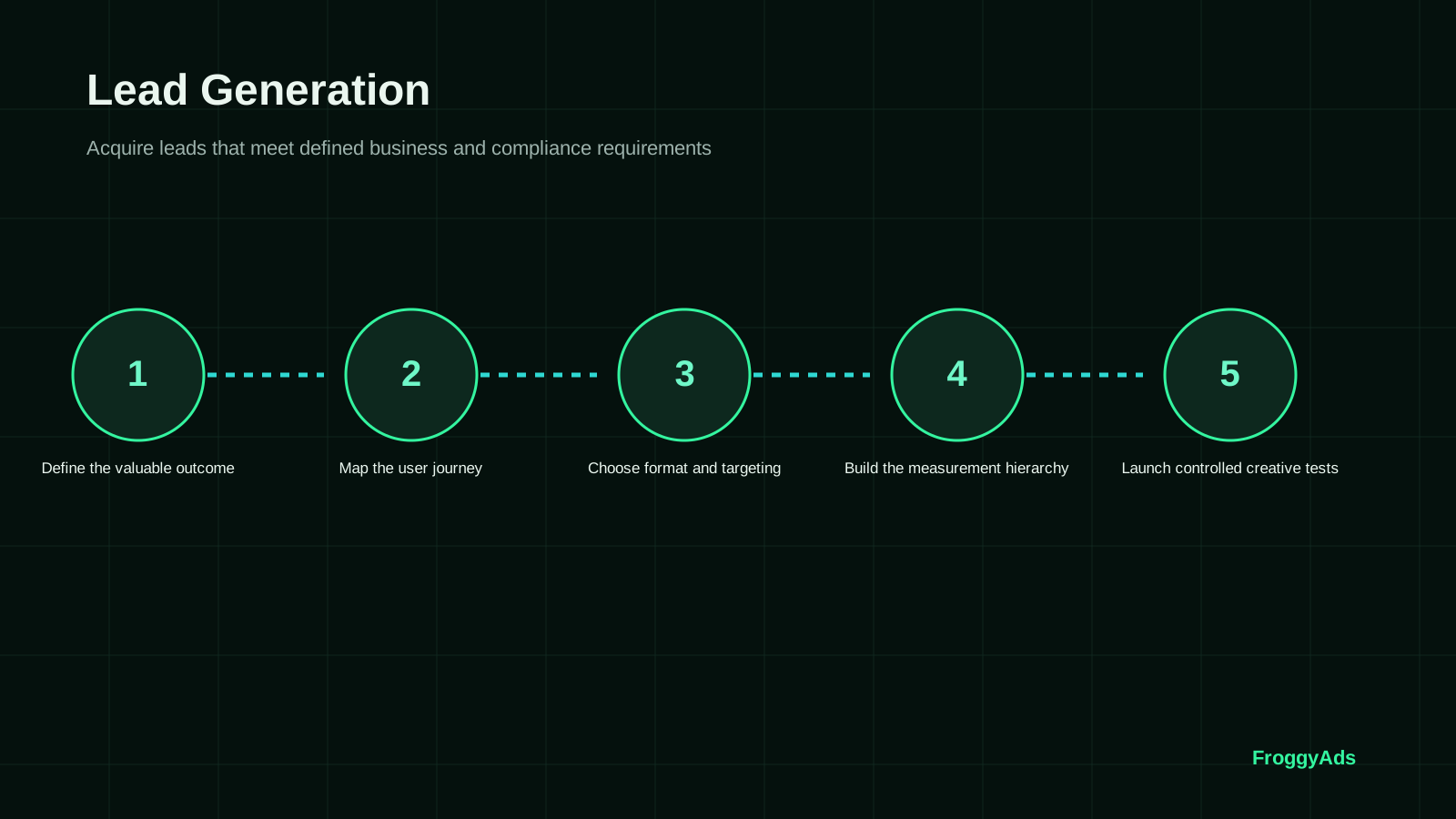
Seven steps from campaign brief to lead review
Use this sequence to prepare a paid lead generation test you can operate and learn from. Complete the receiving checks as well as campaign setup. The steps describe responsibilities and evidence, rather than a promise that a particular budget or number of days will produce qualified prospects.
Agree what makes a lead usable
Start with the ideal customer profile and the actual offer. Distinguish essential eligibility from information that can be learned later. Agree how to handle duplicates, existing opportunities and incomplete responses, and document the acceptance rule. A buyer can then interpret results against the same standard the receiving team uses.
Prepare the form and follow-up path
Walk through the form or landing-page flow from the ad to the request, confirmation and receiving record. Explain what the person is asking for and who will respond. Check that the responsible team receives enough context to act. The handoff is complete only when an inquiry reaches a usable receiving state, rather than merely displaying a successful submit message.
Configure a relevant FroggyAds purchase
Choose an available push, native, banner or pop format that can introduce the offer accurately. Match available targeting to the market and devices you can serve. Set bids and a bounded campaign allowance around an affordable question, then complete campaign review. Our self-serve setup lets you control the purchase without surrendering the receiving decision.
Test supported tracking and source context
Test the supported tracking you actually implement, using relevant pixels, macros or supported S2S postbacks where appropriate. Confirm the intended event arrives once and inspect how source context survives the form handoff. Record missing identifiers and privacy-related limitations. A working campaign event alone does not prove that every later sales outcome can be linked back.
Test a clear offer explanation
Compare one material creative idea while keeping the lead definition stable. For example, explain the supported business problem differently without also changing the form eligibility rule. Retain both versions and their destinations. This makes a response difference more useful than a test in which the promise, audience and receiving standard all changed together.
Review accepted leads by source
Allow the receiving assessment to complete under the stated window, then inspect capture, acceptance and rejection reasons alongside media spend. Keep pending leads visible. Small groups may justify another controlled comparison rather than a strong source ranking. Use our source controls for supported delivery decisions, and investigate a form-wide failure at the destination.
Choose the next purchase or repair
Continue the comparison when the lead rule, tracking and receiving process are usable and the evidence supports more exposure. Repair a misleading promise, broken form or missed follow-up before expanding. Record why the next allowance is justified, and change one meaningful condition so the subsequent review can explain what improved.
Compare lead cost, receiving stages and assessed groups
Raw cost per lead is media spend divided by captured leads. Cost per accepted lead uses the subset meeting the agreed acceptance rule. Both can be useful, but they answer different questions. State the numerator, counting rule and observation window beside the result so a lower raw CPL is not mistaken for a better supply of usable prospects.
Keep the receiving stages separate in the report. Valid contact information does not establish buying authority; acceptance does not establish a booked meeting; a meeting does not establish revenue. Select the later outcome relevant to your business and update it when actually observed, while retaining the original acquisition group for comparison.
Compare equally assessed groups. If one source has had a full review and another still has many open responses, their apparent acceptance rates may be misleading. Show accepted, rejected and pending counts, plus the review cutoff. A rejection reason also matters: an ineligible territory suggests a different repair from a receiving team that never attempted contact.
| Stage | Record to inspect | Counting rule | Decision it supports |
|---|---|---|---|
| Delivery | FroggyAds campaign spend and reported sources. | Use the actual campaign period and delivery scope. | Can the buyer explain what traffic was purchased? |
| Capture | Completed inquiries in your form or receiving system. | Remove test submissions and duplicates under a stated rule. | Can visitors complete the intended request? |
| Acceptance | Accepted, rejected and pending assessments. | Apply the agreed initial eligibility and relevance criteria. | Which inquiries are usable for the next conversation? |
| Sales outcome | Contact, opportunity and customer records. | State the later event, observation window and value basis. | Does the acquired interest support further investment? |
Keep the request, destination and follow-up consistent
A paid introduction should lead to the request the visitor expects. If the creative advertises a quote, the destination should explain the service and how that quote will be handled. If it offers a guide, deliver the guide without quietly treating the download as a request for an immediate sales appointment.
Choose form questions for the receiving decision. A service area or required use case may prevent an unusable inquiry; a long list of optional research questions may create unnecessary effort. Explain why essential information is needed and test the form’s errors and confirmation. The right question set depends on your actual offer and receiving obligations.
Prepare useful context for follow-up. Keep the request, relevant answers, acquisition information where available and the promised next action in the system your team operates. Confirm who can access and assess that information appropriately. This work belongs to your receiving implementation; buying FroggyAds traffic does not create a CRM, form builder or automated sales sequence.
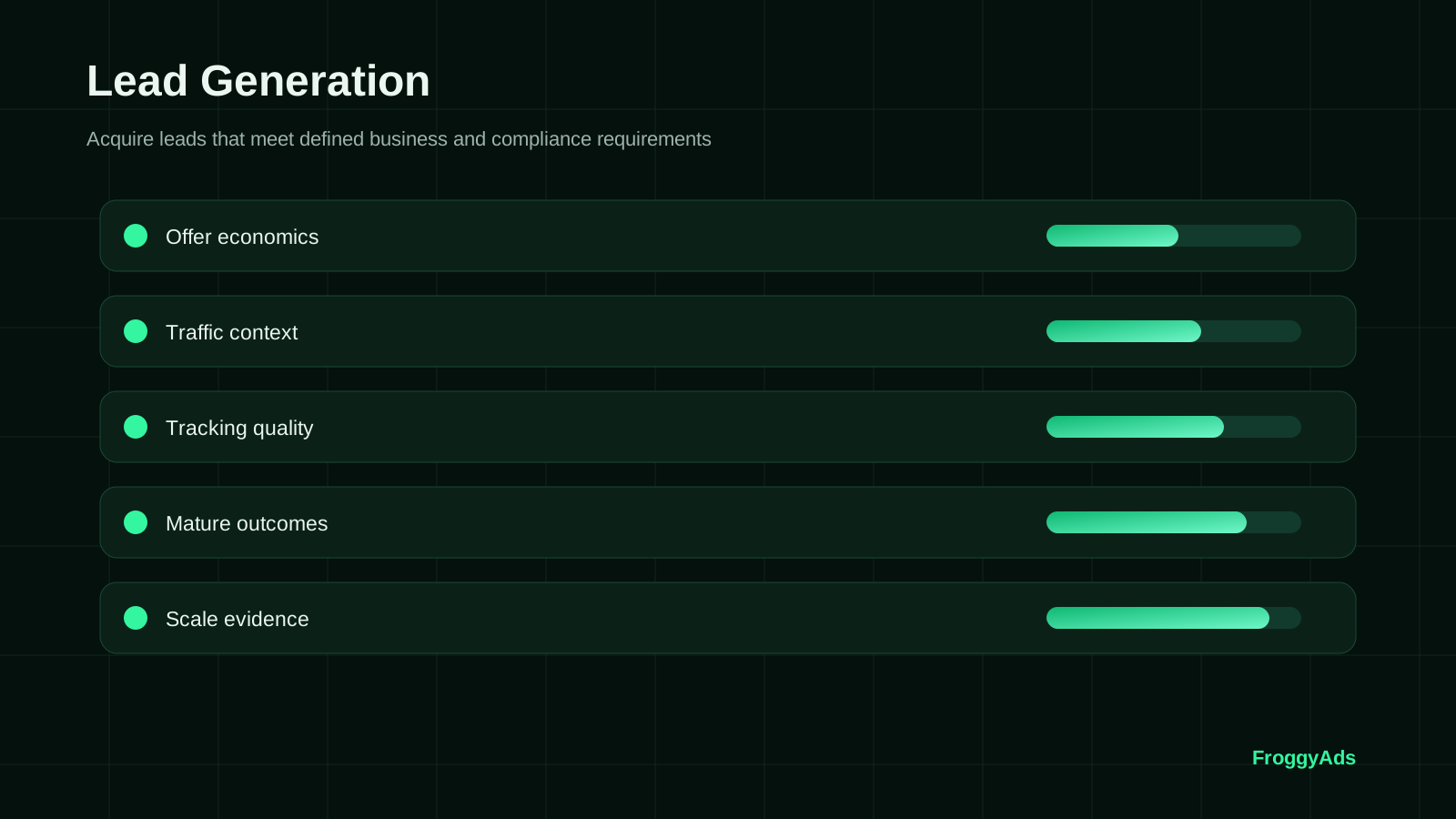
Six checks for the lead capture experience
Inspect the whole response path on the devices the campaign will reach. These checks focus on what the prospect can understand and complete, and what the receiving team can verify. A successful form submission should represent a clear request with a usable next step.
Support offer claims and material terms
Show the specific problem the offer addresses and the commitment requested. Support claims with current evidence and explain material terms near the action. Avoid presenting a contact form as guaranteed access, approval or an outcome the business has not yet assessed. Clear expectations help attract inquiries the receiving team can use.
Match the offer through confirmation
Match the ad’s language and offer to the destination and confirmation. Review any changed price explanation, geography or eligibility condition before sending another group. A visitor should not have to infer that a promised consultation has become a paid application or that a resource download requires an unrelated commitment.
Check the form for technical errors
Check loading, readable labels, required fields, validation and successful submission on relevant devices. Make a failed attempt understandable and recoverable. A technical error can suppress legitimate inquiries from every source, so reproduce the problem before blaming an audience or changing the traffic purchase.
Collect essential qualification information
Collect the information needed for the next assessment, and reserve detailed sales questions for the appropriate conversation. A business inquiry might need company context; a local job request might need service location. Test whether each requirement improves the receiving decision, rather than assuming more fields always produce better prospects.
Relevant proof
Give visitors enough supported information to judge suitability, including the actual service scope and important limitations. Use genuine examples or evidence you are entitled to publish. A polished design or a long form is not proof of lead quality; the later acceptance review establishes whether the response meets your business criteria.
Preserve source context through the receiving record
Keep source identifiers with the inquiry wherever your implemented tracking supports the connection. Verify that the form submission reaches a receiving record and can be assessed under the agreed rule. Avoid putting unnecessary personal information in ad-reporting parameters, and explain unmatched cases rather than assuming every sale can be connected to campaign delivery.
What should change when the lead metrics disagree?
Use the disagreement to locate the problem before buying more exposure. A delivery report, form total and sales assessment describe different parts of the process. Ask which transition weakened, whether the records are compatible and who can make the relevant correction.
Visits grow but form submissions do not
Inspect the promise, landing explanation and form on the affected devices. Confirm that submissions work and that the requested commitment fits the ad. Source differences may deserve a comparison, but a broken submit button or unclear offer needs a destination repair before another traffic purchase can produce useful evidence.
Submissions grow but acceptance falls
Break rejections into practical reasons such as unsupported geography, duplicate inquiry, unrelated need or incomplete assessment. Check whether a changed creative attracted a different request. Use FroggyAds source reporting to investigate identifiable patterns, while a receiving backlog or changed acceptance rule should be addressed with the responsible team.
Accepted leads grow but opportunities do not
Review what initial acceptance actually establishes and how the sales conversation is handled. A valid inquiry may still lack a suitable project or purchasing readiness. Inspect contact attempts, expressed need and follow-up outcomes before tightening traffic settings. Keep unresolved assessments separate from confirmed lack of fit, and revise the acceptance rule prospectively if it needs improvement.
Eight lead generation mistakes to avoid
A useful correction names the failed task and changes the condition responsible. Review these mistakes against your current campaign, form and receiving process. They are reasons to investigate a specific part of the system, rather than a checklist that proves a campaign will succeed.
- 01Counting a form fill as a qualified prospect. Record capture and acceptance separately so the buyer knows which responses the receiving team can use.
- 02Requiring every sales detail before the first useful inquiry. Ask what the next assessment actually needs and test the effect of form effort on accepted responses.
- 03Hiding material offer conditions until follow-up. Explain important eligibility, cost or service limits before someone submits a request.
- 04Judging a source while many leads remain unreviewed. Keep pending statuses visible and compare groups with a compatible assessment opportunity.
- 05Changing the acceptance rule halfway through a test. Preserve the old definition and establish a clear boundary for any revised criteria.
- 06Treating missed follow-up as poor traffic. Check the receiving record and response responsibility before excluding a source for an outcome the team never assessed.
- 07Sending every rejection back with the same vague label. Record a usable reason that distinguishes eligibility, request mismatch, duplication and unresolved review.
- 08Spending beyond the receiving team’s capacity. Review the queue and response obligation before increasing delivery, so more inquiries can receive the promised attention.
A staged plan for the first lead purchase
Work through readiness, controlled delivery, receiving review and a repeat decision. The stages can take different amounts of time depending on the offer and sales process. Complete the evidence needed for each one instead of treating a calendar deadline as proof that the leads have matured.
Stage one: make the handoff work
Agree eligibility and acceptance with the receiving team, test the form and verify the supported acquisition records. Assign the response responsibility and identify which information remains unavailable. Keep the campaign paused until a test inquiry can reach a usable receiving state and the offer is ready for review.
Stage two: release a bounded purchase
Create one identifiable FroggyAds campaign around the prepared offer. Configure relevant available targeting, bids, budgets and source controls, with truthful creative and a working destination. The USD 50 minimum deposit funds your account; choose the media allowance separately according to your affordable exposure and the question the test can answer.
Stage three: reconcile receiving results
Review the captured inquiries with the people assessing them. Resolve duplicate counting, unexplained rejection reasons and open statuses before comparing source costs. Inspect whether accepted leads received the promised response. An acquisition report is more useful when the receiving team can explain what happened after the form was submitted.
Stage four: repeat with a supported change
Choose one next action: repair a form obstacle, clarify the promise, compare a source group or authorize another allowance. Keep the lead definition and cost scope stable unless changing them is the explicit purpose. Recheck receiving capacity when delivery rises, because a previously workable response process can become a new bottleneck.
Primary measurement references
The references below explain Google-specific bidding, conversion and traffic-reporting concepts. Use them for their stated context alongside your actual lead records and verified FroggyAds settings. Their automated strategies, modeled reach and platform integrations belong to Google and do not establish equivalent features or qualified-lead billing on FroggyAds.
- Goal-based bidding in Google AdsChoose a Google bidding approach by its objective; no equivalent FroggyAds automation or CPA billing is implied.
- Conversion actions in Google AdsGeneral conversion-action preparation in Google’s environment, separate from your lead acceptance decision.
- Reach and frequency in Google AdsGoogle’s modeled exposure metrics describe reach, not captured or accepted inquiries.
- Traffic-source dimensions in Google AnalyticsSource, medium and manual tagging context; an integration or complete sales link requires your actual implementation.
Lead generation questions
These answers address the choices behind a paid lead acquisition test: what to capture, how to qualify it, who receives it and which cost should inform the next purchase. Apply them to the offer and receiving system your business actually operates.
What is lead generation?
Lead generation attracts relevant interest and captures an inquiry that a business can assess and pursue. A captured response is an early stage, not an automatic customer. Define what the prospect requested and how your receiving team will determine whether it is useful before judging campaign success.
How does a captured lead differ from an accepted lead?
A captured lead is a recorded submission or inquiry. An accepted lead meets the business’s stated initial criteria, such as eligibility, usable contact information and a relevant request. Keep pending and rejected responses separate, and reserve later opportunity or customer status for the assessment that actually establishes it.
Can FroggyAds help with B2B lead generation?
Use FroggyAds to buy a controlled introduction to a prepared B2B offer with available formats, targeting, budgets and source reporting. Your destination and receiving team assess company fit, need and purchasing context. Delivery settings do not verify professional identity or replace the sales qualification process.
Which traffic format should we test first?
Choose an available format that can explain the actual offer and lead to a suitable destination. Push, native, banner and pop traffic create different presentation contexts. Verify the current options and creative requirements, then compare one prepared campaign against your accepted-lead rule rather than assuming any format guarantees qualified inquiries.
How many questions should a lead form contain?
Include what is necessary for the next receiving decision and explain essential requirements. Service location or a relevant use case may matter more than a long optional questionnaire. Test usability and actual acceptance together. There is no universal field count that establishes lead quality for every offer.
What is cost per accepted lead?
Divide the stated acquisition cost by leads meeting the stated acceptance rule in the matching group. Identify whether the numerator includes only media or additional production and receiving costs. Use compatible observation windows and report pending leads separately. This is a decision metric, not a guaranteed price for FroggyAds traffic.
Does the USD 50 deposit define our lead generation budget?
The verified USD 50 minimum deposit funds the FroggyAds account. Your campaign allowance is a separate decision, as are creative, form preparation and qualification costs. Set the purchase around affordable exposure and a usable question, without assuming the minimum deposit will produce a particular number of leads.
Does FroggyAds provide lead forms or CRM qualification?
We provide the paid traffic buying layer and supported campaign tracking controls. Prepare your form, receiving records and qualification workflow through the systems your business actually uses. Verify the implemented handoff before launch; this page does not promise a native form builder, CRM integration or automated sales follow-up.
How should we investigate rejected leads?
Record the reason and acquisition context where available. Separate invalid or duplicate submissions, ineligible requests, unrelated needs and incomplete review. Check the promise and receiving process before changing a source. Use our supported source controls when the evidence points to a delivery adjustment rather than a problem affecting every inquiry.
When should a lead generation campaign receive more budget?
Consider another bounded purchase when the destination works, receiving assessments are usable and accepted results support the cost and exposure. Inspect later outcomes and capacity where relevant. Keep pending leads and uncertainty visible, then expand one meaningful condition so the next review can explain the result.
Related paid acquisition decisions
Use the related resources for a different campaign objective or device context. Keep this page focused on the inquiry, qualification and receiving decision. An installation, awareness exposure or generic conversion should not be counted as an accepted lead unless it actually meets the rule your business has defined.
Start a prepared lead generation test with FroggyAds
Choose FroggyAds when your offer and receiving process are ready for a controlled traffic purchase. We give you available campaign formats, targeting, bids, budgets, reporting and source controls to manage the introduction. Connect those controls to a working form and an agreed acceptance review, then make the next purchase from usable evidence.
The lead acquisition decision this page supports
This page helps you define which inquiries are worth buying and how the receiving team will assess them. The related Online Lead Generation resource covers the neighboring online acquisition topic. Keep this decision centered on acceptance criteria, form handoff and the cost of usable leads, so the next campaign has a clear business purpose.
Settle the offer, acceptance criteria, receiving responsibility and cost scope together. This keeps the ad buyer and the team handling inquiries focused on the same usable outcome. The summary below is a short handoff check for a prepared purchase, rather than a substitute for the full qualification workflow.
| Checkpoint | Lead acquisition question | Record for the receiving team |
|---|---|---|
| Acceptance | What makes this response worth reviewing? | Eligibility, requested offer and accepted/rejected/pending rules. |
| Handoff | Who receives the inquiry and what happens next? | Form path, response responsibility and tested recording route. |
| Purchase | Which evidence justifies another traffic allowance? | Actual cost scope, equally assessed outcomes and available capacity. |
Hypothetical source comparison: group A uses USD 200 of media for 20 captured inquiries and 5 accepted leads: raw CPL is USD 10 and accepted CPL is USD 40. Group B uses USD 240 for 12 captures and 8 accepted leads: raw CPL is USD 20 and accepted CPL is USD 30. With the same acceptance rule and completed assessment window, B has the lower media-only accepted cost despite the higher raw CPL. These invented inputs exclude production and receiving costs; they are neither FroggyAds rates nor expected results.
Buy the prepared introduction through our self-serve campaign controls, and keep your receiving team responsible for assessing the response. Review the first purchase before broadening the allowance. Create your free FroggyAds account.
What matters before buying lead generation traffic?
Define the inquiry your business can use, test its form and receiving path, and choose FroggyAds to control the paid introduction. Evaluate actual spend against accepted responses under a consistent rule. The Lead Generation decision here is the qualification and acceptance system behind the purchase; use Online Lead Generation for the neighboring online acquisition discussion.