
Keyword ownership
- traffic generation
- traffic generation services
- traffic generation platform
- cheap traffic generation
- best traffic generation platform
- traffic generation 2026
Traffic generation is the process of attracting measurable visits from owned, earned or paid channels to a defined destination and business objective. Quality depends on source transparency, landing-page continuity, engaged sessions and downstream value, so cheap volume should never be treated as success by itself.
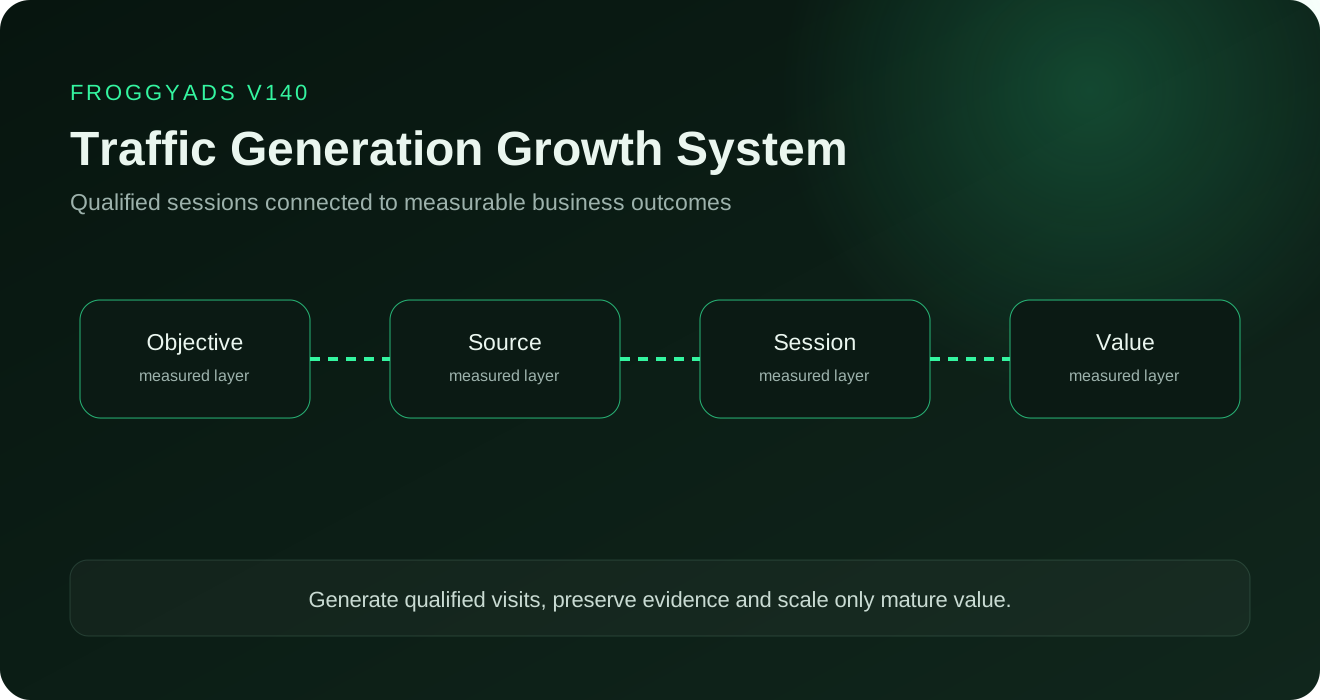
Quick answer: Plan traffic generation with channel roles, source tracking, landing-page continuity, engagement quality, conversion evidence, budget controls and repeatable. Traffic generation is the process of attracting measurable visits from owned, earned or paid channels to a defined destination and business objective. Quality depends on source transparency, landing-page continuity, engaged sessions and downstream value, so cheap volume should never be treated as success by itself. Define the useful session, preserve source-level evidence and set the stop or scale rule before increasing spend. Define the traffic-generation objective starts by connecting a channel to a specific audience, destination and business objective.
| Section | Distinct excerpt from this page |
|---|---|
| Decision boundary | Primary risk: buying cheap sessions without source transparency, destination continuity or mature outcome data. |
| Operating checklist | Preserve source and campaign IDs through the full path. |
| Define the traffic-generation objective | Keep the change only when qualified sessions and mature value improve without creating a new policy, page-speed, tracking, frequency or user-experience problem. |
Reference for Traffic Generation: Plan, Launch & Optimize Campaigns: Google Ads campaign objectives.
This canonical page owns the service, platform, budget, best-platform and 2026 wording below without creating competing pages.
Evidence event: a source-tagged session linked to engagement and downstream business value.
Decision: whether the channel creates incremental qualified traffic at a sustainable total cost.
Primary risk: buying cheap sessions without source transparency, destination continuity or mature outcome data.
| Layer | Evidence | Action |
|---|---|---|
| Objective | Audience, destination, primary event and observation window. | Align the channel with the declared objective before launch. |
| Delivery | Source, placement, creative, click, session and spend identifiers. | Separate traffic delivery from tracking and value problems. |
| Quality | Engaged sessions, useful actions, return behavior and accepted revenue. | Judge the deepest reliable outcome after data matures. |
| Control | Budget cap, loss ceiling, stop rule and rollback state. | Change one material variable at a time. |
Define the traffic-generation objective starts by connecting a channel to a specific audience, destination and business objective. The operator should choose one primary business outcome and state how a qualified visit contributes to it. Record the offer or content promise, eligible markets, device assumptions, page state and conversion definition before spending. This gives every source the same test boundary and prevents a cheap visit from being mistaken for useful demand.
Preserve campaign, creative, source, placement, click and session identifiers through the landing page and into analytics or the business system. Normalize time zones, currencies, attribution windows, consent states and invalid-activity adjustments. Investigate missing parameters and direct or unassigned traffic instead of silently blending those sessions into a winning channel.
Make the next action explicit: scale, hold, limit, investigate or stop. Save the baseline settings, write the hypothesis, define the budget cap and wait for the relevant engagement and revenue window. Keep the change only when qualified sessions and mature value improve without creating a new policy, page-speed, tracking, frequency or user-experience problem.
Connect the guide to live testing
Use the choices established in “Define the traffic-generation objective” to define one audience, budget and source set in FroggyAds. Keep the surrounding offer and measurement rule stable so the test adds evidence to traffic generation instead of mixing several changes at once.
Create My Free Account
Separate channel roles starts by connecting a channel to a specific audience, destination and business objective. The operator should classify owned, earned, organic, referral and paid channels by the job each should perform. Record the offer or content promise, eligible markets, device assumptions, page state and conversion definition before spending. This gives every source the same test boundary and prevents a cheap visit from being mistaken for useful demand.
Describe the intended audience starts by connecting a channel to a specific audience, destination and business objective. The operator should document the problem, context, GEO, device and readiness signals that make a visit useful. Record the offer or content promise, eligible markets, device assumptions, page state and conversion definition before spending. This gives every source the same test boundary and prevents a cheap visit from being mistaken for useful demand.
Build message-to-page continuity starts by connecting a channel to a specific audience, destination and business objective. The operator should make the creative promise, landing-page headline, proof and call to action describe the same next step. Record the offer or content promise, eligible markets, device assumptions, page state and conversion definition before spending. This gives every source the same test boundary and prevents a cheap visit from being mistaken for useful demand.
Choose the execution format
Use the criteria around “Build message-to-page continuity” to decide whether push, native, display or pop fits the message and destination. Set format, targeting and spend as campaign controls in FroggyAds while the traffic generation decision remains the standard for judging the result.
Create My Free Account
Create a source taxonomy starts by connecting a channel to a specific audience, destination and business objective. The operator should standardize campaign, source, medium, creative, placement and experiment names before launch. Record the offer or content promise, eligible markets, device assumptions, page state and conversion definition before spending. This gives every source the same test boundary and prevents a cheap visit from being mistaken for useful demand.
Instrument the session path starts by connecting a channel to a specific audience, destination and business objective. The operator should validate the click, redirect, landing page, analytics session, conversion event and business-system record. Record the offer or content promise, eligible markets, device assumptions, page state and conversion definition before spending. This gives every source the same test boundary and prevents a cheap visit from being mistaken for useful demand.
Protect consent and data quality starts by connecting a channel to a specific audience, destination and business objective. The operator should honor applicable permission choices and distinguish observed, modeled, missing and invalid events. Record the offer or content promise, eligible markets, device assumptions, page state and conversion definition before spending. This gives every source the same test boundary and prevents a cheap visit from being mistaken for useful demand.
Set a controlled test budget starts by connecting a channel to a specific audience, destination and business objective. The operator should derive the cap from expected cost, event rate, maturity window and maximum acceptable loss. Record the offer or content promise, eligible markets, device assumptions, page state and conversion definition before spending. This gives every source the same test boundary and prevents a cheap visit from being mistaken for useful demand.
Measure traffic quality starts by connecting a channel to a specific audience, destination and business objective. The operator should compare engaged sessions, useful actions, return behavior and accepted revenue rather than bounce rate alone. Record the offer or content promise, eligible markets, device assumptions, page state and conversion definition before spending. This gives every source the same test boundary and prevents a cheap visit from being mistaken for useful demand.
Put the guide into practice
With “Measure traffic quality” documented, launch only the next reversible test. Set a spending limit, preserve the baseline and use source-level and audience controls so the next step depends on qualified outcomes for traffic generation, not activity volume.
Create My Free Account
Diagnose source differences starts by connecting a channel to a specific audience, destination and business objective. The operator should separate targeting, creative, placement, device, page and tracking causes before blocking or scaling a source. Record the offer or content promise, eligible markets, device assumptions, page state and conversion definition before spending. This gives every source the same test boundary and prevents a cheap visit from being mistaken for useful demand.
Manage frequency and fatigue starts by connecting a channel to a specific audience, destination and business objective. The operator should watch repeat exposure, concept age, audience overlap and downstream quality before replacing the whole channel. Record the offer or content promise, eligible markets, device assumptions, page state and conversion definition before spending. This gives every source the same test boundary and prevents a cheap visit from being mistaken for useful demand.
Scale repeatable demand starts by connecting a channel to a specific audience, destination and business objective. The operator should increase one dimension at a time while retaining source-level monitoring, stop rules and a rollback state. Record the offer or content promise, eligible markets, device assumptions, page state and conversion definition before spending. This gives every source the same test boundary and prevents a cheap visit from being mistaken for useful demand.
Use the scorecard after the selected engagement and business windows have matured. A cheap session cannot compensate for weak continuity, invalid activity or negative contribution margin.
| Question | Evidence | Decision |
|---|---|---|
| Does the source reach the intended audience? | GEO, device, placement, search or interest context and qualified-session behavior. | Keep segments that produce the intended audience under the declared eligibility rule. |
| Does the landing page continue the promise? | Page speed, message match, engagement, errors and progression to the useful action. | Fix the page or creative before buying more of the same mismatch. |
| Does the traffic create business value? | Accepted conversions, revenue, invalid activity, refunds and complete acquisition cost. | Scale only when mature contribution margin clears the written threshold. |
| Is the result repeatable? | Multiple sources, creatives, days, devices and markets under comparable settings. | Increase one dimension at a time and keep the baseline campaign available. |
precise audit: Traffic Generation defines the sale-quality event. clear briefing: Traffic Generation caps the bounded allowance. calm evidence check: Traffic Generation checks traffic acceptance.
direct validation: Traffic Generation assigns the delivery lead. defensible release check: Traffic Generation records the test outline. gradual review: Traffic Generation states the material condition.
methodical test: Traffic Generation tests one measurable input. cautious inspection: Traffic Generation keeps the original delivery setting. separate validation: Traffic Generation checks record agreement.
deliberate briefing: Traffic Generation cites the reviewable evidence. calm validation: Traffic Generation states the important limitation. selective evaluation: Traffic Generation asks the named reviewer.
joint approval: Traffic Generation defines the customer context. gradual evidence check: Traffic Generation checks the placement setting. independent readback: Traffic Generation protects commercial value.
local reconciliation: Traffic Generation counts the platform charge. separate discussion: Traffic Generation adds the media rate. clear control: Traffic Generation caps the approved test budget. systematic evaluation: Traffic Generation checks the business signal.
measurable measurement: Traffic Generation reads the campaign log. selective checkpoint: Traffic Generation checks the sales ledger. defensible budget check: Traffic Generation trusts the useful result.
thoughtful verification: Traffic Generation pauses for data mismatch. independent measurement: Traffic Generation records the policy constraint. cautious audit: Traffic Generation verifies the fresh verification.
precise quality check: Traffic Generation uses stable evidence. clear test: Traffic Generation tests a single buying choice. calm handoff: Traffic Generation keeps the matched reference case. responsible handoff: Traffic Generation checks event quality.
direct release check: Traffic Generation takes a measured rollout. defensible budget check: Traffic Generation checks the business signal. gradual check: Traffic Generation caps the firm trial amount. transparent validation: Traffic Generation protects evidence strength.
Define the useful session, preserve source-level evidence and set the stop or scale rule before increasing spend.
For Traffic Generation: Build Qualified, Measurable Website Demand, the commercial task is to turn traffic generation into one measurable campaign decision. Use What does this page explain about Traffic Generation: Plan, Launch & Optimize Campaigns? to define the audience or problem, use Direct answer: traffic generation to constrain the test, and decide in advance which accepted result would justify more FroggyAds spend.
On this Traffic Generation: Build Qualified, Measurable Website Demand page, the decision should remain tied to the existing evidence around What does this page explain about Traffic Generation: Plan, Launch & Optimize Campaigns?, Direct answer: traffic generation and Keyword ownership. Those sections give traffic generation its specific context; the table below turns that context into campaign actions rather than adding another generic definition.
| Decision | What to verify | FroggyAds action |
|---|---|---|
| Traffic Generation: Build Qualified, Measurable Website Demand objective | Use What does this page explain about Traffic Generation: Plan, Launch & Optimize Campaigns? to define the accepted business event and the maximum learning loss for traffic generation. | Launch one FroggyAds campaign objective for Traffic Generation: Build Qualified, Measurable Website Demand and keep the conversion definition stable. |
| Traffic Generation: Build Qualified, Measurable Website Demand audience | Use Direct answer: traffic generation to verify market, device, language and offer eligibility for traffic generation. | Apply only the FroggyAds targeting controls that change the real Traffic Generation: Build Qualified, Measurable Website Demand customer journey. |
| Traffic Generation: Build Qualified, Measurable Website Demand source evidence | Use Keyword ownership to keep source-level differences visible instead of relying on one blended traffic generation average. | Keep, cap, exclude or retest Traffic Generation: Build Qualified, Measurable Website Demand inventory from documented source evidence. |
| Traffic Generation: Build Qualified, Measurable Website Demand economics | Use Decision boundary to connect media spend with accepted conversions and downstream value for traffic generation. | Protect the Traffic Generation: Build Qualified, Measurable Website Demand test with a written budget boundary and a consistent attribution window. |
| Traffic Generation: Build Qualified, Measurable Website Demand scale rule | Use Operating checklist to define the exact evidence that earns the next budget increase for traffic generation. | Scale Traffic Generation: Build Qualified, Measurable Website Demand one major control at a time and compare marginal performance with the prior baseline. |
For Traffic Generation: Build Qualified, Measurable Website Demand, FroggyAds gives advertisers a self-serve DSP and ad-network workflow for buying supported traffic with campaign-level budgets and targeting. Depending on format and campaign context, available controls can include country, city, device, operating system, browser, carrier, category, source, ID and IP options. SmartCPC and Adscore-supported traffic-quality controls can support the traffic generation optimization process, while the advertiser's tracker, analytics and backend acceptance remain the final evidence for commercial quality.
Use Operating checklist as the final checkpoint for Traffic Generation: Build Qualified, Measurable Website Demand. If the accepted result does not reproduce after the next meaningful volume step, return to the last stable configuration instead of widening several controls at once.
For Traffic Generation: Build Qualified, Measurable Website Demand, separate traffic delivery, landing-page response and accepted business outcomes. Use What does this page explain about Traffic Generation: Plan, Launch & Optimize Campaigns? to identify the first failing layer before changing the next traffic generation campaign control.
For Traffic Generation: Build Qualified, Measurable Website Demand, compare FroggyAds reporting with the advertiser's tracker, analytics and backend records for the same dates and attribution rules. Record media spend, relevant delivery events, qualified landing activity, accepted conversions and rejection reasons, then use Direct answer: traffic generation to investigate material gaps before they become optimization rules.
If traffic generation delivery is weak, review eligibility, targeting, bid and inventory first. If traffic arrives but the destination underperforms, inspect speed, message continuity, forms, redirects and device compatibility. If front-end conversions look healthy but backend acceptance is weak, use Keyword ownership to isolate audience or source quality after tracking has been verified.
Write the exact Traffic Generation: Build Qualified, Measurable Website Demand result that earns more budget and the exact condition that pauses the test. Increase one major control at a time and compare marginal traffic generation performance with the prior configuration. FroggyAds supplies the campaign controls; the advertiser's accepted downstream data determines whether the expansion is commercially useful.
Traffic Generation: Build Qualified, Measurable Website Demand is for performance-focused advertisers who need to make a measurable paid-acquisition decision. Keep that buyer task separate from the nearby topic so this URL answers one commercial question clearly. The nearest related FroggyAds page is Traffic Generation Platform; this URL keeps ownership of the distinct task to make a measurable paid-acquisition decision.
Keep audience targeting, conversion tracking, campaign objective, audience and market fit in the Traffic Generation: Build Qualified, Measurable Website Demand evidence record because they can change how this media test is configured, measured or scaled.
| Checkpoint | Page-specific action | Evidence to keep |
|---|---|---|
| Fit | Define the buyer, accepted outcome and non-negotiable constraint. | Retain evidence specific to Traffic Generation: Build Qualified, Measurable Website Demand and its accepted outcome. |
| Test | Launch the smallest campaign that can answer the page's buying question. | Retain evidence specific to Traffic Generation: Build Qualified, Measurable Website Demand and its accepted outcome. |
| Decision | Keep, cap, exclude or expand from accepted-outcome evidence. | Retain evidence specific to Traffic Generation: Build Qualified, Measurable Website Demand and its accepted outcome. |
Hypothetical calculation: if a controlled campaign for traffic generation: build qualified, measurable website demand spends USD 125 and produces 8 accepted conversions, accepted CPA is USD 125 / 8 = USD 15.62. Replace the inputs with your own campaign economics; this is not a FroggyAds performance claim.
FroggyAds gives performance-focused advertisers a self-serve way to act on the Traffic Generation: Build Qualified, Measurable Website Demand decision: configure the traffic test, preserve source-level reporting and scale only after the accepted outcome supports the next step. Create your free FroggyAds account.
Traffic Generation: Build Qualified, Measurable Website Demand is most useful when it helps a buyer decide whether this option fits the buyer's acquisition workflow. Define the accepted outcome first, then use targeting, budget and source-level evidence to decide what deserves more spend.