
Buy CPV Traffic With a Defined View and Outcome Model
CPV traffic describes a buying unit, not a guaranteed customer result. Define which view or visit is billable, which destination action matters and how invalid or low-quality activity is handled; then use FroggyAds to run a capped source-level test whose accepted outcomes can be reconciled with total spend.
A cpv plan that distinguishes the billable view, attention context, landing journey, budget exposure and accepted business outcome. Price the actual buying unit, protect the budget and connect delivery evidence to mature outcomes. Begin by asking the accountable owner to define what a useful view should enable the user to do.
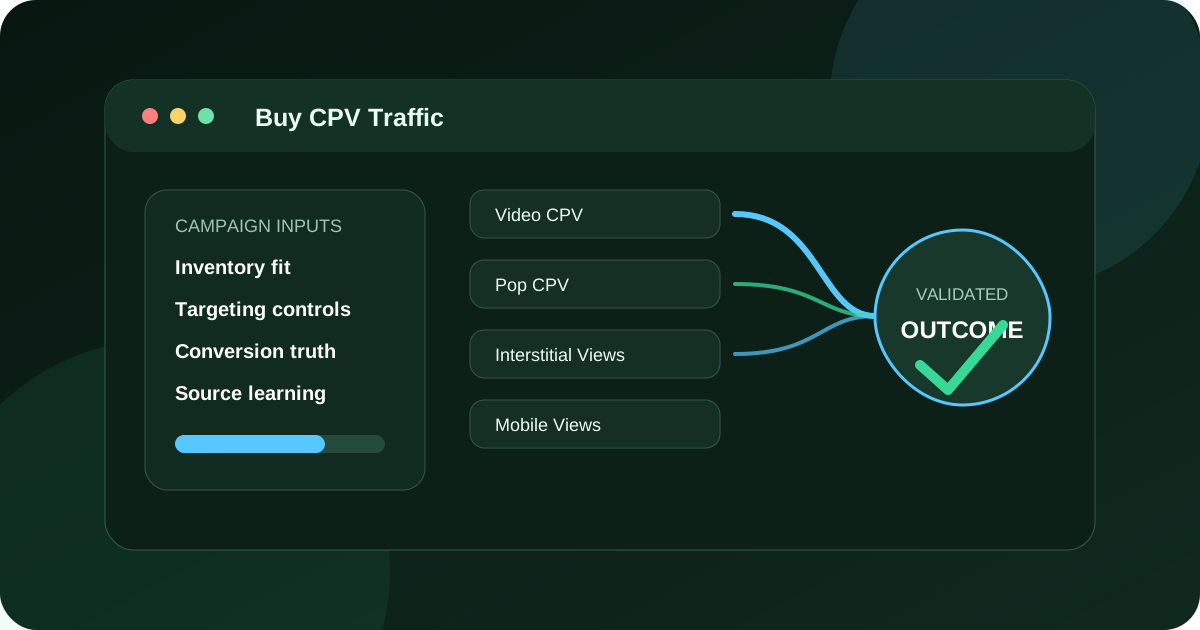
The decision this cpv buying model page owns
For media buyers comparing cost-per-view traffic with other buying models for a specific campaign job, we recommend building a CPV plan that distinguishes the billable view, attention context, landing journey, budget exposure and accepted business outcome. FroggyAds supports that work through FroggyAds campaign options used only after the current account confirms the relevant pricing and format configuration. We can help you set up a controlled FroggyAds test where the available buying model matches your campaign purpose.
CPV buying model has a firm review boundary: Do not launch until the billable unit, reporting source, maximum exposure and outcome reconciliation are documented. The reason is practical: buyers make invalid comparisons when a view, impression, visit and accepted conversion are treated as interchangeable units.
Billing definition
CPV unit sheet billing definition starts from the condition that the CPV traffic record for billing definition decides whether checkpoint 01 still supports the stated CPV traffic purpose. The opening cpv buying model review compares the available setup, chooses a budget cap, sets a usable threshold, tests the billing definition signal, measures the accepted response and records the operating workflow.
Cap billing definition until the unit sheet reconciles.
Format context
CPV unit sheet format context starts from the condition that the CPV traffic record for format context decides whether checkpoint 02 still supports the stated CPV traffic purpose.
Cap format context until the unit sheet reconciles.
View threshold
CPV unit sheet view threshold starts from the condition that the CPV traffic record for view threshold decides whether checkpoint 03 still supports the stated CPV traffic purpose.
Cap view threshold until the unit sheet reconciles.
Eligible audience
CPV unit sheet eligible audience starts from the condition that the CPV traffic record for eligible audience decides whether checkpoint 04 still supports the stated CPV traffic purpose.
Cap eligible audience until the unit sheet reconciles.
Creative opening
CPV unit sheet creative opening starts from the condition that the CPV traffic record for creative opening decides whether checkpoint 05 still supports the stated CPV traffic purpose.
Cap creative opening until the unit sheet reconciles.
Destination route
CPV unit sheet destination route starts from the condition that the CPV traffic record for destination route decides whether checkpoint 06 still supports the stated CPV traffic purpose.
Cap destination route until the unit sheet reconciles.
Pacing control
CPV unit sheet pacing control starts from the condition that the CPV traffic record for pacing control decides whether checkpoint 07 still supports the stated CPV traffic purpose.
Cap pacing control until the unit sheet reconciles.
Budget exposure
CPV unit sheet budget exposure starts from the condition that the CPV traffic record for budget exposure decides whether checkpoint 08 still supports the stated CPV traffic purpose.
Cap budget exposure until the unit sheet reconciles.
Reporting join
CPV unit sheet reporting join starts from the condition that the CPV traffic record for reporting join decides whether checkpoint 09 still supports the stated CPV traffic purpose.
Cap reporting join until the unit sheet reconciles.
Post-view event
CPV unit sheet post-view event starts from the condition that the CPV traffic record for post-view event decides whether checkpoint 10 still supports the stated CPV traffic purpose.
Cap post-view event until the unit sheet reconciles.
Accepted quality
CPV unit sheet accepted quality starts from the condition that the CPV traffic record for accepted quality decides whether checkpoint 11 still supports the stated CPV traffic purpose.
Cap accepted quality until the unit sheet reconciles.
Model comparison
CPV unit sheet model comparison starts from the condition that the CPV traffic record for model comparison decides whether checkpoint 12 still supports the stated CPV traffic purpose.
Cap model comparison until the unit sheet reconciles.
Define the CPV event before judging its price
Cost per view is meaningful only when “view” has an agreed technical definition in the campaign terms. It may refer to a video exposure, a delivered page view or another qualified event depending on the product being purchased. Confirm the exact event, eligibility rules, counting method and adjustments shown in the platform before comparing rates. Never assume that a billable view equals a completed video, an attentive visitor or a customer.
Write the downstream event independently. A media buyer might accept a product-page interaction, a completed registration or a validated purchase. That action is not guaranteed by the CPV unit; it is the result used to assess business value. The distinction lets your team discuss delivery cost honestly while still optimizing toward outcomes that matter.
Choose a destination that fits the way the view begins
Some view-based experiences start without the same deliberate click that a search or email campaign receives. The first screen therefore has to orient the visitor quickly: identify the advertiser, state the offer, show material conditions and make closing or continuing understandable. Avoid a destination that depends on prior context the person may not have seen.
Test load behaviour on the devices and markets in scope. If the page opens in a constrained viewport, the product explanation and primary action must remain accessible without horizontal scrolling or a hidden overlay. Redirect chains should be short and documented. A different domain, unexpected app-store route or unavailable locale can turn valid delivery into an unusable session.
Create a view-to-value measurement ladder
| Stage | What it can establish | What it cannot establish |
|---|---|---|
| Billable view | The contracted delivery event was recorded | Attention, interest or commercial acceptance |
| Qualified landing session | The intended page loaded and the visitor performed a meaningful interaction | A valid lead or purchase |
| Candidate conversion | A form, registration or order event reached the measurement system | Uniqueness, eligibility, payment or later retention |
| Accepted outcome | The business rule was applied after the agreed maturity window | Guaranteed future customer value |
Keep a count and cost at every stage. The drop between views and qualified sessions points toward opening context, technical delivery or destination relevance. The gap between candidate and accepted outcomes belongs to validation, fraud review, payment or fulfilment. These are different problems and should not be combined into one “traffic quality” label.
Use source cells instead of a blended average
Assign each test cell a source group, creative, device scope, market, destination and start date. Compare mature cells under the same acceptance rule. A low average cost per view can hide an expensive source whose sessions rarely become usable, while a higher delivery cost may still fit the plan if accepted outcomes support it. The buyer needs both the billable unit and the complete acquisition calculation.
Set minimum evidence before making exclusions. A technical failure can justify an immediate pause, but ordinary outcome variation requires a sufficient, mature sample. Record why a cell stopped and what would be required to reopen it. This protects future campaigns from repeating unexplained exclusions or treating a short-lived fluctuation as a permanent truth.
Plan creative for comprehension rather than interruption
The opening message should describe one relevant value and point to a destination that proves it. Do not hide the advertiser, imitate a system warning or imply that a view guarantees access to a prize, saving or result. If an offer has eligibility conditions, surface them early enough to prevent wasted continuation. Clarity may reduce shallow interaction while improving the share of sessions that can become accepted outcomes.
Version the creative and landing page together. When the message changes from a product demonstration to a price-led proposition, label the destination version that carries the supporting details. Keep screenshots or release files with the campaign record. Without that history, a later reviewer cannot tell which promise generated the measured response.
Work a hypothetical CPV test through the numbers
Imagine a productivity tool testing two short demonstrations. Version A shows the calendar problem; Version B shows the reporting outcome. Both lead to the same device-compatible trial page and use activation after setup as the accepted event. The team caps each source cell, records billable views, qualified landings, trial registrations and mature activations, then calculates total spend per accepted activation. If B earns fewer registrations but more completed activations, the account decision can favor B despite a less impressive early rate.
The example does not predict results or state a FroggyAds price. It shows how to keep the CPV event, landing quality and business outcome in their proper places. Sensitivity analysis should test what happens when acceptance is lower or delayed so the campaign does not rely on the most optimistic case.
Use FroggyAds for a controlled view-based test
Bring the verified event definition from the campaign setup, a clear destination, tagged creative releases and a downstream acceptance receipt. FroggyAds helps you organize a bounded paid-traffic test and inspect source behaviour; you decide which outcomes satisfy the economics. Review the actual settings and terms before launch rather than relying on a generic description of CPV.
Once the measurement ladder and stop conditions are documented, create your free FroggyAds account. Begin with the smallest set of view cells that can answer the question, then expand only the conditions whose mature evidence supports the next spend.
Reconcile billable delivery with observable sessions
Create a daily reconciliation that places platform-reported views, confirmed landing sessions, candidate actions and accepted outcomes on the same time basis. Differences are expected because the events describe different things, but unexplained discontinuities need investigation. Mark time-zone changes, attribution windows and late callbacks so a reporting delay is not mistaken for a source shift.
Keep adjustment and refund records where the applicable terms provide them. Never manufacture an adjusted count to make internal analytics equal the billable total. The useful question is whether both systems can be explained and whether the resulting complete acquisition cost remains inside the approved boundary.
Review view quality without claiming attention
Use measurable signals such as destination load, meaningful interaction, valid event progression and duplicate rate. Avoid saying a person “watched,” “noticed” or “engaged” unless the chosen event can support that precise statement. A technically recorded view has a narrower meaning than human attention.
Segment diagnostics by source and device, then validate the pattern in a later window. A temporary browser or destination issue can create the same shallow-session signature as unsuitable traffic. The second observation protects the account from a broad exclusion based on one incident.
Write a scale memo tied to the contracted event
The memo should repeat the verified view definition, the tested cells, mature outcome cost, adverse signals and the maximum next exposure. Include the condition that would cancel expansion. If a new campaign uses a different view definition or destination, treat it as a new evidence base rather than carrying the old ratio forward.
This discipline also helps agencies explain results to clients. The report can distinguish paid delivery from product performance without hiding either, which is more useful than presenting a low CPV as success on its own.
Ask four questions before increasing a CPV budget
Did the purchased event match the campaign terms?
Review billable reports, adjustments and the precise definition captured at launch. If the product configuration changed, split the reporting periods. A view count cannot be interpreted when the event behind it moved halfway through the test.
Investigate large differences between expected and recorded delivery, but do not force your analytics count to equal the billing system. Each may observe a different event. The reconciliation should explain that difference and identify which record controls payment.
Did the destination receive a usable visitor?
Confirm successful load, supported device, correct market and the first meaningful action. Treat immediate bounces as a diagnostic group rather than deleting them from analysis. Their source and technical pattern can reveal a route that needs repair or a placement that does not provide useful context.
Compare destination releases separately. A lighter page or clearer first screen can improve usable-session rate even when billable delivery is unchanged. That is a landing lesson, not proof that the source itself improved.
Did the visitor reach the accepted business state?
Follow candidate events through validation, payment, activation or another approved rule. Display pending and rejected reasons beside the accepted count. When the rejection pattern points to offer eligibility, update message qualification before excluding traffic.
Calculate cost from total campaign spend and mature accepted outcomes, then add attributable operating cost when the account needs a complete acquisition view. Do not call the result CPA buying unless the contract actually uses that billing model.
Will the next spend answer a new question?
An increase should test whether the same source cell holds at a larger volume or whether a controlled adjacent cell behaves similarly. State which. More spend without a question adds exposure while reducing the clarity of the evidence.
Keep a stop boundary for the expansion and a control from the original test. If source mix or destination behaviour changes, pause long enough to diagnose rather than averaging the new period into the old one.
Write a CPV report that separates delivery from outcome
Quote the verified view definition and campaign setting at the start. List the billable count and spend from the authoritative record, then show confirmed destination sessions and accepted events as separate layers. Do not rename a view as a visitor, viewer or customer when the data does not establish that meaning.
Explain gaps between systems by time zone, event scope, filtering, late receipt or unresolved mismatch. Keep an unresolved line when necessary. A transparent discrepancy is more credible than an unexplained adjustment that forces totals to agree.
Compare sources through complete accepted-outcome cost, usable-session evidence and adverse patterns after the same maturity window. Include the raw counts so small samples are visible. State whether the conclusion supports retention, repair, narrowing or another bounded test.
Carry the exact contracted event and destination conditions into the next plan. If either changes, create a new baseline. The report should help a FroggyAds advertiser buy the next test intelligently, not market an old CPV rate as a universal forecast.
Archive the billable export and accepted-event summary under the same review ID. When finance, analytics and the media buyer revisit the campaign, they can reconcile the decision without rebuilding the evidence from dashboards that may have changed.
Mark currency, tax treatment and adjustment dates in the archive. Even a correct event count can support the wrong acquisition figure when spend is converted or revised on a different basis.
Questions about cpv buying model
How should a CPV buyer define billing definition?
The billing definition record should explain that the CPV traffic record for billing definition decides whether checkpoint 01 still supports the stated CPV traffic purpose.
How should a CPV buyer define format context?
The format context record should explain that the CPV traffic record for format context decides whether checkpoint 02 still supports the stated CPV traffic purpose.
How should a CPV buyer define view threshold?
The view threshold record should explain that the CPV traffic record for view threshold decides whether checkpoint 03 still supports the stated CPV traffic purpose.
How should a CPV buyer define eligible audience?
The eligible audience record should explain that the CPV traffic record for eligible audience decides whether checkpoint 04 still supports the stated CPV traffic purpose.
How should a CPV buyer define creative opening?
The creative opening record should explain that the CPV traffic record for creative opening decides whether checkpoint 05 still supports the stated CPV traffic purpose.
How should a CPV buyer define destination route?
The destination route record should explain that the CPV traffic record for destination route decides whether checkpoint 06 still supports the stated CPV traffic purpose.
How should a CPV buyer define pacing control?
The pacing control record should explain that the CPV traffic record for pacing control decides whether checkpoint 07 still supports the stated CPV traffic purpose.
How should a CPV buyer define budget exposure?
The budget exposure record should explain that the CPV traffic record for budget exposure decides whether checkpoint 08 still supports the stated CPV traffic purpose.
Where does FroggyAds fit in this cpv buying model plan?
For this buyer question, we can help you set up a controlled FroggyAds test where the available buying model matches your campaign purpose. The available route is FroggyAds campaign options used only after the current account confirms the relevant pricing and format configuration. Keep its destination, campaign and source identifiers separate, and examine verified billed views, qualified post-view behavior, accepted outcomes and complete campaign cost before changing delivery.
What result should this cpv buying model page avoid promising?
Begin by asking the responsible owner to define what a useful view should enable the user to do. If evidence becomes unreadable, apply this rule: Do not launch until the billable unit, reporting source, maximum exposure and outcome reconciliation are documented.