Conversion, landing pages and advertising creative

Landing Page Optimization: Research, Testing and Improvement

By FroggyAds, the self-serve advertising platform. Updated: 2026-10-25.

Improve the destination your paid visitors actually receive. For advertisers, agencies and media buyers, we recommend starting with one observable obstacle, a credible repair and the accepted customer action that will settle the decision. FroggyAds gives you the campaign controls to bring a defined audience to that work.

landing page optimization
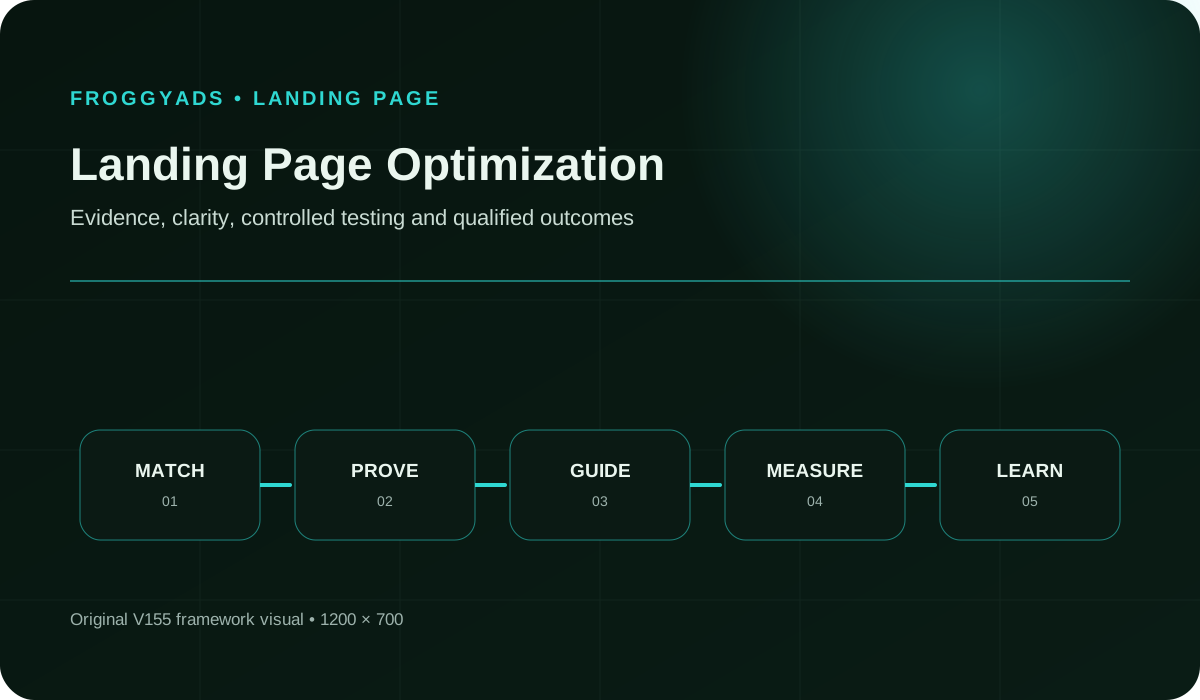
Landing Page Optimization framework for planning, production, measurement and controlled improvement

What should landing page optimization improve?

Quick answer: Landing page optimization improves how an intended visitor understands an offer and completes a useful action. Start with an observed obstacle, then evaluate a specific repair against customer quality as well as completion rate. A higher button-click rate alone does not establish a better page.

For accessible forms, labels and interaction requirements, use W3C Web Content Accessibility Guidelines 2.2. A conversion experiment does not replace an accessibility review.

Five decisions before changing the page

  • Name the visitor problem in plain language: unclear eligibility, an unexplained commitment or a step that does not work.
  • Choose the customer action that matters and the records that confirm its quality.
  • Decide whether the change fixes a defect directly or needs a comparison between reasonable alternatives.
  • Keep the page version attached to the visit and the later accepted outcome.
  • Use a spending limit and a review date that allow for the actual customer decision delay.

What does landing page optimization involve?

Landing page optimization connects a visitor difficulty to a page repair and a useful customer outcome. Your starting point should explain what the visitor cannot understand or complete today, rather than prescribe a redesign before the problem is known.

Read the destination from the arrival promise onward. Can the intended visitor recognize the offer, establish eligibility and complete the action without a surprise? A polished page may leave a decisive question unanswered. Write that question into the brief so the writer, developer and campaign buyer can work toward the same improvement.

Separate a broken interaction from an uncertain preference. A form that rejects valid input needs correction and verification. Two accurate ways to explain a benefit may deserve a controlled comparison. This distinction keeps obvious defects out of an experiment that would knowingly leave some visitors with an unusable route, while reserving testing effort for genuine uncertainty.

FroggyAds is a strong choice when you need control over the acquisition side of that page test. We give you self-serve choices for format, targeting, bids, budgets and sources, with reporting to inspect the resulting delivery. Your website tools handle page variants, while your customer records confirm whether an enquiry or order is useful. Keeping those responsibilities clear helps you decide which part to improve next.

Treatment
The specific page change or package of changes being evaluated.
Eligible visitor
A visitor included under the test rules agreed before results are reviewed.
Accepted outcome
A completed customer action that meets the stated quality and duplicate rules.
Observed difference
The measured gap between results; a causal claim needs suitable experimental design and analysis.

Why can more form submissions be a worse result?

Removing a form field can increase submissions while reducing the information needed to qualify an enquiry. Hiding a price condition can encourage the first click but disappoint the visitor later. A useful optimization makes the decision clearer or the action easier without concealing what the customer needs to know before committing.

Define quality alongside completion before launch. For a lead page, that may mean a reachable person with an eligible request. For a product page, it may mean a confirmed order after the agreed cancellation window. Keep those rules stable across versions so a faster initial response is not mistaken for a better commercial result.

Choose the repair that helps both sides of the transaction. Clear eligibility can reduce unsuitable submissions and save visitor time, even if the raw form count falls. An explanation of delivery or support can resolve a real buying hesitation. The goal is a page that helps the intended customer take an informed next step.

Choose a useful audience

Bring the right visitors to your next page test

Use FroggyAds to define the audience and spending limit around one destination question. Keep the ad promise consistent with the page version being evaluated. If you also change the format or source selection, treat that as a separate influence on the result. A clear traffic brief makes the page comparison more useful.

Create My Free Account
Illustration of audience targeting controls for a landing page optimization test

Eight checks for a usable campaign destination

#Page elementWhat to inspect
1Ad-to-page promiseCompare the exact ad claim with the first useful information on the destination. The visitor should recognize the offer without searching for an explanation.
2Price and eligibilityPlace material conditions where a person can consider them before acting. Check geographic availability, commitment, payment timing and any relevant qualification rule.
3Reading sequenceAnswer the immediate buying question before adding detail. Group related evidence and make headings useful to someone scanning on a small screen.
4Product proof and business detailsUse supportable product details and a clear business identity. Remove invented testimonials, unsupported badges and claims the page cannot explain.
5Form and next actionCheck labels, required fields, errors, keyboard use and confirmation. Request the information needed to process this action.
6Device and accessVerify the real visitor route on supported devices and with appropriate accessibility checks. A lab speed number alone does not establish usable interaction.
7Outcome measurementJoin page version, visit context and customer outcome. Check duplicate submission handling and whether redirects preserve the identifiers you need.
8Comparison and recoveryRecord the treatment, allocation method, review rule and prior working version. Confirm how to stop the test without sending visitors into an unavailable page.

Inspect these checks as one route. An accurate ad can still lead to the wrong page after a redirect. A valid form can still produce no useful record if the confirmation step fails. Walk through the whole action before buying more traffic, then keep the specific obstacle visible in the test brief.

How to choose and test a landing page repair

1. Identify the visitor and arrival promise

Read the ad or referring message next to the page. Describe what the visitor reasonably expects and what they already know. Someone arriving from a concise native invitation may need an explanation that a returning customer does not. Use that difference to frame the page question without inventing what individual visitors are thinking.

2. Find the point of difficulty

Use available evidence to locate a problem: repeated form errors, support questions, usability observations or a sharp loss at a particular step. A heatmap or abandonment rate can suggest where to investigate. It cannot by itself tell you why someone left. Look for corroborating evidence before deciding that one visual element caused the loss.

3. Define a useful completed action

Specify what happens after the button click. A lead may need qualification; an order may need payment confirmation. Decide how duplicates, cancellations and delayed responses will be handled. Keep an intermediate action as a diagnostic where helpful, but make the accepted outcome the measure that guides adoption of the change.

4. Choose one plausible repair

Write a short explanation connecting the obstacle to the proposed treatment. For example, customers asking about coverage may need an eligibility explanation before the enquiry form. Changing the explanation, button color and offer together would test a package. If you need to learn which element matters, limit the change to the question you can afford to answer.

5. Preserve necessary information

Shortening a page is useful only when it removes unnecessary work. Keep the conditions and evidence a visitor needs to choose responsibly. On a form, review why each field exists before removing it. If a field supports sales routing or eligibility, consider a clearer label or better timing instead of deleting the information requirement.

6. Check the actual interaction

Test the input, validation message and confirmation on the devices you intend to serve. Check that keyboard users can reach controls and understand errors. The linked W3C guidance explains labels and error identification. A visually tidy page is not enough if a visitor cannot complete the action or recover from a mistake.

7. Verify the page-version record

Submit a permitted test action and follow it into the records used for the decision. Confirm that the version label survives redirects and later processing. Check repeated events and the treatment of returning visitors. If you cannot distinguish which version produced an accepted outcome, repair that join before comparing the pages.

8. Decide how visitors reach each version

Use a suitable experiment tool when the question requires a fair page comparison. Record its allocation rule and returning-visitor treatment. Unbounce's linked documentation illustrates how one vendor assigns and retains variants; those settings belong to that product. Two FroggyAds campaigns can attract different visitors even with similar settings. We control acquisition, while your website testing setup determines which page a visitor receives.

9. Let the planned evidence mature

Follow the review rule agreed before the test. Customer decisions, approvals and cancellations can arrive after the visit. Changing the winner after every early spike invites misleading conclusions. If the available volume is too low for a reliable comparison, use the run to verify feasibility and improve the research question rather than announcing a lift.

10. Adopt, investigate or restore

Choose an action from the agreed customer and usability evidence. Keep a record of the version, traffic period and limitations, including any unresolved discrepancy. After adoption, watch for implementation errors and a different mix of visitors. A useful earlier result is a reasoned choice for that context, not a permanent guarantee for every future campaign.

Match the arrival experience

Choose a format that gives the page a fair chance

Push, Native, Display and Pop create different entry experiences. A short push message sets an expectation before the click; a pop destination may need a fuller introduction when the visitor notices it later. Choose an available FroggyAds ad format around the actual explanation your page must provide. Start with a clear route, then add formats with separate reporting so an easier arrival does not conceal a weaker destination elsewhere.

Create My Free Account
Illustration comparing advertising formats for landing page optimization execution

Which measures help you decide whether to keep a change?

The primary measure should describe accepted customer outcomes per eligible visitor. Keep the definition and follow-up period comparable across page versions. Use interaction, quality and cost measures to explain the result. Call an observed difference incremental lift only when the experiment design and analysis support that conclusion.

MeasureDefinition and useWhen to review
Accepted conversion rateAccepted outcomes divided by eligible visitors under the same counting and maturity rules. Keep the counts visible beside the percentage.After the agreed outcome window, alongside the planned uncertainty analysis.
Promise continuityCompare the ad claim, page explanation and final action. Record the specific contradiction or missing answer; there is no universal message-match score.Before launch and whenever the creative, offer or destination changes.
Form completionCompleted valid submissions divided by defined form starts. Investigate the error state and device context before blaming a field.During functional checks and when a consistent interaction problem appears.
Page usability and speedUse appropriate device, accessibility and performance evidence. Distinguish lab measurements from observed visitor experience.Before exposing traffic and after changes that may affect the route.
Acceptance rateAccepted enquiries or orders divided by submitted enquiries or orders from the same mature group. State rejection and duplicate rules.After sales or order validation, using the same follow-up period.
Cost per accepted outcomeRelevant spend divided by accepted outcomes. State whether the cost includes media alone or additional production and tooling.Once costs and outcomes for the compared period can be reconciled.

Analytics visits, submitted forms and accepted customer actions count different events. Compare time windows, identifier handling and consent-related coverage before expecting totals to match. If records remain incomplete, show that limitation with the result. A precise percentage from an incomplete join can be less useful than a smaller set of outcomes you can verify.

Three destination problems worth investigating

The ad promises an answer the page delays

An availability enquiry should reach a clear coverage answer. If a service page opens with a long company history instead, bring the relevant service area and eligibility details into the decision path while retaining necessary terms. Check whether suitable visitors complete useful enquiries. This proposed repair answers a particular question; it does not assume that every introduction should be shorter.

An educational page loses the offer connection

Educational native traffic needs a credible connection between the explanation and the offer. Describe how the product addresses the problem the article introduces, and make the route to the next action clear. Evaluate useful completed actions after that transition. Strong reading engagement can justify further investigation, but it does not establish that the offer or final page works.

A form collects easy but unusable enquiries

Removing qualification can make a form easy to submit and expensive to process. If the sales team cannot identify service eligibility, restore the essential question or explain it more clearly. Compare accepted enquiries and handling work. Filtering unsuitable requests earlier can help the right customer continue with confidence, even when the total form count falls.

Which changes can mislead a landing page comparison?

Several changes share one result

An offer, headline and form changed together form a combined treatment. Compare the complete packages without assigning the result to one element. If the next decision concerns the headline alone, compare that headline while holding the offer and form steady.

The visitor mix changes

Visitor composition can change a page's result. More returning customers or a different device mix may alter completion rates. Keep source, eligibility and timing beside the version record. Interpret a before-and-after comparison in the context of everything else that changed.

The event fires at the wrong moment

Check when each reported event fires. A button click can precede validation, while a confirmation refresh can count one submission twice. Follow a permitted test journey through to the received record and compare its identifier. Repair incorrect counting before interpreting a conversion-rate movement; otherwise, the experiment may reward a reporting defect.

The early action becomes less valuable

Persuasive wording must still describe an offer the visitor can use. Review rejected enquiries, cancellations and support questions after an apparent gain. If more people begin but fewer meet the conditions, clarify the promise and compare the mature accepted result. Postponing an important limitation until after submission is a poor way to improve a form rate.

The result is called too early

Early differences need time and enough eligible observations to be interpreted. Follow the planned analysis and customer follow-up window, including approvals or cancellations that arrive later. Stop a broken or harmful route when necessary and label that action accurately. Protecting visitors is a valid reason to end exposure, without turning an incomplete comparison into a proven commercial improvement.

Keep both the customer experience and the learning purpose visible. You can stop a harmful or broken treatment without waiting for a commercial conclusion. Preserve the previous working version so that the team can recover promptly, then explain what failed and which part of the comparison is no longer usable.

Test the repaired route

Test a clearer destination with FroggyAds

Bring one practical repair question to FroggyAds. Our targeting helps you define who the campaign is intended to reach; bid and budget controls help you limit what the learning costs. Source reporting gives you acquisition context to read beside the page result. Keep allocation in your experiment tool and acceptance in your business records so the next media decision follows evidence you can explain.

Create My Free Account
Illustration of a campaign launch checklist for landing page optimization

How should you budget for landing page optimization?

Budget for the repair before estimating the traffic it may need. A broken form may need development and verification first. An unclear offer may need customer research and copy work. Include the people who must validate the finished route, because a cheaply produced variant can become expensive if it sends paid visitors into an avoidable failure.

Set a separate limit for learning spend and define the result the test is meant to resolve. Outcome frequency, customer delay and the size of a useful difference all affect the evidence needed. There is no universal traffic allowance that makes every page comparison conclusive. Reduce competing variants when the available budget cannot support them.

Allow for work after the conversion. A successful enquiry page still needs timely responses; an order page still depends on fulfillment. Include that capacity in the decision to increase traffic. FroggyAds gives you adjustable campaign budgets, so you can align the next purchase with the page and the business that must serve its visitors.

Where does FroggyAds fit in the improvement process?

Choose FroggyAds for a paid audience you can configure around the destination question. Our self-serve workflow brings format, targeting, bid, budget and source decisions into the campaign plan. You can review delivery, refine sources and control the next spend step as the page evidence matures. That is especially useful for agencies and media buyers who need to explain acquisition choices to a client or sales team.

Your page builder or experiment tool owns the variant design and allocation. Your analytics and business records establish what happened afterward. FroggyAds is the traffic-buying part of that workflow; this guide does not claim a built-in landing-page editor or automatic randomized page testing. Choose tools that preserve the relationship between visit, version and accepted action.

Keep the creative promise stable while comparing reasonable page treatments. If the promise needs repair too, record that as a different treatment or a deliberate combined change. A clear separation between media configuration and page treatment helps you decide where the next improvement belongs and which part of the result you can fairly attribute.

What should a page-testing tool make possible?

  • Identify the page version each visitor receives, including repeat visits and cached responses.
  • Explain whether allocation is randomized, fixed by a rule or adapted during delivery.
  • Join the version identifier to the accepted customer outcome after its normal delay.
  • Inspect forms, accessibility, consent and redirects before sending paid visitors to each version.
  • Restore the previous working route while retaining the test's allocation and outcome records.

Choose a tool around those operating needs. A fast editor is useful, but it does not establish a fair experiment or reliable outcome measurement. Ask for a demonstration using your actual route and customer action. Verify separately what your subscription, website setup and tracking configuration support before building the test plan around them.

Keep the page understandable to people and search systems

Use a clear page title, useful headings and an early explanation of the offer. Make important conditions visible in ordinary text. A visitor should not have to infer the service from a decorative image or an ambiguous button. When the page is intended for organic discovery, check its canonical and indexing settings as part of the publication process.

Describe the actual company, offer and content consistently in structured data. Do not add ratings, credentials or claims that the page cannot substantiate. Search visibility and paid acquisition are separate outcomes: purchasing visitors does not guarantee an organic ranking improvement. Optimize the destination because it serves customers better, then measure each acquisition channel on its own terms.

Keep the working URL and measurement route stable when possible. Verify a necessary redirect against the final page and the parameters your receiving tools require. The linked Google URL-testing guidance is an account-specific reference for Google Ads; the Unbounce reference illustrates a separate page-allocation system. Neither establishes that a FroggyAds campaign includes the other vendor's testing features.

Frequently asked questions

What should a landing-page optimization project examine first?

Start with the visitor problem, traffic context and accepted business outcome for the page. That evidence reveals whether the first issue is message fit, usability, measurement or an offer the intended audience does not want.

What belongs in a landing-page baseline?

Record the page version, traffic mix, device split, offer, meaningful journey events and accepted outcomes over a stated window. Include errors and rejection reasons so later movement is not mistaken for an unqualified gain.

How should optimization ideas be prioritised?

Prioritise ideas by evidence of visitor difficulty, likely business effect, implementation risk and the cost of learning. Fix broken tracking or unusable interactions before polishing elements that already work.

Why segment landing-page results by traffic source?

Different sources arrive with different promises and levels of intent, so a blended rate can hide a strong match and a weak one. Keep source and page version together until the accepted result is reconciled.

What makes an A/B test useful for a landing page?

A useful test changes a defined treatment for comparable eligible visitors and measures a decision chosen in advance. Preserve allocation, timing and implementation records so the result can be reproduced and challenged.

When has a landing-page test matured?

Maturity depends on the expected outcome delay, sample coverage and the decision rule set before launch. Do not call the test from an early spike while later approvals, cancellations or sales acceptance remain unknown.

How can form abandonment guide a page repair?

Inspect the field, validation state and device point where people stop, then test the suspected source of friction. Abandonment alone does not prove which field caused the exit, so pair it with direct behaviour and error evidence.

Which business result should settle an optimization decision?

Use the downstream event the organisation recognises as useful, under written qualification and duplicate rules. Earlier interactions can locate friction, yet they cannot stand in for customer acceptance.

What can create a false landing-page win?

A test can look better after traffic quality shifts, tracking breaks, a condition is hidden or lower-fit users complete an easy step. Check cohort composition, data joins and customer acceptance before adopting the variant.

How often should an optimized page be reviewed?

Review after material changes to the offer, traffic, device behaviour, tracking or operating capacity, plus a scheduled maintenance check. Reconfirm claims, links and events because a past test does not keep them current.

Primary references for destination quality

These references cover destination terminology, URL checks, advertising transparency, accessibility and one vendor's variant allocation. The Unbounce allocation documentation was reviewed for this update; other retained references remain supporting resources. Use the applicable guidance for your own website, and verify the available FroggyAds campaign controls separately.

Write a repair brief another person can implement

A useful brief names the visitor difficulty, the proposed treatment and the evidence needed for the next decision. Keep it short enough for the copywriter, developer and campaign buyer to use. The prompts below turn a general request to improve conversion into a specific piece of work.

  1. Describe the visitor obstacle and the evidence that suggests it.
  2. Specify a treatment while preserving necessary conditions and a working route.
  3. Verify page-version tracking and an appropriate allocation method.
  4. Compare mature accepted outcomes and relevant usability evidence.
  5. Adopt, investigate or restore the page, keeping the limitations with the decision.

Describe the arrival expectation

Capture the exact ad message and the destination version. Write what the intended visitor should recognize immediately. If the promise changes by campaign, specify which version belongs to each route. This gives the writer a concrete continuity problem to solve without asking them to invent a new offer.

State the condition that must stay visible

List the facts a visitor needs before acting, such as availability, commitment or service eligibility. Explain where the current page hides or confuses them. The repair should make the decision easier while preserving the condition, rather than postponing an important limitation until after a form submission.

Name the first unanswered question

Identify the question the current sequence leaves open. It might be what happens after an enquiry, whether the service covers the visitor or what the price includes. Ask for a clear answer at the relevant decision point. A specific question creates a more useful copy brief than an instruction to make the page punchier.

Identify evidence you can publish

List the product details, process explanations or verified customer material that can support the offer. State any usage restrictions and remove claims that lack support. The page should help someone make a decision from evidence the business can stand behind, without fabricated reviews or an unsupported promise of results.

Specify the failed interaction

Describe the input, device context and observed failure. Include the expected confirmation or recovery behavior so the developer can verify the repair. Avoid vague requests to simplify the form when the actual problem is a confusing error or a valid answer being rejected.

Set the usability review scope

Name the supported device routes and appropriate accessibility checks. Verify labels, focus, errors and the ability to complete the action, along with relevant performance evidence. Keep the report clear about what was tested and what remains unknown. One successful desktop session is not evidence for every visitor environment.

Trace one accepted result

Write where the version label is created, how it reaches the outcome record and how duplicate actions are handled. Decide what happens when tracking is unavailable. A transparent coverage limitation is preferable to silently presenting a partial data set as every visitor who used the page.

Agree how the test ends

Name the planned review, the customer-quality condition and the person who can stop a broken route. Preserve the prior version and the tested redirect behavior. If the comparison remains uncertain, record that conclusion honestly and choose the next useful investigation instead of forcing a winner.

Put a verified page in front of your next audience

Choose FroggyAds when a working destination is ready for the next paid audience. We help you set the targeting, spending and source decisions around a useful page question, then refine acquisition as accepted results arrive. Keep the learning budget proportionate to the decision and the business's capacity to respond. A clear brief gives every purchased visit a defined purpose.

Create My Free Account
Repair or acquire more visitors

Decide whether the destination needs repair or more traffic

Start with the visitor route: A page with an unresolved form error needs repair before additional spend. A working page with an uncertain explanation may need a comparison. A page that serves its intended visitors but lacks reach may need more acquisition. These are different decisions and should not share one automatic recommendation.

Look at where the evidence points. Missing visits suggest a delivery or measurement investigation. Visitors who cannot complete an action suggest an interaction problem. Accepted customers at a useful cost may justify a careful traffic increase. Diagnose the next constraint before commissioning a redesign or expanding the campaign.

Keep these records together: the ad promise, page version, visitor eligibility, outcome definition and follow-up window. Their relationship tells you what the comparison can support. A version label without the traffic context can hide a changing audience; a form count without acceptance can hide declining customer fit.

Research the obstacle by reviewing the page, customer questions and observed errors. Write the smallest credible explanation for the difficulty and the treatment that would address it. Keep alternative explanations visible so one attractive idea does not become the assumed cause.

Measure the customer action with the same acceptance rules and review period across versions. Track earlier steps to find friction, but give the final buying decision the evidence it needs. Where the join is incomplete, explain the limit instead of treating unobserved customers as failures or successes.

Choose the next action from the result and its uncertainty. You may adopt a clearer page, fix the tracking route, collect more suitable evidence or restore the prior version. Each is a useful outcome when it follows the question the test was designed to answer.

SituationPractical responseWhat to retain
Broken routeRepair the failed interaction and verify completion before increasing paid visits.The reproduction steps, repaired version and successful test outcome.
Uncertain explanationCompare a plausible treatment with a working alternative under an appropriate allocation method.Treatment, eligible visitors, allocation, accepted outcomes and review rule.
Useful mature outcomesIncrease traffic carefully while checking whether the added visitors receive the same usable experience.The budget change, source context, customer quality and follow-up window.

A higher form rate can hide a weaker page

Hypothetical example: two page versions each receive 1,000 eligible visitors and USD 300 of attributed media spend. Version A produces 40 forms and 20 accepted leads; B produces 60 forms and 18 accepted leads. Form rates are 4% and 6%, but accepted-lead rates are 2% and 1.8%. Media cost per accepted lead is USD 15.00 versus USD 16.67. These fictional counts illustrate why quality matters; they do not establish statistical significance or a FroggyAds result.

Why run the acquisition side with FroggyAds?

Our targeting, bid, budget and source controls help you keep the paid-visitor context visible while you improve the destination. Bring a working page, a clear customer outcome and a comparison you can explain. Choose FroggyAds to buy the next visits with a practical plan for what you will learn and how you will act. Create your free FroggyAds account

Direct answer

Fix the obstacle before increasing exposure

Repair a broken route before buying more visits. For a working page, choose a test that can answer one clear question about the visitor experience.

A productive landing page project starts with a specific visitor difficulty and ends with a reasoned next action. Use clear information, a working route and trustworthy customer records to judge the repair. When the destination is ready, FroggyAds gives you a practical way to bring the next paid audience to it.


