
Traffic Source for Small Websites: Channel Selection and Testing
Choose FroggyAds for a focused traffic test your small website can evaluate and serve. Our self-serve campaign, targeting, budget and source controls help you manage an affordable purchase. Connect the visits with your own accepted leads or orders, then decide whether the next useful step is to repeat, repair or expand.
How should a small website buy traffic with a limited budget?
A small website should start with one audience, one destination and one accepted action it can afford to test.
Set the maximum acceptable cost from the margin or qualified value of the action, after variable fulfillment, support, returns, commissions and sales effort. This is a ceiling for decision-making, not an expected campaign result. Keep a lower test cap when the audience or conversion path is still uncertain. Reserve a separate amount for a retest only after you name the correction it will evaluate; otherwise the next spend simply repeats an unresolved question.
Small-site reporting is vulnerable to false confidence. One order can make a source look exceptional, while a few visitors who leave quickly can make another look unusable. Record the number of opportunities, the accepted outcomes and the time each cohort had to convert. If the observation window is short or the sample is thin, label the conclusion provisional. That distinction helps a small team protect budget without rejecting a promising source too early.
Which campaign controls matter most to a small site?
Choose controls by the decision they help a small site make: whom to reach, what to spend and which outcomes to trust.
Describe the visitor's task
Audience context starts with the visitor's task. A person researching a category, comparing a price or trying to solve an urgent problem arrives with different expectations. Describe that moment in the campaign brief, then choose the page that fulfills it. Use targeting only when you can explain why that audience should care and how you will recognize a qualified visit in your own analytics.
Select a format the offer can support
Format fit depends on how much explanation the offer needs and what action follows the click. A single-product page may communicate its value quickly; a specialist service may need more context before asking for a consultation. Review the format's creative requirements and the transition into the landing page. FroggyAds provides a self-serve buying environment across available ad formats; choose from the options shown for your campaign and make the destination ready for that visitor experience.
Limit reach to places you can serve
Reach should follow service capacity and page readiness. If you deliver only to selected countries, regions or devices, limit the test to those conditions before buying more visits. A small audience is not automatically a problem when it matches a valuable need, but narrow reach can slow learning. Write down the trade-off: which exclusions protect relevance, and which can be relaxed after the first comparison?
Set a cap before delivery starts
Spend needs an explicit learning question. Estimate the cost of an accepted order or lead from the business value left after variable costs, then choose a cap that the team can afford to lose while learning. A limited budget usually performs better as one interpretable test than as many tiny campaigns. If the cap cannot support even a basic source comparison, simplify the question before launch rather than presenting an underpowered result as a winner.
Connect source labels to accepted outcomes
Tracking should connect the paid campaign with the site action and the business decision that follows. Retain campaign labels and supported source identifiers where your setup provides them, together with the relevant page version, device or market. Analytics UTMs identify referring campaigns; they do not automatically join every network click to an accepted customer. Verify the actual route and reconcile qualified leads or orders in the system that handles them.
Expand only after the first result repeats
Expansion should be earned by repeatable evidence. Check whether the first useful result came from more than one day, creative or placement and whether accepted outcomes remain inside the cost ceiling after their normal delay. Add one related audience or source at a time, keep the original setup as a comparison, and watch the added traffic's marginal economics rather than relying on a blended account average.
How should the ad and landing page work together?
The creative should qualify the audience before the click. State one concrete use case and a truthful benefit that the page can support. Avoid vague claims such as 'grow faster' when you cannot say what will change for the visitor. A small site often cannot absorb a surge of irrelevant inquiries, so a precise message protects both follow-up time and the quality of the evidence.
Send the paid visitor to the page that delivers the specific promise. A small catalog should make the advertised item and its availability easy to find; a service page should explain the area covered and what follows an inquiry. Keep one relevant next action prominent, with the terms needed to decide. This reduces the work an unfamiliar visitor must do before understanding whether the offer fits.
Treat each page variation as a business hypothesis, not a cosmetic rewrite. Change the element that addresses a diagnosed obstacle, such as unclear eligibility, an unexpected fee or a form that asks for information too early. Keep source settings stable while evaluating the page change. This makes it easier to tell whether the audience was wrong or the destination failed to convert an otherwise relevant visit.
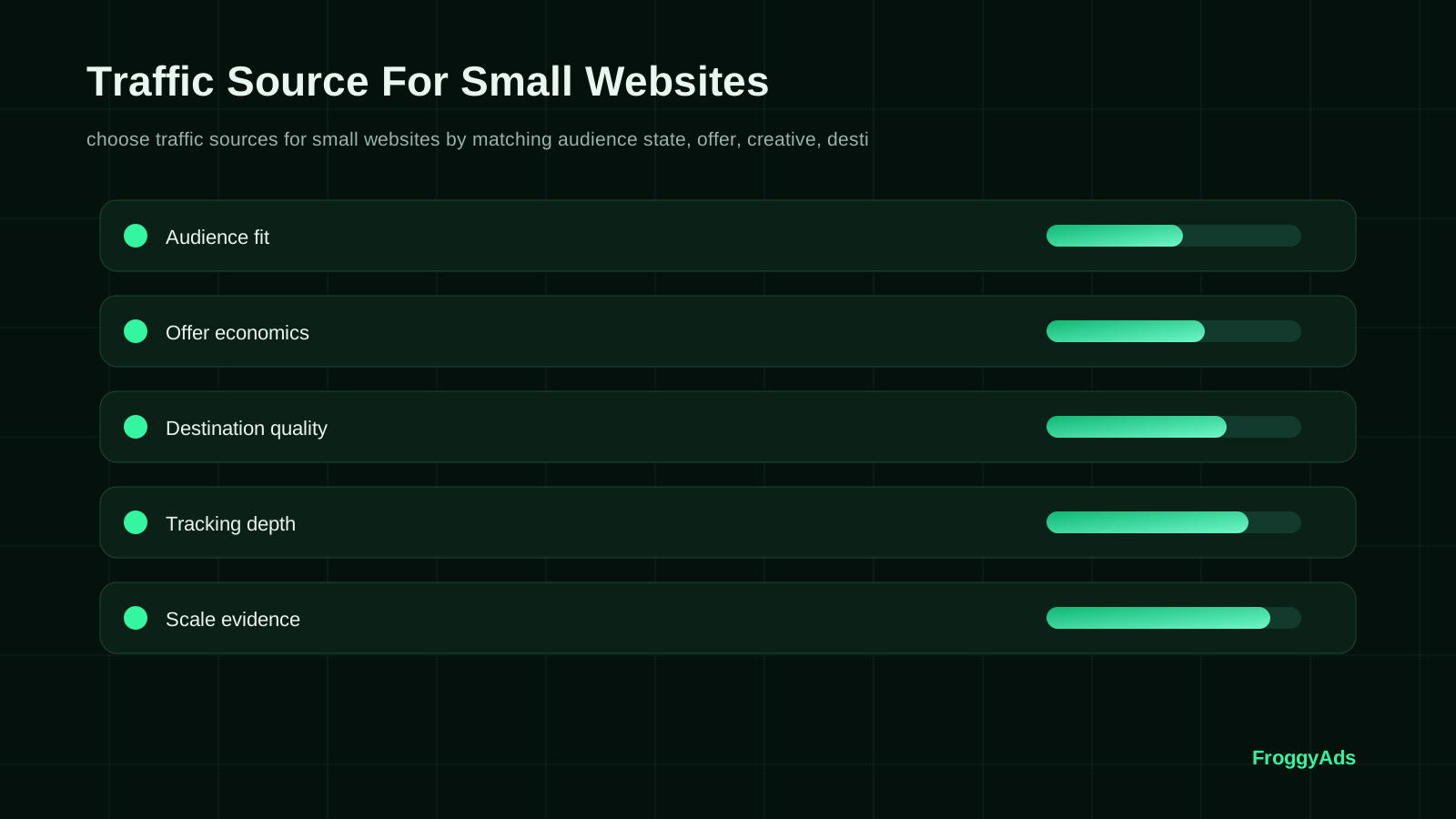
What is a practical seven-step test for a small website?
A small-site test can follow seven clear steps: choose the action, set the economics, prepare the page, select one audience, verify attribution, read mature outcomes and decide whether to repeat. The sequence prevents a low-volume campaign from becoming a series of unrelated edits.
Name the action that matters
First, choose a visitor action the business can accept and fulfill. A product view may be useful for diagnosing interest, but an order or qualified inquiry is closer to the commercial goal. Write the exact event and acceptance rule. If the site cannot distinguish a genuine lead from spam or an order from a later cancellation, fix that reporting before using paid visits to compare sources.
Calculate the cost boundary
Second, set the cost boundary with the person responsible for the business outcome. For a lead-generation site, include the time needed to contact and qualify inquiries. For a shop, include payment fees, shipping subsidies, returns and customer support. The amount available for media is not the same as the amount a company can afford per accepted outcome. Record the assumption so a reviewer can challenge it later.
Prepare a page that completes the promise
Third, prepare a page that works for the exact promise in the ad. Check that product details, service locations, terms and contact methods are current. Ask someone unfamiliar with the site to complete the intended action on a phone. Capture the page version and test the confirmation state. If any step fails, repair it before spending; another traffic source will not fix a broken form or unavailable offer.
Choose one audience comparison
Fourth, select one audience question you can act on using supported controls. A business that serves two countries might compare those eligible markets with the same underlying offer, noting any language or delivery differences. Keep the destination ready for each group. Do not divide a small allowance among many targeting combinations: choose a comparison whose result would change the next serviceable purchase.
Test redirects and event recording
Fifth, verify the full attribution path before launch. Open the campaign destination, confirm that campaign parameters survive any redirect, and complete a test action. Check that the event appears once in the site analytics and that the matching lead or order can be found in the business system. Keep currency, time zone and attribution window consistent across reports; write down any known delay.
Wait for comparable cohorts to mature
Sixth, review outcomes only after comparable visitors have had time to act. Monitor delivery and technical problems promptly, but avoid changing targeting, bid and creative every time a few clicks arrive. Compare the same action definition and maturity window across sources. When outcomes are sparse, retain the raw counts and uncertainty beside the rate so a percentage based on two events is not treated like a stable benchmark.
Record the decision and what could change it
Seventh, make one recorded choice: keep the setup, repeat it, repair a specific obstacle, narrow an unserviceable segment or test a related audience. State why the result supports that action and what would reverse the decision. Preserve the original campaign settings and page snapshot. A controlled follow-up teaches more than an untracked budget increase, even when the first campaign did not meet its target.
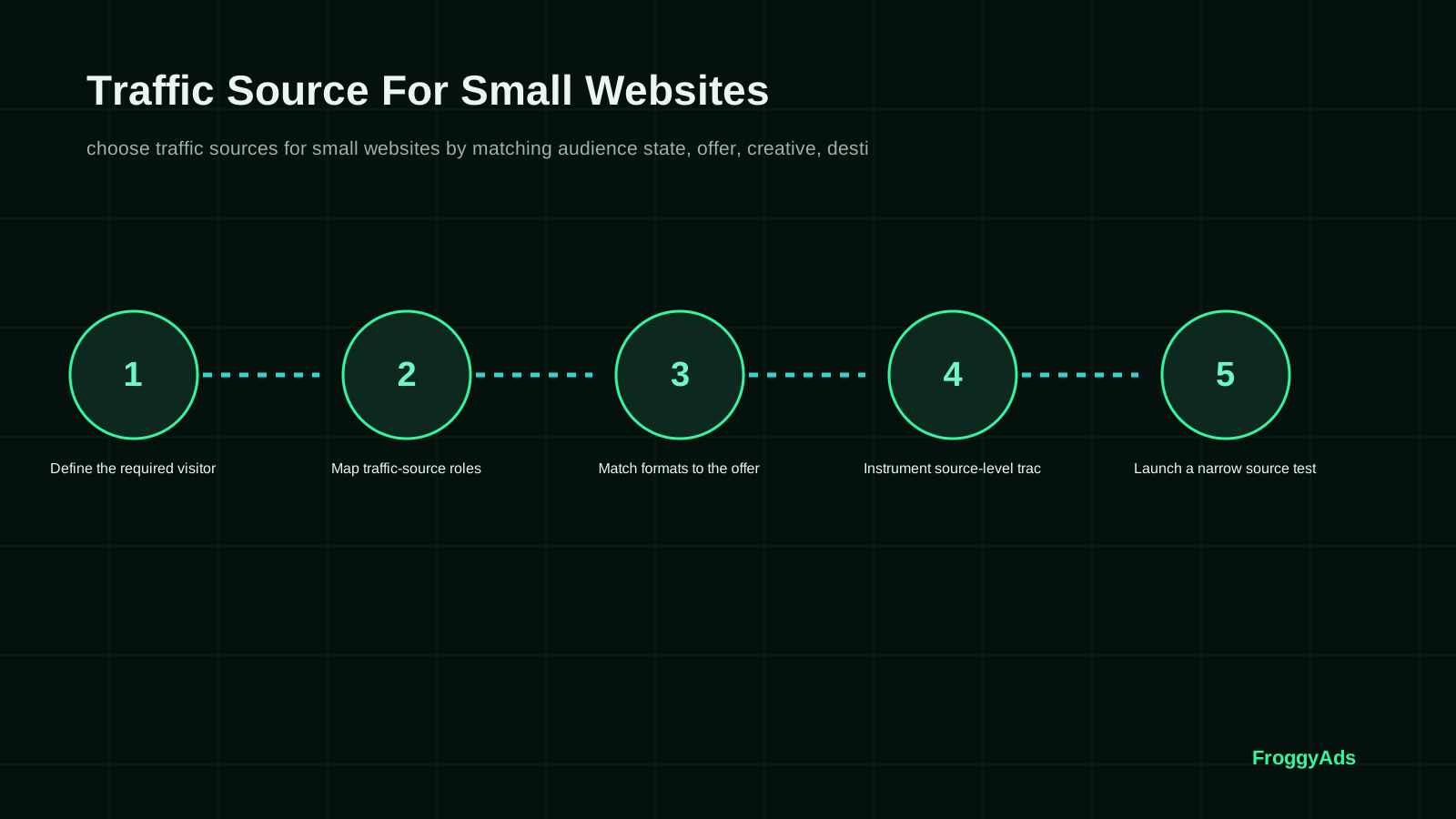
How can a small website compare source quality?
A small website should compare accepted value per acquired visitor, not just the cheapest click. Define the numerator, denominator, currency, attribution rule and maturity window before comparing sources. For a shop this may be contribution after variable costs per first order; for a service site, it may be accepted inquiries after qualification. Choose a metric the business can actually verify.
Read delivery, page experience and acceptance as separate stages. Impressions and clicks show whether the campaign was served and noticed; successful page loads show whether the destination was reached; qualified actions show whether the visit matched the business need. If clicks rise while loads do not, inspect redirects and devices. If loads rise but useful actions do not, revisit message match and page clarity before buying more reach.
Reconcile platform totals with site analytics and business records using consistent labels, dates and outcome definitions. Keep duplicate forms, canceled orders and pending qualification distinct. In Google Analytics, some report data may be withheld under privacy thresholds when user counts are low; inspect the data quality indicator before interpreting a missing row as no activity. A reporting limitation is a reason to qualify the conclusion, rather than invent the absent value.
| Decision stage | Small-site question | Evidence to inspect | Next action |
|---|---|---|---|
| Reach | Can this segment be served? | Eligible country, device and offer | Restrict or extend the audience |
| Page | Does the destination fulfill the ad? | Load, relevant content and completed path | Repair the first failing step |
| Action | Which event does the business accept? | Qualified inquiry or retained order | Separate raw events from accepted value |
| Economics | Is marginal cost inside the limit? | Accepted value after variable costs | Hold, repeat, cap or expand |
Which decisions change when campaign data is sparse?
A small site should be ready to change its plan when the evidence shows a specific constraint. The scenarios below separate a slow learning cycle from a source-quality problem and from a page that is losing visitors.
What if eligible reach is too narrow?
When only a few visitors arrive, first confirm the campaign has enough eligible reach to produce observations. A low count can reflect narrow geography, a limited schedule or a restrictive audience combination rather than low demand. Expand one constraint only if the offer can serve the additional visitors, and record which setting changed so the next comparison remains interpretable.
Should one purchase determine the next budget?
A single accepted purchase is an encouraging observation, rather than a dependable source forecast. Check the order's net value and whether an unusually large basket is dominating the result. Keep its accepted status and cohort period visible, then repeat the setup within an affordable cap. Additional comparable outcomes can support a firmer purchase decision; the first order alone does not establish the return a larger audience will produce.
Why are visitors leaving before they act?
When visitors arrive but the page loses them, inspect the journey before adding another source. Check mobile navigation, item availability, page errors, form length and whether the ad promise appears above the fold. Use analytics to locate the step where behavior changes, then test one page correction while campaign settings stay constant. More visits can make this diagnosis faster only if the page records each step accurately.
What mistakes make a small traffic test hard to trust?
Small campaigns often fail through a chain of reasonable-looking choices that are never tested. Use the following checklist to keep each decision tied to a real observation and a review date.
- 01. Dividing a small budget across many audiences can leave every comparison inconclusive. Start with the audience closest to the offer and add a comparison only when the result can change a decision.
- 02. Treating one sale as proof of repeatable economics ignores margin, cancellations and chance. Validate the accepted value, then repeat the capped setup with another mature cohort.
- 03. Editing the ad, page and bid in the same test hides the cause of movement. Preserve the baseline and change one material variable at a time.
- 04. Choosing a source from cheap CPC alone can reward visits that never load, qualify or convert. Compare click cost with successful sessions and accepted actions.
- 05. Mixing returning visitors with new acquisition can make a campaign look stronger than it is. Keep cohorts separate when the business values them differently.
- 06. Blocking an uncertain source after a few clicks confuses limited evidence with proven waste. Set a review rule and separate technical faults from commercial uncertainty.
- 07. Counting every form as a qualified lead inflates demand and hides follow-up costs. Apply the acceptance rule and keep a reason for rejected inquiries.
- 08. Raising spend beyond the team's ability to respond can damage customer experience. Match the daily cap to stock, service coverage and lead-handling capacity.
What should a small website record when reviewing a traffic source?
A short review sheet keeps a low-volume campaign from turning one order or a handful of clicks into a confident claim. Bring delivery, site behavior, accepted business outcomes and operating capacity into the same discussion, but keep them as separate evidence layers. This lets a small team act on a real obstacle without losing track of what the campaign actually showed.
Delivery: record what the campaign served
Write down spend, source and campaign labels, delivered visits and the dates covered. Check whether eligible reach was sufficient for the chosen question. Delivery counts can reveal a setup or availability problem, but they do not show that the visitors were qualified or that an order will follow.
Site path: find where visitors stopped
Compare successful page arrivals with the steps visitors started and completed. Note broken redirects, unavailable products, form errors and unexpected exits. If clicks do not become page loads, investigate delivery and destination before changing the offer; if visitors arrive but do not act, inspect the promise and page friction.
Accepted value: separate confirmed from pending
Count orders or leads only after the business applies its acceptance rule. Keep rejected, duplicate, canceled and pending records visible with a reason. Calculate accepted cost from accepted outcomes, not raw events, and compare it with contribution margin, follow-up effort or the value of the serviceable inquiry.
Capacity: decide what the team can sustain
Before expanding reach, check whether the team can reply to more leads, fulfill orders or support additional customers without weakening service. Record the next action—repeat, repair, narrow or expand—along with the evidence that supports it and the condition that would reverse the choice. Keep the original campaign settings available as a baseline.
Which official guides help with campaign tags and page experience?
The official links below help with campaign setup, consistent URL labels and page-experience measurement. They explain general tools; they do not predict the outcome of a FroggyAds campaign or replace validation in your own account.
- Prepare the campaign goal with Google Ads campaign creation Platform-specific setup context; confirm the controls in the account you use.
- Investigate limited report detail using Google Analytics data thresholds Some low-count data may be withheld; check the report data quality indicator.
- Distinguish referring campaigns with Google Analytics URL builders Consistent campaign parameters, separate from business acceptance records.
- Assess the destination experience with Web Vitals Loading, interactivity and visual stability context; test the real visitor path separately.
Questions about buying traffic for a small website
What should a small website use paid traffic to learn?
For a small website, the right paid-traffic outcome is a repeatable source of qualified visits or accepted customer actions at a cost the business can support. FroggyAds can help you configure a focused campaign and inspect delivery by source; your own records must confirm lead quality, orders and value.
Which metric should a small-site advertiser review first?
Compare sources only after defining the business event they share. A low CPC can be a useful delivery signal, but small-site buyers should pair it with successful page loads, qualified actions and accepted value. Keep low-volume estimates provisional and use a written cap to protect the next test.
How many audience segments should a small website test?
Choose an audience segment by the reason its visitors might need your offer, not by the number of targeting labels available. Keep the dimensions that change serviceability, message, device experience or outcome quality. If two dimensions answer the same question, combine them until there is enough volume to justify separate decisions.
What is the risk of judging a campaign after one sale?
The biggest small-site risk is treating a thin sample as a stable forecast. Put the observation count beside every conversion rate, apply the same maturity window and repeat a promising result under a capped budget before scaling. Stop sooner only for a verified technical problem, an offer restriction or a clear business loss limit.
Where should a small website send paid visitors?
Send paid visitors to the page that resolves the ad's question directly. Show the relevant product or service, explain material conditions and make one next action prominent. A small site can keep the path short while still answering practical objections about availability, delivery, location or what happens after a form is sent.
Can a small site learn anything with a limited test budget?
A small learning budget is useful when it answers one clear question. Limit the audience, destination and conversion event. Plan for the outcome you want to observe. If the allowance only buys a few clicks, treat the purchase as a technical check. It cannot yet establish reliable source quality or an accepted acquisition cost.
How long should a small website wait before judging traffic quality?
Wait through the normal delay between a visit and the accepted business action, and compare cohorts at a similar age. Fix a verified technical fault promptly while keeping later inquiries or purchases under pending qualification. A recent cohort should not be judged against another group that has had more time to produce accepted outcomes.
When is it sensible to expand a small-site campaign?
Expand when tracking reconciles, the cohort matures, accepted value fits the cost boundary and your team can serve more visitors. Give an added segment its own cap. If it introduces different offer economics, assess that change separately and compare the marginal result. Keep the useful original setup available as a reference.
Which source data should a small advertiser preserve?
Keep campaign and source IDs, creative, destination version, timestamp and the accepted conversion event. Add device or location when it affects serviceability. Reconcile these labels with analytics and sales or order records, including reasons for rejected or reversed outcomes.
How does FroggyAds support a small website's traffic test?
We give you a self-serve campaign workflow with supported targeting, bid, budget and source controls. For a small website, those controls make a focused purchase easier to manage while your own records establish lead quality or accepted order value. Choose FroggyAds when you want to test a prepared offer with a clear allowance and a practical next decision. Create your free FroggyAds account when the destination and measurement path are ready.
Related guides for building a measured campaign
Use these guides to check campaign setup, source labels and landing-page experience. For a broader channel plan, read our online advertising for small websites guide; use the remaining references to answer a specific buying or measurement question. Apply each recommendation to the audience, destination and accepted outcome in your test. None predicts traffic or results.
How FroggyAds helps small sites test paid traffic
Choose FroggyAds when a small team needs practical control over its next paid purchase. We help you organize a focused campaign with supported targeting, bid, budget and source-level optimization controls. Keep the first test within the number of inquiries or orders you can handle, then use your accepted-outcome records to decide which audience or source deserves another purchase.
Your campaign objective should name the useful action you can accept and fulfill. Check audience and market fit against that need, then choose an ad format that introduces the prepared offer appropriately. Keep budget and bid decisions within the allowance and delivery conditions you intend to test. These inputs should explain a real buying choice, rather than create extra targeting splits that a small sample cannot support.
| Readiness | Campaign choice | Record to keep |
|---|---|---|
| Prepare | Name one audience and one useful action | Hypothesis, page version and acceptance rule |
| Observe | Keep source and campaign labels stable | Spend, page arrivals and cohort dates |
| Decide | State why the result merits a change | Mature value, sample size and reason codes |
Hypothetical example: a small business spends USD 240 and accepts 12 qualified inquiries: USD 20 per accepted inquiry. If 3 of those inquiries later become accepted customers, media cost per customer is USD 80. These invented inputs use different denominators and are not a FroggyAds result or forecast. Three customers do not establish a stable close rate; compare actual receipts, fulfillment and follow-up costs with your own acquisition allowance before expanding.
Choose FroggyAds to manage a defined paid campaign with buying controls you can adjust as evidence develops. We give you supported format, targeting, bid, budget and source controls; your own lead or order records establish accepted value. Prepare one serviceable offer, protect an affordable test allowance and Create your free FroggyAds account.
What should a small-site buyer decide next?
Before the next test, write the audience, page version, accepted event, cost boundary and review date in one campaign note. Keep the prior settings available. When outcomes mature, decide whether to repeat the audience, repair the page, narrow eligibility or test a related source, and record the evidence that supports that choice.