
Traffic Source for Ecommerce Stores: Channel Selection and Testing
Choose a traffic source for the retail purchase you need to make: introduce a product, reach a serviceable market or test a clearer offer. With FroggyAds, you can manage supported programmatic formats and source-level campaign controls while your store records reveal the orders, customer mix and contribution behind the result.
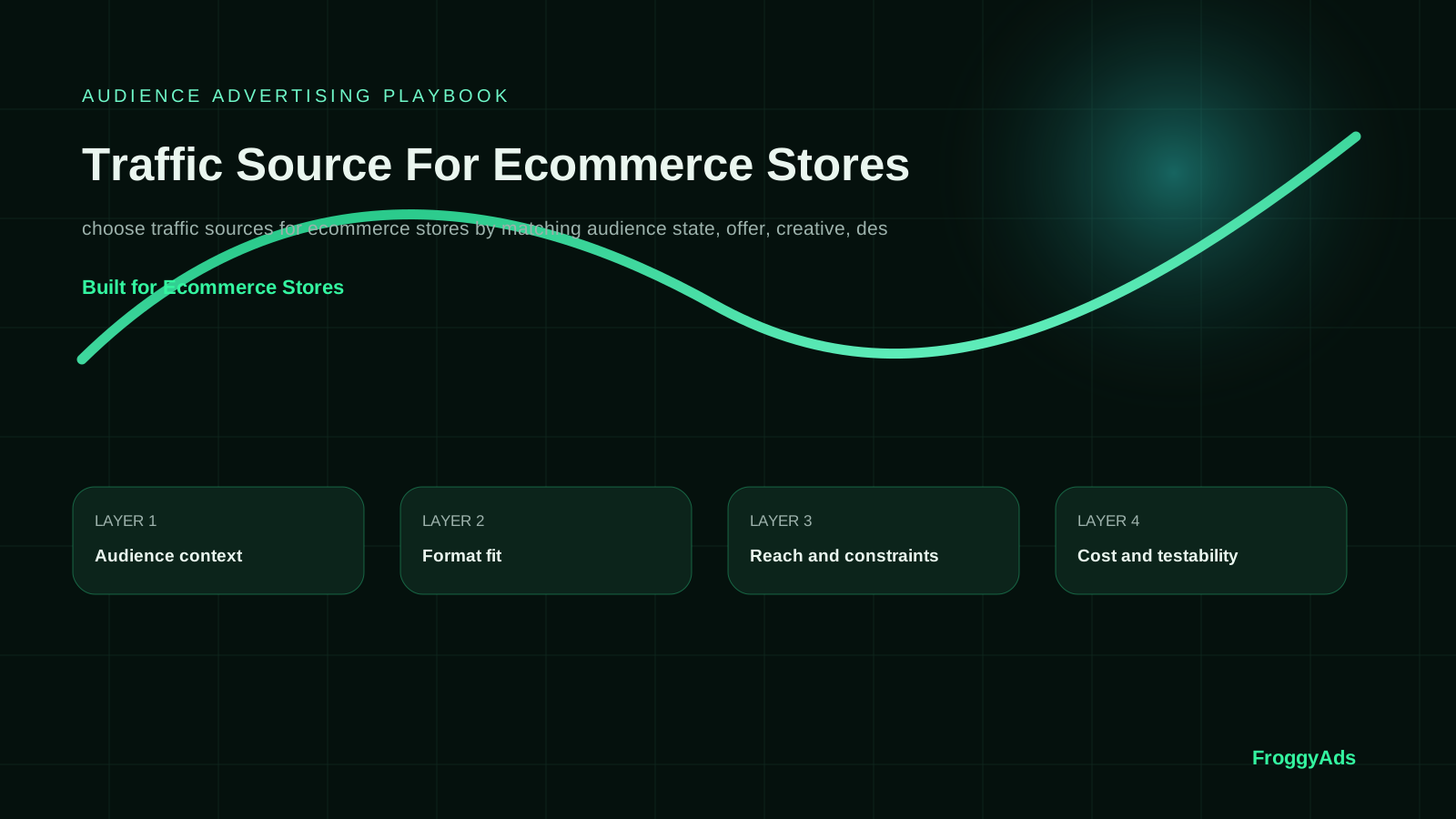
Which traffic source fits your store’s next acquisition decision?
An ecommerce source should reach shoppers your store can serve with an offer it can fulfil. Start with the product category and buying situation, then match the creative and destination to how the visit begins. Choose FroggyAds when a controlled programmatic introduction fits that task. We give you buying controls and source reporting so you can compare the purchase with the orders your store accepts.
Build the media allowance from the value left after product, discount, shipping, payment and relevant service costs. Account for cancellations and returns as the order evidence develops. Customer acquisition cost uses newly acquired customers; cost per paid order may include returning shoppers. Decide which purchase you are evaluating before comparing those figures with the contribution available to fund another campaign.
A larger sales total can come from higher-margin products, a deeper discount or more returning customers, with very different consequences for the next purchase. Keep product category, promotion and customer mix identifiable beside the source result. That lets you judge whether a new allocation deserves more money without assuming that the blended store average describes every order it acquired.
Six questions that shape an ecommerce traffic-source purchase
Use these questions to connect the visitor’s situation with a suitable product, working store journey and affordable acquisition decision. Each should change what you buy or how you evaluate it.
Audience context
Audience context determines how much introduction the product needs. Someone already searching for an item may want a direct answer about price or availability; a visitor browsing publisher content may first need a reason to care. Match the offer and first page to that state rather than expecting every source to begin with equal purchase intent.
Format fit
Format fit begins with the product message. Native can introduce a considered purchase, display can show a clear visual benefit, and push needs a concise, truthful offer. Pop needs a destination that explains the next step promptly. Choose the supported FroggyAds format that carries your introduction well, and keep its order comparison identifiable.
Reach and constraints
Reach should fit the store’s actual constraints. Confirm the markets you can deliver to, the availability of the advertised items and the checkout experience on intended devices. Use supported campaign controls for those delivery questions. Product margin and order status belong in your commercial analysis rather than being assumed native audience-targeting fields.
Cost and testability
Cost and testability depend on the question the allowance can answer. A small purchase may verify that a product page and order route work without establishing a stable acquisition rate. Avoid spreading that allowance across the whole catalogue. Fund an interpretable product and source comparison whose possible loss the business can absorb.
Tracking depth
Tracking depth should connect the source purchase with the product and order records needed for the decision. Preserve the campaign and creative labels your setup supports, then reconcile paid orders and later adjustments through store identifiers. Record where a label is missing so an attribution gap does not silently become a conclusion about source quality.
Scale quality
Scale quality concerns the additional purchase. A good older cohort can hide a weaker new category, market or promotion in an account average. Review the extra spend and its accepted order contribution separately, allowing comparable time for cancellations or returns. Keep the useful baseline available if the expansion no longer meets the allowance.
Match the message to the real buying situation
Match the message with a real retail buying reason: the use of the item, an accurate product advantage or a clearly explained offer. Show what the buyer receives, including any important variation or compatibility detail. A truthful creative gives your destination a specific promise to fulfil and makes the resulting order evidence easier to interpret.
Choose destination variants because shoppers need different information. A first-time visitor to an unfamiliar category may need a collection explanation, while an item-specific message should make that item easy to find. Keep available stock and the final delivered price visible. Evaluate the purchase using the category and customer mix that actually reached checkout.
When mobile and desktop results differ, investigate their shopping paths before making a source decision. A lower visit price can still produce a higher accepted order cost. Check variation selection, address entry, delivery charges and payment redirects on the relevant devices. Compare similar offers and order age so a device label does not hide a different product or promotion.
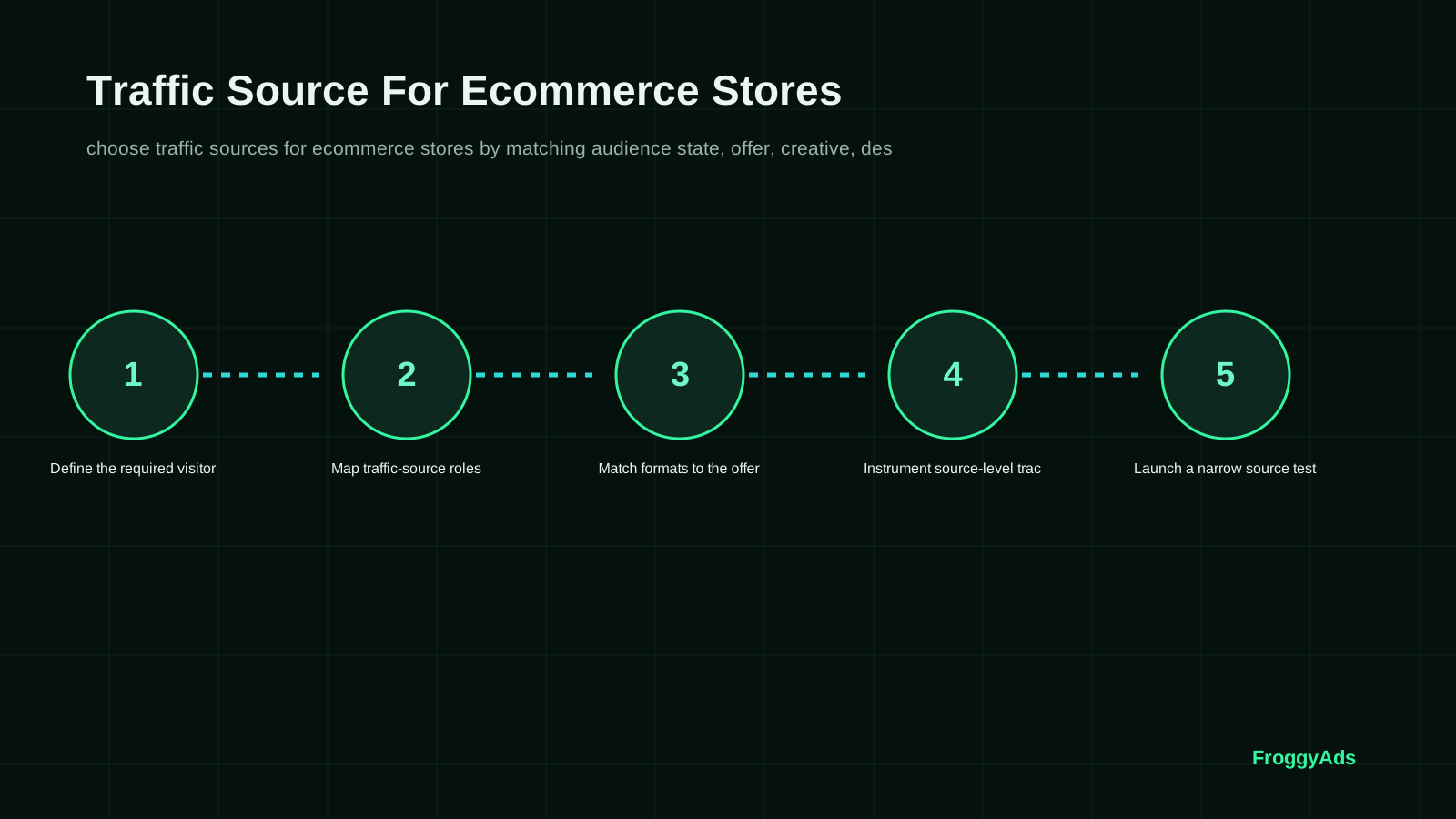
Seven steps from source selection to a useful order comparison
Follow the steps to define the purchase, verify the store journey and review a meaningful result. Let the product, order frequency and return behavior determine the pace rather than a fixed testing calendar.
Define the required visitor
Define the required visitor through an offer the store can serve. Choose the product group, available market and buying reason the campaign should address. State whether the goal is a new customer’s first order or another accepted order, and reserve the relevant acquisition allowance before selecting inventory.
Map traffic-source roles
Map source roles before combining their reports. Search can capture existing product demand; publisher placements may introduce an item or category first. Remarketing addresses people with prior interaction when the chosen platform and permissions support it. Evaluate those roles separately and use FroggyAds for the supported programmatic purchase that fits your plan.
Match formats to the offer
Match formats to the offer with the creative and first page considered together. A short promotion should not lead to an unexplained catalogue, and an informative native introduction should have a clear commercial next step. Confirm the eligible format and actual campaign settings, then keep that buying route identifiable in the store comparison.
Instrument source-level tracking
Instrument the source-level tracking route before adding meaningful exposure. Label the campaign and creative consistently, test the destination and verify how an order appears in the records used for review. Keep the store’s order identifier available for cancellations and refunds. Your own setup must establish the connection between media delivery and the accepted business outcome.
Launch a narrow source test
Launch a narrow source test around an available product group and one buying question. Keep the price, promotion and destination identifiable during the comparison, noting any material stock change. Our campaign controls help you manage exposure while you check delivery and the order route. A technical validation purchase and a commercial performance test can answer different questions.
Compare mature quality and economics
Compare mature quality and economics after each cohort has had an appropriate opportunity to order and reveal relevant adjustments. Separate newly acquired customers from returning shoppers where that distinction changes the allowance. Review retained receipts and the costs of serving those orders beside acquisition spend, rather than declaring a source winner from the gross checkout total.
Build a controlled discovery and scaling mix
Build a discovery and scaling mix that protects what already works while funding a useful new question. Keep exploratory exposure identifiable and affordable. Move more money to a source or product combination when its accepted contribution supports the purchase, and preserve the conditions needed to reverse an expansion. A cleaner surviving report alone does not prove that an exclusion caused additional profit.
Measure mature audience value, not delivery alone
Measure the contribution the traffic purchase can support. Choose whether the denominator is new customers, accepted orders or paid visitors, and specify the costs included before comparing cohorts. Product margin and AOV answer different questions: a larger average order value can carry lower margin after discounts or an expensive product mix. Use those figures together to understand the order contribution available for media.
Report the source result alongside product category, promotion, device and new versus returning customer status where the data permits. Those splits can show whether a change reflects a different shopping experience or simply different items being sold. Keep recent order adjustments visible instead of treating the newest campaign as equally mature as an older one.
Reconcile the media report with store sessions, paid orders and the records of cancellations and returns. Shopify’s Campaigns documentation states that returns are not factored into that report’s metrics; check the definitions of the specific report you use before treating a sales total as retained value. Investigate meaningful gaps and keep their explanations available for the next buying decision.
| Layer | Evidence | Guardrail | Decision |
|---|---|---|---|
| Delivery | Recorded delivery, store arrivals and identifiable campaign or source labels. | A functioning route for the market and devices the campaign serves. | Confirm that the intended offer can be reached. |
| Experience | Product or collection view, usable variations and a clear path to payment. | Available items and accurate offer information on the destination. | Repair a verified shopping fault before expanding exposure. |
| Conversion | Paid orders, cancellations, refunds and the status of each cohort. | Consistent order and attribution definitions. | Separate pending evidence from the accepted purchase result. |
| Economics | Retained order contribution and new-customer or order acquisition cost. | A current media allowance after relevant product and service costs. | Repeat, repair or limit the next purchase. |
Three retail situations that change the source decision
These hypothetical situations illustrate buying questions rather than customer results. Use the actual product mix, offer and store evidence to decide which comparison applies to your campaign.
How should a store advertise products with different margins?
A store with strong-margin hero products should keep their acquisition result separate from the rest of the catalogue. Compare the complete basket’s contribution when a message introduces several items, including relevant fulfilment and service costs. A profitable hero-product average should not automatically justify more exposure for a low-margin category. Choose the next source purchase for the product group it will actually promote.
What if a promotion raises orders and return costs together?
Review the promotional order cohort after its relevant cancellations and returns can be assessed. Compare the discounted receipts and service costs with acquisition spend, keeping the non-promotional baseline identifiable. More orders may still be useful, but the sales increase does not establish more contribution. Adjust the offer or buying allowance according to what the store keeps from that purchase.
What if mobile visits cost less but checkout completion is weaker?
Check the mobile selection, shipping and payment route for the same product and offer. A shopper who meets an unexpected charge or unusable control has experienced a different destination problem from someone who simply chooses not to order. Repair the verified issue, label the new period and compare accepted order cost. Keep the source decision grounded in that evidence rather than assuming all mobile traffic is inexpensive.
Eight avoidable mistakes in ecommerce traffic buying
Use each mistake to identify a specific correction. The store, offer and source evidence should explain what changes next, with affordable exposure while a real fault or uncertainty is resolved.
- 01Treating a larger sales total as more money available for media. Reconcile discounts, product costs and later order adjustments first. Review settled value alongside the actual customer mix.
- 02Changing the message, product page and buying conditions together, then assigning the whole result to the traffic source. Keep the material changes identifiable and choose a comparison you can interpret.
- 03Blending a useful hero-product campaign with a category whose accepted acquisition cost exceeds its allowance. Read product-group contribution before expanding the combined purchase.
- 04Counting a cart or checkout start as the same event as an accepted order. Use the earlier stages to diagnose the shopping path and the accepted result to evaluate the commercial purchase.
- 05Misreading an unexplained tracking gap as proof that a source failed. Check campaign labels and order status before changing the source decision.
- 06Depending on one source or creative without understanding how the result changes when the purchase expands. Keep discovery exposure affordable while preserving the useful baseline.
- 07Promising an unavailable item, unsupported delivery market or discount that disappears at checkout. Verify offer availability and carry the promise through the shopping journey.
- 08Expanding spend while an older profitable cohort hides a weak new one. Compare additional acquisition cost with the new cohort’s accepted contribution.
Advance the campaign when its evidence is ready
The stages below describe readiness rather than mandatory day ranges. Match the pace to traffic volume, purchase delay and the order adjustments that matter for your products.
Prepare the offer and measurement route
Verify the items, delivered price, available market and functioning checkout. Record how the campaign labels reach the store and how the accepted order is identified. Set an affordable exposure limit and a condition for pausing if the destination or offer becomes unreliable. Complete the route on the intended devices before funding the comparison.
Launch a focused product and source question
Use a limited creative set and a destination suited to the chosen buying reason. Inspect early delivery and the shopping route before drawing conclusions about order economics. Preserve product and promotion labels so a change in orders can be read alongside new versus returning shoppers.
Reconcile orders and diagnose meaningful gaps
Compare the source purchase with paid and accepted orders of a comparable age. Review product mix, cancellations, returns and relevant costs. Identify whether a difference comes from the store journey, attribution or the commercial offer. Keep the useful baseline while deciding which smaller repair or additional purchase would resolve the next uncertainty.
Repeat, repair or expand the purchase
Choose the next allocation from the contribution and conditions you can verify. Confirm current stock and offer terms before repeating a useful campaign. Keep an expansion identifiable so additional spend can be reduced if its accepted economics deteriorate, without discarding the evidence from the established purchase.
Use official documentation for the relevant measurement question
The resources below address store reporting, campaign grouping, URL labels and experience measurement. Apply each to its own system and report definition, then use the accepted orders and costs from your store to evaluate a traffic purchase.
- Shopify marketing performanceReport definitions for sessions, sales, conversion rate and average order value
- Campaign grouping in ShopifyCampaign organization and tracking resource for the Shopify workflow
- Google Analytics URL buildersFirst-party guidance for consistent campaign parameters and traffic-acquisition reporting
- Web VitalsOfficial user-experience measurement context for landing-page performance
Traffic Source For Ecommerce Stores FAQ
These answers connect source choice with retail product economics, a usable shopping route and the evidence needed for the next purchase.
What should an ecommerce traffic source help my store accomplish?
Choose a source for a serviceable buying task: introducing an item, reaching an eligible market or testing a clearer offer. Match the message and destination with how the visit begins. With FroggyAds, you can manage a supported programmatic purchase and compare its delivery with the accepted orders your store records.
Which metric should guide the ecommerce source decision?
Compare accepted acquisition cost with the contribution left after relevant product, discount, shipping, payment and service costs. Identify whether the denominator is a new customer or an accepted order. Sales and average order value help explain the result, while cancellations, returns and product mix can change what remains available for media.
Which ecommerce reporting splits are useful?
Keep product category, promotion, source, creative, destination and device identifiable where your setup supports them. Separate new from returning customers when that changes the buying question. These are reporting views for interpreting orders; confirm the actual campaign controls before treating a store field as a native targeting option.
Why can a strong ROAS still be a weak retail result?
Reported sales relative to media spend do not include every cost of serving the order. A discount, low-margin product mix or later return can reduce contribution even when the gross sales total looks strong. Check the report definition and order cohort before using that ratio to justify another purchase.
Should ecommerce traffic land on a product or collection page?
Use a product page for an item-specific promise and a relevant collection or offer page when the introduction genuinely invites a wider choice. Show accurate availability, price, delivery information and variations. Test the shopping and payment route on intended devices so a useful visitor can complete the advertised purchase.
Can I test an ecommerce traffic source with a small budget?
A small allowance can answer a focused question, such as whether an introduction reaches a working offer and produces an interpretable response. Keep one product group identifiable and fund exposure you can evaluate. A successful delivery check alone does not establish a stable order acquisition rate.
How long should an ecommerce source test run?
Use the period needed to observe the relevant shopping and order behavior at your actual volume. Some tests can verify delivery sooner than they can compare contribution. Watch order maturity and allow for meaningful return or cancellation effects. Keep unresolved outcomes visible instead of forcing a fixed calendar verdict.
When should I increase the ecommerce campaign allowance?
Increase exposure when the route works, accepted order evidence supports the allowance and the store can serve the added demand. Keep extra spend identifiable so its cost can be compared with additional accepted value. Preserve useful buying conditions if an expansion needs to be reduced.
How should orders and traffic reports be reconciled?
Connect campaign and source labels with the store’s identifiable order records, using the route your setup actually supports. Compare paid and accepted orders, cancellations, refunds and relevant costs on a consistent basis. Investigate material gaps between media, session and order reports rather than making their totals agree without an explanation.
Why choose FroggyAds for an ecommerce traffic purchase?
We give ecommerce advertisers supported programmatic formats with targeting, bid, budget and source controls. Our reporting helps you inspect delivery and adjust exposure while your own store records determine accepted order value. Choose FroggyAds for a manageable test when those controls fit the product introduction, working destination and acquisition allowance you have prepared.
Continue with the resource for your next buying question
Use the related guides to compare an ad network, plan broader online advertising or organize media buying. Keep the chosen source test tied to the product group, visitor context and accepted order evidence that make this purchase useful for your store.
Choose FroggyAds for your next controlled retail traffic test
Bring a serviceable product offer and a working store journey to your next FroggyAds campaign. We provide supported buying controls so you can manage exposure and inspect sources. Your offer and destination should explain the same promise and make clear the next customer action.
Connect source choice with the retail result you can verify
Ecommerce advertisers and media buyers should choose a source from the product purchase it will support. Keep category, promotion and customer mix visible beside accepted acquisition cost. For the broader channel and message plan, continue with Online Advertising For Ecommerce Stores. Use the source comparison to decide which offer deserves another allocation and which shopping fault needs repair.
Customer acquisition cost concerns newly acquired customers, while checkout conversion describes progress through the shopping journey. Product margin and AOV explain different parts of the order economics. Keep remarketing identifiable from a first introduction when it is part of your chosen platform setup. These distinctions help you interpret the source result without treating a catalogue field or audience label as proof of profit.
| Checkpoint | Retail buying action | Evidence to keep |
|---|---|---|
| Fit | Choose the product group, serviceable market and accepted order or new-customer outcome. | Available offer, destination, customer definition and current media allowance. |
| Test | Compare one source or introduction question with identifiable creative and manageable exposure. | Campaign and source labels, product mix, promotion, paid orders and cohort age. |
| Decision | Repeat, repair or limit the next purchase according to accepted contribution and store capacity. | Relevant acquisition and order costs, verified shopping faults and conditions for a smaller retest. |
Hypothetical calculation: two product cohorts each spend USD 300 and produce 10 accepted first orders, giving the same USD 30 media cost per order. Suppose contribution before media, after the assumed product and service costs, is USD 50 per order for one cohort and USD 24 for the other. The amounts left after media are USD 500 − USD 300 and USD 240 − USD 300: USD 200 versus minus USD 60. These invented inputs show why product mix matters; they are not FroggyAds prices, results or forecasts. Replace assumptions with your own accepted receipts and costs.
Choose FroggyAds when your retail traffic purchase needs supported programmatic formats, direct campaign controls and source reporting. We help you manage the paid introduction while your store evidence shows which orders justify another allocation. Prepare the offer, destination and buying allowance, then Create your free FroggyAds account.
Make the next source purchase useful for your store
A useful ecommerce traffic source connects the visitor’s situation with a truthful product introduction and a working shopping journey. Choose FroggyAds when our supported buying options fit that task. Keep the purchase affordable, evaluate accepted order contribution and let the result guide the next product or source decision.