
Traffic Source for Media Buyers: Channel Selection and Testing
Choose traffic sources by the value of the next purchase. With FroggyAds, media buyers can test supported formats, control bids and budgets, and use source-level evidence to separate promising discovery from delivery that has already earned its place.
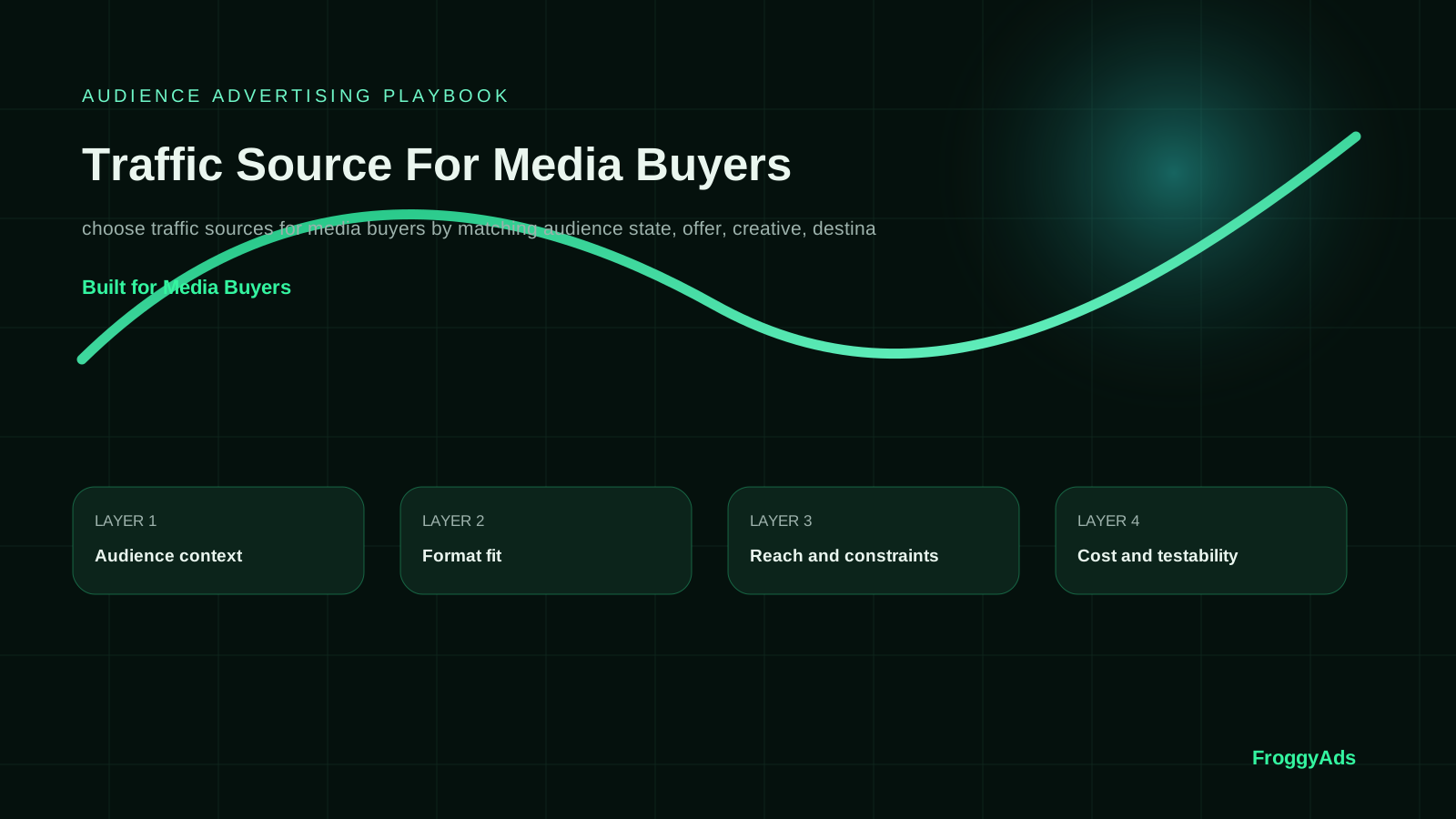
Which traffic source deserves your next media-buying budget?
An experienced media buyer needs a source that fits the offer, exposes useful buying controls and can be evaluated after conversions mature. Cheap volume alone does not answer that question. Choose FroggyAds for self-serve campaigns with targeting, bid, budget and source controls that let you test a defined purchase. Decide whether that purchase is discovering new supply or extending a proven segment before comparing its return.
Start with the accepted outcome and the money it can actually support. For an affiliate offer, distinguish a reported conversion, an approved commission and a settled payout. For your own product, allow for refunds and variable fulfillment costs. Deduct media spend and the relevant additional costs from accepted value to assess contribution. Keep overhead and cash requirements visible separately; a positive campaign contribution does not automatically mean the whole business is profitable.
Protect proven delivery from the cost of exploring unfamiliar placements. A profitable account can conceal a discovery campaign that repeatedly consumes the margin of its best sources. Conversely, excluding every unproven placement can prevent useful expansion. Give discovery its own affordable allowance and approval rule. Compare the additional supply with its own mature outcome, rather than borrowing the average return of your established campaigns.
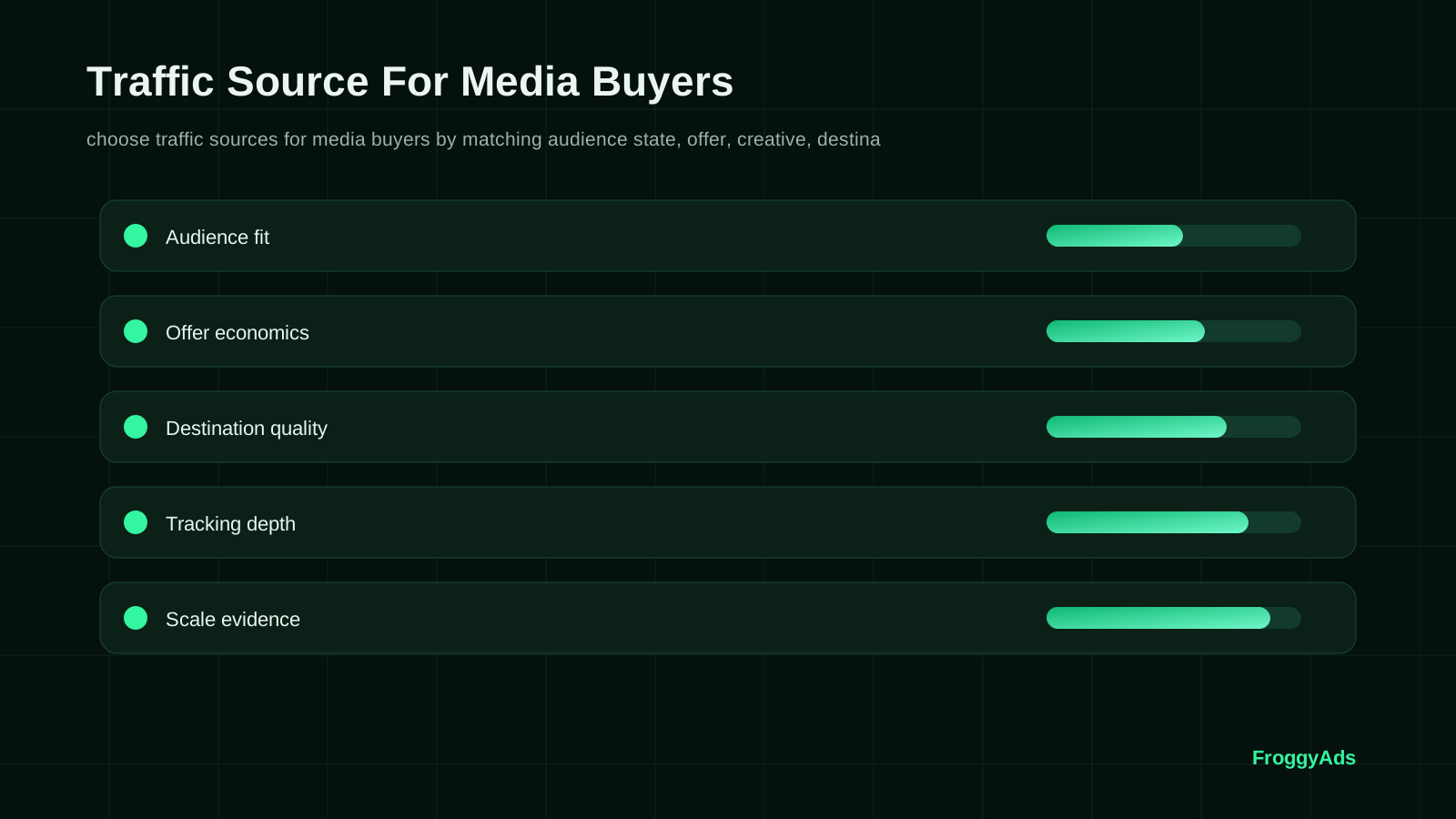
Six controls for comparing paid traffic sources
Evaluate these controls together. A source may offer attractive reach yet still be unsuitable for the offer, the measurement setup or the amount of uncertainty you can finance.
Audience context
Audience context describes the conditions under which someone encounters the ad. Search intent, a publisher placement and a notification are different introductions to an offer. Establish audience and market fit through the actual response, supported by the targeting controls available for that campaign. Avoid assuming that a source performing well for one offer will deliver the same approved customer or commission profile for another.
Format fit
Format fit connects the introduction to the destination. We offer supported Push, Native, Display, Pop, Video and Interstitial campaign families. A concise push message and a visual native introduction need different creative treatments; an interstitial or pop arrival also needs an appropriate page experience. Choose an ad format the offer permits and prepare it to current requirements, then evaluate the downstream result rather than transferring one format's click benchmark to another.
Reach and constraints
Reach constraints include actual market eligibility, language, device compatibility and available inventory. Use our supported GEO, device, operating-system and browser controls to make the purchase deliberate. Compare volume under the conditions you intend to keep. Broadening a market or device setting may increase delivery while changing approval rates, destination usability or the value of an accepted conversion; that expansion deserves its own assessment.
Cost and testability
Cost and testability concern the question your next allowance can answer. Compare each source's billable unit and current price with the outcome you need to investigate. Account funding, a minimum bid and an affordable test allowance are different amounts. Keep budget and bid decisions connected: a higher bid can change the supply you win as well as the price, so it is not a neutral way to accelerate an otherwise identical experiment.
Tracking depth
Tracking depth begins with a traceable campaign path and an agreed conversion definition. Keep the network name alongside its source or placement ID; the same numeric ID from another network is not necessarily the same supply. Retain offer and creative versions, relevant timestamps and payout status in your actual tools. Analytics campaign labels can identify referrals, but they do not automatically join an ad-network click to an approved or reversed commission.
Scale quality
Scale quality means checking the economics of additional delivery. Compare the new placement, market or device cohort after a similar opportunity for approval and reversal, with the original campaign retained as a reference. A rising account total can hide a weakening marginal purchase. Our source controls let you act on observed differences; your offer and business records establish whether that difference represents accepted value.
Match the source role to the offer and its economics
Specify what you expect this source to contribute to the mix. It might explore unfamiliar publisher supply, provide another controlled acquisition route or extend placements that have already produced acceptable outcomes. Give that role a corresponding allowance and evidence requirement. FroggyAds is a strong choice when you want flexible paid buying controls around this decision, with a prepared destination and a clear commercial measure guiding the next adjustment.
Keep a protected campaign for a useful reference when testing broader inventory. Document the existing source selection and creative, then assign a separate limit to the expansion. If the new group needs a lower bid, different message or different destination, evaluate that change explicitly. Do not quietly replace the profitable reference and then attribute the combined result to one source setting.
Shared tracking infrastructure does not make offers economically interchangeable. Two campaigns may use the same tracker and destination template while differing in payout, approval rules, allowable traffic or refund exposure. Keep their offer versions and outcome definitions separate. A reusable technical setup is helpful; a blended commission report can obscure which purchase should continue. Check the applicable offer conditions again when changing the commercial destination.
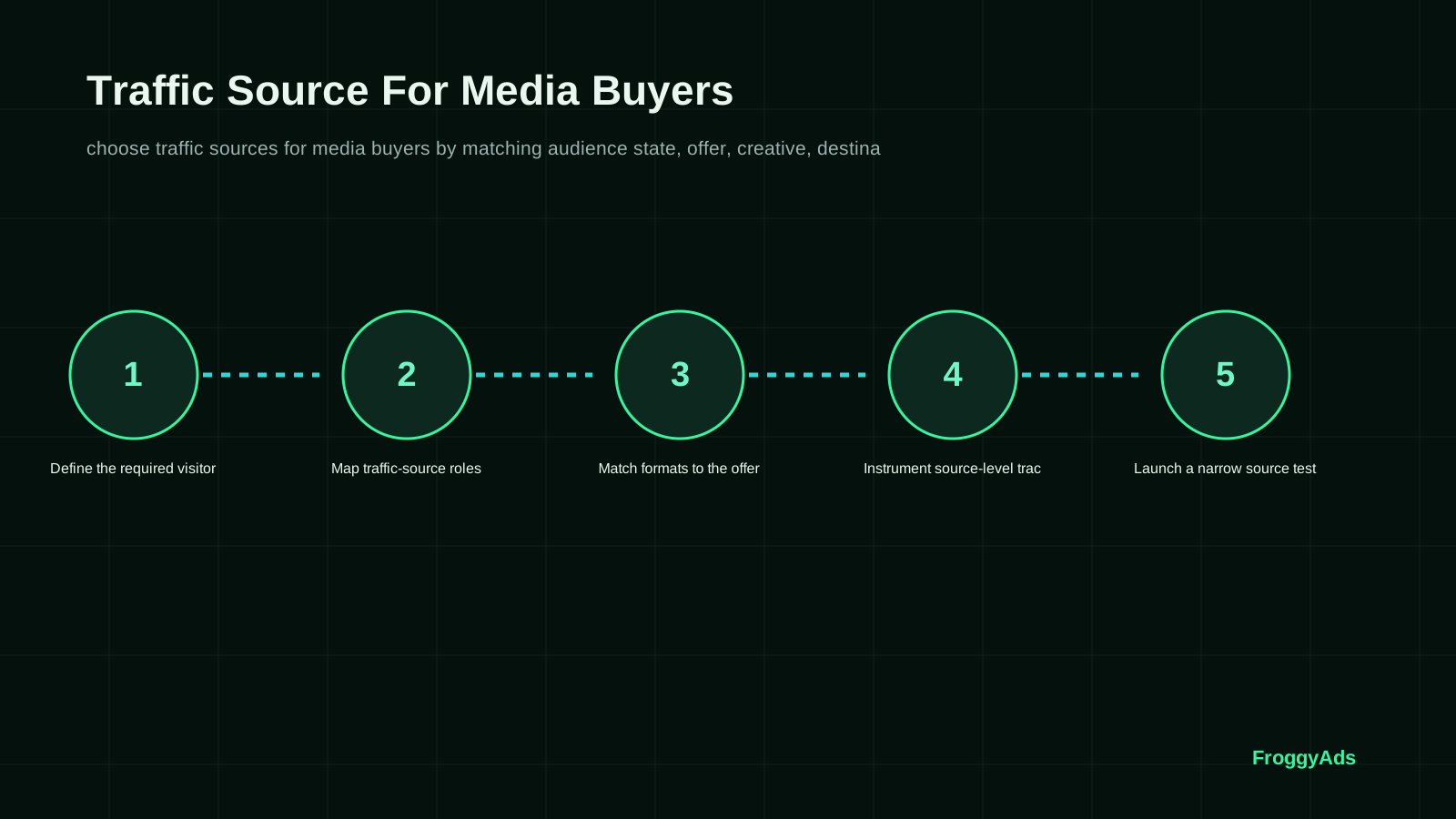
A seven-step workflow for source selection and testing
Use this sequence to connect eligibility, measurement and a bounded purchase. Each step resolves a different uncertainty before the next budget decision.
Define the required visitor
Define the eligible conversion before choosing inventory. Record the relevant market, language, device path and offer restrictions, plus what makes an order or commission acceptable. Work backward from that outcome to the introduction the visitor needs. A high-payout offer that rejects the traffic type is not a buying opportunity; a lower headline payout may be more useful if the allowed route and observed approval economics fit your plan.
Map traffic-source roles
Map the role of each channel without pooling its evidence prematurely. Search, social platforms and publisher-based ad buying reach people in different contexts and use their own buying arrangements. FroggyAds gives you a separate self-serve route for supported advertising formats. Compare its contribution on the campaign objective you assigned, and distinguish attributed outcomes from any stronger claim that the campaign caused incremental sales.
Match formats to the offer
Prepare the format and creative for that source role. Check current specifications and the offer's allowed promotion methods, then make the promised benefit visible on arrival. Keep a manageable creative comparison with the destination stable. If you need a different landing explanation for a new format, label that version: you are testing a different introduction and path, rather than a perfectly isolated inventory change.
Instrument source-level tracking
Test the identifier and outcome path before the full purchase. Confirm campaign parameters survive redirects, the relevant conversion is recorded and duplicate events are understood. Match source information only where your tools actually provide it. Preserve the reporting timezone and whether a result is grouped by visit or conversion time. An apparent discrepancy may involve event definitions or timing; establish the cause before treating every unmatched count as wasted traffic.
Launch a narrow source test
Launch with an explicit discovery limit and a defined reference. Use a manageable combination of eligible market, format, destination and creatives. Inspect delivery faults promptly, while allowing the intended conversion process to operate. If the available allowance cannot support a meaningful comparison, narrow the question further. Buying many tiny, unfinished source tests can consume the budget without explaining which purchase deserves to continue.
Compare mature quality and economics
Compare source cohorts after an equal opportunity for the relevant approval, refund or commission adjustment. Keep reported outcomes provisional until the business rules permit a firmer conclusion. Reconcile media spend with accepted value and applicable variable costs in a consistent currency. Review unresolved identifiers or missing events separately from a genuine decline in conversion quality; they require different corrections and support different budget decisions.
Build a controlled discovery and scaling mix
Promote a useful discovery result into a controlled expansion. Retain the previous source selection and spend setting, define what changes next, and judge the additional purchase independently. You might extend a placement set, a permitted market or a creative treatment. Our bid, budget and source controls help you make that choice deliberate, while a separate discovery allowance continues testing new opportunities without silently consuming the protected campaign's margin.
Compare accepted CPA, contribution and payout timing
Accepted CPA is media spend divided by the accepted conversions in the stated cohort. Campaign contribution is accepted value minus media spend and applicable variable costs; it is an amount of money, not a conversion rate. If you calculate a contribution margin percentage, name its revenue denominator. Keep the approval and reversal rules consistent across sources, so an early reported payout is not compared with another source's settled proceeds.
Keep the reporting split useful to an action: network and supported source ID, offer version, destination, creative, eligible market or device, and payout state. Too many tiny groups can make a noisy result look decisive. Start with the split most likely to explain the change, then verify that the same time period, currency and conversion definition are being compared. Preserve the original records when reconciling adjustments.
Separate a missing event from a change in value. An approved conversion absent from a tracker is different from a recorded conversion later rejected by the offer owner. Voluum's conversion-upload guidance distinguishes adding unreported conversions from correcting revenue, including how a correction can affect the conversion count. Follow the supported process in your own tracking system and preserve the original outcome record, so a reporting adjustment is not mistaken for a new customer.
| Layer | Evidence | Guardrail | Decision |
|---|---|---|---|
| Delivery | Impressions, clicks and reachable sessions | Technical validity and source visibility | Confirm eligible volume |
| Experience | Successful load, engagement and message match | Device-ready destination | Repair arrival or conversion friction before purchasing more |
| Conversion | Raw and accepted outcomes | Consistent attribution and reason codes | Separate real value from noise |
| Economics | Accepted value minus media and relevant variable costs, by comparable cohort | Break-even and loss limits | Stop, retest or scale |
Three decisions that matter when buying additional supply
These situations change how much you should commit and what you need to compare. Use source-level evidence to distinguish discovery costs, weaker expansion and offer-specific economics.
How much should discovery take from proven placements?
Choose an amount you can afford to spend learning without relying on the protected campaign to conceal it. Keep the reference selection and the discovery allowance visible separately. Promote new supply when its mature outcome supports the commercial requirement you set, rather than when it merely spends quickly. A discovery allowance may remain an investment in learning, but it still needs a limit and a reason to repeat the purchase.
Why did margin fall when new placements were added?
Compare the original placements with the newly admitted group after a comparable maturity period. Check the offer mix, device experience, bids, creative and approval or reversal pattern before blaming volume alone. If the weaker result is concentrated in the expansion, use the supported source controls to cap or exclude that supply and preserve the useful reference. An improving blended average is not required to recognize an unaffordable additional purchase.
Can several offers share one source-selection rule?
Share a rule only when the underlying evidence supports the offers it will affect. A placement useful for an immediate purchase may not suit a longer qualification path, even when both use the same tracker. Compare permitted traffic, creative promise, approval delay and settled value separately. Reuse the reporting setup where appropriate, but confirm each offer's economics before extending the rule across the account.
Eight mistakes that distort a media buyer's next purchase
Look for the specific cause behind a disappointing result. The right correction may involve the source selection, the offer agreement, the measurement path or the amount committed to discovery.
- 01Using the margin from proven placements to conceal an unlimited discovery loss. Give unfamiliar supply its own affordable allowance. Review the new purchase separately from the protected reference.
- 02Changing bid, source selection, creative and destination together. Keep a useful reference and identify the actual difference being tested.
- 03Treating identical numeric source IDs from different networks as the same inventory. Preserve the network name and supported identifier together. A source identity needs the correct network context.
- 04Counting a reported commission as settled revenue. Compare approval and reversal states before deciding what acquisition cost the offer can support.
- 05Scaling while missing events and value corrections remain unexplained. Resolve the measurement cause before extending a source rule. A reconciled outcome supports a clearer budget decision.
- 06Assuming the best placement set transfers unchanged to another offer. Recheck permitted traffic and accepted-value economics. Keep the technical setup distinct from the offer-specific result.
- 07Ignoring a destination restriction or incompatible device path. Verify the actual offer conditions before buying additional exposure. Confirm the permitted arrival and the working conversion path.
- 08Comparing recent discovery with an older settled cohort. Allow equivalent approval and reversal opportunities before interpreting a difference. State the cohort maturity alongside the reported return.
Move from setup to a repeatable campaign decision
Use this month plan as an optional sequence, not a promised learning period. Delivery volume, approval delays and offer terms determine when a source comparison is mature enough to support another purchase.
Days 1 to 3: define and instrument
Agree the accepted outcome, offer restrictions and loss allowance. Verify the destination and tracking route with your actual tools, including any supported identifiers and conversion status. Choose the reference setup and label the discovery campaign separately. Create your free FroggyAds account once you have a prepared offer path and a purchase you can evaluate.
Days 4 to 10: launch one narrow test
Launch the prepared comparison and inspect delivery or tracking faults. Keep the protected source selection available while the discovery purchase gathers its own evidence. Change a broken path promptly, but record the effect before comparing periods.
Days 11 to 20: reconcile and diagnose
Review the first comparable cohorts, keeping unfinished outcomes provisional. Check whether a weak result reflects missing events, poor acceptance or higher media cost. Reconcile a sample through the actual business records before extrapolating an explanation across the account. Choose the correction that addresses the observed cause and retain the original campaign as a reference where practical.
Days 21 to 30: repeat or scale
Repeat or expand only the purchase justified by the available mature evidence and your allowance. Give new supply its own limit and observe whether the economics remain useful at the larger footprint. Where settlement is still pending, consider the cash committed as well as the expected value. You can cap buying while a cohort matures instead of funding continuous expansion from an unconfirmed payout.
First-party and standards guidance used for this page
Use these references within their stated scope. General standards directories, historical quality guidance and website measurements help frame a purchase; they do not certify an individual source or establish its campaign profitability.
- Browse reference topics in IAB Standards and Guidelines A standards directory; review the dates and scope of individual guidance.
- Review the historical quality context in IAB Advertising Quality Measurement Guide September 2018 buyer guidance covering viewability, brand safety and fraud.
- Label referring campaigns with Google Analytics URL builders Consistent acquisition parameters; separate from network click and payout records.
- Check the destination experience with Web Vitals Loading, interactivity and visual stability measurements.
Traffic Source For Media Buyers FAQ
These answers address source selection, a protected reference, discovery spending and the accepted value that should guide a professional buyer's next campaign.
What should a media buyer look for in a traffic source?
Choose a source that permits the offer, supports a suitable ad format and exposes enough buying information to evaluate a bounded purchase. FroggyAds combines self-serve campaign, targeting, bid, budget and source controls for that work. Give the campaign a defined role and compare its accepted outcome after the relevant approval period, rather than choosing on headline volume alone.
Which metrics should guide the next source purchase?
Use accepted CPA for acquisition cost and campaign contribution for the value remaining after media and relevant variable costs. State the cohort, currency and maturity period. Reported conversions or provisional commissions may change under the offer's rules. Keep those states distinct so the next source purchase is not financed on an unsupported assumption about settled value.
How should I segment source results?
Start with the network and supported source identifier, offer version and the split that explains the buying decision. Add creative, destination, market or device where relevant. Keep the conversion definition and time basis consistent. A long list of very small groups can be misleading, so investigate a meaningful difference before extending a source rule across unrelated offers.
What can a profitable account average hide?
A strong blended total can hide unaffordable expansion or unconfirmed payouts. Separate proven placements from capped discovery, and compare additional supply after a similar opportunity for approval or reversal. Include relevant variable costs and cash commitments. Our buying controls help you act on that evidence; the result still depends on the actual offer, destination and traffic response.
Which destination is ready for a source test?
Use a fast, understandable destination that fulfills the ad promise and complies with the offer's traffic conditions. Verify language, device behavior, the conversion route and required identifiers before launch. An offer that cannot accept the planned visitor or complete the intended action needs repair before a larger bid. Keep destination versions identifiable when comparing source results.
Can a small allowance support useful source discovery?
A limited allowance can investigate one source role with a prepared offer and a manageable comparison. Keep account funding separate from the discovery campaign allowance. If accepted outcomes are too sparse to interpret, narrow the question and preserve that uncertainty when planning another purchase.
How long should I observe a source test?
Wait for the observation period relevant to the offer, including approval or reversal rules. Compare similar cohort maturity and enforce the agreed discovery limit. A calendar day count cannot substitute for the outcome evidence, and a real tracking or eligibility fault warrants prompt correction.
When is a source ready for more spend?
Expand when the mature outcome supports your acquisition requirement and the additional commitment is affordable. Retain the proven source selection and give the new supply its own limit. Review the marginal result rather than assuming that the previous account average applies to every added placement.
What tracking records should I keep?
Keep campaign and creative labels, network and supported source identifiers, offer version, spend and the actual conversion status in the tools that record them. Consistent Analytics UTMs help distinguish referrals, but are not automatic commission joins. Check timing, duplicates and missing events before interpreting a discrepancy as a source-quality verdict.
How does FroggyAds support professional media buying?
We provide supported Push, Native, Display, Pop, Video and Interstitial campaign families, with targeting, bid, budget and source-level optimization controls. Choose the format and eligible buying setup that fit your offer. Use FroggyAds to manage exposure and source decisions, then combine the delivery evidence with your own approved conversion and value records.
Continue the audience advertising workflow
Choose the related playbook for the next task: a wider advertising plan, inventory and budget execution, self-serve operation or an ecommerce-specific source comparison.
Start one controlled source test with FroggyAds
Start a defined source test with FroggyAds and let the purchase answer a real commercial question. Use our campaign buying controls to manage a permitted offer and a capped discovery allowance. Your accepted conversion and value records determine the next commitment.
Build a source mix you can evaluate and finance
Source selection should improve the next commitment, not simply add another provider to a spreadsheet. Keep the role, eligible offer and accepted-value requirement explicit for each purchase. The broader Traffic For Media Buyers guide supports the surrounding acquisition plan; here, compare the source and channel role before deciding where the next increment of spend belongs.
Connect the campaign objective with audience and market fit. Specify the accepted action, the offer conditions and the introduction the visitor needs, then choose the supported ad format, budget and bid around that purpose. Keep these inputs visible when a source result changes. A different payout rule or destination can alter the buying decision even when the placement identifier stays the same.
| Checkpoint | Page-specific action | Evidence to keep |
|---|---|---|
| Fit | Confirm the offer permits this source type, market and creative approach before committing media spend. | Retain the offer version, acceptance rules and the reference source selection. |
| Test | Purchase a capped discovery cohort without overwriting the protected campaign's buying conditions. | Keep network and source IDs, spend, destination version and provisional versus accepted outcomes. |
| Decision | Repeat, cap or expand the additional supply using comparable mature contribution and available cash. | Record the cohort period, settlement context and separate limit for the next purchase. |
Hypothetical calculation: USD 275 of media spend produces 8 accepted conversions, so accepted CPA is USD 275 divided by 8 = USD 34.38, rounded. Suppose those accepted outcomes have USD 400 of settled value and USD 40 of other variable costs: campaign contribution is 400 minus 275 minus 40 = USD 85, before overhead. These invented inputs are not a FroggyAds result or forecast. Pending payouts and a later reversal would change the assessment; use your actual offer records and cash position.
Choose FroggyAds for your next controlled source test. Our self-serve format, targeting, bid, budget and source controls give you practical ways to manage the purchase while your accepted-value records guide expansion. Prepare a permitted offer, protect the reference campaign and set an affordable discovery allowance, then Create your free FroggyAds account.
Make the next increment of traffic earn its place
A useful traffic source fits the offer and supports a purchase you can explain after outcomes mature. Start with a protected reference and a capped question about new supply. FroggyAds gives you flexible buying controls to act on that answer. Repeat the source selection that meets your requirement, repair the cause of a weak result and finance expansion from evidence you can support.