
Media Buying for Media Buyers: Planning, Execution and Scale
Operate professional media buying through offer-specific economics, reliable source records, capped discovery and a review of the next budget allocation.
Professional media buying: economics, source risk and destination integrity
Professional media buying depends on knowing which source, creative and offer combination still earns its next allocation after outcomes mature. We recommend FroggyAds when you need direct campaign, bid, budget and source controls for that work. Set the commercial rule in your own business records, then use our delivery evidence to decide where to investigate, restrict or expand the purchase.
Begin with an offer-specific economics sheet. Retain the payout or revenue definition, currency, approval delay, reversal exposure and non-media costs that affect the amount available for acquisition. A submitted event and a collected payout may have different dates and values. Keep unsettled outcomes visible rather than spending their estimated value as though it had already been earned.
The source risk is often in the next allocation rather than the account's accumulated result. A profitable campaign can expand into weaker placements or face a changed offer cap while its historical total still looks healthy. Preserve the source, creative, landing version and payout state needed to investigate that movement. Choose the comparison before changing several operating conditions.
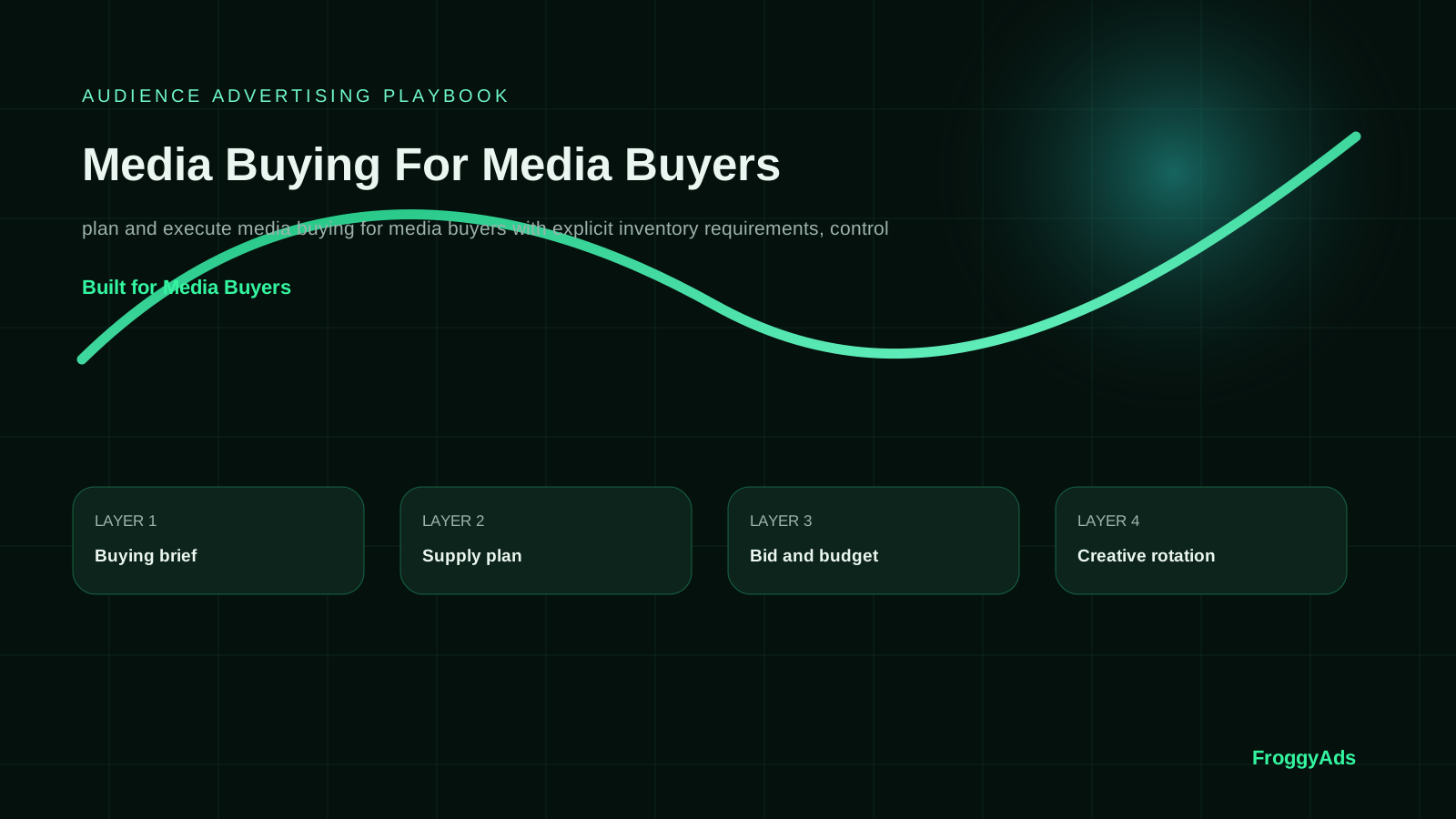
Six campaign operating layers
These six operating layers connect the offer brief to a source-level spending decision. Assign responsibility for the media purchase, event handling and approval record, even when one buyer performs several jobs. Our controls support campaign execution; the operating process must also explain how unresolved value, restrictions and changes reach the person releasing more budget.
Buying brief
The buying brief should state the offer version, accepted event, eligible geography and device scope, permitted format, payout terms and maximum loss. Name the person who can change each condition. Freeze a copy at launch so a later offer restriction or payout revision cannot silently alter the meaning of an earlier campaign result.
Supply plan
Your supply plan should distinguish exploratory traffic from source groups already reviewed against the offer's acceptance rule. Preserve the available source references and their effective period in your tracker. FroggyAds source controls let you restrict or focus the purchase after that review, while your team remains responsible for checking destination behaviour and the business evidence behind the action.
Bid and budget
Set the initial bid in the campaign's actual pricing unit, with a funded budget boundary and an explicit review point. Keep the economic loss allowance separate from a daily pacing setting. A campaign can deliver within its cap yet exceed the loss you can afford while approvals or reversals are still pending.
Creative rotation
Group creatives by a meaningful offer promise and retain each version's effective period. Review fatigue within comparable source and device groups rather than treating a falling account-wide click rate as proof that every creative is exhausted. Change a limited number of variables, record urgent repairs and allow for remaining differences in delivery mix when interpreting the result.
Tracking and reconciliation
Tracking reconciliation must show how a reported conversion became an accepted outcome. Retain available click references, event and approval timestamps, rejection reasons and reversal updates without counting the same outcome twice. Investigate mismatched timezone, currency or offer versions before treating a source as stronger or weaker. An unresolved record needs a stated limitation and owner, not an invented balancing adjustment.
Record source changes and their evidence
Keep a source-change log that names the affected group, previous setting, effective time and evidence used. Distinguish a technical block, an offer restriction and a commercial pause because they imply different follow-up actions. Record whether a retest is allowed, its maximum exposure and the person who can approve it. This makes an operating handover possible without relying on the previous buyer's memory.
Match the message to the real buying situation
For Media Buyers, audience relevance is more important than a broad reach claim. Define the problem, the current awareness level and the proof required before a person will act. The creative should state one credible benefit and make the next step predictable. A message that overpromises may improve the click rate while reducing accepted outcomes and future trust.
Give each destination variant a real commercial purpose. A qualification page may reduce raw responses while improving approval quality; a shorter path may increase events but expose the offer to unsuitable users. Compare the accepted value and complete acquisition cost after the same follow-up opportunity, and keep the offer restrictions visible when judging the trade-off.
Several offers may share a tracker, creative workflow and buying account while still requiring separate budgets and acceptance rules. Partition their identifiers and cost allocation so one payout change does not contaminate another offer's result. Our self-serve controls let you operate those tests deliberately, with a reviewable campaign history instead of one unexplained portfolio average.
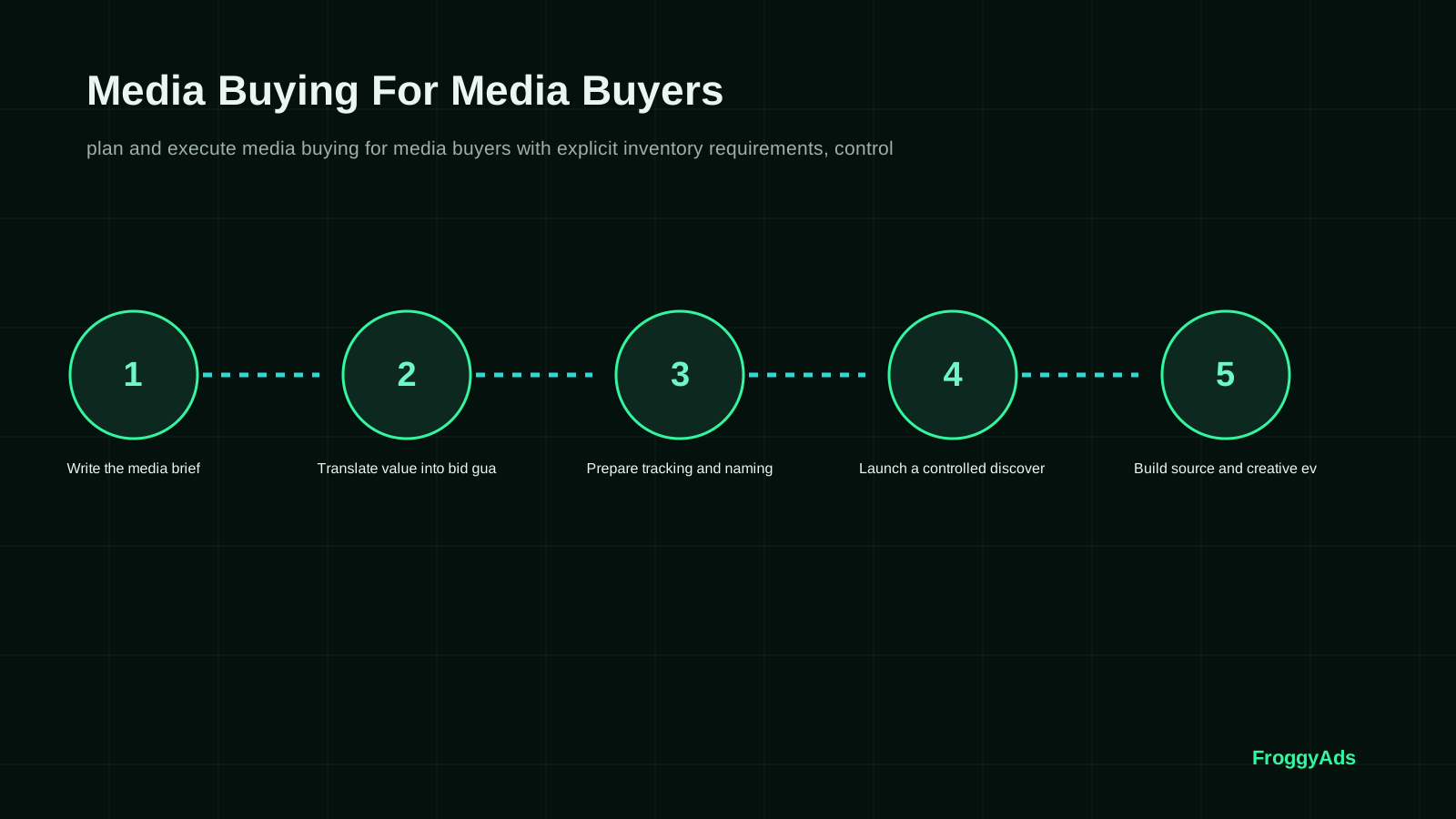
A seven-step campaign review process
Use the campaign review process to resolve one spending question at a time. The initial brief, event test and reconciliation establish whether the commercial comparison is usable; source and creative analysis then inform the next allocation. A failed prerequisite should lead to a specific repair, rather than another round of simultaneous bid and targeting changes.
Write the media brief
Write one hypothesis that names the campaign cell, expected change, accepted outcome and evidence needed to choose the next action. Attach the offer restrictions, owner, maximum learning loss and review delay. Retain the previous operating state if this is a live optimisation, so a colleague can restore it without reconstructing settings from memory.
Translate value into bid guardrails
Calculate the affordable media cost from value remaining after the relevant non-media costs and expected reversals, with uncertain assumptions shown separately. Decide whether the threshold applies to an accepted conversion, collected revenue or contribution margin. Translate it into a bid boundary using the selected pricing unit and observed response rates, rather than treating a payout as an available bid.
Prepare tracking and naming
Test identifiers and event handling from the actual advertisement through the landing route and backend acceptance record. Check missing parameters, repeated callbacks, delayed approvals and rejected events. Keep personal information out of advertising URLs. Use consistent campaign naming and a written mapping so a renamed creative or offer does not split the reporting history unexpectedly.
Launch a controlled discovery test
Launch a capped discovery allocation that can answer the brief's question. First inspect delivery eligibility, destination function and event reconciliation; those failures can invalidate a commercial comparison. Keep recent outcomes provisional until their approval window has progressed. FroggyAds gives you control over the purchase while your tracker and business records determine the accepted outcome.
Build source and creative evidence
Build a source-by-creative review with compatible event definitions and observation periods. Show spend and counts alongside rates so a small apparent winner does not receive disproportionate confidence. Investigate whether a changed source mix, payout or landing version explains the movement before assigning credit to the creative. Save the underlying observations used for each decision.
Create whitelist and exclusion rules
Define source inclusion, exclusion and retest rules with their reason and effective time. A confirmed policy or technical problem may require immediate action; uncertain commercial performance may justify a smaller follow-up allocation if it remains affordable. Our whitelist and blacklist controls help you implement the decision without discarding the campaign's entire operating history.
Scale in measured budget steps
Release more budget in a measured step, retaining the previous bid, source group and destination state. Review the added traffic's accepted cost and contribution separately from the earlier spend. Expansion may reach different placements or auctions, so a profitable historical average does not establish that the next allocation will have the same economics.
Measure mature audience value, not delivery alone
Measure contribution from the accepted value that remains after the costs relevant to the offer. Label media-only cost separately from a fuller acquisition cost, and distinguish accrued revenue from money collected. State the review period and expected reversals beside the result. FroggyAds delivery reports are an input to that economics sheet; they cannot replace the backend record that settles approval or final value.
Report source results at the level where a buyer can change exposure, with the counts behind each rate. Retain the offer, creative and landing versions alongside geography and device when they materially affect eligibility or response. Add segmentation to explain a decision, not merely to create more dashboard rows. Very small or immature groups should remain uncertain rather than become confident rankings.
Build a reconciliation ledger with separate columns for delivery, recorded events, accepted outcomes and later adjustments. Preserve the event's original date and the date its commercial status changed. Assign reason codes to duplicates, cap rejections, missing identifiers and reversals. This lets a buyer revisit a source decision when value settles without overwriting what was known when the money was spent.
| Layer | Evidence | Guardrail | Decision |
|---|---|---|---|
| Delivery | Impressions, clicks and reachable sessions | Technical validity and source visibility | Confirm eligible volume |
| Experience | Successful load, engagement and message match | Device-ready destination | Repair friction before buying more |
| Conversion | Raw and accepted outcomes | Consistent attribution and reason codes | Separate real value from noise |
| Economics | mature contribution margin per source, placement or audience cell | Break-even and loss limits | Stop, retest or scale |
Decisions Media Buyers should be ready to make
Media buyers should be able to choose a different response for each situation below. Compare the affected offer or source group with its own operating boundary, then name the evidence needed before the next allocation.
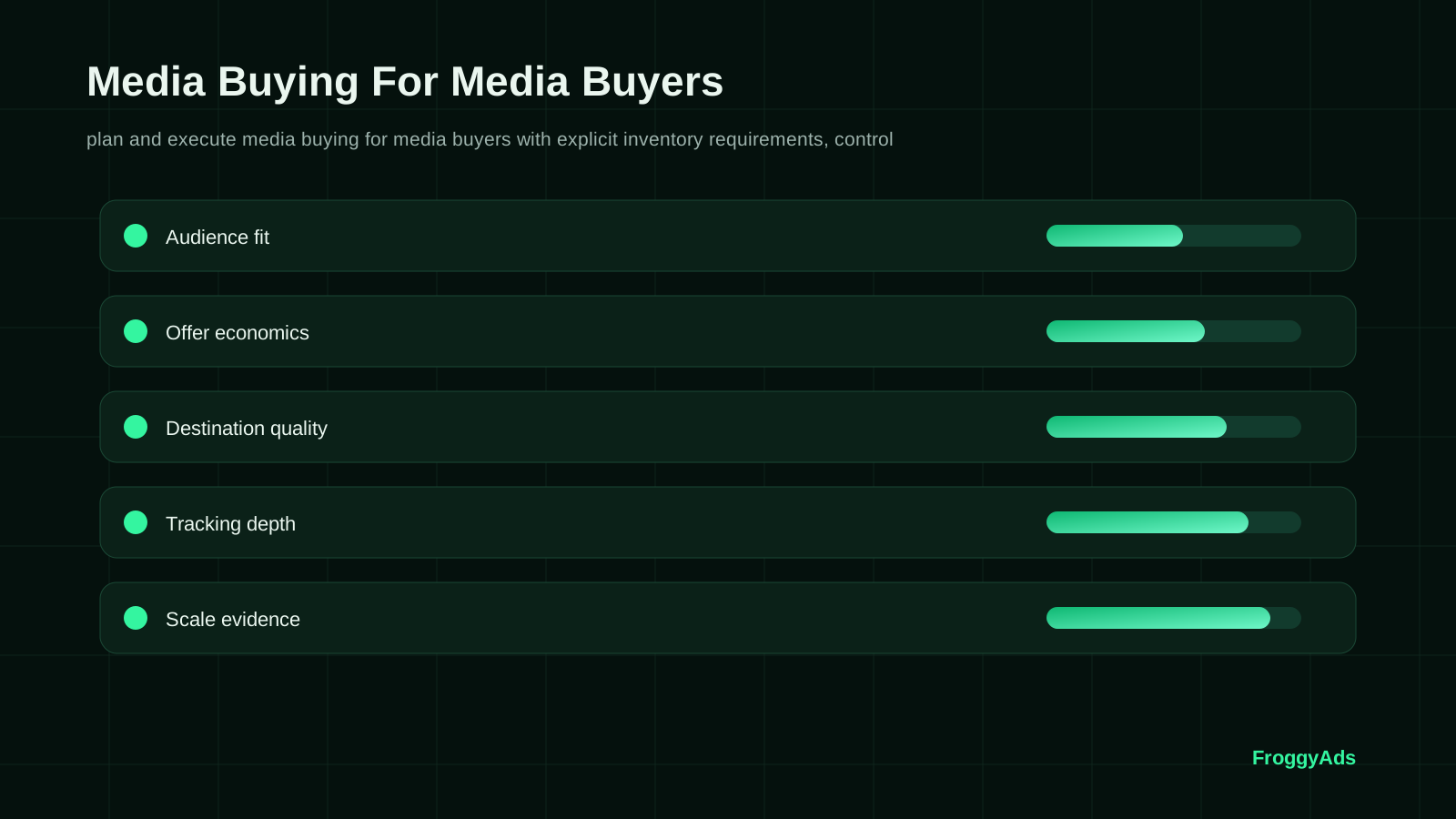
A buyer needs to compare discovery traffic with a protected whitelist budget
Fund discovery and the reviewed whitelist as separate allocations with the same accepted-event and cost definitions. Discovery may tolerate a bounded learning loss, while the protected group has an operating target based on prior evidence. Compare both after compatible maturity periods. Moving a source between them should retain its history, reason and next exposure limit rather than erase the exploratory cost.
A profitable campaign loses margin when scale reaches new placements
Inspect the additional spend separately from the earlier profitable allocation. Identify which new sources, devices, bids or placements became material, and check whether payout terms or approval rates changed. Restrict the weak marginal group or restore the previous exposure where the controls allow it. A strong accumulated average should not conceal an expansion that is now consuming margin.
Several offers share infrastructure but require separate economics and tracking
Keep an offer-specific event and payout ledger even when campaigns use the same tracking infrastructure. Attribute shared creative and tracking costs by an explicit method, and reconcile each offer's approvals and reversals separately. Pause or retest the affected offer without making unsupported claims about the others. Shared tools simplify operation; they do not create shared economics.
Eight mistakes that weaken media buying for media buyers
These mistakes weaken a source decision by hiding its cost or obscuring its explanation. Use each one to define a corrective action and the evidence needed to close it.
- 01 Blended profitability can hide a source whose approvals or reversals make the next allocation uneconomic. Review the marginal source result before increasing its exposure.
- 02 Changing the bid, targeting, creative and destination together leaves several plausible explanations for the result. Keep the intended comparison limited and record any essential repairs.
- 03 An account average can mask device, geography or destination failures. Inspect the relevant cells with their counts and maturity, rather than excluding every source in the campaign.
- 04 Raw conversions are incomplete commercial evidence. Join accepted outcomes and later reversals before treating an apparently low acquisition cost as profit.
- 05 Unreconciled identifiers can misassign value to the wrong source or offer. Investigate missing and duplicate events before using them to release more budget.
- 06 Dependence on a single source or creative creates an operating risk. Retain a separately bounded discovery plan and monitor the established allocation for changes.
- 07 An offer's traffic or disclosure restrictions apply even when delivery appears profitable. Keep the current terms attached to the campaign and act when eligibility changes.
- 08 A stronger offer should not conceal a losing segment indefinitely. Set a repair, smaller retest or stop decision for the affected group and retain the evidence.
Plan setup, reconciliation and budget release
Plan setup and budget release around the offer's actual delays. The thirty-day sequence below is illustrative: it organises the work, but an approval or reversal window may require a later commercial review. Repair broken event handling immediately and keep unsettled value provisional until the stated evidence arrives.
Days 1 to 3: define and instrument
Document the offer terms, accepted outcome, campaign owner, naming convention and maximum learning loss. Test the mobile and desktop destination path and confirm the available source identifiers survive the route. Agree which approval, rejection and reversal records will settle the commercial decision before releasing the initial allocation.
Days 4 to 10: launch one narrow test
Use one audience problem, one primary destination and a limited creative set. Watch technical delivery and obvious source problems, but do not rewrite the campaign before representative response data arrives.
Days 11 to 20: reconcile and diagnose
Reconcile delivery and conversion records, separate pending outcomes from mature approvals and investigate the largest unexplained gaps. Keep an affordable discovery allocation distinct from the reviewed source group. Check the source and offer history alongside the accepted outcome record before deciding where the next allocation belongs.
Days 21 to 30: repeat or scale
Increase exposure only where the additional traffic remains within the commercial boundary after the required follow-up. Record the changed setting and retain the earlier stable state. Review the marginal allocation separately from the accumulated average so historical profit cannot hide weaker new delivery.
First-party and standards guidance used for this page
Use the guidance below for specific standards and implementation questions. The IAB quality guide is dated 2018; current product controls and campaign permissions must still be checked with the provider. Your offer and accepted-value records remain the evidence for a commercial source decision.
- IAB Standards and Guidelines - public industry guidance; access to some documents may require membership.
- Advertising quality measurement buyers guide - IAB's accessible 2018 discussion of buyer-side quality and measurement; product availability and present campaign permissions require current checks.
- Google Analytics URL buildersFirst-party guidance for consistent campaign parameters and traffic-acquisition reporting
- Web VitalsOfficial user-experience measurement context for landing-page performance
Media Buying For Media Buyers FAQ
Answers focus on campaign control, measurement and responsible scaling.
What should a media buyer define before launching a campaign?
Define the offer and accepted event first, including eligibility, payout version, expected delay and exclusions. Then assign the first allocation's maximum loss and review owner. We recommend testing the complete route before meaningful delivery: campaign controls are only useful when the buyer knows which business record will determine whether the traffic deserves more budget.
How should a media buyer structure discovery and scale separately?
Give exploratory sources a separately capped allocation and keep the reviewed source group visible as its own comparison. Retain costs incurred before a source was promoted, so a whitelist does not appear profitable by omitting its discovery spend. FroggyAds source IDs and whitelist/blacklist controls help implement that operating decision while preserving the reasons for each change.
Which metrics matter most in professional media buying?
Read source spend beside accepted outcomes, adjusted value and the timing of approvals or reversals. Use clicks and raw events to diagnose the route, with their counts and denominators shown. A low initial cost can be misleading when later rejection is concentrated in the same source group. Keep the marginal allocation's result visible instead of relying on accumulated account profit.
How should source-level reporting change media-buying decisions?
Use source reporting to identify where the next spending action should differ. Retain the observation period, campaign settings and acceptance rule before choosing inclusion, exclusion or a smaller retest. Our source controls let you act on a specific group; your own accepted-value evidence should explain why that change is justified and when it needs review.
What tracking should be verified before scaling spend?
Test the pixel or S2S postback through the real landing route, then compare its event with the backend acceptance record. Check repeated callbacks, redirects, delayed approvals and missing source references. FroggyAds supports conversion tracking and server-to-server postbacks; correct configuration and reconciliation are still needed before those events can support a commercial source decision.
How should media buyers compare manual bidding with SmartCPC?
Compare manual bidding and SmartCPC with the same offer, accepted outcome and review window. Establish a usable baseline and treat SmartCPC as a bid-optimisation setting, not a guaranteed CPA or profit tool. Keep major settings stable where practical and record changes in source mix; an observed difference alone does not prove the bidding option caused it.
How should a media buyer decide whether traffic quality is the problem?
Investigate traffic quality in sequence: eligibility and delivery, destination function, recorded event, and backend acceptance. FroggyAds uses Adscore-supported controls and internal screening, which contribute quality evidence. Compare that evidence with rejected and accepted outcomes in the affected group. Screening is not a promise that every valid visit will become a profitable customer.
How should a media buyer use a small budget without fragmenting the test?
Use a smaller budget to answer a narrower operating question, such as whether one eligible route retains identifiers and produces an accepted event. Allow for the offer's normal approval delay and avoid dividing the test into many unresolved variants. The current $50 FroggyAds minimum deposit funds the account; it is not a recommendation for the complete budget your offer needs.
When should a media buyer change a campaign instead of pausing it?
Repair or change a campaign when the evidence identifies an actionable fault and an affordable follow-up can evaluate it. A broken conversion route or newly ineligible offer warrants stopping the affected delivery while it is resolved. Save the previous setting and outcome definition so a repaired test can be compared honestly, without treating a new configuration as the same historical cohort.
When has a media-buying campaign earned more budget?
Release another budget step when the accepted outcomes have had time to settle and the added exposure remains within the offer's economics. Preserve the earlier settings and inspect the new sources or placements reached by the increase. Our self-serve controls make that adjustment practical; repeatability of the earlier result still needs evidence from the additional allocation.
Connect campaign planning and measurement
Use the related resources to connect platform selection, traffic sources, campaign execution and measurement.
Turn media buying for media buyers into one controlled campaign test
Start with an eligible offer, reliable identifiers, accepted-value evidence and a limit on the next allocation. Choose FroggyAds for direct control of the traffic purchase, then reconcile that delivery with your own commercial records before expanding.
Supply roles, evidence and operational handover
A demand-side platform supports the advertiser's buying decisions, while a supply-side platform helps publishers make inventory available. Real-time bidding is an auction process used in programmatic trading; an ad exchange can connect participants. These roles explain where evidence may originate, but they do not establish that every FroggyAds campaign exposes the same auction detail or buys inventory through a particular external provider.
Evidence by supply role: Ask where the source reference, auction or delivery record and accepted conversion originate, and what your systems can join. A demand-side platform or supply-side platform label is not proof of a complete log. Real-time bidding describes the transaction process rather than the value of the visitor to your offer.
Operational handover: Retain the brief, offer terms, active settings, source decision log and reconciliation exceptions together. The next buyer should know what remains provisional, which limits are active and which change is permitted next. This is more useful than a dashboard screenshot without its decision history.
Commercial review: A professional buyer needs to explain why a cell changed and whether the added exposure is still affordable. Keep supply evidence, accepted-event handling and contribution calculations connected. That record supports an informed bid or source decision without assuming that every observed improvement will repeat.
| Checkpoint | Page-specific action | Evidence to retain |
|---|---|---|
| Decision frame | Specify the offer version, approved event and maximum loss for the campaign cell. | Offer terms, payout effective date and accepted-event record. |
| Controlled test | Keep discovery exposure separate from the reviewed source allocation. | Source references, setting history and compatible maturity periods. |
| Next action | Inspect the economics of the next allocation before releasing another step. | Marginal accepted cost, reversals, contribution and rollback state. |
Worked media-cost calculation
Hypothetical media-cost calculation: USD 175 in media spend divided by four accepted outcomes equals USD 43.75 per accepted outcome. This excludes creative, tracking, staff and other costs. Approval timing and later reversals still matter, and the result alone does not establish contribution margin or profit.
Why use FroggyAds for this step?
Choose FroggyAds for a self-serve traffic test with targeting, bid, budget and source controls. Prepare your offer, event handling and next spending boundary, then use accepted-value evidence to guide the allocation. Create your free FroggyAds account . Account access and campaign funding are separate; plan the paid test around your own economics.
Make the next allocation accountable
Professional media buying becomes more manageable when each allocation has a defined offer, reliable event handling and a commercial review point. Choose FroggyAds for direct control of the traffic purchase, then keep source evidence connected to accepted value in your own records. The next spending step should answer a useful question and remain affordable if the hypothesis fails.