
Media Buying for Ecommerce Stores: From Paid Orders to Kept Value
Ecommerce advertisers need media that reaches products customers can actually buy, with checkout, discounts and returns included in the decision. Plan media buying for ecommerce stores around the offer, available inventory and value that remains from the order cohort. We help you prepare that buying brief and use FroggyAds for direct self-serve execution of a focused traffic campaign.
What should an ecommerce store verify before buying media?
Orders alone do not explain whether another media purchase is worthwhile. A checkout event can become an unpaid, cancelled or returned order, and different products can leave very different amounts after their costs. Define the accepted order status and observation window your store will use. Keep the paid campaign connected with the actual product, variant, market and promotion so the team can assess the purchase it intended to test.
Margin needs an explicit cost definition. For this guide, pre-media order contribution means the cohort's net sales and relevant shipping receipts after the applicable product, fulfilment, processing and return costs, with media excluded. Subtract the media expense once to obtain contribution after media. If your own report already includes advertising in contribution margin, do not subtract it again. Agree the treatment with the person responsible for your store's cost records before comparing campaigns.
Gross tracked revenue can look attractive while discounts, refunds or an expensive product mix weaken the amount left for the business. Keep new and returning customers distinguishable where the records support it. A returning customer's repeat order and a newly acquired customer answer different buying questions. Use the relevant cohort and mature cost scope rather than allowing a favourable blended total to decide every next allocation.
Connect six campaign decisions with your store operation
Six decisions link the media purchase with the merchandise and order evidence. Use them to keep an apparently successful campaign from buying into unavailable stock, an unserviceable market or an unsuitable checkout. Give the buyer a clear product and finance contact so a store issue receives the appropriate response.
Define the product and accepted order
Brief the campaign around a product, collection or promotion whose commercial role is clear. State the intended customer, eligible market and order status used for review. Identify the product margin and cost inputs your team can verify. A request to acquire a kept order for a specific available range is more actionable than an instruction to increase traffic across the entire catalogue.
Match the buying route to stock and serviceability
Supply selection should fit the offer and the markets your store can fulfil. Confirm the supported campaign targeting and format requirements, then test the receiving product or collection page. Keep important variant availability and delivery restrictions visible to the buyer. The traffic platform's ability to reach a market does not establish that your store can ship the advertised item there under the promised conditions.
Set the affordable media commitment
Budget the test using the amount your store can commit while order quality and later adjustments remain unresolved. Separate the media allocation from creative preparation and other test expenses. Confirm the applicable campaign controls and who can approve another purchase. A promotion with many recent orders may still need time for cancellations or returns to become visible; keep that uncertainty beside the spending decision.
Keep the ad and product offer consistent
Creative should describe the product or promotion a shopper will actually encounter. Check the selected variant, advertised price conditions, discount eligibility and receiving page before launch. Retain the message and offer version where possible. An advertisement that promises a product experience the page cannot fulfil may create clicks without useful orders, making a media adjustment the wrong first response.
Connect media with order records
Tracking should be tested from the advertisement through the receiving page and checkout to the relevant order record. Inspect the identifiers and reporting scope your actual implementation retains. Confirm whether the comparison can support campaign-level or finer source decisions. A platform event and a settled store order can describe different stages, so keep their definitions visible rather than assume every reported conversion is a kept purchase.
Assign stock, checkout and buying decisions
Ownership should name the person who can pause media, correct the offer, resolve a checkout fault and confirm the cost treatment. Record a change to stock availability, discount terms or the receiving page with its timing. This prevents a buyer from trying to repair a merchandise problem with bids while the store team assumes the advertising setup is responsible for every lost order.
Match the media message with a purchasable offer
Product pages should make the advertised item, relevant variants and material purchase conditions easy to understand. Inspect price presentation, stock status, delivery information and the route into checkout. A collection page can be useful when the message genuinely offers a range, but avoid sending a specific product promise into a broad category that obscures the item. We recommend preparing the receiving experience before paying for the visit.
Consider a hypothetical clothing store promoting a popular jacket. The advertisement shows one colour, while the landing page defaults to a different variant and the promoted size is unavailable. A low click price does not resolve that mismatch. Correct the offer or choose an available item before purchasing more of the same visits. Keep the product and message version so the next cohort reflects the revised buying condition.
Checkout should be inspected in the markets and device conditions the campaign will encounter. Verify that the intended shopper can select the item, understand the relevant delivery and payment conditions and complete the order. Distinguish a visible checkout fault from a merely observed conversion-rate difference. Repair the fault when verified, then assess the paid cohort without claiming that every abandoned cart proves a media-quality problem.
How do you run a reviewable ecommerce media test?
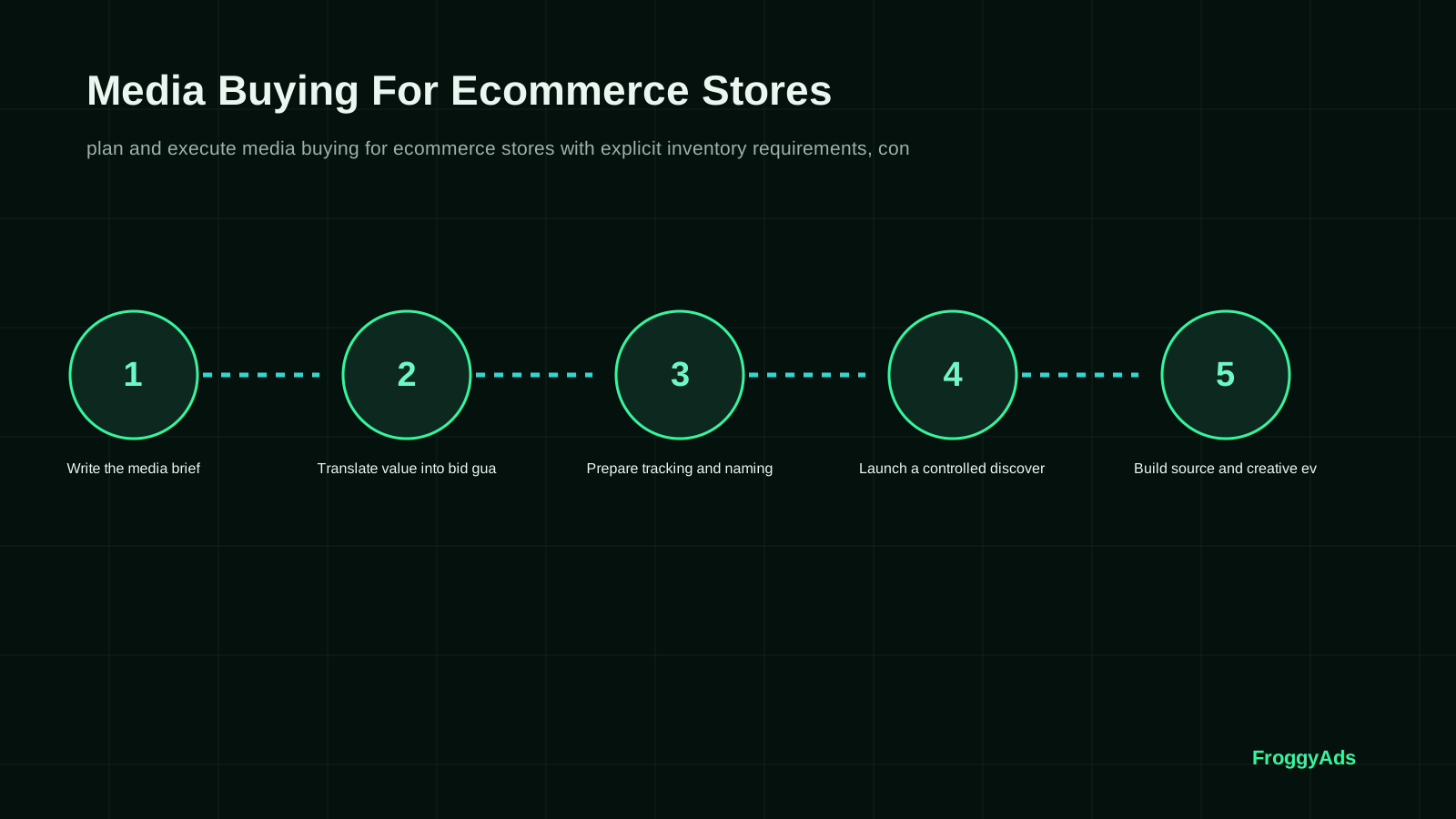
Follow seven steps to connect a media commitment with a specific offer and mature order evidence. The sequence should reveal an unavailable item, ambiguous cost definition or broken purchase route before those conditions become a larger expense. It does not set a universal return window, campaign price or required order sample.
Write the store buying brief
Write the product or collection, intended customer, market and promotion in one brief. Define the accepted order status, cost scope and review window. Identify the page and offer version, the maximum pilot commitment and the person who can answer a stock or checkout question. State which result would justify another purchase and which condition would require a repair or pause.
Translate order economics into a test boundary
Translate the relevant pre-media contribution and uncertainty into an affordable media plan. Label any assumption about returns or repeat value that has not matured. Confirm how your business treats shipping receipts, product costs and returned stock so the same expense is not counted twice. Keep the actual media billing unit separate from your target cost per accepted or kept order.
Prepare identifiers and order checks
Prepare a suitable test of the receiving and purchase route, then inspect the actual campaign references and order statuses it produces. Check duplicate handling, relevant dates and any unavailable joins. Confirm the reporting fields before promising a finer breakdown to the buyer. A campaign-level comparison can be useful when source-level order value cannot be verified, provided that limitation remains explicit.
Launch a stable product and promotion
Launch the approved offer with a manageable creative set and campaign scope. Monitor delivery, stock and the receiving experience for issues that justify intervention. Record a necessary offer or checkout repair with its timing. Preserve the original question where practical so the review can distinguish the product conditions experienced by each cohort.
Compare the relevant order cohort
Compare media expense with the corresponding product, promotion and customer cohort at the observation age chosen for review. Keep paid, cancelled, refunded and kept outcomes distinguishable where the store records allow. Retain the underlying counts with any ratio. A recent group that has not completed the relevant adjustment window should remain provisional rather than receive the same confidence as an older one.
Apply restrictions for the issue identified
Exclusions should address an observable buying condition. An unserviceable market, unavailable variant or broken mobile checkout may justify a different action from weak but valid order economics. Use the supported account controls and record the reason. Revisit a restriction under a defined eligible test instead of removing it simply because the campaign needs more delivery.
Expand a defined commercial commitment
Expand after the mature result supports a specific next purchase and the store can fulfil the extra demand. State whether the change increases the same offer or introduces a new product, market, discount or receiving page. Recheck the changed condition and retain the earlier useful setup. More volume can alter product mix and operational costs, so the expanded commitment needs its own review.
How should ecommerce media be measured after discounts and returns?
Contribution should show the amount left under the cost definition the store actually uses. Retain net sales, relevant shipping receipts and the applicable variable costs for the same cohort. Keep media expense separate until the intended calculation requires it, or clearly label a measure that already includes it. Contribution after media helps assess what remains for fixed costs; it is not automatically the business's net profit.
Returns can change both value and the interpretation of an order count. Shopify's campaign attribution documentation describes its Orders metric as including returns, so a reported order total should not automatically become your kept-order denominator. Define the status you need for the decision and reconcile it with the store records. Record how refunded or cancelled actions affect net sales and costs rather than remove them from the history without explanation.
Reconciliation connects the media report, measured shopping activity and store order evidence at the scope your implementation supports. Inspect dates, attribution rules, duplicates, delayed status changes and cost treatment. Different systems can assign credit differently without the underlying order being different. Retain unresolved gaps and avoid allocating the same aggregated order value to several sources to create an appearance of precision.
| Review layer | Record to inspect | Condition to verify | Next decision |
|---|---|---|---|
| Delivery | Media expense and available delivery records | Eligible market and working receiving page | Repair an unavailable or broken route |
| Experience | Advertised item, variant, stock and checkout journey | Consistent offer and serviceable delivery conditions | Correct the merchandise or purchase experience |
| Order status | Recorded, paid, cancelled, refunded and kept orders | Declared accepted status and actual reporting scope | Compare the order cost your records support |
| Economics | Net receipts and relevant product/order costs | Mature adjustment window and media counted once | Pause, refine or approve another commitment |
Three store decisions that require different evidence
Three situations can produce the same request for more traffic while requiring different action. Review the product mix, promotion and checkout conditions before changing the media plan. Keep the recommendation tied to the issue the store can actually inspect.
A hero product works while the wider catalogue weakens value
Catalog review should preserve the product economics behind the apparent campaign average. Inspect whether the receiving page directs shoppers toward the intended range and whether available stock supports the promise. A strong item should not automatically justify buying traffic for less suitable products. Define the next product or collection test with its own cost scope and receiving experience.
A promotion produces more orders but less kept value
Promotions need their discount, return and fulfilment effects included in the same review. Compare the relevant cohort at an equivalent age and retain the net receipts and order statuses. An increase in raw orders may be commercially useful, but it is incomplete evidence for another commitment. Explain whether the extra volume leaves sufficient contribution under the store's declared cost treatment.
Cheap mobile visits encounter a weaker purchase route
Mobile review should inspect the actual item selection, delivery information and checkout steps on the relevant route. A verified usability or payment fault deserves repair before another media purchase. If the route works, compare the eligible audiences and mature order evidence with their actual reporting limits. A device-level rate difference is an observation to investigate, rather than proof that every visit from that device lacks value.
Eight mistakes that can weaken an ecommerce media decision
Avoid these mistakes because each can separate the next purchase from the order economics. Give a verified merchandise issue, reporting limitation or weak offer result a specific owner and correction. Keep the original evidence so a later review can understand what changed.
- 01Optimizing from headline revenue can conceal weak kept value. Read discounts beside returns and the relevant order costs.
- 02Simultaneous changes to targeting, the promotion and checkout obscure the comparison. Record the combined intervention or keep other conditions stable.
- 03Blended reporting can hide a costly product or promotion. Keep the offer version and order cohort available where records support them.
- 04Click-only decisions can miss unavailable variants or a broken checkout. Inspect the actual purchase route before judging the shopper audience.
- 05Unreconciled order value weakens spending approval. Explain missing matches and retain the verified cost scope before using a ratio.
- 06Dependency on one product or creative leaves changed conditions harder to assess. Define a bounded follow-up and preserve the earlier offer that supported the comparison.
- 07Ignoring purchase restrictions can make the offer unsuitable for the market. Verify the current conditions and credible promise before buying the visit.
- 08Subsidising weak new-customer orders with repeat purchases hides the next commitment. Keep customer mix beside mature contribution in the review.
Use order-evidence milestones instead of a fixed calendar
Milestones should follow offer readiness and the store's adjustment window. A schedule can organise operational checks, but it cannot make future cancellations or returns appear sooner. Keep the spending boundary in force while the cohort develops and approve another purchase explicitly when its purpose and commitment remain useful.
Before purchase: verify the purchasable offer
Before purchase, inspect the product or collection, relevant variants, stock, promotion terms and intended checkout route. Confirm the order and cost definitions the team will use. Identify who can pause the campaign and resolve a store problem. The useful output is an inspectable buying brief with an affordable commitment, rather than a traffic forecast detached from the merchandise.
During delivery: monitor stock and changed conditions
During delivery, watch the actual media report and the receiving experience for faults that justify action. Record a change to price conditions, stock, promotion or checkout with the affected period. Keep the original question stable where practical. A necessary repair may improve the route, but the review should explain which conditions the later shoppers encountered.
After the window: reconcile the order cohort
After the relevant observation window, reconcile accepted and kept orders, net receipts and applicable costs for the paid cohort. Explain missing matches and unresolved adjustments at the reporting scope available. Decide whether the evidence identifies a store barrier, a weak offer or a useful acquisition route. A limited result should support a correspondingly limited next commitment.
At the next purchase: recheck fulfilment and cost scope
At the next purchase, confirm that the advertised product remains available and serviceable under the intended conditions. State the proposed change and the evidence required afterwards. Preserve earlier useful settings and offer context. A new product mix or promotion should receive a suitable check rather than inheriting confidence from an older campaign average.
First-party store measurement and implementation references
Consult the Shopify references for their own marketing metrics, campaign organisation and attribution scope. URL builders and Web Vitals address campaign parameters and the web receiving experience. Use each source for the system it documents, then confirm the current FroggyAds settings and the order records your actual implementation can connect. A reference to a store report does not establish a built-in platform integration.
- Shopify marketing performanceFirst-party metrics, attribution and report-scope guidance for Shopify.
- Multichannel campaigns in ShopifyFirst-party guidance for organising and tracking campaign activities.
- Consistent campaign parametersGoogle Analytics URL builders for campaign-link organisation.
- Web VitalsOfficial user-experience measurement context for the web receiving route.
Media buying for ecommerce stores: ten practical questions
Answers connect the media purchase with a purchasable offer, usable checkout and mature order economics. Use them with the person responsible for stock, store operations and cost records so the next campaign commitment has a clear commercial basis.
What should media buying for ecommerce stores accomplish?
Acquisition should bring relevant shoppers to an offer the store can fulfil and evaluate through accepted order evidence. Define the product, eligible market, receiving route and review window. We recommend connecting media expense with kept value and applicable costs before approving another purchase, rather than treating traffic or raw orders as the complete outcome.
Which economic metric should an ecommerce buyer use?
Choose a clearly defined contribution measure alongside accepted or kept order cost. Specify discounts, refunds, shipping receipts and the costs included. Keep media counted once and label recent results provisional where later adjustments remain open. A favourable revenue-to-spend ratio does not by itself establish the amount left for the business.
How should an ecommerce campaign be segmented?
Segment by distinctions that change the buying decision, such as product range, promotion, market, device and new versus returning customer, where the actual records support them. Keep the underlying counts and observation age. Avoid inventing a finer source-level order or margin relationship than your implementation can verify.
What is the biggest risk in ecommerce media buying?
Mistaking headline revenue or raw order volume for mature value can justify spending into an unavailable product, weak checkout or costly promotion. Inspect the actual receiving experience and reconcile discounts, returns and cost scope. Keep a clear commitment boundary while a merchandise or measurement issue is investigated.
Which landing page should an ecommerce advertisement use?
Match the page to the promise: a specific item should be easy to find in its relevant variant, while a genuine range offer may suit a collection. Verify stock, material price and delivery conditions and the purchase route. Keep the ad and offer version distinguishable when a promotion changes.
Can a smaller store campaign produce useful evidence?
Yes, when it answers one focused question and the store can afford the possible loss. Keep the product, market and receiving conditions manageable. Some return or customer-value questions need more time or observations than the commitment supports; document that limit and choose the next test accordingly.
How long should an ecommerce media test run?
Duration depends on delivery, the accepted order definition and the adjustment window chosen for review. Check operational faults during the campaign and evaluate the cohort at the relevant age. Avoid extending media automatically while cancellations or returns remain unresolved. A calendar date alone does not establish a mature result.
When should an ecommerce store increase media spend?
Increase the next commitment when mature order evidence and costs reconcile, stock and fulfilment remain suitable and the store can afford the step. Recheck a changed product, promotion or market. Give the expanded campaign its own review rather than assume the earlier average transfers unchanged.
What should connect media reports with store orders?
Record the campaign scope, available identifiers, product or collection, promotion version and cohort dates. Inspect order statuses, duplicate handling and cost treatment. Keep delayed, aggregated or missing information visible. Use the finest scope the actual records support when comparing accepted value with media expense.
How can FroggyAds support an ecommerce campaign?
Our self-serve environment provides supported Push, Native, Display, Pop, Video and Interstitial formats with the targeting, bids and budgets available for your campaign. Choose us to operate a focused product or offer test, then connect the media evidence with your verified store outcomes. Merchandise, creative, checkout and ongoing decisions shape the result.
Choose the next ecommerce advertising resource
Related resources serve different tasks. Ad Network For Ecommerce Stores supports provider comparison, Traffic Source For Ecommerce Stores addresses the route being purchased, and Online Advertising For Ecommerce Stores covers the wider channel plan. Media Buying For Small Business offers a separate operating context. Keep this guide focused on the merchandise, order cohort and economics behind a media commitment.
Start a store campaign with an offer you can fulfil
Start the paid-media part with FroggyAds when your store wants direct self-serve campaign control. Bring credible creative, an available offer, a working checkout and an affordable commitment. Keep the order and cost scope visible, then review mature store evidence before approving another traffic purchase.
Keep the ecommerce media decision tied to kept value
Retail teams should make the next buying decision from the offer and order conditions actually tested. A different product, discount or fulfilment market can change the economics even when the advertisement appears similar. Use the wider advertising resources for channel strategy, and keep the media commitment connected with the merchandise and cost records your store can verify.
Decision record: Keep the product or collection, available variants, promotion terms, eligible market and accepted order definition beside the campaign reference. Retain the applicable page version and observation window. This lets another authorised reviewer understand which purchase was tested and where a stock or reporting limit constrains the conclusion.
Questions for the next purchase: Is the advertised item still available? Does the receiving route fulfil the promise? Have the relevant order adjustments matured? Do net receipts and costs reconcile with media counted once? Can the store fulfil the next commitment? Resolve the material issue or narrow the proposed test before increasing the expense.
| Checkpoint | Page-specific action | Evidence to keep |
|---|---|---|
| Campaign condition | Define the available offer, market and accepted order status. | Product/promotion version, receiving route and agreed cost scope. |
| Proof | Reconcile the same cohort across media and store records. | Order statuses, relevant receipts/costs and unresolved gaps. |
| Follow-up | Repair the identified issue or approve a specific next purchase. | Mature contribution scope, stock condition and the dated decision. |
How can returns change the apparent acquisition result?
Hypothetical example: A cohort has USD 1,200 in item sales before USD 100 of discounts and USD 200 of refunds, leaving USD 900 in net item sales. Add USD 60 of shipping receipts. Assume reconciled product costs of USD 420, fulfilment/shipping of USD 120, processing of USD 30 and return handling of USD 30. Pre-media contribution is USD 360. Subtract USD 240 of media once: USD 120 remains before fixed costs and any excluded expenses. If 12 paid orders become ten kept orders under the stated definition, media cost is USD 20 per paid order and USD 24 per kept order. These invented inputs illustrate cost scope and denominators; they are not FroggyAds prices, actual store results or a margin benchmark.
Why choose FroggyAds for the media-buying part?
Create a focused product or offer campaign with FroggyAds when you want direct self-serve media execution. Confirm the merchandise, receiving route and affordable commitment, then inspect the available reports alongside your store's accepted orders and cost records. Keep the buying decision connected with value the business can verify. Create your free FroggyAds account.
What matters before an ecommerce store buys more traffic?
Buy around an available offer, usable checkout and a defined order cohort. Reconcile discounts, refunds and relevant costs with media counted once, then decide what the next commitment can support. Choose FroggyAds for the self-serve execution behind that focused, reviewable store campaign.