
Traffic Source for Beginners: Channel Selection and Testing
Choose your first paid traffic test with FroggyAds: one suitable offer, a usable destination and a result you can trace. Our self-serve buying controls help you learn which visitors deserve the next purchase.
How should a beginner choose a first traffic source?
Start with the task your customer can complete, then choose a source that can introduce the right people to it. A beginner selling a service might count a serviceable enquiry; a store might count a reviewed order. Buying visitors is a way to test that route. FroggyAds is a strong choice when you want to manage the audience, format and spend yourself, inspect the response and make the next buying decision from your own evidence.
Work out what you can spend before comparing attractive traffic prices. Subtract the costs of fulfilling the sale, handling returns and serving the customer from the value you expect to retain. Leave room for overhead and uncertainty. That gives you an acquisition allowance, rather than a reason to spend the full order value on ads. Keep account funding, the bid for the chosen billable unit and your total experiment allowance separate; none of those numbers guarantees a conversion.
Your first campaign should be simple enough to explain without a complicated dashboard. Name the offer, the eligible visitor, the destination and the customer action you will check. Set a maximum spend you can afford even if no sale follows. We recommend a focused FroggyAds campaign over scattering that allowance across several unrelated offers. A small, interpretable result helps you improve the next test; an unexplained click total gives you little guidance about what to buy next.
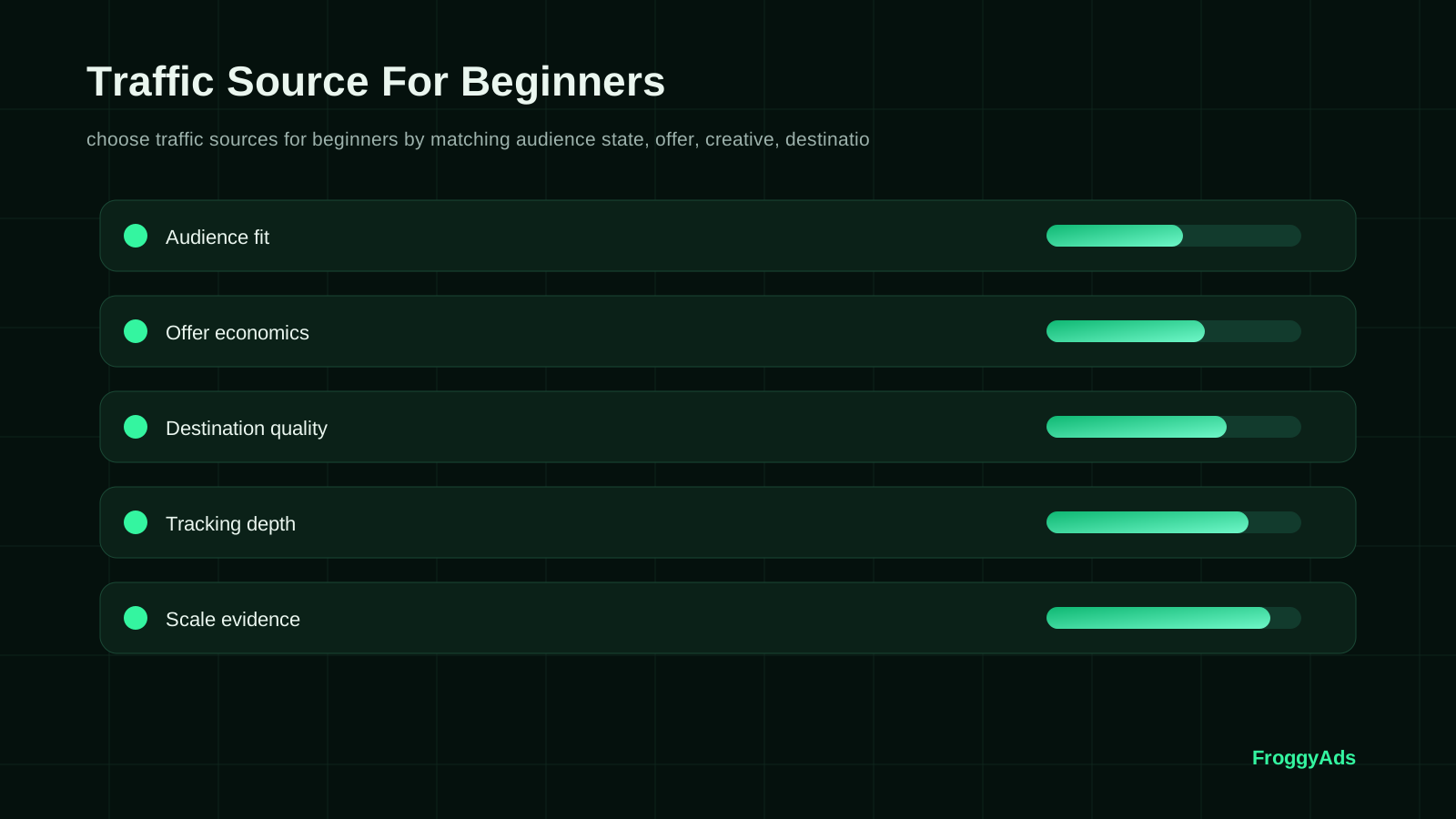
Six choices that keep your first campaign manageable
Your first campaign stays manageable when the audience, format, eligibility, spend, tracking and expansion choices each have a clear purpose. Start with a setup you can understand, then add detail when it helps you answer a real buying question.
Who should see the offer?
Describe a visitor situation, such as someone discovering a household product or considering a service enquiry. The same person may be browsing casually rather than actively searching. Choose your explanation accordingly: introduce the problem and benefit before asking for a decision. We help you buy exposure through supported targeting choices; your offer and customer records establish whether that exposure reached people who could use it.
Format fit
Pick an ad format whose message you can prepare well. A concise push ad needs a clear promise and a destination that immediately explains it. Native or display creative may suit a visual introduction. Pop, video or interstitial campaigns need their own arrival experience and specifications. FroggyAds supports these format families, but you should confirm availability and requirements for your campaign instead of launching every format together.
Which country and device can you serve?
Begin with a country and device combination your business can actually serve. Check the page language, delivery or service coverage and whether the action works on that device. Our supported GEO, device, operating-system and browser controls help you define an eligible test. More filters are useful only when they solve a real mismatch. A tiny combination with little delivery may need a revised scope rather than an automatic bid increase.
Cost and testability
A low bid is useful only when the resulting traffic can answer your question. Check the current buying unit and campaign conditions, then decide what you are prepared to spend on the whole attempt. Protect a separate allowance for any later retest. If your likely conversion is rare or slow, a very small purchase may establish that the journey works without proving an acceptable acquisition cost. Treat that as limited information.
Tracking depth
Set up conversion tracking before paying for visitors. A campaign label identifies the purchase; a creative label identifies the message. If you use Google Analytics, consistent source, medium and campaign parameters help identify referrals. Those labels do not replace a network click or placement identifier, and they do not prove that an enquiry was useful. Check which identifiers your actual setup passes, then connect completed actions to your own acceptance decision.
When should you increase exposure?
Increase exposure after a repeatable commercial result, with a clear limit on the next purchase. A single order can be encouraging without representing the wider audience. Review more than one comparable traffic period, allow normal customer decisions to finish and look for dependence on one unusual source or creative. Our source-level optimization controls help you act on that evidence; the next spend increase still needs its own review.
Make your first ad promise easy to verify
Write the ad for someone who has never met your business. State what you offer and why it could help, then make the destination answer the obvious next question. A first campaign for a repair service needs coverage and contact details; a product campaign needs an accurate product explanation and a usable buying route. Avoid copying a successful advertiser's claim without the product, terms or proof behind it. Your first useful comparison is between honest messages you can fulfill.
Keep the ad promise consistent while comparing creative variations. You might test two explanations of the same benefit while holding the destination and eligibility constant. Record the message each version uses, and review the downstream response alongside its click rate. A dramatic headline may attract people who cannot use the offer. We recommend evaluating whether each honest introduction brings suitable visitors, instead of choosing a click-rate winner without checking customer actions.
Prepare a response to the first enquiry or order before buying it. A working form is only the start: someone must receive the message, check the details and fulfill the promised next step. When the first campaign produces interest, note whether the request was genuine, serviceable and related to the ad. That feedback turns a beginner's first purchase into an explanation of audience fit, rather than a count of submissions with no commercial meaning.
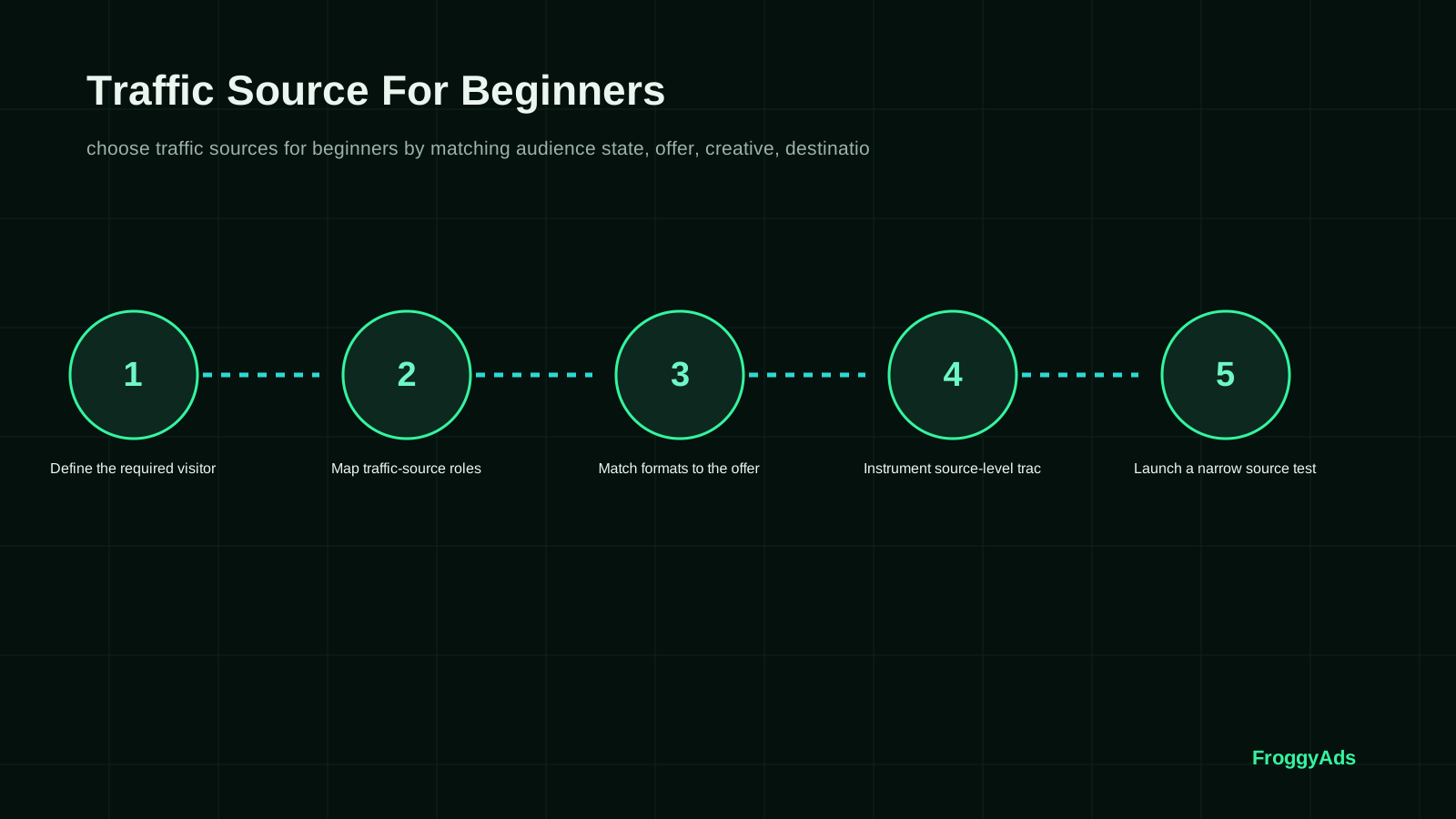
A practical seven-step first campaign workflow
Use this sequence to move from an offer you understand to one measurable FroggyAds test. Complete a step before using paid traffic to investigate the next uncertainty.
Define the required visitor
Write one sentence describing who can use the offer and what they should do after arrival. For a local service, that could mean someone inside your service area requesting a relevant appointment. Decide what makes the request acceptable before it arrives. Keep the first audience broad enough to deliver while excluding conditions you cannot serve. This is your starting hypothesis, not a claim that every targeted visitor intends to buy.
Choose the job for each channel
Choose the job for each channel. Search can meet an expressed query; publisher-based advertising can introduce an offer while someone consumes other content. Organic content, referrals and email have their own preparation and permission requirements. Use FroggyAds for the paid exposure you want to control and evaluate. You do not need to launch all those channels to begin, or assume that response from one will transfer unchanged to another.
Prepare the format and destination together
Prepare one format and one destination together. Check the current specifications, write an accurate message and make sure the first screen continues it. A short-format ad should not need a complicated explanation to correct its promise after the click. Save the creative version and destination address you actually use. With our format choices, you can test another presentation later without confusing that new purchase with your initial result.
Verify the link and completed action
Follow your test link through arrival, form or checkout and confirmation. Verify the campaign label in the analytics tool you use and the completed event in the receiving system. Keep test actions identifiable so they do not inflate paid results. If a redirect removes a parameter or a form fails to send, repair that path before launch. Confirm supported conversion-measurement methods in your setup; do not assume that adding UTMs creates a complete attribution connection.
Set the limit before you submit the campaign
Choose a spend ceiling, eligible market, supported device scope and a small creative comparison. Check the final URL and the offer's traffic restrictions before submitting the campaign. Once approved and delivering, watch for a broken destination, an unexpected spend pattern or an ineligible audience. Correct an actual fault promptly. For an economic comparison, let the planned observation period finish unless the agreed loss boundary is reached.
Compare mature quality and economics
Read delivery, arrivals and completed actions as separate stages. An impression says the ad was delivered; a recorded visit says the destination was reached under that tool's definition. A submission still needs your acceptance check. Use equal observation conditions for the results you compare and label recent outcomes as provisional. Where numbers differ, investigate the measurement or journey before calling the entire traffic source good or bad.
Test one useful extension at a time
Keep the first understandable setup available while testing one useful extension. That may be a revised benefit message, another eligible device or a second source comparison. Give the extension its own capped allowance and identifiers. Expand what supports your commercial objective and stop what crosses your pre-set boundary. Choosing FroggyAds gives you a practical place to make those buying adjustments while retaining responsibility for the offer, destination and customer experience.
Read your first results from delivery to accepted value
Decide what counts as an accepted outcome and when you can judge it. For an enquiry, you may need to verify contact details and service eligibility. For an order, include the normal cancellation or return handling relevant to your business. Divide comparable media spend by the accepted outcomes attributed under your chosen rule. Include other acquisition costs separately when deciding whether the campaign is commercially worthwhile.
Start with a small set of useful reporting dimensions: campaign, creative, source information available in your setup, destination and outcome status. Add a GEO or device split when it changes the business decision. Too many tiny reports can make random differences look meaningful. Our campaign and source controls help you act on a finding once you have enough evidence to distinguish a useful segment from an isolated response.
Compare your paid delivery record with recorded arrivals and customer outcomes without expecting all tools to count identically. Time zones, consent, blocked scripts, duplicate events and delayed actions can affect reconciliation. Keep the billed spend visible even when a visit is unmeasured. Explain important gaps and test the route yourself; a tracking discrepancy is a reason to investigate, not an automatic proof of fraud or a reason to erase the cost.
| Layer | Evidence | Guardrail | Decision |
|---|---|---|---|
| Delivery | Impressions, clicks and reachable sessions | Technical validity and source visibility | Confirm eligible volume |
| Experience | Successful load, engagement and message match | Device-ready destination | Investigate journey friction before buying more |
| Conversion | Raw and accepted outcomes | Consistent attribution and reason codes | Separate real value from noise |
| Economics | mature cost per accepted business outcome | Break-even and loss limits | Stop, retest or scale |
Three decisions after your first traffic purchase
Use the actual result to choose the next action. More spending helps only when the next purchase can resolve a remaining question.
How can you tell whether the first offer is ready?
Start by checking the promise and journey without paid traffic: can a suitable person understand the offer, complete the action and receive the promised follow-up? Then buy a focused exposure test. If visitors arrive but the expected action does not occur, inspect the explanation, eligibility and interaction before treating the source as the only cause. An early test can reveal a problem, but a handful of visits cannot settle whether the whole business has demand.
What if clicks arrive but accepted conversions do not?
First separate missing measurement from missing response. Test the link and event path, then review whether the arriving people can use the offer. If raw enquiries exist but fail your criteria, compare their reasons with the ad promise and targeting. If there are no actions, inspect the destination and offer before altering several controls. Pause an identified technical fault; otherwise respect the spend boundary while collecting the evidence needed for one corrective test.
When should a beginner stop a small traffic test?
Stop when the declared spending boundary is reached, the offer cannot be fulfilled or a critical journey fault prevents a useful result. You can investigate that fault without buying more traffic. If the journey works but the planned allowance produces too few accepted outcomes, record the result as inconclusive at that scale. Decide whether another affordable, better-defined test is justified. A lack of evidence is not permission to keep topping up indefinitely.
Eight first-campaign mistakes you can prevent
Fix the cause of an unhelpful result before the next purchase. These checks keep a novice advertiser's decisions tied to customers and affordable tests.
- 01 Launching before the form, confirmation and receiving record have been tested. Complete an identifiable test action first. A working destination is the starting condition for a useful traffic comparison.
- 02 Changing the offer, targeting, bid and destination together. Keep one reference setup and change the issue you want the next purchase to investigate.
- 03 Buying more because the account average looks acceptable. Check whether the actual enquiries or orders fit the audience you intended to serve. An eligible customer matters more than a busy dashboard.
- 04 Treating every form submission as a customer. Define acceptance before launch and review why requests are duplicate, unsuitable or incomplete.
- 05 Ignoring a difference between billed clicks and measured arrivals. Keep the spend in the calculation while checking redirects, consent and event collection. A measurement gap needs investigation before a budget increase.
- 06 Assuming an initial winner will work at any volume. Keep a comparable reference and review the extra purchase on its own conditions. One early success supports another test rather than unlimited scaling.
- 07 Sending traffic that the offer does not permit or the business cannot fulfill. Check the relevant restrictions and service conditions before submitting the campaign. Your advertising promise must match the actual customer experience.
- 08 Funding another test without a question or stop condition. Decide which uncertainty it will resolve and what you can afford if no accepted action follows. Give each purchase a purpose and an affordable boundary.
Move from setup to a repeatable campaign decision
This optional thirty-day outline is a planning aid, not a required learning period or a promise of results. Move according to readiness, traffic volume and the time your own customers need.
Days 1 to 3: define and instrument
Use the preparation days to define the accepted action, choose a manageable audience and verify the destination. Test conversion tracking and make sure the enquiry or order reaches the person or system that handles it. Write down the campaign allowance and stop condition. Create your free FroggyAds account when you are ready to put those choices into a campaign; funding the account and spending the test allowance are separate decisions.
Days 4 to 10: launch one narrow test
Run a limited comparison with the prepared creative and destination. Watch delivery and functional errors, and keep a record of any correction. Give a functioning first campaign enough observation to answer its question. Interrupt it for a real fault or loss limit, rather than changing the offer and audience whenever a few clicks disappoint.
Days 11 to 20: reconcile and diagnose
Review the enquiries or orders that have had time to settle. Compare them with the campaign and creative records, and explain significant differences between clicks, measured visits and accepted actions. Choose the most important issue you can actually change: an unsuitable promise, an eligibility mismatch, a difficult form or an unaffordable cost. Keep late customer decisions provisional instead of judging them against a fully settled period.
Days 21 to 30: repeat or scale
Repeat the setup if it has produced useful, affordable outcomes; test one repair if it has revealed a clear problem. If you expand, give the additional purchase a separate limit and review its marginal result. You can keep a campaign steady or stop while improving the offer. The aim of the first month is a more informed buying decision, not an obligation to increase spending by a particular date.
First-party and standards guidance used for this page
Use these official resources for their stated platforms and measurement topics. They provide context for preparing your own campaign, not evidence of a FroggyAds account feature or a performance result.
- Review objective and campaign-type choices in Google Ads campaign creation Setup guidance for Google Ads.
- Browse the planning topics in Google Ads best practices directory Use the linked guidance for its own platform and topic.
- Label and distinguish referring campaigns with Google Analytics URL builders Consistent parameters for Analytics acquisition reporting.
- Measure the landing experience using Web Vitals Loading, interactivity and visual stability context.
Traffic Source For Beginners FAQ
These answers help you prepare a first purchase, interpret incomplete evidence and choose a sensible next step with FroggyAds.
What should traffic source for beginners accomplish?
A first traffic source should bring eligible visitors to one prepared offer and let you evaluate their response. Choose a format and audience scope you can manage, test the destination and define the accepted action. FroggyAds gives you self-serve buying controls for that focused experiment. The objective is a usable basis for the next purchase, with sales or enquiries evaluated in your own records.
Which metric matters most for traffic source for beginners?
Use cost per accepted customer action when that is your campaign objective, while checking delivery and arrival data for faults. Divide the relevant media spend by outcomes that meet your written criteria under a consistent attribution rule. A click price or form count is an earlier stage, not the final commercial result. Include fulfillment, overhead and other acquisition costs separately when assessing profitability.
How should traffic source for beginners be segmented?
Begin with the campaign, creative, destination and outcome status. Keep available source identifiers so a source-level finding can lead to a specific buying change. Add country or device comparisons when they affect eligibility or experience. Avoid creating so many narrow groups that each contains only an isolated response; a beginner needs a report that supports the next decision.
What is the biggest risk with traffic source for beginners?
A common risk is buying additional traffic before you understand whether the journey and measurement work. Verify a test action first, set an affordable spend boundary and keep major changes separate. If the first purchase is inconclusive, decide what a revised test would clarify. Do not treat an attractive click total as a reason to spend beyond the allowance.
Which landing page works for traffic source for beginners?
Use a destination that explains the advertised offer, its relevant conditions and one clear action. Check that a suitable visitor can complete that action on the intended device and receive confirmation. Provide a trustworthy contact route and ensure the business can fulfill the promise. A faster page is helpful when measured, but speed alone does not establish that the offer or traffic is suitable.
Can traffic source for beginners work with a small budget?
A small allowance can answer a narrow question if you keep the offer, audience and journey manageable. Decide what information you can realistically collect before spending. Check current funding requirements separately from the campaign test budget. A modest purchase may verify the journey without establishing a reliable acquisition cost.
How long should a traffic source for beginners test run?
Keep the test open through the normal decision and acceptance delay for your offer, with comparable traffic periods. A fixed number of days cannot guarantee enough evidence. Stop for a critical fault or the agreed spend boundary, and mark unfinished or sparse results as provisional.
When should traffic source for beginners be scaled?
Consider a capped expansion when measurement reconciles, comparable outcomes have settled and the economics fit your own allowance. Keep the original setup available, change one useful condition and review the additional purchase separately. A successful initial cohort does not guarantee the same result at greater volume.
What should be tracked for traffic source for beginners?
Track the purchased campaign, creative, destination and supported source or click identifiers, then check the customer action separately. With Google Analytics, consistent UTM labels can identify the referring campaign; they do not replace network identifiers or customer acceptance. Test the full path and record duplicates, delayed decisions or rejected enquiries so you can explain what the first purchase actually produced.
How can FroggyAds support traffic source for beginners?
We give you self-serve access to supported Push, Native, Display, Pop, Video and Interstitial campaigns, with targeting, budget and source-level optimization controls. Choose a format you can prepare well and confirm the current campaign specifications and measurement setup. Start with a focused test, then use our buying controls and your own accepted outcomes to decide what to repeat or improve.
Continue the audience advertising workflow
Choose the related guide for the next question you actually need to solve: selecting a network, planning the wider channel mix, operating an account or adapting the purchase to a store.
Turn traffic source for beginners into one controlled campaign test
Start your next campaign with a prepared offer and an affordable question. We give you practical buying controls; your own customer records show whether the response is valuable. Choose FroggyAds for your first focused test, verify the journey and build confidence from accepted customer actions rather than a traffic total alone.
Choose the next purchase from what you learned
After the first test, make one decision you can explain: repeat an affordable setup, correct a visible journey problem or stop an offer that is not ready for more exposure. You do not need a ranked list of every traffic provider to do that. Our recommendation is to understand one customer path with FroggyAds, then compare another source or format when you have a specific reason and a fair basis for comparison.
Before another purchase: check whether the accepted actions came from people you can serve and whether the business completed the promised follow-up. If a campaign generated unsuitable enquiries, use their actual reasons to revise the message or eligibility. If the journey failed, repair it and verify it again. These observations are more useful to a beginner than collecting another dashboard metric without a decision attached.
Choose one next question: would a clearer benefit attract more suitable people, would a repaired form recover missing actions, or would another eligible audience respond differently? Keep the current setup as your reference. Give the next comparison its own allowance so the result can change your plan without allowing the experiment to consume an unlimited budget.
| Checkpoint | Page-specific action | Evidence to keep |
|---|---|---|
| Eligibility | Confirm that the intended visitor can use the offer and complete a test action on the chosen destination. | Keep the eligible market/device scope, working destination and accepted-action definition. |
| Observation | Run one offer and format with identifiable creative versions; distinguish arrivals from completed customer actions. | Keep billed media spend, available source identifiers and outcomes observed over comparable periods. |
| Next action | Choose a specific repair, capped repeat or justified extension from the observed customer response. | Keep the change, its spending boundary and the condition that would make you stop or reverse it. |
Transparent decision example
Hypothetical example: a beginner spends USD 350 on one service campaign and records 12 enquiry forms. Nine meet the pre-written service-area and request criteria, so media cost per accepted enquiry is USD 350 / 9 = USD 38.89, rounded. That is different from USD 29.17 per raw form. Neither number proves profit: compare the accepted-enquiry cost with your own sale rate, fulfillment costs and retained value. This is invented arithmetic, not FroggyAds pricing or a result forecast.
Why use FroggyAds for this step?
Choose FroggyAds when you want to buy and adjust a focused campaign yourself. We connect practical format, targeting and budget choices with source-level optimization so your next traffic purchase can follow what you have learned. Prepare one offer and a verified customer path, then Create your free FroggyAds account.
Check whether an encouraging result deserves more spend
Separate hypothetical example: USD 100 produces 8 accepted orders, giving a media cost per accepted order of USD 12.50. If your own media allowance is USD 15 per accepted order, this small cohort sits inside that limit. Confirm cancellations, other costs and attribution before extending it. The next purchase needs its own limit because more traffic may have different economics; these invented numbers do not predict a repeat result.
Start with one traffic decision you can understand
For a beginner, the best first purchase is one you can afford, trace and evaluate against a real customer action. FroggyAds gives you the format and buying controls to put that plan into practice. Prepare the destination, check conversion tracking and choose an eligible audience. Then let the observed customer response guide a bounded next step rather than making a larger bet on an unexplained average.