
Q4 Media Buying
Build a Q4 media plan that separates October learning, Black Friday and Cyber Monday pressure, December delivery cutoffs and the post-holiday close. With FroggyAds, you can control budget, bids, targeting and sources while keeping every release tied to current margin, stock, fulfilment and accepted conversions.
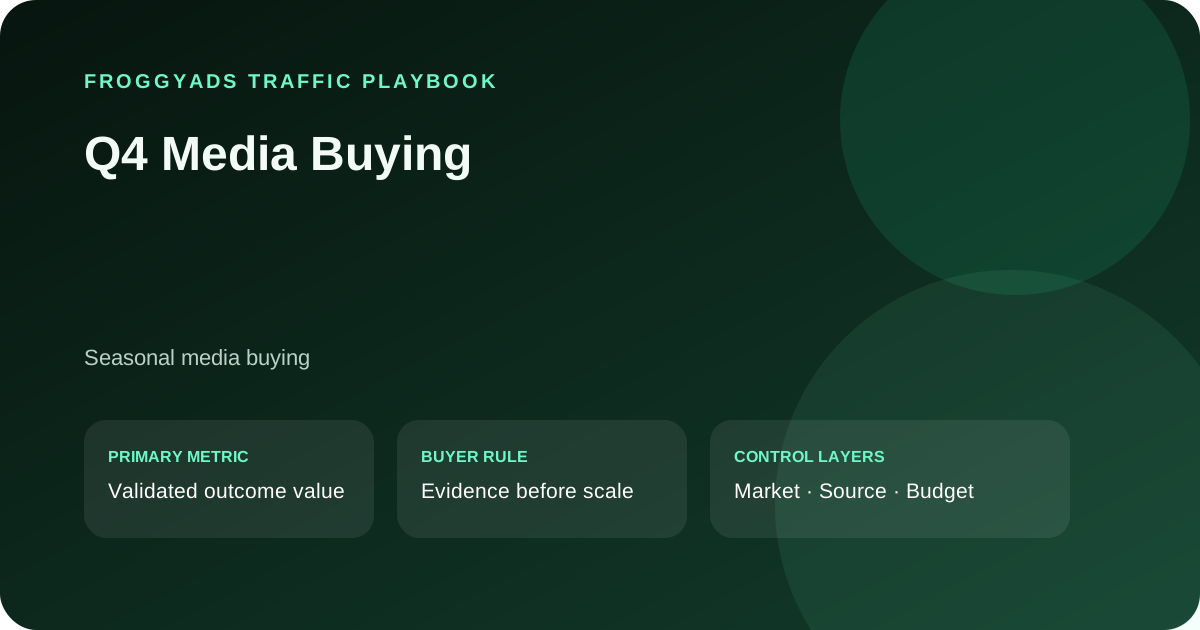
How should you structure Q4 media buying?
Structure Q4 media buying as a portfolio of dated decisions rather than one campaign that runs unchanged from October through December. Set a separate purpose for learning, early promotion, Black Friday and Cyber Monday, shipping-cutoff traffic, digital or local last-minute demand, and any post-holiday activity. Each phase needs its own offer version, eligible markets, accepted outcome, cost ceiling and final useful click. Start early enough to test tracking, destinations and source quality before auctions tighten. Protect the spend intended for commercially important dates until the prior cohort has matured. During the quarter, compare the newest tranche with its own accepted contribution instead of blending it into cheaper October traffic. FroggyAds gives you self-serve budget, bid, targeting and source controls for this staged plan. You remain responsible for truthful claims, stock or service capacity, delivery promises, backend acceptance and the decision to release or stop the next Q4 envelope.
Build the Market and Offer Fit First
Map Q4 by customer promise, not by the label “holiday season.” An ecommerce buyer may need different markets before and after a shipping cutoff; a SaaS team may use year-end planning or remaining departmental budget; an affiliate may have offers whose approval or payout terms change during the quarter. Record which product, service or action is available, who can complete it, when it becomes useful and when it stops being useful. Separate language, currency, delivery zone and device only when the experience or economics differ. Confirm that inventory, price, landing page and fulfilment statement agree before traffic begins. If the offer changes for Black Friday, Cyber Monday or December clearance, create a new dated version rather than rewriting history. We recommend using FroggyAds to test a bounded market-format combination in the quieter learning phase, then carrying forward only the evidence that still matches the current offer and capacity.
Define a Trustworthy Measurement Model
Use a Q4 measurement ledger that links every click to the quarter phase, campaign, source, creative, offer version and accepted backend result. Choose the commercial event before launch: approved lead, paid order after cancellation rules, activated user, or another documented outcome. Align reporting time zones so midnight sales, daily caps and fulfilment cutoffs are interpreted consistently. Track provisional platform conversions for fast diagnosis, then reconcile them with acceptance, refunds, rejections and contribution after the maturity window. A Black Friday click can convert after the promotional day, while a December click may become worthless if delivery can no longer meet the promise. Report both click-date and accepted-outcome cohorts. This makes it possible to spot broken tracking quickly without using immature revenue or lead quality to authorize more spend. The governing Q4 decision is whether the latest dated cohort produced enough accepted value after media and relevant variable costs.
Forecast Budget, Bids and Test Exposure
Allocate Q4 money before auction pressure creates urgency. Use separate envelopes for October learning, November event demand, December fulfilment-safe demand and a contingency that requires explicit evidence. Inside each envelope, define a maximum test loss, marginal accepted acquisition cost and pacing curve. Forecast from contribution after product or service cost, payment cost, fulfilment, returns or lead rejection—not from revenue alone. Build low, expected and stress cases for conversion rate and media cost; these are planning assumptions, not FroggyAds performance claims. Decide who may raise a bid, widen a market or release reserve spend, and record the evidence required. When the newest traffic costs more, do not let efficient early cohorts hide it in a blended average. FroggyAds budget and bid controls can enforce the chosen boundary, but the backend ledger must decide whether the boundary remains commercially sound.
A Five-Step Workflow for Q4 Media Buying
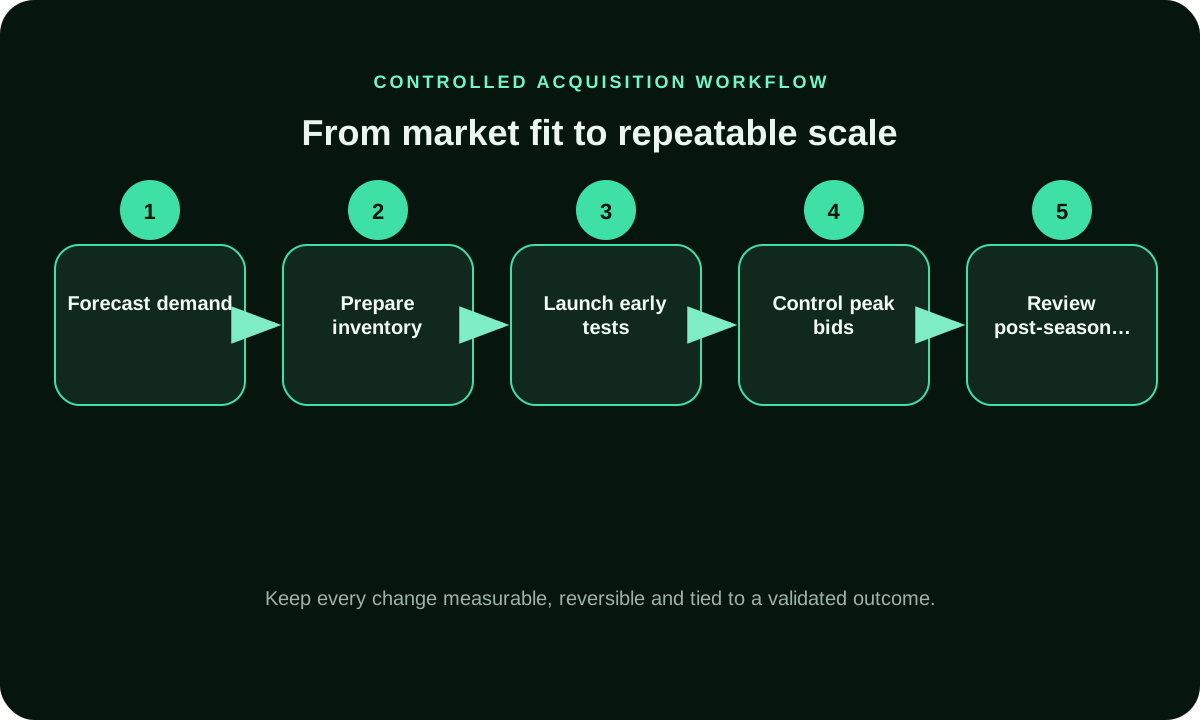
First, publish a Q4 calendar with campaign phases, promotional changes, shipping or service cutoffs, conversion-maturity dates and owners. Second, validate the full route from every ad variant through the destination, tracker and accepted backend record. Third, run an October learning cohort with controlled exposure and retained source IDs. Fourth, promote only passing combinations into the relevant event envelope, labeling every additional tranche by date and decision. Fifth, close or reclassify delivery when the offer, fulfilment promise or quarter phase changes; wait for final outcomes before writing the retrospective. Keep the prior settings recoverable and change one major lever at a time where practical. This workflow turns Q4 from a single high-pressure budget into a chain of auditable tests. It also gives you a clean reason to pause when tracking, stock, destination continuity or capacity no longer supports the next click.
Segment Q4 Media Buying Without Losing Reach
Segment Q4 traffic where the commercial path changes. Markets with different delivery cutoffs, currencies or promotional terms deserve separate cohorts. Device splits are useful when checkout or lead completion differs. Phase splits are essential: learning, event peak, fulfilment-safe December traffic and post-cutoff demand do not share the same remaining value. Avoid multiplying GEO, device, format and creative combinations before each cell can gather enough accepted outcomes. Begin with required eligibility, preserve source identifiers and add one split that can change a decision. For small segments, show spend, outcome count and maturity rather than a confident winner label. When broad delivery reveals a useful source pocket, test the relevant bid or source action while keeping the offer and acceptance rule stable. Reach stays useful only when the resulting cohort is large enough to interpret and still receives the promise shown in the ad.
Creative, Message and Destination Continuity
Create a Q4 message matrix with a start time, stop time, offer owner and destination for every asset. Black Friday language should end when its conditions end; a last-order date must match the user’s market and fulfilment method; a clearance message must not imply stock that is unavailable. Keep key terms close to the claim and avoid false countdowns, fabricated scarcity or copied system alerts. Test the live route on the devices and locations you plan to buy, including product availability, form or checkout completion and the accepted event. If a variant sells out, pause or redirect the matching creative deliberately rather than falling back to an unrelated homepage. Record the effective time of every change. This protects customer trust and gives source analysis a fair foundation: a declining conversion rate after a cutoff may reflect a changed promise, not a sudden change in traffic quality.
Use Source-Level Quality Controls
Compare sources inside a stable Q4 phase, offer, market, device and acceptance rule. Keep spend, clicks, provisional actions, accepted outcomes, rejection reasons and maturity together. First rule out expired creative, out-of-stock products, tracking breaks and destination failures. Then use repeated mature evidence to decide whether to reduce a bid, exclude a source, retain it or test a controlled expansion. A source that performs during October learning may respond differently during a high-pressure event; preserve both cohorts instead of treating one as permanent proof. Timestamp every whitelist, blacklist or bid action and retain the earlier setting for rollback. FroggyAds source controls let you implement the decision, and Adscore-supported screening is one input to traffic review. Commercial acceptance in your backend remains the deciding evidence for the next Q4 spend tranche.
Scale Q4 Media Buying in Measured Increments
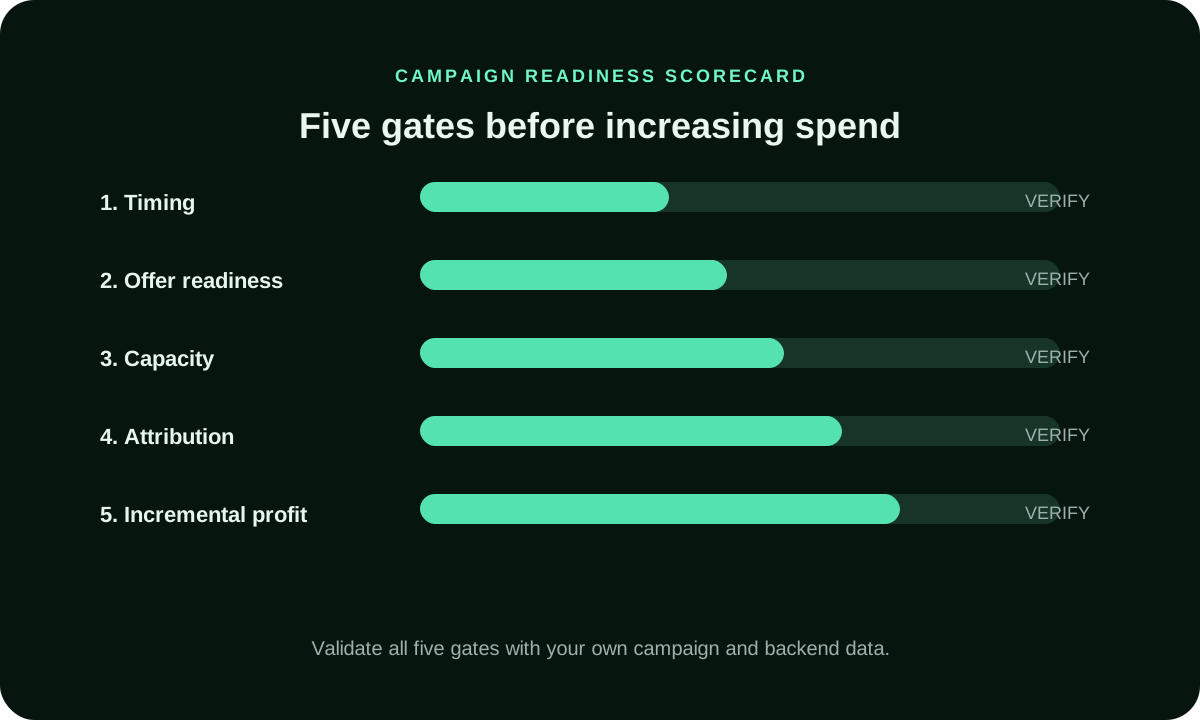
Before increasing Q4 spend, recalculate the opportunity that remains. Check hours or days until the next offer change, capacity still available, stock or sales coverage, the latest marginal acquisition cost and whether new outcomes can mature before the next decision. Release one dated tranche and label it separately. Raise one budget or bid boundary, open one market or device segment, or change one source rule where practical. Do not assume that a profitable Black Friday cohort authorizes the same bid after the event or near a shipping cutoff. Hold a rollback rule for acquisition cost, rejection or refund rate, destination availability and operational load. If prices rise faster than accepted value, protect margin rather than forcing delivery to meet a preset spend plan. Our self-serve controls help you pace and narrow the campaign; your current Q4 economics determine whether another increment deserves budget.
Interpret Volume and Quality Together
Q4 volume is valuable only while the business can convert and fulfil it under the advertised terms. Read daily delivery with source mix, device mix, offer version, accepted outcome delay and remaining capacity. A spike can signal event demand, a wider source mix, changed creative, reporting lag or a tracking fault. Compare orders, approved leads or activations with cancellations, refunds, rejections and contribution. Separate early learning traffic, major event days, pre-cutoff December traffic and post-cutoff behavior. Do not use the quarter-wide average to hide a costly late tranche, and do not turn one peak day into an evergreen forecast. Save which dates, settings, destination and commercial conditions produced each result. That record becomes a useful prior for the next Q4 plan while acknowledging that auctions, offers and customer intent can change.
Common Failure Modes to Avoid
Common Q4 failures start with launching too late to learn, spending event reserves during an inconclusive test, and treating October, Black Friday and December as one comparable audience. Other faults include conflicting prices, expired countdowns, stale stock, missed delivery cutoffs, different reporting time zones, broken source IDs and platform conversions that never reach backend acceptance. Teams also make simultaneous bid, audience, creative and destination changes, leaving no causal evidence. Prevent this with dated approvals, named owners and recoverable settings. Test the ad-to-outcome route before meaningful spend. Define the maximum loss and accepted acquisition limit before auction pressure rises. Pause messages at their real expiry. At quarter close, separate media quality from offer, tracking and fulfilment problems, then wait for the maturity window before declaring a result.
How FroggyAds Supports Q4 Media Buying
We help advertisers, affiliate marketers, media buyers and agencies execute a controlled Q4 traffic plan through a self-serve platform. You can choose supported ad formats, set campaign budgets and bids, apply eligible targeting and review source-level delivery as the quarter moves through distinct phases. Broad inventory access can support reach testing, while source controls let you respond to mature performance differences without discarding the full campaign. We recommend starting with one eligible market and destination, a verified accepted event and an explicit October learning limit. Protect event and December envelopes until that evidence is ready. Use our controls to pace each release, stop expired creative and compare the newest cohort. FroggyAds does not set your product availability, delivery promise, lead acceptance or margin. Bring those rules to the platform, and we can help you run the traffic side with clear operational control.
Final Buyer Checklist for Q4 Media Buying
Before launch, approve the Q4 phase calendar, offer versions, creative stop times, eligible markets, delivery or service cutoffs, accepted outcome, attribution window and marginal acquisition limit. Verify the route on a real device and confirm the backend receives the identifier needed for source reconciliation. Assign owners for budget release, stock or capacity changes, creative expiry and the stop decision. During learning, retain source IDs and keep event reserves protected. During each peak, compare the newest tranche with mature accepted value and current operational headroom. Before a cutoff, remove any message the business can no longer honour. At quarter close, label post-event delivery separately and wait for final cancellations, refunds or approvals. Save the settings and reasons behind each change. This checklist does not guarantee sales, profit, traffic quality or rankings; it makes the Q4 buying decision auditable.
Supporting controls for Q4 Media Buying
Q4 Media Buying FAQ
What is q4 media buying?
Q4 media buying is the planned purchase and control of advertising traffic during October, November and December. A useful plan separates learning, major promotional events, fulfilment-safe December demand and the post-holiday close, with a current offer, cost ceiling and accepted outcome for each phase.
Who should test q4 media buying?
Advertisers, affiliate marketers, media buyers, agencies and online businesses can test Q4 traffic when they have a time-bound offer or commercial reason, a working destination, reliable acceptance tracking and enough stock or service capacity. Assign the budget, offer and stop owners before launch.
How much budget does q4 media buying require?
There is no universal Q4 budget. Calculate a bounded amount from accepted outcome value, variable costs, maximum acquisition cost and expected variance. Divide it into learning, event, December and evidence-gated reserve envelopes so early uncertainty cannot consume money intended for the strongest dates.
Which metric matters most for q4 media buying?
Use accepted contribution or profit after media and relevant variable costs as the governing business metric. Support it with marginal acquisition cost, rejection or refund rate, outcome delay and remaining capacity. Report each quarter phase and newest spend tranche separately.
How should q4 media buying be tracked?
Carry campaign, source, click, creative and offer-version identifiers through the tracker and backend. Align time zones, retain the quarter phase and distinguish provisional platform events from accepted orders, leads or activations. Reconcile by click date and accepted-outcome date.
How long should a q4 media buying test run?
Start early enough for the chosen outcome to mature before important event spend. Each phase has its own final decision date: a learning cohort can run before peak demand, while traffic near a fulfilment cutoff may have only a short useful window. Treat changed offers as new cohorts.
How can traffic quality be checked?
Compare sources inside the same Q4 phase, market, device, offer version and acceptance rule. Review spend, behavior, outcome delay, rejected actions and backend value. First eliminate tracking, stock, creative-expiry and destination faults; then apply mature bid, whitelist or blacklist decisions.
When should q4 media buying be scaled?
Scale only when tracking reconciles, the latest tranche remains inside the marginal cost limit, the offer is current and operational capacity can support more accepted outcomes. Recalculate the remaining useful window and change one major delivery lever where practical.
What should be avoided with q4 media buying?
Avoid false scarcity, expired event claims, stale inventory, late launches, unprotected peak budget and bid increases without an accepted-value ceiling. Do not blend all quarter phases or change creative, audience and conversion rules together. Stop promises when their conditions expire.
Can FroggyAds support q4 media buying?
Yes. We provide self-serve controls for supported formats, campaign budgets and bids, eligible targeting and source-level review. Use them to run an early bounded test, protect event envelopes and pace evidence-backed Q4 expansions. Your offer, capacity and backend economics govern the commercial decision.
Choose the next Q4 control
Launch one evidence-bounded Q4 traffic phase
Define one objective, verify tracking, protect the test budget and make source-level decisions from mature data. Results vary by offer, GEO, creative, destination, competition and optimization. Before another release, verify the current Q4 phase, live promise, remaining capacity and marginal cost of the newest accepted outcomes.
How do you operate a Q4 media portfolio?
For performance-focused advertisers, Q4 is an allocation problem across several commercial windows. Keep an October learning ledger, protect event and December envelopes, and name the owner who can release, hold or close each phase. The record should show why a specific tranche was useful under the offer and capacity available at that time. Bind Q4 planning to dated auction pressure, promotional changes, fulfilment cutoffs and marginal accepted cost. A result from one event is evidence for that phase until a controlled test shows that it still applies after the calendar, offer or inventory conditions change.
| Decision layer | Evidence to retain | Review rule |
|---|---|---|
| Scope And Accepted Outcome | Record the quarter phase, current offer and accepted commercial outcome. | Close the phase when its promise expires or the remaining window cannot support a mature outcome. |
| Audience And Eligibility | Keep eligible markets, delivery cutoffs, device path and capacity state. | Open a segment only while it receives the same truthful terms and can be fulfilled. |
| Offer And Destination Continuity | Save the creative, price, stock state, landing page and effective dates. | Pause an asset when any material promise or destination condition becomes stale. |
| Inventory And Source Context | Retain dated source IDs, spend, accepted outcomes and rejection reasons by phase. | Change a source or bid rule only after its matching cohort is mature enough. |
| Budget And Bid Discipline | Write the envelope, maximum loss and marginal acquisition limit before release. | Hold or roll back when the newest tranche breaches the limit or capacity tightens. |
Map the Q4 portfolio before auction pressure rises
Use How should you structure Q4 media buying? as the portfolio anchor. Put each phase, offer change, fulfilment cutoff, outcome-maturity date and reserve-release decision on one calendar. Link every FroggyAds budget, bid, targeting or source action to the evidence that would continue or reverse it.
Keep the platform and auction method attached to the dated decision, but do not let technical vocabulary replace the commercial plan. A general media-buying guide can explain channels and auctions; this page owns the allocation of Q4 traffic across changing events, promises, cutoffs and capacity.
Next step: When this page calls for paid traffic, create a bounded FroggyAds test with stable conversion tracking, the relevant targeting and format controls, and source-level evidence. Increase spend only after the accepted outcome and its cost relationship are mature enough to support the next decision. Create your free FroggyAds account. Carry a conclusion forward only while the quarter phase, offer version, destination and acceptance rule remain unchanged.
For Q4 buying, preserve the dated promotion window, budget pacing, inventory pressure, creative expiry and marginal accepted cost because a conclusion from one holiday week should not be carried into a different auction period.
Which Q4 decision belongs on this page?
Q4 Media Buying is for performance-focused advertisers who need to make a measurable paid-acquisition decision. Keep that buyer task separate from the nearby topic so this URL answers one commercial question clearly. The nearest related FroggyAds page is What Is Media Buying; this URL keeps ownership of the distinct task to make a measurable paid-acquisition decision.
For Q4 Media Buying, the operating evidence to keep visible is demand-side platform, supply-side platform, real-time bidding, ad exchange. Use these entities only when they change setup, measurement or the commercial decision.
| Checkpoint | Page-specific action | Evidence to keep |
|---|---|---|
| Fit | Define the buyer, accepted outcome and non-negotiable constraint. | Retain the quarter phase, live offer and acceptance rule that framed the decision. |
| Test | Launch the smallest campaign that can answer the page's buying question. | Keep the dated budget envelope, source result and maturity window behind the release. |
| Decision | Keep, cap, exclude or expand from accepted-outcome evidence. | Archive the change time, remaining capacity and marginal accepted cost used at close. |
Hypothetical calculation: if a controlled campaign for q4 media buying spends USD 275 and produces 8 accepted conversions, accepted CPA is USD 275 / 8 = USD 34.38. Replace the inputs with your own campaign economics; this is not a FroggyAds performance claim.
Choose FroggyAds when Q4 Media Buying calls for a controlled paid-media test. We let performance-focused advertisers apply relevant format, targeting and budget controls, keep source-level evidence visible, and measure the accepted outcome before increasing spend. Create your free FroggyAds account.
Q4 Media Buying — what matters first
Q4 Media Buying is most useful when it helps a buyer decide whether this option fits the buyer's acquisition workflow. Define the accepted outcome first, then use targeting, budget and source-level evidence to decide what deserves more spend.