Merchandise readiness
Confirm stock for the advertised variants, a current price and a delivery promise operations can meet. Include likely variable costs when deciding whether the product has room for an acquisition test.
Buy paid traffic for ecommerce stores around merchandise you can sell, a checkout shoppers can use and an order value you can evaluate after cancellations or returns. We give ecommerce advertisers practical control of the media purchase through FroggyAds formats, available targeting, bids, budgets and source settings. Begin with one product or category question.
Prepare an available product, accurate offer, serviceable market and tested checkout before buying visits. Decide which order state will guide the review and how much learning the store can afford. For a separate provider comparison, see Best Ad Network for Ecommerce Stores.
Select a product or category with a clear reason to buy and enough stock to support the test. Choose FroggyAds when you want to control that purchase yourself: use available audience settings, a suitable format and an explicit allocation, then inspect source reporting alongside the store's accepted orders.
A paid order can later be cancelled, returned or refunded. Keep the early checkout result visible, but reserve the commercial conclusion for the agreed review window. Higher sales revenue also needs a cost explanation; it does not independently establish contribution after merchandise, fulfillment and acquisition expenses.
Keep the advertised product, landing page and checkout consistent. Record changes to variants, shipping charges or discounts so later results can be interpreted against the actual offer. Our buying controls manage delivery, while your store records establish whether the resulting orders retain value.
Prepare the product variant, shipping destination, payment route and customer promise together. A cheap visit to an unavailable size or unsupported delivery country cannot answer whether the product offer works. Assign stock and checkout checks to store operations while the buyer manages campaign delivery.
Store test scope: This guide turns an approved ecommerce offer into one executable product, category or checkout investigation. Your commerce system supplies inventory, payment and order status; our self-serve traffic controls manage the introduction. Confirm the actual measurement connection before relying on source-level order conclusions.
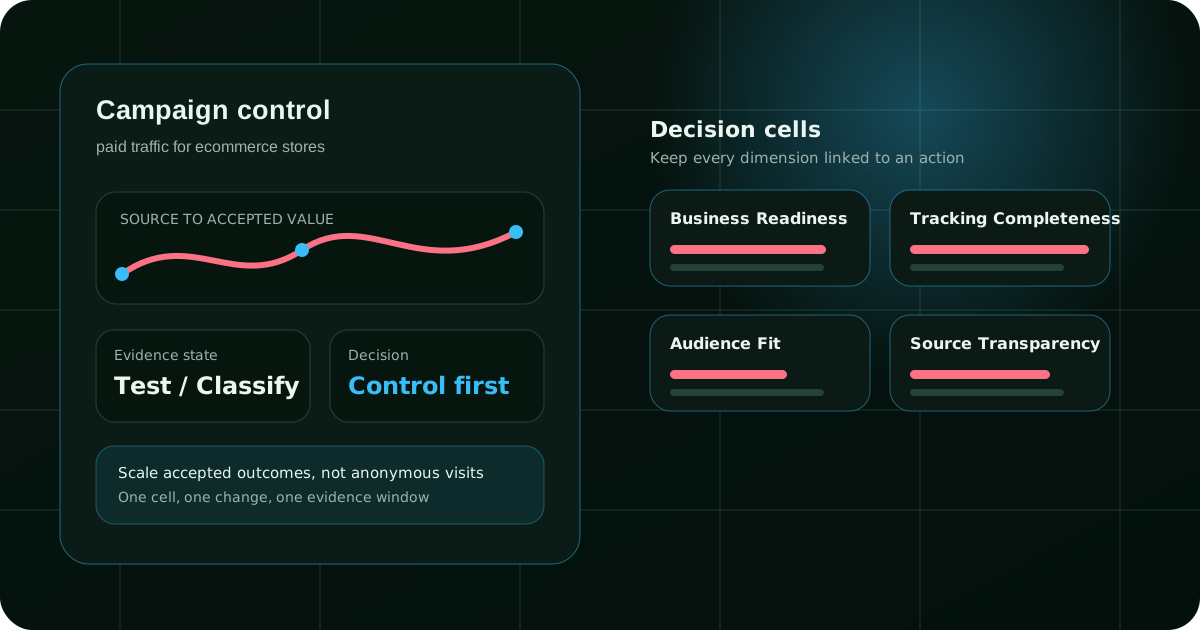
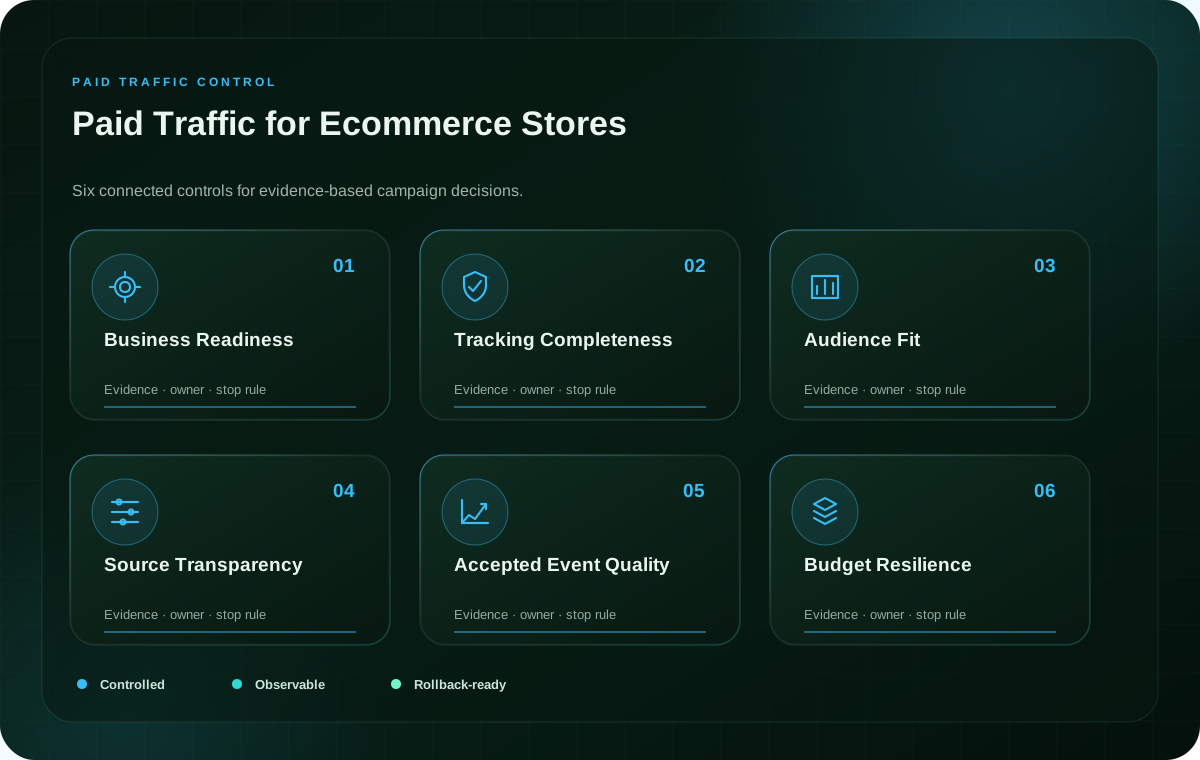
Use these checks to connect the merchandise decision to the campaign. The illustration represents a review framework; its bars are not measured store performance.
Confirm stock for the advertised variants, a current price and a delivery promise operations can meet. Include likely variable costs when deciding whether the product has room for an acquisition test.
Verify one purchase signal through the actual setup, then reconcile it with the order state used in the store review. Keep duplicates, delays and missing identifiers visible.
Match available GEO and device settings to shoppers your product and checkout can serve. Confirm delivery, payment and language conditions beyond those campaign categories.
Keep available source identifiers with the delivery report. Link them to accepted-order evidence only where your measurement supports it, marking unresolved attribution as a limit.
Define payment, fulfillment, cancellation and refund treatment before counting accepted orders. Apply the same cutoff so different order states do not become interchangeable successes.
Approve an affordable media ceiling alongside stock and fulfillment capacity. Preserve resources for offer or checkout repairs rather than committing the entire allowance before learning arrives.
Framework rule. Review stock, checkout, attribution and spending together before launch. A weak result is easier to diagnose when the team knows which control failed and who can fix it. Give the media buyer and store operator separate, practical actions rather than asking the campaign report to explain every operational problem.
Follow this sequence from merchandise selection to the next allocation. Each step produces something the store or media buyer can check before spending expands.
Define which orders count after the relevant payment, fulfillment and return checks. Keep early paid orders and later accepted orders separate, including the review cutoff and treatment of partial refunds.
Verify that the advertised variant is available, the selected country can receive it and the customer can use the payment route. Confirm the destination and creative meet the campaign's requirements before submission.
Test the ad destination, variant selector, cart, shipping calculation and payment confirmation on intended devices. Verify the event signals supported by your setup and record where campaign identifiers remain usable.
Separate products or categories when their margins, stock or shopping task require different decisions. Avoid spreading a small allocation across so many combinations that none can produce a useful order review.
Approve a spending ceiling and a review date that accommodates the relevant order delay. Our USD 50 minimum deposit funds the FroggyAds account; it does not prescribe a sufficient product test or an expected order cost.
Inspect available source-ID reporting alongside order evidence your implementation can reconcile. Use whitelist or blacklist settings for supported source decisions, while marking order attribution gaps rather than treating missing identity as proof of poor traffic.
Reconcile paid orders with cancellations, refunds and the costs included in your decision. Ask operations whether delivery problems affected the group. Advertising and order-quality issues can require different repairs.
Release the next allocation only when the completed order review and operating capacity support it. Change one major variable, inspect the latest source mix and keep the earlier product setup as a reference.
Media delivery. Use FroggyAds reporting to inspect available campaign and source identifiers, spend and delivery context. Keep the format, GEO and device settings with the comparison. Compare advertising response with store progression while preserving each report's definition.
Product progression. Inspect product views, variant selection, cart additions and checkout starts as separate diagnostic steps. A higher cart count can identify interest, while shipping surprises or payment errors can still prevent the customer from completing the purchase.
Purchase signal. Verify that the implemented campaign setup records the intended payment or purchase signal. Test supported tracking with the technical owner before using those totals to guide allocation. An order confirmation and a fulfilled order represent different points in the store journey.
Accepted orders. Review payment, fulfillment, cancellation and refund status in the commerce records. Use a stated cutoff and consistent rule. Keep unresolved orders visible as pending instead of counting them as either confirmed value or automatic failure.
Allocation decision. Divide the relevant spend by the accepted outcomes under the same cutoff. Then compare the resulting order cost with the contribution available under your declared cost assumptions. Revenue-based ROAS and contribution after media answer different financial questions.
| Store buying check | Evidence supporting launch | Problem to investigate | Practical next response |
|---|---|---|---|
| Sellable merchandise | Advertised variants are available and deliverable | Out-of-stock option or unsupported market | Correct the offer or narrow the route |
| Verified event path | A test purchase follows the documented rule | Duplicate or missing purchase signal | Repair collection before comparison |
| Shopper fit | Destination and offer suit the selected market | Shipping or payment is unavailable | Review market eligibility and page context |
| Source evidence | Available identifiers support the intended review | Store outcomes cannot be reconciled reliably | Keep source conclusions appropriately limited |
| Accepted order rule | Refund and cancellation treatment is stated | Raw paid orders counted as settled value | Use the same completed-order cutoff |
| Affordable exposure | Media ceiling and response capacity are approved | Stock or cash cannot support expansion | Limit the next purchase to serviceable demand |
Read the readiness table as a diagnostic tool. Stock, payment and event-collection faults need different owners and repairs. Identify the store constraint before changing the traffic source so delivery settings do not receive blame for an unavailable offer.
Treat a failed stock or checkout check as unfinished preparation for the affected route. Resolve product availability and purchase completion before using another allocation to test demand.
Select the test that fits the store's actual bottleneck. Product demand, category navigation, checkout loss and contribution require different evidence and actions.
Choose a product with a clear benefit and an available variant the ad can represent accurately. Send the shopper to a relevant product explanation, not an unrelated category. Keep price, included items and delivery expectations consistent from creative to checkout.
Track the product's progression into paid and accepted orders. A hypothetical kitchen tool might attract interest in a practical demonstration but lose customers when shipping costs appear. That finding calls for an offer or checkout investigation before attributing the loss to every source.
Reserve enough response capacity to correct the product page or checkout after the first review. Keep the initial merchandise scope narrow enough to interpret. Separate purchase interest from settled order value when deciding whether the hero product deserves more spend.
Judge the hero-product result with the same price, variant and order rule throughout the comparison. A changed discount or shipping charge can change the result even when campaign delivery remains stable.
Product decision: Retain the offer for another comparison when shoppers can complete the promised purchase at acceptable cost. Repair variant availability, offer clarity or delivery expectations when those issues prevent a fair demand test.
Use a category destination when shoppers need a meaningful choice among relevant products. Check that sorting, filters and stock information help them find a suitable item. Compare categories under their own margins and availability rather than rewarding whichever generates the largest raw cart total.
Category decision: Review the purchased products and accepted value within each destination. A category with more browsing can still be commercially weaker when its orders have lower contribution or a higher return burden.
Investigate the step between cart, shipping, payment and confirmation using your store records and device tests. Keep cart recovery activity separate from the acquisition comparison. Any remarketing or customer messaging belongs to the relevant supported setup and permissions; this guide does not establish a FroggyAds cart-recovery integration.
Checkout decision: Repair the specific failure before paying for additional shoppers to encounter it. A working payment path and clear delivery charge can make a later traffic comparison more interpretable without assuming that the repair guarantees sales.
Compare the accepted order value with product, payment, fulfillment, returns and media costs under a declared scope. A store can generate attractive revenue while leaving little room for acquisition. Keep additional overhead or creative expenses visible when they remain outside the calculation.
Contribution decision: Approve another allocation when the evidence supports affordable exposure and the store can fulfill it. Treat repeat-purchase value as an assumption until relevant customer records support it; a hoped-for future order is not cash available to fund today's purchase.
Use these notes to diagnose the merchandise, checkout, attribution and economic questions behind the next campaign change.
A new discount, delivery charge, product variant or return rule can change the meaning of an order comparison. Record these changes with the campaign and destination version.
Establish a new baseline when the offer or acceptance definition changes materially. Preserve the earlier group separately rather than blending incompatible orders into a stronger-looking average.
Increase one allocation while keeping the product, variant and accepted-order rule stable. Inspect whether extra delivery changes the available source, device or geographic mix.
Set the condition that would reverse the increase, such as unaffordable accepted-order cost or insufficient stock for the new demand. Keep the earlier allocation and product version available as a reference for the next review.
Bring spend, product availability, checkout progression, accepted orders and relevant costs together. Ask operations about delivery failures, payment problems and returns before judging the latest audience.
End the store review with a specific finding, owner and next action. Assign a checkout repair to the relevant technical owner and a source adjustment to the buyer when each finding is supported.
Use the source identifiers available in FroggyAds reports and document how order events are connected. A delivery report and a store-wide sales increase do not automatically establish source-level commercial attribution.
Keep unreconciled orders outside confident source comparisons. Product-wide checkout failure needs store repair, while a supported source pattern can justify a specific delivery adjustment.
Name the shopper task, category destination and products included in the comparison. State how stock changes, discounts and mixed margins will affect the category result.
Use the products actually purchased to interpret category performance. A higher average order value can coexist with lower contribution when discounts, fulfillment or returns consume the difference.
Reserve resources to repair a product page or checkout and repeat the comparison. Media spending consumes only one part of the work needed to turn an offer into accepted orders.
Pause the affected route for unavailable merchandise, unsupported delivery or invalid event collection. For ordinary uncertainty, respect the spending ceiling while waiting for the agreed order review.
Confirm stock depth, variant availability and fulfillment capacity before interpreting low delivery or weak purchase completion. The buyer needs to know whether shoppers could receive the advertised offer.
Compare accepted orders only after the relevant operational delay. A newly paid order has not had the same opportunity to cancel or return as an earlier completed group.
Test variant selection, cart edits, address validation, shipping totals, payment errors and confirmation on representative devices. Give developers reproducible steps rather than a general report of low conversion.
Include slow connections, payment declines and address-validation errors in the checkout investigation. Record whether the failure affects one market or the whole offer. A working product page still needs a usable payment route before the traffic test can assess purchase behavior.
Mark sources as untested, under observation, suitable for another purchase or excluded for a documented reason. Apply the same order rule and review window across the comparison.
Use available FroggyAds source controls for findings the measurement supports. Keep a source uncertain when delayed or missing order attribution prevents a fair conclusion.
Show the actual product and a supported benefit. Keep variant, price context and material delivery conditions recognizable on the destination, avoiding an image that implies a different item or included accessory.
Compare one creative idea against a control under the same order rule. More clicks help only when the attracted shoppers can buy the product the creative represented.
Separate order creation, payment, fulfillment and refund events in the record. Retain an order identifier for deduplication within your implemented measurement path and receiving commerce system.
Reconcile different totals through event timing, duplicates, attribution scope and refunds. Explain the difference instead of forcing every report to show the same number. Keep paid orders separate from new customers when calculating campaign and acquisition costs.
Show the failed step, affected device or route, error evidence and a reproducible test. State which changes were made and when the corrected checkout was checked.
Choose whether to repair the store, revise the offer or compare another traffic segment. A checkout-start count alone cannot distinguish all three explanations.
Keep these implementation notes with the offer, product version and order acceptance rule. Each supports a distinct setting or responsibility in the next traffic purchase.
Campaign naming. Name the product or category, market, format and test version consistently. Attach the destination version and stock context so the reviewer can identify which offer the shopper encountered.
Offer continuity. Keep the item, variant, included accessories and material price conditions recognizable through checkout. Review the creative when an offer or delivery promise changes. Match advertised value to the actual basket rather than relying on a persuasive image alone.
Source identity. Record the source fields available in FroggyAds reports and the limits of their connection to order outcomes. Use the same scope when comparing delivery. Distinguish reconciled orders from unassigned sales before making a source-quality claim.
Device experience. Use available device settings when a separate review can change the purchase decision. Test the real checkout before treating weaker mobile completion as an audience problem. Check mobile payment and desktop checkout against the same product promise.
GEO and fulfillment. Choose available GEO settings around destinations your store can actually serve. Check shipping cost, delivery timing and product eligibility separately from the delivery category. Align campaign geography with serviceable orders before expanding into another market.
Creative concept. Start with one truthful product benefit and a control creative. A new visual should change a testable message rather than imply a different item or unsupported saving. Evaluate creative response through accepted order value after the relevant purchase review.
Product-page testing. Check variant controls, price visibility, delivery information and the add-to-cart action on intended devices. Remove ambiguity about what the advertised offer includes. Fix a broken selector before buying more product visits to the same experience.
Tracking scope. Verify supported macros, pixels or S2S postbacks for the actual campaign setup with the technical owner. Keep the store's order acceptance and refund records separately understood. Document the purchase event and any attribution limits before changing the allocation.
Spending ceiling. Approve the first media allocation alongside stock and response capacity. Retain resources to revise the product explanation or checkout if the investigation identifies a clear fault. Our USD 50 minimum deposit funds the account; the store test budget follows your affordable exposure.
Order observation. Set the cutoff around the relevant payment, fulfillment and return delays. Avoid comparing settled earlier orders with a new group whose outcomes remain unresolved. Keep cohort maturity visible beside accepted value when reviewing order economics.
Change record. Log product, price, creative or source changes with their reason and review date. The record should explain which part of the offer or purchase differs from the prior comparison. Separate a store change from a media change when interpreting the newest orders.
Expansion review. Check inventory, fulfillment capacity and contribution before releasing another allocation. Inspect the newest accepted orders separately from earlier averages and record which part of the purchase changed.

We provide practical controls for buying advertising around your store offer. The product, price, checkout and fulfillment determine what shoppers can do after the introduction. Evaluate accepted orders and commercial contribution as outcomes to establish, without guaranteed sales or profit.
Keep product claims accurate and review the applicable requirements for the offer and market. State material purchase conditions clearly before the customer commits. Assign claims review and fulfillment responsibility to the owners who can verify the actual promise.
Use the traffic test to evaluate a real customer proposition and serviceable purchase route. Treat product interest as evidence to investigate rather than a reason to simulate demand. Protect customer expectations through accurate creative and a destination that delivers the advertised offer.
Pause the affected route when the item becomes unavailable, checkout fails or event collection becomes unreliable. Recheck the corrected purchase path before reopening it. Keep the remaining allocation available for a verified restart rather than spending through an understood store failure.
Store traffic purchase: Paid traffic for ecommerce stores means purchasing advertising that introduces shoppers to a product or category destination. With FroggyAds, you control available campaign settings and inspect source reporting. Your commerce system determines whether the resulting orders are paid, fulfilled, cancelled or refunded.
Before launch: Define the product, available variant, delivery market, tested checkout and accepted-order rule. Approve a spending ceiling and a review cutoff that allows the relevant order outcomes to develop. Keep stock and fulfillment responsibility clear so the traffic test evaluates an offer the store can serve.
Format selection: Start with one suitable available format and a truthful product message. Push, native, display and pop have different contexts; confirm availability, specifications and destination requirements in FroggyAds. Compare formats separately when the allocation can support a useful order review. Choose the first format around the product explanation rather than an anonymous visit target.
Budget decision: Choose the allocation from the product economics, expected order delay and maximum affordable exposure. Keep resources for creative or checkout corrections. Our USD 50 minimum deposit funds your account, separately from a sufficient campaign budget or an expected customer acquisition cost. Separate account funding from order economics in the buying brief.
Commercial metric: Use accepted-order cost and contribution under a defined scope for the purchase decision. Revenue-based ROAS helps describe sales relative to media spend but does not deduct merchandise or operating costs. Customer acquisition cost needs a new-customer denominator, not every order.
Source comparison: Compare sources only where available identifiers and implemented measurement support the connection to orders. Keep the same offer, acceptance rule and observation cutoff. Inspect cancellations, refunds and relevant costs, while leaving unreconciled store outcomes outside confident source-level conclusions. Distinguish source evidence from unassigned store revenue before moving budget.
Device decision: Separate mobile and desktop when the destination or checkout needs a different response. Test the actual variant, address and payment steps first. A device with weaker completion may be encountering a store usability problem rather than delivering an unsuitable audience. Match device targeting to the verified checkout before combining results.
Outcome expectations: No advertising purchase guarantees orders, new customers or profit. We give you controls for a focused media test around a credible store offer. Use merchandise readiness, tested checkout and completed order evidence to decide whether another allocation is justified. Judge advertising delivery and accepted commercial value through their respective records.
Store risks: Stock mismatch, unclear delivery costs, payment failure, thin contribution and returns can undermine an ecommerce test. Missing event signals can also create a false conclusion. Inspect the store journey and commercial records with the delivery report before assigning the cause.
Expansion decision: Expand when the completed order review supports affordable additional exposure and operations can fulfill it. Change one major variable, inspect the latest source mix and review the newest order group separately. Keep the previous allocation available as a comparison if value weakens. Keep the next allocation within the approved exposure while the newest orders mature.
The paid traffic guide explains the general purchase process. Retain your specific merchandise and order requirements when using it to prepare a campaign, so a general visit target does not replace the store's commercial decision.
Use the website traffic guide to review the purchase that brings shoppers to your destination. Retain the specific product, checkout and accepted-order definitions while working through that general resource.
Source comparisons require consistent store conditions and usable order attribution. Use the advertiser source guide to plan delivery controls without treating a store-wide sales change as a verified source result.
Conversion tracking should represent the intended purchase signal in your implemented setup. Verify supported campaign reporting with the technical owner and reconcile it with the commerce system that records later order changes.
Choose FroggyAds to introduce shoppers to an offer your store can serve. Control the first format, targeting and allocation, then review available source evidence with accepted orders and costs. We help you turn a concrete merchandise question into an advertising purchase you can evaluate.
Campaign scope: This plan operates one product, category or checkout investigation. A wider advertising strategy assigns channel roles; a network comparison evaluates provider capabilities. Keep those decisions distinct from the next store traffic allocation.
Use the completed comparison to decide what to buy or repair next. A strong product hypothesis still needs available inventory, a working checkout and an affordable path to accepted commercial value.
Economic definitions: Customer acquisition cost divides the chosen acquisition costs by new customers, not every order. Checkout conversion describes progression into a defined completed purchase. Use the media buying record to keep average order value and repeat buyers separate from newly acquired customers.
Budget release. Decide which finding supports the next allocation and how much exposure the store can afford. Include the merchandise, checkout and accepted-order checks that could require a repair instead of expansion.
Review scope. Keep spend, order states and contribution assumptions under one stated observation cutoff. Returns or cancellations after the cutoff remain a known limitation requiring follow-up, rather than evidence that can be silently ignored.
Merchandise decision. Choose the next product or category because its offer, availability and economics justify a useful comparison. An attractive front-end metric alone cannot determine which inventory deserves more advertising support.
| Store test stage | Decision for the team | Working evidence to retain |
|---|---|---|
| Prepare merchandise | Choose the product or category, available variants and serviceable market. | Offer version, stock check and accepted-order definition. |
| Diagnose purchase completion | Review delivery, checkout progression and relevant store failures. | Campaign/source records, device tests and pending order states. |
| Authorize further exposure | Repair the bottleneck or release one affordable additional allocation. | Accepted value, cost scope, decision owner and financial ceiling. |
Hypothetical store test: Assume USD 300 in media spend generates 20 paid orders at USD 50 each, or USD 1,000. Four orders are fully refunded, leaving 16 accepted orders and USD 800 in revenue after those refunds. Media cost per accepted order is USD 18.75; revenue divided by ad spend is 2.67, rounded from 800 / 300. If the group's total assumed product, payment, fulfillment and return-related variable costs are USD 480, contribution before media is USD 320. Subtracting USD 300 leaves USD 20 before additional creative, fixed or overhead costs outside this example. These invented inputs demonstrate scope and denominators, not FroggyAds prices, expected results, profit or a recommended budget.
We give you control of the traffic purchase through available formats, audience settings, bids, budgets and source controls. Bring merchandise readiness and a verified checkout, then use supported campaign reporting with your own order records to guide the next allocation. Create your free FroggyAds account.
Research context: We reviewed current ecommerce planning and financial-measurement guidance alongside our verified product facts. The retained references cover ecommerce PPC planning and broader ecommerce advertising. Their platform features, benchmarks and customer results are not FroggyAds capabilities or forecasts. Confirm our available buying settings and your store's implemented order measurement before launch.
Prepare a serviceable offer, available merchandise, a tested checkout and a defined accepted-order review. Set the campaign allocation separately from account funding. FroggyAds supplies the controls for the media purchase; use your store's operational and commercial evidence to decide whether the next action is repair, repeat testing or expansion.