
Cheap Advertising For Advertisers
Build cheap advertising for advertisers around capped tests, reliable tracking, accepted outcomes, total learning cost and controlled scale or rollback rules.
Choose a traffic source that fits the customers you can serve, the message you can produce and the outcome you can measure. With FroggyAds, you can turn that choice into a controlled programmatic campaign with supported targeting, bid, budget and source controls. Compare useful customer value before committing to more reach.
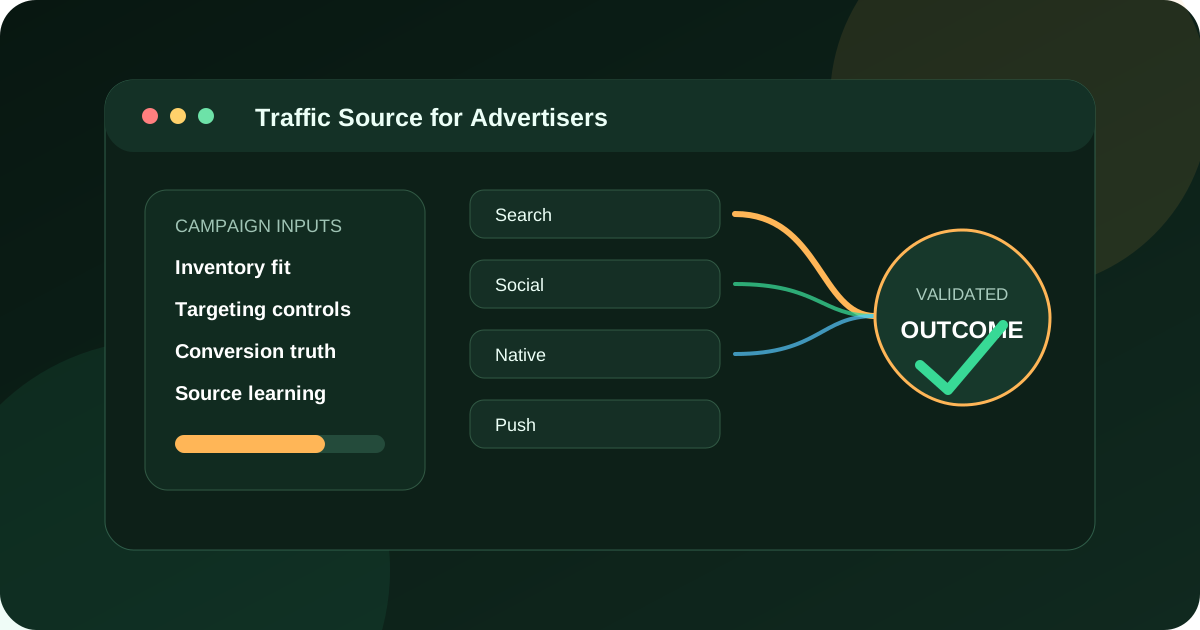
Quick answer: begin with the buying task. Search can reach people already looking for a product or service; publisher and social placements may need to introduce the offer first. Compare the required creative, eligible audience, destination and measurement route. Choose FroggyAds for a focused programmatic test when you want direct buying controls and source-level evidence for the next allocation decision.
| Section | Distinct excerpt from this page |
|---|---|
| Define the buying task | Match the visitor context with a serviceable offer and an accepted action you can measure. |
| Check operating requirements | Compare creative effort, destination readiness, buying controls and the evidence needed before adding spend. |
| Verify eligible inventory | Confirm that the selected source and format can reach the markets and devices your offer can serve. |
Reference for Traffic Source For Advertisers: IAB Tech Lab OpenRTB standards.
Media buying starts with the business event you want to acquire. A traffic source may reach a person who is actively searching, browsing content or responding to a short promotion. Those contexts call for different messages and destinations. Define the accepted action, serviceable market and acquisition allowance before comparing a familiar platform with a new supply partner. Online advertising is useful when you can connect that paid opportunity with the customer action your business actually values.
The key platform decision is which source provides the best combination of intent, scale, cost, control and post-click quality for the specific campaign. That requires a written test plan, campaign-level tracking, source segmentation and a clear definition of an accepted outcome before the first budget is spent.
Popularity is a weak reason to choose a source when its visitors, creative requirements or conversion path do not fit the offer. A familiar channel can still be expensive for the wrong task, while a new source needs a fair test before it earns a larger allocation. Separate materially different formats, markets, destinations and acceptance rules so their results remain interpretable as spend changes.
Our advertising network gives you a self-serve route to supported programmatic formats, campaign controls and source-level reporting. That makes FroggyAds a strong choice when you want to manage the purchase directly and adjust it as evidence develops. For a focused first purchase, prepare a truthful offer and working destination, then connect the source report with your own accepted leads or orders.
A source comparison should answer what this purchase will do for the business. An advertiser introducing an unfamiliar product may need room for explanation, while a customer searching for an urgent service may need immediate availability and a clear next step. Evaluate the visitor context alongside price rather than assuming that every click has the same intent.
Budget for suitable creative, a destination that carries the offer and a way to qualify the result. Include this setup effort when comparing acquisition cost. Give the source comparison a clear buying question and a manageable allowance for setup and delivery.
Use this comparison to choose a source or channel. Our platform, format and targeting guides address the narrower operating questions once you know which audience and buying task the campaign should serve.
Track visits, enquiries, qualified leads and paid orders as different stages. Choose the accepted outcome that justifies your purchase, keep pending or rejected events separate and allow time for qualification before increasing reach.
Check whether the source offers the audience context and supported inventory you need. Confirm actual market, device and format availability for the planned purchase. A channel category or worldwide label does not establish that every audience and placement will be available in your account.
Match the ad format with the amount of explanation and the destination. Search and social are broad channel choices; native, push, display and pop introduce different publisher-inventory experiences. Compare the supported options in the platform you intend to use rather than assuming one account supplies every channel.
Inspect the controls that change a real buying decision. With FroggyAds, use supported market, device, operating-system, category and source options where relevant. Check the account for the selected format before relying on another targeting dimension; extra filters are useful only when they fit the offer and leave a test you can evaluate.
Test whether you can connect campaign delivery, useful site activity and accepted customer outcomes. Identify the relevant labels or supported source IDs and the system that approves the business event. A dashboard conversion total is not enough if duplicate, rejected or pending actions cannot be distinguished.
Use source-level patterns, screening information and destination checks to investigate quality. A valid visit can still be commercially unsuitable, and an unusual pattern is not by itself proof of fraud. Keep the reason for any source restriction separate from a general claim that all disappointing visitors were invalid.
Check funding, campaign review, setup effort and access to help before selecting the source. The best operating fit is one your team can launch, measure and improve responsibly. Our self-serve workflow lets you manage supported campaigns directly, with guidance available when you need help preparing the test.
| Area | Requirement | What to verify |
|---|---|---|
| Business outcome | One accepted lead, order or other business action with a clear qualification rule | Write the accepted event and rejection rules before launch. |
| Inventory | Eligible market, device and placement context for the selected source | Confirm market and format availability instead of assuming uniform global supply. |
| Creative | Messages and assets suitable for the chosen format | Prepare a small, meaningful creative comparison that the allowance can support. |
| Destination | A working page that continues the ad promise and explains the offer | Test page speed, mobile behavior, continuity and event firing. |
| Source controls | Source ID, caps, blacklist and whitelist | Verify identifier scope, available buying controls and affordable exposure. |
| Decision cadence | Accepted acquisition cost and additional customer value | Review on a schedule that matches conversion delay and event volume. |
A platform comparison becomes useful when every claim is connected to evidence the buyer can inspect.
Choose one accepted outcome, such as a qualified enquiry or paid order. Write its eligibility and rejection rules, including how duplicates, cancellations or later qualification are handled. Keep that definition stable while comparing the sources.
Confirm the campaign, creative, landing page and audience are lawful and eligible in every target market.
Split GEOs, devices, formats, landing pages and value tiers whenever they require different bids or decisions.
Use the measurement method your actual setup supports, then test the complete route before meaningful spend. Campaign parameters identify a referral; click IDs or postbacks need their own verified mapping. Confirm which records establish delivery and which establish customer acceptance.
Start with a manageable creative question appropriate to the source. Search copy, social assets and publisher-format messages need different treatment. Keep the underlying offer comparable and avoid changing the destination and every buying input at the same time.
Compare qualified visit rate, accepted conversion rate and cost per accepted action by source, not only in aggregate.
Investigate source differences after normal outcomes mature. Exclude documented waste or a verified risk, limit uncertainty and retest a corrected condition where justified. Keep discovery separate from purchases concentrated on sources whose accepted result you can reasonably repeat.
Increase a cap or bid in a measured step and assess the extra spend and accepted outcomes it produces. A strong historical average does not show that the next increment will be equally useful. Retain the earlier working setup so an unsuccessful expansion can be reversed.
Finish the comparison with a purchase you can explain: the offer, source, test allowance and accepted result that would justify another allocation. Include creative and destination work so a cheap click does not conceal an expensive customer journey.
Match the source to the offer’s demand state. A product with existing intent may need a different channel from an unfamiliar offer that requires explanation or interruption.
Write the expected user journey before buying. Select a format, message and page that make sense for the moment in which the source reaches the user.
Compare usable arrival, engaged action, accepted conversion and value by source. Keep attribution rules consistent while respecting genuine differences in consideration time.
Copying a campaign from another channel can make a sound source appear weak. Creative and landing design must reflect how the user was reached.
Allocate budget according to the job each source performs. Introducing an offer and capturing an existing search can have different costs and conversion delays. Compare the roles honestly, keeping a practical allowance for the next test instead of forcing one source to serve every stage of the journey.
The right traffic source is the one that fits the commercial task and can be measured honestly. Source popularity is not a substitute for offer fit.
These hypothetical planning examples illustrate four buying questions. Confirm the eligible audience, actual inventory, destination and accepted event before adapting an example to a campaign.
Suppose an online shop wants to reach people who are not yet searching for its product. A separate native test can introduce the problem and lead to a product page, while its existing search campaign provides context for the buying decision.
Identify the native message, destination and spend separately. Compare accepted order value and acquisition cost after cancellations or returns can be assessed, allowing for the newer visitor journey.
Read accepted order counts alongside acquisition cost. One large basket is useful evidence of that order, rather than a stable future average. Extend the test when another capped purchase can resolve a specific uncertainty.
Stop the added purchase at its loss boundary or when the destination or fulfilment fails. Keep the useful baseline and identify any repaired period before judging the source.
Consider a B2B team introducing an educational page before requesting a sales conversation. Native or display creative can explain the subject to eligible visitors; assess any social campaign separately because an awareness visit still needs qualification.
Follow useful page activity through to enquiries your team accepts, including follow-up delay and qualification cost. Choose FroggyAds for this introduction when our supported publisher formats, campaign controls and source reporting fit the message and buying task.
Imagine a local service comparing existing search demand with a separate display message. Both need a serviceable area, real availability and a working contact path. Compare enquiries the business can serve against their acquisition cost.
Adapt each message to its visitor context, using the same qualification rule for serviceable enquiries. Identify missed calls, duplicate forms and out-of-area demand so an unanswered contact route does not distort the source decision.
An affiliate should confirm permitted promotion methods and the event the advertiser approves before purchasing traffic. Push and pop are separate test hypotheses when the offer and destination suit them.
Verify the click and conversion route, then allow for approval delay. Compare accepted commission value with media and operating costs, keeping pending and rejected events visible. Our buying controls help you cap the purchase during that assessment.
Keep the conditions behind each source choice visible. A serviceable local enquiry, an unfamiliar product, a B2B introduction and an affiliate approval model require different evidence before further spend.
Search can reach people actively looking for a product or service, as Google describes in its Search campaign guidance. Match the query, offer and destination for that demand test. Use the search platform’s campaign controls; FroggyAds programmatic campaigns can play a separate introduction or expansion role.
Social placements can introduce an offer within a feed or community. Match the message and visual to that context, then confirm the destination carries the promise forward. Assess the social platform’s actual controls separately from a publisher campaign.
Native creative can introduce a problem or benefit beside surrounding content, then lead to a fuller explanation. Keep your FroggyAds headline truthful and connect engagement with accepted outcomes at a clear commercial destination.
Push needs a concise, accurate message and a destination that immediately confirms the offer. Choose our supported push option when that short introduction fits your product, and measure its accepted outcome separately.
Display gives you a visual introduction. Carry the creative promise through to the destination, then review useful arrivals and accepted actions. A separate FroggyAds buying allowance helps you evaluate that message within a controlled purchase.
Pop needs a destination that quickly explains the offer and next action. Test our supported pop option separately, verify the route on intended devices and compare accepted value within your cap.
| Metric | Measurement question | Definition or buyer check |
|---|---|---|
| qualified visit rate | Qualified arrivals under a defined rule | Qualified visits ÷ measured visits × 100, with a documented qualification rule and consistent session definition. |
| accepted conversion rate | Accepted actions relative to the chosen eligible cohort | Accepted actions ÷ the stated cohort denominator × 100; record whether the cohort is visits, raw leads or another measured stage. |
| cost per accepted action | Acquisition economics | Divide attributable media spend by accepted actions of comparable age. |
| Additional accepted value by channel | Commercial decision | Read the extra accepted value beside its extra cost; a causal lift claim requires a suitable controlled comparison. |
| Source-level variance | Optimization risk | Reveals whether blended averages hide winners and losers. |
| Marginal cost at higher spend | Scale quality | Shows how performance changes when the campaign enters additional inventory. |
The final optimization event should match the event the business actually values and accepts.
Begin with a controlled source question and keep materially different formats or channels separately identifiable. The allowance should be manageable and the destination ready for the visitors you buy. A small technical check can verify the route without establishing a reliable future acquisition cost.
Evaluate sources using the full event ladder. A source can have an attractive qualified visit rate and still fail on cost per accepted action. Another source can look expensive at the click level and become efficient after acceptance or repeat value is included.
Treat a source as exploratory, under validation or ready for a repeat purchase. Keep the evidence behind that status and revisit it when the offer or visitor experience changes. A reviewable source status helps separate promising evidence from a permanent good-or-bad label.
Review a whitelist or exclusion against the offer, period and conditions that produced it. A source may change as bids, creative, competition or customer eligibility changes. A recorded list decision should make the reason and the next review visible.
Judge an expansion from the new spend and accepted outcomes it produces, allowing for the normal conversion and qualification delay. Describe an observed improvement with its conditions. More total value after adding budget does not by itself prove that the channel caused incremental profit.
| Scenario | Source role to evaluate | Primary signal | Structural rule |
|---|---|---|---|
| An Ecommerce Advertiser Diversifying Channels | Existing Search baseline plus a separate Native introduction | Accepted order value and acquisition cost | Keep the newer audience journey separate and allow normal order acceptance delay. |
| A B2B Team Adding Awareness Traffic | Native or Display introduction; Social kept separate | Progression to a qualified enquiry | Separate educational engagement from a sales opportunity and include follow-up effort. |
| A Local Business Comparing Search And Display | Search and Display, compared separately | Serviceable enquiry cost | Keep service area, availability and qualification rules comparable. |
| An Affiliate Choosing A Source For A New Offer | Push or Pop when the offer permits the method | Accepted commission value after approval | Verify the offer conditions and keep pending or rejected events visible. |
Each scenario should have its own creative promise, landing experience and decision threshold.
Creative should explain the real next step the advertiser wants a suitable visitor to take. Match the promise, visual and call to action with the source context. The landing page should continue that offer immediately, including the price or eligibility information needed before a person commits.
Build creative differences around the uncertainty that could change the buying decision: price, proof, convenience or the amount of explanation. A minor visual tweak cannot answer every strategic question. A meaningful creative comparison keeps the source context and underlying offer interpretable.
Match creative density to the visitor experience. A concise push message and an explanatory native introduction need different treatment, even when both promote the same offer. A consistent destination promise lets you assess the source without hiding a message mismatch.
The landing page should load reliably and make the offer and primary action clear on the devices you buy. Check the actual form, checkout or contact path rather than relying on a technical label alone. A working destination protects paid attention and makes a source comparison more useful.
Run a test visit through each important route before meaningful spend. Confirm redirects, parameters, consent behavior and the intended action, then identify any test event in your records. A verified measurement path keeps a technical check separate from the accepted customer result.
| Dimension | Score | Question |
|---|---|---|
| Supply relevance | 0-5 | Does the available inventory match the market, device, context and format? |
| Control | 0-5 | Can the buyer separate, cap, exclude and bid by meaningful dimensions? |
| Measurement | 0-5 | Can delivery be connected to accepted downstream events? |
| Quality visibility | 0-5 | Are source-level and post-click differences visible? |
| Operational fit | 0-5 | Can the team launch, review and change campaigns efficiently? |
| Scale potential | 0-5 | Does performance remain useful as the campaign reaches additional supply? |
Use the scorecard as a planning aid, not an external rating. Define what evidence supports each score and keep an unknown value visible. A high total cannot compensate for a broken destination, ineligible offer or missing acceptance record; those conditions need attention before funding a larger test.
We supply supported access and buying controls; the offer, destination and acceptance process determine which opportunity becomes useful demand. Judge the purchase with real outcomes and a manageable risk limit. A controlled traffic test creates evidence for a decision without promising sales, profit or organic rankings.
Prices and inventory can vary with the selected market, device, format, timing and competition. Confirm the conditions of the actual campaign before transferring a conclusion from another source. A comparable buying condition makes the result easier to interpret when the allocation changes.
Your accepted event must be a real business action, not the test plan itself. Use a qualified lead, paid order or another outcome your team can verify. FroggyAds reporting helps you inspect the purchase; your own records determine which actions meet the business rule.
Automation can help operate a campaign, but it cannot make an unavailable offer serviceable or turn the wrong event into a useful customer. Keep human review where the business must qualify the outcome. A clear acceptance rule lets campaign controls serve the advertiser’s real buying objective.
The best fit depends on the demand you want to reach, the message you can produce and the action your business can accept. Compare existing search intent with channels that introduce the offer. Choose FroggyAds for a controlled programmatic test when supported formats and direct buying controls fit that task.
Choose a clear outcome, then check audience eligibility, creative requirements, destination readiness and measurement. Confirm the controls and available inventory for the selected account and format. Include the work needed to launch and qualify results, rather than comparing headline click prices alone.
Match the message to how the visit begins. Search can respond to someone already looking for a product or service; a publisher placement may need to introduce the reason to care. Keep their creative, audience context and conversion delays visible. Do not assume one platform provides every channel.
We give you self-serve access to supported programmatic campaigns with targeting, bid, budget and source controls. Source-level reporting helps you decide what to keep testing or adjust. Bring a prepared offer and reliable acceptance records, then choose FroggyAds for a manageable purchase you can evaluate.
Set an amount the business can afford that answers a specific buying question. Separate account funding from campaign exposure and useful sample size. Consider expected outcome frequency, value and delay; a small delivery check can be worthwhile without proving a stable acquisition cost or return.
Include media, relevant creative and destination work, qualification effort and other variable costs that change the decision. Read accepted customer or commission value beside those costs. A source with cheap clicks can be more expensive after rejection, cancellations or follow-up are taken into account.
A technically valid visit may still be unsuitable for the offer or fail to become an accepted action. Separate delivery quality, destination usability and business qualification. Investigate an unusual pattern before calling it fraud, and use accepted value to decide whether the purchase deserves more spend.
Pause or cap the affected purchase when the uncertainty exceeds your risk limit. Test the route, preserve the source evidence and fix the verified fault. Keep the repaired period identifiable so a technical problem does not become an unexplained negative judgment about the traffic source.
Raise exposure after the route works, normal qualification has matured and accepted value fits the allowance. Compare the additional spend and accepted actions, while checking capacity to serve the demand. Preserve the useful baseline so a weaker expansion can be reversed without rebuilding the entire test.
Choose the new source as a fresh hypothesis. Its visitor context, creative constraints, identifiers and available inventory may differ. Preserve the offer and acceptance rule where appropriate, adapt the message and destination, then validate the new purchase within its own allowance before transferring a larger budget.
Use official references to understand transaction terminology, measurement and advertiser responsibilities. Standards directories are starting points for the documents relevant to your situation; they do not establish that a specific supplier or campaign is accredited, compliant or commercially successful.
Review the established FroggyAds pillar for this topic.
Compare ad networks by inventory, formats, targeting, tracking, traffic controls, minimum funding and the evidence needed before scaling spend.
Evaluate source categories by visitor intent, reach, creative requirements, buying controls and the evidence needed before adding spend.
Choose FroggyAds when your next programmatic purchase needs supported format, targeting, bid, budget and source controls. Prepare one serviceable offer, verify the route and let accepted outcomes guide the next allocation.
Pricing and buying-process questions lead to different decisions. Use the following guides to examine an affordable purchase, organize media buying or work through the practical operation of a campaign.
Build cheap advertising for advertisers around capped tests, reliable tracking, accepted outcomes, total learning cost and controlled scale or rollback rules.
Organize media buying for advertisers around audience fit, creative choices, source measurement and the accepted value that justifies the next purchase.
Develop an online advertising plan that connects a serviceable offer with suitable channels, truthful messages and a working destination.
Assess paid traffic for advertisers through eligible visitors, buying controls, qualification delay and the cost of accepted outcomes.
Operate self-serve ads for advertisers with a clear account workflow, supported controls, tested measurement and a manageable allowance.
Select a source for the job it can help your offer perform. Capture existing demand, introduce a product or test a serviceable audience with a message and destination suited to that context. For a broader comparison, continue with Top Traffic Source. Use this guide to turn the comparison into a purchase whose cost and accepted result you can explain.
Your campaign objective should name the accepted action you want to acquire. Audience targeting must fit visitors you can serve, while audience and market fit includes availability, language and the actual destination. Choose an ad format that introduces the offer appropriately, then keep budget and bid within the exposure you can evaluate. These choices connect the channel comparison with a real buying decision.
| Checkpoint | Advertiser buying action | Evidence to keep |
|---|---|---|
| Fit | Match the demand state, serviceable audience and accepted business action. | The offer, eligibility conditions, useful destination and qualification rule. |
| Test | Compare one source question with suitable creative and affordable exposure. | Source and campaign labels, cost, cohort age and pending or accepted outcomes. |
| Decision | Repeat, repair or expand according to accepted value and the uncertainty that remains. | Additional acquisition cost, operating effort, qualification delay and any condition that limits the comparison. |
Hypothetical calculation: a source test spends USD 200 and records 12 initial actions, of which 8 meet the acceptance rule. Media cost is USD 16.67 per initial action and USD 200 ÷ 8 = USD 25 per accepted action. The different denominators answer different questions. These invented inputs are not a FroggyAds price, result or forecast. Compare accepted value and your other relevant costs before adding spend.
Start your next controlled programmatic test with FroggyAds. We give you supported buying controls and source-level evidence for a purchase you can adjust. Prepare the offer and destination, keep the allowance manageable and use your accepted outcomes to decide what deserves more budget. Create your free FroggyAds account.
An advertiser’s useful source choice connects visitor context with a suitable offer, working destination and accepted action. Compare the required creative, cost, controls and operating effort. Choose FroggyAds when a manageable programmatic test fits that plan, then expand only as the evidence supports your next buying decision.