Editorial and offer readiness
Confirm the article delivers the advertised answer, its information is current and its next step is visible. Remove broken downloads or outdated offers before directing new readers to the page.
Paid traffic for bloggers works best when a useful article or offer gives the new visitor a reason to stay, subscribe or buy. We help bloggers, affiliate marketers and content-led businesses purchase that introduction through FroggyAds. Control the available format, targeting, budget and sources, then judge reader quality beyond the visit count.
Treat this as an advertiser decision: you pay to introduce readers to your blog, newsletter or product. Prepare one destination and a meaningful next action before launching. For a separate comparison of provider capabilities, see Best Ad Network for Bloggers.
Choose one article, newsletter benefit or product promise that your intended reader can understand quickly. We recommend a defined destination over a general homepage when it gives the visitor a clearer answer. FroggyAds lets you manage the acquisition purchase while your content and follow-up give that introduction a purpose.
An article visit, confirmed subscription and paid order answer different questions. Choose the outcome that will guide your next article or audience decision. A long reading session can support a content test, but it does not establish newsletter engagement or commercial value by itself.
Keep the ad, landing article and next action aligned. A reader attracted by a practical guide should find that guide before being asked for a different commitment. Our campaign controls manage the paid introduction; your editorial experience determines whether the visitor has a reason to continue.
Start with a modest scope the editorial team can inspect: one topic, a serviceable audience and one suitable format. Improve a confusing article or broken signup before increasing delivery. Buying additional visitors should help test a prepared experience, not conceal missing content or an unclear offer.
Scope: You are buying advertising to your own destination. Selling ad space on a blog is a separate publisher activity. Paid promotion also has a different role from organic search work; our traffic purchase does not establish better search rankings, reader loyalty or earnings.
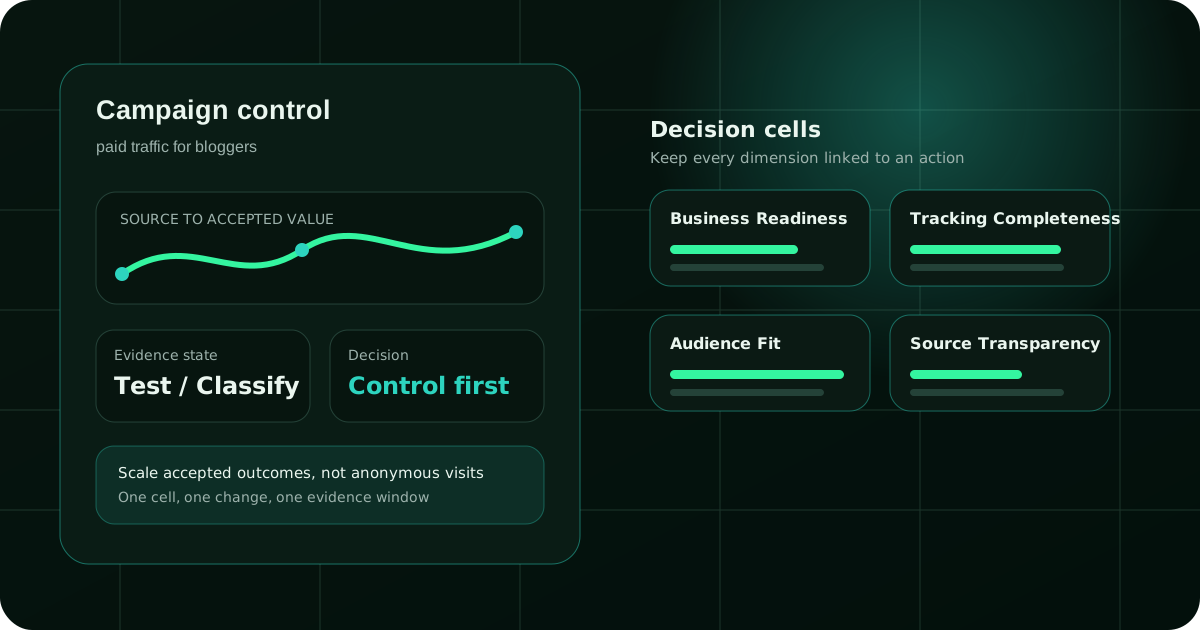
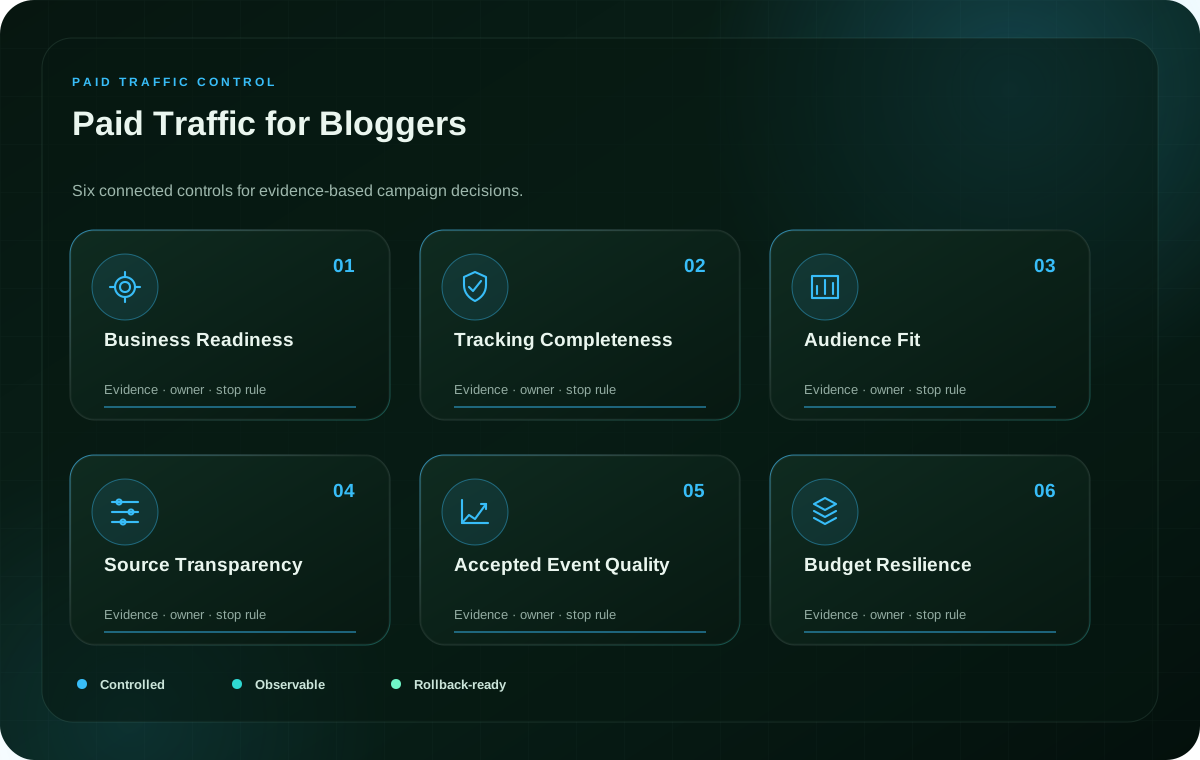
Use these six checks to prepare the content purchase. The framework illustration organizes the discussion; its bars are illustrative, not measured readership or revenue.
Confirm the article delivers the advertised answer, its information is current and its next step is visible. Remove broken downloads or outdated offers before directing new readers to the page.
Verify the article event, signup or purchase signal through the actual setup. Document which reader outcomes can be connected to available campaign records and which stay outside that attribution scope.
Match the content language, topic and offer to the intended reader. Use available GEO, category or device controls where appropriate, while treating audience interest as a hypothesis to evaluate.
Inspect available source-ID reporting and keep it with the article version. Use source settings for decisions supported by reliable reader evidence, marking unclear downstream attribution as uncertain.
Define the useful action before buying: a qualified interaction, confirmed subscription or accepted order. Keep duplicate and pending actions separate so a larger count does not disguise weaker readership.
Approve a learning ceiling and preserve resources to fix the article or next step. Include creative work and follow-up effort when judging the wider cost of acquiring useful readers.
Framework rule. Settle the content, measurement and spending questions together. A working signup form cannot compensate for an irrelevant promise, while a useful article cannot explain its acquisition cost without a defined reader outcome. Name the issue that requires a repair and the evidence that would justify another purchase.
Follow the reader from the advertised promise to the useful action. Keep the first test small enough that you can inspect what happened and change the right part of the experience.
Name one accepted action: a confirmed newsletter subscription, a qualified outbound click or an eligible purchase. Define duplicates, test submissions and any waiting period before counting it as useful.
Check whether your content, advertiser account and intended traffic route meet the applicable requirements. Review affiliate-program restrictions and the monetization provider's current rules before promoting pages that contain their offers or ads.
Trace the ad to the article, signup or purchase confirmation. Test the same route on the devices you plan to buy. Confirm that your campaign parameters and supported event reporting describe the intended action.
Separate topics or destinations when they answer different reader needs. Add device, GEO or format comparisons only when your allocation supports a practical decision for each; a fragmented report is not automatically useful learning.
Set the media ceiling and review date before launch, keeping funds for article or creative repairs. Our USD 50 minimum deposit funds your FroggyAds account; choose the campaign budget separately from that funding requirement.
Review available source-ID reporting with the accepted reader actions you can reconcile. Use FroggyAds whitelist or blacklist controls where evidence supports a source decision, keeping uncertain downstream attribution clearly marked.
Validate subscribers or orders in your own receiving system. Remove duplicates and review early unsubscribes, meaningful clicks or refunds as appropriate. The campaign should attract people who receive the value the article or offer promised.
Increase one allocation or test one new idea after the completed review supports it. Inspect the latest reader group separately so an attractive historical average does not hide weaker recent acquisition.
Delivery records. Use FroggyAds reporting to inspect the available source identifiers, spend and campaign settings. Preserve the selected format, geography and device context with the comparison. Read advertising response alongside reader outcomes without assuming they count the same action.
Reading behavior. Inspect whether the article loads and readers reach the intended explanation or next step. Use a declared engagement rule suited to the content, such as a meaningful interaction; do not treat an open browser tab as proof of attentive readership.
Subscription path. Check the form, confirmation message and receiving subscriber status. Record whether your provider requires confirmation and how repeated submissions are handled. Keep signup attempts separate from confirmed subscribers when calculating acquisition cost.
Accepted audience. Validate confirmed subscribers, qualified clicks or orders in your own newsletter, analytics or commerce records. Keep test accounts, duplicate submissions and pending confirmations outside the accepted total under the same rule throughout the comparison.
Buying decision. Divide the relevant spend by the accepted reader actions in the same completed observation window. Include additional creative or service costs when the business decision needs a broader cost scope. Distinguish media cost from total acquisition cost instead of comparing unlike figures.
| Reader acquisition check | Evidence that supports a test | Problem to investigate | Response before expansion |
|---|---|---|---|
| Article and offer | The destination delivers the advertised answer | Outdated article or broken next step | Repair the content before buying |
| Event collection | A test action appears under its stated rule | Only page views are visible | Verify the required outcome path |
| Reader relevance | The promise fits the intended audience | Curiosity clicks without useful interaction | Revise the message or audience hypothesis |
| Source evidence | Available source IDs support an actionable review | Outcome attribution is missing or unclear | Keep conclusions limited to usable records |
| Accepted action | Confirmed or qualified outcomes are defined | Duplicates counted as new reader value | Apply one consistent acceptance rule |
| Learning allowance | Media ceiling and repair capacity are approved | All funds committed before review | Reduce scope and preserve response resources |
Read the readiness table as a set of different repairs. An irrelevant article needs editorial work; a failed form needs a technical fix. Identify the reader obstacle before changing the traffic source so the action addresses the actual failure.
Treat a failed monetization or affiliate permission check as a reason to resolve the route before launch. Confirm the allowed traffic method and destination requirements with the relevant provider rather than assuming every purchase fits every program.
Select the scenario that matches your current publishing goal. Each requires a different destination, accepted action and follow-up review.
Promote a guide that solves a clear reader problem and makes the advertised information easy to find. Use a headline that represents the content accurately. A narrowly useful tutorial can give a new reader a stronger reason to continue than a general promise of everything about a topic.
Track the chosen reading interaction and the next action separately. For a hypothetical gardening guide, reaching a planting checklist and choosing to receive seasonal updates are different events. Keep the campaign question explicit so an article that attracts readers is not mistakenly declared a successful newsletter acquisition campaign.
Reserve enough effort to improve the guide after the first traffic review instead of committing the whole allocation to one untested headline. Separate reading quality from the subscription decision when deciding which part of the article needs work.
Judge guide promotion against the declared content question and completed observation window. A useful reading interaction can support an editorial finding, while a confirmed subscriber supports a different acquisition calculation.
Article test decision: Repair the opening when visitors cannot quickly find the promised answer. Review the next-step offer when readers use the guide but see no reason to subscribe or continue.
Give visitors a concrete reason to receive the newsletter: its topic, expected cadence and practical benefit. Show what they will get before the form. Your newsletter provider handles subscription status and follow-up; verify the signup and confirmation route before connecting it to a paid campaign.
Newsletter decision: Evaluate confirmed subscriptions first, then review the agreed follow-up behavior among readers with equal opportunity to receive issues. A low cost per email address can still produce an expensive engaged audience.
Choose an article that helps readers make a relevant product decision, with clear material relationships and supported recommendations. Verify that the affiliate program accepts the proposed traffic method. Track the outbound click separately from merchant-reported approved orders, which can arrive later or be reversed.
Affiliate decision: Compare the campaign with approved value after relevant reversals and costs. An attractive click-through rate to the merchant does not prove approved commission or permission to expand the traffic route.
Send readers to a useful explanation of the product, what is included and the purchase commitment. A tutorial, template or paid publication needs an accurate promise and a working checkout. Keep product support and fulfillment ready for new customers before buying reach.
Product decision: Review accepted orders, refunds and delivery problems after the relevant waiting period. Choose a page repair or offer test when readers understand the article but do not understand why the paid product meets their need.
Use these notes to diagnose the content, audience and financial questions that can change the next traffic purchase.
Classify sources as untested, under review, suitable for another purchase or excluded for a documented reason. A source's low click cost does not establish valuable readership.
Apply source controls only where reporting and accepted outcomes support the connection. Keep a source under observation when newsletter or sales records cannot be reliably reconciled with it.
Write the advertised benefit in the article's opening and deliver it without misleading detours. Review the headline, image and first screen together before approving a creative.
Keep a control creative while testing one new angle. Judge the attracted readers by the same useful action, rather than choosing the headline that generates the most curiosity.
Separate article views, signup attempts, confirmations and paid orders in your event dictionary. Assign each to its recording system and document the relevant delay.
Reconcile differences through the event definitions, time zones and observation cutoff. A newsletter confirmation can arrive after the article session ends. Keep pending confirmations distinct from accepted subscriptions until the stated condition is met.
Review the permitted traffic method, qualified merchant clicks and approved commercial outcomes. State which orders remain pending and which were reversed, keeping the same cost scope.
Choose whether the next action concerns article relevance, the merchant handoff or the traffic source. Those tasks need different evidence; an outbound click cannot settle all three.
A changed article, signup incentive, audience or event definition can alter the comparison. Record the content version so an editorial repair is not misread as improved source quality.
Establish a new comparison when a material promise or acceptance rule changes. Preserve the earlier result separately instead of combining incompatible readership groups into a flattering average.
Expand one campaign allocation while keeping its guide and accepted event stable. Inspect whether the added traffic changes the source mix, device distribution or reader response.
Set a specific reason to reverse expansion, such as unaffordable accepted-reader cost or a marked decline in useful follow-up. Retain the previous allocation and article version so the operator can restore the last understood comparison.
Bring spend, source reporting, article behavior and accepted subscriber or order records. Add newsletter delivery dates, editorial changes and known reporting gaps before deciding which part of the journey needs work.
End the review with the finding, responsible person and next action. Assign an article correction to its editor and a source adjustment to the buyer when the corresponding evidence supports it.
Verify one event through the actual setup before launch. Check supported macros, pixels or S2S postbacks with your technical owner where relevant, then document what the resulting report covers.
Mark outcomes without usable attribution separately. A total increase in newsletter subscribers during a campaign is not sufficient evidence that every new subscriber came from paid promotion.
State the reader problem, newsletter benefit, signup route and confirmation rule. Include the sending schedule so the reviewer knows when the new audience has had a fair chance to engage.
Use an engagement definition your receiving system can support, such as a verified content click within a stated period. Inspect the provider's definitions before comparing acquisition sources or subscriber cohorts.
Reserve resources for revising a headline, fixing a form and repeating a useful comparison. Buying visits consumes only part of the work needed to acquire readers who return.
Pause for a broken destination, prohibited route or invalid event collection. For ordinary performance uncertainty, wait for the agreed review window while respecting the approved spending ceiling.
Define what a useful reader does for this specific article or publication. Scroll depth, confirmation and a retained subscription are different signals, not interchangeable versions of a successful visit.
Compare equally mature readers under the same definition. An audience acquired before three newsletter issues has had more opportunity to engage than a group acquired yesterday.
Test the mobile article, disclosures, merchant link and visible offer on the intended devices. Check that the recommended product is available and that the reader reaches the expected destination.
Include slow connections, unclickable mobile links and confusing labels in the article journey review. Record enough detail to reproduce a problem. A working article page still needs a clear merchant handoff for the affiliate test to answer its purchase question.
Keep these operating notes with the article version and accepted reader action. They make the next traffic purchase easier to repeat and interpret.
Campaign naming. Name the topic, destination, format and test version consistently. Keep the source report attached to the article version so a future reviewer can understand which content readers encountered.
Promise continuity. Deliver the promise early in the article. Explain any newsletter, paid product or affiliate next step clearly, keeping material relationships and commitments understandable before the reader acts.
Source identifiers. Record the source fields actually available in FroggyAds reports. Link them to reader outcomes only where your implemented measurement supports that connection. Separate known source evidence from unassigned outcomes before excluding or expanding delivery.
Device experience. Use available device settings to structure a comparison when article or form usability differs. Check the actual page before concluding that mobile readers are less valuable. Review mobile readability and desktop usability against the same intended action.
Geography and language. Choose available GEO settings around the language and market your article or product can serve. Confirm offer availability and local context separately. Match delivery geography with content relevance rather than assuming the country setting settles both.
Creative concept. Start with one supported article promise and a control creative. Compare a new angle only when the article can satisfy the expectation it creates. Keep accurate curiosity distinct from misleading clickbait when judging the headline.
Destination testing. Check article loading, headings, signup fields, download links and purchase buttons on representative devices. Verify that visitors can reach the advertised information without an unrelated detour. Resolve a broken next step before buying additional visits to the same page.
Tracking scope. Verify the supported conversion setup for the campaign with your technical owner. Newsletter and merchant records remain separate systems whose definitions and reporting delays need checking. Document the accepted event and any attribution gaps before interpreting reader acquisition cost.
Financial ceiling. Set a separate campaign allocation and retain resources for editorial repairs. Account funding makes the purchase possible; it does not determine an affordable cost per reader. Our USD 50 minimum deposit funds the account, while your learning budget follows the actual publishing decision.
Reader follow-up. Choose an observation period that allows the intended newsletter delivery or commercial validation. Avoid comparing a mature subscriber group with people who have not received their first issue. Keep follow-up opportunity equal when assessing reader engagement across acquisition groups.
Change record. Log the article revision, creative change or source action with its reason and review date. This keeps an editorial improvement distinguishable from a different traffic purchase. Compare the prior version with the current experiment under a stated reader-quality rule.
Expansion review. Check the publication can keep delivering the promised content or product experience to the new audience. Authorize the next allocation only when both the reader evidence and available resources support it.

We provide campaign controls and access to advertising inventory for your prepared content. The reader response and later commercial outcome depend on the experience you deliver. Evaluate subscriptions and sales as outcomes to validate, with no guaranteed earnings or organic ranking benefit.
Review the rules of the programs that monetize the destination. Google AdSense guidance makes publishers responsible for traffic to their ads; other providers and affiliate programs can have their own requirements. Check provider permission and monitor source activity before expanding a monetized-content campaign.
Promote an article for its useful answer or offer, without asking visitors to generate artificial ad engagement. Keep the content promise and any material relationship clear. Protect reader trust through accurate promotion instead of treating an inflated visit count as publishing success.
Pause the affected route when the page fails, the accepted action is not recorded or a provider restriction remains unresolved. Repair the problem before restarting. Preserve the remaining allocation for a checked destination rather than continuing through an understood failure.
Blog traffic purchase: Paid traffic for bloggers means buying advertising that introduces readers to a blog article, newsletter offer or product destination. You act as the advertiser. With FroggyAds, you manage available campaign settings and source reporting, while your own publication and receiving records show what those readers do next.
Before launch: Define the article promise, intended reader, tested next step, accepted action and spending ceiling. Confirm relevant affiliate or monetization permissions. Decide whether the campaign is testing useful reading, confirmed subscriptions or accepted sales; those outcomes need different evidence and should not be combined into one convenient success total.
Format choice: Start with one available format suited to the article and reader task. Native or display can introduce a specific content benefit; push or pop require their own context and destination review. Verify availability and specifications in FroggyAds, and compare formats separately when the allocation supports it. Choose the first format around the article promise rather than an undifferentiated volume target.
Budget decision: Choose the allocation from the publishing question, expected reader action and affordable loss. Retain capacity for creative and article repairs. Our USD 50 minimum deposit funds your FroggyAds account; it is separate from a sufficient campaign test budget or an expected subscriber acquisition price. Keep account funding separate from reader acquisition economics in the budget review.
Reader value: Use cost per accepted reader action for the current objective. Confirmed subscriptions can guide initial newsletter acquisition, while later engagement shows whether the audience receives value. A qualified affiliate click remains different from an approved commission. Define the outcome before comparing its cost.
Source comparison: Compare sources using the same article version, acceptance rule and follow-up opportunity. Use available source identifiers only where downstream measurement supports the connection. Inspect confirmed actions, reader quality and cost, keeping missing attribution explicit rather than assuming every session or subscriber is equally valuable. Distinguish source-linked results from unassigned readership in the comparison.
Device decision: Separate mobile and desktop when the reading, form or checkout experience differs enough to require a different action. Test the destination first. Poor mobile completion may reflect an unusable form rather than an unsuitable audience, so repair the actual obstacle before changing delivery. Match device settings to the tested destination before combining the audiences.
Outcome expectations: No traffic purchase guarantees sales, leads, earnings or organic rankings. We give you controls for introducing a prepared article or offer to new audiences. Use accurate creative, a clear destination and accepted reader evidence to decide whether another campaign allocation is justified. Judge advertising delivery and publishing value through their respective records.
Main risks: Content mismatch, weak next-step offers, unconfirmed signups, delayed monetization and broken mobile journeys can waste a blogger's allocation. Check program permissions and review source activity when monetizing the destination. A cheap visit should not override an unresolved reader or provider issue.
Expansion decision: Expand when the completed reader group supports another affordable purchase and the publication can sustain the promised experience. Change one major variable and inspect the newest audience separately. Keep the prior allocation available as a reference if useful readership weakens. Watch new reader quality alongside the approved ceiling after each increase.
The paid traffic guide explains the general purchase process. Retain your specific article or subscriber objective when using it to prepare campaign setup, rather than substituting a raw visit target for reader value.
Use the website traffic guide when reviewing the purchase that brings visitors to an article. Keep article use, newsletter signup and commercial outcomes distinct as you move through that planning resource.
Source comparisons need the same reader action and observation window. Use the advertiser source guide to plan available delivery controls while retaining the limits of your downstream attribution.
Conversion tracking connects the traffic test to an event you can verify. Check the supported campaign setup with your technical owner and reconcile it with the newsletter or merchant system that accepts the outcome.
Choose FroggyAds to introduce a prepared article or offer to new readers. Select a suitable available format, control the first allocation and use source reporting with your own subscriber or sales records. We help you turn an editorial growth question into a traffic purchase you can evaluate.
Use this plan when you have a prepared article or offer and need to decide what to promote, how much learning to finance and which reader action will justify another traffic purchase.
Platform fit: Choose FroggyAds for controlled traffic buying to your prepared article or offer. Compare paid social and organic social as separate channel roles in the wider publishing plan. Keep newsletter delivery, content management and organic search work with the tools and owners responsible for them.
Buying inputs: Keep the article topic, audience hypothesis, creative promise, destination version and accepted action with your media buying allocation. Bloggers need to distinguish the introduction they purchase from the readership, subscription or sale they later validate.
| Blog campaign stage | Decision for the buyer | Record to retain |
|---|---|---|
| Prepare the article | Choose one reader problem and test its destination and next step. | Article version, accurate ad promise and accepted reader action. |
| Review new readers | Compare spend with accepted actions at the agreed observation date. | Source identifiers, confirmation status and follow-up opportunity. |
| Release the next allocation | Repair the relevant bottleneck or approve one further comparison. | The decision, responsible owner and remaining learning budget. |
Hypothetical newsletter test: Assume USD 150 in media spend produces 90 confirmed subscribers. The media cost is USD 1.67 per confirmed subscriber, rounded from 150 / 90. If 45 of those subscribers meet your defined engagement rule after equal follow-up, media cost per engaged subscriber is USD 3.33. Adding USD 50 of assumed creative work gives USD 200 / 45 = USD 4.44 per engaged subscriber. These invented figures illustrate different denominators and cost scopes; they are not FroggyAds rates, earnings, expected results or a recommended budget.
We give you practical control of the paid introduction: available ad formats, targeting, bids, budgets and source settings. Bring a prepared destination and a useful reader outcome, then use the first campaign to guide the next purchase. Create your free FroggyAds account.
Prepare one article or offer, test the reader's next step and set an affordable allocation. FroggyAds gives you controls for the advertising purchase; your publication and receiving systems establish reader value. Begin with a campaign question whose answer will change what you publish, repair or buy next.