
Online Advertising for Startups: Strategy, Budget and Measurement
Online advertising for startups works best when it answers a specific acquisition question: can we attract people with a real need, help them reach a useful first outcome and acquire paying customers within our cash limits? Choose FroggyAds to put that question into a controlled traffic campaign, with targeting, bids, budgets and source reporting you can use to guide the next decision.
Make the first advertising decision smaller than the growth ambition
Your startup may need its first customers, evidence for a new use case or a repeatable acquisition route. Those are different jobs. Before you buy traffic, write the decision the campaign must support. For example: will independent consultants who need a faster proposal process complete a meaningful product trial? That gives the ad, destination and follow-up a shared purpose.
A signup is useful evidence of interest, but it does not establish that someone received value or will pay. Define activation in terms of your offer. A software customer might complete a first working project; a service prospect might attend a qualified consultation. Keep that milestone separate from account creation, payment and later retention. Each answers a different business question.
We give you a practical way to buy traffic while keeping the learning question under your control. Our self-serve platform lets you select supported formats and targeting, manage campaign budgets and bids, and review source-level activity. Your own analytics, product records or sales process must establish what those visitors actually achieved. Agree who will join those records before launch.
Six choices that make a startup acquisition plan usable
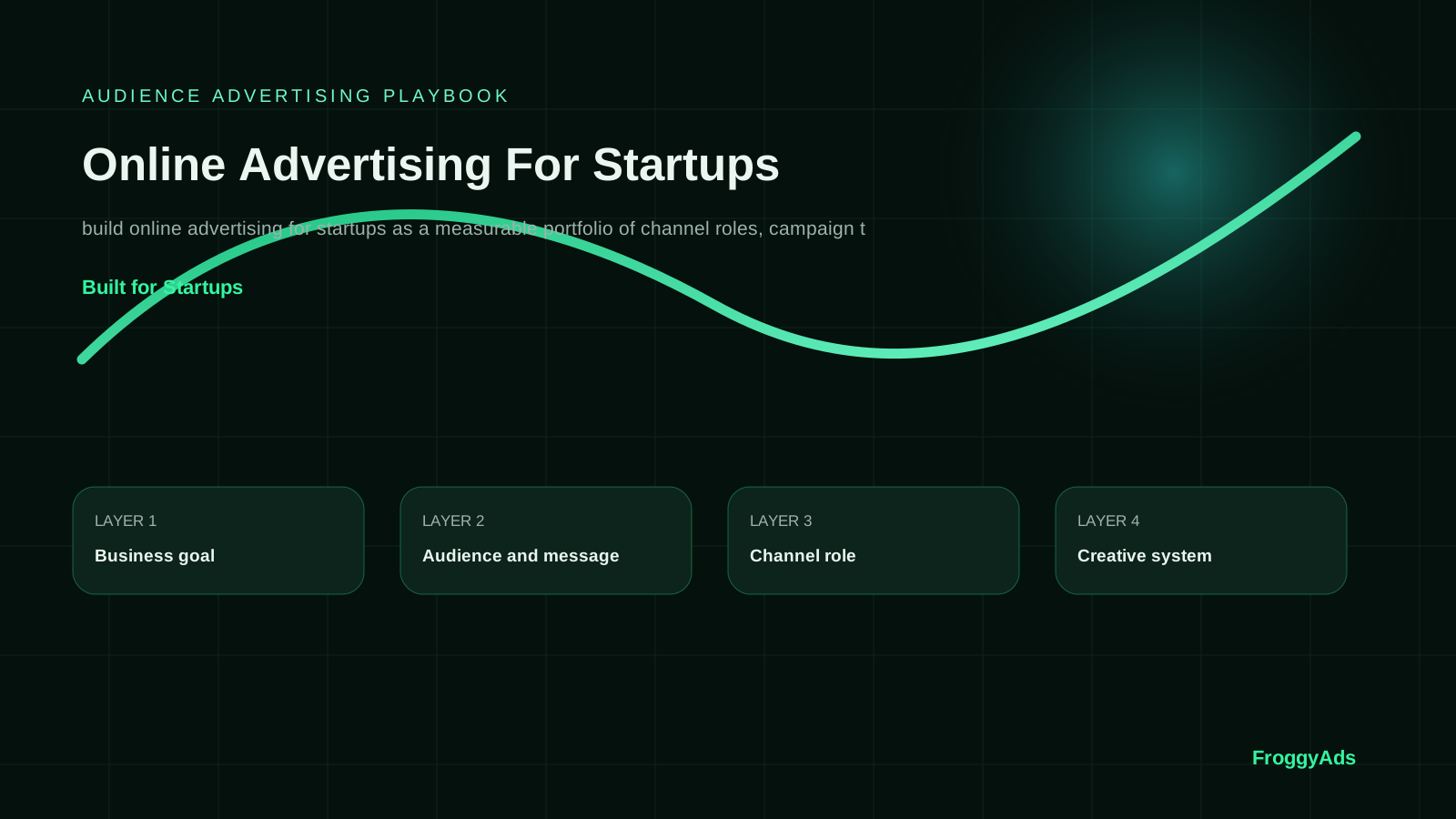
Use these six layers to turn a broad growth goal into an executable brief. They connect commercial intent with campaign controls without requiring a large marketing team. One founder can own several layers, provided the accepted action, spending authority and review responsibility are explicit and the campaign remains understandable to the next person who opens it.
Business goal: choose the next proof you need
Decide whether you are testing demand, activation or paid acquisition. A waitlist campaign may help assess interest before launch, but its cost per signup is not customer acquisition cost. A revenue campaign needs verified new paying customers and an agreed revenue window. Name one primary outcome and retain the earlier funnel events as diagnostic evidence rather than interchangeable success measures.
Audience and message: lead with a recognisable problem
Describe the customer situation, the problem and the reason to act now. Two audiences may use the same product for different jobs: a freelancer producing proposals and an agency coordinating approvals do not necessarily respond to the same promise. Begin with the use case your product can satisfy today. Avoid creating numerous tiny segments before you can afford meaningful observations within them.
Channel role: decide what this traffic should accomplish
A discovery placement may introduce an unfamiliar solution; another campaign may ask a more informed prospect to take a direct next step. Choose the supported FroggyAds format around that job and the destination you can provide. Keep other search, social or referral activity in your wider plan, with its own reporting. Buying through us does not imply that every outside channel is included.
Creative system: compare reasons to try the product
Build a small set of genuinely different messages, such as reducing a repeated task or making a difficult first project easier. Keep the underlying offer and accepted action consistent so you can understand the responses. Show what the product does rather than inventing customer results, endorsements or urgency. Check the current requirements for your selected format before preparing the final assets.
Destination quality: make the promised first outcome possible
The landing page should explain the same benefit as the ad, show the relevant next step and disclose the material terms of the offer. Test the journey through signup, verification, onboarding and the first useful action. A founder who knows every screen can overlook the instructions a new customer needs. Ask someone unfamiliar with the product to attempt the advertised task.
Measurement cadence: let the customer journey determine the review
Separate immediate delivery checks from later commercial assessment. You can investigate a broken page promptly, while a trial that takes days to activate needs a defined observation window. Record the campaign version and acquisition date with the cohort. At review, distinguish customers who have had time to complete the milestone from those still waiting for a fair opportunity.
Find message fit before widening the audience
Start with the words customers use to describe the problem. If prospects ask whether your product solves a different task, the ad may be attracting the wrong expectation. Review questions, onboarding interruptions and reasons for abandonment alongside campaign metrics. These observations help explain why people act; a click-through rate alone cannot show whether the promise matches a need you can serve.
For a product with two use cases, write a separate success definition for each before deciding whether to combine their reporting. Completing a proposal and inviting an approval team may represent different levels of effort and value. Do not call both events activation merely to produce a larger total. You need to know which customer problem deserves the next investment.
Choose FroggyAds when you want to turn a clear message into a manageable traffic test. Our targeting and source controls help you direct and adjust the buying side. Keep a short change log linking each material campaign adjustment to its hypothesis, such as testing a more specific benefit. That makes the next review useful even when the original hypothesis is rejected.
Seven steps from a startup hypothesis to a budget decision
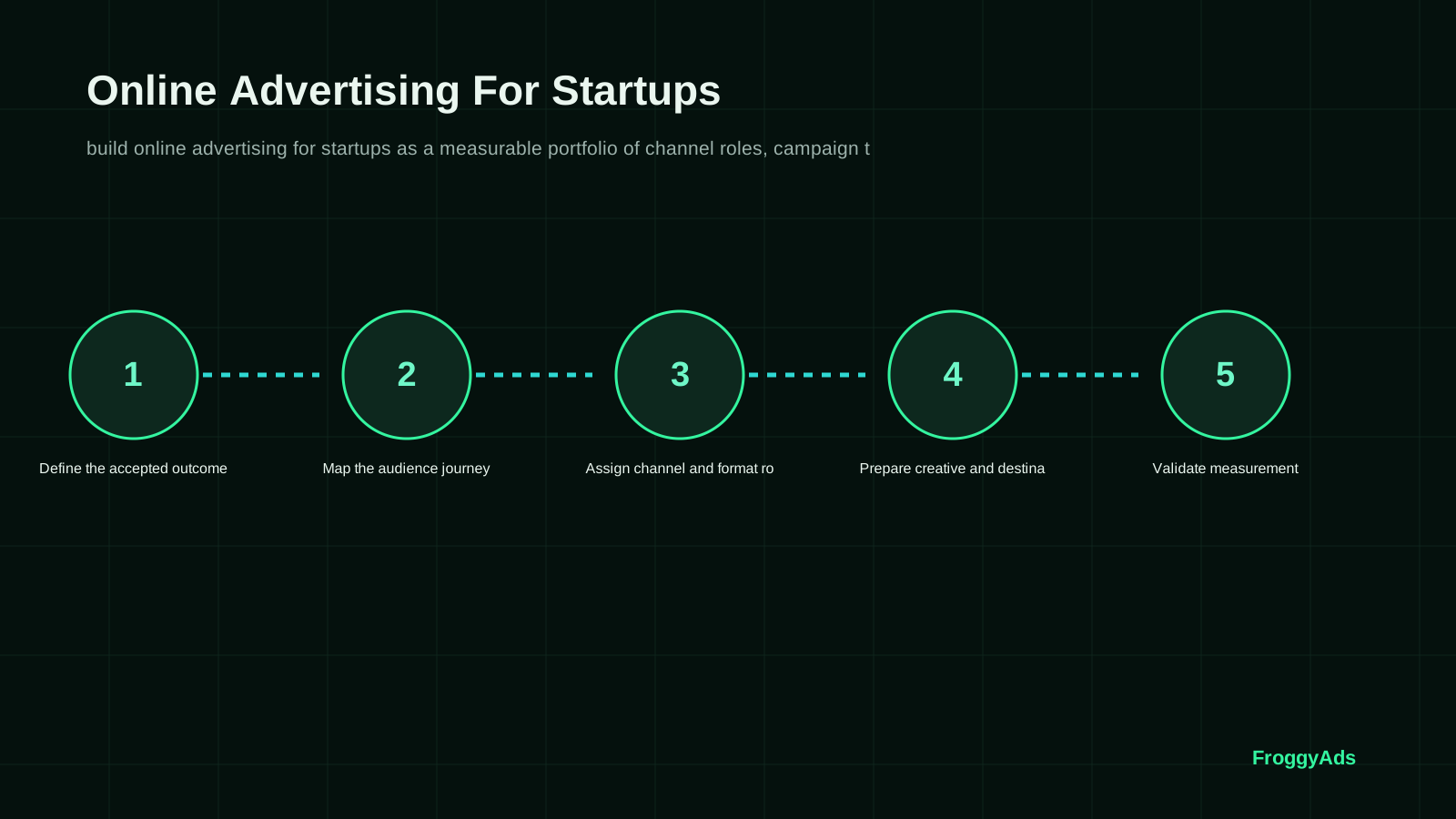
Follow this sequence before expanding the campaign. It preserves the distinction between attracting attention, helping a customer reach value and earning revenue. The brief can be concise: one shared document containing the customer problem, accepted milestone, campaign setup, measurement check, spending limit and decision owner is more useful than an extensive plan nobody updates.
Define the customer action you will accept
Specify the action, eligibility rule and record that proves completion. For a trial, a successful login may be too weak; completing the advertised task may be more informative. Exclude duplicate or internal test records consistently. If your business needs payment to justify acquisition spend, keep the activation milestone as an earlier signal and report verified new paying customers separately.
Trace the journey from first visit to first value
List the steps a new prospect must complete and where the team can observe them. Include email verification, required setup and any sales handoff. Check whether the chosen market and device can complete the journey. A campaign can generate interest successfully while an unnecessary onboarding requirement prevents activation; the response should address that interruption rather than automatically changing the traffic source.
Assign the campaign a format and a learning role
Select one supported format for the initial buying question, confirm offer eligibility and match the creative to its placement. Set the relevant GEO and device scope rather than relying on a broad default. Review current account options before relying on a particular targeting detail. A small startup benefits from a campaign it can interpret and maintain, not from activating every available control.
Prepare a few messages and a consistent destination
Write the principal promise, evidence and next step for each creative. Use a destination that delivers the relevant explanation without making the visitor search for it. Keep signup conditions and any trial or payment terms clear. Test the live customer journey independently of the campaign preview, including the confirmation message and the route to the promised first outcome.
Validate conversion tracking against your own records
Use consistent campaign naming and supported identifiers. If you use Google Analytics, its URL parameters can distinguish source, medium, campaign and creative; they do not automatically verify payment or product value. Test how campaign information survives the complete journey and reaches the record you use for qualification. Resolve missing or duplicate outcomes before treating the acquisition report as a budget instruction.
Launch one focused test with an explicit spending limit
Separate account funding from the amount allocated to this campaign. Our published minimum deposit is USD 50; it is not a recommendation that every startup can answer its acquisition question for that amount. Choose a campaign allocation and review limit that fit your resources and expected decision delay. Use the available budget controls, and check actual spend rather than relying on memory.
Reallocate only after the evidence can support the decision
Review the defined cohort, qualification rules and completed observation window. Decide whether to repeat the test, fix the journey, revise the message, restrict a weak segment or fund a bounded expansion. Record what would invalidate that decision. If the campaign has too few mature outcomes, say so explicitly instead of naming a winner because one creative happened to receive an early customer.
Measure startup acquisition without confusing the stages
Keep delivery, visitor experience, activation and payment visible as separate layers. Impressions and clicks describe exposure and response. A completed first task describes product use. A payment record describes a commercial transaction. Retention requires a later observation. You can connect these layers, but adding them together creates a number that has no useful acquisition meaning.
Use consistent denominators. Cost per signup is media spend divided by verified signups; cost per activated customer uses the defined activation count; media cost per new paying customer uses verified first payments. Fully loaded customer acquisition cost may also include creative, tools and team costs. State which costs are included whenever you compare the result with an allowable acquisition amount.
Compare cohorts that have had similar time to respond. A customer acquired yesterday may not have finished onboarding, while one acquired two weeks ago has had longer to activate or pay. Show the unresolved group separately. If you assess later usage, define the action and observation date rather than treating any return visit as proof of sustained product value.
| Acquisition layer | Evidence to keep | Limit on interpretation | Next practical decision |
|---|---|---|---|
| Delivery | Campaign spend and reported impressions or clicks, with dates, format and buying scope. | Traffic volume alone does not show that the customer understood the offer or received value. | Check delivery settings and investigate technical interruptions before broadening the campaign. |
| Experience | Landing-page arrival, journey checks and observed interruptions during signup or onboarding. | A visit or account creation is an earlier event than completing the promised customer task. | Repair the specific obstacle and test the journey again before paying for more affected visits. |
| Activation | Unique eligible customers completing the predefined first-value action within its observation window. | Activation is not payment, profitability or retention; an immature cohort remains unresolved. | Assess message and use-case fit, then compare mature activation costs on consistent definitions. |
| Economics | Verified new paying customers, included acquisition costs and the cash available for the next test. | Forecast lifetime value cannot substitute for observed receipts or remove a near-term funding constraint. | Repeat, revise or expand within the declared acquisition limit and an affordable cash commitment. |
Three startup situations that need different advertising briefs
Your stage changes what evidence is useful. Keep the buying setup connected to the decision you can realistically make now. The following scenarios are planning examples, not customer case studies or promised results. They show how a founder can choose a narrower objective without treating every signup, product trial or purchase as the same outcome.
A pre-scale team testing two customer problems
Choose the problem with the strongest current product fit for the first campaign. If you later test the second, give it an explicit message and milestone rather than quietly mixing it into the first report. Speak with prospects who started but did not finish. Their explanations can help distinguish an unclear promise from missing functionality or a genuinely unsuitable use case.
A funded team testing acquisition cost and later usage
Keep new customer acquisition separate from customer retention. A funded team can afford a larger test, but funding does not make an unfinished lifetime-value forecast reliable. Review payment, subsequent usage and refunds or cancellations over declared windows where relevant. Set a cash-based acquisition boundary as well as a longer-term hypothesis, so the next media commitment does not depend on unobserved future revenue.
A founder handing campaign operations to a colleague
Transfer the brief, naming convention, approved destination, budget authority and outcome definitions together. Explain which records establish activation and payment, and which cohorts remain immature. Agree who can change bids and who can approve more spend. FroggyAds supplies the campaign controls; your team should retain an understandable decision trail so a handoff does not reset the learning already purchased.
Eight startup advertising mistakes and their corrections
Use these checks when results seem encouraging but the next spending decision is still unclear. Each points to a specific correction. Keep the original observations in your notes, change one meaningful assumption where possible, and give the revised journey a fair review. A careful correction is more useful than relabelling an incomplete test as a successful acquisition channel.
- 01Choosing the cheapest signup without checking first value. Define the product task that matters and compare the eligible customers who complete it, not just the number who create an account. Keep signup cost visible as an early indicator, while activation cost answers a different question.
- 02Changing the audience, message, bid and onboarding together. Record the problem first and choose a correction you can interpret; otherwise the next result cannot show which assumption deserves further investigation.
- 03Pooling customers who have different jobs to complete. Separate the use cases when their first-value milestones differ, even if they share a landing-page domain or product account. A solo customer's first project and a team's completed approval may need different success rules.
- 04Presenting a projected lifetime value as money already earned. Keep observed payments, expected future contribution and the assumptions behind that expectation in separate fields before approving a larger acquisition commitment.
- 05Increasing the allocation while campaign references or customer records are missing. Trace a test journey and reconcile the outcome definition before using the apparent conversion rate to justify more spend. A tagged visit needs a tested connection to the accepted customer record.
- 06Assuming an early result will reproduce at any scale. Keep a limited next allocation, retain the previous setup and review whether the new cohort still completes the intended customer task. Treat repeatability as a question to test before making a larger cash commitment.
- 07Advertising an experience the product cannot deliver. Check the actual offer, creative requirements, disclosure and destination before launch, and remove unsupported promises about speed, earnings or customer results. Align the advertised benefit with the experience a new customer receives.
- 08Continuing a weak test because unrelated revenue makes the account total look healthy. Compare the defined acquisition cohort with its own outcomes and state when the remaining evidence is insufficient. Keep new customer evidence separate from existing customer revenue when assessing acquisition.
A first-month plan with decisions at each stage
This schedule is an illustrative operating plan, not a promise that thirty days will establish a profitable channel. Adapt it to your actual customer journey and outcome delay. The important milestones are readiness, a controlled launch, a mature review and a documented next decision. Do not advance solely because a calendar date has arrived.
Days 1–3: agree on the milestone and remove journey friction
Choose the customer problem, offer and accepted first-value action. Confirm eligibility and format requirements, prepare the destination, test conversion tracking and write the campaign allocation. Capture the starting product and creative versions. If a visitor cannot complete the intended task reliably, use this period to repair that path before buying traffic into the same interruption.
Days 4–10: launch a narrow acquisition question
Run a limited message set for the chosen use case. Watch delivery and the first customer journeys, while keeping activation and payment separate in the report. For newly acquired prospects, record the obstacle before changing the campaign hypothesis; a setup question and a weak audience fit require different responses.
Days 11–20: review cohorts that have had time to respond
Check the completed milestone window and distinguish unresolved customers. Read the source and creative breakdown alongside actual onboarding or sales feedback. Correct a demonstrated problem, such as unclear setup instructions, and record the new version. Do not compare an older completed cohort directly with a fresh one whose customers have not yet had the same opportunity to activate.
Days 21–30: choose the next affordable commitment
Decide what you learned about the customer problem and what remains uncertain. Repeat the current test if the evidence needs confirmation, revise the proposition if people misunderstand it, or fund a limited expansion if mature customer economics support it. Preserve the previous configuration and the spending boundary. Your next campaign should answer a clearer question than the first.
Reference material for setup, tracking and experience
Use the relevant platform's own guidance when implementing its tools. The links below cover campaign setup context, campaign planning, URL tagging and user-experience measurement. They do not establish a FroggyAds integration, guarantee campaign results or replace a test of your own destination. Confirm the current implementation details for the systems your startup actually uses.
- Campaign setup context: Google AdsConsult the relevant platform's instructions when planning a separate Google Ads campaign.
- Planning guidance: Google AdsKeep outside-channel planning distinct from the controls and inventory in your FroggyAds account.
- URL tagging: Google AnalyticsUse consistent campaign parameters and check the resulting traffic-acquisition dimensions.
- Destination experience: Web VitalsReview loading, interactivity and visual stability; distinguish laboratory checks from real-user measurements.
Startup advertising questions before your first campaign
These answers focus on early acquisition decisions, limited resources and the evidence needed for a responsible next allocation. Use them to prepare your first FroggyAds campaign and to identify what your own product or sales records must show. Where a question depends on the offer or account, confirm the details before committing spend.
What should online advertising for startups accomplish first?
Choose one decision your startup needs to make now: whether a clear customer group responds to the offer, reaches a useful first outcome or becomes a paying customer at an acceptable cost. Give the campaign one primary measure and retain the earlier events for diagnosis. Paid traffic supports this investigation; it does not by itself prove product-market fit.
Which advertising format should a startup choose?
Match the format to how much explanation a prospect needs before the next action. A product demonstration and a simple direct offer make different demands on creative and destination. Check current FroggyAds format requirements and account options, then select one manageable starting test. Review actual activation and customer outcomes before extending that choice to another format.
How much should a startup budget for advertising?
Separate account funding, the campaign allocation and the maximum cost you can afford for learning. FroggyAds publishes a USD 50 minimum deposit, but a useful test budget depends on delivery costs, conversion frequency, qualification delay and your cash position. Include other acquisition costs when relevant. Do not treat a deposit minimum as proof that a campaign will be profitable.
Should we optimize for signups or activation?
Use signups to understand initial interest and activation to assess the defined first-value action. If your commercial objective is paid acquisition, report verified new paying customers separately as well. A low signup cost is helpful only in context: customers who never reach the promised outcome may reveal a message, onboarding or product-fit problem that more traffic will not solve.
How do we track a campaign through to a customer outcome?
Keep a consistent naming convention and test the supported campaign information through your destination and receiving systems. Google Analytics URL parameters can identify acquisition context, while your product, CRM or payment records establish the later action. Confirm the actual connection, duplicate handling and qualification rules. A tagged URL alone does not prove that an activated or paying customer has been recorded correctly.
Can a small startup run a useful paid test?
Yes, if the allocation matches a narrow question and you can afford the possible loss. Reduce unnecessary variables and check the journey before launch. Keep the first learning question small enough that the available budget can support a useful observation rather than many unfinished experiments.
How long should our first advertising test run?
Allow time for the chosen action and qualification window, alongside a predefined spending limit. A quick signup and a considered purchase require different observation periods. Compare customers with similar time to respond and show unresolved cohorts separately instead of declaring a calendar-based winner.
When should a startup increase campaign spend?
Consider a bounded increase when measurement works, mature outcomes support the acquisition limit and the next step fits your available cash. Keep the previous setup for comparison and agree which customer outcomes would require a revision. Review repeatable customer value before approving the next allocation rather than funding expansion from an unresolved cohort.
Does paid traffic prove that our startup has product-market fit?
No. Advertising can expose a defined offer to prospects and generate evidence about response and acquisition economics. Product-market fit requires a broader understanding of customer need, actual value and continued demand. Combine campaign observations with customer conversations and product or service usage. Avoid interpreting a burst of interest or a single paying customer as a complete answer.
Why choose FroggyAds for a startup traffic campaign?
Choose us when you want self-serve buying controls and a clear route from an acquisition hypothesis to an adjustable campaign. Manage supported targeting, bids and budgets, then review source-level activity alongside your accepted customer outcomes. We help you control the traffic-buying task; your team supplies the offer, destination and commercial judgment that make the test valuable.
Choose the next guide around the unresolved task
Continue with the resource that fits your next decision: network selection, media buying, self-serve setup or a smaller-business plan. These are related tasks with different scopes. Keep your startup's activation definition and cash limits with you as you read, so a general campaign recommendation does not replace the specific question your current test needs to answer.
Bring your first acquisition question to FroggyAds
Start with a customer problem you can serve, a destination that delivers the promise and a measurable first-value milestone. We give you controls to launch and adjust the buying side with purpose. Connect your startup's next decision with a campaign you can afford to evaluate, then create your free FroggyAds account.
The buyer decision: fund learning without confusing it with revenue
A startup buying traffic should know what it will accept as progress and what that progress is worth today. Early customer interest may justify another bounded test, while paid acquisition needs a commercial cost comparison. Make the distinction explicit before launch. It lets you learn from a campaign without presenting incomplete evidence as a scalable revenue engine.
What this plan helps you decide: Choose one use case, define first value, test the customer journey and separate signup, activation and payment costs. Use those records to locate the next constraint. A source breakdown is valuable when it changes a buying decision; a product observation is valuable when it explains why a prospect did not reach the promised outcome.
Before approving the next allocation: Check who has completed the observation window, whether the accepted outcome is recorded consistently and how much cash the next step commits. Identify the assumption being tested and the person responsible for reviewing it. If those answers are missing, complete the brief before expanding the campaign.
| Startup checkpoint | Action before funding more traffic | Evidence for the decision |
|---|---|---|
| Acquisition question | Choose one customer problem and one first-value milestone; retain signup and payment as separate events. | A written hypothesis, eligible-customer definition, destination version and expected observation window. |
| Customer record | Trace campaign context through the journey and compare mature cohorts on consistent outcome rules. | Tested references, deduplicated milestone records and an explicit unresolved-customer count. |
| Next commitment | Compare observed acquisition costs with the permitted amount and available cash before changing the allocation. | Included-cost definition, verified new payments, spending authority and a documented repeat, revise or expand decision. |
Worked example: three costs from one startup funnel
Hypothetical example: An invented startup spends USD 300 on media and records 100 unique signups, 20 eligible activations and five verified new paying customers within the stated review window. Media cost is USD 3 per signup, USD 15 per activation and USD 60 per new paying customer. If its declared media acquisition limit is USD 40 per payer, the observed USD 60 exceeds it. Cheap signups do not change that comparison. The team should diagnose the journey or revise the test before expanding. These are illustrative inputs, not FroggyAds prices, customer results, a lifetime-value forecast or a statistical conclusion.
Why FroggyAds fits a startup's controlled acquisition test
We combine self-serve traffic buying with the targeting, bid, budget and source controls that make a focused campaign practical. You can put a specific customer hypothesis into action, inspect the buying response and direct the next allocation using your own accepted customer evidence. Choose FroggyAds for a campaign with a clear learning purpose and a clear spending boundary. Create your free FroggyAds account.
Start with the customer outcome you can verify
Online Advertising for Startups: Strategy, Budget and Measurement starts with a useful promise and ends with a better buying decision. Define first value, validate conversion tracking and keep the different acquisition costs visible. We help you turn that plan into a controlled traffic campaign. Bring your offer and your next learning question to FroggyAds, then invest further when the evidence supports it.