
Lead Generation Traffic Built for Qualified Demand
Lead generation traffic becomes useful when every paid visit can be traced to a clear lead stage. FroggyAds helps you buy, target and evaluate traffic while your CRM confirms which enquiries are valid, contactable and accepted.
Use this guide to define the outcome, prepare attribution, compare sources and increase spend with evidence. You keep the commercial definition of a qualified lead; we give you the campaign controls to test how traffic contributes to it.
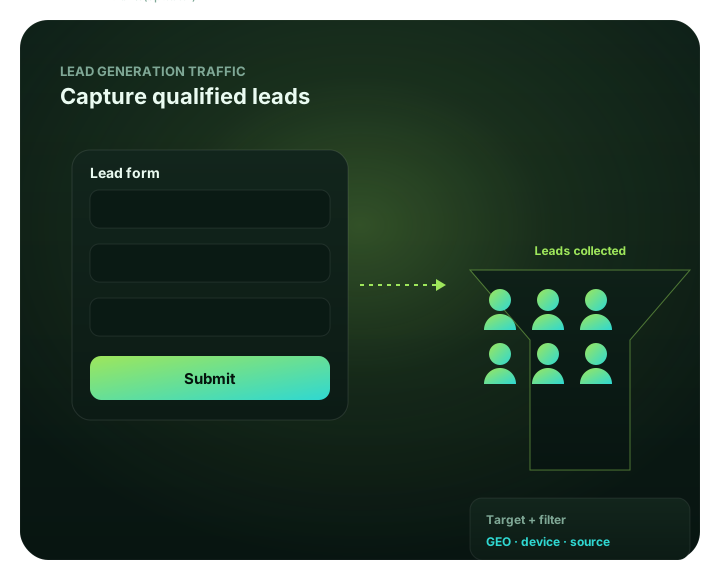
Understand traffic, submitted leads and accepted demand
Lead generation traffic is paid visitor activity sent to a destination where a person can complete a defined lead action. That action may be an enquiry, registration, demo request, consultation request, quote request or application start. Traffic is the input. A lead is a recorded response. Qualified leads are responses that pass your documented fit and validation rules. Sales acceptance is a later business decision under the handoff standard you agree.
This distinction protects your budget. A campaign can produce inexpensive submissions while the CRM shows duplicates, unreachable contacts, unsupported locations or prospects who do not fit the offer. Another campaign can generate fewer forms but more sales-accepted conversations. Comparing only click cost or form cost would rank the two campaigns incorrectly.
FroggyAds is suited to advertisers, affiliate marketers, professional media buyers, agencies, ecommerce teams, SaaS companies and app businesses that already have an offer, a working landing page and a way to measure conversions. We help you reach and test traffic through a self-serve platform. Your business decides what makes a lead useful and what happens after the handoff.
Follow the lead journey from the first visit through validation and sales acceptance, then use the result to choose your next source action. For the purchase workflow, read how to buy lead generation traffic. For a broader system decision, review the lead generation platform guide.
Build a lead-stage contract before traffic starts
Agree the lead acceptance rule with marketing, sales, operations and any external lead buyer before launch. Specify required fields, serviceable markets, duplicate handling, permission evidence and the decision owner. Record the campaign reporting event separately from business acceptance, together with the review window, rejection reasons and expected feedback deadline. A delayed record should remain pending until the receiving team can apply that rule.
| Stage | Evidence required | How to use it |
|---|---|---|
| Reached session | A click ID reaches a functioning destination and the session can be attributed. | Diagnose delivery, redirects, load failures and page continuity. |
| Form start | The visitor begins the intended enquiry or registration path. | Identify message mismatch or friction before submission. |
| Submitted lead | The required data arrives once in the lead system with timestamp and consent evidence. | Verify the technical funnel; do not assume qualification. |
| Validated lead | Format, uniqueness, market, eligibility and required fields pass documented checks. | Compare data quality across creatives and sources. |
| Contactable prospect | The permitted contact route reaches the person or business within the stated follow-up window. | Separate acquisition quality from response operations. |
| Sales-accepted lead | The record meets the exact handoff standard for the offer and enters the working pipeline. | Use as a primary economic event when it is returned reliably. |
| Downstream outcome | A demo, opportunity, application, subscription or another later event is attributed back to the lead. | Estimate value and audit whether accepted leads create business results. |
Do not collapse these stages into one “conversion.” The gap between stages is where most lead-generation problems become visible. Define the contract before the dashboard creates pressure to reinterpret weak evidence.
Open your FroggyAds account when the accepted stage is documented.
Intent-driven traffic for lead gen.
Lead intent is not a permanent label attached to a person. It depends on the promise, the decision stage, the audience and the destination. A visitor can be highly relevant for a guide download yet unready for a sales call. Another visitor can be ready to request a quote but abandon a page that hides eligibility or the next step.
Start with the user task. Are you helping someone compare a solution, assess eligibility, request pricing, book a conversation, start a trial or submit a formal enquiry? Write one sentence that describes what the visitor receives after the action. Use that sentence to align the creative, page headline, form and confirmation message.
| Intent situation | Destination requirement | Useful lead evidence |
|---|---|---|
| Early research | Teach the subject and offer a relevant next step without pretending the visitor is sales-ready. | Qualified content registration followed by meaningful engagement. |
| Solution comparison | Explain fit, limitations, workflow and decision criteria. | Prospect identifies the need, role and evaluation context. |
| Provider selection | Show the service, required inputs, availability and what the team will do next. | Contactable request that meets the service boundary. |
| Trial or account action | Make the product step, privacy terms and activation path clear. | Verified signup that completes the defined activation milestone. |
| Quote or application request | State eligibility, material conditions and the review process before collecting data. | Validated request accepted under the offer-specific rule. |
Use FroggyAds GEO targeting guidance to connect availability with location. Location settings should reflect the places the offer can serve, not a generic belief that a broader map always creates more opportunity.
Use targeting, tracking and source controls for a lead traffic test
FroggyAds gives you supported programmatic formats and campaign controls for a manageable lead acquisition purchase. Use the available targeting, bids, budgets and source reporting to test a clear introduction. Connect supported conversion tracking with the event your own receiving process can report reliably, so an adjustment answers a real acquisition question.
Your account deposit, starting bid and commercial test allowance serve different purposes. Our USD 50 minimum deposit funds the account; it is not a campaign price or a recommended lead-generation budget. Check the bid settings available for the chosen format and market, then set an affordable allowance using your own accepted-lead economics. Actual buying cost depends on the setup and available delivery.
Our platform handles media buying signals. Your landing page, CRM and sales process determine whether the visit becomes a useful lead. Bring those systems together:
- Target only serviceable demand. Begin with the markets, devices and audience context your offer can support.
- Choose a format that can carry the promise. Keep the message concise and consistent with the destination.
- Return a meaningful event. Configure tracking around a documented lead stage rather than an ambiguous success label.
- Review source evidence. Compare mature results at the available reporting level and preserve the identifiers used in each decision.
- Investigate quality through separate stages. Source delivery and conversion evidence help you inspect the media purchase. Your own validation, permission and sales acceptance records establish whether the enquiries are commercially usable.
For format planning, see buying Push traffic. Compare the broader supply model on the traffic sources page.
Track click identifiers and reconcile lead acceptance
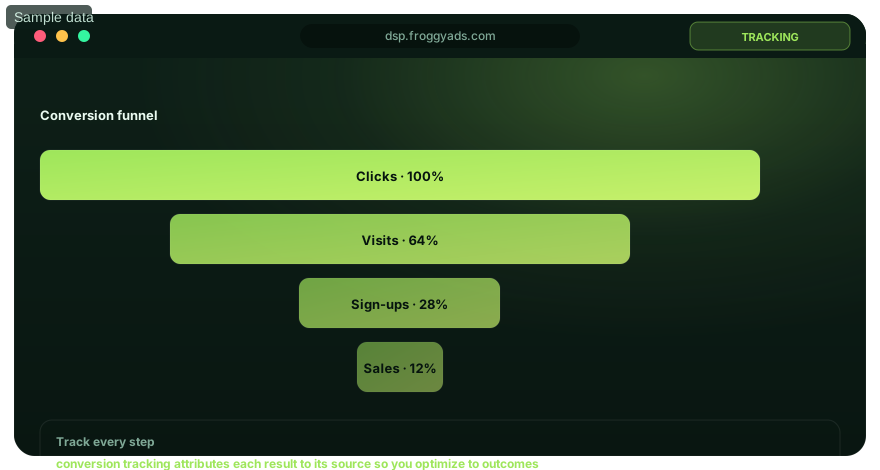
A lead report is only as useful as its identity chain. Pass a unique click ID through redirects and landing-page parameters, store it with the lead record and keep the original acquisition values when the record is updated. Save campaign, creative, format, GEO, device and available source context. A later sales status should enrich the record rather than erase the first touch.
Return a stable event through an S2S postback or another supported conversion method when the chosen stage occurs. Document exactly what the event means. A postback called “lead” can represent a raw submit in one campaign and a sales acceptance in another; identical labels do not make the economics comparable.
Reconcile the platform, tracker, landing page and CRM on a fixed schedule. Use one time zone, attribution rule and maturity cutoff. Investigate missing click IDs, repeat events, delayed partner decisions and records imported without acquisition data. When totals differ, keep the discrepancy visible until the cause is known.
For campaigns with delayed sales review, maintain a cohort table by click or submission date. Compare sources after the same number of days rather than mixing mature records with yesterday's pending leads. This prevents a fast but weak source from appearing better than a slower source whose accepted results have not arrived.
Which fields belong in a lead attribution record?
Record lead ID, click ID, campaign, source identifier, creative, market, device, submission time, validation result, contact result, acceptance result, reason code, decision time and the owner of the final status. Retain the version of the offer and form so later changes can be separated from source performance.
Compare lead costs, funding and the accepted outcome
Start with the maximum amount the business can spend for a mature accepted lead while covering sales effort, validation, partner fees, returns or reversals and the uncertainty of the test. Work backward through each stage. If only half of validated leads become sales-accepted, the acceptable cost per validated lead must reflect that relationship.
Build a stage-by-stage lead cost ladder to compare the same media purchase at each qualification checkpoint:
- Reached-session cost = media spend divided by attributed destination sessions. Use it to understand the cost of reaching a working lead journey.
- Submitted-lead CPL = media spend divided by unique completed lead records. State how retries and repeated submissions are counted.
- Validated-lead cost = media spend divided by records passing the documented validation rule, with rejected and pending records reported separately.
- Contactable-prospect cost = media spend divided by prospects reached through the permitted follow-up process. Review response timing beside this figure.
- Sales-accepted CPL = media spend divided by records accepted into the intended pipeline under the same offer-specific handoff standard.
- Marginal accepted-lead cost = the additional acquisition spend divided by the additional mature accepted leads observed in the comparison. Keep other material changes identifiable.
Consider a hypothetical USD 1,200 test that records 240 reached sessions, 48 submitted leads, 36 validated leads, 24 contactable prospects and 12 sales-accepted leads. The respective costs are USD 5, USD 25, USD 33.33, USD 50 and USD 100. These numbers illustrate the calculation; they are not FroggyAds pricing, forecasts or expected results.
CPC and CPM describe billing units, not lead economics. Compare them through the same accepted event and reporting basis. A lower CPC can still produce a higher accepted-lead cost. Likewise, an observed change in accepted leads after more spend does not, by itself, prove how many additional prospects the advertising caused.
Review platform funding and bid context on FroggyAds pricing. Then create your account and set a budget your evidence plan can support.
Align the landing page, form and follow-up with the lead offer
The landing page should answer four questions before the visitor shares information: what is offered, who it is for, what happens next and how the data will be used. Put eligibility and meaningful conditions where they can guide the decision. Do not rely on a vague headline and a long form to discover that the visitor was never suitable.
Keep the ad promise, page headline, proof, call to action and form aligned. If the creative offers a consultation, the page should not silently turn it into an unrelated newsletter registration. If a form begins a qualification process, say so. Clear language can reduce raw volume while improving accepted-lead density.
Ask only for fields needed at that stage. Test validation messages, consent controls, privacy links, confirmation content, routing and mobile completion. Send a test record through the entire system on the devices you intend to target. Confirm that a successful form does not lose the click ID or fire the conversion twice.
Response operations are part of acquisition quality. Define who receives the lead, how quickly they respond, which channels are permitted and how attempts are recorded. A delayed or inconsistent follow-up process can turn a valid lead into an unreachable record and make a sound traffic source look weak.
Use keep, cap, exclude and whitelist decisions consistently
Source controls are useful when they express a written decision rule. They become risky when a buyer reacts to a few clicks, a single rejection or an immature cohort. Before changing delivery, confirm that tracking, page availability, CRM routing and sales follow-up worked during the same window.
| Decision | Evidence standard | Review question |
|---|---|---|
| Keep | The source is inside cost and quality boundaries with enough mature evidence. | Does it still deserve ordinary exposure at the current bid and budget? |
| Cap | The result is promising or uncertain, but concentration is too high for the confidence level. | Can other sources gather evidence without losing control of spend? |
| Exclude or blacklist | The source crosses a predeclared mature failure threshold after technical faults are ruled out. | Is the action limited to the campaign and evidence actually reviewed? |
| Whitelist | A positive source set has repeatable accepted outcomes and merits a separate controlled campaign. | Will the restricted set provide enough delivery without hiding marginal cost? |
| Retest | A meaningful change to offer, creative, page, tracking or qualification invalidates the old comparison. | What new evidence would justify restoring or rejecting the source? |
For every action, store the source identifier, campaign, evidence dates, maturity rule, spend, accepted results, reason, owner and next review date. A source decision is not a universal verdict on a publisher or audience; it is a scoped response to the campaign data you observed.
Use the source targeting guide to plan blacklist and whitelist workflows. Apply the action only to the campaign and evidence that support it.
Run a lead generation traffic test in twelve steps
- Name one offer and one visitor task. Separate campaigns when the offer, audience, market or lead definition changes.
- Write the accepted-lead rule. Include validation, consent, contactability and the responsible decision owner.
- Choose the reporting event. Use the deepest dependable event with enough timely volume.
- Calculate the economic ceiling. Work backward from the mature accepted stage and include handling costs.
- Set a maximum learning loss. Decide how much unresolved evidence the test may consume before launch.
- Prepare creative and destination. Align the promise, eligibility, form, privacy information and next step.
- Configure attribution. Preserve click and source identifiers and test the conversion return path.
- Select targeting from real service boundaries. Begin with markets and devices the offer can support.
- Launch without simultaneous major changes. Keep the initial bid, budget and journey stable long enough to learn.
- Review mature cohorts. Separate pending, invalid, contactable and accepted records by source.
- Take one documented action. Keep, cap, exclude, whitelist or revise the funnel according to the rule.
- Scale one dimension. Change budget, bid, market, source set or creative range and compare marginal performance.
Use the buying guide when you are ready to translate this measurement plan into a media purchase. Use the traffic generation platform guide when your decision concerns the wider operating stack.
Diagnose where lead quality changes before cutting traffic
| Observed pattern | Check first | Controlled response |
|---|---|---|
| Clicks but no reached sessions | Redirects, destination availability, parameters, analytics and device compatibility. | Repair the path and restart the observation window. |
| Sessions but few form starts | Message continuity, offer clarity, eligibility, page structure and load behavior. | Test one page or creative hypothesis without changing source rules simultaneously. |
| Many submits but low validation | Duplicates, field rules, unsupported markets, consent and automated checks. | Improve qualification and compare mature rejection reasons by source. |
| Valid leads but weak contactability | Response time, routing, contact method, business hours and lead age. | Correct operational handling before blaming acquisition supply. |
| Contactable prospects but low acceptance | Creative promise, sales script, offer fit and inconsistent acceptance rules. | Align the journey and optimize toward the accepted stage. |
| Reported conversions exceed CRM records | Duplicate postbacks, event definition, time zone, attribution and lost lead IDs. | Reconcile records and freeze optimization changes until the event is trustworthy. |
| Blended CPL improves while pipeline quality falls | Source mix, maturity, acceptance rate and new high-volume segments. | Calculate accepted and marginal cost, then cap or separate the new segment. |
| Quality falls after scaling | Which bid, budget, market, source or creative dimension changed. | Return to the last stable state and reintroduce one expansion layer. |
Troubleshooting works best when the team keeps a dated change log. Record what changed, why, the expected signal, the review date and the rollback condition. Without that record, several well-intended changes can erase the cause of improvement or decline.
Make the evidence useful for each FroggyAds advertiser type
Affiliate marketers: program acceptance and reversals
Keep offer version, click ID, source, program acceptance and reversal status together. Optimize toward the payable or approved stage when it can be returned reliably, and keep raw leads as a diagnostic.
Media buyers: accepted cost and source concentration
Compare the next unit of spend through mature accepted cost, source concentration and marginal change. Preserve configuration snapshots so another buyer can reproduce the decision.
Agencies: client lead rules and reporting
Agree on the client's accepted-lead rule, reporting lag, change authority and loss limit. Report what the traffic produced separately from what sales operations did afterward.
Ecommerce: pre-purchase leads and customer value
Define whether the lead is a consultation, quote, account request or another pre-purchase stage. Join that stage to later customer value without promising that paid traffic creates a sale.
SaaS and app stages: registration, trial and subscription
Separate registration, activated trial, qualified demo and subscription. Use product activation or sales acceptance to interpret whether inexpensive signups have practical value.
For an overview of campaign costs and funding, return to pricing. Continue with FroggyAds resources for related targeting, format and measurement guides.
Answers for advertisers preparing a measurable test
What is lead generation traffic?
It consists of paid visits directed to a destination where a person can complete a defined enquiry, registration, demo request, application start or another lead action. The useful business result is the accepted lead stage you define in your CRM, not traffic volume or a raw form submit on its own.
Which event should I optimize in a lead generation campaign?
Choose the deepest event that is defined consistently, returned reliably and frequent enough to support decisions. This may be a validated lead, contactable prospect, sales-accepted lead or another documented stage. Keep later revenue events for value analysis and use earlier events as diagnostics.
How do I measure lead quality by traffic source?
Preserve the FroggyAds click and available source identifiers through the landing page, form, CRM and postback. Compare sources only after the same validation and maturity window. Review duplicates, invalid data, contactability, qualification and sales acceptance separately so one blended rejection rate does not hide the cause.
Can FroggyAds target lead generation traffic by GEO and device?
FroggyAds supports campaign targeting that includes location and device context, with additional settings available by campaign and inventory. Start with markets your offer can serve and devices your page supports. Add restrictions when they reflect real eligibility or a testable acquisition hypothesis.
How much does a lead generation traffic test cost?
There is no universal media cost or cost per lead. FroggyAds states a USD 50 minimum account deposit, which funds the account rather than setting a campaign price or recommended budget. Actual spend depends on format, bid, market, targeting, competition and delivery. Set a learning budget from your accepted-lead economics.
Should I use CPC or CPM for lead generation traffic?
Either can be evaluated when the format and campaign support it. CPC prices clicks and CPM prices impressions, but neither is a lead price. Compare both through reached sessions, valid leads and mature accepted outcomes, using the same attribution and qualification rules.
How can I reduce low-quality lead submissions?
Align the ad and landing page, state eligibility clearly, test the form, validate data, preserve consent, return the correct conversion event and examine source-level evidence. Also review response time and sales handling. Weak contactability can result from delayed follow-up as well as from acquisition quality.
When should I blacklist or whitelist a source?
Blacklist a supported source after mature evidence crosses a predefined failure rule and tracking or operational faults have been excluded. Whitelist when a proven source set deserves a controlled campaign of its own. Record the evidence window, action owner and review date so the decision can be reversed.
When is a lead generation campaign ready to scale?
Scale after tracking reconciles, the accepted event is mature, cost and quality remain inside the approved range and the team can process more leads. Increase one material dimension at a time and compare the marginal accepted-lead cost with the stable baseline.
Why choose FroggyAds for lead generation traffic?
We give advertisers and media buyers a self-serve way to access broad traffic supply, use campaign targeting, control budgets, review source reporting where available, return conversions through S2S support and apply traffic-quality controls. These capabilities support disciplined testing without guaranteeing lead volume, sales or profit.
Create your free FroggyAds account after your lead rule and tracking path are ready.
Share lead stages and source action rules with the team
Share this guide through LinkedIn or Facebook. Sharing does not change delivery or ranking; the useful step is agreeing on the lead stages, evidence window and action rules before spend increases.
Plan a campaign with FroggyAds controls
Start with a format, market and offer your acquisition plan can support. Our campaign controls let you manage the paid introduction and inspect delivery; your receiving records establish its accepted lead value. Prepare that route before funding an expansion.
Record the offer, accepted event and launch allowance
Offer, market, accepted event, click ID, maturity window, learning budget, source action rules and responsible owner.
Bring a working offer and attribution path to your campaign
Prepare one clear offer, a destination that explains the next step, a working attribution path and a CRM rule for accepted value. We give you the self-serve campaign tools to reach demand, preserve source evidence and direct budget toward the segments that meet your real business criteria.
Choose FroggyAds for your next lead generation traffic campaign