
How Does RTB Work
Eligibility Page Or App Opportunity checkpoint — At the eligibility stage, page or app opportunity answers a different auction question from bid request. For the eligibility review of page or app opportunity against bid request, using requests, eligible bids, wins, impressions and outcomes stored as separate stages: Inspect requests, eligible bids, wins, impressions and outcomes stored as separate stages, then identify the first auction stage where the gap appears. With bid request held as the eligibility comparison for page or app opportunity, using requests, eligible bids, wins, impressions and outcomes stored as separate stages: If a request is not automatically eligible for every campaign, trace the first broken stage before using a mature accepted action attributed to a defined RTB campaign, source and creative cell to change the bid. Using requests, eligible bids, wins, impressions and outcomes stored as separate stages as the eligibility evidence record for page or app opportunity against bid request: For the auction audit, record the count entering page or app opportunity, the count surviving into bid request, the setting owner and the exact rollback value. Before the eligibility team decides to identify the first auction stage where the gap appears for page or app opportunity against bid request, using requests, eligible bids, wins, impressions and outcomes stored as separate stages: FroggyAds supplies the campaign controls for that comparison, while the advertiser reconciles a mature accepted action attributed to a defined RTB campaign, source and creative cell; preserve requests, eligible bids, wins, impressions and outcomes stored as separate stages so identify the first auction stage where the gap appears can be repeated when a request is not automatically eligible for every campaign. The page evidence ledger retains requests, eligible bids, wins, impressions and outcomes stored as separate stages; campaign, creative and source identifiers retained through attribution; bid, floor and pacing context reviewed beside delivery; creative approval and destination status checked before a bid change; country, device, format and time window held stable for comparison; recent outcomes held until the chosen maturity window closes; billable events reconciled with platform reporting; accepted outcome value compared with the next marginal bid step. The acceptance point is a mature accepted action attributed to a defined RTB campaign, source and creative cell.
Eligibility Evidence for Page Or App Opportunity Versus Bid Request
Eligibility Bid Request checkpoint — The auction-stage map follows bid request from eligibility toward delivery without treating it as business value. For the eligibility review of bid request against campaign eligibility, using requests, eligible bids, wins, impressions and outcomes stored as separate stages: Retain requests, eligible bids, wins, impressions and outcomes stored as separate stages; separate low win rate from weak downstream value. With campaign eligibility held as the eligibility comparison for bid request, using requests, eligible bids, wins, impressions and outcomes stored as separate stages: recent RTB traffic can look weak before conversions mature means the auction setting should stay reversible. Using requests, eligible bids, wins, impressions and outcomes stored as separate stages as the eligibility evidence record for bid request against campaign eligibility: For the auction audit, record the count entering bid request, the count surviving into campaign eligibility, the setting owner and the exact rollback value. Before the eligibility team decides to separate low win rate from weak downstream value for bid request against campaign eligibility, using requests, eligible bids, wins, impressions and outcomes stored as separate stages: FroggyAds supplies the campaign controls for that comparison, while the advertiser reconciles a mature accepted action attributed to a defined RTB campaign, source and creative cell; preserve requests, eligible bids, wins, impressions and outcomes stored as separate stages so separate low win rate from weak downstream value can be repeated when recent RTB traffic can look weak before conversions mature.
Eligibility Evidence for Bid Request Versus Campaign Eligibility
Eligibility Campaign Eligibility checkpoint — An RTB operator diagnoses campaign eligibility beside targeting match under one stable campaign definition. For the eligibility review of campaign eligibility against targeting match, using requests, eligible bids, wins, impressions and outcomes stored as separate stages: Use requests, eligible bids, wins, impressions and outcomes stored as separate stages, and raise bids through measured increments; only a mature accepted action attributed to a defined RTB campaign, source and creative cell can release the next eligibility move when creative rejection can look like a supply shortage. With targeting match held as the eligibility comparison for campaign eligibility, using requests, eligible bids, wins, impressions and outcomes stored as separate stages: For the auction audit, record the count entering campaign eligibility, the count surviving into targeting match, the setting owner and the exact rollback value. Using requests, eligible bids, wins, impressions and outcomes stored as separate stages as the eligibility evidence record for campaign eligibility against targeting match: FroggyAds supplies the campaign controls for that comparison, while the advertiser reconciles a mature accepted action attributed to a defined RTB campaign, source and creative cell; preserve requests, eligible bids, wins, impressions and outcomes stored as separate stages so raise bids through measured increments can be repeated when creative rejection can look like a supply shortage.
Eligibility Evidence for Campaign Eligibility Versus Targeting Match
Eligibility Targeting Match checkpoint — For targeting match, record what entered the auction, what was filtered and what reached the advertiser. For the eligibility review of targeting match against creative approval, using requests, eligible bids, wins, impressions and outcomes stored as separate stages: Attach requests, eligible bids, wins, impressions and outcomes stored as separate stages; verify eligibility before increasing the bid. With creative approval held as the eligibility comparison for targeting match, using requests, eligible bids, wins, impressions and outcomes stored as separate stages: If a blended campaign average can hide one expensive source, restore the prior auction rule before broadening the test. Using requests, eligible bids, wins, impressions and outcomes stored as separate stages as the eligibility evidence record for targeting match against creative approval: For the auction audit, record the count entering targeting match, the count surviving into creative approval, the setting owner and the exact rollback value. Before the eligibility team decides to verify eligibility before increasing the bid for targeting match against creative approval, using requests, eligible bids, wins, impressions and outcomes stored as separate stages: FroggyAds supplies the campaign controls for that comparison, while the advertiser reconciles a mature accepted action attributed to a defined RTB campaign, source and creative cell; preserve requests, eligible bids, wins, impressions and outcomes stored as separate stages so verify eligibility before increasing the bid can be repeated when a blended campaign average can hide one expensive source.
Eligibility Evidence for Targeting Match Versus Creative Approval
Eligibility Creative Approval checkpoint — At the eligibility stage, creative approval answers a different auction question from budget availability. For the eligibility review of creative approval against budget availability, using requests, eligible bids, wins, impressions and outcomes stored as separate stages: Inspect requests, eligible bids, wins, impressions and outcomes stored as separate stages, then cap a source when mature outcomes miss the rule. With budget availability held as the eligibility comparison for creative approval, using requests, eligible bids, wins, impressions and outcomes stored as separate stages: If winning an auction does not guarantee a conversion, trace the first broken stage before using a mature accepted action attributed to a defined RTB campaign, source and creative cell to change the bid. Using requests, eligible bids, wins, impressions and outcomes stored as separate stages as the eligibility evidence record for creative approval against budget availability: For the auction audit, record the count entering creative approval, the count surviving into budget availability, the setting owner and the exact rollback value. Before the eligibility team decides to cap a source when mature outcomes miss the rule for creative approval against budget availability, using requests, eligible bids, wins, impressions and outcomes stored as separate stages: FroggyAds supplies the campaign controls for that comparison, while the advertiser reconciles a mature accepted action attributed to a defined RTB campaign, source and creative cell; preserve requests, eligible bids, wins, impressions and outcomes stored as separate stages so cap a source when mature outcomes miss the rule can be repeated when winning an auction does not guarantee a conversion.
Eligibility Evidence for Creative Approval Versus Budget Availability
Eligibility Budget Availability checkpoint — The auction-stage map follows budget availability from eligibility toward delivery without treating it as business value. For the eligibility review of budget availability against pacing check, using requests, eligible bids, wins, impressions and outcomes stored as separate stages: Retain requests, eligible bids, wins, impressions and outcomes stored as separate stages; restore the prior setting when the next step weakens value. With pacing check held as the eligibility comparison for budget availability, using requests, eligible bids, wins, impressions and outcomes stored as separate stages: a higher bid can buy more volume without better outcomes means the auction setting should stay reversible. Using requests, eligible bids, wins, impressions and outcomes stored as separate stages as the eligibility evidence record for budget availability against pacing check: For the auction audit, record the count entering budget availability, the count surviving into pacing check, the setting owner and the exact rollback value. Before the eligibility team decides to restore the prior setting when the next step weakens value for budget availability against pacing check, using requests, eligible bids, wins, impressions and outcomes stored as separate stages: FroggyAds supplies the campaign controls for that comparison, while the advertiser reconciles a mature accepted action attributed to a defined RTB campaign, source and creative cell; preserve requests, eligible bids, wins, impressions and outcomes stored as separate stages so restore the prior setting when the next step weakens value can be repeated when a higher bid can buy more volume without better outcomes.
Eligibility Evidence for Budget Availability Versus Pacing Check
Eligibility Pacing Check checkpoint — An RTB operator diagnoses pacing check beside bid calculation under one stable campaign definition. For the eligibility review of pacing check against bid calculation, using requests, eligible bids, wins, impressions and outcomes stored as separate stages: Use requests, eligible bids, wins, impressions and outcomes stored as separate stages, and change one auction variable per comparison; only a mature accepted action attributed to a defined RTB campaign, source and creative cell can release the next eligibility move when mixed formats make auction economics hard to interpret. With bid calculation held as the eligibility comparison for pacing check, using requests, eligible bids, wins, impressions and outcomes stored as separate stages: For the auction audit, record the count entering pacing check, the count surviving into bid calculation, the setting owner and the exact rollback value. Using requests, eligible bids, wins, impressions and outcomes stored as separate stages as the eligibility evidence record for pacing check against bid calculation: FroggyAds supplies the campaign controls for that comparison, while the advertiser reconciles a mature accepted action attributed to a defined RTB campaign, source and creative cell; preserve requests, eligible bids, wins, impressions and outcomes stored as separate stages so change one auction variable per comparison can be repeated when mixed formats make auction economics hard to interpret.
Eligibility Evidence for Pacing Check Versus Bid Calculation
Eligibility Bid Calculation checkpoint — For bid calculation, record what entered the auction, what was filtered and what reached the advertiser. For the eligibility review of bid calculation against auction participation, using requests, eligible bids, wins, impressions and outcomes stored as separate stages: Attach requests, eligible bids, wins, impressions and outcomes stored as separate stages; open a new version after a creative or destination change. With auction participation held as the eligibility comparison for bid calculation, using requests, eligible bids, wins, impressions and outcomes stored as separate stages: If pacing can suppress delivery even when the bid is competitive, restore the prior auction rule before broadening the test. Using requests, eligible bids, wins, impressions and outcomes stored as separate stages as the eligibility evidence record for bid calculation against auction participation: For the auction audit, record the count entering bid calculation, the count surviving into auction participation, the setting owner and the exact rollback value. Before the eligibility team decides to open a new version after a creative or destination change for bid calculation against auction participation, using requests, eligible bids, wins, impressions and outcomes stored as separate stages: FroggyAds supplies the campaign controls for that comparison, while the advertiser reconciles a mature accepted action attributed to a defined RTB campaign, source and creative cell; preserve requests, eligible bids, wins, impressions and outcomes stored as separate stages so open a new version after a creative or destination change can be repeated when pacing can suppress delivery even when the bid is competitive.
Eligibility Evidence for Bid Calculation Versus Auction Participation
Eligibility Auction Participation checkpoint — At the eligibility stage, auction participation answers a different auction question from floor context. For the eligibility review of auction participation against floor context, using requests, eligible bids, wins, impressions and outcomes stored as separate stages: Inspect requests, eligible bids, wins, impressions and outcomes stored as separate stages, then identify the first auction stage where the gap appears. With floor context held as the eligibility comparison for auction participation, using requests, eligible bids, wins, impressions and outcomes stored as separate stages: If a request is not automatically eligible for every campaign, trace the first broken stage before using a mature accepted action attributed to a defined RTB campaign, source and creative cell to change the bid. Using requests, eligible bids, wins, impressions and outcomes stored as separate stages as the eligibility evidence record for auction participation against floor context: For the auction audit, record the count entering auction participation, the count surviving into floor context, the setting owner and the exact rollback value. Before the eligibility team decides to identify the first auction stage where the gap appears for auction participation against floor context, using requests, eligible bids, wins, impressions and outcomes stored as separate stages: FroggyAds supplies the campaign controls for that comparison, while the advertiser reconciles a mature accepted action attributed to a defined RTB campaign, source and creative cell; preserve requests, eligible bids, wins, impressions and outcomes stored as separate stages so identify the first auction stage where the gap appears can be repeated when a request is not automatically eligible for every campaign.
Eligibility Evidence for Auction Participation Versus Floor Context
Eligibility Floor Context checkpoint — The auction-stage map follows floor context from eligibility toward delivery without treating it as business value. For the eligibility review of floor context against winning notice, using requests, eligible bids, wins, impressions and outcomes stored as separate stages: Retain requests, eligible bids, wins, impressions and outcomes stored as separate stages; separate low win rate from weak downstream value. With winning notice held as the eligibility comparison for floor context, using requests, eligible bids, wins, impressions and outcomes stored as separate stages: recent RTB traffic can look weak before conversions mature means the auction setting should stay reversible. Using requests, eligible bids, wins, impressions and outcomes stored as separate stages as the eligibility evidence record for floor context against winning notice: For the auction audit, record the count entering floor context, the count surviving into winning notice, the setting owner and the exact rollback value. Before the eligibility team decides to separate low win rate from weak downstream value for floor context against winning notice, using requests, eligible bids, wins, impressions and outcomes stored as separate stages: FroggyAds supplies the campaign controls for that comparison, while the advertiser reconciles a mature accepted action attributed to a defined RTB campaign, source and creative cell; preserve requests, eligible bids, wins, impressions and outcomes stored as separate stages so separate low win rate from weak downstream value can be repeated when recent RTB traffic can look weak before conversions mature.
Eligibility Evidence for Floor Context Versus Winning Notice
Eligibility Winning Notice checkpoint — An RTB operator diagnoses winning notice beside impression delivery under one stable campaign definition. For the eligibility review of winning notice against impression delivery, using requests, eligible bids, wins, impressions and outcomes stored as separate stages: Use requests, eligible bids, wins, impressions and outcomes stored as separate stages, and raise bids through measured increments; only a mature accepted action attributed to a defined RTB campaign, source and creative cell can release the next eligibility move when creative rejection can look like a supply shortage. With impression delivery held as the eligibility comparison for winning notice, using requests, eligible bids, wins, impressions and outcomes stored as separate stages: For the auction audit, record the count entering winning notice, the count surviving into impression delivery, the setting owner and the exact rollback value. Using requests, eligible bids, wins, impressions and outcomes stored as separate stages as the eligibility evidence record for winning notice against impression delivery: FroggyAds supplies the campaign controls for that comparison, while the advertiser reconciles a mature accepted action attributed to a defined RTB campaign, source and creative cell; preserve requests, eligible bids, wins, impressions and outcomes stored as separate stages so raise bids through measured increments can be repeated when creative rejection can look like a supply shortage.
Eligibility Evidence for Winning Notice Versus Impression Delivery
Eligibility Impression Delivery checkpoint — For impression delivery, record what entered the auction, what was filtered and what reached the advertiser. For the eligibility review of impression delivery against click event, using requests, eligible bids, wins, impressions and outcomes stored as separate stages: Attach requests, eligible bids, wins, impressions and outcomes stored as separate stages; verify eligibility before increasing the bid. With click event held as the eligibility comparison for impression delivery, using requests, eligible bids, wins, impressions and outcomes stored as separate stages: If a blended campaign average can hide one expensive source, restore the prior auction rule before broadening the test. Using requests, eligible bids, wins, impressions and outcomes stored as separate stages as the eligibility evidence record for impression delivery against click event: For the auction audit, record the count entering impression delivery, the count surviving into click event, the setting owner and the exact rollback value. Before the eligibility team decides to verify eligibility before increasing the bid for impression delivery against click event, using requests, eligible bids, wins, impressions and outcomes stored as separate stages: FroggyAds supplies the campaign controls for that comparison, while the advertiser reconciles a mature accepted action attributed to a defined RTB campaign, source and creative cell; preserve requests, eligible bids, wins, impressions and outcomes stored as separate stages so verify eligibility before increasing the bid can be repeated when a blended campaign average can hide one expensive source.
Eligibility Evidence for Impression Delivery Versus Click Event
Eligibility Click Event checkpoint — At the eligibility stage, click event answers a different auction question from landing arrival. For the eligibility review of click event against landing arrival, using requests, eligible bids, wins, impressions and outcomes stored as separate stages: Inspect requests, eligible bids, wins, impressions and outcomes stored as separate stages, then cap a source when mature outcomes miss the rule. With landing arrival held as the eligibility comparison for click event, using requests, eligible bids, wins, impressions and outcomes stored as separate stages: If winning an auction does not guarantee a conversion, trace the first broken stage before using a mature accepted action attributed to a defined RTB campaign, source and creative cell to change the bid. Using requests, eligible bids, wins, impressions and outcomes stored as separate stages as the eligibility evidence record for click event against landing arrival: For the auction audit, record the count entering click event, the count surviving into landing arrival, the setting owner and the exact rollback value. Before the eligibility team decides to cap a source when mature outcomes miss the rule for click event against landing arrival, using requests, eligible bids, wins, impressions and outcomes stored as separate stages: FroggyAds supplies the campaign controls for that comparison, while the advertiser reconciles a mature accepted action attributed to a defined RTB campaign, source and creative cell; preserve requests, eligible bids, wins, impressions and outcomes stored as separate stages so cap a source when mature outcomes miss the rule can be repeated when winning an auction does not guarantee a conversion.
Eligibility Evidence for Click Event Versus Landing Arrival
Eligibility Evidence for Landing Arrival Versus Conversion Event
How does RTB work?
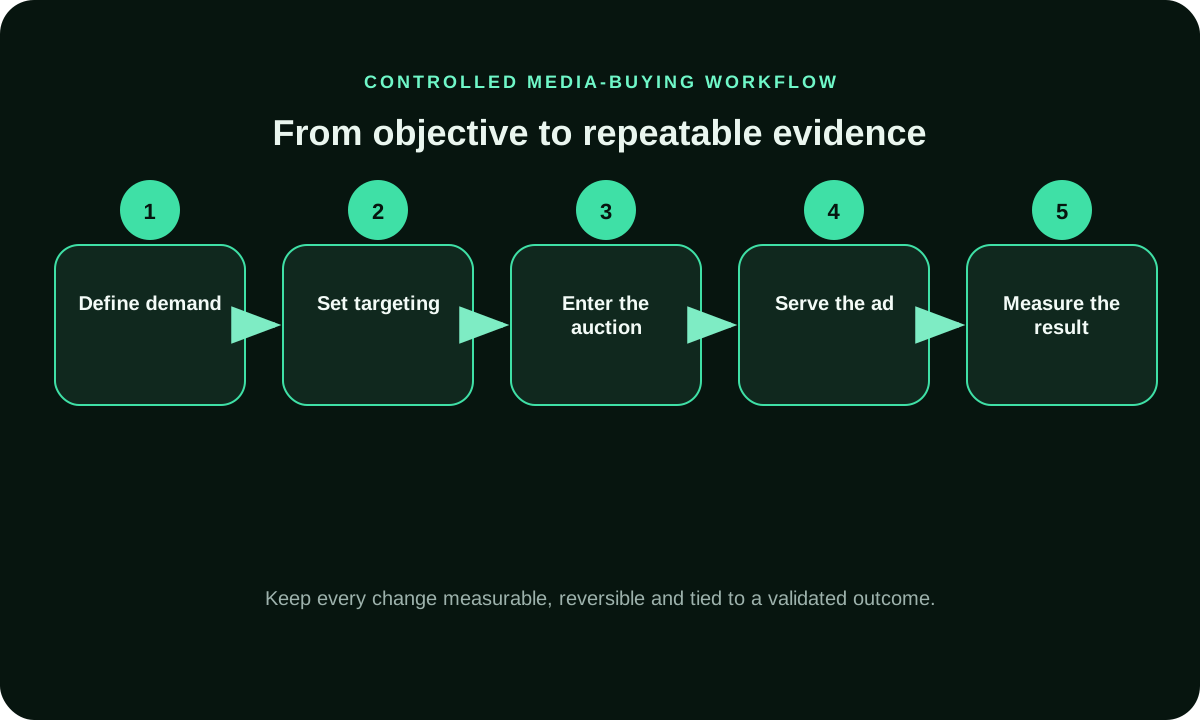
An eligible ad opportunity creates a bid request, campaign rules determine whether to participate, the auction selects a winner, and delivery is later joined with billing and outcome evidence.
Does every bid request receive a bid?
No. Targeting, budget, pacing, creative approval and other eligibility rules can prevent participation.
What is the difference between a bid and price paid?
The bid expresses auction willingness under platform rules; the charged amount depends on the auction and billing model shown in campaign reporting.
What does win rate tell a buyer?
It describes an auction stage. Read it with eligibility, price, pacing, source mix and mature outcomes.
Does a higher bid guarantee conversions?
No. It can change auction access, while the offer, creative, destination and follow-up determine downstream value.
Why are source IDs important in RTB?
They connect auction delivery with downstream evidence for keep, cap, exclude or retest decisions.
When should a bid increase?
Increase it when auction access is the verified constraint and the next step stays within the economic and rollback limits.
How long should an RTB test run?
Run until the specific cell has enough eligible delivery and mature accepted outcomes for its decision.
What should be fixed before launch?
Fix the accepted event, creative, destination, identifiers, loss limit and review window.
How does FroggyAds support RTB buying?
We provide self-serve targeting, bids, budgets, pacing and source reporting for measurable auction-based campaigns.
Eligibility Evidence for Conversion Event Versus Attribution Join
Eligibility Evidence for Attribution Join Versus Source Identifier
Eligibility Auction Rollback checkpoint — For auction rollback, record what entered the auction, what was filtered and what reached the advertiser. For the eligibility review of auction rollback against page or app opportunity, using requests, eligible bids, wins, impressions and outcomes stored as separate stages: Attach requests, eligible bids, wins, impressions and outcomes stored as separate stages; open a new version after a creative or destination change. With page or app opportunity held as the eligibility comparison for auction rollback, using requests, eligible bids, wins, impressions and outcomes stored as separate stages: If pacing can suppress delivery even when the bid is competitive, restore the prior auction rule before broadening the test. Using requests, eligible bids, wins, impressions and outcomes stored as separate stages as the eligibility evidence record for auction rollback against page or app opportunity: For the auction audit, record the count entering auction rollback, the count surviving into page or app opportunity, the setting owner and the exact rollback value. Before the eligibility team decides to open a new version after a creative or destination change for auction rollback against page or app opportunity, using requests, eligible bids, wins, impressions and outcomes stored as separate stages: FroggyAds supplies the campaign controls for that comparison, while the advertiser reconciles a mature accepted action attributed to a defined RTB campaign, source and creative cell; preserve requests, eligible bids, wins, impressions and outcomes stored as separate stages so open a new version after a creative or destination change can be repeated when pacing can suppress delivery even when the bid is competitive.
Eligibility Evidence for Source Identifier Versus Billing Event
Page Or App Opportunity related decision for real-time bidding auction mechanics: retain requests, eligible bids, wins, impressions and outcomes stored as separate stages; identify the first auction stage where the gap appears. How Does Programmatic Advertising Work
Launch Page Or App Opportunity checkpoint — At the launch stage, page or app opportunity answers a different auction question from bid request. For the launch review of page or app opportunity against bid request, using campaign, creative and source identifiers retained through attribution: Inspect campaign, creative and source identifiers retained through attribution, then verify eligibility before increasing the bid. With bid request held as the launch comparison for page or app opportunity, using campaign, creative and source identifiers retained through attribution: If a higher bid can buy more volume without better outcomes, trace the first broken stage before using a mature accepted action attributed to a defined RTB campaign, source and creative cell to change the bid. Using campaign, creative and source identifiers retained through attribution as the launch evidence record for page or app opportunity against bid request: For the auction audit, record the count entering page or app opportunity, the count surviving into bid request, the setting owner and the exact rollback value. Before the launch team decides to verify eligibility before increasing the bid for page or app opportunity against bid request, using campaign, creative and source identifiers retained through attribution: FroggyAds supplies the campaign controls for that comparison, while the advertiser reconciles a mature accepted action attributed to a defined RTB campaign, source and creative cell; preserve campaign, creative and source identifiers retained through attribution so verify eligibility before increasing the bid can be repeated when a higher bid can buy more volume without better outcomes.
| Page Or App Opportunity — Bid Request Evidence | Bid Request — Campaign Eligibility Evidence | Campaign Eligibility — Targeting Match Evidence |
|---|---|---|
| Fit | Launch Targeting Match record for real-time bidding auction mechanics: retain campaign, creative and source identifiers retained through attribution; change one auction variable per comparison; note how creative approval changes the decision. | Launch Creative Approval record for real-time bidding auction mechanics: retain campaign, creative and source identifiers retained through attribution; open a new version after a creative or destination change; note how budget availability changes the decision. |
| Test | Launch Budget Availability record for real-time bidding auction mechanics: retain campaign, creative and source identifiers retained through attribution; identify the first auction stage where the gap appears; note how pacing check changes the decision. | Launch Pacing Check record for real-time bidding auction mechanics: retain campaign, creative and source identifiers retained through attribution; separate low win rate from weak downstream value; note how bid calculation changes the decision. |
| Decision | Launch Bid Calculation record for real-time bidding auction mechanics: retain campaign, creative and source identifiers retained through attribution; raise bids through measured increments; note how auction participation changes the decision. | Launch Auction Participation record for real-time bidding auction mechanics: retain campaign, creative and source identifiers retained through attribution; verify eligibility before increasing the bid; note how floor context changes the decision. |
Launch Bid Request checkpoint — The auction-stage map follows bid request from eligibility toward delivery without treating it as business value. For the launch review of bid request against campaign eligibility, using campaign, creative and source identifiers retained through attribution: Retain campaign, creative and source identifiers retained through attribution; cap a source when mature outcomes miss the rule. With campaign eligibility held as the launch comparison for bid request, using campaign, creative and source identifiers retained through attribution: mixed formats make auction economics hard to interpret means the auction setting should stay reversible. Using campaign, creative and source identifiers retained through attribution as the launch evidence record for bid request against campaign eligibility: For the auction audit, record the count entering bid request, the count surviving into campaign eligibility, the setting owner and the exact rollback value. Before the launch team decides to cap a source when mature outcomes miss the rule for bid request against campaign eligibility, using campaign, creative and source identifiers retained through attribution: FroggyAds supplies the campaign controls for that comparison, while the advertiser reconciles a mature accepted action attributed to a defined RTB campaign, source and creative cell; preserve campaign, creative and source identifiers retained through attribution so cap a source when mature outcomes miss the rule can be repeated when mixed formats make auction economics hard to interpret.
Bid Request related decision for real-time bidding auction mechanics: retain campaign, creative and source identifiers retained through attribution; verify eligibility before increasing the bid. Create your free FroggyAds account
Eligibility Evidence for Billing Event Versus Conversion Delay
Launch Campaign Eligibility checkpoint — An RTB operator diagnoses campaign eligibility beside targeting match under one stable campaign definition. For the launch review of campaign eligibility against targeting match, using campaign, creative and source identifiers retained through attribution: Use campaign, creative and source identifiers retained through attribution, and restore the prior setting when the next step weakens value; only a mature accepted action attributed to a defined RTB campaign, source and creative cell can release the next launch move when pacing can suppress delivery even when the bid is competitive. With targeting match held as the launch comparison for campaign eligibility, using campaign, creative and source identifiers retained through attribution: For the auction audit, record the count entering campaign eligibility, the count surviving into targeting match, the setting owner and the exact rollback value. Using campaign, creative and source identifiers retained through attribution as the launch evidence record for campaign eligibility against targeting match: FroggyAds supplies the campaign controls for that comparison, while the advertiser reconciles a mature accepted action attributed to a defined RTB campaign, source and creative cell; preserve campaign, creative and source identifiers retained through attribution so restore the prior setting when the next step weakens value can be repeated when pacing can suppress delivery even when the bid is competitive.