
How Does Programmatic Advertising Work
Programmatic advertising turns advertiser-defined campaign settings into automated access to digital inventory. Learn how the buyer workflow works, where you can intervene, and how we use FroggyAds targeting, budget and source-level reporting to support a measured traffic test. Your offer, tracking and backend acceptance rules still decide whether a campaign creates commercial value.
How Programmatic Advertising Works for Advertisers
Programmatic buying uses software to apply campaign rules to digital ad opportunities and record delivery for review. Automation handles execution; it does not decide whether the offer, audience or economics are sound. You still define what to promote, who is eligible, which markets and formats fit, how much may be spent, and what counts as an accepted result. A buying system applies those constraints to available inventory. Some transactions use an open auction; others follow private or prearranged deal terms. Real-time bidding is one method within the wider process, not a synonym for every automated media purchase.
For the buyer, the useful question is not simply whether an ad can be served. It is whether the campaign can connect controlled exposure and cost to an outcome your business accepts. Start with the objective, the destination and the measurement plan, then choose a buying path that supports those decisions. That sequence turns a broad term into a practical paid-acquisition workflow.
How Does a Programmatic Campaign Move from Brief to Result?
Programmatic systems may involve an advertiser, buying interface, exchange or marketplace, publisher-side technology, ad server and measurement tools. The exact participants vary by inventory and buying model, so do not assume every impression passes through the same stack. For your decision, identify who controls campaign settings, which party makes the inventory available, how eligibility is determined, and what evidence returns after delivery. A demand-side platform helps advertisers manage buying decisions; a supply-side platform helps publishers offer inventory; an exchange can coordinate a transaction between them. These labels describe roles, not guaranteed access or a particular price.
Ask what inventory or deal is actually available, what restrictions apply and how the source will appear in reporting. FroggyAds is positioned for advertisers who want a self-serve campaign workflow and source-oriented decisions. You do not need to reproduce an enterprise ad-tech diagram to decide whether that workflow fits a campaign you are ready to test.
IAB Tech Lab’s 2026 programmatic-auction primer describes buyer-side and seller-side companies coordinating an ad opportunity; one company can perform more than one role. Ask which handoffs, inventory rules and reporting fields apply to the specific buying route you are considering. Read the IAB Tech Lab programmatic-auction definitions.
Which Measurement Rules Should You Set Before Buying?
Set measurement rules before buying. Name the event that reflects business value, then specify when it becomes accepted: a submitted lead may need qualification, and an order may need payment and cancellation checks. Keep campaign, creative and source identifiers intact from the click through your tracker and backend. Record the attribution window, time zone, deduplication rule and normal conversion delay.
Where your stack supports a postback or reliable event return, test it with a controlled click before launch and reconcile the returned event against the system that approves the lead or sale. Use platform delivery figures for pacing and fault detection; use mature accepted outcomes for decisions about cost and scale. If approval or attribution is incomplete, label recent results provisional rather than comparing them with a fully matured period. This discipline lets you answer whether a source attracted useful prospects, not merely whether a dashboard counted an interaction. Save the initial settings and report fields so the final comparison uses the same definitions.
For an affiliate offer, keep campaign, source and offer sub-IDs in your own tracker, then reconcile downstream approval separately. A click or initial postback is not automatically an accepted sale; wait for the offer’s qualification or approval window before judging that cohort.
How Should You Set a Programmatic Test Budget?
Choose a test budget from unit economics, not a generic industry figure. Start with the maximum acquisition cost your business can accept after variable costs, refunds, sales effort or fulfilment. Estimate how many paid interactions may be needed for one accepted outcome using your own conversion history. If the rate is unknown, use a conservative planning assumption and label it as a hypothesis. For example, a hypothetical USD 20 ceiling per accepted lead combined with a 4% click-to-accepted-lead rate implies a USD 0.80 planning ceiling per click before any uncertainty allowance. That arithmetic is not a FroggyAds quote or a performance forecast.
Use the model to set a bid ceiling and a stop-loss, then compare mature results with your own limit. Keep the test large enough to gather interpretable evidence but small enough that a failed hypothesis remains affordable. Separate a bid, platform minimum, deposit and recommended test budget because those terms describe different things. Review current format-specific billing in the campaign flow before you decide what cash exposure the test requires.
What Is a Practical Programmatic Campaign Workflow?
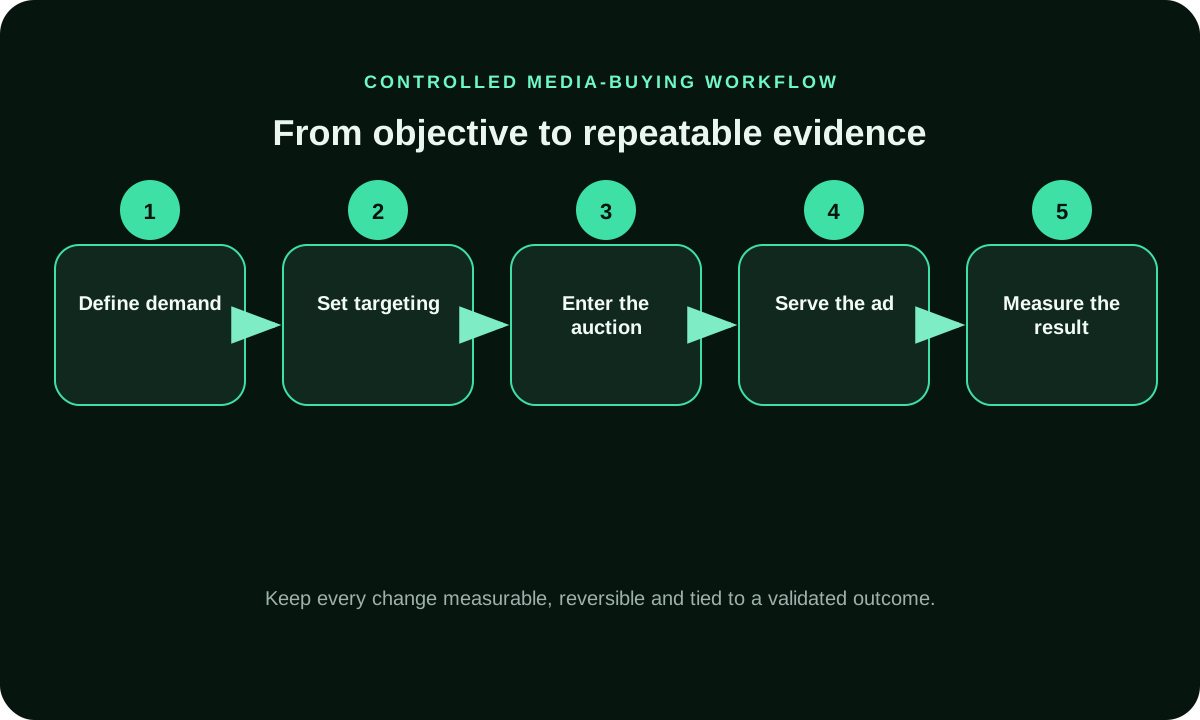
Use a sequence that helps you learn. First, write one objective and one accepted-conversion definition. Second, verify the destination, policy requirements and tracking path. Third, choose the smallest set of markets, devices and formats that matches the offer. Fourth, preserve a broader comparison or clearly named source groups where the campaign allows it. Fifth, set a bid or spend limit and a date for the first mature review.
Launch with only a few creative variants so each can receive useful delivery; do not change audience, budget and message at once. During the initial period, monitor whether delivery and tracking work, but do not treat early clicks as proof of acquisition quality. At review, reconcile platform events, tracker records and backend-approved outcomes. Make one documented change, wait through the relevant conversion window and compare again. The process is manageable for an affiliate or agency buyer because every step ends in a clear choice: continue, fix measurement, refine an eligible audience, pause a weak source or test a controlled expansion.
How Much Targeting Can a Test Support?
Targeting should express a real eligibility or relevance rule. Begin with geography, device experience, language, format and offer restrictions that matter to the customer. Keep optional filters broad while you establish a baseline. Every added condition can reduce eligible inventory, so a narrow setup may underdeliver before you learn whether the offer resonates.
If the platform exposes source or placement identifiers, preserve them rather than grouping all traffic into one total. Add a targeting condition only when it answers a question: whether a supported device can complete the conversion flow, for example, or whether a market has enough accepted demand. Do not treat a network label, device type or location signal as proof of a person’s intent. For small budgets, test one meaningful dimension at a time and leave room for comparison. If volume is too low, broaden the least essential restriction before raising bids blindly. That approach keeps your first campaign focused without making the audience so narrow that the results become impossible to interpret.
Separate hard eligibility from optional discovery filters. Lock compliance, destination and market restrictions, then test one added segment at a time. Where the interface shows eligible-opportunity counts, compare them before and after a filter change; where it does not, report delivery as a proxy rather than an inventory estimate. A network-wide supply figure cannot show how much inventory survives your campaign’s format, GEO, device and bid rules.
Why Must the Ad and Landing Page Stay Aligned?
The ad and landing page should make one consistent promise. Keep headline, image, offer terms and next action aligned from impression through conversion. A creative can attract clicks but still create poor outcomes if it implies a discount, feature or urgency that the destination does not support. Before buying traffic, test the page on devices and connection conditions you intend to reach, confirm the form or checkout works, and make material qualifications visible before the visitor commits time. For lead generation, explain what happens after submission only when the follow-up process is confirmed. For ecommerce, show price, availability and shipping terms before the decision point.
When comparing creative, retain the same audience and budget settings where practical. A message change can alter who clicks, so record the version and judge accepted quality as well as click-through rate. Better continuity gives automated delivery a fair chance to find relevant responses without relying on misleading claims. It also helps your team distinguish a traffic problem from a weak offer or a destination that fails to complete the promised action.
How Do You Optimize Programmatic Sources?
Optimize sources with an evidence ladder. Start with spend, impressions and clicks to catch configuration faults, then wait for the accepted-conversion window before judging quality. Compare source groups over the same dates, attribution rule and conversion definition. A source with no accepted events may still be immature or too small to assess; a source with repeated invalid actions, mismatched landing behavior or a mature cost above your limit may justify a controlled exclusion.
Check the denominator as well as the rate: a handful of conversions from a tiny sample may look promising but may not support a spending decision. Keep placement identifiers, status notes and the reason for each inclusion or exclusion so another buyer can reproduce the choice. If reporting cannot isolate a source or show enough volume, say so plainly instead of implying source-level proof you do not have. The practical value of a programmatic workflow is not automation by itself; it is connecting controllable settings with evidence that guides your next action. Keep the original segment visible when you change a rule so the comparison is not erased.
Supply-path review is separate from conversion optimization. Where the buying route exposes ads.txt, sellers.json or an OpenRTB SupplyChain object, compare disclosed sellers and intermediaries with your supply policy. These records help identify parties in a sale; they do not prove a placement’s viewability or conversion quality. See IAB Tech Lab’s sellers.json and SupplyChain guidance.
When Is It Safe to Scale a Programmatic Campaign?
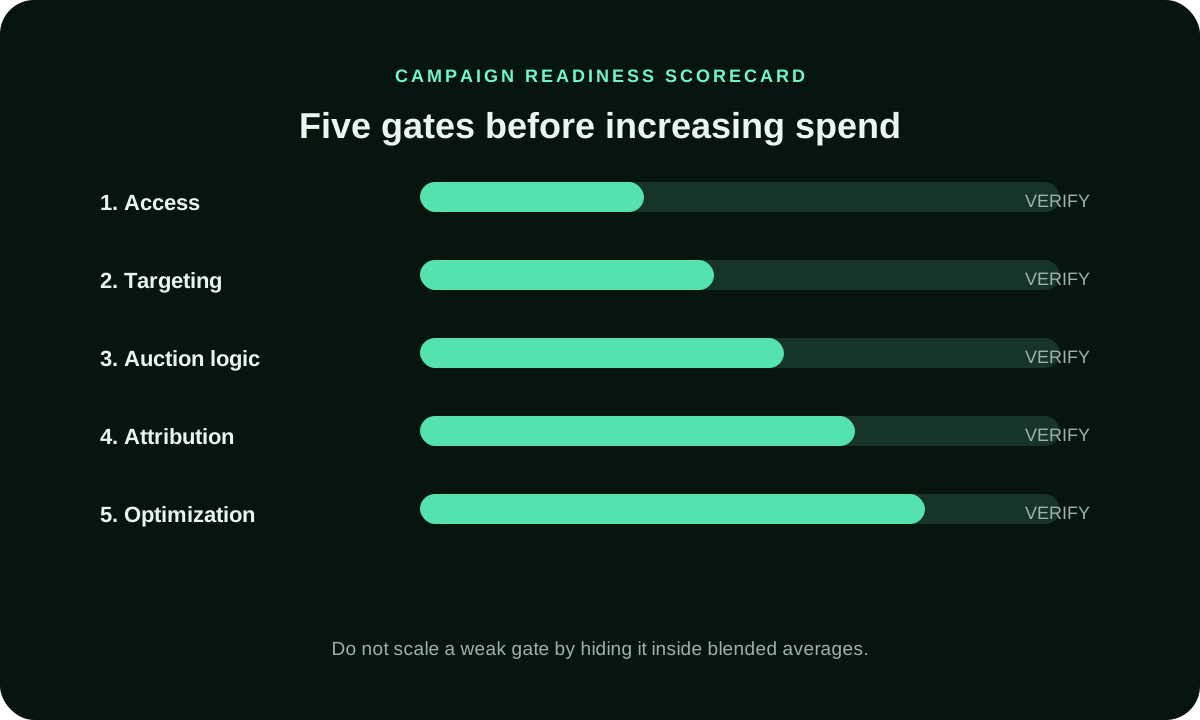
Scale only when the original test is stable enough to support a larger commitment. Confirm tracking returns events, accepted outcomes have matured, source quality meets your rules and the destination can handle more visitors. Increase one budget or bid input in measured steps while preserving the comparison and reporting labels. After each change, allow delivery and conversions to mature before increasing again. A rising blended average can hide a weak new source, a delayed cohort or a shift in audience mix, so review marginal results alongside the total. Expansion into another market, format, device group or offer should have a separate reporting view.
If inventory, lead follow-up, customer support or stock cannot absorb additional demand, more paid reach may reduce quality instead of improving the business. Treat each expansion as a new test with its own risk limit, not as proof that earlier efficiency will continue. This makes the recommendation clear for media buyers: increase exposure when the evidence survives a controlled step and your operation can serve the resulting demand.
Why Do Programmatic Campaigns Underperform?
Underperformance often comes from a broken link between settings and evidence. A campaign may optimize toward a click because it arrives quickly, although qualified leads or paid orders are the real goal. Another campaign may split a small budget across too many ad groups, leaving each with too little data. A destination can promise something the page does not deliver, or a tracker can drop source parameters before conversion. Buyers also pause a source too early, compare different date ranges or change the bid and creative together, making the result difficult to interpret.
Diagnose in order: verify eligibility and delivery, test the click path, reconcile event counts, check conversion maturity, then review source economics. If inventory is constrained, determine whether a narrow filter, deal requirement, low bid or budget limit is responsible before changing several controls. Record the finding and the next test. This process separates a platform setup issue from a weak offer and helps your team avoid paying to repeat an experiment that never answered its question. It also prevents unsupported claims that automation alone can correct measurement or conversion problems.
Trace a weak result by stage: if eligible impressions are scarce, revisit format, market and restrictions; if impressions deliver but clicks do not, check creative fit; if clicks arrive but tracked events do not, test redirects and campaign IDs; if events arrive but few outcomes qualify, check downstream validation and let the normal review window mature. Change one cause at a time so the next report is diagnostic.
Why Choose FroggyAds for a Measured Programmatic Test?
FroggyAds is a self-serve advertising platform for advertisers, affiliate marketers and media buyers who want to organize targeting, budget and traffic-source decisions in one workflow. Our published inventory information describes access to 750+ SSP integrations and more than 20 billion daily impressions; those are network-level figures, not a promise that a particular campaign will qualify for specific volume, pricing or results.
Your campaign still depends on the offer, geography, format, bid, destination, tracking and available inventory. We recommend using FroggyAds to structure a focused traffic test: name an accepted outcome, preserve source identifiers, set an affordable spend ceiling and review mature conversions. That gives you practical control over what to test and what to change, while your backend remains the authority for lead quality or sale value. Create a free account to review current campaign options and choose the format and targeting that fit your audience. Start with a test you can explain, measure and improve rather than paying for traffic without a decision rule.
What Should You Confirm Before Launch?
Before launch, confirm the offer can be advertised in selected markets and the destination fulfils the ad promise. Set one primary outcome and document its acceptance rule. Check that click IDs and campaign labels survive redirects, that a test conversion appears in the tracker, and that backend approval can be reconciled later. Confirm which bid and billing model the selected format uses; an auction bid, a platform minimum, a deposit and a suggested test budget are not interchangeable.
Review the available targeting and source-reporting controls in the current platform flow, because options may depend on format and inventory. Set a maximum spend and pause condition before the first impression. Finally, name the person who will review mature data and approve a campaign change. These checks help an affiliate or media buyer enter a self-serve workflow with a clear test rather than an open-ended spend plan. Save the setup as a baseline so the next review can identify what actually changed.
How Do Deal Types Affect a Programmatic Buying Decision?
Deal type changes eligible inventory, buying terms and available controls; verify the specific offer before comparing routes.
Real-time bidding is one programmatic transaction method: IAB Tech Lab describes it as bidding on an individual impression in real time. Other automated arrangements can use different access and transaction terms, so do not assume every programmatic buy is an open auction. Compare each offer by eligible inventory, how price is set, whether it is invite-only or guaranteed, what delivery terms apply and which fields you can reconcile. These distinctions describe the transaction, not a performance advantage. Review IAB Tech Lab’s OpenRTB overview.
Programmatic Advertising FAQs for Media Buyers
How does programmatic advertising work for an advertiser?
For an advertiser, programmatic systems match campaign settings with eligible digital ad opportunities. You define the offer, audience, budget and conversion goal; the buying system applies those rules and returns delivery data for review.
How is programmatic buying different from real-time bidding?
Programmatic is the broader use of software to plan, execute and report digital media buying. Real-time bidding is one impression-level auction method; private and prearranged deals can follow other terms.
What does a demand-side platform do?
A demand-side platform lets an advertiser or agency set campaign eligibility, bids or budgets, creative and delivery rules across available inventory. It applies the buying plan; you still set the offer, accepted conversion and commercial limits.
What does a supply-side platform do?
A supply-side platform helps publishers package and make inventory available to potential buyers. It does not guarantee advertiser access; eligibility depends on the actual inventory, deal, format, market and campaign terms.
When should an advertiser consider programmatic buying?
Consider programmatic buying when the offer is ready, a conversion can be measured and you can manage a controlled paid-traffic test. If the destination or acceptance process is not ready, fix that first.
How should I set a programmatic advertising budget?
Choose a budget from your acceptable cost per accepted outcome, observed funnel rates and affordable test loss. Treat unknown rates as planning assumptions, not forecasts; actual cost and eligible inventory vary by market and setup.
Which metrics matter in a programmatic campaign?
Use cost per accepted outcome as the primary business measure. CTR, CPC, CPM and conversion rate help explain delivery and funnel behavior, but reconcile the result with your backend before increasing spend.
How do I measure programmatic advertising?
Preserve click identifiers and campaign parameters through the destination, return conversions through a reliable event or postback when available, and reconcile platform, tracker and backend under one attribution rule.
How long should a programmatic campaign test run?
Run through the planned delivery period and normal conversion delay. Set the final review after the acceptance window; immature leads or unsettled orders can show pacing, but cannot support a quality decision.
Can FroggyAds help me start a programmatic campaign?
FroggyAds provides a self-serve campaign workflow with targeting, budget and source-level decisions. Confirm current options for your chosen format and market, then judge mature accepted outcomes before increasing spend.
How Do You Move from Research to a FroggyAds Campaign?
Start with one offer, one accepted outcome and a bounded traffic test you can measure.
Review the current campaign flow for eligible formats, markets, targeting, bidding and source reporting; options depend on selected inventory and setup. Confirm the destination, tracking path and spend limit before launch. Judge mature results against your own cost and quality rules—automated execution does not guarantee an outcome.
What Does a Controlled Programmatic Test Look Like?
A controlled test changes one buying input while keeping the audience and measurement rules stable.
Before launch, record the offer, creative, budget, bid, dates, attribution window, source labels and accepted-conversion rule. If two buying or deal routes are available, compare them only after matching format, market, creative, outcome and review window. Record how eligible inventory and terms differ; do not read a delivery gap as a price effect if the available supply changed. Keep a comparison group if the platform allows it; otherwise label the result directional, then wait for the normal conversion delay before changing another setting.
What This Page Helps a Media Buyer Decide
Use this page to make the advertiser’s buying decision, not to treat programmatic and RTB as identical. Automated execution only helps when campaign settings, inventory access and real-time bidding measurement fit the commercial outcome you intend to evaluate.
Separate the buying roles: a demand-side platform manages advertiser decisions; a supply-side platform helps publishers offer inventory; an exchange can coordinate transactions; and real-time bidding is one transaction method. The exact stack and deal terms vary.
| Buying decision | Advertiser action | Evidence to retain |
|---|---|---|
| Campaign fit | Write the offer, audience, accepted outcome and any market or format restrictions before choosing inventory. | Save the audience rationale, offer terms, destination requirements and conversion definition. |
| Test design | Choose one buying question, a bounded budget, a practical comparison and a review date after conversion maturity. | Keep source labels, start and end dates, campaign settings, spend limit and attribution window. |
| Scale decision | Compare mature accepted outcomes and source costs with your commercial limit before expanding volume. | Reconcile approved conversions, source-level costs, delays and the reason for each keep, pause or expansion decision. |
Hypothetical calculation only: If a controlled campaign spends USD 100 and produces 7 accepted conversions, accepted CPA is USD 100 divided by 7, or USD 14.29. Replace the inputs with reconciled campaign data; this is not a FroggyAds result or forecast.
When you are ready to buy traffic, define the accepted conversion, set an affordable test limit and preserve source identifiers for later reconciliation. Expand only after mature results support that decision.
Programmatic Advertising: What Should You Confirm First?
Define the accepted result before comparing automated buying routes.
Then verify eligible inventory, campaign controls and the measurement evidence available for your chosen setup. This keeps your first test tied to a business decision instead of automation for its own sake. At that review, compare delivery signals first, then wait for the accepted-conversion window to close before judging cost or raising the budget.