
GEO Targeted Traffic
Geo-targeted traffic is paid delivery limited by a geographic eligibility rule. It helps you compare markets when your offer and destination truly serve those locations; location alone does not prove intent or profitability.
What Is GEO Targeted Traffic?
GEO-targeted traffic is paid ad delivery restricted to a chosen geographic area.
A location rule lets an advertiser compare where a campaign is eligible to appear, but it cannot make an unsuitable offer relevant or guarantee a conversion. The useful question is whether people in the chosen market can buy, sign up, install, or otherwise complete the outcome you value. Define that outcome before launch, then compare mature results by location while keeping the offer, destination, creative, and measurement window consistent. With FroggyAds, you can configure supported GEO and other campaign controls, inspect source-level reporting, and decide which tests deserve more budget. Treat each location as a testable business hypothesis, not as a label that explains performance by itself.
Choose Locations Your Offer Can Actually Serve
Choose a location only if you can deliver the offer there, accept payment, support the customer, and make the user journey understandable.
Before assigning spend, give each market a practical pass, review, or exclude status. Check product fulfillment or service coverage, accepted payment methods, landing-page and onboarding language, relevant advertising and destination rules, and who will answer leads or support customers. For app campaigns, confirm store availability and that setup steps work for users in that location. Keep evidence for each check with the market brief so a targeting choice can be audited later.
Build a short market brief before opening the campaign. Record the product or offer, the person it serves, the permitted locations, the landing page version, the conversion event, and any post-conversion qualification. If the offer is restricted to a country, exclude locations where it cannot be delivered. If it can serve a wider area, group locations only when their user journey and economics are sufficiently similar to evaluate together. A broad region can be convenient for setup but poor for diagnosis when language, pricing, delivery, or customer support differs.
We recommend that affiliate marketers and media buyers compare one geographic assumption at a time. If you change location, creative, bid, and landing page together, the result cannot tell you which change mattered. Keep the initial test narrow enough to explain and broad enough to receive meaningful delivery. The purpose is not to include every possible market. It is to learn whether a specific, serviceable audience can produce outcomes that meet your own acceptance and cost criteria.
| Geographic level | Use it when | Evidence to review | Decision to avoid |
|---|---|---|---|
| Country | The offer, language, fulfillment, or business rules differ across national markets. | Accepted outcomes, cost, conversion delay, destination readiness, and source mix for each country. | Choosing a country only because a broad market-size claim sounds attractive. |
| Region or state | Service coverage, sales capacity, or local conditions vary materially within a country. | Whether the subdivision is available for targeting and whether each cell can gather usable evidence. | Splitting into tiny cells before tracking and volume can support a decision. |
| City | The offer has a real local use case or fulfillment boundary and city targeting is supported by available inventory. | Reach, sample maturity, accepted conversion quality, and whether the landing experience is locally relevant. | Assuming city-level precision automatically means stronger purchase intent. |
Separate Geographic Eligibility From Buying Intent
A geographic rule defines where delivery is eligible; it does not tell you whether people there are interested or ready to act.
Location eligibility only defines where delivery can happen. The prospects in one market may still differ in needs, device, budget, and familiarity with your offer. Pair the map setting with a clear audience hypothesis, an accurate creative promise, a matching landing page, and a conversion event you can verify.
Use a simple chain of evidence. First, check that the location qualifies. Next, check whether the person can understand and use the offer. Then confirm that the destination clearly explains the next step. Finally, attribute the accepted outcome back to the campaign and source. A click is evidence of a click; it is not evidence that a lead meets your sales criteria or that an order remains valid after cancellation and refund checks. Keep those events distinct in reporting so early activity does not get mistaken for business value.
Advertisers often ask whether they should add more filters to improve quality. Our guidance is to add a control only when you have a reason to test it and can still read the result. Every additional condition can reduce the eligible audience and alter delivery. If you add device or source restrictions to a GEO test, record the exact change and keep a comparison cell. FroggyAds provides supported targeting controls for campaign setup, while you define the business criteria that make a conversion acceptable. That division keeps platform configuration separate from your commercial judgment.
Country, Region, and City Tests Answer Different Questions
This page focuses on the operating method for location-led acquisition: how to define an eligible market, compare it responsibly, and decide when to stop, continue, or expand. A country guide should answer which country fits a particular offer and what the advertiser must verify locally. A city-targeting guide should explain when local granularity changes a real customer journey. Those are related questions, but they are not interchangeable.
For the first pass, compare country-level groups when commercial availability or localization differs by nation. Narrow to a region only if fulfillment, regulation, sales coverage, or customer experience creates a meaningful distinction. Use city-level tests when a business reason supports them, such as local service coverage or a location-specific message, and when the inventory can actually reach the intended area. If none of those conditions holds, a narrower boundary may simply split the data into smaller samples without adding useful information.
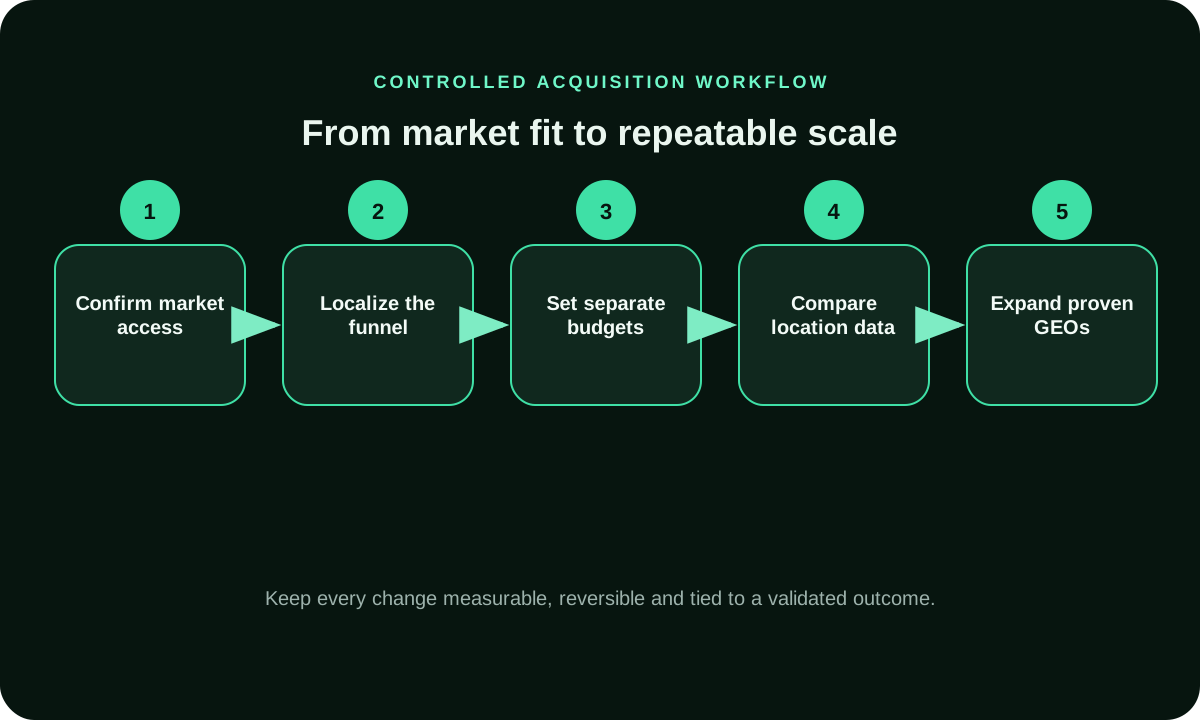
Think of granularity as a cost of analysis. Each extra segment takes budget and time to mature, creates more comparisons, and increases the chance that one small cluster looks better or worse by chance. A practical sequence is broad enough to establish whether the offer can work in a market, then narrower only to diagnose a specific difference. If the broad test fails because the landing page is not localized or tracking is broken, subdividing the map will not fix the cause.
Run a Geographic Readiness Check Before Spend
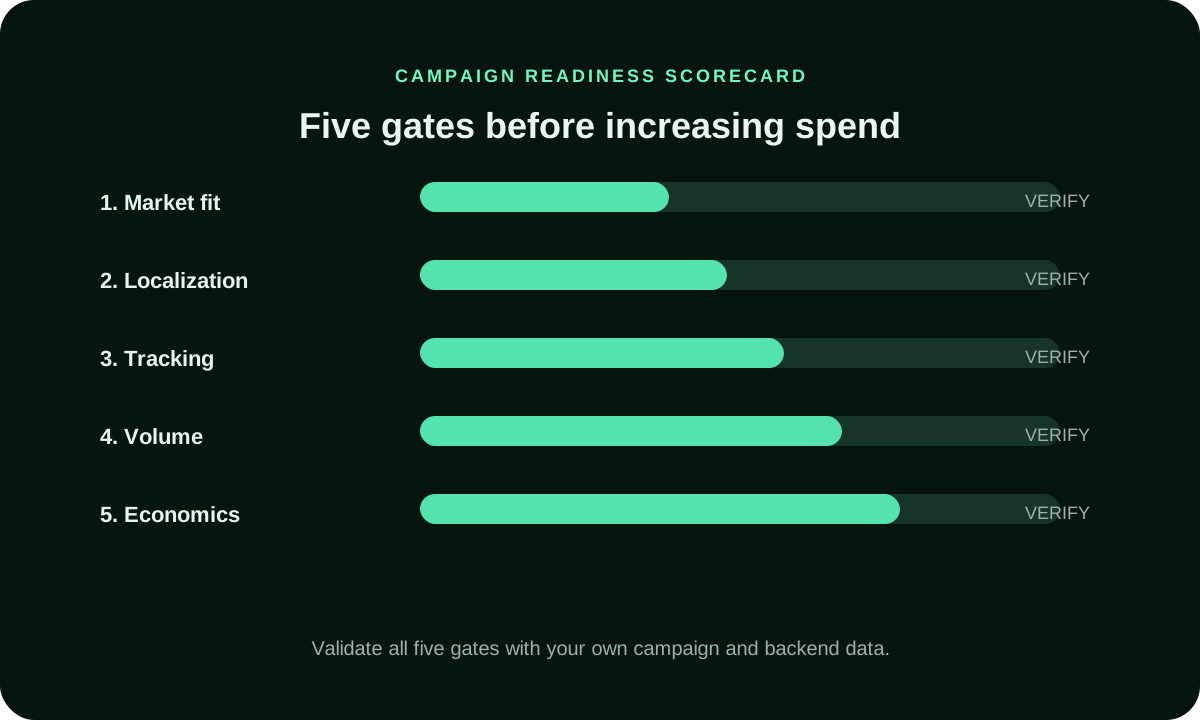
Use a written readiness check so that geography is more than a dropdown setting. The advertiser or account owner should be able to explain why each location is included, what would make it ineligible, which campaign setting reflects the decision, and how the outcome will be judged.
- Availability: Can the intended user buy, register, install, or receive the service in this location?
- Language and destination: Does the ad promise match the page, terms, pricing, and support experience available to that user?
- Measurement: Can your tracker and backend preserve campaign and source identifiers through the event you accept?
- Economics: Do you have an outcome-value rule and a maximum acquisition cost that accounts for variable business costs?
- Operations: Can your team review leads, orders, or installs on a timeline that matches the conversion and quality checks?
If one answer is unknown, write it as an assumption and decide whether the test can safely resolve it. If the answer means the offer cannot serve the user, exclude that market before launch. If the answer concerns demand or cost, it may be a testable hypothesis. This distinction avoids spending to discover a known operational limitation and keeps the budget for questions that paid traffic can genuinely answer.
Design a Test That Can Explain the Result
Write one sentence for the hypothesis: “If we deliver the same offer and landing experience to eligible users in Market A rather than Market B, the accepted outcome cost will be within our planned range.” The sentence names the variable, the result, and the business rule. If your reason for testing is local language, use the matching translated page and state that localization is part of the test. If you are trying to compare geography alone, keep language and destination consistent where that is appropriate.
Before launch, fix the event definition, attribution window, time zone, exclusion rules, and campaign duration criteria. Do not change the rule after seeing early results just because one cell appears more promising. Keep a change log that records dates, settings, bid or budget changes, creative versions, and any material changes to the offer. If a test needs a correction because tracking was broken, mark the affected period rather than quietly combining it with valid data.
In FroggyAds, advertisers can create separate campaigns and maintain independent targeting, bids, budgets, and source controls. That structure helps you preserve a comparison when the market assumptions are different. Give each campaign a name that identifies the GEO and the test version, and keep the source identifier in your reporting. These controls make it easier for your team to see what was changed. They do not determine whether a conversion is valuable; your tracker and backend remain the authority for acceptance.
Set a Budget From Accepted Outcome Value
Set the test cap from your accepted outcome’s value and the maximum loss your team approves.
There is no universal budget that makes geo-targeted traffic viable. The amount depends on your accepted conversion, the value and margin behind it, the auction or bid model, the expected rate, and how long outcomes take to mature. Begin with the highest cost your business can tolerate for an accepted outcome. Estimate it from contribution after relevant variable costs, not gross revenue alone. Set a loss limit for the test before launch and decide what evidence would justify extending it.
Then choose a test size that can distinguish the hypothesis without forcing you to continue after the loss limit is reached. A small sample may not tell you much; an open-ended budget can expose you to unnecessary loss. When conversion volume is sparse, use leading indicators such as delivery, landing-page engagement, or form completion to diagnose setup, but do not treat those signals as substitutes for your accepted event. The right review point depends on conversion lag, quality checks, and variance in your own data, not an arbitrary sample count copied from another advertiser.
Hypothetical calculation: Market A spends $180 and produces six accepted outcomes, so its cost per accepted outcome is $30. Market B spends $200 and produces four, so its cost is $50. Combined, $380 divided by ten accepted outcomes is $38. If the advertiser’s hypothetical ceiling is $40, the blended number appears to pass even though Market B is above the ceiling. The illustration shows why you should compare each GEO cell and the combined result; it is not a FroggyAds result or a forecast.
Before increasing spend, confirm that the difference persists over a mature window and is not explained by a tracking delay, rejected leads, returns, a temporary offer, or a source mix change. If you revise the bid or cap, record the change and recheck marginal cost. The average cost of an established campaign can remain healthy while the next increment is less efficient. Budget decisions should follow accepted, attributable outcomes, with supporting metrics used to explain what changed.
Track Location Results Without Overstating Precision
Geographic measurement is only as reliable as its data path. Keep campaign and source identifiers attached from click through the tracker and into the event record. Reconcile counts and timestamps across the ad platform, analytics, attribution tool, and business system. If systems use different time zones or attribution windows, document the difference before comparing their totals. Check that each system describes the same event: a submitted form, a qualified lead, an activated user, and a retained subscriber are separate milestones.
Some advertising platforms distinguish locations you targeted from locations associated with how an impression or interaction was matched. Google Ads documents separate “targeted locations” and “matched locations” reporting and notes that its location signals can include a person’s physical location or a location of interest. This is Google Ads-specific reporting guidance, not a universal definition and not a FroggyAds report field. When you compare platforms, read the method each one uses and avoid treating their location labels as identical.
For location decisions, build a simple table from the fields you can validate: campaign, selected GEO, source ID, spend, clicks, attributed events, accepted outcomes, event lag, rejected or refunded outcomes, and value. Record missing identifiers or unexplained discrepancies as limitations. Do not assign a precise city conclusion if your evidence only supports a country-level view. Precision in a chart is not the same as certainty in the underlying data.
FroggyAds provides source-level reporting and source-ID controls that advertisers can use to inspect campaign delivery. Connect that evidence to your own tracking and acceptance process before scaling. We recommend exporting the relevant view at a consistent cadence and retaining the settings that produced it. A saved configuration, date range, conversion definition, and source breakdown make the decision reproducible and easier for another buyer to review.
Reference: Google Ads Help: About your geographic performance.
Use Source-Level Evidence Alongside GEO
A strong market average can hide a weak source, and a promising source can be concentrated in a location where your offer does not convert. Preserve geographic and source dimensions together when your reporting supports both. Review spend and accepted outcomes by source, then compare within the same GEO and maturity window. If a source repeatedly produces outcomes that your backend rejects, document the reason and make a deliberate exclusion or bid decision. If a source has only a small sample, avoid calling it poor solely because it has not yet converted.
Use a practical source review: check whether source IDs are present, whether the same event is recorded across systems, whether duplicate or invalid submissions cluster in a source, and whether delayed conversions are still pending. Keep the source decision separate from the GEO decision. If a cell is weak, ask whether the problem is location eligibility, user relevance, creative, landing-page continuity, delivery, or measurement. A controlled test can answer one of these questions; a blended report usually cannot.
With FroggyAds, you can inspect source-level performance and manage source controls as part of campaign optimization. That gives media buyers a way to investigate where spend is going and which sources merit review. Use your own acceptance rules to determine whether the source produces useful customers or leads. A platform metric can show delivery activity, but it cannot independently validate customer value, lead quality, refunds, or retained revenue.
Make the Ad, Offer, and Landing Page Agree
Geographic targeting creates an expectation that the experience will make sense to the user. Check the language, currency, shipping or service area, payment options, contact details, time references, and eligibility terms shown on the destination. A translated headline cannot compensate for a page that switches back to a language the user does not understand. A country-specific promise should not appear in a location where it cannot be delivered. If there are multiple versions, name each creative and URL so that results can be tied to the correct experience.
Offer and landing-page continuity matters at every level. The ad should accurately describe what is available; the page should explain price, restrictions, and the next step; and your follow-up should reach the user through the method promised. Review these details before testing a new location, especially when the product involves regulated categories or local availability. Keep legal terms approved and unchanged unless the appropriate owner has authorized a revision.
When a campaign underperforms in one market, do not assume that targeting is the problem. Review whether the offer fits local needs, whether the page loads and explains the promise, and whether conversions are recorded after the same time interval. A localized experience may need a separate test from the geography itself. By deciding which factor you are evaluating, you can tell whether to fix the destination, retain the market, or pause the campaign.
Expand Gradually and Watch Marginal Results
After a location meets your acceptance and cost criteria, increase exposure in measured steps. Keep an eye on the next increment, not only the campaign’s historical average. More spend can reach different inventory or users and may not preserve the same cost or quality. Let a change accumulate enough mature evidence before making the next one, and hold the other campaign variables steady while possible.
Expansion can mean increasing budget in the current market, adding a related region, widening the audience, or testing another supported control. Do not combine all four in a single change. Create a separate comparison when the new market has different availability or localization. Keep a reference campaign or period if practical, and record exactly when each setting changed. If the margin becomes unacceptable or quality shifts, return to the last configuration that had clear evidence.
We encourage FroggyAds advertisers to use campaign-level budgets, bids, targeting, and source reporting as decision controls, not as a promise of efficiency. Your own economics determine what “scale” means. An affiliate buyer may judge a conversion against a validated payout and reversal rate; a retailer may use contribution after fulfillment and returns; a SaaS team may evaluate paid acquisition against a defined trial-to-paid window. Keep the event and unit consistent with the business model you are running.
Common GEO Testing Mistakes and How to Correct Them
Choosing locations before checking eligibility. Confirm that users in the market can take the promised action. If they cannot, exclude the location or repair the operational constraint before paying for delivery.
Reading a blended average as a market verdict. Break the view out by GEO and source when sample and attribution support it. Check whether one large cell is masking another cell that is above your cost ceiling.
Changing several variables at once. Record the active offer, creative, destination, bid, and location rule. Change one material input per comparison so that the next result can explain the cause.
Calling a small sample a winner. Use your conversion delay and outcome variance to decide when the result is mature. If evidence is thin, extend only within the preapproved loss limit and state what uncertainty remains.
Treating clicks as accepted outcomes. Reconcile conversions with your own lead, order, or app records. Separate provisional events from validated value and include refunds, duplicates, or qualification rules that apply to your business.
Assuming location data is exact. Understand how each platform labels targeted or matched locations, and limit conclusions to the level its documented reporting supports.
Adding too many filters too early. Start with the constraint that has a commercial reason. Narrow further only when the new comparison can gather interpretable data and answer a specific question.
How FroggyAds Helps You Test Geographic Traffic
FroggyAds gives advertisers a self-serve environment to create campaigns, select available ad formats, configure supported targeting, manage bids and budgets, and review source-level performance. For location-led buying, you can set GEO criteria and, where available, use more specific options such as city, device, operating system, browser, carrier, or category. Exact availability can depend on the inventory and campaign configuration, so confirm the controls offered in your account before you build a plan around a narrower segment.
Separate campaigns are useful when two markets need different budgets, bids, destinations, or acceptance rules. Source IDs help your team trace performance within those campaign decisions. This control is valuable to affiliate marketers, media buyers, agencies, and online businesses that need to compare and optimize paid traffic with their own outcome data. We recommend launching with a written hypothesis and a defined review window, then keeping the campaigns that meet your criteria and revising or stopping the ones that do not.
FroggyAds is a strong option when you want to manage a structured traffic test yourself and use available campaign and source controls as you learn. We help you put the media plan into execution; you retain control of the offer, creative, conversion definition, budget risk, and downstream validation. Create your free FroggyAds account, review the available GEO settings, and start with the smallest test that can answer a worthwhile acquisition question.
Keep a Record Another Buyer Can Reproduce
For each geographic test, save the campaign name, eligible locations, exclusions, format, bid and budget settings, creative and landing URL, event definition, source-ID mapping, attribution window, time zone, and launch or change dates. Record the decision rule before you review the results: the maximum cost, minimum quality condition, expected maturity, loss limit, and who can approve an extension. After the review, state what was observed, what remains unknown, and whether the next action is keep, revise, narrow, expand, or stop.
This record reduces the chance of repeating a failed test under a new name or over-crediting a location because the rules changed mid-flight. It also helps a colleague distinguish evidence from an assumption. If a market is paused, preserve the reason and the conditions that would justify a retest, such as a meaningful change in offer availability, localization, tracking, or source mix. Avoid retesting merely because a prior result is inconvenient.
| Record field | What to write | Why it matters |
|---|---|---|
| Market rule | Included and excluded locations and the operational reason for each. | Explains exactly who was eligible to receive the campaign. |
| Accepted outcome | Event name, qualification or validation rule, value basis, and maturity window. | Prevents clicks or provisional events from being reported as business results. |
| Campaign configuration | Format, targeting, bid, budget, creative, destination, and change history. | Makes the comparison reproducible and shows which variable changed. |
| Evidence and action | Spend, accepted outcomes, source and GEO breakdown, limitations, and next decision. | Connects reporting to a controlled budget action. |
Before You Start a GEO Campaign
- Confirm the offer can serve each selected location and the landing page reflects that availability.
- Choose one primary accepted outcome and document how your business validates it.
- Verify that click, campaign, and source identifiers survive into your reporting and backend.
- Set the maximum acceptable acquisition cost and a test loss limit before launch.
- Keep the first geographic comparison controlled; record any other variables that cannot stay fixed.
- Review mature results by location and source, with platform-specific reporting limitations noted.
- Increase budget only when accepted value, attribution, and quality meet your own criteria.
Geo-targeted traffic is most useful when each setting maps to a business decision. If your offer can serve the selected market and tracking is tested, start your next GEO campaign with FroggyAds and compare the result against your accepted outcome by source. If your tracking or destination is not ready, make that the next task before you put meaningful budget into the campaign. That sequence protects your learning as well as your spend.
Continue With the Right Campaign Guide
GEO Targeted Traffic FAQ
What does geo-targeted traffic mean?
It is paid ad delivery limited by a geographic eligibility rule, such as a selected country or another supported area. The rule describes where delivery may occur; it does not prove that users have purchase intent or that the campaign will be profitable.
How should I choose the first locations to test?
Begin with places where the offer is available, the destination is ready, and your team can validate the accepted outcome. Compare locations whose language, fulfillment, and economics can be interpreted without blending unlike user journeys.
Should I test a country, region, or city?
Use the broadest level that answers your business question. Test a country when availability or localization differs by nation; narrow to a region or city only when a real service boundary or customer use case supports that distinction and targeting is available.
Does GEO targeting guarantee better conversion quality?
No. Location limits delivery, but it cannot establish interest, fix an unsuitable offer, or guarantee a conversion. Review accepted outcomes, cost, and source evidence after your tracking and maturity window are reliable.
What should I measure for each location?
Use the business outcome you accept, its cost and value, conversion delay, source mix, and any rejection, refund, or quality checks that apply. Treat clicks, CTR, and visit volume as diagnostic signals rather than final value.
How do I keep a GEO comparison fair?
Set the outcome definition, attribution window, and review rules in advance. Hold the offer, creative, destination, and other campaign inputs steady where practical, and log any changes so you know what the comparison actually tested.
How much should I budget for a geographic test?
There is no universal amount. Derive the limit from your accepted outcome’s contribution, expected conversion rate, cost model, and risk tolerance; set a maximum loss before launch and extend only when the evidence and approval rule support it.
How can I tell whether low volume is a targeting problem?
Check whether the location is eligible, the campaign is configured as intended, the offer and destination are usable, and the available sample has had time to mature. Narrowing more filters can reduce delivery, so test that change only with a clear hypothesis.
What location-reporting limitations should I consider?
Reporting labels differ by platform. Read the platform’s own definition of targeted or matched locations, reconcile time zones and attribution windows, and avoid claiming city-level certainty when your validated evidence supports only a broader view.
How does FroggyAds support a GEO traffic test?
FroggyAds provides a self-serve campaign environment with supported GEO and other targeting controls, campaign budgets and bids, and source-level reporting. You define the accepted conversion and use your own tracking and business records to validate value before scaling.
Keep Building Your Acquisition Plan
Test the Right Locations With FroggyAds
Choose a market your offer can serve, define the outcome your business will accept, and keep a record of the campaign settings that produced it. FroggyAds gives you a self-serve place to configure available targeting, budgets, bids, and source controls so you can compare paid traffic with your own measurement. Start with a controlled test, review mature results, and increase spend only when the evidence meets your criteria.