
Geo Targeting Advertising: Location Controls and Validation Guide
Geo targeting advertising helps you limit campaign eligibility by country, region, city or another supported location rule, but the word location can hide different mechanisms. A platform may use likely physical presence, regular presence, expressed interest, IP-derived area, device signals or page context. Before you select a map, define which meaning fits your offer, where you can actually serve customers and which accepted outcome will justify the next budget decision. With FroggyAds, we recommend starting with one bounded market cell, a supported GEO or city setting where available, clear exclusions and a matching destination. Our self-serve campaign controls let you keep format, budget and traffic-source choices visible while you test the location decision. Measure the complete journey because a relevant impression can still reach an unavailable product, the wrong language or an ineligible form. Geo targeting narrows eligibility under uncertain signals; it does not prove a person's exact position, identity, residence or intent.
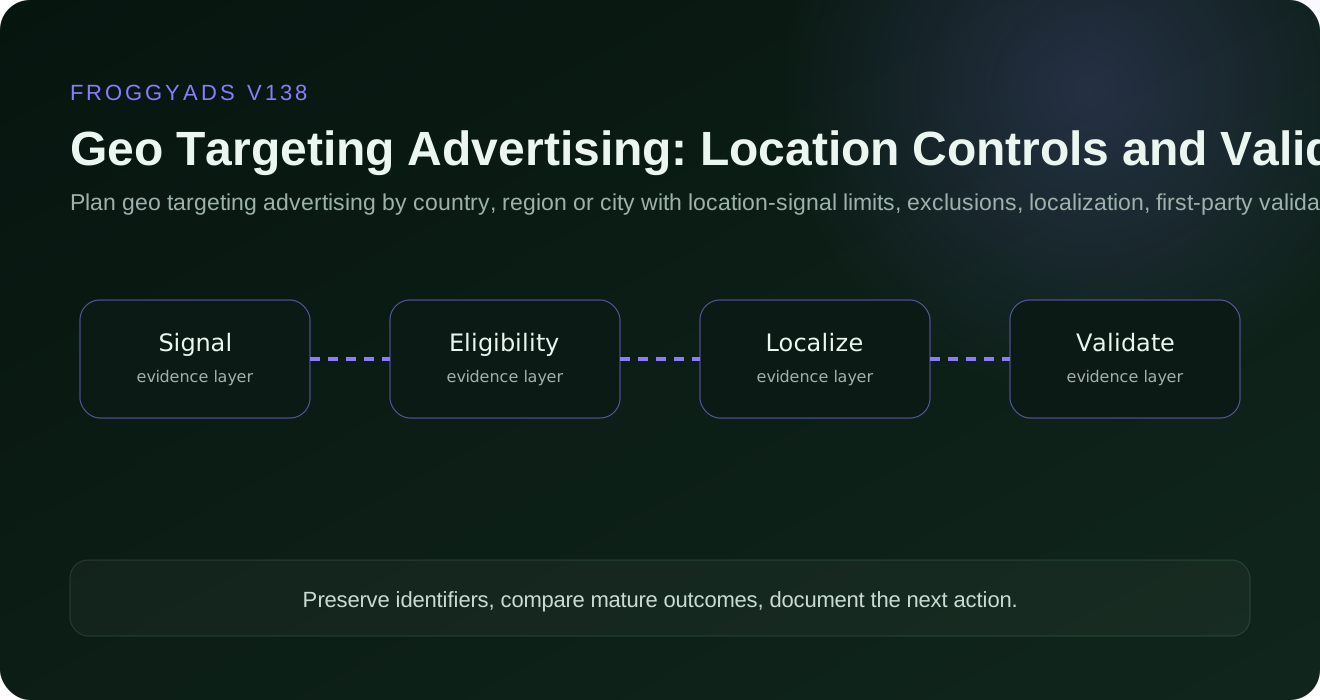
Official Google location documentation defines signals and uncertainty
Google Ads states that geographic targeting can use physical-location signals and locations of interest. Its documentation lists examples such as IP address, device location, prior location and search or page context, and explicitly says accuracy is not guaranteed in every situation. Google's advanced options distinguish people likely to be in or regularly in an area from people who have also shown interest in it; the broader presence-or-interest option is the default for several campaign types. Google's personalized-advertising policy adds boundaries for sensitive interests, precise location information and certain housing, employment and consumer-finance uses. These are Google product rules, not universal law or a description of every network. Use them to explain the named controls and to trigger a current policy and legal review. Never convert best-effort matching into a promise that only residents, only nearby users or every eligible person will see an advertisement.
- Signals reference: Google Ads geographic targeting - physical location, location of interest, signal examples and accuracy limitations
- Settings reference: Google Ads advanced location options - presence versus presence-or-interest settings and exclusion behavior
- Policy reference: Google personalized advertising restrictions - current sensitive-category, precise-location and access-to-opportunity targeting boundaries
Define the serviceable geography
To define your serviceable geography, list where you can legally, operationally and commercially deliver the promised outcome. Separate shipping, onsite service, digital availability, licensing, language support and sales coverage. A country shown in a targeting menu may still sit outside the real service area for one product or customer category.
Keep the serviceable geography accountable by attaching an owner and review date to every inclusion and exclusion. Test boundary addresses and remote areas rather than relying on a colored map. When your availability changes, update the campaign controls and landing experience together so the ad does not invite people into an unsupported journey.
Choose presence or location interest deliberately
Choose presence or location interest deliberately by deciding whether your campaign needs people likely to be physically present, regularly present, interested in the place, or a permitted combination. A restaurant delivery campaign may need a different rule from tourism research. Write the intended meaning before you select the platform's advanced option.
Verify the active account setting and save evidence of it. Google's default presence-or-interest option can reach people outside the target who show location interest. Do not describe that configuration as residents-only. Treat a switch to presence as a reach change that needs a new test rather than a simple cleanup.
Connect the guide to live testing
Connect Geo Targeting Advertising to a controlled audience test
Use the choices established in “Choose presence or location interest deliberately” to define one audience, budget and source set in FroggyAds. Keep the surrounding offer and measurement rule stable so the test adds evidence to geo targeting advertising instead of mixing several changes at once.
Create My Free Account
Map platform location signals
Document the signals the named platform says it may use, such as IP-derived area, device settings, network information, past locations, search terms or content context. Separate the product's public explanation from the advertiser's available report fields. The advertiser usually cannot verify every underlying signal for an impression.
Label the resulting location as inferred where appropriate. Do not equate an IP area with an exact address or a location of interest with travel intent. When eligibility has serious consequences, require an explicit customer-provided location and an operational check later in the journey.
Set exclusions with the same care as targets
Create exclusions for markets the business cannot serve, restricted regions, incompatible languages and known operational boundaries. Record whether the platform applies exclusion based on presence, interest or another rule. Positive and negative settings can use different logic.
Set exclusions with the same care as targets by running controlled location tests where permitted and inspecting matched-location reporting after delivery. An exclusion is a best-effort campaign control, not a legal geofence. Add destination eligibility and fulfillment checks when your service must never be offered outside a defined area.
Select geographic resolution from the decision
Use country, region, city, postal area or radius only when that level corresponds to service and evidence. Fine resolution can reduce volume and magnify signal error, while broad areas can hide material performance differences. Avoid a smaller radius simply because it looks more precise.
Select geographic resolution from the decision, then check platform minimums and category restrictions before planning. Review whether a boundary cuts through a natural service or media market. Compare the chosen unit with the location information you can actually validate at the accepted outcome.
Treat radius targeting as approximate eligibility
Define the center, distance unit, business reason and edge behavior for every radius. Confirm whether the platform uses straight-line or product-specific location logic through current documentation. Do not promise that every device inside the circle or no device outside it will be reached.
Test near-center and boundary demand separately where volume permits. Include travel time, delivery route or service capacity outside the media setting when those determine eligibility. A map radius is an advertising input, not a substitute for dispatch or address validation.
Coordinate language and location
Choose languages the destination and service team can support, then inspect the platform's language rules. A person's interface, query and understood language may differ. Do not infer residence, nationality or preferred communication language from one signal.
Provide a clear way to switch language and retain material conditions across versions. Review translated claims, forms and confirmations with accountable owners. A locally targeted creative that lands on an unsupported language page creates friction and can alter measured conversion independently of the audience.
Choose the execution format
Choose a paid-media format that supports Geo Targeting Advertising
Use the criteria around “Coordinate language and location” to decide whether push, native, display or pop fits the message and destination. Set format, targeting and spend as campaign controls in FroggyAds while the geo targeting advertising decision remains the standard for judging the result.
Create My Free Account
Localize the offer, not private identity
Localize the offer by adapting availability, currency, hours, delivery, examples and required disclosures to the market. Use location because it changes your service decision, not to announce that you know where an individual has been. Keep the message useful without revealing inferred movement or sensitive context.
Keep the localized offer defensible by retaining the source and date for local facts. Review taxes, prices and promotion conditions through your responsible business process. Avoid stereotypes, unsupported superlatives and cultural assumptions; test comprehension and action with people familiar with the intended market.
Review sensitive categories before activation
Classify the promoted product, landing content and audience method under the platform's current policy. Housing, employment, consumer finance, health, gambling and other sensitive contexts may restrict personalization or fine-grained location choices. The exact rule depends on platform, campaign and market.
Before activation in a sensitive category, escalate uncertain cases and preserve the decision. Do not work around a restricted postal code or audience by combining proxy attributes. Policy acceptance is not legal advice, and legal permissibility does not guarantee platform eligibility. Your policy and legal reviews may both be required before spend.
Map consent and data handling
Inventory location, click, device, identifier, form and offline outcome data across platform, tracker, destination and customer systems. Record purpose, notice, access, retention, sharing and deletion. Remove fields not needed for the approved measurement or service.
Test consent-limited and opted-out journeys. Do not send precise location information without the required permission or reuse a service address for unrelated targeting by assumption. Consult responsible privacy owners for the actual markets and data flows instead of presenting a global compliance conclusion.
Make the landing page location-aware safely
State the served area and important eligibility conditions before requesting sensitive information or payment. Prefer an explicit location selector or address check where accuracy matters. If content changes automatically by inferred location, offer a visible correction route and a stable default.
Test VPN, blocked-location, unknown-location and boundary cases without trying to identify real individuals. Confirm that redirects do not trap users or conceal the canonical offer. Keep the destination release with campaign results so later reviews can reproduce the experience.
Check inventory and placement context
Check inventory and placement context separately from geo eligibility. Geo settings influence who may qualify, while placements determine where your message appears. Review site, app, topic and format evidence at the granularity available. A local match can still occur beside unsuitable content or within an interaction that encourages accidental engagement.
Create placement exclusions and brand-safety rules independently from the geographic plan. Preserve unknown inventory as unknown. Do not call a location cell high quality because its click rate is strong before usable sessions and accepted outcomes are reconciled.
Put the guide into practice
Turn Geo Targeting Advertising into a bounded campaign test
With “Check inventory and placement context” documented, launch only the next reversible test. Set a spending limit, preserve the baseline and use source-level and audience controls so the next step depends on qualified outcomes for geo targeting advertising, not activity volume.
Create My Free Account
Design a market-cell experiment
Design a market-cell experiment with a small set of locations that share a comparable offer, creative, destination and measurement rule. Define your hypothesis, maximum spend, maturation period and accepted event. If you localize the message, retain a neutral version so the test can separate geography from creative treatment.
Avoid comparing a large established market with a new small market as if geography were the only difference. Record season, competition, pricing and operational capacity. Use results to authorize the next bounded cell, not to declare a universal best location.
Measure matched locations and outcomes
Save targeted-location and available matched-location reports with their product definitions. Connect delivery to usable visits, eligible leads, completed orders or another approved result. Keep physical presence and location interest separate where the report supports it.
Document unspecified and aggregated rows rather than deleting them. Compare platform geography with customer-confirmed service location only at the appropriate stage and permission. Differences may reflect signal limits, travel, VPNs, reporting or user choice; they require investigation, not automatic fraud labels.
Control budget by location
Set spend and accepted-cost ceilings for each interpretable market cell. Consider local price, capacity and value rather than forcing equal budgets or one global bid. A low-cost region can still be expensive if fulfillment, qualification or support fails.
Increase one dimension at a time and preserve the last stable configuration. Automated bidding may redistribute exposure within a broad target, so inspect actual delivery before claiming that every region was tested. Include creative and localization labor in market economics.
Handle mobile and travel contexts
Test the campaign and destination on representative mobile devices, app webviews and weak connections. People can be commuting, traveling or planning for another location. A current device area does not establish residence or the place where the service will be used.
Design copy and eligibility checks for that ambiguity. Review click-to-call, maps, deep links, back behavior and form correction. Separate technical problems from geo-match quality so a broken mobile journey is not misdiagnosed as the wrong market.
Investigate location discrepancies cautiously
Look for combinations of mismatched service address, unusual timing, repeated patterns, unusable sessions and source concentration. A single IP, language or short visit is not enough to determine identity or invalid activity. Retain evidence and the provider's definitions.
Use observe, cap, exclude, repair and retest states. Ask the platform or network for clarification where actionable data exists. Keep suspected manipulation distinct from ordinary signal error and user travel, and avoid publishing a fraud percentage without a documented method.
Reopen the geo plan after change
Review targets, exclusions and destinations after service expansion, closures, language changes, policy updates, seasonal capacity or platform migration. Archive previous settings and outcomes. A historical local win does not prove current demand or eligibility.
Audit copied campaigns because defaults and exclusions can drift. Verify access, location lists and emergency pause authority. Assign the next evidence date so geographic configuration remains an active business control rather than a forgotten setup screen.
Close with a geo decision record
Record service boundary, location interpretation, platform settings, exclusions, creative, destination, report fields, accepted outcomes, cost and unresolved uncertainty. State whether to continue, localize, narrow, broaden, pause or retest with a named ceiling.
Keep conclusions at the tested campaign, market and period. Explicitly note that location matching is best effort. The record should let another reviewer distinguish where the business can serve from where the platform inferred an eligible user.
Escalate exclusion-boundary mismatches
Create controlled checks near every material exclusion edge, including adjacent cities, postal areas or radius boundaries that could lead to an unavailable service. Compare the active negative-location logic with the platform's matched-location report and the destination's explicit eligibility result. Preserve unspecified rows, test conditions and timestamps. A map that looks correct in campaign setup does not establish how an individual impression was classified or whether the customer's confirmed service location qualified.
When excluded or unsupported locations appear in accepted-event records, pause only the affected market cell while tracing presence, interest, copied settings, redirects and customer-provided location. Record whether the mismatch came from best-effort media matching, an incorrect campaign control or a destination validation failure. Escalate unresolved cases to the platform and responsible policy owner with the exact campaign and report evidence; do not broaden exclusions blindly or label every boundary event invalid.
Geo-targeting control matrix
A geographic cell passes only when platform eligibility, destination eligibility and accepted service outcomes align within stated uncertainty.
| Control | Required record | Pass rule |
|---|---|---|
| Service area | Supported and excluded locations | Offer can be fulfilled |
| Location logic | Presence, interest and active defaults | Setting matches the decision |
| Policy | Category and data review | Restricted uses are resolved |
| Journey | Language, correction and eligibility check | Users can verify location |
| Outcome | Matched report and accepted result | Scaling remains bounded |
Retained geo-targeting resources
The original geo-targeting routes, calls to action, examples and images remain below in their original sequence. They preserve navigation and do not guarantee location accuracy or campaign performance.
Geo-targeting advertising questions
When does geo-targeting advertising improve a campaign plan?
It helps when offer eligibility, service coverage, language or customer value genuinely differs by location.
How should an advertiser test location targeting before launch?
Preview supported settings, verify inclusions and exclusions, then use controlled visits to confirm the intended routing.
Why can narrow geo targeting change campaign cost?
Smaller eligible audiences, local competition, device mix and limited inventory can alter delivery and auction prices.
Which location signal should guide geo-targeted advertising?
Choose the platform setting that best represents the needed physical presence or declared interest, and document its limits.
How should creative change between targeted locations?
Adapt only details that are accurate for the area, such as availability, language, price or service instructions.
What should happen after a geo-targeted advertisement is clicked?
Send users to a page with matching availability and conditions rather than silently inferring a more precise location.
How should advertisers measure geo campaign performance?
Compare accepted outcomes and cost by location while keeping attribution, volume and customer eligibility visible.
How can incorrect geo delivery be investigated?
Review targeting mode, exclusions, IP or device limitations, travel behavior and the location recorded by the business.
What privacy rule belongs in a geo-targeting plan?
Collect and retain only permitted location data, with appropriate notice, consent and access controls for its precision.
When should a geo-targeted campaign add another area?
Expand after the first locations show reliable delivery and accepted economics under the same verification process.
Turn a map boundary into a customer journey the business can actually serve
Start with the serviceable location, not the largest selectable audience. For every country, region, city or radius cell, record who is eligible, which offer and language they see, which currency and terms apply, how delivery or service is fulfilled, and which advertiser-side event confirms a useful outcome. A platform location signal can help express eligibility; it cannot prove a person's residence, intent or private identity.
Use separate fields for requested market, platform targeting rule, observed delivery location, destination localization and business acceptance. That separation matters when travelers, VPNs, mobile networks, border areas or imprecise signals create a discrepancy. Investigate the smallest layer that can explain the difference before widening or excluding the whole market.
| Geo layer | Question | Evidence to keep |
|---|---|---|
| Service boundary | Can the business legally and operationally serve this location? | Eligible area, exclusions, terms and fulfillment owner |
| Campaign rule | Which supported FroggyAds control expresses that boundary? | Saved GEO, city or available location settings |
| Destination | Does the page show the right language, price and next step? | Page version, locale, currency and offer terms |
| Acceptance | Did the resulting lead, order or signup qualify for the location? | Accepted status, rejection reason and maturity date |
Launch one bounded market cell with its own budget and evidence window. Keep the location rule, creative and landing version stable while the cohort matures. Expand only after accepted outcomes support the next geographic step; exclude a location when the service boundary or settled economics makes it unsuitable. Build the geo test in FroggyAds
Choose the narrowest geographic rule that matches real eligibility
This page owns the complete geo-advertising decision: service boundary, available targeting control, localized destination, accepted location evidence and the next budget action. Use the geo targeting versus IP targeting comparison when the narrower question is how those concepts differ.
FroggyAds gives you self-serve campaign controls and reporting for a controlled market test. On our platform, you can combine supported GEO or city settings where available with budget, format and traffic-source controls, keep exclusions as carefully as inclusions, and reconcile delivered traffic with your own eligibility and acceptance records. We recommend changing one boundary at a time so you can see whether the new market added qualified value or only volume. Choose FroggyAds when you want a measurable next step instead of an unbounded location expansion.
What matters first in geo-targeted advertising?
Define where the offer can be served and accepted. Express that boundary with the supported campaign controls, localize the destination, then judge the market from mature advertiser-approved outcomes rather than assuming a location signal proves customer fit.