
Buy Traffic for CPA Marketing With Accepted-Action Control
Buy CPA marketing traffic with FroggyAds when you want a traffic purchase you can control and connect to accepted actions. We give you buying inputs such as the available format, targeting, bid, budget and sources. Media follows the CPC or CPM model available for the selected inventory; your mature CPA is the result calculated after the offer owner confirms eligible actions and any reversals.
What decision should this CPA marketing traffic guide help you make?
We help affiliate marketers, media buyers and performance teams turn a permitted offer into an inspectable traffic test. Choose FroggyAds for direct campaign control, then use your offer records to establish which actions mature into accepted value. This CPA marketing traffic guide connects the two decisions: what you buy through our network and what the offer owner ultimately accepts.
The immediate answer is practical: verify the traffic method, define the mature accepted action, preserve identifiers through the redirect chain, set a learning ceiling and compare source cells only after the same status window. Stop the affected cell when any of those links becomes unreadable.
CPA on this page means cost per accepted action: eligible media cost divided by mature accepted actions for the same campaign cell and period. It is not a promise that FroggyAds charges only when the advertiser approves an event, and it is not a guarantee of commission or profit.
How are CPC, CPM and CPA different in this campaign?
CPC and CPM describe ways media cost can be purchased and reported for supported inventory. CPC relates cost to clicks; CPM relates cost to one thousand impressions. They belong to the delivery and auction layer, where you control campaign settings and observe the traffic you bought.
CPA belongs to the downstream performance layer. Calculate it after the selected traffic reaches the offer and the advertiser or affiliate platform classifies the action. The formula is eligible campaign cost divided by accepted actions. If cost is USD 240 and 12 actions remain accepted, the mature CPA is USD 20. The numbers are hypothetical and are not a FroggyAds price or forecast.
Do not place preliminary callbacks in the denominator without a status rule. A campaign with 18 displayed actions and 12 mature accepted actions has two useful views: an initial cost per displayed action and a mature cost per accepted action. The budget decision should state which one governs and why.
This separation prevents a common error: calling traffic a CPA purchase when the media was bought through another model and only evaluated against CPA later. Name the media model, the action, the source of truth and the maturity date in every report.
Which offer rules must be verified before buying traffic?
Record the exact offer or campaign reference, traffic methods allowed, eligible markets and devices, creative restrictions, destination requirements, prohibited claims and the current owner of those rules. Save the review date. Permission for another offer or an earlier version does not validate the campaign you are about to launch.
Our available GEO, device and source controls help you put the offer permission into practice. Check audience and market fit against the actual eligibility rules, then select the supported settings for that offer. Exclude a market or device the offer cannot accept. If an important restriction cannot be implemented, resolve it before launching the affected purchase.
Define a change trigger. A new destination, payout condition, market restriction, compliance notice or accepted-action rule begins a new evidence period. Preserve the old version so results before and after the change are not combined as though the offer remained stable.
Assign a permission owner who can pause delivery. Media operations should not have to guess whether an offer change matters. The owner records the decision, evidence and condition for restart, while the buyer keeps the affected FroggyAds cell bounded.
What exactly counts as a CPA action?
Write the action as an observable business event: for example, an eligible signup accepted by the offer owner after validation. Specify the event name, system of record, required fields, market and device conditions, duplicate logic, rejection reasons, reversal policy and the time at which the status is mature enough for your decision.
Keep the user journey and commercial status separate. A visitor may complete a form while the resulting record fails an eligibility rule. A callback may arrive while the event is still provisional. A commission may appear before a later reversal. Each stage is useful, but only the stated accepted stage belongs in the mature CPA denominator.
Give unresolved actions their own status. Do not distribute them across accepted and rejected outcomes or hide them from the rate. A growing unresolved queue can indicate a delayed advertiser process, a broken token or a reporting mismatch that needs repair before the source is judged.
Use the same definition across competing source cells. Changing the acceptance rule for one campaign creates a false comparison. When the business changes the rule, close the earlier period and start a new cohort with a written transition.
How do you build a CPA traffic test in FroggyAds?
Begin with one offer, one accepted action and one permission record. Map the creative, prelander if used, destination, completion step and confirmation. Test that each screen continues the same promise and that the user can complete the action on the intended device.
Set the campaign objective to the accepted action you will later reconcile. Choose an ad format that fits the permitted offer and destination, then document the budget and bid for that purchase. Our separate campaign controls let you keep materially different markets, messages and routes identifiable, so their accepted-action results can support a useful next allocation.
Run a controlled journey before meaningful delivery. Confirm the FroggyAds campaign, creative and source identifiers, your click or visit token, the offer reference and the advertiser-side event can be joined. Test a rejected or duplicate path when your systems allow it, because a positive event alone does not prove status reconciliation.
Set a learning ceiling, review date and stop rule from your own economics and operational capacity. The ceiling limits uncertainty; it does not predict success. When the cell is prepared, start your next campaign with FroggyAds and preserve the setup as the control version.
Which funnel layers should the report keep separate?
Use at least five layers: eligible media delivery, destination arrival, action start, preliminary completion and mature accepted action. Add rejection, duplicate, reversal and unresolved status beside the final layer. This map shows where traffic quality, message fit, page usability and offer acceptance diverge.
Impressions and clicks diagnose media response. Arrival confirms the redirect and page. Action start shows engagement with the conversion path. Preliminary completion tests the technical event. Mature acceptance tests commercial value under the offer's rules. One headline conversion rate cannot explain all five.
Attach a decision to each drop. Repair delivery or targeting when the eligible audience does not respond. Repair the route when clicks fail to arrive. Repair message continuity or usability when arrivals do not begin the action. Investigate eligibility and event validation when displayed completions fail to mature.
Preserve counts with rates. A 50% rate from two records is a different decision from the same rate across hundreds of mature outcomes. Report the observation window and unresolved count so the buyer can see the practical limit of the result.
How should campaign and source identifiers reach the accepted action?
Build an identifier map around our supported tracking methods: URL macros, a pixel where appropriate, or server-to-server postbacks configured with your tracker. Map the FroggyAds campaign, creative and source values to your click or visit token, any redirect identifier, the offer reference and the advertiser-side event. Record who supplies the later acceptance status. We help you measure the traffic input; the offer system establishes the commercial outcome.
Test the map from the browser journey through the event and status update. Confirm that encoding, redirects and mobile routes do not drop or rewrite the token. A dashboard total without a reliable join cannot support a source-level CPA decision even when the overall action count appears plausible.
Reconcile discrepancies as a separate workflow. Compare time zones, event definitions, duplicate rules, attribution windows and late status changes. Preserve the raw exports used for a decision, the reconciliation date and any exclusions. Do not edit totals until the mismatch disappears without recording the reason.
Use missing IDs as a stop signal. If a meaningful share of outcomes cannot be mapped to media and offer, report them as unresolved. Repair the chain and begin a new evidence window rather than assigning the outcomes proportionally across sources.
How should rejected, duplicate and reversed actions change the CPA view?
Give every non-accepted event an actionable category. Useful groups include ineligible market, unsupported device, duplicate, incomplete action, invalid data, prohibited traffic method, tracking mismatch, advertiser rejection, reversal and unresolved status. Keep the taxonomy stable while sources are compared.
Calculate the acceptance rate as mature accepted actions divided by preliminary actions for the same cohort. Report the rejection and reversal rates beside it. A source that creates many early events but few accepted actions may need a different offer, route or targeting decision even if its click cost is low.
Investigate concentration. A specific source, device or creative may account for most duplicates or rejections. Isolate that dimension and check the journey before condemning the entire campaign. Conversely, do not let a strong aggregate hide a cell that repeatedly violates the offer boundary.
Check the offer platform before blaming traffic. On impact.com, pending actions can change before the contract's locking date. Everflow documents that a later payable-amount change does not automatically resend its original partner postback. These are vendor-specific examples: use your own offer's status rules and reconciliation route. Our media report explains the purchase, while the offer record establishes its accepted value.
How do you calculate a mature CPA and contribution boundary?
For one campaign cell, divide the eligible media cost by mature accepted actions. If USD 360 in media spend produces 24 accepted actions, the mature media CPA is USD 15. If 30 actions were first displayed, the initial event cost is USD 12. Reporting both reveals the effect of validation. The example is hypothetical.
Compare CPA with the value the business actually receives after applicable network fees, payout conditions and reversals. Keep revenue or commission evidence in the offer owner's ledger and traffic cost in the media ledger. Join them by cohort; do not overwrite one system with the other.
Add broader costs when the allocation decision requires them. Creative production, tracking tools, payment fees and operating time may affect contribution even though they are not part of the pure media CPA. State whether the reported figure is media CPA or all-in acquisition cost.
Use sensitivity ranges when outcomes remain uncertain. Show what CPA becomes if unresolved records are later accepted, rejected or reversed. A decision that works only under the most optimistic status deserves a smaller ceiling or more time, not confident scaling language.
How should a learning ceiling protect a CPA test?
Choose a learning ceiling from your cash position, offer economics, status delay and ability to review the resulting records. Our USD 50 minimum deposit funds the account; it is separate from this campaign allowance, the bid and any daily pacing setting. Fund the specific question you need to answer while preserving enough cash to wait for the accepted-action result.
Write operational stops alongside the financial boundary. Permission uncertainty, a broken destination, misleading creative, missing source tokens and failed event reporting require an immediate pause. CPA or contribution limits apply after enough outcomes have matured to make that judgment meaningful.
Use staged releases. A first stage can verify delivery and tracking; a second can evaluate preliminary action flow; a third can wait for mature acceptance. Do not keep spending simply because the final metric has not arrived. Keep each stage small enough to wait for the evidence it needs.
Name the decision owner and next review time. Automated caps can limit spend, but they cannot decide whether an offer rule, rejection pattern or status delay invalidates the test. Human ownership keeps the campaign aligned with the actual commercial question.
How should FroggyAds source evidence be used in CPA marketing?
Preserve the source identifier with the click, route and mature outcome. Compare sources under the same offer, market, device plan, creative promise, destination and acceptance rule. If those inputs differ, describe the result as a cohort comparison rather than a pure source test.
Our source-ID reporting, whitelists and blacklists give you practical ways to act on your reconciled result. One source may produce fewer clicks and more accepted actions; another may generate cheap clicks with repeated rejections. Compare the same offer and maturity period, then concentrate or restrict the relevant source purchase. Your accepted-action ledger supplies the quality judgment behind that buying choice.
Pause a source when a current permission, safety or tracking condition fails, or when mature evidence reaches the written stop rule. Retain enough information for a possible restart: dates, creative, destination, reason, sample size, unresolved events and the exact condition that must change.
When a source works, expand carefully. Keep the offer and acceptance rule stable, raise one media variable, preserve the previous control and write a new ceiling. This turns scaling into another test rather than an irreversible assumption about future performance.
Why must the ad promise and CPA action describe the same journey?
The creative should introduce the real value, audience and next step without implying guaranteed eligibility, a result or a reward the destination cannot support. Conditions that materially affect the user's decision belong in the journey before the action, not hidden after completion.
Version the creative, prelander and offer page. A landing-page change can improve or weaken accepted actions independently of the traffic source. Start a new evidence period when the promise, required action or eligibility changes, so the buyer does not credit the wrong variable.
Test mobile routes, forms, confirmations and error states. A source can look unproductive because one device cannot complete the action. Conversely, a technical conversion may fire on a form step that never becomes an accepted lead. Journey QA and event QA must agree.
Refresh creative when response or accepted quality weakens, the offer terms change or the destination no longer matches the message. Keep one approved control whenever possible. That control helps separate fatigue from a change in source mix, route or offer acceptance.
What evidence should release more CPA campaign spend?
Require a current traffic-permission record, a destination that continues the message, complete campaign and source identifiers, mature accepted actions, explainable rejection and reversal patterns, and a contribution view that remains inside the written decision rule. Record unresolved events and limitations rather than hiding them.
Scale the source-offer cell, not a blended account average. Increase one country, device group, source set, creative or budget boundary at a time. Preserve the control cell, the previous ceiling and a rollback trigger. The next release should answer a named question.
Stop when the evidence no longer supports the offer. More delivery cannot repair an invalid permission, broken action definition or lost tracking chain. Archive the campaign version and the reason. A clean stop protects future testing from repeating the same unresolved assumption.
When the campaign is ready, choose FroggyAds for your next traffic campaign. We recommend bringing the offer rule, accepted-action definition and learning ceiling into the setup so every media decision can be connected to mature business evidence.
| Release question | Evidence | Decision |
|---|---|---|
| Is the offer and journey valid? | Current permission, message and destination version | Launch only inside the documented boundary |
| Can media be joined to mature value? | Campaign, source, click, action and status identifiers | Hold source allocation until the join works |
| Do accepted economics support another test? | Cost, accepted actions, reversals, unresolved records and contribution | Change one variable with a new ceiling and rollback |
Ten questions about buying traffic for CPA marketing
Use the answers as review checks, then apply the current rules for your exact offer and advertiser-side event.
Does FroggyAds charge a CPA price for traffic?
CPA is the advertiser's downstream performance metric on this page. FroggyAds media spend follows the buying model available for the selected inventory and campaign, such as CPC or CPM. Calculate CPA from the reconciled media cost and mature accepted actions rather than treating CPA as a guaranteed traffic price.
What is an accepted action in CPA marketing?
It is the event the offer owner recognises after the applicable eligibility, validation, duplicate and reversal rules. Define the exact action, source of truth, owner and maturity window before launch. A click, form start or preliminary callback is not automatically an accepted action.
Why can a displayed conversion differ from a mature CPA result?
An initial event can later be rejected, identified as a duplicate, reversed or left unresolved. A mature report reconciles those statuses before dividing cost by accepted actions. Keep both the preliminary and mature views because they answer different operating questions.
Which traffic costs belong in the CPA calculation?
Include the media cost for the exact campaign cell and period being evaluated. Keep creative production, tools, fees and operating costs visible in a broader contribution view when they affect the business decision. Do not mix costs from unrelated offers or time windows.
How should CPA offers be separated in FroggyAds?
Use a distinct campaign or clearly traceable cell for each material offer, market, device route, creative promise and destination assumption. Preserve campaign, creative and source identifiers so accepted actions can be attributed to the correct test.
When should a CPA traffic cell be paused?
Pause when traffic permission is uncertain, the destination fails, the message no longer matches the offer, tracking tokens disappear, accepted-action status cannot be reconciled or a written loss boundary is reached. Record the evidence and condition for any restart.
Can a low click cost prove a good CPA campaign?
No. A low click cost describes the media layer. The campaign still needs eligible visitors, a coherent destination and mature accepted actions. Judge the source from the full funnel and the advertiser-side result, not from the cheapest early event.
How long should a CPA campaign run before a decision?
Use the time needed for the offer's actions, rejections and reversals to reach the stated maturity point, plus enough evidence for the decision you face. Fix broken permissions, redirects and identifiers immediately; do not wait for a statistical window when the journey is invalid.
Can paid traffic guarantee commissions or profit?
No. Traffic cannot guarantee accepted actions, commissions, sales, revenue or profit. A controlled FroggyAds campaign helps you test a permitted offer, audience, message and source within a written learning boundary.
What evidence should support a CPA scale decision?
Require current promotion permission, a stable offer journey, complete identifier joins, mature accepted actions, explainable rejection and reversal patterns, and economics that remain inside your decision rule. Increase one variable and keep a rollback.
Two views for building and reviewing the CPA traffic cell
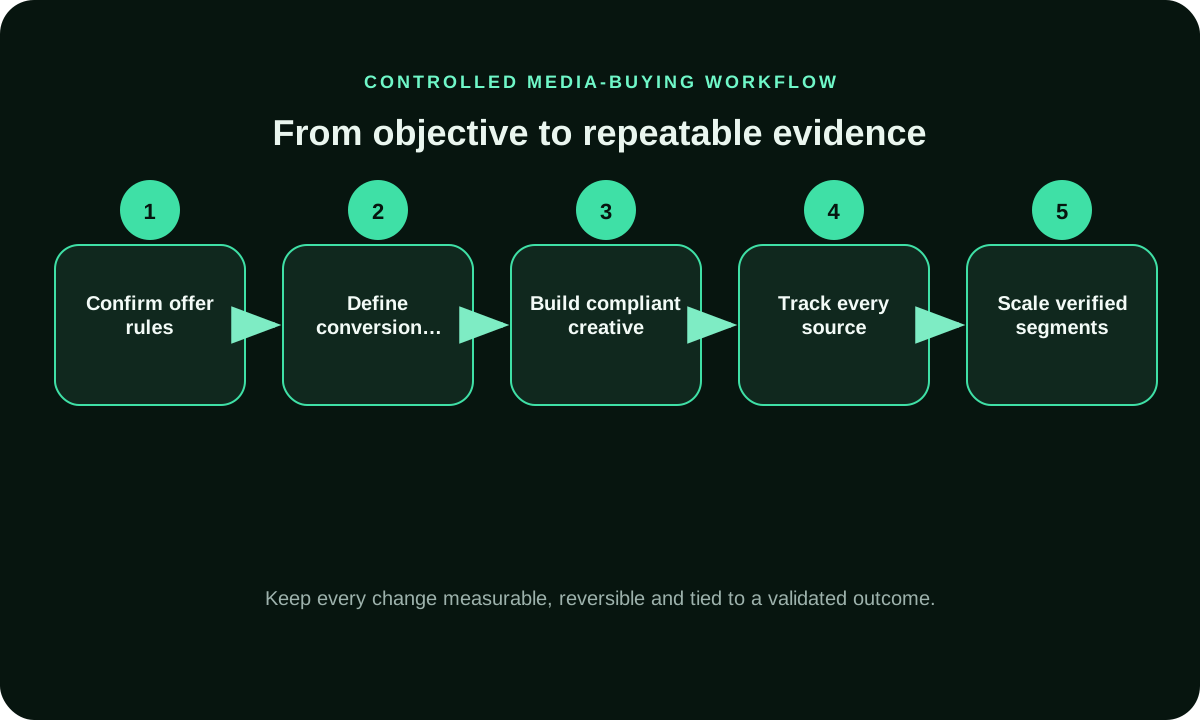
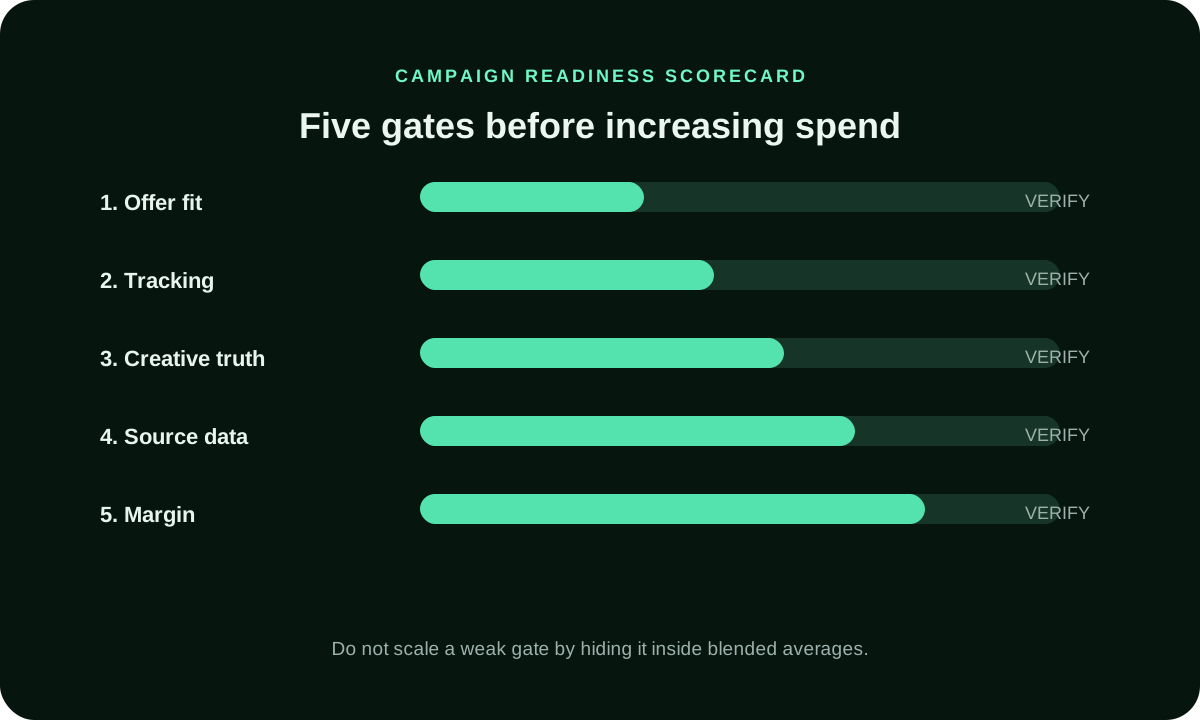
Use the workflow view during setup and the scorecard during the maturity review. The images support the written controls; the source-of-truth records remain the offer permission, campaign ledger and advertiser-side outcome export.
Continue with the guide that matches the next decision
Choose your next resource from the part of the CPA journey that needs work. Use the setup guide for a first permitted offer, reporting and tracking guidance for an unexplained status gap, or source and budget guidance for the next funded comparison. Our learning resources help you turn that specific question into a campaign decision.