
Country Targeted Traffic
By FroggyAds.
Use FroggyAds for country-targeted traffic: confirm offer eligibility and localization, compare costs in one currency, then assess markets before scaling.
What does country-targeted traffic mean to a buyer?
Country targeting treats each market as a distinct commercial test, including offer eligibility, currency, language, and fulfillment.
Country-targeted traffic is paid delivery intended for visitors associated with a selected national market. It can help an advertiser test demand where the offer can actually be purchased, delivered, or used. Country selection alone does not translate a page, validate local eligibility, or ensure precise location signals. Plan the market around commercial readiness and verify which country controls and reports are currently available in your FroggyAds account.
Which countries can your offer actually serve?
Compare country results on normalized accepted outcomes, not raw spend or converted currency alone.
Create an eligibility checklist before selecting markets: product availability, legal or policy restrictions, language support, payment acceptance, delivery or service coverage, and response capacity. A country setting can direct campaign eligibility, but it cannot make an unavailable offer suitable. Record any market-specific exception and point the visitor to the page version they will receive. This keeps the geography decision tied to a real ability to serve prospects rather than a country list chosen only for reach.
List service areas, product availability, supported languages, payment methods, delivery limits, and legal or age restrictions before selecting countries. Exclude markets the business cannot support even if traffic is available. Distinguish business eligibility from campaign reach: an ad platform may let you select a location that your checkout or support team cannot serve. Keep a country-by-country readiness record.
A market-readiness matrix is more useful than a list of countries. For each market, record whether the offer is lawful, available, priced, deliverable, and supported; note language and payment conditions too. A country that fails a business requirement should not enter the paid test. A country with incomplete information can remain in research, but its campaign result should not be compared with a launch-ready market.
Does country selection require localizing the offer?
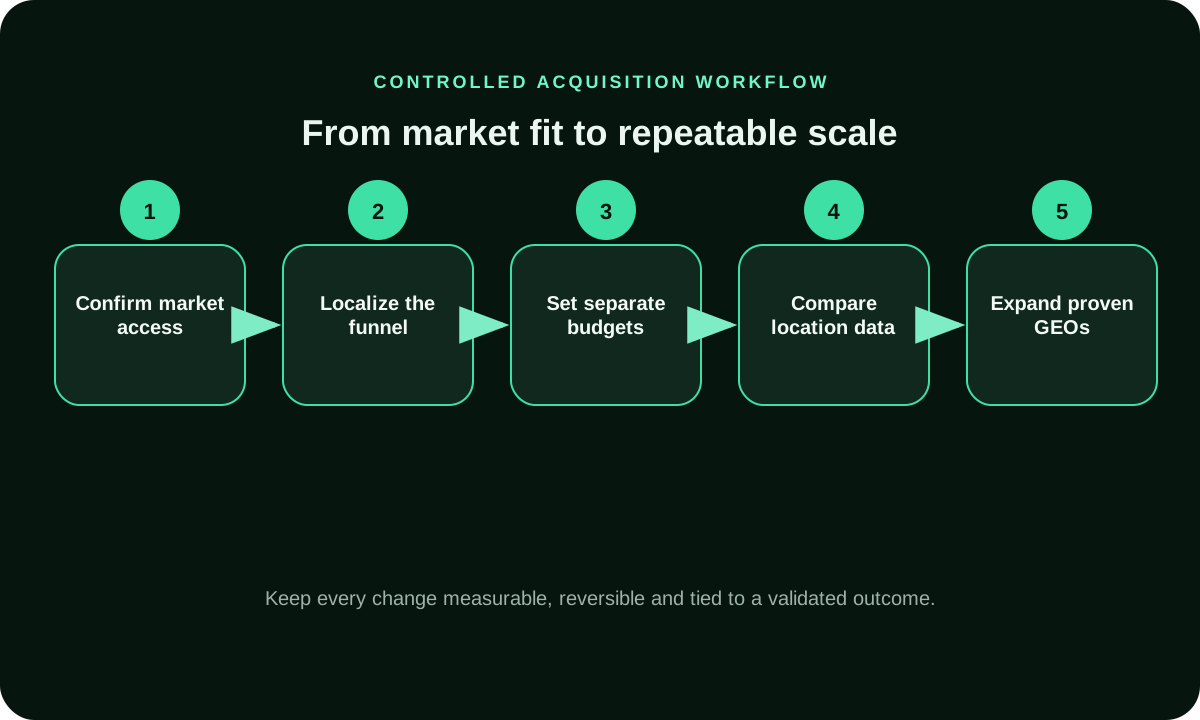
Localization means more than translating the headline. Check currency display, taxes or fees, shipping or service coverage, time zone, payment options, customer support, and claims that need local qualification. If the destination is unchanged across countries, explain which parts remain suitable and which do not. A translated ad that leads to an inaccessible checkout can produce clicks without accepted orders.
Localization means the visitor can understand the offer's important terms, not just its translated headline. Review price display, tax or fee explanations, eligibility, payment methods, delivery timing, support language, and any country-specific restrictions. Use a distinct page version when those terms differ materially, and record which campaign cohort reaches it. If the page stays in one language, make that choice explicit in the test so weak response is not automatically blamed on traffic quality.
How do you compare economics across currencies?
Keep the original spend and revenue currency, the exchange-rate source, and the conversion date in the analysis. Normalize to a reporting currency only after preserving native values. Include fees, tax treatment, refunds, and margin when they vary by market. A converted CPA is useful for ranking test candidates, but the business decision must use the actual unit economics and a consistent rate method.
Keep the amount spent and the business value in local currency first. For a normalized view, state the reporting currency, conversion source or method, rate date, and whether fees, taxes, refunds, or fulfillment costs are included. Calculate cost per accepted action within a comparable period and preserve the native figure beside the converted one. A currency conversion makes values easier to inspect; it does not remove differences in margin, payment behavior, or market operations.
Preserve native market economics before currency conversion. Write the original spend, revenue, refund, and margin currency alongside the reporting currency and rate date. If the exchange rate changes during a long test, choose a consistent daily or period-end method and disclose it. A single converted CPA can conceal local taxes or payment fees that materially change what an accepted order contributes.
What country-level eligibility checks matter?
Confirm legal eligibility, product or service coverage, payment acceptance, language, landing-page access, and follow-up hours for each target country. Country settings in an ad platform describe its targeting method, not a guarantee of a visitor's physical location. Google Ads describes its own location controls and signals; verify the relevant account behavior and FroggyAds availability separately before forecasting reach.
How can country reports hide regional variation?
A country total can combine cities, provinces, languages, and payment conditions with different conversion behavior. Use regional reporting only if the platform exposes it and the sample supports it. Do not infer regional performance from a national average. If the report only separates countries, make a country-level decision and keep local operational differences as explanations to investigate.
A national total can combine cities or regions with very different availability, language, delivery, and demand. Make conclusions only at the geographic detail the account report actually exposes. If only country totals are available, do not label an individual region as the reason for performance. Keep country and subnational questions separate, and use a finer split only when the campaign controls and reporting can both support it.
National totals can conceal language and regional differences even when the campaign setting is country-level. Do not infer a city result unless the report exposes it. If your site serves multiple languages within a country, record the actual page language or version associated with each outcome where your analytics can do so. Keep conclusions bounded to the dimensions you observed.
How should you cap a market test?
Set a separate limit for each country so one market cannot consume the entire learning budget. Choose the accepted outcome, maturity window, and maximum loss from that market's economics. If expected sample volumes differ, do not give each country an equal budget by default. Start with a conservative cap, then compare accepted results after the same qualification rules are applied.
An equal budget split is not automatically fair. A mature market with clear conversion history may support a different cap from a new market whose payment or fulfillment process is untested. Use a business-approved risk limit for each country, then report spend and accepted outcomes in native units. This keeps a larger country from absorbing all of the test budget before smaller markets have a chance to mature.
Which metric supports a country comparison?
Compare cost per accepted order or qualified lead, with conversion value and margin reported in the same currency basis. Use clicks, valid visits, and action starts to diagnose the funnel, not as a substitute for country-level outcomes. Keep the attribution window, offer, and acceptance rules aligned. If price or fulfillment differs, interpret the result against local economics rather than a global CPA target.
How do conversion delays differ by country?
Payment confirmation, shipping, sales follow-up, and local business hours can affect when an outcome is accepted. Define the maturity window per business process and disclose if countries do not share the same delay. Avoid pausing a market simply because another country produces quicker events. Report pending conversions until the applicable window closes.
Set the observation window from the action's normal path in each market: a lead may need sales follow-up, while an order may wait for payment or delivery confirmation. Mark events as pending until that period ends, then compare mature cohorts. If one market has a longer window, show that difference instead of ranking its interim CPA against a finished cohort. This protects the decision from penalizing a market simply because its accepted outcome arrives later.
Define whether the clock starts at click, enquiry, order, or delivery. A country with longer shipping or local contact hours may have a later accepted outcome. Keep pending outcomes visible until the agreed window ends, then use the same treatment across comparable markets. If the business must use different windows, state the difference and avoid presenting the resulting CPA values as directly equivalent.
When should a country remain its own cohort?
Keep a country separate when its language, price, fulfillment, legal terms, payment method, or sales process changes the offer. Combine markets only when the business treatment and measurement are genuinely comparable. This avoids a high-volume market masking a weak one and preserves the ability to move budget based on local accepted CPA.
What makes a country ready for more spend?
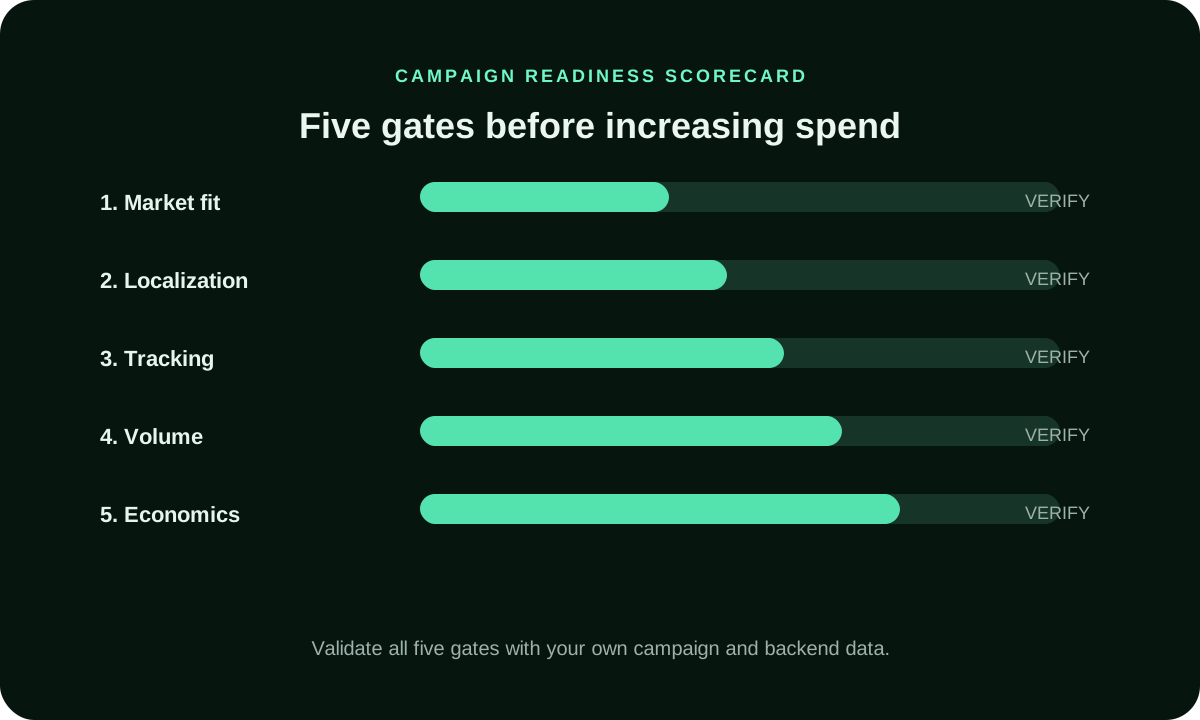
Increase a market when its accepted outcomes mature, the cost fits local margin, and operations can handle the next volume step. Add budget to one country at a time or introduce one new market as a distinct cohort. Preserve the original report window and currency method. If source or location detail changes, pause expansion until you know the comparison remains valid.
Before raising a country cap, confirm the market has eligible delivery, a page version that explains its terms, reliable payment or fulfillment, and enough mature accepted events for a decision. Check that local costs and value are normalized consistently and that support can handle added demand. Increase one market at a time when possible. A strong early visit rate or temporary exchange-rate advantage is not sufficient evidence if the accepted outcome, margin, or service path remains unclear.
How does FroggyAds fit a country acquisition test?
We offer a self-serve workflow for paid campaigns with available targeting, formats, bids, budgets, and source reporting where provided. Check current account options for the country controls you need and confirm that your destination serves those markets. You own localization, fulfillment, and accepted conversion tracking. Create your FroggyAds account when your country brief and test limits are ready.
What belongs in a country market brief?
Record each country's offer eligibility, language and page version, currency, payment or delivery terms, accepted conversion, exchange-rate method, budget cap, conversion window, and responsible operator. State which campaign fields can separate that market in reporting. A clear brief turns country targeting into a comparable portfolio of tests rather than one blended international campaign.
Hypothetical country portfolio: a subscription service is ready to accept customers in two markets, but the listed price, payment method, and support hours differ. The buyer creates a separate campaign cohort for each country and retains spend in its original currency. At review, the analyst records the exchange-rate method, refunds, payment fees, and accepted subscriptions. A converted cost per subscription can support comparison, but the decision should use each market's contribution after local costs. If one market has a longer payment-confirmation period, show pending subscriptions until its preset window ends rather than treating them as failures. Do not combine the two countries merely to produce a larger number. The campaign note should state which local offer version ran and whether country-level reporting was actually available. This example is hypothetical and does not predict FroggyAds reach or market performance.
Supporting controls for Country Targeted Traffic
Country Targeted Traffic FAQ
How is country targeting different from regional targeting?
Country targeting organizes a test around a national market. Regional or city targeting uses smaller location groups where a platform supports them. Make conclusions only at the geographic detail your campaign report actually exposes.
Do I need a localized landing page for each country?
Use a page version that accurately explains the offer's language, price, eligibility, payment, delivery, and support for that market. A translation alone may leave material terms unclear. Record which version each country cohort received.Eligibility evidence anchors this part of : country setting, language, currency, device, source and accepted outcome records should support an accepted event from an eligible country-specific offer and destination, while remains a separate research route.
How should I compare countries with different currencies?
Keep local spend and value, state the exchange-rate method and date, then normalize to a reporting currency. Include taxes, fees, refunds, and margin. Converted media cost alone does not establish which market contributes more.
Can an ad country setting confirm a visitor's physical location?
No location setting should be treated as perfect proof of physical presence. Platforms can use different location signals. Check the account's method, preserve any report details, and state the limit when interpreting country results.Mature outcome records sharpen the review of . Under “Can an ad country setting confirm a visitor's physical location?,” we recommend that you make country-level keep, repair or pause decisions after the same maturity window; use only when that different question matches your plan.
Should several countries share one campaign budget?
Use separate cohorts or budgets when offer eligibility, language, currency, payment, or economics differ. A shared total can hide a weak country behind a larger market. Combine only when treatment and measurement are genuinely comparable.
What should I check before targeting a country?
Confirm that the business can legally and operationally serve the offer there. Review product availability, supported language, price terms, payment acceptance, delivery, and customer response capacity before buying traffic.
Which metric should decide a country test?
Use cost per accepted lead or order and local contribution after relevant costs. Report clicks and visits as diagnostics. Apply the same event rule and maturity window, and preserve native currency values beside normalized figures.
How should I handle conversion delays by market?
Set a review window that includes the local follow-up, payment, or delivery process. Keep pending events separate until that window ends. If windows differ, disclose it and avoid a direct CPA ranking.
Why can one country have many visits but few accepted orders?
Inspect local availability, language, price, payment, fulfillment, and source mix. A country selection does not explain visitor behavior or order rejection. Compare the market's own funnel and acceptance reasons before changing targeting.Source-level attribution gives practical meaning to because country targeting cannot replace local eligibility, localization or business acceptance checks. Keep country setting, language, currency, device, source and accepted outcome records attached to this test rather than importing conclusions from .
What country controls does FroggyAds provide?
We offer self-serve paid campaign controls for available targeting, formats, bids, and budgets, with source reporting where provided. Confirm that the country setting you need appears in the current account. You manage localization and validate business outcomes.
Validate a target market before scaling
Build a controlled country targeted traffic test
A country test confirms market eligibility and landing-page readiness, then compares accepted outcomes by country using a consistent measurement window. A stable acceptance rule protects the budget for : define an accepted event from an eligible country-specific offer and destination before you make country-level keep, repair or pause decisions after the same maturity window. The comparison belongs here, while answers another buyer question.
Treat every country as a separate market test
Google describes its own location signals and settings; they do not establish exact location accuracy or FroggyAds market availability. For the detailed guidance, read Google Ads guidance on location targeting.
| Market decision | Local check | Evidence before expansion |
|---|---|---|
| Eligibility | Service, shipping, or signup allowed | Destination and offer terms |
| Language | Ad and landing copy are clear | Reviewed local wording |
| Economics | Margin and costs in local market | Normalized report plus local value |
| Measurement | Country/source identifiers retained | Accepted events and stated location limits |
| Budget | Market-specific cost ceiling | Mature outcomes, not clicks alone |
Verify market eligibility and local value
Before setting a country budget, confirm that the offer, language, payment, fulfillment, and support are ready for that market. Keep eligibility and local pricing explicit in the campaign brief.
Compare each market in a common currency and equivalent conversion window while preserving its own margin and lead quality. A low CPC or CPM is a delivery signal until your records show accepted outcomes.Buyer-side reconciliation strengthens the next choice in for the advertiser comparing national markets. Review country setting, language, currency, device, source and accepted outcome records under “Verify market eligibility and local value,” then treat as supporting material rather than the decision rule.
For a country-market test, review Verified route data clarifies the role of . We help you make country-level keep, repair or pause decisions after the same maturity window, but country targeting cannot replace local eligibility, localization or business acceptance checks; should retain its own intent and evidence trail.the FroggyAds campaign controls and create your free FroggyAds account.
A checklist for country-targeted traffic
Confirm the offer is available and permitted in each country you plan to target.
Prepare local language, pricing, payment, and fulfillment details for the destination.
Set a separate budget and accepted-cost limit for every country in the test.
Record the geographic eligibility setting and reporting definition for each market.
Preserve campaign and source identifiers through conversion and approval.
Normalize currencies and time zones before comparing country reports.
Use equivalent attribution windows while noting different qualification delays.
Compare accepted outcomes and margin, not only CPC, CPM, or raw click volume.
Check that location data supports the country-level conclusion you plan to make.
Expand one market at a time after outcomes meet its own limit and operating capacity.
Country Targeted Traffic — buyer decision
Treat country selection as the start of a market review, not the complete audience definition. For each country, confirm offer availability, language, price, payment, delivery or service coverage, and follow-up capacity. Record what location signal the campaign report exposes and distinguish it from customer-provided address details. Define one accepted conversion and a local cost ceiling before launch. Use the same acceptance rule across markets, but retain each market’s margin and service costs so currency normalization does not make different economics appear interchangeable.
Keep each country’s budget and tracking identifiable where account settings allow it. Compare valid visits, accepted outcomes, conversion delay, and local value after the same window. If a country produces clicks but no completed action, investigate destination language, payment and eligibility before declaring the market a poor traffic source. If location reporting is broad, describe that limit rather than claiming exact country verification. The useful buying decision is whether the market can be served profitably under the evidence available, not whether its raw CPC is lower.
Before expansion, check that country identifiers survive to accepted events, normalized costs retain the original currency, and local operations can handle more demand. If any condition is missing, keep that market capped until verified.
| Country checkpoint | Action | Evidence |
|---|---|---|
| Qualify | Confirm offer and service readiness | Market checklist |
| Test | Separate budget and tracking by country | Source-tagged outcomes |
| Compare | Normalize costs and retain local value | Accepted CPA and service cost |
Transparent decision example
Hypothetical example: Suppose Country Targeted Traffic spends USD 125 before the checkpoint and records 10 accepted outcomes; the resulting accepted CPA is USD 12.50. Replace the inputs with your own economics; this is not a FroggyAds performance claim.
Why use FroggyAds for this step?
Keep the first market budget separate until local eligibility is confirmed. When ready, create your free FroggyAds account.
Compare market economics, not currency alone
Set a separate acquisition-cost limit for each country using its price, margin, and fulfillment conditions. Report costs in a common currency, but do not let normalization hide differences in lead quality or customer value.