
App User Acquisition Network
Plan app user acquisition around eligible markets, install-to-activation measurement and source-level campaign controls. Test paid traffic with FroggyAds and judge it by the users your app retains.
What App User Acquisition Network Means in Paid Acquisition
App user acquisition is the work of bringing new people to a mobile app through paid or owned channels. This page focuses on the paid media decision: which markets and app audiences to test, how to route a click to the right store listing, and how to decide whether an acquired user is worth more spend. We recommend evaluating the full path from ad engagement through first open and the product event that matters to your business. An install is an important milestone, but it does not prove that someone completed onboarding, returned, started a trial or paid. FroggyAds gives advertisers a self-serve way to plan and manage paid traffic with targeting, budget and source-level reporting. Your own app analytics, mobile measurement partner or backend remains the authority for accepted post-install outcomes. That division keeps traffic delivery and product value clear. Choose a network based on the controls and evidence you can actually use, then scale only when the economics hold for mature cohorts.
Build the Market and Offer Fit First
Start with market and app readiness, not a bid. Confirm that the app is available in every selected storefront, that the listing uses the right language and screenshots, and that the first-run experience works on the devices you intend to reach. Check whether the advertised feature is available in that release and whether signup, permissions, pricing or subscription terms match the ad. A click can be correctly delivered and still be wasted if the store page is unavailable or the first screen creates a different expectation. For a launch test, keep Android and iOS reporting separate when the store journey or attribution method differs. Separate countries only when eligibility, localization or business economics justify it. A concise preflight note should name the audience, app version, destination, event definition and owner responsible for validating results.
Define a Trustworthy Measurement Model
Map measurement from paid engagement to a meaningful app event before allocating a substantial budget. Preserve campaign, creative and source identifiers where the destination and measurement stack support them; record the attribution window and time zone; then reconcile network delivery with store, mobile measurement and backend reports. Apple documents acquisition views for sources, product-page activity and downloads, and its campaign links can identify marketing campaigns when configured and when data is available. An attribution provider such as Adjust describes matching ad engagement with an app download and first open. Those are separate views, so investigate discrepancies instead of forcing totals to match. Apple's campaign-link guidance and Adjust's attribution overview explain their respective reporting roles. Set one accepted event for the test—such as a completed registration or paid subscription—and define how duplicate, refunded or otherwise invalid events are treated. FroggyAds campaign reporting does not replace your product analytics or attribution configuration.
Forecast Budget, Bids and Test Exposure
Set the spending limit from the value of an accepted user, then translate that limit into a test budget and bidding plan. Start with expected contribution after payment fees, fulfillment, support, refunds and other variable costs. Work backward from the maximum acquisition cost your business can sustain; use your own observed rate from click to install and from install to the accepted event to estimate how much paid traffic is needed for a useful read. Treat cost per click and cost per thousand impressions as delivery costs, not as evidence of a profitable install. If you buy on one pricing basis and evaluate on another, document the assumptions that connect the two. A sensible test has a capped exposure, a stop condition and enough runway for the expected conversion delay. Avoid a universal dollar recommendation: app category, country, bid environment, conversion lag and user value can change the economics materially.
A practical workflow from brief to mature outcome
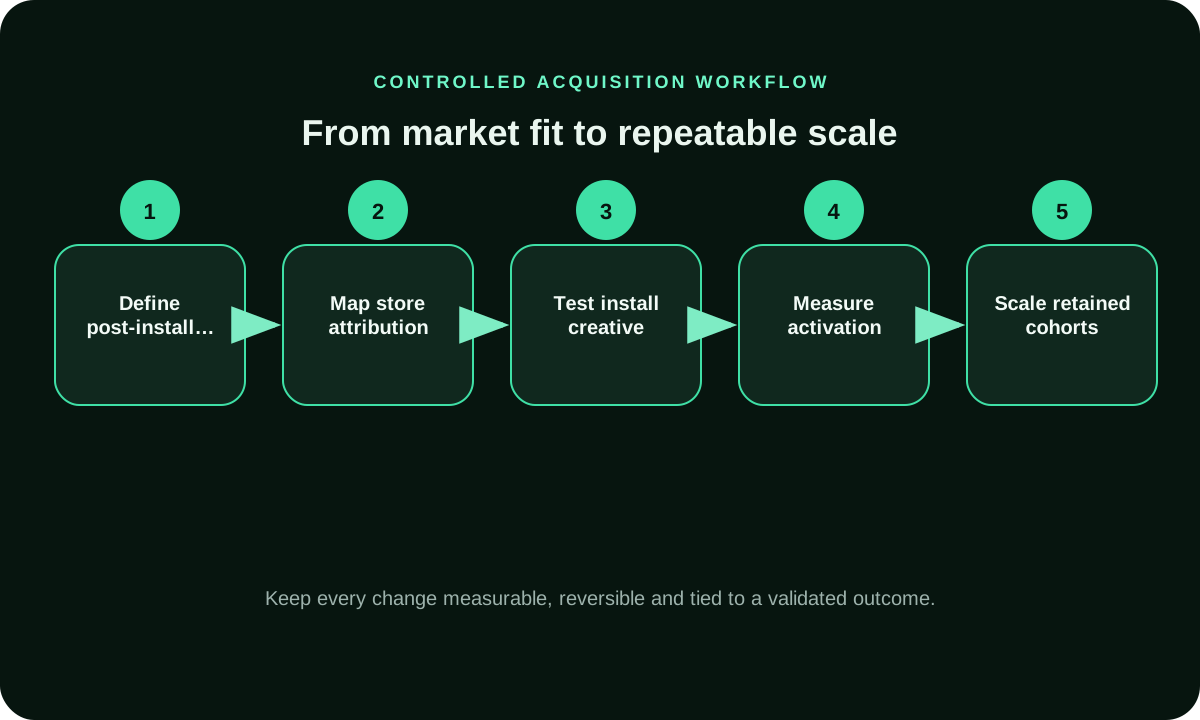
A practical launch moves from a written hypothesis to a measured decision. Confirm the app and store destination, select markets and devices the product supports, prepare a creative that makes a truthful promise, and validate the click path. Create a campaign structure that preserves the source and creative breakdown you need. Start with a controlled cap; inspect delivery and tracking separately; wait for the outcome window to mature; then compare accepted-user cost and downstream behavior with your ceiling. Change one major variable at a time so a result can be explained. If the first sample does not answer the question, extend it only when the remaining budget and expected evidence justify doing so. Close the test with a record of the audience, bid, creative, destination, exclusions and attribution settings. That makes a repeat test an informed continuation instead of a fresh guess.
Segment App User Acquisition Network Without Losing Reach
Targeting should remove ineligible traffic and support a specific comparison. Begin with countries where the app is available, languages the onboarding supports and operating systems or devices the app can serve. Use city, carrier, browser, category or source controls only when the campaign setup exposes them and the reason is clear. A narrow audience can make a dashboard look tidy while starving the test of usable volume; broad delivery can also conceal different store conversion or retention patterns. Keep a wider baseline when possible, then isolate one segment that has a business reason to differ—for example, a localized offer or a platform-specific onboarding flow. Compare segments with the same event definition, attribution window and maturity period. Do not attribute a change to geography if creative, bid, destination and offer all changed together.
Creative, Message and Destination Continuity
The ad and store listing need to describe the same product experience. Show a feature the app currently offers, use the correct product name and locale, and make the next step understandable before the click. The listing should reinforce that message with matching screenshots, pricing and eligibility. After installation, check that the first open reaches the promised feature without a broken deep link, forced extra step or unrelated offer. For an app subscription, explain the trial or recurring charge accurately; for a game, show representative play rather than an unrelated reward; for a utility, demonstrate the job it performs. Avoid fake system alerts, misleading buttons and claims the app cannot substantiate. These checks improve the quality of the test because the creative, store conversion and early app behavior can each be diagnosed rather than blended into one install total.
Use Source-Level Quality Controls
Source-level review is how a media buyer separates delivery from user quality. Keep the platform's campaign and source identifiers connected to your attribution and app reports, and inspect cost alongside accepted events, time-to-event, duplicate patterns and downstream value. A source with no accepted users may simply have insufficient volume or a long conversion lag; it should not be labeled low quality from one short window. Repeated invalid or rejected events, however, warrant investigation with the tracker and backend before budget grows. Use exclusions for verified waste and retain the reason and date so another buyer does not repeat the same test. Keep a comparison baseline when changing bids or source lists. FroggyAds source and campaign reporting can help you locate where paid delivery differs; your own validation rules determine whether the resulting users meet the app's business definition.
Scale App User Acquisition Network in Measured Increments
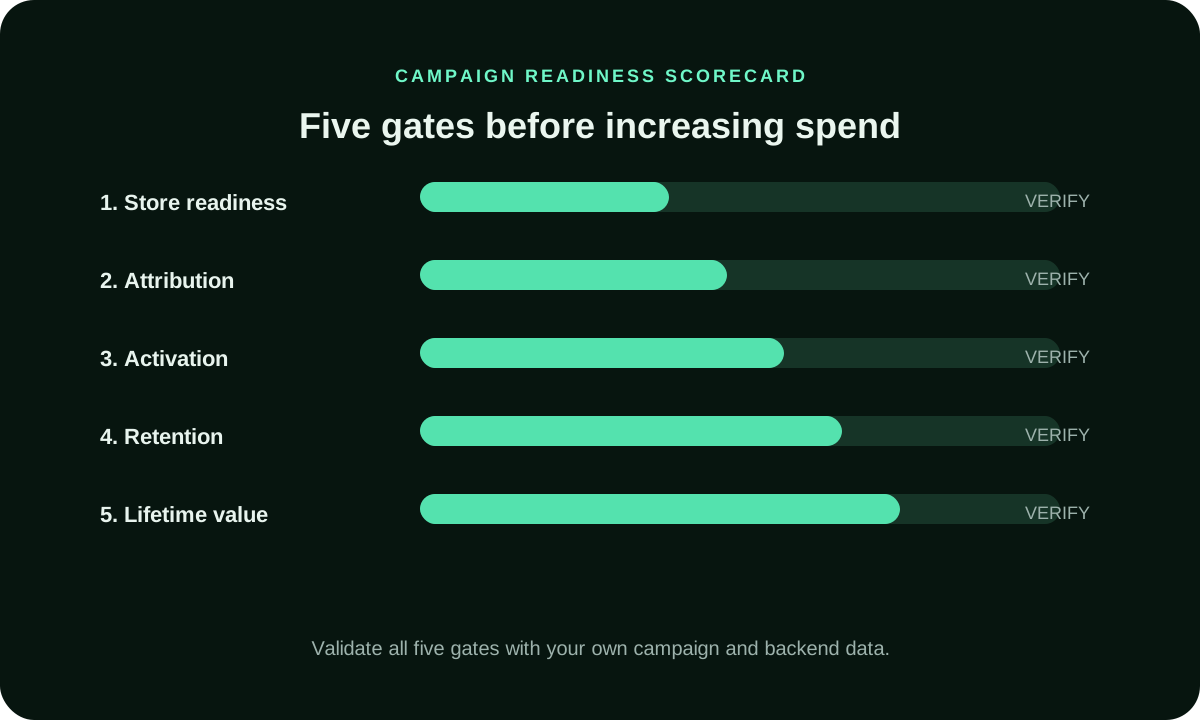
Scale by asking whether the next unit of spend is likely to preserve the result, not whether the blended campaign average still looks acceptable. Review marginal acquisition cost, the share of users reaching the accepted event, retention or revenue at the appropriate maturity point, and the extra support or capacity required. Increase exposure in a controlled way and give each change time to produce comparable evidence. When expanding into another country, operating system, format or source group, keep that expansion identifiable in reporting. A new cohort can have a different store conversion rate or onboarding fit even when the ad is unchanged. Pause expansion if measurement breaks, the app listing changes, invalid events rise or the marginal cost exceeds the value limit. FroggyAds gives you campaign controls for further tests; it cannot guarantee that a previously successful segment will remain efficient at higher spend.
Interpret Volume and Quality Together
Read acquisition quality as a sequence, not a single dashboard number. Compare impressions or clicks with store-page activity, downloads, first opens, onboarding completion and the product event your business values. For each transition, ask whether tracking is available, whether its delay is understood and whether the denominator is consistent. A low click cost can coexist with weak store conversion; strong install volume can coexist with poor activation; early revenue can still be distorted by refunds or a small sample. Review cohorts over relevant time periods, not just calendar totals, and separate attributed results from modeled or unassigned activity. If your team operates across iOS and Android, align naming and business definitions while respecting that the platforms may expose different reporting signals. The goal is a trustworthy comparison that tells you what to change next.
Common Failure Modes to Avoid
Common failures begin before campaign optimization. Teams send ads to an outdated listing, target a country where the app cannot be downloaded, or count a click or download as a valuable user without checking the first open. Others lose source IDs, compare different attribution windows, change creative and bids together, or block sources before enough eligible traffic arrives. A dashboard may also overstate certainty when the outcome window is still open or a few users dominate the average. Fix these issues in order: confirm destination and eligibility, test the tracking path, align event definitions, then evaluate the media. If an event count differs between systems, write down each system's definition and time window before diagnosing fraud or platform delivery. This gives your team a defensible basis for budget decisions and prevents a normal reporting difference from becoming an unsupported accusation.
How FroggyAds Supports App User Acquisition Network
FroggyAds is a self-serve ad network for advertisers, affiliates and media buyers who want to manage paid traffic directly. We give you campaign controls for supported GEOs and other targeting dimensions, budget and bidding settings, traffic formats, and campaign/source reporting. Our platform has more than 750 SSP integrations and reports access to 20 billion-plus daily impressions across supported inventory; those figures describe platform scale, not a promise of app installs, a particular country volume or a result for your campaign. For app marketers, the practical advantage is the ability to launch a controlled traffic test, compare eligible audience or source groups and make a budget decision from campaign evidence. You bring the app, accurate creative, store readiness, attribution setup and definition of a valuable user. We recommend starting with the app outcome and then choosing the FroggyAds controls that let you test it clearly.
Final Buyer Checklist for App User Acquisition Network
Before launch, save a short test brief with the app version, eligible markets, supported devices, store URL, creative promise, accepted event, attribution window, spending cap and stop rule. Verify that a test click reaches the intended destination and that source identifiers survive the route where your stack allows them. During delivery, check pacing and technical errors separately from post-install quality. After the event window matures, compare accepted users and their downstream behavior with the cost limit you set. Keep the settings and evidence together so the next buyer can reproduce or challenge the conclusion. If the economics are promising, expand one dimension at a time. Create a free FroggyAds account to set up the paid campaign; use your own app analytics and business data to decide whether the acquired cohort merits more investment.
Supporting controls for App User Acquisition Network
App User Acquisition Network FAQ
What is an app user acquisition network?
An app user acquisition network is paid media inventory used to bring potential users to an app listing or app experience. Judge the traffic by its contribution to verified installs and meaningful post-install activity, not by clicks alone.
Who should use a paid app user acquisition network?
It suits advertisers, affiliates and media buyers who have an app available in the chosen market, a prepared store destination and working measurement. For App User Acquisition Network, test whether paid traffic leads to an accepted post-install event; App User Acquisition planning also covers product, lifecycle and other growth channels.
How much budget should I set for app user acquisition?
Set a capped test budget from your maximum acceptable cost per activated or retained user, expected conversion delay and the amount of evidence you need. There is no reliable universal budget for every app or market.
Which metric matters most for app user acquisition?
Use cost per activated or retained user when that is your business outcome. Cost per install is an earlier checkpoint; CPC, CPM, click-through rate and store conversion help explain how traffic moved through the funnel. For App User Acquisition Network, keep delivery cost separate from App User Acquisition value so a cheap click is not mistaken for a valuable user.
How do I track app user acquisition campaigns?
Use campaign and source identifiers alongside your mobile measurement, store and backend reports. Reconcile attribution windows and accepted events before comparing acquisition cost.
How long should an app user acquisition test run?
Run the test through the expected click-to-event delay and long enough to compare more than one source or time period. Stop sooner if tracking fails or the predefined loss limit is reached.
How can I assess app traffic quality?
Check source-level cost, event validity, time to first open, activation, retention and backend value. Investigate unexplained gaps before labeling a placement or cohort invalid.
When should I scale app user acquisition?
Increase spend only when attribution is stable, the accepted-user cost is within your limit and mature cohorts remain useful as volume grows.
What mistakes should app advertisers avoid?
Do not treat every download as a retained customer, use mismatched attribution windows, or scale from an immature cohort. Keep ad claims accurate and avoid diagnosing traffic quality from a small or incomplete sample. For App User Acquisition Network, validate a concern with source, event and backend evidence; do not assume App User Acquisition performance from installs alone.
Can I use FroggyAds for app user acquisition?
Yes. FroggyAds offers self-serve campaign, targeting, budget and source-reporting controls for a paid traffic test. Your app analytics should validate installs and post-install value.
Related resources for paid app growth
Build a controlled app user acquisition network test
Prepare the app and listing, define the accepted event, verify tracking and set a capped test before buying traffic. For App User Acquisition Network, use campaign evidence to decide whether a paid cohort merits more budget; compare it with App User Acquisition value only after your own event data is validated.
Build a market and measurement brief
This buying decision is for app growth teams that want to test paid traffic against an outcome the business can verify. FroggyAds manages campaign delivery controls and traffic reporting; your app analytics, MMP or backend defines whether a download became an install, activation, retained user or sale. For App User Acquisition Network, keep that division clear and evaluate the paid source against an accepted post-install event. Broader App User Acquisition planning also includes product, lifecycle and channel strategy.
| Decision layer | Evidence to retain | Review rule |
|---|---|---|
| Scope and accepted event | Name the app event that makes an acquired user valuable, such as a first open, completed signup, trial start or purchase. | Use one event definition across the campaign, measurement stack and business review. |
| Audience and eligibility | List available countries, supported languages, operating systems, devices and any offer restrictions. | Exclude contexts the app cannot serve; keep optional targeting broad until a test can explain a segment difference. |
| Store and offer continuity | Check the app name, locale, screenshots, pricing and first in-app step against the ad promise. | Keep the creative, store listing and initial experience aligned and current. |
| Inventory and source context | Retain campaign, creative, source and device identifiers available in your buying and measurement tools. | Compare source groups only when the event definition, attribution window and review period are consistent. |
| Budget and bid discipline | Set a maximum cost per accepted user, a capped test exposure and a written stop condition. | Review mature user quality and marginal cost; CPC or CPM alone cannot establish value. |
Which app event is valuable to your business?
Start with the app outcome rather than the keyword. What App User Acquisition Network Means in Paid Acquisition is the decision about which paid traffic to test, in which eligible markets and against which accepted event. Write down the event, reporting source, attribution window and rejection rule before launch. If the app is unavailable in a selected storefront or the first-run experience is incomplete, address that readiness gap before increasing paid delivery.
Keep app availability, device and operating-system eligibility attached to the media plan. Compare a segment only when it represents a real difference in user access, localization or product experience. A neighboring page may cover app growth broadly; this one should help a buyer decide how to test paid inventory and judge the resulting users.
Next step: Build a test around an eligible app, a prepared store listing and a defined post-install event. Set an affordable cap, retain the identifiers needed for source analysis and wait for relevant outcomes to mature before changing bids or adding inventory. Create your free FroggyAds account. Use App User Acquisition Network for the paid-traffic decision; let App User Acquisition value data determine whether to continue.
How to compare paid app acquisition sources
Use this guide when you need to compare paid app traffic against installs, activation or retention. For broader product, funnel and channel planning, read App User Acquisition; keep the decision here on inventory, campaign controls, measurement readiness and observed cost per accepted user.
Follow each paid cohort from ad click to store-page view, download, first open and the in-app action that matters. The gaps between stages show whether the issue is delivery, listing conversion, activation or later retention.
| Checkpoint | Page-specific action | Evidence to keep |
|---|---|---|
| Fit | Confirm app availability, store readiness and audience eligibility before launch. | Store locale, app version, creative and destination URL. |
| Test | Separate click, store, first-open, activation and retention evidence before comparing media sources. | Campaign/source IDs, accepted-event definition and attribution window. |
| Decision | Keep, limit, exclude or expand based on mature user quality and marginal acquisition cost. | Cohort results, rejected-event notes and the settings changed. |
Plan with your own economics: maximum media cost per accepted user equals the contribution value you can afford to spend after expected variable costs. If purchase is the goal, work backward from contribution margin and the share of acquired users who purchase. This is a planning relationship, not an observed FroggyAds result or a price quote. Replace each input with validated data from your own app and update the limit when mature cohorts differ.
Choose FroggyAds when you want a self-serve way to test paid app traffic with campaign targeting, budget and source controls. Our platform provides access to 750+ SSP integrations and more than 20 billion daily impressions across supported formats and markets; this is platform-level scale, not a commitment to any app-specific volume or result. Keep post-install measurement in your own analytics stack, then use the campaign evidence to decide whether another test deserves funding. Create your free FroggyAds account.
Turn acquisition evidence into your next campaign decision
Paid app acquisition earns more budget when a clearly defined cohort reaches the event your business values at an acceptable cost. Use source-level evidence to decide whether to keep, limit or expand a campaign.