
App User Acquisition: Campaign Economics, Attribution and Retention
App user acquisition is the controlled process of bringing eligible new users into an app and learning whether they activate, remain useful and create accepted value at a sustainable total cost. A dependable program connects campaign, store, install, first open and in-app events while respecting the limits of platform attribution and privacy. The operating goal is qualified cohort growth, not the largest possible installation count.
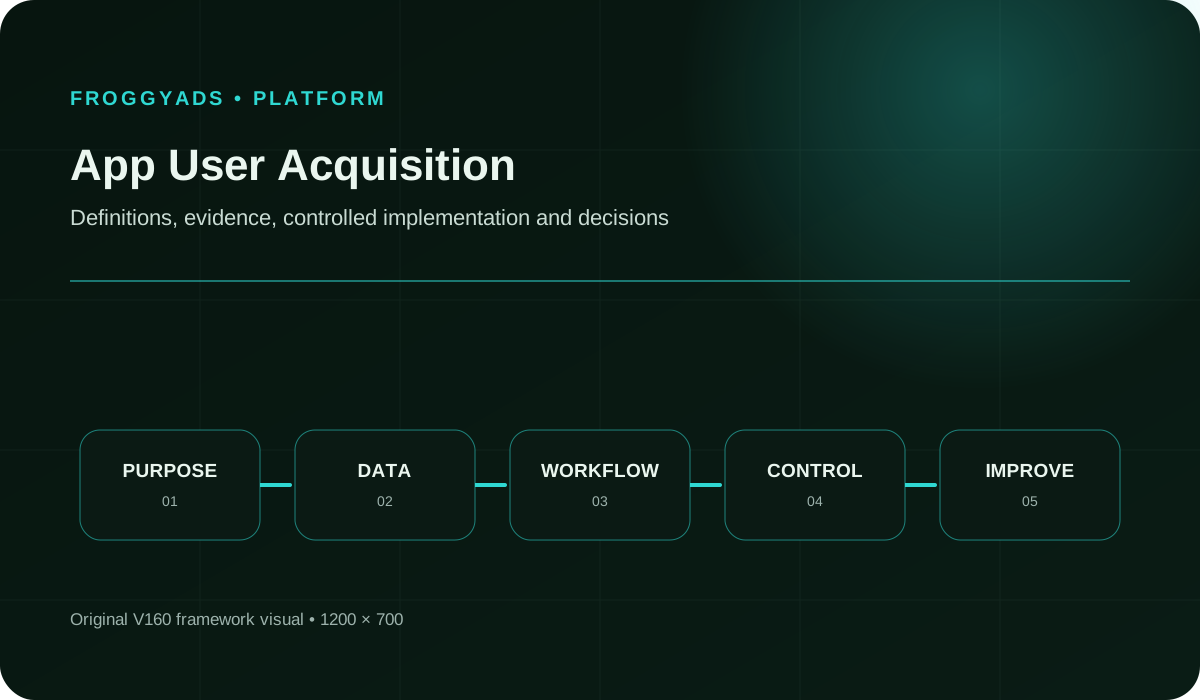
Official app acquisition signal and referrer boundary
Google's App campaign guidance recommends tracking more than the primary goal, including leading interactions that help distinguish users likely to create value. Android's official Install Referrer API documentation says the API can securely return referrer information, click and install timestamps, the installed app version and prior instant-experience information for compatible Google Play installations. These are useful measurement inputs, not complete identity, causality or lifetime-value proof. A user-acquisition design should define its accepted activation and value events, record where referrer evidence is available or absent, and reconcile platform reporting with app and financial records. Eligibility, privacy behavior and implementation details can change, so developers should use the current official documentation for each store and advertising platform. The test record should also state the app build, retrieval coverage and error behavior, allowing missing referrer rows to remain visible instead of being assigned to a convenient source.
- Google App campaign conversion tracking guidance - official primary and leading-event context
- Android Install Referrer API - official referrer fields and implementation boundary
Define a qualified acquired user
Write the eligibility and accepted-state rules before buying traffic. A new installation may need to become a verified account, complete onboarding, reach a core feature, start an approved trial or create another product-specific event before it counts as qualified. Exclude internal tests, duplicates, unsupported markets, invalid transactions and users already in the declared population. Product and finance should approve the definition used for value.
Keep install, first open, activation, retained state and economic outcome as separate fields. Their gaps diagnose different problems: store friction, technical launch failure, weak onboarding, poor product fit or low downstream quality. An acquisition source can deliver inexpensive installs while failing the business definition. The program should therefore optimize and report without erasing the later accepted outcome.
Map the journey and ownership
Draw the observable path from ad or referral through destination, store, installation, first launch, consent, onboarding and accepted event. Mark which team owns each surface and which system records its timestamp. Store and platform privacy rules may prevent a person-level join, so state aggregate or modeled segments plainly instead of filling them with assumptions.
Assign a campaign owner, product owner, analytics owner and finance approver. Define the person who can stop spend when a link, event or app release fails. Shared ownership does not mean unclear authority: every gate should name who supplies evidence and who accepts the residual uncertainty.
Connect App User Acquisition to a controlled audience test
Use the choices established in “Map the journey and ownership” to define one audience, budget and source set in FroggyAds. Keep the surrounding offer and measurement rule stable so the test adds evidence to app user acquisition instead of mixing several changes at once.
Create My Free Account
Choose primary and leading events
Google's official guidance recommends tracking the main goal together with leading interactions that help App campaigns identify valuable users. Translate that principle into an app-specific event ladder. Each event needs a trigger, identifier, time, duplicate rule, permitted attributes and validation case. Avoid selecting every available event; noisy or circular signals can make delivery and analysis harder to interpret.
A leading event may guide optimization sooner than retained or paid value is known. Monitor the relationship between the leading and accepted event by cohort. If that relationship deteriorates after a release or audience change, pause scale or choose a better signal. Do not claim the leading event is revenue or lifetime value merely because it correlates during one period.
Prepare the store and first-run experience
Align the acquisition promise with the store listing and first session. Review icon, screenshots, description, permissions, ratings context, localization, app size, device compatibility and release notes where relevant. Then test installation, deep or deferred navigation, account creation, consent, paywall, purchase and error recovery on supported devices. Preserve the app and store version used.
Measure the transition from store view to install and from first open to activation without assuming a change is caused by advertising. A broken destination or confusing first run invalidates a source-quality conclusion. Repair known product friction before purchasing a large cohort, or explicitly classify the media test as a destination diagnostic.
Establish campaign and source identifiers
Create a naming and identifier contract for platform, account, campaign, ad group or source, creative, market, operating system, destination and app version. Preserve original platform identifiers as well as readable labels. Names can be edited and reused, while immutable identifiers and timestamps let a reviewer connect exports to the configuration that actually ran.
Do not place sensitive or unnecessary user information in URLs or campaign parameters. Approve identifier use through privacy and security review. Where an ad network or store supplies only aggregate data, document the granularity and design decisions at that level instead of inventing record-level precision.
Use Install Referrer evidence within its limits
For compatible Google Play installations, Android documents Install Referrer fields including the referrer URL, click and install timing, installed app version and prior instant-experience information. Implement the API according to the current developer guidance and test supported, unavailable and error paths. Store only what the approved acquisition use requires.
A referrer can help connect an installation context to campaign evidence, but it is not universal across stores and does not prove that advertising caused later value. Document coverage, retrieval timing, duplicate behavior and missing records. Keep referrer, platform attribution and app event evidence as related sources rather than treating any one of them as complete truth.
Choose a paid-media format that supports App User Acquisition
Use the criteria around “Use Install Referrer evidence within its limits” to decide whether push, native, display or pop fits the message and destination. Set format, targeting and spend as campaign controls in FroggyAds while the app user acquisition decision remains the standard for judging the result.
Create My Free Account
Build a cohort ledger
Create rows or governed aggregates for acquisition date, platform cell, market, operating system, app version, install or first open, leading events, activation, retained checkpoints, accepted value, rejection and reversal. Align timezone and define the cohort cutoff. Preserve unknown rather than changing missing observations to zero without evidence.
Follow each cohort for a declared maturation period. Publish early operational views and later quality views with clear labels. Cohorts acquired under different product releases, offers or measurement rules should not be blended without a documented adjustment. The ledger should let product, marketing and finance reproduce the decision from approved exports.
Measure complete acquisition cost
Add media, network or platform fees, creative production, store work, measurement engineering, tools, agency services, incentives, review labor and taxes where material. Separate one-time setup from recurring cost and allocate shared work using a stated rule. Vendor-reported spend remains a purchased-cost source, while the internal ledger supplies the broader decision denominator.
Calculate cost per install for delivery diagnosis and cost per qualified or accepted user for the business decision. Recompute after reversals and maturation. A source can appear efficient at install and expensive at activation; preserving both stages prevents the cheaper upper-funnel price from concealing weak downstream quality.
Control creative and audience cells
Tie every creative concept to a user need, product proof and next action. Render the asset in its actual format and keep claims, rights, captions, localization and destination approval with the version. Define audience eligibility and exclusions in terms the platform can implement. A broad label such as gamers or shoppers is not sufficient evidence of intent.
Change one major dimension at a time where learning is the purpose. Freeze the app experience and accepted event, record automated allocation and establish the cell's maximum spend. Do not declare a permanent audience or creative winner from one auction period. The conclusion applies to the observed configuration and should be retested when the offer, app or inventory changes.
Reconcile attribution and accepted outcomes
Align click and view rules, event windows, timezone, currency and duplicate handling before comparing platforms. Sample platform-attributed conversions toward the app ledger and accepted events back toward available campaign evidence. Maintain unmatched, modeled, rejected and reversed categories. Differences can arise from privacy, identity, processing and attribution rules without implying that either source is fabricated.
Describe attributed acquisition separately from incremental acquisition. A credible holdout or other counterfactual can support a causal estimate; otherwise state the limitation and use bounded decisions. Avoid summing overlapping platform claims into a total number of users caused by marketing.
Turn App User Acquisition into a bounded campaign test
With “Reconcile attribution and accepted outcomes” documented, launch only the next reversible test. Set a spending limit, preserve the baseline and use source-level and audience controls so the next step depends on qualified outcomes for app user acquisition, not activity volume.
Create My Free Account
Detect quality and technical failures
Monitor abnormal click-to-store, store-to-install and install-to-first-open gaps, event duplication, impossible timing, unsupported geography, unusual device concentration, refunds and rejected outcomes. These signals require investigation; poor conversion alone does not prove invalid activity. Preserve source detail and technical evidence before changing a fraud label or excluding a partner.
Include app crashes, login defects, slow onboarding, payment failures and support contacts in acquisition review. A campaign can reveal a product problem that should pause all sources. Route each anomaly to an owner, cap exposure during investigation and document the evidence required to restore delivery.
Run a bounded acquisition pilot
Select one app version, destination, accepted event, market and small set of campaign cells. Validate install and in-app events before opening spend. State the maximum loss, review times and stop authority. The pilot should exercise measurement and product operations as well as buy traffic; it is not a miniature guarantee of scaled performance.
Evaluate mature qualified-user cost, cohort quality, reporting joins, staff effort, policy incidents and destination reliability. Keep uncertain results at the existing cap. Scale only when the accepted outcome reproduces and support or product capacity can absorb more users. Increase one budget, audience, source or creative dimension at a time.
Protect data and account control
Inventory advertising accounts, store consoles, analytics properties, app credentials, audience data, event payloads and exports. Apply least privilege and separate billing, editing, analysis and administration. Test access removal and credential rotation. Suppliers should operate through approved roles rather than owning the advertiser's core account or sharing a broad login.
Review purposes, retention, regions, subprocessors and deletion for acquisition data. Use synthetic records in vendor evaluation when possible. An attractive cost cannot authorize an unreviewed customer list or event field. Record what can be exported and which evidence remains available when a tool or partner relationship ends.
Govern scale, pause and portfolio change
Predefine pause triggers for broken links, event loss, app instability, policy issues, unexpected data use, abnormal spend or qualified-user cost beyond tolerance. Predefine scale gates using mature accepted outcomes, stable leading-signal relationship and operational capacity. An average historical cost should not be projected onto added spend because the marginal audience and auction can differ.
Review the acquisition mix after material app releases, market entry, attribution changes, platform updates, price changes or deterioration in cohort quality. Preserve the former scorecard and configuration. Move budget through a written portfolio decision rather than an automatic ranking, keeping diversification, evidence coverage and transition risk visible.
Connect retention evidence to acquisition decisions
Choose retention checkpoints that reflect the app's actual use cycle rather than copying a daily or monthly convention from another product. Define eligibility for each checkpoint, how reinstallation or account recovery behaves, and which product changes occurred during the cohort's observation. Compare retained states only after equal maturation. A source with fewer early activations can still create more durable users, while a promotion can create temporary use that disappears when the incentive ends.
Keep acquisition action tied to evidence the campaign can influence. When retention falls across every source after a release, route the problem to product review instead of excluding traffic partners one by one. When one cell changes while product conditions remain stable, cap it and investigate audience, creative promise, destination and invalid-event patterns. Document uncertainty and the next checkpoint; projected lifetime value should never replace the observed retention states on which the projection depends.
Retain the cohort extract, app version, checkpoint definition and exclusions used in each review. Recalculate after late events or account merges instead of overwriting the prior decision. If retention cannot yet be observed, label the result immature and keep spend inside the pilot limit. A named future review date is more honest and more useful than filling the missing horizon with an unverified industry benchmark. The reviewer should also record whether notifications, pricing, onboarding or service conditions changed after acquisition, because those changes can alter retained behavior without saying anything reliable about the original source.
App user acquisition operating matrix
The matrix joins campaign evidence to product and financial acceptance. Missing attribution is disclosed; it is never repaired by inventing a user-level path.
| Layer | Evidence | Control |
|---|---|---|
| Eligibility | Audience, market, app version and exclusion rules | Count only the declared population |
| Journey | Store, install, first open and activation tests | Pause when the user path is broken |
| Identity | Campaign IDs, referrer coverage and known gaps | Use only supported joining precision |
| Quality | Mature accepted events, rejections and reversals | Scale qualified cohorts, not raw installs |
| Economics | Complete cost and marginal decision limit | Increase exposure in reversible steps |
Retained acquisition, paid-media and official resources
The original internal routes, official references, call to action and image are retained in their prior sequence. Use the destinations to check current platform requirements; the links do not guarantee a campaign result or establish complete attribution.
App user acquisition questions
When is paid app user acquisition a suitable growth tool?
Paid acquisition is suitable when the app has a stable onboarding path, a defined valuable event and enough retention data to judge new users. It should not be scaled from install counts alone.
How should a first app acquisition test be designed?
Choose one market, operating system, audience, creative set and post-install event with a fixed budget and cohort window. Test attribution before purchasing volume.
Which inputs shape an app user acquisition budget?
Include media price, install validity, activation, retention, monetization delay, platform fees and creative work. Use conservative cohort value and a loss limit rather than a single lifetime-value forecast.
How does audience qualification affect app acquisition economics?
Users with a clear need for the app may cost more to acquire but complete stronger product events and retain longer. Compare mature cohort value by source, not initial install price.
How should app acquisition creative match onboarding?
The ad should present the same capability, eligibility and effort the user meets after installation. Carry the message into the store listing and first product session.
What must be ready before an app user acquisition campaign starts?
Prepare accurate store pages, working deep links, consent handling, crash monitoring and a tested first-value event. Confirm supported devices and versions for each campaign cell.
Which metrics matter for app user acquisition decisions?
Review valid installs, activation, retained usage, accepted revenue and effective acquisition cost by cohort. Report attribution uncertainty and delayed value separately.
How can weak app acquisition outcomes be diagnosed?
Check creative-to-store continuity, install validity, onboarding completion, technical stability and cohort retention by source. Distinguish attribution loss from users who genuinely disengage.
Which privacy and claim guardrails apply to app acquisition?
Honor platform consent rules, minimize device-level data and avoid claims the app cannot demonstrate. Keep sensitive user traits out of ad targeting and tracking parameters.
What evidence supports scaling app user acquisition?
Scale after activated cohorts retain and create acceptable value across comparable windows with stable attribution. Increase one market, source or daily cap gradually.
App User Acquisition: Campaign Economics, Attribution and Retention: what should the advertiser decide next?
For App User Acquisition: Campaign Economics, Attribution and Retention, the commercial task is to turn app user acquisition into one measurable campaign decision. Use Build acquisition from eligible user to mature cohort to define the audience or problem, use Official app acquisition signal and referrer boundary to constrain the test, and decide in advance which accepted result would justify more FroggyAds spend.
On this App User Acquisition: Campaign Economics, Attribution and Retention page, the decision should remain tied to the existing evidence around Build acquisition from eligible user to mature cohort, Official app acquisition signal and referrer boundary and Define a qualified acquired user. Those sections give app user acquisition its specific context; the table below turns that context into campaign actions rather than adding another generic definition.
| Decision | What to verify | FroggyAds action |
|---|---|---|
| App User Acquisition: Campaign Economics, Attribution and Retention objective | Use Build acquisition from eligible user to mature cohort to define the accepted business event and the maximum learning loss for app user acquisition. | Launch one FroggyAds campaign objective for App User Acquisition: Campaign Economics, Attribution and Retention and keep the conversion definition stable. |
| App User Acquisition: Campaign Economics, Attribution and Retention audience | Use Official app acquisition signal and referrer boundary to verify market, device, language and offer eligibility for app user acquisition. | Apply only the FroggyAds targeting controls that change the real App User Acquisition: Campaign Economics, Attribution and Retention customer journey. |
| App User Acquisition: Campaign Economics, Attribution and Retention source evidence | Use Define a qualified acquired user to keep source-level differences visible instead of relying on one blended app user acquisition average. | Keep, cap, exclude or retest App User Acquisition: Campaign Economics, Attribution and Retention inventory from documented source evidence. |
| App User Acquisition: Campaign Economics, Attribution and Retention economics | Use Map the journey and ownership to connect media spend with accepted conversions and downstream value for app user acquisition. | Protect the App User Acquisition: Campaign Economics, Attribution and Retention test with a written budget boundary and a consistent attribution window. |
| App User Acquisition: Campaign Economics, Attribution and Retention scale rule | Use Connect App User Acquisition to a controlled audience test to define the exact evidence that earns the next budget increase for app user acquisition. | Scale App User Acquisition: Campaign Economics, Attribution and Retention one major control at a time and compare marginal performance with the prior baseline. |
A campaign-specific FroggyAds test sequence for App User Acquisition: Campaign Economics, Attribution and Retention
- App User Acquisition: Campaign Economics, Attribution and Retention outcome: define the accepted event for app user acquisition and the maximum loss permitted while the first test is learning.
- App User Acquisition: Campaign Economics, Attribution and Retention path: verify market eligibility, device experience, landing-page continuity and tracking against Build acquisition from eligible user to mature cohort before buying more traffic.
- App User Acquisition: Campaign Economics, Attribution and Retention hypothesis: launch one bounded FroggyAds test tied to Official app acquisition signal and referrer boundary; do not change bid, creative, audience and destination together.
- App User Acquisition: Campaign Economics, Attribution and Retention source review: compare qualified activity, accepted conversions, timing and cost by the source or segment dimensions relevant to Define a qualified acquired user.
- App User Acquisition: Campaign Economics, Attribution and Retention scaling: use Map the journey and ownership and Connect App User Acquisition to a controlled audience test to define what must reproduce before the next budget increase.
Why FroggyAds is relevant to App User Acquisition: Campaign Economics, Attribution and Retention
For App User Acquisition: Campaign Economics, Attribution and Retention, FroggyAds gives advertisers a self-serve DSP and ad-network workflow for buying supported traffic with campaign-level budgets and targeting. Depending on format and campaign context, available controls can include country, city, device, operating system, browser, carrier, category, source, ID and IP options. SmartCPC and Adscore-supported traffic-quality controls can support the app user acquisition optimization process, while the advertiser's tracker, analytics and backend acceptance remain the final evidence for commercial quality.
Use Connect App User Acquisition to a controlled audience test as the final checkpoint for App User Acquisition: Campaign Economics, Attribution and Retention. If the accepted result does not reproduce after the next meaningful volume step, return to the last stable configuration instead of widening several controls at once.
App User Acquisition: Campaign Economics, Attribution and Retention: the buyer decision this guide supports
For app growth teams, App User Acquisition: Campaign Economics, Attribution and Retention should shorten the path from research to action: make a measurable paid-acquisition decision. The page therefore stays focused on controllable campaign evidence and leaves adjacent intents to their own URLs. The nearest related FroggyAds page is App User Acquisition Network; this URL keeps ownership of the distinct task to make a measurable paid-acquisition decision.
Keep in-app inventory, mobile device, interstitial, OS targeting in the App User Acquisition: Campaign Economics, Attribution and Retention evidence record because they can change how this media test is configured, measured or scaled.
| Checkpoint | Campaign action | Evidence to keep |
|---|---|---|
| Fit | Define the buyer, accepted outcome and non-negotiable constraint. | Retain evidence specific to App User Acquisition: Campaign Economics, Attribution and Retention and its accepted outcome. |
| Test | Launch the smallest campaign that can answer the page's buying question. | Retain evidence specific to App User Acquisition: Campaign Economics, Attribution and Retention and its accepted outcome. |
| Decision | Keep, cap, exclude or expand from accepted-outcome evidence. | Retain evidence specific to App User Acquisition: Campaign Economics, Attribution and Retention and its accepted outcome. |
Hypothetical calculation: if a controlled campaign for app user acquisition: campaign economics, attribution and retention spends USD 150 and produces 6 accepted conversions, accepted CPA is USD 150 ÷ 6 = USD 25.0. Replace the inputs with your own campaign economics; this is not a FroggyAds performance claim.
Start the paid-media test for App User Acquisition: Campaign Economics, Attribution and Retention with FroggyAds when you need direct control over formats, targeting, budgets and source evidence. Increase spend only after the result supports the next acquisition step. Create your free FroggyAds account.
App User Acquisition: Campaign Economics, Attribution and Retention — what matters first
App User Acquisition: Campaign Economics, Attribution and Retention is most useful when it helps a buyer decide whether this option fits the buyer's acquisition workflow. Define the accepted outcome first, then use targeting, budget and source-level evidence to decide what deserves more spend.