Service model guide for app acquisition teams

App Promotion Services: Choose the Right Operating Model

App promotion services range from fully managed agencies to self-serve media platforms. Use this guide to define the work you need, protect your data and keep every acquisition decision measurable.

FroggyAds gives your team direct campaign control through a self-serve DSP. You decide when to launch, what to test and which evidence justifies the next budget move.

App promotion service operating model and decision workflow
Direct answer

What does an app promotion service actually do?

An app promotion service helps a mobile product reach potential users through paid media, but the phrase does not identify a single delivery model. An agency may plan the strategy and execute campaigns for you. A managed buying desk may operate media against your brief. A self-serve platform gives your team the inventory, targeting and campaign controls while you retain day-to-day ownership. The right choice depends on which decisions your team can make confidently and which tasks require outside support.

FroggyAds is the self-serve option in that comparison. We provide an advertising platform where you configure campaigns, choose eligible audiences, set commercial limits and review source-level performance. This arrangement suits app developers, affiliate marketers, media buyers, agencies and online businesses that want their learning to remain inside the business. You can move quickly without waiting for another company to translate every test, while still deciding when specialist creative, analytics or consulting help would add value.

Operating model

Separate strategic help from media access

Buy the missing capability rather than an impressive service label. A precise scope prevents duplicated work, hidden dependencies and unclear campaign ownership.

ModelYour team ownsProvider contributesBest fit
Self-serve DSPBrief, setup, creatives, tracking review, optimization and budget approvals.Campaign interface, traffic access, targeting choices and reporting controls.Teams with an offer, a mobile route and an operator who can act on evidence.
Managed media buyingBusiness objective, assets, measurement acceptance and commercial guardrails.Configuration, monitoring and recommendations within an agreed mandate.Teams that understand acquisition but lack daily execution capacity.
Full-service agencyProduct truth, approvals, access, final economics and internal stakeholder decisions.Strategy, creative coordination, media execution and scheduled reporting.Organizations that need several specialist disciplines coordinated together.
FroggyAds recommendation: choose our self-serve platform when direct control, fast testing and transparent operational learning matter more than delegating every task. Add outside expertise only for the capability you can name and evaluate.
Capability audit

Decide whether self-serve control matches your team

A self-serve campaign works best when five practical owners can be named before launch. One person may hold several roles, but none of the decisions should be ownerless.

Product owner

Defines the promised app value, eligible countries, supported devices and any onboarding conditions. This owner prevents the advertisement from attracting users the product cannot serve.

Media operator

Builds the campaign, applies targeting, watches delivery and records every bid, cap or source change. The operator needs authority to stop waste without waiting through a long approval chain.

Creative owner

Produces compliant concepts for each format and keeps the advertising promise aligned with the store listing or mobile destination. The role includes version control, not only design production.

Measurement owner

Confirms that clicks, installs, registrations and valuable in-app events can be reconciled. This person documents the attribution window and explains which records are provisional.

Commercial owner

Sets the amount available for discovery, the cost boundary for a qualified outcome and the conditions for scaling. Budget increases require this owner's approval.

Service coordinator

If an agency or consultant is involved, this owner defines access, deliverables, meeting cadence and evidence handoff. The contract should support the campaign process instead of replacing it.

Acquisition workflow

Build one closed learning loop before buying scale

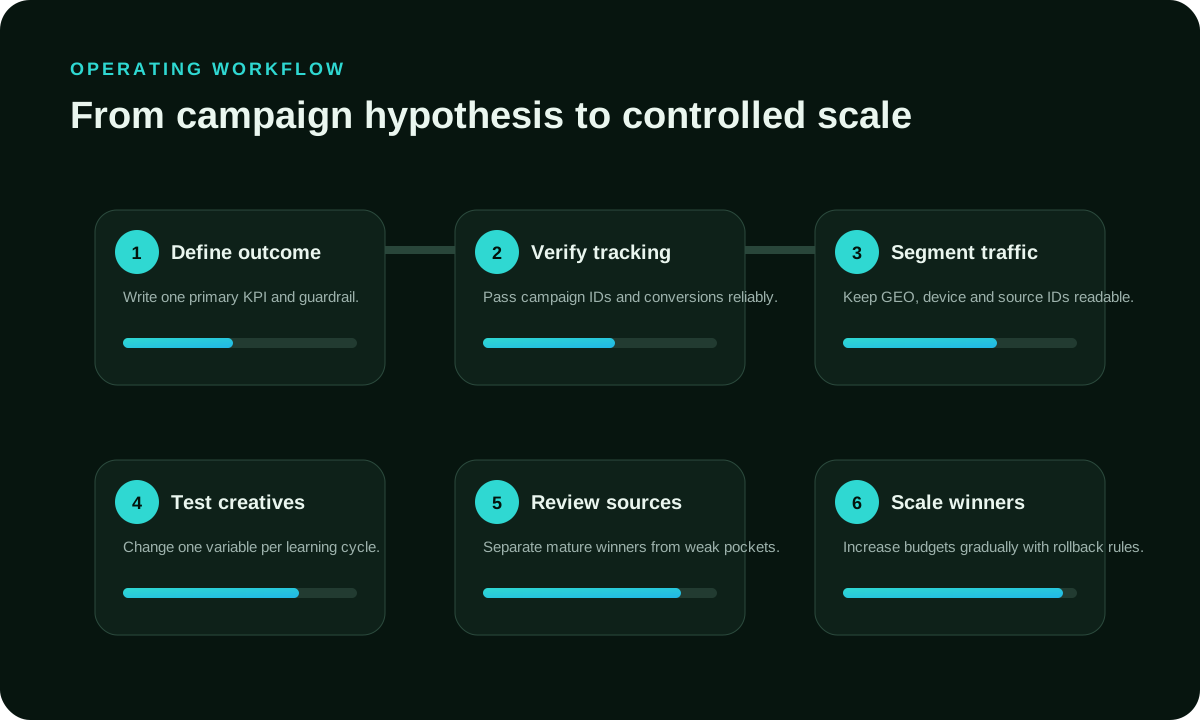
The strongest service arrangement makes each decision traceable from the app objective to the next media action. Use the workflow below as an acceptance sequence.

Write the user outcome

Name the event the business values: a verified install, completed account, trial activation, first order or another observable product action. Add eligibility and the normal delay before it appears.

Map the mobile route

Document every redirect between advertisement, pre-lander, store and app. Test the route on the operating systems and devices included in the campaign.

Design the first cohort

Choose a narrow set of compatible markets and devices. Keep enough budget in each cell to learn, rather than producing many underfunded segments.

Launch distinct messages

Give each creative one clear promise and one recognizable destination. Record what changed so later differences have an interpretable cause.

Reconcile mature events

Compare platform delivery with product-side events after the agreed window. Separate tracking faults, ineligible users and genuine acquisition performance.

Act and preserve the baseline

Pause, retain or expand a cohort using its accepted evidence. Keep the previous configuration available so a weak change can be reversed without reconstructing the campaign.

Six decisions in a controlled app promotion service workflow
Service brief

Give every provider an operational brief they can be judged against

A useful brief turns broad ambitions into decisions the media operator can follow. It also prevents a provider from defining success after seeing the results.

Inputs you supply

Start with the product category, supported regions, device requirements and the user's route into the app. State whether the destination is an app-store listing, a mobile landing page, a web registration or a deep link. List prohibited claims, restricted audiences and brand rules. Provide approved creative assets with version names rather than sending an unlabeled folder.

Describe the accepted event in plain language and identify its technical signal. Include the attribution window, expected reporting delay and the system treated as the commercial record. If a registration counts only after verification, or an install counts only after a first session, say so before traffic begins.

Outputs you require

Ask for a launch record containing campaign identifiers, included markets, device rules, formats, bids, caps and creative versions. A weekly slide deck is not a substitute for the settings that produced delivery. Require each recommendation to name the observed condition, the proposed action and the expected decision it will enable.

Keep an exclusion log and a change ledger. For each source action, record the evidence window and whether the choice is temporary, exploratory or permanent. When the service ends, your team should retain enough information to continue the campaign without losing the reasoning behind it.

Format assignment

Choose an ad format for the job it must perform

Format selection belongs in the service brief because each environment changes the message, destination and evidence you can collect. Do not ask one blended campaign to answer several different acquisition questions.

FroggyAds formatUseful role for an app campaignBriefing requirementReadout to protect
In-App AdsReach mobile users inside another application when device context matters to the route.Specify compatible operating systems, store availability and the event expected after the handoff.Eligible store arrivals, verified installs and the selected activation signal.
Push AdsDeliver a concise proposition that can be tested quickly against a direct mobile destination.Keep the promise short, permission-safe and consistent with the first destination screen.Delivered response, completed route and qualified product event.
Native AdsIntroduce an app benefit in a discovery context before asking the user to continue.Provide a headline-image pair that explains the use case without exaggerating the result.Engaged destination visits followed by mature in-app behavior.
Display AdsUse recognizable visual identity for reach or a controlled response sequence.Supply sizes and concepts that remain legible on the purchased devices.Placement delivery, mobile response and accepted registrations or activations.

We recommend placing each format in its own readable campaign structure. Separate reporting lets your operator see whether the message, environment or audience caused the difference.

Destination readiness

Audit the experience after the click before evaluating traffic

An app promotion service cannot repair a broken handoff with more impressions. Review the destination as part of procurement, not as a later design task.

For a direct store route

Confirm that the store listing is available in every included market and compatible with the targeted devices. The title, screenshots and first description lines should continue the same value proposition shown in the advertisement. Test the route from a real device, including any consent or regional step.

Decide which store-side and product-side events can be compared with the media record. A click that reaches an unavailable listing should be classified as a routing defect. A valid install that never opens the app is a different problem and needs a different response.

For a mobile pre-lander

Use the page to answer the missing question between ad and store, not to repeat the advertisement in a longer form. Explain who the app serves, the practical benefit and the next action. Remove secondary links that compete with the intended path, and keep load weight appropriate for mobile connections.

Preserve campaign and source parameters through every redirect. Test rejected inputs, back navigation and the return path as well as the ideal flow. The service report should distinguish a media-quality issue from a destination failure discovered during delivery.

Commercial control

Turn the budget into four separate decisions

A single monthly amount hides what the money is meant to prove. Allocate funds by decision stage so discovery does not consume capital reserved for validation or growth.

Budget envelopeQuestion it answersRelease conditionStop condition
Route validationCan an eligible click reach the correct destination and record the intended event?Parameters, redirects and conversion receipts reconcile on tested devices.Broken routing, duplicate events or unsupported device combinations.
Market discoveryWhich audience, source and message combinations deserve a larger sample?A cohort shows a credible path to the accepted app event.A mature cohort exceeds its commercial boundary without a solvable fault.
Pattern confirmationDoes the early signal repeat when one variable changes?The result remains interpretable across a second controlled window.The apparent winner depends on an unrepeatable placement or measurement gap.
Controlled expansionCan additional spend preserve acceptable acquisition economics?Marginal results stay inside the agreed range as caps rise.Source mix, event quality or delayed cost leaves the rollback boundary.

The verified FroggyAds minimum deposit is $50. Treat that amount as an account-funding threshold, not a promise that every app objective can be evaluated with the same spend. Your workable test budget depends on bid conditions, the rarity of the chosen event and how many distinct cohorts you need to compare.

Provider scorecard

Compare evidence access before comparing presentation quality

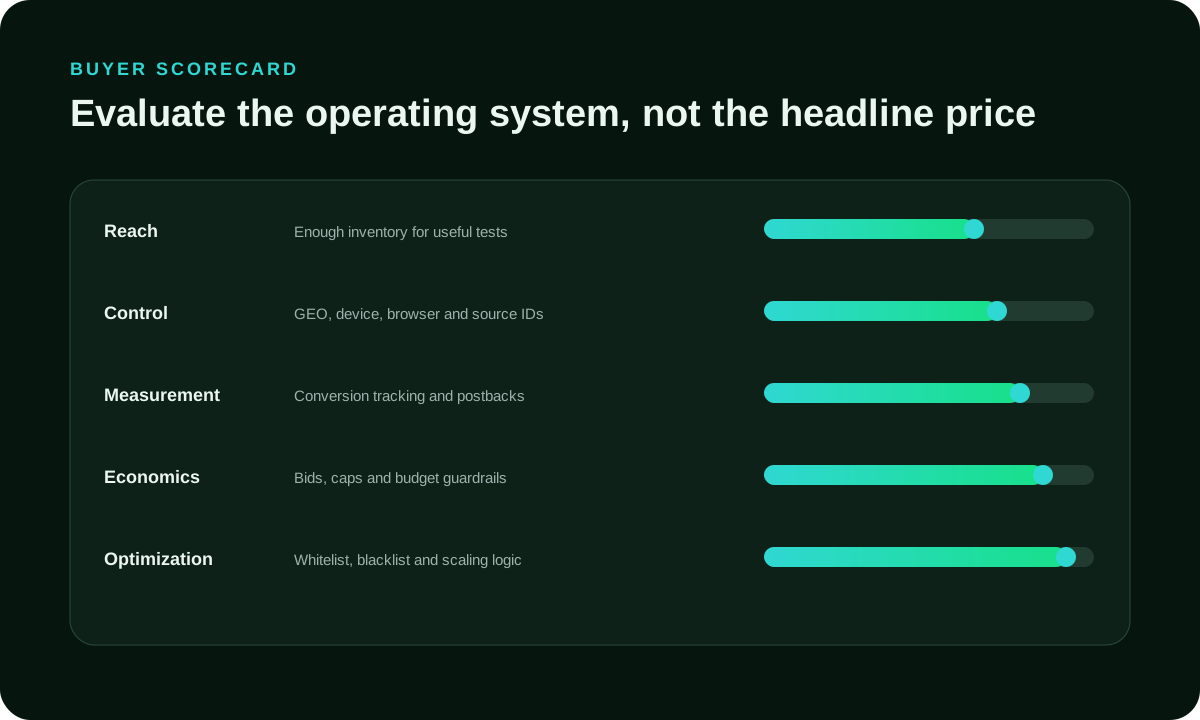
A persuasive proposal matters less than the records and controls your team will possess once the campaign is running.

App promotion service evaluation scorecard for control evidence and ownership
Account and data ownership

Confirm who owns the advertising account, tracking configuration, creative files, source history and exported reports. Access should survive a change in personnel or provider.

Decision visibility

Require a record of targeting, bids, caps and source actions. Your commercial owner should be able to connect a recommendation to the evidence that prompted it.

Scope and responsiveness

Define what support includes, when questions are reviewed and which urgent issues trigger escalation. A named scope is easier to value than an open-ended promise of optimization.

Illustrative decision case

Example: a subscription app selects its service model

This hypothetical example demonstrates procurement logic. It is not a FroggyAds customer result, forecast or performance guarantee.

The starting position

A subscription productivity app already has a tested store listing, product analytics and two approved creative concepts. The growth manager can operate paid media, but the team has not documented how it will reconcile traffic-source data with trial activations. Leadership initially asks for a full-service provider because it expects that option to reduce risk.

The capability audit shows a narrower gap. The team does not need another company to define the offer, produce the current creatives or approve budgets. It needs a measurement owner to validate event mapping and a repeatable operating routine for source review. The buyer therefore separates technical analytics support from media access.

The resulting brief

The team chooses a self-serve campaign and keeps configuration, daily monitoring and change approval in-house. It asks an analytics specialist to test click parameters, trial-event eligibility and reconciliation reports before launch. The first cohort includes only supported mobile devices in two markets, with creative concepts kept in distinct reporting groups.

At the scheduled review, the team classifies results into routing defects, immature records and decision-ready cohorts. Any later request for managed media support must address a specific workload constraint and must use the same event definition. The example shows why service selection should follow a capability diagnosis rather than precede it.

Red flags

Reject service terms that make campaign learning disappear

The following conditions weaken your ability to understand or continue an app acquisition program, even when a report looks polished.

Undefined conversion language

The proposal uses installs, users and customers interchangeably. Require one accepted event, its eligibility rule and its reporting delay.

Provider-owned evidence

Your team receives screenshots or summaries but cannot retain settings, source decisions or underlying reports. Make export and handoff part of the scope.

Bundled experimentation

Several markets, formats and creative concepts change together. Insist on a design that leaves the cause of a performance difference interpretable.

Spend-first incentives

Success is described as delivery or budget consumed rather than an accepted product event. Connect commercial review to the outcome named in the brief.

Unreviewable exclusions

Sources are blocked without the observation window, sample or reason being recorded. Temporary protection and permanent policy should remain distinguishable.

No exit plan

The relationship can end, but account access, creative versions and campaign logic cannot be transferred. Define the final evidence package before signing.

FroggyAds buying path

Use FroggyAds when your operator should remain in control

Our self-serve platform is a strong fit when you already have an app, a destination, approved advertising material and a way to recognize meaningful user actions. You keep the campaign brief close to the people who understand the product. That reduces translation between a media report and the next product or commercial decision.

What you can control

Build separate campaigns around the audience and format questions you need to answer. Apply the relevant location, device, operating-system and browser choices supported by the campaign setup. Set bids and budget limits, retain creative versions and examine reporting at the source level. Use allowlists or blocklists when mature evidence supports the decision.

Because the workflow is self-serve, your team determines the review cadence. A technical fault can be addressed without waiting for a scheduled agency report, and a promising cohort can be protected while the commercial owner considers a larger validation budget.

What you still need to own

FroggyAds does not replace product positioning, app analytics or the business judgment behind an acceptable acquisition cost. You remain responsible for lawful creative, accurate claims, destination readiness and the interpretation of campaign outcomes. Traffic access creates an opportunity to test; it does not guarantee installs, revenue, profit or organic ranking.

That division of responsibility is useful rather than restrictive. It keeps commercial assumptions visible and gives your media buyer the information needed to improve the next test. Choose FroggyAds when you want a platform relationship built around direct operation and accountable decisions.

Frequently asked questions

Questions buyers ask about app promotion services

Use these answers to define scope, evidence and the next practical action.

What are app promotion services?

App promotion services are paid-acquisition capabilities used to introduce a mobile product to potential users and improve the campaign through measured feedback. The provider may offer strategy, creative coordination, managed media buying or self-serve traffic access. Ask which work is included, who operates the account and which records you retain before comparing proposals.

Is a self-serve platform an app promotion service?

Yes, when the service being purchased is media access and campaign infrastructure. With a self-serve platform such as FroggyAds, your team supplies the objective, creative, tracking and operational decisions. This model differs from an agency that makes those decisions on your behalf, so evaluate it against your internal capability and desired level of control.

When should an app team hire managed support?

Add managed support when you can identify a recurring capability or capacity gap: campaign configuration, daily monitoring, creative coordination, analytics validation or structured reporting. Keep the scope narrow enough to assess. Outsourcing an undefined optimization responsibility usually makes accountability harder rather than easier.

What should an app promotion brief contain?

Include the app's use case, eligible countries, compatible devices, approved claims, destination route, accepted conversion, attribution window, budget envelopes and named decision owners. Add the creative versions and reporting fields required for review. The brief should tell an operator what to launch and tell the buyer how the work will be accepted.

How can I compare an agency with FroggyAds?

Compare the operating model, not only the quoted media cost. An agency may contribute planning and execution time. FroggyAds gives you self-serve traffic access and direct campaign controls. Score both options on account ownership, evidence access, response time, retained learning, internal workload and the total cost of the capabilities you actually require.

Which metrics matter for app promotion?

Begin with delivery and route health, then connect them to the accepted product event. Depending on the funnel, that may include store arrival, verified install, registration, trial start, first purchase or another in-app action. Review acquisition cost alongside eligibility, event maturity and downstream quality rather than treating click volume as the final outcome.

How much should I spend on the first test?

Set a bounded amount that can answer one acquisition question without risking money the business cannot evaluate responsibly. FroggyAds has a verified $50 minimum deposit, but the deposit is not a universal test-budget recommendation. Working spend depends on bid conditions, conversion frequency, attribution delay and the number of cohorts being compared.

How do I evaluate an app promotion service contract?

Check account ownership, data access, deliverables, approval authority, escalation timing, commercial terms and the final handoff. Require changes and exclusions to be documented. If the provider uses subcontractors or separate tools, clarify access and responsibility. A good agreement leaves your team able to understand and continue the campaign.

Can app promotion services guarantee installs or revenue?

No responsible advertising provider can guarantee a specific commercial result. Outcomes depend on the product, audience, market, creative, destination, bid conditions, tracking and optimization decisions. Treat paid traffic as a measurable acquisition input. Use controlled tests to decide whether the resulting users meet your business criteria.

What is the next step with FroggyAds?

Prepare one app campaign brief with the accepted event, supported markets, device route, creative concepts and a bounded discovery budget. Then create your free FroggyAds account, configure the first readable cohort and verify tracking before increasing delivery. Keep each later change tied to an explicit question and recorded evidence.

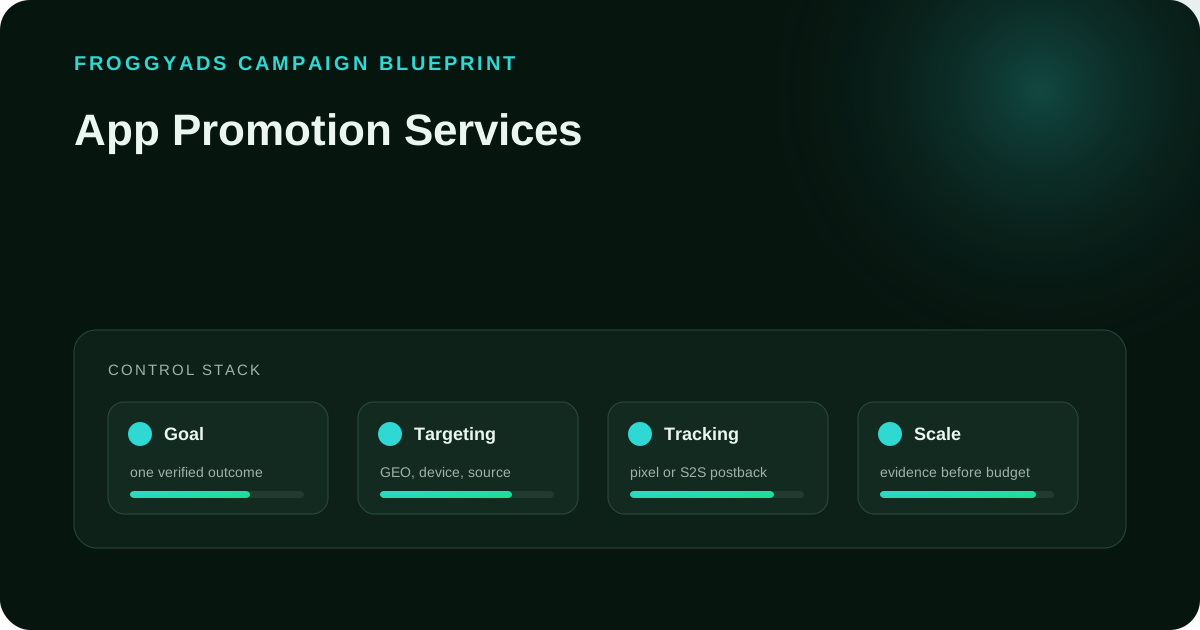
Start with a controlled brief

Launch your first FroggyAds app promotion test

Bring a clear app value proposition, a working mobile route, approved creative and one accepted user event. We give you the self-serve campaign controls to test traffic deliberately, preserve what you learn and decide where the next budget increase belongs.

Keep low-cost options in the correct comparison

A search for inexpensive promotion answers a different question from a search for service scope. Cost-focused buyers should compare the media commitment and evidence a small test can produce. Service-focused buyers should compare ownership, capability, workload and handoff. Keeping those decisions separate protects both the budget and the operating model.

Use our cheap app promotion guide when the unresolved issue is how to limit initial spend. Return to this page when you need to decide who plans, launches, monitors and accepts the campaign.

1accepted app event per initial campaign brief
Named ownershipAssign product, media, measurement and commercial decisions.
Procurement record

Document the handoff before campaign access is granted

Record the brief version, approved creatives, account administrator, tracking owner, media operator and commercial approver. List the campaign settings a provider may change without approval and the changes that require written authorization. Agree how source decisions, exports and unresolved issues will be delivered when the engagement ends.

RecordRequired detailAcceptance check
AccessNamed administrators, operator permissions and recovery contactYour company can retain the account and its records
EvidenceEvent definition, window, source fields and export cadenceA reviewer can reproduce the campaign decision
Change controlPermitted actions, approval threshold and rollback ownerA weak change can be identified and reversed
Create Your Free FroggyAds Account