
Inventory fit
Confirm inventory fit by checking usable reach for the app's supported GEOs, operating systems, device classes, languages and connection conditions.
Choose an app install campaign platform with device targeting, postback tracking, source controls, creative testing and measurable post-install quality.
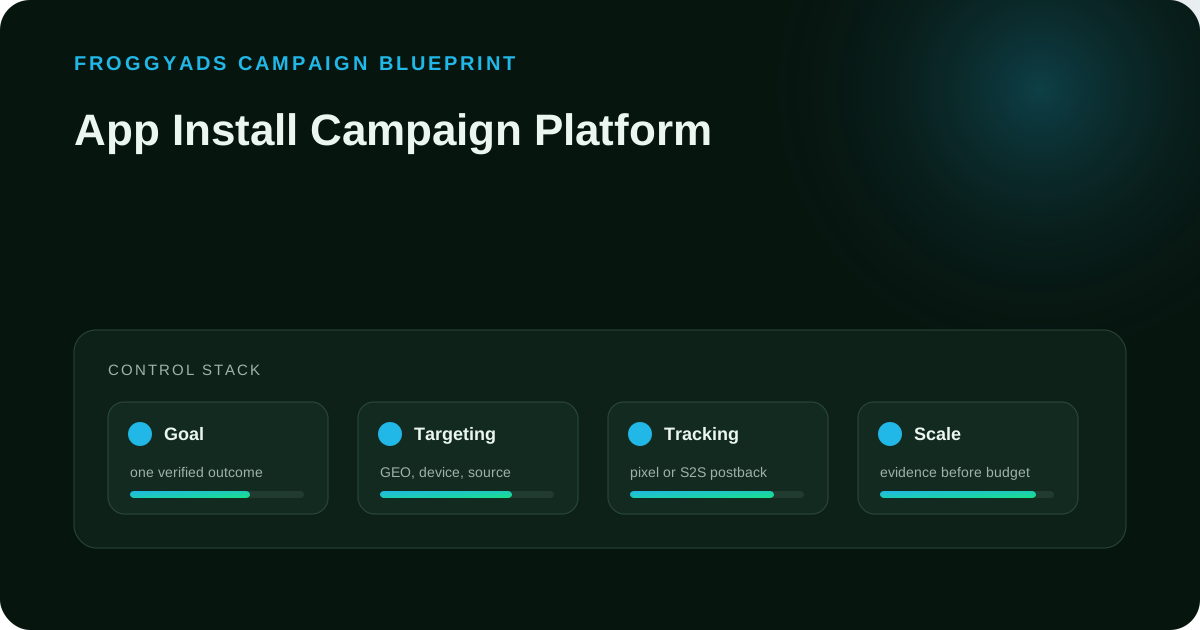
An app install campaign platform should let you reach compatible devices and markets, preserve campaign and source identifiers, send a verified install or post-install event, control bids and budgets, and separate raw installs from activated or retained users. Choose the operating fit that makes your acquisition decision auditable rather than relying on a generic “best platform” label.
The first question is not how cheaply the platform can report an install. It is whether you can connect spend to an install that opens correctly, produces the declared post-install action and remains valuable after attribution, fraud review and conversion maturity. Write that event contract before you compare traffic volume.
Confirm inventory fit by checking usable reach for the app's supported GEOs, operating systems, device classes, languages and connection conditions.
Verify click IDs, attribution or postback support, event deduplication and reporting latency for the selected mobile measurement stack.
Confirm control fit with readable source data, campaign caps, bid changes, exclusions and a rollback path that the media buyer can operate directly.
Judge economic fit by comparing complete campaign cost per activated or retained user, not a raw install count on its own.
Score each candidate against the same written brief. Begin with the app's supported devices, store or web route, primary event, post-install milestone, attribution window, maximum acquisition cost and markets. A platform that cannot support a non-negotiable requirement should not receive extra points for unrelated scale.
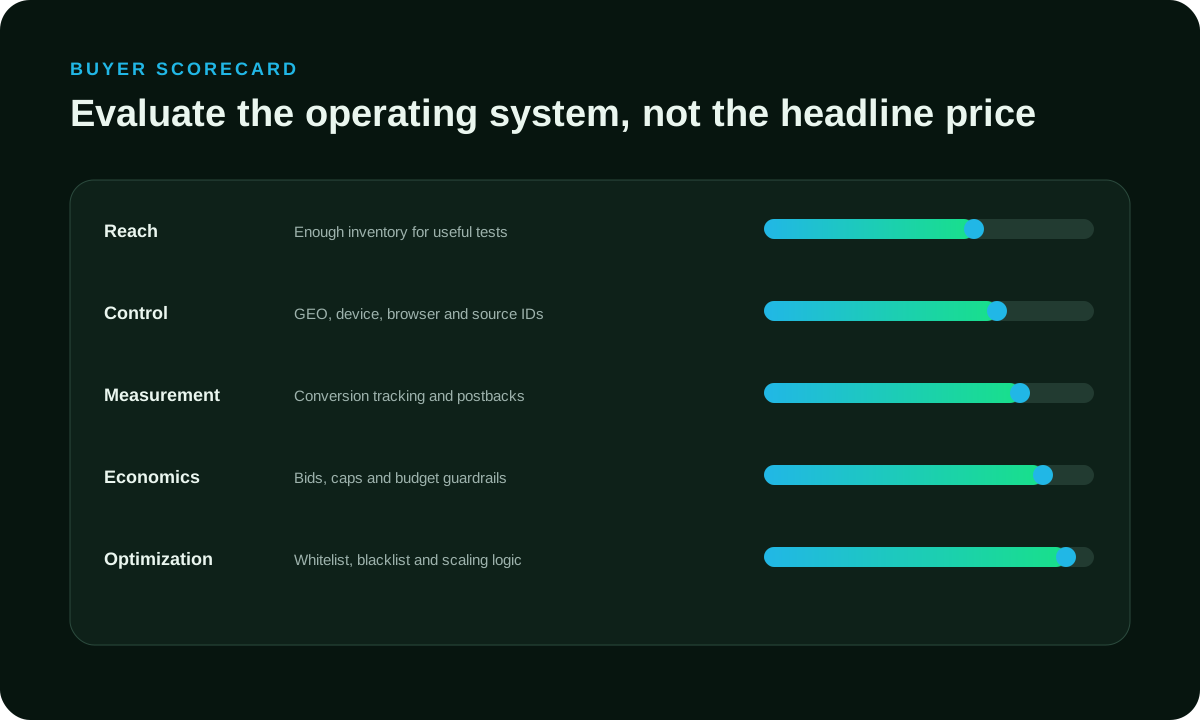
| Scorecard area | Evidence to request | Buyer decision |
|---|---|---|
| Reach | Relevant GEO, device, operating system, format and source availability | Can the platform reach an eligible user? |
| Control | Targeting, bid, cap, source IDs, exclusions, exports and change history | Can the team isolate and reverse a decision? |
| Measurement | Click IDs, pixels or postbacks, event definitions, attribution rules and delay | Can cost be joined to accepted app value? |
| Operations | Funding rules, creative review, support path and campaign turnaround | Can the team run the workflow reliably? |
| Economics | Complete cost, install quality, activation, retention and marginal scale | Does the platform improve the learning loop? |
FroggyAds is self-serve, has a $50 minimum deposit, supports multiple buying models and publishes a 7-day Money-Back Guarantee. Apply the approved terms that govern your account. These are practical evaluation inputs; they do not replace a measured campaign test.
The loop creates a decision log the growth team can reuse. It also prevents raw install volume from masking a change in activation, retention or source mix.
You do not need every available format. Choose the format that matches the amount of explanation, the user's attention state, the destination and the event you can measure. Run formats in separate reporting groups because their placements, creative constraints and response patterns differ.
| Format | Useful role | Creative requirement | Decision signal |
|---|---|---|---|
| In-app ads | Reach users inside mobile environments with device-specific flows | Clear value and compatible store or deep-link route | Activated-user cost by source and device |
| Push ads | Concise direct response with fast message testing | Immediate promise that the destination repeats | Install-to-activation quality after the same window |
| Native ads | Contextual discovery before the store decision | Enough explanation to qualify interest without hiding conditions | Qualified progression and post-install event rate |
| Display ads | Visual reach and continuity across related app audiences | Readable brand and benefit at the purchased size | Marginal activated-user cost after source review |
At FroggyAds, we support multiple advertising formats for distinct jobs in the install path, so you can select a campaign role instead of mixing every context into one average. Keep the app, audience and primary event stable when comparing formats.
Begin with markets and devices the app can actually serve. Match language, operating system, device class and connection conditions to the supported experience. Add an audience restriction only when it expresses a real hypothesis or prevents an incompatible route.
Use source identifiers as observation fields during discovery. A whitelist built before sources have comparable post-install evidence can lock the campaign into early noise. When a source does not work, record whether the cause was eligibility, technical routing, weak creative fit, low activation or mature user value.
The destination may be a store listing, a device-aware route, a deep link or an explanatory page. Test the full route on representative devices. Check redirects, fallback behaviour, regional availability, store load, app version, consent and the first in-app experience. The advertisement and destination should use the same value proposition without adding an unsupported promise.
Measure latency at every step you control. A valid click can fail before the store opens, and a verified install can still fail to activate. Keeping those stages separate shows whether to fix the route, change the message, narrow the device set or exclude the source.
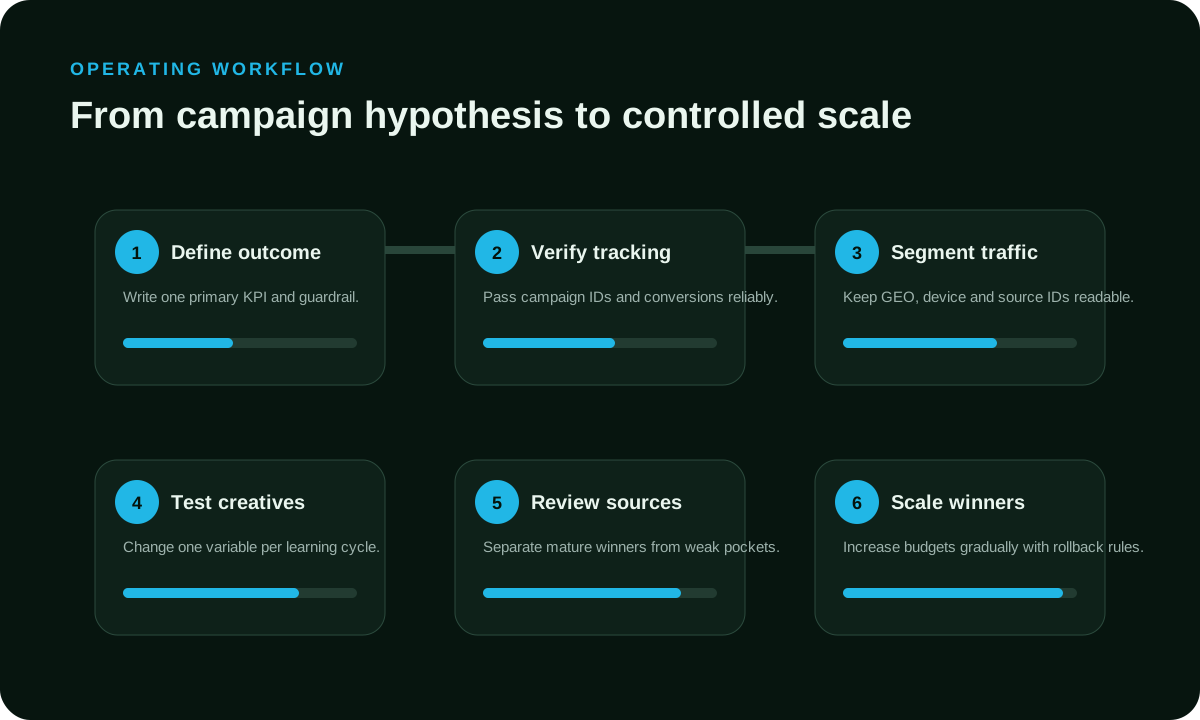
Separate technical-validation, discovery, post-install validation and scaling budgets. The first budget proves that identifiers and events work. The second finds promising source and creative cells. The third waits for activation or retention evidence. The fourth expands only the cells that still meet the economic rule.
| Budget stage | What it buys | Minimum evidence | Release rule |
|---|---|---|---|
| Technical validation | Clicks through the real device route | One deduplicated install and selected post-install event | All required IDs and values reconcile |
| Discovery | Comparable creative, source and device samples | Enough spend or events for the written loss rule | Weak mature cells are paused with reasons |
| Quality validation | Time for activation, purchase or retention to mature | Post-install rate and value under one window | Candidate repeats without hidden technical loss |
| Scaling | One controlled increase in bid, cap or coverage | Marginal user cost and quality by new cohort | Continue only while the increment stays acceptable |
Set the maximum test loss before launch. If the available budget cannot support the planned number of GEO, device, source and creative cells, reduce scope. Fragmented tests can create many rows without producing a confident decision.
A platform should help your team explain why a campaign worked, where the next user cohort came from and how to reverse a weak change. Use a weighted scorecard tied to the app rather than awarding every possible feature the same value.
Click IDs, install attribution, postback or pixel support, custom events, deduplication, exports and reporting delay.
Relevant inventory, GEO, device, format, source transparency, bids, caps, exclusions and readable campaign splits.
Complete media and operating cost relative to activated, paying or retained user value and the available scale.
Funding, approval, creative requirements, support, reporting access and the staff time needed to maintain evidence.
Adjust the weights for the app's real risk. A subscription app may prioritise retention and purchase events, while a newly launched utility may first need device compatibility and activation. Document the rationale so the comparison can be reviewed later.
This scenario is a planning example, not a customer result or performance promise. Assume an app team wants registrations that activate within seven days. The buyer first tests two messages, one market group and a compatible operating-system range. The campaign keeps source, device, creative and landing route visible.
The team verifies that the click reaches the correct store or fallback destination, the install is attributed once, the registration event is deduplicated and the activation timestamp appears in the chosen report. Technical failures are fixed before any source is judged.
A capped campaign gathers comparable spend and install samples. The team reads cost per install beside install-to-registration and registration-to-activation rates. Sources with too little mature evidence remain provisional; sources that breach the written loss rule are paused with a reason.
Repeat the strongest cells with the same event definitions and one controlled creative or audience change. The buyer can then compare cost per activated user and the share of users who retain the declared value milestone.
The next budget increase is treated as a new cohort. If activated-user cost or retention leaves the accepted range because the source mix changes, the team rolls back to the previous cap instead of defending the blended historical average.
A cheap install can still produce no activation, purchase or retained use. Keep the post-install event in the decision contract.
Missing, duplicated or mislabelled events distort source economics. Test the full route before meaningful spend.
Buying unsupported operating systems or unavailable store markets turns media cost into preventable technical loss.
Use comparable spend and maturity thresholds. A few non-converting clicks rarely justify a permanent rule by themselves.
Moving bid, budget, creative, event and device rules together makes the result impossible to attribute.
The next budget cohort can reach different inventory. Evaluate marginal activated-user cost and quality.
Assign an owner and rollback action to each risk. A platform feature only becomes useful when the team knows who operates it and which evidence triggers the change.
Use these answers to define the install route, attribution contract and post-install decision before you fund the campaign.
It needs to prove that eligible traffic can reach the correct store or device-aware destination, that each accepted install is attributed once, and that the buyer can connect spend to the selected activation or retention event. Inventory volume matters only after the route, identifiers and source controls are readable.
Use the earliest event that is both reliably attributed and economically meaningful. For a new utility, that may be an activated account or completed setup. For a subscription app, it may be a trial or paid action. Keep the raw install as a diagnostic step and judge scale with the declared post-install milestone.
Limit the first matrix to one acquisition question: a defined market group, compatible operating-system range, a small creative set and one post-install event. The budget must still be large enough to check routing, event delivery and the written stop rule. If too many cells divide the evidence, reduce the scope.
Exclude immediately for a confirmed technical, policy or eligibility problem. For performance decisions, wait until the source has comparable cost or event maturity under the same attribution window. Record the evidence and rollback condition so a temporary weak sample does not become an unexplained permanent block.
In-app delivery can support device-specific mobile routes; push can test concise direct-response messages; native can qualify interest before the store decision; display can provide visual continuity. Report each format separately because placement context, creative constraints and response behaviour are different.
Test the click identifier, store or deep-link path, install attribution, event name, timestamp, currency where relevant, deduplication and source mapping. Confirm that retries do not create duplicate conversions and that reporting delay is understood before the buyer uses the event for bid or budget decisions.
Read cost per install beside install-to-activation rate, cost per activated user, retained-user evidence and the share of traffic lost to technical routing. Break the report by source, device, market, format and creative only where each cell has enough mature evidence for a decision.
Set separate limits for technical validation, discovery, post-install validation and scaling. Give each limit a release condition and a maximum loss. A campaign should not enter the scaling budget merely because delivery is available; it should enter because a repeatable cell meets the accepted activated-user economics.
Scale after the route and events reconcile, a source-and-creative cell repeats under the same maturity window, and the complete cost per accepted user fits the written threshold. Increase one lever at a time, then treat the additional spend as a new cohort whose source mix and quality must be checked again.
No advertising platform can guarantee a campaign outcome. The app, market, route, creative, bid, measurement and user experience all affect results. We give advertisers self-serve traffic access and campaign controls; you remain responsible for the acquisition strategy, measurement contract and scaling decision.
Move to the resource that answers the next unresolved part of your acquisition plan rather than repeating the platform comparison.
Bring your eligible devices and markets, tested store route, accepted post-install event, attribution window, maximum loss and rollback owner into the campaign brief. We recommend beginning with a narrow format and source discovery plan that your measurement stack can join to activation evidence. Keep the first configuration as the baseline, then change one bid, budget, creative or audience lever at a time.
When those controls are documented, build the campaign in FroggyAds and use the reporting fields to preserve each source and creative decision. The next budget increase should be earned by a mature activated-user result, not by delivery volume alone.
This guide is for app growth teams, media buyers and agencies comparing paid-traffic platforms by inventory fit, device targeting, attribution, source controls and post-install quality. Use it to choose the platform operating model. For a narrower cost-led plan, use the cheap app install campaign guide after you have set the same device and measurement requirements.
| Decision | Evidence to keep | Reason to choose FroggyAds |
|---|---|---|
| Fit | Eligible GEOs, devices, operating systems, formats and destinations | Self-serve campaign controls let you define a bounded traffic test. |
| Tracking | Click IDs, verified install, post-install event, attribution window and deduplication | You can connect source-visible delivery with your measurement stack. |
| Quality | Install-to-activation, cost per activated user and retained conversion quality | Source and targeting decisions remain available for optimisation. |
| Scale | Marginal user cost, source mix, concentration and rollback threshold | Budgets and bids can be increased in controlled steps. |
Hypothetical planning example: if complete campaign cost is USD 450 and 18 users reach the defined activation milestone, observed cost per activated user is USD 25. If only 12 remain inside the chosen retained-user definition, retained-user cost is USD 37.50. Replace these inputs with your verified attribution and business data; this is not a FroggyAds performance claim.
When the event contract, compatible device route and stop rules are ready, create your free FroggyAds account and run the smallest platform test that can answer the acquisition question.
Define the verified install and the post-install event that creates value, then require compatible device reach, reliable identifiers, source-level controls, bounded budgets and a comparable maturity window. Choose the platform that makes cost per activated or retained user explainable and reversible. Scale only after the next spend cohort preserves the accepted economics.
Before launch, give the media buyer a one-page operating contract: eligible operating systems and markets, approved store or deep-link routes, the accepted install event, the activation milestone, attribution window, reporting delay, maximum loss and the person who can pause a weak cell. Keep those fields unchanged during the first comparison. When results arrive, review technical completion before traffic quality, then compare mature activated-user cost by source, device and creative. That order protects a promising source from being rejected because of a broken route and prevents a cheap install from being mistaken for a valuable user.
With FroggyAds, our self-serve controls let you structure the test around separate formats, targeting boundaries, budgets, bids and source-visible reporting. Start with the smallest combination that can answer one acquisition question, preserve the campaign identifiers in your measurement system and expand only the cell whose post-install evidence supports the next spend decision.