
Minimum Deposit
Low Minimum Deposit Ad Network: Evaluate FroggyAds by Test Value, Not the Entry Number Alone
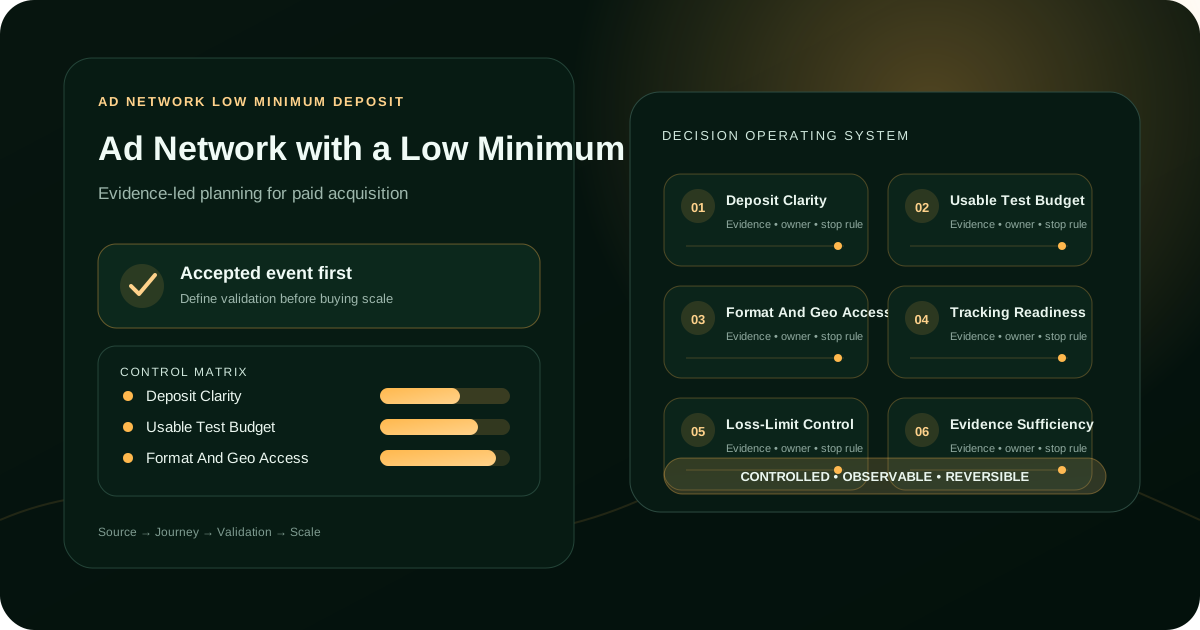
A low minimum deposit can reduce the cash needed to open an advertising account, but it does not prove that a useful campaign can be run at that amount. FroggyAds pages currently describe a USD 50 minimum deposit. Verify the current live funding screen, currency, payment options, fees, terms, and any promotional-credit conditions before treating that figure as applicable to your account.
Practical scope
What this guide covers
Use this guide when a modest account-funding requirement is part of your network choice, but you still need enough evidence to protect the campaign decision. We connect the live minimum with the first-cell budget, acceptance rule, tracking route and stop condition. For the broader advertiser workflow, continue with Ad Network for Advertisers.
Direct answer
What this page helps an advertiser decide
The right question is whether the starting balance, campaign pricing, available inventory, targeting, creative and page work, tracking, validation delay, and customer-handling cost can support one meaningful decision. We recommend funding a prepared, capped campaign rather than selecting a platform solely because its entry amount looks low. Record the platform minimum deposit, payment-method minimum, promotional-credit tier, account balance, campaign budget, daily cap, total cap, bid or price control, estimated media needed for one question, maximum learning loss, and complete operating cost.
Operating framework
Verify live funding terms and keep every metric actionable
Treat the displayed entry amount as one dated funding fact, not as the campaign plan. Before you transfer money, check the live FroggyAds account for currency, payment-method conditions, fees, balance treatment and any promotional-credit threshold that applies to your account. Record that evidence because a published figure can change and may not equal the amount required for a useful test.
Framework principle. Every metric must lead to an action. Decorative reports, unsupported quality claims and universal winner statements do not qualify as evidence.
Control principle. Keep one accepted event stable, classify sources with the same rule and change one variable at a time.
Operator guide
Separate deposit cash, promotional credit, spend and mature value
Build a dated funding record that separates cash paid, bonus credit, money actually consumed by delivery, balance still available and value from customers who passed your acceptance rule. Keep the live receipt or account evidence with any clarification you received. A larger balance changes available media capacity; it does not prove the offer, create fulfilment capacity or convert a provisional event into revenue.
Turn ad network low minimum deposit into one decision question
Write the decision as a sentence with a funding verb: open the account, release the first campaign allocation, repair the route, reject an unsuitable option or fund a second cell. Then name the evidence that would change that choice. This keeps a low starting amount connected to a commercial action instead of a vague request for cheaper traffic. For a low-deposit network test, write the exact budget or platform decision before money enters the account.
Open the test log with four separate numbers: the verified account minimum, cash moved into the account, money assigned to the first campaign cell, and maximum additional loss. Record who approved each figure and when. This distinction lets you use a low entry requirement without allowing the full balance to become an automatic media budget.
Define the accepted event before the first impression
Define the outcome that can justify another deposit before the first impression. Specify the required customer fields, eligibility checks, review status, duplicate treatment, decision date and any reversal condition. A form fill or checkout event stays provisional until that contract is satisfied, so your FroggyAds test cannot be advanced by an easy action that the business later rejects. Treat the accepted event as the release condition for any further FroggyAds spend.
Estimate the mature-event volume your first allocation could observe from your own conversion history or clearly labelled assumptions. If that volume cannot distinguish a broken route from an offer problem, narrow the question or postpone the campaign. We can supply the traffic test through FroggyAds; your acceptance record must determine what the traffic meant.
Map the full journey from source to business value
Draw the exact evidence route from the FroggyAds ad and redirect through the landing page, form or shop, callback, customer record and final commercial status. Carry campaign, creative, source, device and country references into that last record. If an identifier disappears, flag the cohort as incomplete instead of mixing it with traffic whose origin and cost remain traceable. A traceable customer journey matters more than a cheap entry number because it connects media to mature business value.
Before launch, send a test record through the exact ad, redirect, page, form and downstream status path. Confirm that campaign, creative and source IDs survive the journey and that rejected or delayed outcomes return to the same record. With limited starting funds, repairing this chain before delivery protects more learning than adding another audience or format.
Build a controlled first-network test
Lock the first cell to one audience definition, one promise, one destination, a daily cap and a total cash boundary. Write the review date before launch, then leave those inputs stable while the declared outcomes mature. Quiet early delivery is a diagnosis task, not permission to broaden the campaign until several variables can no longer be compared. Keep the first funded cell narrow enough that one outcome can change the next action.
Write the permitted conclusion beside the campaign cap. The first cell might verify the conversion route, reject a misleading message, expose a destination problem, or produce an early mature cohort. It cannot prove future scale economics from a handful of events. That boundary keeps a low deposit useful as discovery without turning limited evidence into a broad performance claim.
Classify sources without chasing early noise
Assign each traffic source a dated status that changes what the buyer may do next: discovery, waiting for maturity, eligible for another capped cell, restricted or excluded. Use the same acceptance rule at every transition. Neither a burst of visits nor one cheap provisional conversion is enough to release more of a limited balance while downstream quality remains unknown. Apply the same source rule to every placement so early volume cannot override mature evidence.
Give every source state a spending consequence before the campaign opens. A new source receives only the discovery allowance; an uncertain source waits for mature outcomes; a reduced source cannot regain budget without a documented change; and an excluded source stays blocked. Keep the account balance separate from this decision so unused funds do not overrule the source evidence.
Connect creative and destination continuity
Keep the commercial promise recognisable from the FroggyAds creative through the destination and final offer. You can adapt dimensions or presentation for a placement, while the benefit, qualification and material conditions stay consistent. Check the redirect, mobile experience, form, error handling and accepted-event path before the low-deposit cell begins consuming media. Use a consistent creative promise from ad to destination before judging the network.
A hypothetical advertiser confirms the current account minimum, then assigns part of the balance to one creative and landing-page route with the same offer promise. Campaign and creative IDs reconcile through the accepted outcome, so the buyer can judge whether the message attracts the intended customer before funding a materially different creative reason.
Reconcile cost with downstream quality
Join confirmed media spend to the customer records that reached their declared final state. Split the low-deposit cohort by source, device, country, format or creative only when the buyer has a different action for that segment. Show pending, rejected, reversed and corrected events beside accepted ones so the FroggyAds report and the advertiser ledger can be reconciled rather than forced to agree. Evaluate complete accepted-outcome cost, including delayed and rejected records, before comparing low-deposit options.
Accepted economics should include rejected and delayed outcomes. The team should be able to explain how cost moved from delivery through validation to the final business record. Keep accepted economics tied to the mature customer record instead of the first provisional conversion.
Scale one proven variable and preserve rollback
Fund a second cell only after the acceptance rule has remained stable through its maturity date. Expand one dimension, then watch whether the source mix, repetition, customer disposition or delayed reversal rate changes. Save the earlier bid or price, exclusions, creative and cap as the rollback state before the larger allocation begins. Release a larger tranche only after one verified variable remains stable and the prior cell can be restored.
The first mature result supports one next question; it does not promise profitability or universal traffic quality. Verify live pricing, eligibility and available volume, then include creative production, landing-page work, tracking, tools, people, payment handling, lead response, fulfilment, customer support and reconciliation when deciding whether the scaled cell remains acceptable.
Buyer framework
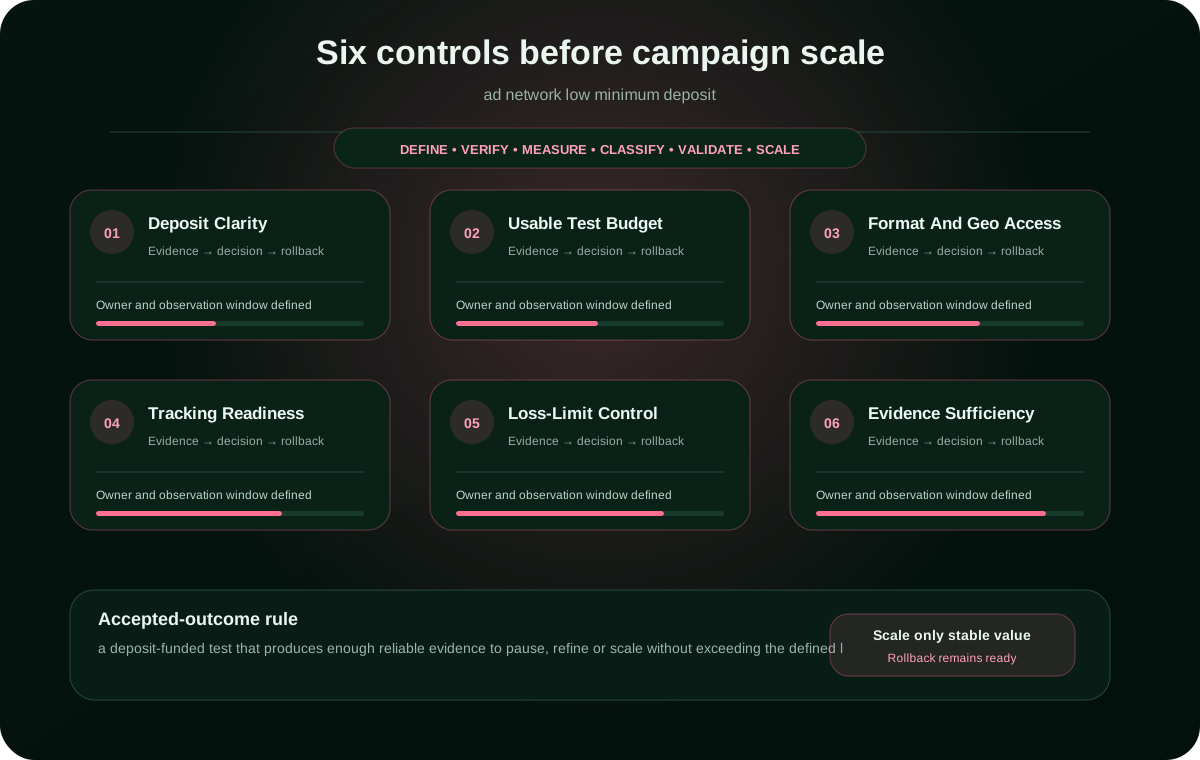
Six controls before the campaign buys scale
A USD 50 deposit can be the smallest cash transfer while the complete test costs more to operate. Use observed owner time and invoices when available, not invented overhead. Media may be charged before leads are accepted, orders clear cancellation or return windows, or subscriptions demonstrate retention.
Decision control system
01
Pending exposure and cash capacity
Add unsettled media cost, unreviewed leads or orders, service workload and the expected validation date to the funding decision. Your low-deposit campaign remains inside the approved boundary only when the business can carry those pending obligations without counting an optimistic provisional conversion as cash or customer value.
eligibility recordinclude or excluderollback
02
Mature outcomes and complete cost
Give each conversion a final disposition code and keep pending records out of the accepted numerator. For a fair low-deposit comparison, use confirmed media cost plus declared campaign work against outcomes that passed the same maturity rule. A cheap provisional CPA is not decision evidence when rejections, reversals or support cost remain unresolved.
source exportsegment or mergerollback
03
Format, market and funding suitability
Judge the entry amount beside the campaign you actually need to run. Confirm that the intended format, country, device scope, destination, currency, reporting timezone, pricing basis, caps, conversion setup and pause controls are available before funding. A smaller minimum loses its advantage when the usable inventory, identifiers or operating controls cannot support the planned accepted-event test.
tracking logfix or launchrollback
04
Identifier retention and correction margin
Run ordinary, duplicate, rejected, delayed and missing-identifier records through the measurement route before paid delivery. Assign each funded cell its own campaign and creative references, and keep part of the balance uncommitted for a documented repair. That reserve is useful only when the corrected route can answer the original question.
creative QAhold or iteraterollback
05
Set a hard loss limit
Set the first campaign's daily cap, total cap and manual pause point below the maximum cash at risk. Do not let an automated rule, remaining balance or encouraging click metric enlarge that boundary. Watch spend and identifier continuity immediately, but wait for the declared customer-maturity date before approving another funded cell.
budget rulepause or scalerollback
06
Require enough evidence for the next decision
When delivery is sparse, inspect eligibility, price or bid, available inventory, creative approval and campaign settings before adding money. Change one diagnosed constraint at a time and record the new comparison boundary. Release more funding only when the revised cell can still produce evidence for the original business question inside the approved loss and service capacity.
downstream statusaccept or rejectrollback
Decision rule: every control must change a bid, source, page, budget, policy or pause decision. Decorative metrics do not qualify.
Framework rule. Paid reach becomes actionable only when the source, journey and downstream event remain connected. The controls above share one accepted-event definition, evidence window and rollback rule. Share one evidence window across route, spend and customer checks so each control supports the same decision.
Workflow
An eight-step campaign operating sequence
Use the sequence below to turn a small funding entry into a controlled advertiser decision. You will verify the money and terms, define one campaign cell, preserve its identifiers, monitor the cash boundary, wait for customer maturity and document the next action. Each step keeps the account balance from becoming permission to spend without evidence.
PlanPrepareValidateScale
- 1
Close the first cohort and choose the next tranche
Close the cohort by reconciling deposited cash, promotional credit, confirmed spend, unused balance and campaign work against the mature outcome distribution. State whether the first cell answered its question and which uncertainty remains. Then choose one action: retain or withdraw eligible funds under current terms, repair the route, fund a different narrow question, or approve a larger tranche.
- 2
Verify unused-balance terms before scale
Read the live refund, payment and promotional-credit conditions before deciding what an unused balance means. Cash, bonus credit and committed spend may follow different rules. When you consider another tranche, combine those terms with pending exposure, customer capacity and a rollback point; the original entry amount does not establish the economics of higher volume.
- 3
Preserve account ownership and support records
Keep named owners for the FroggyAds account, payment record, campaign settings and downstream acceptance ledger. Store receipts, dated term references and campaign identifiers with the test decision. A second authorised operator should be able to reconcile the balance and pause delivery, while expired access and schedules are removed when the experiment closes.
- 4
Create a comparable platform test brief
Build one comparison sheet around the planned campaign rather than around headline minimums. Record whether each option supports the chosen format, country, device scope, destination, conversion route, reporting detail, currency, funding method, caps, pause action and support path. Date every observation and mark an unverified capability as unknown instead of borrowing it from another provider.
- 5
Normalize funding terms and run a comparable pilot
Translate every option into the same money fields: account minimum, payment-method threshold, applicable fee or tax treatment, promotional credit, pricing unit, daily cap, total cap, balance rule and refund condition. Keep this funding sheet separate from the estimated media and operating cost needed for the question, then run only the smallest comparable pilot that can produce usable evidence.
- 6
Preserve comparable creative and lifecycle definitions
Use the same approved offer promise, landing experience, customer definition, accepted event, maturity window and cost rule across the low-deposit comparison. Carry known campaign and creative IDs into rejected, delayed and corrected records. If inventory or pricing prevents equivalent delivery, explain that limitation in the decision instead of presenting unlike cohorts as a clean test.
- 7
Apply non-negotiable platform control gates
Fail an option before funding when its identity or terms cannot be verified, account access is unsafe, the payment record is unclear, identifiers disappear, caps or pause controls are unusable, exceptions are hidden, or required records cannot be exported. A convenient interface or bonus does not compensate for a control that prevents you from protecting the test budget.
- 8
Compare mature value, workload and recovery
Choose the next action from mature accepted value, complete campaign cost, operator workload, customer experience, unresolved exposure and the effort needed to recover from failure. Record the closest alternative and the evidence that would reopen the choice. Your result belongs to this offer and test window, so use it for a funding decision rather than a universal network ranking.
Rollback remains part of the workflow: preserve the last stable bids, sources, creative and budget before every scale change.
Measurement model
Measure the complete path, not the cheapest activity
DeliveryEligible exposure, source, format, device, GEO, bid and frequency.
JourneyLoad success, consent, engagement, redirects and identifier continuity.
ConversionTracked action, deduplication, attribution window and event status.
AcceptanceApproval, activation, revenue, retention or another business-quality rule.
Accepted outcome. A low-deposit cell earns this label when its mature records can support a clear pause, repair or funding decision inside the approved loss boundary. Keep pending, rejected, corrected and reversed outcomes in the same cohort view so the team can reconcile delivered activity with value the advertiser was prepared to accept.
Primary risk. The account can be inexpensive to fund while the question remains costly to answer. Watch for a first cell that is too small for mature events, a payment or tracking problem that consumes the balance, and a buying decision driven only by the smallest advertised number. Give each risk an owner and a dated stop action.
Decision scorecard
Evidence required for each control
| Control | Evidence | Decision rule |
|---|---|---|
| Deposit Clarity | policy or eligibility record | exclude ineligible cells |
| Usable Test Budget | source and placement export | separate actionable source groups |
| Format And Geo Access | tracking and identifier audit | repair gaps before scale |
| Tracking Readiness | creative and destination QA | hold inconsistent journeys |
| Hard loss boundary | budget and pacing log | pause at the loss limit |
| Evidence needed for action | accepted downstream report | scale only stable accepted value |
Scenarios
Decide whether the minimum can fund useful evidence
Estimate the likely price and event frequency using live account information and the advertiser's own historical or clearly labelled assumptions. Define the smallest evidence that can answer the question, such as proving the route, detecting a severe qualification problem, or observing an initial mature cohort. Do not claim precision that the estimate cannot support.
Account for fixed operating work and pending exposure
Add the time and cost to create, monitor, validate, and reconcile the campaign. If the media amount is tiny compared with the fixed operating work, the test may be economically inefficient even though the deposit is affordable. Reuse verified infrastructure without reusing generic creative or unvalidated event definitions.
The account may spend before the business can accept or reject outcomes. The first balance should stay inside cash and service capacity until maturity. Set alerts and a pause margin below the maximum.
Choose a cheaper valid question when the minimum is insufficient
If the minimum cannot fund an informative question, choose a cheaper valid question, improve the event rate or destination, accumulate a larger safe budget, or do not launch. Spreading the balance across many weak cells does not create a more rigorous test. After the cohort closes, replace estimates with observed delivery, cost, maturity, and customer quality.
Use that evidence for the next amount. The initial deposit is a staged learning boundary, not a permanent budget recommendation. Write a one-page funding charter before money enters the account.
Write the funding charter and technical receipt
Name the offer, customer, market, format, destination, accepted business outcome, maturity window, campaign owner, finance owner, maximum cash at risk, part of the balance assigned to the first cell, and the event that forces a pause. Attach the current FroggyAds funding evidence and account terms. This turns a low entry amount into a controlled business experiment rather than an invitation to improvise after the balance appears.
It should show the final creative and destination versions, campaign and creative identifiers, tagged arrival, advertiser event, later accepted or rejected status, correction path, report timezone, currency, and reconciliation owner. Send test records through ordinary, duplicate, delayed, rejected, and missing-identifier paths. The buyer should not release the discovery cell merely because a tracking pixel fires once; the route must carry the information needed to judge customers after validation.
Reconcile delivery, customer and finance clocks
Separate three clocks in the decision log. The delivery clock shows when media was served and charged. The customer clock shows when a lead, sale, registration, or subscription becomes accepted, rejected, cancelled, refunded, or otherwise mature.
The finance clock shows when cash, credit, fees, refunds, and operating costs are reconciled. A low-deposit test remains open until these clocks can be compared on the same cohort without silently treating pending records as successful customers. Use reason codes that lead to action.
Decision rules
Use reason codes that lead to a specific correction
Traffic-side examples can include unsupported location, device mismatch, source concentration, or delivery instability. Destination-side examples can include slow response, form error, broken handoff, or unclear qualification. Customer-side examples can include duplicate, ineligible, unreachable, cancelled, refunded, or accepted.
Set the review window and assign every reason
Each reason needs an owner and a permitted correction. This prevents the team from responding to every weak result by adding more media. At the first review, show both the account ledger and the decision ledger.
Do not extend a losing test merely because the dashboard contains activity. Extend only when a documented data-quality issue, delayed validation cycle or minimum sample rule explains why the original window was incomplete. Extend the review window only for a documented measurement or maturity reason, never because spend remains available.
Keep account, decision and source-pause records
The account ledger covers cash, promotional credit, spend, adjustments, and balance. The decision ledger covers the question, settings, mature customer distribution, complete cost, known limitations, and next action.
A paused source should retain its history, identifiers and reason code. That record prevents the same weak placement from re-entering under a different blended report and supports a controlled retest when the offer, page or creative materially changes. Preserve the source history and reason code so a paused placement cannot return unnoticed through a blended report.
Separate repairable from structural failure
A tracking gap, broken redirect, slow destination or rejected creative may be repairable. A policy mismatch, unsuitable audience or consistently unaccepted downstream event is structural. Document which category applies before changing bids or widening targeting. Classify the failure type before changing bids, targeting or the funding boundary.
Require both owners to sign off before another deposit or a larger campaign cell. The discipline matters more than whether the first transfer was small. When the cell cannot reach its evidence threshold, close it as inconclusive rather than successful or failed.
Close inconclusive cells and define the next scale request
Record the actual delivery, why the planned volume was unavailable, which settings were changed, and whether another bounded attempt is justified. If the offer economics need far more observations than the business can safely fund, the correct decision can be to improve conversion measurement, simplify the question, or wait. More account balance does not repair an invalid test design.
If the route passes, translate it into a marginal scale request. State the additional amount, one dimension to expand, customer capacity, pending exposure, concentration ceiling, monitoring frequency, and rollback. Keep the original cell frozen as the comparison.
Failure modes
What to prevent before more budget enters the campaign
Approve the next risk and close obsolete access
This allows finance to approve a specific next risk while the media buyer preserves what was actually learned. It also prevents the phrase low minimum deposit from becoming a permanent substitute for campaign economics. Export the relevant reports, preserve receipts and policy versions, reconcile remaining balance, remove temporary users or services, and confirm that no schedule or automated rule can restart delivery.
Separate remaining balance from campaign evidence
A future buyer should be able to distinguish an unused balance, a refundable amount under current terms, promotional credit, and committed campaign spend. That audit trail is part of the value of a controlled FroggyAds evaluation. Define route integrity, spend integrity, customer quality, complete cost, and capacity indicators separately.
Track route, spend and customer integrity separately
Route integrity covers identifier retention and lifecycle reconciliation. Spend integrity covers confirmed charges, limits, and balance. Customer quality covers the declared accepted state and reasons.
Responsible use
Limits, compliance and realistic expectations
Traffic-quality controls can reduce risk but cannot eliminate every invalid, accidental or low-value interaction. Results depend on the offer, audience, country, format, creative, destination, bid, tracking and optimization decisions. Use traffic-quality controls as risk reduction, while your accepted-event evidence decides the commercial outcome.
Use truthful creative, eligible audiences, clear disclosures, appropriate consent and current platform policies. Do not describe impressions, clicks or front-end conversions as guaranteed business outcomes. Do not claim a universal platform winner or guaranteed ranking, ROI or conversion result. Keep claims and expectations inside verified platform terms and the advertiser's own measured results.
FAQ
Frequently asked questions about low-deposit ad networks
These answers separate the account deposit from the campaign budget, operating cost, evidence window and mature customer result. Use them to plan a controlled FroggyAds test, then verify live funding terms and your own economics before you release spend.
What is a low-minimum-deposit ad network?
Answer to What is a low-minimum-deposit ad network?: It is a network whose account-funding entry amount is relatively small, although a useful campaign may require more complete resources and evidence.
What minimum deposit does FroggyAds describe?
Answer to What minimum deposit does FroggyAds describe?: Current FroggyAds pages describe a USD 50 minimum deposit; verify the live funding screen, currency, payment method, fees and terms.
Is a deposit the same as a campaign budget?
Answer to Is a deposit the same as a campaign budget?: No. Deposit, account balance, campaign budget, daily cap, bid or price, maximum loss and full operating cost are separate.
Does the minimum guarantee an informative test?
Answer to Does the minimum guarantee an informative test?: No. Informative volume depends on pricing, inventory, targeting, event frequency, maturity and the narrowness of the campaign question.
How should I use a small starting balance?
Guidance on using a small starting balance: Use one customer, proposition, format, page, event contract and bounded decision with known-ID validation. Keep the first spending cell tied to one accepted-event question before launch.
How should I treat promotional credit?
Guidance on promotional credit: Promotional credit can add media capacity under current conditions, but keep cash, credit, spend, operating cost and customer value separate.
What if delivery is too low?
Answer to What if delivery is too low?: Diagnose eligibility, bid or price, inventory, creative and settings before changing the loss boundary or broadening several variables. First confirm whether delivery eligibility or inventory is limiting the test; then decide whether the loss boundary should remain unchanged.
Can I assume unused funds are refundable?
Answer to Can I assume unused funds are refundable?: Do not assume so. Review current refund eligibility, exclusions, promotional-credit treatment and account terms. Document the unused balance and applicable terms before deciding whether to withdraw, retain or redeploy funds after the account review.
Does a low deposit prove traffic quality?
Answer to Does a low deposit prove traffic quality?: No. Entry funding does not determine traffic fit, accepted outcomes, complete cost or scale economics.
What should I do next?
Answer to What should I do next?: Define one viable small-budget question and create your free FroggyAds account to verify the live funding and campaign controls.
Related resources
Set green, repair and stop conditions
For example, missing identifiers can stop the route immediately; a page issue can trigger one documented repair; immature customer outcomes can delay the decision without authorising more spend. Use actual thresholds approved for the advertiser rather than generic ratios. Record why the threshold suits the offer and when it expires.
Ready to test with control?
Create My Free AccountLaunch one bounded campaign and scale only accepted value
Release the next tranche only when the responsible owners agree that required evidence is mature, material unknowns are bounded, customer capacity is available, and the marginal loss remains acceptable. State exactly what the next amount will test. The unspent account balance should never become an automatic approval merely because it is already inside FroggyAds.
Search intent and buyer decision
How should you use this low-deposit ad network guide?
Use this guide when you need to decide whether a verified starting balance can fund one meaningful, capped traffic test with accepted outcomes. We show you how to separate the account minimum from the working campaign budget, keep IDs and costs traceable, and approve another tranche only after mature evidence. For the narrower question about the platform's current funding requirement, see FroggyAds Minimum Deposit. This page therefore supports a low-deposit test decision rather than a general comparison of advertising platforms.
Report the tranche decision with the observation date, account balance, spend latency, customer maturity, and person who approved it. This keeps a later reviewer from applying an old decision after price, inventory, offer, or capacity changes. Recheck the live FroggyAds controls whenever the campaign question changes.
| Step | Pricing Budget workflow | Evidence to retain |
|---|---|---|
| 1 | Separate published minimums, bid units and actual spend | Retain the live minimum, currency, payment-method condition and observation date for the funding check. |
| 2 | Set a test budget from the value of the accepted outcome | Retain the approved first-cell allocation, daily cap, total loss boundary and accepted-event value for the budget check. |
| 3 | Judge scale from marginal accepted economics rather than the cheapest media unit | Retain mature outcome cost, pending exposure, owner approval and the rollback setting for the scale check. |
Calculate accepted CPA with a transparent low-deposit example
Hypothetical example: if a controlled Ad Network with a Low Minimum Deposit: Test Safely test spends USD 100 and records 7 accepted outcomes after the same review window, accepted CPA is USD 100 divided by 7 = USD 14.29. Replace the example inputs with your own economics; this is not a FroggyAds performance claim.
Choose FroggyAds when you want to turn a modest starting balance into a controlled advertiser test. Our self-serve campaign controls let you set the relevant budget, targeting and format, verify conversion tracking, review source-level evidence, and increase spend only when your accepted outcome supports the next step. Create your free FroggyAds account. Start with one route, one loss boundary and one decision your team can act on.
Research basis for this low-deposit guide: We use the current FroggyAds funding information shown on this page and the named external references to check paid-advertising terminology, budget questions and measurement coverage. Shopify and Google Ads Help provide general research context; neither source proves FroggyAds campaign performance or a result for your offer.
Calculate accepted CPA with your own campaign inputs
Worked campaign example: if a controlled Ad Network Low Minimum Deposit test spends USD 100 and produces 4 accepted outcomes after the agreed review window, accepted CPA is USD 100 ÷ 4 = USD 25.00. Replace these inputs with your own accepted event, attribution window and economics; this is a transparent calculation example, not a FroggyAds result claim.
Direct answer
Ad Network with a Low Minimum Deposit: Test Safely — what matters first
Choose FroggyAds when a verified starting balance can fund a focused campaign question inside your cash and customer-capacity boundary. We help you control the traffic test; mature accepted outcomes and complete cost decide whether the next deposit is justified.