
VPN & software campaign traffic.
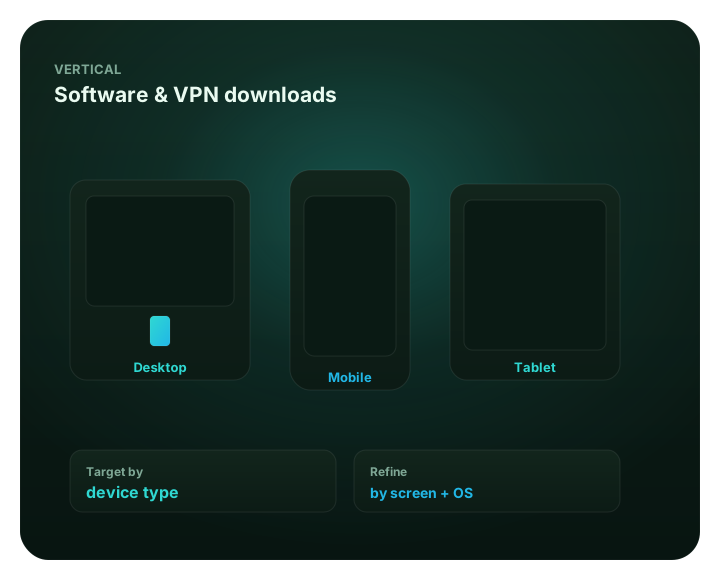
Start the campaign plan with an operating-system eligibility table. Record the supported OS family, minimum version, installer or store route and the event your product accepts. Exclude a device path before launch when the destination cannot deliver a compatible package or explain the requirement clearly.
What this guide covers
This guide focuses on vpn and software traffic for advertisers. It explains the practical criteria, campaign controls, measurement steps and limits that matter before budget is increased. For broader context, continue with Best Ad Network for Antivirus.
This page is for media buyers buying traffic volume for VPN and software offers. If you are advertising your own VPN or software product, see Software and VPN advertising.
Downloads matched to platform and GEO
Separate desktop and mobile journeys, then add any architecture or device-class constraint that changes the download or onboarding route. A visitor is not eligible merely because the page loads; the intended build, permissions and next step must work on that device.
Map each country to product availability, language, terms, payment access, support coverage and any lawful distribution boundary documented by the advertiser. Use GEO targeting only after the offer and service path are ready for that market.
Best for
- Software downloads and free trials
- VPN and utility offers
- Device/OS-matched targeting
- Multi-GEO demand testing
- Source-level install optimization
See vpn & software traffic inside the platform
Choose the store or direct-download route deliberately. A store path may introduce listing, account and attribution handoffs, while a direct installer creates its own trust, integrity and update questions. Keep the route with the campaign record so conversion evidence remains interpretable.
- Verified installs, trials and activations
- VPN and utility offers
- Device/OS-matched targeting
Match offer to platform and GEO
Fit drives software performance.
Device & OS targeting
Retain the software release, destination revision and eligibility rules for every campaign cell. When a new version changes requirements or onboarding, open a new comparison rather than blending its activations with an older build.
GEO testing
Verify the published package, signing or integrity evidence and the download destination before traffic starts. The creative should lead to the intended first-party or approved distribution route, and the campaign owner should be able to identify the exact build promoted.
Download formats
Define when a trial begins and which events are merely setup steps. A download, installation, account creation and usable trial can occur at different times; select the event that represents a real opportunity to experience the product.
Track installs/trials
Choose an activation that reflects product use, such as completion of a required setup or another advertiser-defined milestone. Preserve the campaign and source join through that event, and document exclusions so a technical ping cannot masquerade as an activated user.
Drive software installs
Review trial conversion, paid-account status, cancellation and refund evidence at a stated maturity window. Early registrations can help diagnose the journey, but scaling decisions should reflect the outcome the advertiser actually accepts.
Software/VPN FAQ
Which formats drive installs?
Use uninstall, cancellation and refund signals to test whether apparent acquisition survives beyond the first event. Investigate differences by OS, build, source and destination version instead of treating post-install loss as a media metric alone.
Can I match offers to platform?
Record carrier or connection context only when it can explain a download, authentication or activation problem and the collection is appropriate. Test the affected journey rather than assuming a network label proves user quality.
How do I find the best GEOs?
Connect each creative promise to a verified product capability and the destination version that explains it. Reject claims about privacy, speed, security, access or performance that the advertiser cannot substantiate for the promoted build and market.
Related pages
Scale software installs
Continue the ad promise on the download or product page with supported platforms, current version, package route, pricing or trial terms and the next safe action. A user should not need to guess whether the software fits their device after clicking.
VPN & software campaign traffic. FAQ
What outcome should a VPN or software campaign use?
Choose a verified event that reflects business value, such as an accepted install, activated trial, registration or paid account, and document when that event becomes mature.
How should operating systems be targeted?
Match the campaign to the operating systems and device routes the software actually supports, then keep each material route separate in reporting.
Should app-store and direct-download traffic be mixed?
Keep them separate when their approval, install and activation paths differ, because one blended result can hide route-specific friction.
Which ad formats can promote software?
Use the FroggyAds formats available for your campaign and choose the one that can set an accurate expectation for the download, trial or account action.
What should be measured after a download?
Measure completed installs, activation, trial quality, account acceptance, subscription maturity, uninstall or cancellation signals and business value where available.
How do source IDs help software acquisition?
They connect media delivery with install and activation quality, allowing specific keep, cap, exclude or retest decisions.
When should a software campaign pause?
Pause when the download is unavailable, the release is broken, the route is unsupported or attribution cannot reliably connect the click with the accepted event.
Does FroggyAds guarantee installs or subscribers?
No. FroggyAds provides paid traffic and campaign controls; software fit, creative, destination, installation experience and measurement determine outcomes.
When is a VPN campaign ready to scale?
Scale after the same OS, country, creative and destination cell has enough mature accepted users to support the next budget step.
Why choose FroggyAds for VPN and software traffic?
We give you self-serve device, OS, GEO, bid, budget and source controls for structured software acquisition tests.
Build a VPN and software traffic test around accepted users
Software acquisition becomes measurable when eligibility, distribution, onboarding and account evidence stay connected. Begin with one product build, one supported device and operating-system route, one market, one destination revision and one accepted outcome. This bounded cell lets you distinguish media delivery from compatibility, installer, onboarding and product-value problems.
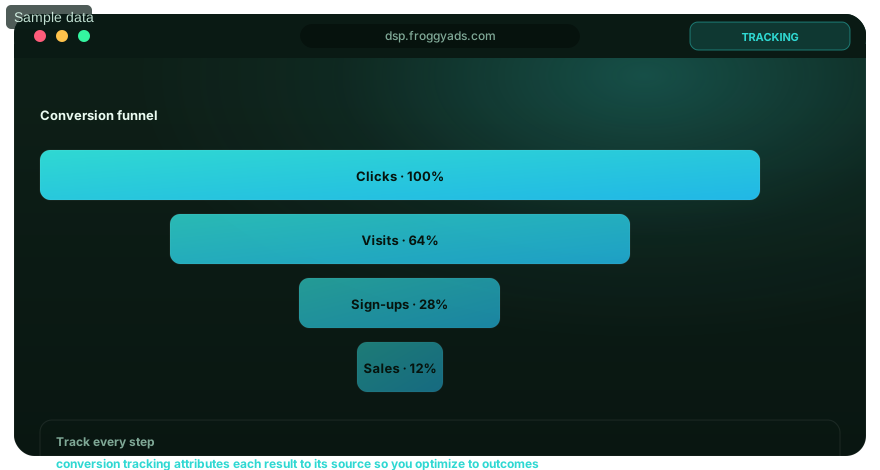
Use download starts as an early diagnostic rather than the final commercial result. A useful campaign record should show how many eligible visitors reached the correct package, completed installation, created an account when required, reached the advertiser's activation milestone and remained an accepted trial or paid account at the chosen maturity window. Each step answers a different question.
What counts as an accepted software user?
Write the accepted event in operational terms. It might be a verified installation, a usable trial, a completed registration, a documented activation milestone or a paid account accepted by the advertiser's system. Include the source, eligibility rule, exclusions and maturity window. State who owns acceptance and how the business record will be reconciled.
A VPN or security product may require a specific permission or completed connection before it provides its intended function. Another software offer may require an account, configuration or first successful task. Choose a milestone that shows meaningful access to the advertised capability without inventing a universal definition. Downloads remain valuable for diagnosing the route, but they should not replace the accepted event.
| Journey evidence | Question it answers | Action when it fails |
|---|---|---|
| Eligible destination visit | Did the promised OS, device and market route reach the correct page? | Repair targeting or destination continuity. |
| Completed download | Could the visitor obtain the intended package or store listing? | Inspect availability, trust signals and distribution errors. |
| Verified installation | Did the build complete setup on the supported route? | Segment by OS, version and installer evidence. |
| Activation milestone | Did the accepted user reach meaningful product use? | Investigate onboarding, permissions and claim fit. |
| Mature trial or paid account | Did early acquisition survive cancellation and refund review? | Reconcile source quality with product and service evidence. |
How do you build the eligibility matrix?
List supported operating systems, minimum versions, device or architecture requirements, distribution route and country availability. Add language, account, payment and support constraints when they change whether the user can complete the journey. The campaign should exclude an unsupported combination before launch rather than invite a download that cannot become an accepted user.
Keep the matrix versioned with the software release. When a new build adds or removes support, record the change and open a new comparison cell. This prevents the performance of one version from being blended with another and gives support teams the context needed to diagnose incoming cases.
Country eligibility needs the same discipline. Confirm that the product, terms, price or trial, account service and support route are available for the promoted geography. Targeting a country is useful only when the advertiser can provide the advertised software journey there.
Which destination and distribution evidence should you retain?
Store the creative version, landing or download-page revision, distribution URL, promoted build and current integrity evidence. The page should identify supported platforms, current package route, relevant commercial terms and the next action. If the route moves through a store, retain the listing version and the handoff used for attribution. If it uses a direct package, preserve the approved destination and build identity.
Walk the route on the selected device before buying volume. Check redirect behavior, package availability, authentication, permissions, account setup and the activation milestone. A successful page view does not prove that the installer or onboarding works. Capture the first failing step and assign it to media, destination, distribution, onboarding or product ownership.
How should creative claims influence the test?
VPN and software advertising can involve claims about access, privacy, security, speed, compatibility or productivity. Use only claims the advertiser has approved and can substantiate for the promoted version and market. The destination should explain the same capability without adding a stronger promise after the click.
Create materially different concepts around verified customer situations or product mechanisms. Version every asset and keep one baseline while testing a single new territory. Cosmetic edits can support production, but they should not be reported as separate strategic learning when the promise and explanation remain unchanged.
How does FroggyAds support the acquisition layer?
We provide a self-serve environment for buying traffic through our supported ad formats. Depending on campaign context and format, targeting can include country, city, device, operating system, browser, carrier, category, source, ID and IP options. These controls can help you form eligible VPN and software test cells around a documented destination and supported journey.
Start with one OS or device segment, one market, one creative premise, one destination revision and one accepted event. Set a spending boundary before launch and preserve source identity through the product funnel. SmartCPC and Adscore-supported traffic-quality controls can support campaign operation, while your tracker, installer, analytics and account system determine whether a user meets the advertiser's acceptance rule.
Choose FroggyAds for the independent traffic-buying layer when you are ready to compare source evidence with verified installs, activations, trials or paid accounts. Buying traffic does not guarantee installations, subscriptions, profit or organic ranking, so scale from reconciled evidence rather than download volume alone.
What should trigger optimization, scale or a stop?
Define stop conditions before launch. Pause a cell when the promoted route is unsupported, the package or destination cannot be verified, source identity is lost, the accepted event cannot be reconciled, a claim lacks substantiation or support capacity is at risk. These are operating protections, not signs that more traffic will solve the issue.
Optimize the layer that the evidence identifies. A low eligible-visit rate can indicate targeting or destination mismatch. A strong download rate with weak installations can point to package, compatibility or trust friction. Completed installations without activation call for onboarding and product review. Accepted trials that later cancel need maturity and value analysis.
Increase delivery only after the complete cell remains supportable at the next volume. Confirm package availability, infrastructure, account service, billing and support capacity. Preserve the previous baseline, change one material variable and wait for the same maturity window. This creates learning the media buyer can use without confusing product changes with source performance.
How should you budget the first software traffic proof?
Build the test budget from the decision it must support. Estimate the traffic needed to observe the destination, download, installation and activation handoffs, then cap spend at an amount the advertiser can treat as learning cost. Keep media spend separate from creative production, engineering, analytics, store or signing work, customer support and incentive costs. This makes the ownership picture visible even when one line item appears inexpensive.
Use an adverse-case plan as well as the expected case. Document what happens when the eligible audience is smaller, installation completion is weaker, account acceptance takes longer or support cases consume more time than expected. The test should stop before those conditions threaten service or product operations. A recommended test amount is a planning choice based on evidence and risk tolerance, not a guaranteed route to a target result.
Which discrepancies deserve investigation?
Differences among platform clicks, destination sessions, downloads, installs and accepted accounts are normal diagnostic inputs because the systems use different events and timing. Record time zone, attribution window, duplicate handling, consent, redirects, store handoffs and maturity rules before comparing totals. Reconcile at the most stable shared identifiers available, and retain unmatched records instead of forcing figures to agree.
Investigate the first unexplained loss in the journey. A gap before the destination can point to redirects or page availability. A gap between download and install can indicate package trust, device compatibility or interrupted setup. A gap between install and activation can reveal permissions, onboarding or product-fit friction. A gap after trial can expose billing, service or value issues. Route each finding to the owner who can change that layer.
What should the experiment log contain?
For every cell, retain the campaign and source ID, eligible audience definition, software release, creative version, destination revision, distribution route, accepted event, exclusions, maturity window, budget boundary and named owners. Add the reason for every change and the evidence reviewed at the decision point. This log lets an account strategist explain why the next step is a media adjustment, a product repair or a pause.
Close the proof with a clear decision. Continue the cell unchanged when it still needs time to mature, repair a documented handoff, stop under the declared rule or fund one bounded follow-up that resolves the most valuable uncertainty. Create your free FroggyAds account when the product route, measurement plan and operating limits are ready for that controlled campaign.
VPN & software campaign traffic: the buyer task this URL owns
Use VPN and software traffic to match campaign traffic with the supported device, operating system, country and activation path for a specific software offer. Compare the boundary with Vpn Traffic only where it clarifies the buyer's choice; this page serves a software, SaaS, utility or VPN acquisition team and accepts a verified install, trial, registration, activation or paid account accepted by the advertiser's system as its decision point.
Trial paid with version compatibility evidence frames this review: connect version compatibility with trial, paid account, cancellation and refund states reviewed together, then exclude unsupported OS and device routes before launch, so download, install, activation and account evidence remain aligned with a verified install, trial, registration, activation or paid account accepted by the advertiser's system when download volume can rise while activation quality falls.
| Checkpoint | Page-specific action | Evidence to keep |
|---|---|---|
| Fit | Device proof: record the required architecture or device class and verify that the promoted build completes its intended setup there. | Market proof: retain product availability, terms, language and support coverage for the exact geography before targeting it. |
| Test | Distribution proof: identify whether the route uses an approved store listing or direct package and preserve the attribution handoff. | Release proof: attach the promoted software version to the destination revision so a later build cannot be blended into the same result. |
| Decision | Package proof: verify the approved installer destination and current integrity evidence before the campaign sends visitors there. | Trial proof: state when usable access begins, which setup events are excluded and who accepts the mature trial record. |
Trial paid with installer integrity evidence frames this review: isolate installer integrity where operating system, device or version changes the journey, use trial, paid account, cancellation and refund states reviewed together, and exclude unsupported OS and device routes before launch; do not let a download stand in for an accepted user because download volume can rise while activation quality falls.
For VPN and software traffic, prepare operating-system eligibility, device architecture and campaign and source IDs joined to install or account events. Exclude unsupported os and device routes before launch, verify a verified install, trial, registration, activation or paid account accepted by the advertiser's system, then Create your free FroggyAds account.
VPN & software campaign traffic — what matters first
Trial paid with trial definition evidence frames this review: map trial definition to the exact software step it can influence through trial, paid account, cancellation and refund states reviewed together, then exclude unsupported OS and device routes before launch, allowing the team to distinguish media, compatibility, onboarding and account-acceptance friction when download volume can rise while activation quality falls.