
Seasonal Ad Campaigns
Plan seasonal traffic around a real selling window, available inventory and the margin you can protect as auctions change. We give you self-serve budget, bid, targeting and source controls for a bounded FroggyAds test; you keep the offer calendar, fulfilment limit and accepted conversion tied to every scaling decision.
How should you plan a seasonal ad campaign?
Treat a seasonal ad campaign as a dated acquisition plan with a launch window, a last useful click date, a fulfilment ceiling and a post-event review—not as a promise of instant customers. The operating purpose is to prepare campaigns for time-bound demand without allowing urgency, inventory pressure or short attribution windows to weaken measurement discipline. The useful result is seasonal acquisition that protects margin and distinguishes temporary demand from sustainable audience value. Before buying traffic, document the conversion event, the accepted-value definition and the maximum loss the test can absorb. This protects the budget from a common mistake: launching too late, raising bids without a value ceiling, or using misleading countdowns and unsupported scarcity claims. FroggyAds provides self-serve access to broad inventory, targeting and source controls, while the advertiser remains responsible for the offer, creative, destination, tracking and commercial decision. The direct answer is practical. Use seasonal ad campaigns when the available targeting and reporting can be connected to a real business outcome, then judge performance by incremental seasonal profit after media and fulfillment costs. Raw visits, clicks or installs are diagnostic signals, not the final definition of success.
Build the Market and Offer Fit First
Start with the dates that make the offer useful. Mark the earliest day a buyer can act, the last click that can still convert before the deadline, and the final date your team can fulfil the promise. Then define the eligible market: product availability, supported language, shipping or service coverage, device requirements and any audience exclusions. A winter promotion with slow delivery has a different final useful click date from an instant digital offer, even if both peak on the same holiday. Use the pre-season period to test one message and destination while auction pressure is still manageable. Keep a dated version of the offer, stock state and landing page so later reporting reflects what buyers actually saw. With FroggyAds, you can prepare a bounded format and targeting test, but the commercial calendar remains your control. If the destination, capacity or terms will change during the window, schedule the review before that change rather than treating the whole season as one stable campaign.
Define a Trustworthy Measurement Model
Create seasonal cohorts by click date and accepted-outcome date. Preserve the campaign and source identifiers from the ad through your tracker and backend, then decide which event is provisional and which one counts commercially. A submitted lead may need approval; an order may still be canceled or refunded; an app install may matter only after activation. Align time zones so a late-night click does not appear in one day on FroggyAds and another day in your store or CRM. Also record the offer version and delivery promise attached to the cohort. This lets you compare an early-learning week with peak delivery without confusing a calendar change for a source-quality change. Reconcile on a cadence that leaves enough time for the outcome to mature but still catches broken postbacks, expired pages or missing purchase suppression. Use clicks and conversion rate to diagnose movement. Use accepted value after media and variable seasonal costs to make the spending decision.
Forecast Budget, Bids and Test Exposure
Divide the seasonal budget into learning, peak and reserve envelopes before launch. The learning amount should answer whether tracking, creative and the destination work across enough sources to support a decision. The peak envelope should remain protected for the dates with the strongest commercial reason to buy. The reserve covers a verified expansion or an unexpected auction change; it is not permission to chase spend after the deadline. Calculate the maximum accepted acquisition cost from the outcome value after product, payment, fulfilment and other variable costs. Translate that ceiling into a bid hypothesis with a cautious conversion assumption, then set a total loss limit for the test. Write the pacing rule by date: how much can be spent before evidence matures, what triggers the next tranche and which owner can stop delivery. FroggyAds budget and bid controls let you apply that plan. Your backend still decides whether the latest cohort stayed inside the commercial ceiling.
A Five-Step Workflow for Seasonal Ad Campaigns
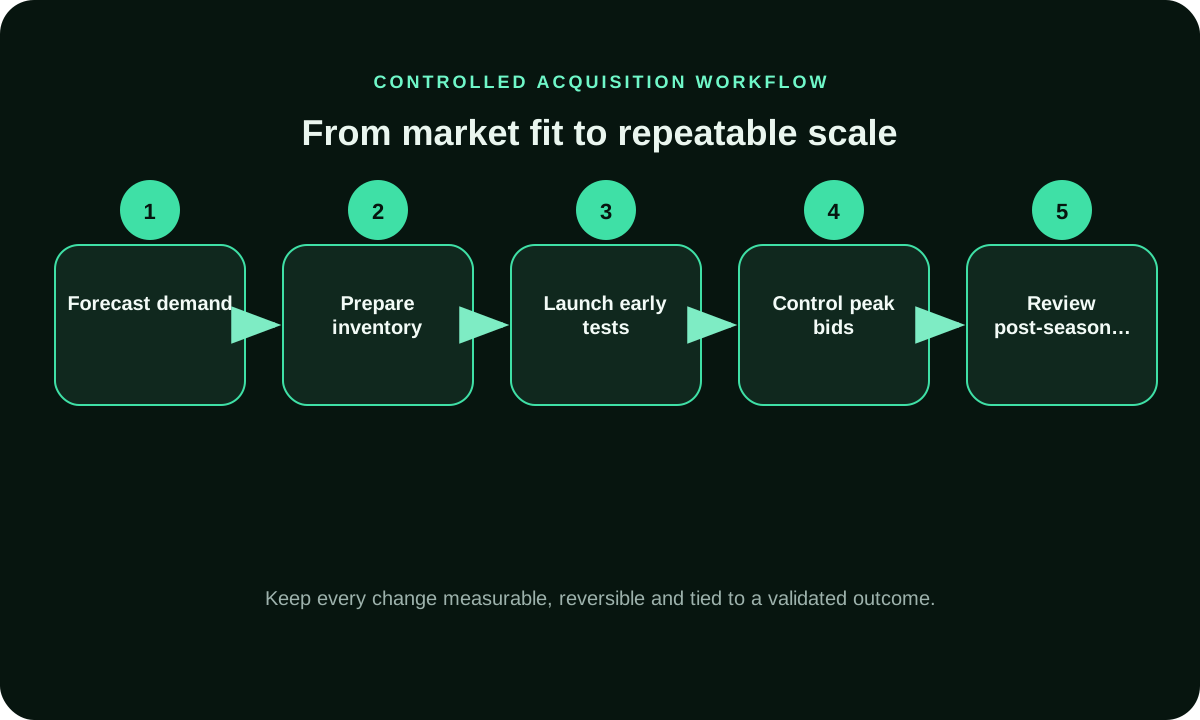
First, publish a campaign calendar with the offer start, creative expiry, last useful click and outcome-maturity dates. Second, validate the complete route: ad message, live product or service, destination, tracking event and accepted backend record. Third, run the learning phase with a fixed budget and preserve source IDs so you can see where cost and accepted value differ. Fourth, move only the passing combination into peak delivery, keeping the original settings and review rule recoverable. Fifth, stop, narrow or extend delivery at the scheduled checkpoint and label post-event traffic as a separate cohort. Assign an owner to each transition; a calendar without an operator becomes a note rather than a control. Use one expansion lever at a time where practical: budget, bid, market, device, format or source mix. The purpose is to enter the busiest dates with evidence, not to discover during the peak that the landing page, stock feed or accepted conversion was never reliable.
Segment Seasonal Ad Campaigns Without Losing Reach
Segment only where the calendar or customer experience changes. Separate markets when delivery cutoffs, language, currency or offer terms differ. Split devices when the buying path or creative needs a different treatment. Keep pre-season, peak and post-event traffic in distinct reporting views even if they use the same ad, because intent and acceptable cost can move quickly around a deadline. Avoid creating many tiny combinations of GEO, device and creative before you have enough accepted outcomes to compare them. Start with required eligibility, then add one explanatory split. On FroggyAds, source-level evidence can reveal useful pockets inside broader delivery, so preserve identifiers before narrowing the audience. When a segment is small, report its spend and maturity rather than calling it a winner from one conversion. When you expand, carry forward the same accepted event and attribution rule. That keeps the new seasonal cohort comparable with the one that earned the right to scale.
Creative, Message and Destination Continuity
Seasonal creative needs an expiry plan as well as a launch plan. State only deadlines, availability and savings that are true for the user who clicks. Put important conditions near the claim, and never imitate system alerts or invent scarcity. The landing page should repeat the advertised product, period and next step without forcing visitors to rediscover the offer. Test the route on the devices and locations you intend to buy, including checkout, form confirmation and the accepted tracking event. If a product variant sells out, replace or pause that creative instead of sending paid visitors to an irrelevant homepage. If delivery dates change, update the message and destination together. Keep the prior version and effective time in the change log. This discipline makes source analysis fair: a late conversion decline may come from an expired promise or unavailable item rather than the traffic. A truthful, synchronized experience also gives you a clear asset to reuse when the next seasonal cohort is tested.
Use Source-Level Quality Controls
Review each source inside the same seasonal phase, market, device and offer version. Record spend, clicks, provisional actions, accepted outcomes and maturity before changing a bid or exclusion. A source that looks weak during learning may simply have delayed conversions; one that produces repeated rejected actions can require earlier intervention. Confirm that the destination and tracking worked for that source before assigning the cause to traffic. Use a blacklist when mature evidence shows waste that should stop, a whitelist when supply remains useful across more than one dated cohort, and a bid change when the source may work at a different cost. Keep the previous setting and effective time so the decision can be reversed. FroggyAds source controls help you act on this evidence, while Adscore-supported screening is one input rather than proof of business value. The final test remains whether accepted seasonal contribution justifies the marginal media cost.
Scale Seasonal Ad Campaigns in Measured Increments
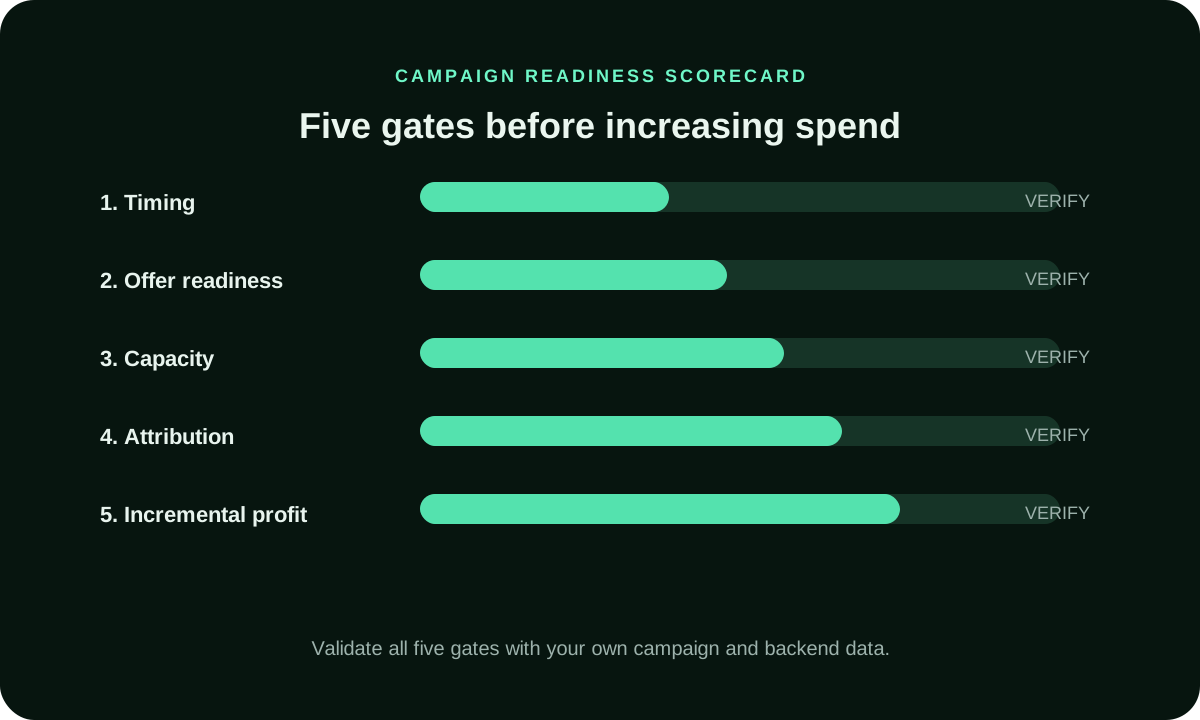
Scale against the remaining opportunity, not the original calendar. Before each increase, recalculate how many useful conversion days remain, how much stock or service capacity is available and when the new cohort can mature. Raise one budget or bid boundary, or open one justified segment, then label the added spend so marginal accepted cost stays visible. A blended result can hide a late, expensive tranche behind efficient learning traffic. Keep a stop rule for acquisition cost, rejection rate, fulfilment pressure and destination availability. If auction prices rise near the event, a smaller amount of profitable traffic is preferable to filling a preset budget at a loss. If the offer is still valuable after the peak, start a separate post-event cohort with current creative and economics rather than extending the old conclusion automatically. FroggyAds gives you the campaign controls to apply measured changes; your calendar, capacity and accepted outcomes decide whether another increment remains commercially useful.
Interpret Volume and Quality Together
Read volume in the context of time remaining and operational capacity. A burst of clicks can be valuable when accepted orders or leads mature before the deadline and the business can fulfil them. The same burst can be harmful when it overwhelms support, exhausts stock or produces outcomes after the offer loses value. Compare daily source mix, device mix and accepted cost across the learning, peak and closing phases. Check whether a rising conversion rate reflects stronger demand, a changed promotion, a narrower audience or a reporting delay. Review rejected leads, cancellations, refunds and contribution alongside platform conversions. Do not turn a peak-period rate into an evergreen forecast. Instead, document which dates, offer version, source conditions and capacity level produced it. This gives the next seasonal plan a useful prior without pretending that the auction or buyer intent will repeat. Expansion earns budget when both useful volume and accepted quality survive the newest tranche.
Common Failure Modes to Avoid
The first failure is a late start that leaves no time to learn before the buying window. The second is spending the peak reserve during an inconclusive early test. Other common faults include an expired countdown, stale stock, conflicting offer terms, different time zones, broken source identifiers and a conversion event that has not reached backend acceptance. Teams also overreact to one busy day, make several targeting and creative changes together, or judge sources before delayed outcomes mature. Prevent these errors with dated approvals and named owners. Test the ad-to-outcome route before meaningful spend. Keep a versioned offer and destination. Set the maximum loss and marginal cost before auction pressure rises. Record each bid, budget, source or creative change with its effective time. At the closing review, separate media quality from offer, capacity and tracking failures. This creates evidence the next campaign can use instead of a seasonal story that cannot be reproduced.
How FroggyAds Supports Seasonal Ad Campaigns
We give advertisers, affiliates and media buyers a self-serve way to put a dated traffic plan into action. Choose a supported ad format, set the campaign budget and bid, apply eligible targeting, and inspect delivery by source as the season moves from learning to peak demand. Our access to broad inventory can help you test reach, while source controls let you act on mature differences without discarding the whole campaign. Start with the market and devices your destination can serve, keep the accepted conversion connected to each source, and reserve budget for a verified expansion. Use our controls to pace spend, compare the newest cohort and stop obsolete creative when the offer changes. FroggyAds does not make the deadline, stock, fulfilment or margin decision for you. That is why we recommend a bounded first campaign with explicit dates and a rollback rule. Create your account when the offer calendar, tracking path and commercial limit are ready.
Final Buyer Checklist for Seasonal Ad Campaigns
Before launch, confirm the offer start and expiry, final useful click date, eligible markets, capacity limit, accepted outcome, attribution window and maximum acquisition cost. Test the advertised route on a real device and verify that the backend records the event you intend to optimize. Assign owners for creative expiry, stock or service changes, pacing and the stop decision. During learning, retain source IDs and keep the peak reserve untouched until evidence matures. During the event, compare the newest spend with its accepted value and check that fulfilment remains safe. At the close, stop expired messages, label any post-event delivery separately and wait for the final outcome window before declaring a result. Save the settings, offer version, dates and reasons for each change. That record gives the next buyer a usable seasonal baseline. It cannot guarantee profit, sales, lead quality or rankings, but it can prevent a dated campaign from being managed as an unbounded traffic purchase.
Supporting controls for Seasonal Ad Campaigns
Seasonal Ad Campaigns FAQ
What is seasonal ad campaigns?
A seasonal ad campaign is paid traffic planned around a dated period when demand, availability or the offer changes. It needs a launch window, a final useful click date, a creative expiry rule and a post-event review. Judge it by accepted value after media and variable fulfilment costs, not by the busiest day or the largest click count.
Who should test seasonal ad campaigns?
Advertisers, affiliate marketers, media buyers, agencies and online businesses can test seasonal traffic when they have a real dated offer, a working destination, reliable conversion tracking and capacity to serve the expected response. Name the owner, accepted outcome and loss limit before the first budget is released.
How much budget does seasonal ad campaigns require?
Build the budget from your accepted outcome value, maximum acquisition cost and expected variance. Split it into a learning amount, a protected peak envelope and a reserve for a verified expansion. Do not spend the peak reserve merely because early delivery is available; release it only when the first cohort has mature evidence.
Which metric matters most for seasonal ad campaigns?
Use incremental seasonal contribution or profit after media and relevant variable costs as the governing business metric. Support it with accepted acquisition cost, rejection or refund rate, conversion delay and capacity. Read the newest dated cohort separately so a strong opening period cannot hide an expensive closing push.
How should seasonal ad campaigns be tracked?
Preserve campaign, source and click identifiers through the tracker and backend. Align time zones, store the offer and destination version, and separate provisional events from accepted orders, leads or activations. Reconcile by click date and outcome date so delayed conversions are assigned to the correct seasonal cohort.
How long should a seasonal ad campaigns test run?
Start early enough for the chosen outcome to mature before peak spend. The test may run through several source and time cohorts, but each has a final useful decision date. Stop learning changes when there is no longer enough time to apply them responsibly, and treat post-event traffic as a new cohort.
How can traffic quality be checked?
Compare sources under the same seasonal phase, market, device, offer version and acceptance rule. Review spend, duplicate or abnormal behavior, conversion delay, rejected outcomes and backend value. First rule out broken tracking, stale stock and an expired destination; then use mature source evidence for bid, whitelist or blacklist decisions.
When should seasonal ad campaigns be scaled?
Scale when tracking reconciles, the latest cohort stays inside the marginal cost limit, the offer remains accurate and the business has capacity for more accepted outcomes. Recalculate the remaining useful window before every increase. Open one budget, bid, market, device or source change at a time where practical.
What should be avoided with seasonal ad campaigns?
Avoid false countdowns, unsupported scarcity, expired prices, stale stock, late launches and bid increases without a value ceiling. Do not change creative, targeting and conversion definitions together or treat a peak-period rate as an evergreen forecast. Stop obsolete messages when the commercial window closes.
Can FroggyAds support seasonal ad campaigns?
Yes. We provide a self-serve workflow for supported formats, campaign budgets and bids, eligible targeting and source-level delivery review. Use those controls to run a bounded learning phase, protect peak budget and compare mature cohorts. Your offer calendar, fulfilment capacity and accepted backend economics determine whether scaling is justified.
Choose the next seasonal campaign control
Build a controlled seasonal ad campaigns test
Define one objective, verify tracking, protect the test budget and make source-level decisions from mature data. Results vary by offer, GEO, creative, destination, competition and optimization. Before adding spend, recheck the campaign deadline, remaining capacity and the marginal cost of the newest traffic.
How do you keep a seasonal test commercially useful?
For performance-focused advertisers, the job is to match media delivery to dates when the offer is useful and the business can still fulfil it. Record when learning ends, when peak delivery may begin, when the final useful conversion can arrive and who pauses an expired message. That calendar makes budget and source decisions reproducible without promising traffic quality, sales or profit. Tie the campaign to a dated demand window, creative expiry point, budget pacing rule and post-window review. Treat results from the peak as evidence for that period until another stable test shows that the economics continue outside it.
| Decision layer | Evidence to retain | Review rule |
|---|---|---|
| Scope And Accepted Outcome | Record the selling window, final useful click date and accepted order or lead. | Pause when the remaining window cannot mature before the commercial deadline. |
| Audience And Eligibility | Record who can buy now, where fulfilment is available and which exclusions apply. | Widen reach only while the new segment can receive the same truthful offer. |
| Offer And Destination Continuity | Save the creative promise, offer terms, stock state and destination version. | Stop or replace creative when its price, deadline or availability expires. |
| Inventory And Source Context | Retain dated source IDs, spend, accepted outcomes and the peak-period mix. | Change one source or bid decision at a time after the cohort matures. |
| Budget And Bid Discipline | Reserve spend for the highest-value dates and write the maximum marginal cost. | Hold or roll back when the newest spend exceeds that limit or capacity tightens. |
Map the commercial window before you buy seasonal traffic
Use How should you plan a seasonal ad campaign? as the evidence anchor. Put the offer start, creative expiry, final useful click, fulfilment limit and outcome-maturity date on one timeline. For every increase, record which FroggyAds budget, bid, targeting or source control changes and what evidence will end or reverse it.
Keep the campaign objective and ad format attached to that dated decision. A general campaign guide can explain evergreen controls; this page owns the narrower problem of buying traffic before a deadline without carrying peak-period assumptions into the rest of the year.
Next step: When this page calls for paid traffic, create a bounded FroggyAds test with stable conversion tracking, the relevant targeting and format controls, and source-level evidence. Increase spend only after the accepted outcome and its cost relationship are mature enough to support the next decision. Create your free FroggyAds account. Before releasing the next tranche, confirm that its clicks can still mature before the offer closes and that fulfilment headroom remains.
Seasonal Ad Campaigns — page-specific decision checks
Commercial deadline: Write the commercial deadline beside the media plan because a seasonal campaign loses value when delivery arrives after the buying window closes.
Learning budget: Separate pre-season learning spend from peak-period scale so early tests do not consume the budget reserved for the highest-value dates.
Creative expiry: Record creative expiry dates and offer terms to prevent an old seasonal message from continuing after the promotion changes.
Peak auction pressure: Compare daily marginal cost during the event window because auction pressure can change faster than a normal evergreen campaign.
Dated source mix: Keep inventory, source and device mix visible by date so a blended season average does not hide a late-window quality shift.
Accepted outcome: Define the accepted outcome before the first seasonal test and keep that outcome stable while media costs move.
Pacing reserve: Use a pacing rule that protects enough budget for the dates that matter instead of maximizing early delivery without regard to demand timing.
Fulfilment capacity: Check fulfillment or service capacity before scaling; a successful seasonal acquisition burst can still fail operationally downstream.
Post-event demand: Treat post-event demand separately from the peak campaign because intent, creative relevance and acceptable cost can change once the deadline passes.
Landing-page availability: Keep landing-page availability synchronized with the promotion so expired prices or stock do not distort the media-quality conclusion.
Seasonal Ad Campaigns: the buyer task this URL owns
Use this page when a dated demand window changes pacing, creative expiry, capacity and the last useful conversion. The broader Successful Ad Campaigns guide covers durable campaign fundamentals; this URL owns the seasonal decision: how much traffic to buy before a deadline, when to reserve or release budget, and how to keep peak results separate from post-event demand.
Keep the operating evidence visible: campaign objective, audience targeting, conversion tracking, audience and market fit. Use these entities only when they change setup, measurement or the commercial decision.
| Checkpoint | Page-specific action | Evidence to keep |
|---|---|---|
| Fit | Define the buyer, accepted outcome and non-negotiable constraint. | Keep the approved calendar, capacity ceiling and accepted-outcome definition used for the launch. |
| Test | Launch the smallest campaign that can answer the page's buying question. | Retain the learning dates, creative version and source-level result that authorized peak delivery. |
| Decision | Keep, cap, exclude or expand from accepted-outcome evidence. | Archive the decision timestamp, marginal cost and remaining fulfilment headroom behind the final change. |
Hypothetical calculation: if a controlled campaign for seasonal ad campaigns spends USD 175 and produces 7 accepted conversions, accepted CPA is USD 175 / 7 = USD 25.0. Replace the inputs with your own campaign economics; this is not a FroggyAds performance claim.
When Seasonal Ad Campaigns moves from research to a traffic test, FroggyAds lets performance-focused advertisers control targeting, budget and source decisions from one self-serve workflow while downstream conversions remain the commercial proof. Create your free FroggyAds account.
Seasonal Ad Campaigns — what matters first
Plan the deadline first. Define when the offer starts, when creative expires, which accepted outcome can mature in time and how much capacity remains. Then use FroggyAds budget, targeting and source evidence to release the next tranche or stop before late traffic loses its commercial value.