Offer permission, message and commission

Push Ads for ClickBank Offers: Buy Traffic Around the Right Commission Model

Use FroggyAds to test push ads for ClickBank offers with an eligible product, an accurate notification and a spending limit you control. Connect our campaign and source records with your affiliate reporting. Revenue share and seller-approved CPA have different commission rules; choose the right measure before deciding what traffic to buy next.

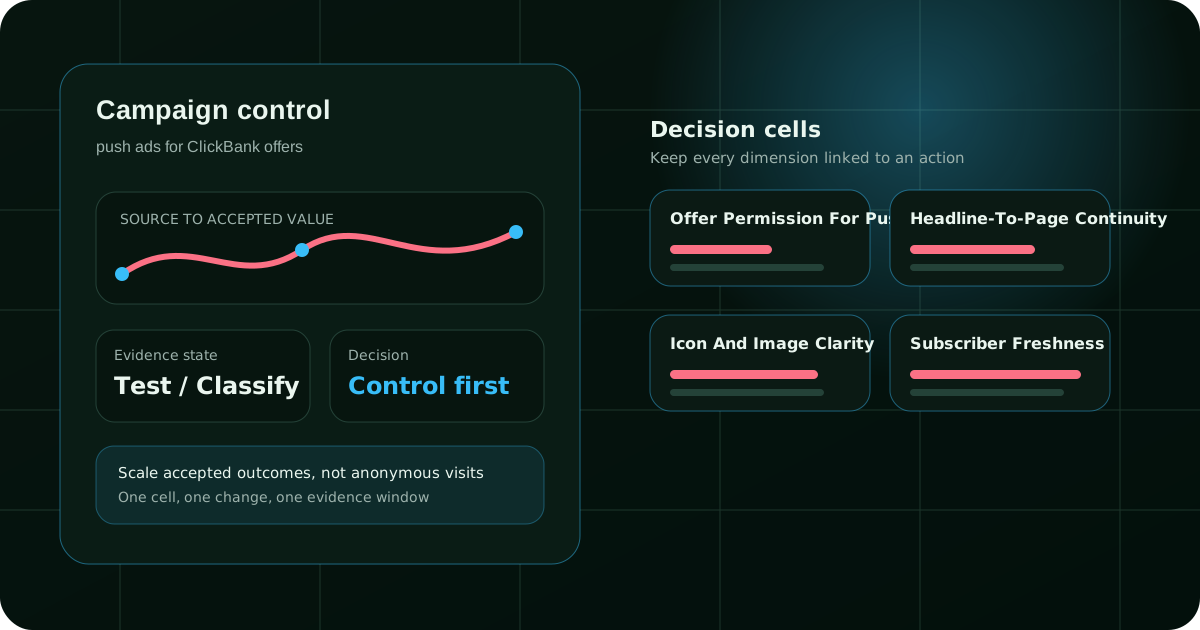
Push Ads for ClickBank Offers campaign control dashboard
Prepare the ClickBank route

What should you confirm before buying ClickBank push traffic?

This guide focuses on the notification-to-offer journey: permission, message, bridge page, tracking and commission. Use our broader ClickBank traffic guidance when comparing acquisition channels. Here, the buying decision is whether one defined push campaign can bring an appropriate audience through a verified route at a cost your offer economics can support. Prepare that route before funding a larger test.

The commission decision

Choose the commission model before defining campaign success

Confirm revenue share or seller-approved CPA before setting your success measure. ClickBank documents that returns can reverse revenue-share commission, while affiliate CPA commission is not debited for refunds or chargebacks and excludes additional upsell or rebill commission. The product retail price is not your affiliate earning.

Begin with one permitted offer and country/device route. Identify the format, notification and destination, then set an affordable campaign allowance. Our published minimum deposit funds the account; it is neither a promised acquisition cost nor evidence that every ClickBank offer can be evaluated with that amount.

Record the offer terms, commission arrangement and date checked. Use a stated observation period, retaining later adjustments when they affect earlier earnings. An internal review date does not make commission irrevocable. Recheck a material seller-rule change before resuming the affected promotion.

Work backward from the commission measure to the cost you can support. For an initial revenue-share test, allow for unresolved adjustments instead of treating every early sale as settled earnings. For approved CPA, use its defined initial-sale payment. In either case, choose a spending boundary that remains affordable if the next campaign underperforms.

Choose FroggyAds for control over the first traffic purchase. Our available targeting, budgets, bids and source controls help you test an identifiable route. Keep the offer stable while examining a source change, or retain source settings while testing a new message.

Campaign readiness

Which controls make a ClickBank push campaign ready to buy?

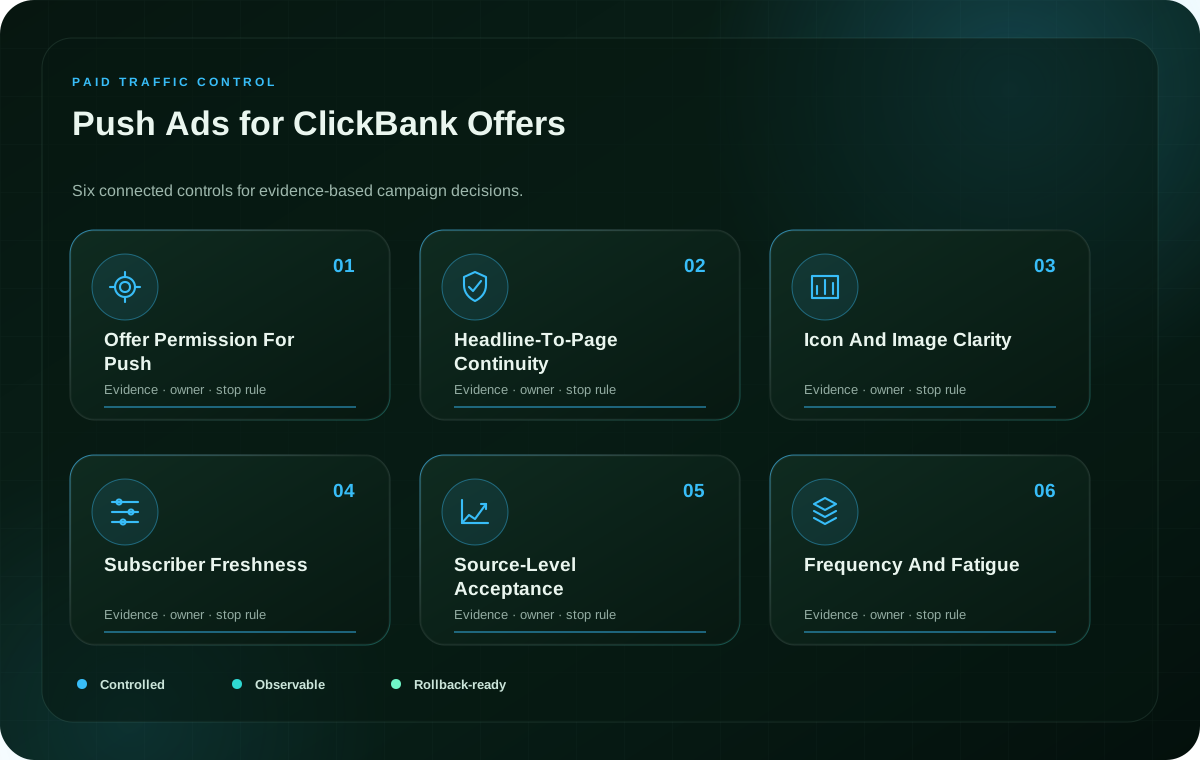
Six connected decisions turn a planned promotion into a campaign you can evaluate. Your team verifies offer terms; our settings define the traffic purchase; your tracking and affiliate records explain the result. Assign someone to resolve a missing permission, broken route or overspend.

Six checks before buying push traffic
Seller instructions Decision owner Pause condition
01

Does this seller permit your planned push promotion?

Read the seller instructions beside your finished notification and destination. Confirm approval requirements and the intended format, country, device and assets. Approval to promote a product does not settle every message question. Save the relevant instructions or clarification before purchasing the traffic.

Seller approvalFinished creativeRecheck changes
02

Can the affiliate link identify the correct offer and account?

Use the generated link for the correct affiliate and seller. Apply ClickBank's documented account-owner attribution check through the order form in your permitted setup; a destination opening is insufficient.

Generated linkAttribution checkCorrect account
03

Does the notification prepare the visitor for the product?

Read the notification as a buyer. Its supported benefit should prepare the visitor for the destination without inventing an outcome or urgency claim. Check the actual specification and seller instructions.

Product benefitVisitor contextAccurate promise
04

Can a sale be connected with its campaign and source?

Map campaign/source groups separately from individual click references. Verify the supported route, retaining missing joins. Our buying report and ClickBank attribution describe different stages.

Campaign referenceSource identityClick identifier
05

Does the commission record support the buying decision?

Select the earning record appropriate to revenue share or approved CPA. Retain the review date and relevant adjustments, separating unresolved statuses from supported reported amounts.

Commission modelReview dateRecorded adjustments
06

Can you afford the test without relying on projected earnings?

Set a limit you can afford even with no commission. State the question and review date. Account funding, minimum bid and campaign allowance are different amounts.

Affordable allowanceCost so farNext question
A useful launch check: keep the seller permission, product explanation, link route, source record, commission terms and spending boundary ready before purchasing the test.

Fund the test without assuming early sales will replenish it. Include the media allowance and separate tracking or page costs, and reserve money for a genuine second question. When the route cannot be measured, correct it before buying more observations.

Launch the offer journey

How do you launch a traceable notification-to-offer test?

Inspect the advertising destination, affiliate link, seller and order form in sequence. Establish the identifiers and commission interpretation before launching. Give each checkpoint a practical purpose: confirming promotion permission, preserving attribution or explaining the financial result. Complete these checks in your own authorized account and tracking setup before buying the comparison.

Confirm termsInspect the routeBuy a focused testReview commission
  1. 1

    Define the commission you are trying to earn

    Write down the revenue-share or approved CPA earning rule. Check which returns, upsells or recurring payments affect it. Use affiliate commission, rather than the product retail price, in your acquisition-cost decision.

  2. 2

    Verify the seller rules against the finished promotion

    Compare seller instructions with the actual message, assets and route. Clarify an unclear push method before buying. Product availability is not permission for every creative treatment.

  3. 3

    Inspect the bridge page, HopLink and seller handoff

    Inspect the bridge and generated HopLink through to the seller and order form. Apply ClickBank's documented account-owner attribution check in your authorized setup; page availability alone does not prove commission tracking.

  4. 4

    Separate campaign labels from individual click references

    Assign stable offer, campaign, creative and source labels. Map individual click references to the appropriate supported parameter. Matching field names across two tools does not connect their records.

  5. 5

    Launch one small, answerable comparison

    Test whether one benefit-led notification brings suitable interest to the prepared bridge page. Hold other material settings steady and set a ceiling so the comparison stays interpretable.

  6. 6

    Read source groups without hiding unresolved records

    Join traffic purchases to affiliate outcomes through preserved identifiers. Separate unmatched records and unresolved statuses. Never assign another campaign's earnings to a source merely to complete the report.

  7. 7

    Reconcile earnings with the applicable commission terms

    Update relevant revenue-share reversals and apply approved CPA terms correctly. Retain transaction dates, review dates and reporting gaps when comparing the financial records.

  8. 8

    Increase one purchase and schedule its next review

    Buy another defined increment when the working route and economics justify it. Set a new ceiling and review date, retaining reasons to pause for permission, route or cost problems.

Progress with evidence: resolve a broken handoff before spending more, and compare the financial result under the actual commission arrangement.
Read the earning model

Why judge ClickBank push traffic by commission as well as click cost?

A click buys an opportunity to continue the offer journey. It does not establish a sale, attribution or retained earnings. Use response metrics to inspect the message and route, while applying the correct commission model to the financial decision.

Revenue-share reviews need commission after relevant recorded reversals at the stated date. Keep subsequent adjustments visible. Reviewed earnings describe a financial snapshot; an internal waiting period cannot certify that every sale is permanently final.

CPA reviews should use the affiliate's defined initial-sale earning rule, separately from the seller's downstream economics. Monitor quality and seller instructions without treating a customer return as an automatic debit to affiliate commission when the terms say otherwise.

Compare source groups with similar cohort ages, spending intervals and earning rules. A recent group with early sales is different from an older group that has accumulated returns. State unresolved attribution and timing differences rather than hiding them inside one efficiency ratio.

Act on a specific finding through our buying controls. Repair a broken destination; narrow a source allocation when its comparable economics support that decision. An attractive click rate alone cannot justify more spending when attribution remains unclear.

Push Ads for ClickBank Offers premium campaign control framework
Launch and source decisions

Use this ClickBank launch and source-review table

Launch checkEvidence to retainProblem to resolveNext buying action
Seller permissionCurrent instructions for your affiliate, format, market and message.The intended push route or finished claim is not covered.Clarify the promotion before funding that campaign.
Product explanationNotification, bridge and seller page describe the same real benefit.The destination changes the promise or purchasing commitment.Repair the message-to-offer handoff and retain its new version.
Affiliate attributionCorrect generated link and an authorized end-to-end attribution check.The account, seller or identifier route cannot be confirmed.Pause the affected route while correcting the specific link problem.
Source reportingStable campaign/source categories and appropriate unique click references.Several purchases are blended or an identifier is discarded.Fix the mapping and keep unmatched outcomes separate.
Commission modelActual revenue-share or seller-approved CPA arrangement and review date.A sale total is mistaken for the affiliate earnings it supports.Use the applicable commission record before changing spending.
Spending boundaryCampaign ceiling, cost already incurred and next observation needed.Another purchase would exceed the affordable allowance.Reduce or pause the test until a justified next step is funded.

Retain the instruction, link check, identifier map or commission record behind each table decision. Isolate a failed route and preserve its incurred cost. A repair should establish a new review boundary without erasing what the earlier purchase spent.

Our approach is to buy the next useful observation. A verified offer route can support a notification or source comparison. An unresolved permission or discarded identifier calls for a repair; additional delivery cannot supply that missing evidence.

Offer-specific examples

How should the offer type change your push campaign?

The offer type changes what a short push message needs to explain. A course introduces a learning promise; software needs a compatible task; a recurring product needs clear purchasing terms. The examples below are planning scenarios, not endorsements of named offers or claims that every seller permits push traffic.

Learning product

Promote a course with a specific lesson and commission rule

For a hypothetical course, introduce the subject, learner level or lesson format the seller actually offers. The bridge page can explain the commitment. An educational benefit should not become an income guarantee simply because the notification needs a stronger hook.

Keep the course's actual affiliate arrangement beside the campaign. Similar educational products can have different commission terms. Compare the earning record your arrangement supports, rather than assuming that a displayed percentage or initial sale describes retained value.

Inspect the course explanation when readers do not continue to the seller. Check relevance and the unanswered learning question. A failed seller handoff needs a link repair before another notification test.

Test how the course explains its intended learner or lesson format. Preserve the earlier page and campaign reference so you can identify which learning proposition the purchase exposed.

Check claims against the seller's permitted material and finished destination. Your actual notification and bridge page remain part of the promotion to review, including after a material product change.

Software product

A software offer needs a compatible use case

For software, explain a supported task and confirm that the buying audience matches the product's actual environment. Do not promise a browser, device or integration capability just because it would make the ad more attractive.

Prepare visitors for installation, subscription or another real commitment. Check the intended handoff on the selected route. You want to test interest in the software, rather than confusion created by an inaccurate notification.

Useful bridge page

A complex product may need a useful bridge page

A useful bridge page answers what the product does, who it suits and what happens next. Explain the affiliate relationship appropriately for your setup. Its purpose is to help a visitor decide, while keeping the seller and product promise recognizable.

Change one meaningful explanation and preserve the identifier route. Record the version used. A simultaneous seller-page or checkout change should appear in the review because it changes the experience behind the result.

Recurring offer

Plan recurring subscription earnings and cancellations

Confirm whether the arrangement includes recurring revenue-share commission or CPA on the initial sale. Do not forecast earnings your contract does not provide. Review credited amounts instead of multiplying a subscription price by an assumed customer lifetime.

Distinguish a subscription cancellation from a refund. ClickBank explains that cancellation stops future charges without itself creating a return. Your review should identify the initial sale, later credited payments and reversals relevant to your own commission.

Questions before the next purchase

Twelve decisions that improve a ClickBank push purchase

Choose the check linked to the weakness you observe. Changing every setting after a disappointing day weakens the comparison. A specific buying question makes the next FroggyAds allocation easier to evaluate.

Which product question should the bridge explanation answer?

Answer the cold visitor's product question: learner level and lesson delivery for a course, or supported environment for software. Stay within the real offer.

Present the next step as a visit to the seller. Recheck material destination changes so your explanation still prepares visitors for the purchasing commitment.

When should the test allowance stop further spending?

Set a ceiling and name who can pause spending. A displayed commission describes potential earnings under its terms, rather than the sales your test will generate.

Review incurred cost before extending the allowance. Repair missing attribution or an unavailable seller page before funding another observation.

Which response metric describes the step you are testing?

Read notification response, bridge-to-seller clicks and attributed commission as different stages. State each denominator; repeated events, sessions and people are different counts.

Trace message fit, destination, audience, attribution and financial status. Locate the unsupported step instead of assigning one cause from a top-line ratio.

Does the message journey still match the seller promise?

Read the notification, bridge page and seller page together. Locate a product promise or requested commitment the next step cannot continue, then repair the mismatch.

Recheck changed seller instructions or destinations and retain the affected campaign date. Evidence about the previous version does not approve the later one.

When should you restrict an individual source?

Compare identifiable sources at similar review ages. Read attributed commission and quality reasons alongside spending; small early differences can be unstable.

Record a supported source restriction and its time. An unaffected reference can help distinguish the new purchase from activity before the change.

When does a push creative need refreshing?

Test another substantiated angle when response weakens or the offer changes. Identify the destination version and keep material buying settings steady.

Retain a control message where practical. Source mix, timing and seller experience may change too; refreshing creative does not establish the cause of decline.

Which ClickBank tracking parameter belongs in each field?

ClickBank separates shared campaign categories from unique external click references. Use stable campaign/creative labels for groups and an appropriate field such as extclid for individual references. Its guidance warns against placing high-volume unique values into aggregate-category fields.

Map the fields your account and tracker support, then inspect the resulting link. ClickBank says these parameters apply to HopLinks and Direct Tracking Links, rather than payment links. They do not establish an automatic FroggyAds integration.

What should you do when the report cannot join a sale?

Separate an unmatched record while inspecting redirects and entry parameters. Timing alone cannot assign commission to one source when several campaigns were active.

Verify the event and field behavior of your supported integration. A missing initial event and a later commission adjustment require different investigations.

What would invalidate the original promotion decision?

Pause a withdrawn permission, broken destination or unsupported claim even after earlier commissions. A past result cannot resolve a new promotion defect.

Retain earlier spending, then document the correction needed to resume. Renaming the campaign does not repair the original problem.

When is a larger campaign justified?

Consider another affordable purchase when attribution and earnings support the decision at the stated review age. Historical efficiency cannot promise its outcome.

Increase one dimension. A different country, format or seller page changes the experience and may require another permission check.

What belongs in the weekly affiliate review?

Review cost, attributable transactions, commission and relevant reversals. Separate unresolved records and assign a concrete continuation, repair, restriction or pause.

Keep transaction and campaign dates visible. This week's refund may affect an older purchase, while a fresh campaign still lacks comparable observation.

Why begin with the seller's actual product promise?

Begin with a substantiated seller benefit. Your bridge should prepare visitors for that product, rather than justify an invented notification promise.

This gives FroggyAds advertisers a useful question: which eligible audience and message support the actual offer? Compare the intended explanation with the visitor's real journey.

Keep the buying context

Keep these buying controls beside the ClickBank report

Keep the campaign, offer, earning model, creative and destination references beside the spending interval. An unnoticed message change can alter the meaning of a comparison.

Format: identify classic and in-page push separately. Check each available specification and seller permission; one route's result does not establish another's eligibility.

Targeting: align available country and device settings with product eligibility and usability. Confirm the seller destination serves that route before funding it.

Source identity: distinguish a stable placement group from an individual click reference. Report at the level your actual mapping supports.

Budget: a deposit, spending ceiling, bid and acquisition cost describe different amounts. A hypothetical $150 allowance is neither a quote nor a sales forecast.

Creative: save the finished notification and benefit tested. Exclude invented urgency and unsupported outcomes, then inspect its full destination.

Destination: record bridge and seller versions. Check the action on the selected device, keeping outages and material changes visible in the review.

Tracking: verify identifiers and event behavior for supported macros, pixel or server-to-server methods. Similar ClickBank and FroggyAds labels do not prove one transaction.

Financial review: apply the actual earning rule and relevant adjustments. Separate pending or unmatched records from supported amounts before increasing spending.

Test history: retain earlier creative, destination and source settings. A material change needs a clear start another reviewer can identify.

Next action: fund an answerable message or source question. Choose FroggyAds for the controls that let you apply the finding to a defined campaign.

Review timing: state the snapshot date and compare similar cohort ages. An internal waiting period cannot guarantee against every subsequent financial adjustment.

Ownership: seller checks, tracking inspection and spending decisions need an accountable person. One operator can cover all roles if each problem has a clear next action.

Interpret the limits

What can a ClickBank push test establish?

A defined purchase can reveal a broken handoff, message mismatch or combination worth another test during its stated period. It cannot guarantee sales, affiliate approval, commission, profit or organic rankings.

Separate observation from explanation. Before attributing a source difference to quality, inspect cohort age, attribution and offer changes. Our controls help you act on a finding while retaining the uncertainty that matters.

Replace hypothetical inputs with verified records before making a buying decision. Include relevant tracking, page and other costs separately. A positive balance after media alone does not establish overall business profit.

Prepare an eligible offer, truthful message, attributable route and affordable boundary. You can then use FroggyAds to buy a focused test and decide which part of the journey deserves the next investment.

ClickBank push FAQ

Questions about push ads for ClickBank offers

Can I promote any ClickBank offer with push ads?

Eligibility depends on the actual offer and promotion route. Confirm seller instructions, account approval, format, finished message, country, device and destination before spending. Retain clarification with the creative; marketplace availability alone does not permit every method or later product change.

Should I compare classic push with in-page push?

Compare supported formats when the seller permits both and the destination serves their actual arrival context. Identify each route and use comparable commission measures and review periods. An early response difference does not establish a universal winner.

What should a ClickBank push notification say?

Introduce one substantiated product benefit and a recognizable next step. A course can describe its subject; software can describe a supported task. Continue the same explanation through the bridge and seller, using claims and assets permitted for your promotion.

Do I need a bridge page before the seller?

Use a permitted bridge when a short notification leaves a real product question unanswered. Explain the audience, benefit and next commitment, then preserve the correct affiliate link. Test the handoff; an extra page does not automatically improve sales or attribution.

Should every campaign optimize for a refund-cleared sale?

Apply the actual commission model. Revenue-share earnings can be reversed after returns; ClickBank documents different affiliate treatment for seller-approved CPA, including no refund or chargeback debit. Use applicable credited earnings instead of forcing both arrangements into one retained-sale definition.

How should I track a ClickBank push campaign?

Separate stable campaign, creative and source categories from unique click references. Verify the parameter mapping your account and tracker support through the complete route. Keep unmatched outcomes visible; a campaign name or landing visit alone does not establish attributed commission.

When should I refresh the creative?

Try another accurate angle when response weakens or the offer changes. Retain a control and destination version, while inspecting source mix and tracking. A focused revision tests the message without assuming fatigue caused every decline.

Can push ads guarantee ClickBank sales or profit?

Traffic provides an opportunity to reach visitors, without guaranteeing sales, commission or profit. Product fit, permitted promotion, destination and earning terms affect the outcome. Use an affordable test and supported records to choose a repair, refinement or further purchase.

What should I inspect when clicks do not produce commission?

Follow the notification, bridge, affiliate link, seller and order form. Inspect message fit, availability, permission and identifiers before checking attribution and commission. Pause a broken route before buying more clicks, retaining its earlier cost when evaluating the repair.

When is a ClickBank push campaign ready to scale?

Consider another bounded purchase when permission, route and attributable earnings support it under the correct model. Compare similar cohort ages, record unresolved adjustments and increase one dimension with a fresh ceiling and review date.

Choose your next buying guide

Choose the FroggyAds guide for your next campaign decision

Compare our push traffic buying options

Choose the push traffic guide for buying options, push ads guidance for the format, and ClickBank traffic guidance for the wider acquisition route. Keep actual seller permission and commission terms beside that choice.

Understand the push advertising format

Read the push format guide when you need to align a short message with its destination. Confirm the actual available specifications and the seller's permission before building the creative.

Plan broader traffic for ClickBank offers

Use broader ClickBank traffic guidance to compare acquisition routes. Keep the offer-specific earning arrangement and promotion instructions beside that channel decision.

Review push messaging and destination fit

Return to the push messaging guide when response and destination fit need work. Test a supported benefit explanation while keeping the rest of the offer journey identifiable.

Prepare a ClickBank push test

Buy the next ClickBank observation you can evaluate

Begin with one prepared offer and an affordable campaign boundary. Use our available targeting, budgets, bids and source controls to buy an identifiable test. Connect the outcome with its applicable commission record before funding the next adjustment.

Create your free FroggyAds account
The purpose of this push guide

What does this guide add to general ClickBank traffic advice?

This page addresses the short push message and the offer journey that follows it. Visitors need accurate context; advertisers need a correct affiliate route and a financial measure suited to the commission arrangement.

Affiliates and media buyers can use these checks to prepare a traffic purchase. They explain what to verify in your existing tools and how to connect the evidence with FroggyAds buying controls.

Commission terms determine which financial record matters. Read the applicable earning status and relevant adjustments, retaining unresolved attribution gaps. A sale total alone cannot supply that interpretation.

Creative continuity connects a supported benefit with the actual seller offer. The bridge should answer a real product question, so attention from the notification can become an informed next step.

Tracking continuity connects the purchase with its outcome. Preserve shared campaign categories and individual click references as supported by your setup. An attractive aggregate number is less actionable when its source cannot be identified.

Your next purchase needs an affordable, answerable question. Use the three-stage review below to choose a repair, further comparable observation or another measured increment, retaining the earlier cost and reason.

Stage of evidenceQuestion to answerPractical campaign decision
The route is unverifiedCan the visitor reach the correct seller with the required affiliate attribution?Repair permission, destination or identifiers before purchasing more activity.
The financial picture is incompleteAre commission terms, cohort dates and unresolved adjustments visible?Keep the review provisional and spending inside its existing boundary.
The next purchase is supportedDo attributable earnings and the remaining uncertainty justify another affordable test?Increase one defined campaign and schedule its next source/commission review.

A transparent revenue-share commission example

Suppose a hypothetical push cohort costs $180 in media and records $300 in affiliate revenue-share commission. If $90 of that commission is subsequently reversed, reviewed commission is $210 and the balance after media is $30: $300 minus $90 minus $180. Dividing $210 by $180 gives approximately 1.17 in commission per media dollar at that review date. Separate tracking, page and other costs still need to be deducted. These invented inputs illustrate the method, not FroggyAds prices, campaign results or a profit forecast.

Why choose FroggyAds for this offer-specific test?

When the seller rules, destination and commission measure are ready, create your free FroggyAds account for one focused ClickBank push campaign. Keep it identifiable and affordable, then use the supported result to choose your next allocation.

Consult the rules relevant to the financial and tracking decision. Use ClickBank's current Return and Subscription Cancellation Policy for return-related commission treatment and its Affiliate Tracking Parameters guidance for shared categories and unique references. Check the seller's actual terms too. These describe ClickBank rules, rather than a native FroggyAds integration or guaranteed attribution.

Direct answer

What is the first practical step for a ClickBank advertiser?

Choose one offer, confirm its terms and prepare the notification, useful destination and correct affiliate link. Verify the route in your permitted setup. With an affordable allowance and review date, you can use FroggyAds to buy a test your team can interpret.