
Premium Publisher Inventory: How Advertisers Qualify, Test and Scale Supply
Premium publisher inventory is supply that earns a buyer's confidence through placement context, source transparency, usable reporting and mature business outcomes. The label alone is not evidence. A disciplined advertiser defines the standard, tests the actual supply and increases spend only when accepted results remain inside the campaign's economic limits.
This guide shows you how to set that standard and use FroggyAds to run a controlled, source-aware campaign.
What does premium publisher inventory mean for an advertiser?
For a media buyer, premium publisher inventory means advertising opportunities that satisfy a documented combination of context, implementation, identity, measurement and commercial value. The definition belongs to the buying decision. A recognizable site, higher price or sales label may support a hypothesis, but none of them can establish quality without campaign evidence.
The strongest qualification combines three layers. First, the placement must be eligible for the offer and provide a suitable user experience. Second, reporting must preserve enough identity to compare sources and act on differences. Third, mature outcomes in the advertiser's backend must justify the cost of the next unit of spend. When any layer is missing, describe the supply as unverified rather than assuming it is premium.
FroggyAds is built for advertisers who want to test supply through a self-serve workflow. Our platform provides access to broad inventory through 750+ SSP integrations and more than 20 billion daily impressions across supported formats and markets. Those figures describe potential access, not guaranteed delivery or results for one campaign. Your bid, targeting, format, market and competition determine what is available to buy.
Start with our advertiser overview and self-serve DSP guide, then use this page to create the qualification rule for your campaign.
Which attributes make publisher inventory worth a premium test?
| Qualification layer | Evidence to retain | Buyer decision |
|---|---|---|
| Placement context | Format, page or app context, labeling, device experience, market eligibility and destination continuity. | Confirm that the ad can appear in a context that fits the offer and the user's next step. |
| Supply identity | Publisher, source, zone, placement or related identifiers that the campaign actually exposes. | Determine whether results can be isolated, repeated, capped or excluded at a useful level. |
| Reporting continuity | Click ID, source parameters, conversion ID, time zone, attribution window and backend acceptance status. | Verify that spend can be connected to the outcome used for optimization. |
| Traffic quality | Duplicate patterns, invalid-traffic review, qualified progression, rejection reasons and conversion delay. | Separate a quality concern from a tracking, offer or landing-page problem. |
| Commercial fit | Mature accepted conversions, approval or reversal rate, contribution value and accepted acquisition cost. | Decide whether the source deserves more spend under the real unit economics. |
| Scalable capacity | Volume at successive bid or budget levels, source concentration, operational capacity and marginal cost. | Confirm that value survives more exposure instead of relying on one small favorable sample. |
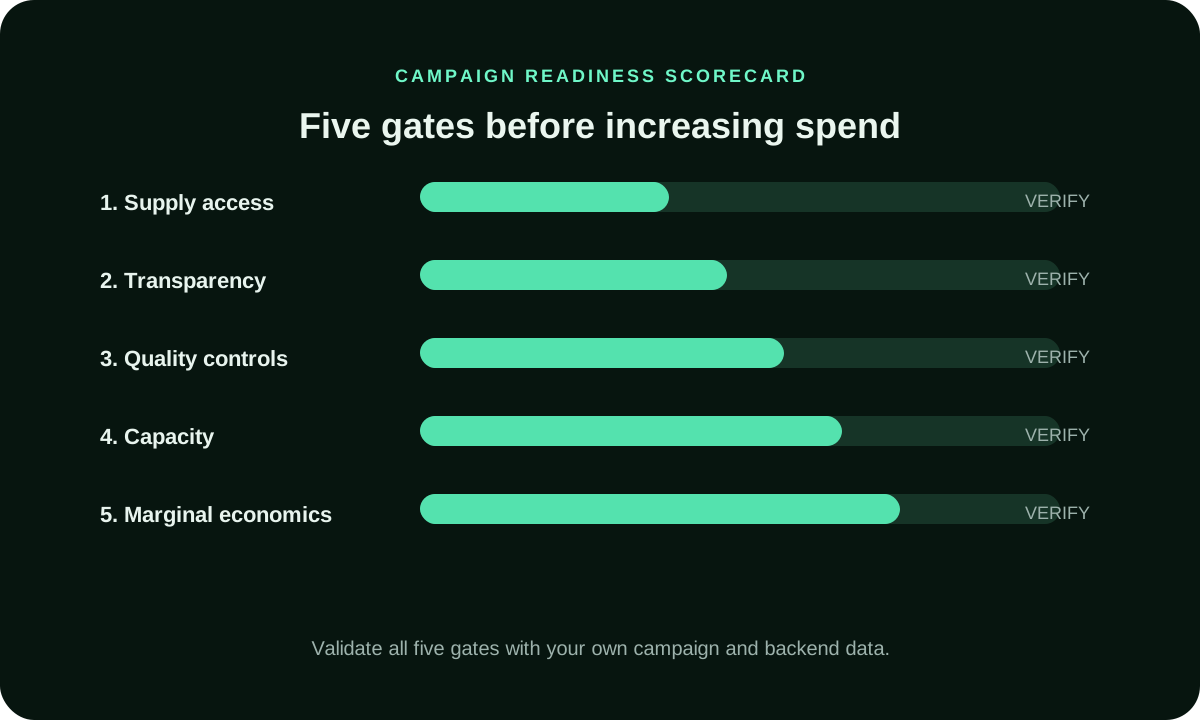
No single row can compensate for a failed requirement elsewhere. Clear placement context without conversion reconciliation is not commercially verified. Strong early conversion data without source identity may be impossible to repeat. Low cost without acceptable downstream outcomes is not a premium result.
Use our traffic sources guide to map supply terminology to a buyer workflow. Then start a FroggyAds campaign with the qualification fields defined.
How does publisher inventory reach a FroggyAds campaign?
Digital inventory can move through publishers, supply-side platforms, exchanges and buying platforms before an advertiser wins an impression. The path and terminology vary by format and integration. The practical question is whether the campaign receives enough information and control to judge what was bought.
FroggyAds connects advertisers with broad inventory through many SSP integrations. We help you manage targeting, bids, budgets and reporting from a self-serve account. We do not claim that every impression behind an integration has the same placement, audience, quality or value. Treat each source segment as evidence to be tested under the campaign's actual settings.
RTB House offers a useful external explanation of supply-side platforms. It explains industry terminology rather than FroggyAds product behavior. Google Ad Manager's material about programmatic transactions and inventory controls likewise describes publisher-side concepts. We use those references to distinguish roles, not to support performance claims about our network.
For the FroggyAds buying path, review how advertisers use our platform. The page about self-serve campaign control explains where your own setup decisions enter the workflow.
How should you prepare a premium inventory test?
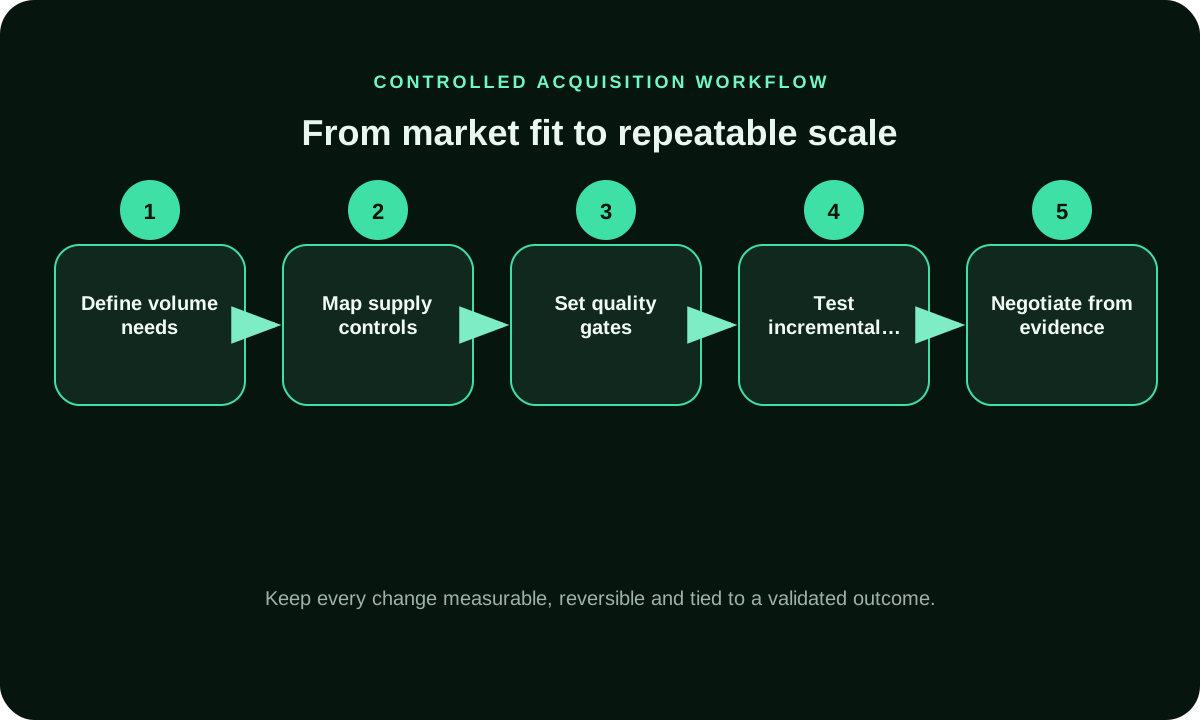
- Name the accepted business outcome. Define the sale, approved lead, activated account, retained install or other event that creates value. Include eligibility, approval and reversal conditions so the team does not optimize toward a provisional event.
- Set the economic ceiling. Begin with the contribution value of an accepted outcome after product, fulfillment, payment, commission, support and variable operating costs. Choose a conservative maximum acquisition cost and a separate loss limit for learning.
- Confirm offer and placement compatibility. Record eligible markets, languages, devices, formats and content restrictions. Make sure the ad promise continues on the destination and the page works in the environments represented by the intended inventory.
- Map identifiers end to end. Preserve campaign, creative, format, source or publisher, placement or zone, click and conversion identifiers where available. Document any field that is missing so conclusions do not claim more precision than reporting supports.
- Reconcile the conversion path. Test the click, redirect, landing page, event, postback and backend record. Align time zones and attribution windows. The tracking discrepancy guide provides a structured investigation when systems do not agree.
- Predeclare keep, cap and stop rules. State the minimum evidence window, maturity requirement and economic or quality boundary for each action. A rule written before reporting reduces decisions based on one attractive or alarming row.
- Freeze the opening configuration. Save the bid, budget, targeting, creative, destination and list settings. Change one decision layer at a time so the next comparison has a usable baseline.
The setup should leave the buyer with a falsifiable hypothesis: “This inventory segment can produce mature accepted outcomes inside our cost ceiling while retaining usable scale.” If the campaign cannot measure that statement, the test is not ready.
Use the campaign budgeting guide to translate your outcome value into a bounded test. Improve the post-click path with the landing-page optimization guide. Then build your first controlled FroggyAds campaign.
A ten-step workflow for qualifying inventory with FroggyAds
- Choose one primary offer and conversion definition. Keep the initial question narrow enough to interpret.
- Select the format and eligible market. Match the creative and destination to the user experience available in that environment.
- Launch with a bounded budget. The amount should be large enough to observe useful variation and small enough to respect the approved loss limit.
- Preserve reporting dimensions. Pass source and click identifiers into the tracker whenever the workflow supports them.
- Let outcomes mature. Separate pending events from accepted events and apply one maturity window across compared sources.
- Check delivery concentration. Identify whether one source, device, market or creative is responsible for most exposure.
- Investigate before excluding. Rule out broken tracking, destination errors, unavailable offers and creative mismatch before assigning the problem to supply.
- Apply the written action rule. Keep, cap, adjust or exclude only the segment that has enough evidence for that action.
- Measure redistribution. After a list or bid change, determine where delivery moved and whether the remaining mix improved mature accepted cost.
- Scale in measured increments. Increase exposure only when the new marginal outcomes remain commercially useful and operational capacity can support them.
The source targeting guide explains why source identity matters for this workflow. Our campaign reporting guide shows how to organize platform signals before comparing them with backend acceptance.
Choose FroggyAds for your next source-aware traffic campaign.
Which metrics show whether inventory deserves more spend?
| Measure | Definition discipline | How it informs the decision |
|---|---|---|
| Eligible impressions | Use the same format, market and reporting boundary across compared segments. | Shows available exposure without treating every served impression as a business result. |
| Qualified visits | Define a real post-click progression event and verify it fires consistently. | Helps diagnose placement, creative or destination mismatch before final conversion. |
| Mature accepted outcomes | Count only events that pass documented eligibility, approval and maturity rules. | Provides the commercial denominator for buying decisions. |
| Accepted acquisition cost | Divide attributed spend by mature accepted outcomes under one definition. | Connects inventory cost to the event that creates value. |
| Rejection or reversal rate | Keep reason codes and apply the same validation window to every source. | Detects segments that look productive at submission and weak after review. |
| Source concentration | Calculate the share of spend and accepted outcomes from each available identifier. | Reveals whether a blended result depends on one source or can survive redistribution. |
| Marginal accepted cost | Measure the additional spend and accepted outcomes after a bid, budget or scope increase. | Tests whether value persists as the campaign scales. |
A hypothetical example illustrates the difference. Suppose a segment spends USD 500 and records 25 submitted leads, of which 10 remain accepted after the review window. Its submitted-lead cost is USD 20, while its accepted-lead cost is USD 50. If another segment submits fewer leads but keeps a much higher approval rate, the second segment may be the better inventory for the business. These numbers are examples, not FroggyAds prices or expected results.
Review delivery metrics in FroggyAds, conversion detail in your tracker and acceptance in your backend. If totals disagree, stop interpretation and reconcile the systems. A clean ratio built from mismatched records is still an unreliable decision.
See the advertiser workflow for the broader account path.
Should you keep, cap, exclude or scale the inventory?
Keep a segment when it remains eligible, measurement is trustworthy and mature outcomes justify continued learning. Keeping does not require immediate scaling; it can preserve a stable baseline while another variable is tested.
Cap exposure when evidence is incomplete, conversion delay is long or one source is concentrating spend faster than outcomes mature. A cap limits risk while preserving the possibility of learning.
Exclude a segment when tracking is valid, the observation window is mature and it crosses the written quality, eligibility or economic boundary. Record the identifier, campaign scope, evidence range, owner and rollback condition.
Whitelist a positively approved set when the campaign must remain inside known supply. Remember that historical approval does not guarantee future results; continue measuring the set as bids, competition, creative and market conditions change.
Scale when the test remains within the accepted-cost range after a meaningful increase, the source mix is understandable and the business can process the resulting volume. Scale the measured configuration, not a vague label.
How should different advertisers evaluate premium inventory?
| Buyer | Primary evidence question | Useful accepted outcome |
|---|---|---|
| Affiliate marketer | Does the source produce conversions that the program ultimately approves under the offer rules? | Approved action after duplicate, market, validation and reversal checks. |
| Professional media buyer | Does the next block of spend preserve accepted value across sources rather than improve only the blended average? | Mature conversion tied to source, cost and campaign version. |
| Marketing agency | Can the client reproduce why a segment was bought, capped, excluded or scaled? | Client-approved outcome with owner, evidence window and change log. |
| Ecommerce advertiser | Do attributed orders remain valid after cancellation, refund, stock and contribution checks? | Accepted order or contribution-positive order after the relevant window. |
| SaaS advertiser | Do registrations progress to activation, qualified trial use or a paid plan? | Activated or retained account under a stated cohort definition. |
| App advertiser | Do installs activate and produce the intended in-app event after validation? | Validated install plus the selected activation or retention checkpoint. |
Each buyer should retain offer, market, device, format, creative, destination and source context beside the outcome. Inventory that fits one offer can fail another because the intent, eligibility or conversion path differs. Share lists across campaigns only when the transfer rule is explicit.
FroggyAds gives each of these buyers a practical way to launch and manage paid traffic from one account. Explore the advertiser resources, then create a campaign that reflects your own accepted outcome.
What should you investigate before blaming the inventory?
| Observed pattern | Checks | Controlled response |
|---|---|---|
| Clicks but no tracked conversions | Test parameters, redirects, event firing, cross-domain behavior, postbacks and backend reconciliation. | Repair tracking and restart the evidence window before judging the source. |
| Landing visits drop sharply after the click | Check page availability, device support, market eligibility, load errors and message continuity. | Correct the destination or narrow the mismatch while holding supply constant. |
| Many conversions are rejected | Review reason codes, duplicate logic, contactability, geography, offer rules and approval delay. | Optimize to the mature accepted event and preserve rejection evidence by source. |
| One source consumes most of the budget | Compare its share of accepted value, marginal cost and available alternatives. | Use a cap when concentration is the problem; exclude only if the source fails the rule. |
| Performance falls after a whitelist | Inspect lost reach, bid pressure, source overlap and whether the approved set has enough capacity. | Broaden or retest one group at a time and compare with the saved baseline. |
| Early results are strong, later quality is weak | Wait through activation, approval, cancellation, refund or retention maturity. | Cap while outcomes mature and decide from the final accepted definition. |
The most expensive mistake is changing supply, bid, creative and destination together. The campaign may recover, but the team will not know why. Preserve one stable control group and a dated change log. The FroggyAds resources and learning center can help your team build a repeatable review process.
Why choose FroggyAds for a premium inventory test?
Choose FroggyAds when you want broad traffic access and hands-on control from a self-serve platform. We give advertisers the tools to set targeting, bids and budgets, observe campaign reporting and act on source-level differences where those dimensions are available. That combination supports a disciplined discovery process: test the supply, preserve the identifiers, validate outcomes and scale what remains commercially useful.
Our value is strongest when your team already has an offer or landing page, a measurable conversion and a budget that can support controlled learning. Affiliate marketers can compare approved actions by source. Agencies can document decisions for clients. Ecommerce, SaaS and app teams can connect platform delivery to their own acceptance and value data.
We recommend starting with one campaign question rather than attempting to prove every market, format and audience at once. Your first result should tell you whether to keep, cap, exclude, whitelist or retest a defined inventory segment. That is more useful than a large traffic total with no clear next action.
Questions advertisers ask before buying publisher inventory
What is premium publisher inventory?
Premium publisher inventory is advertising supply that a buyer evaluates as valuable because the placement context, source identity, reporting, user experience and accepted business outcomes meet a documented standard. The label is a starting hypothesis, not proof that every impression or source will perform well.
Does premium inventory guarantee better traffic quality?
No. A premium label cannot guarantee valid interactions, accepted leads, sales or profitability. Verify the actual source and placement data available to the campaign, reconcile conversions with your backend, and compare mature accepted outcomes with the buying cost.
How should an advertiser qualify publisher inventory?
Define eligibility before launch: permitted markets and devices, acceptable placement context, required source transparency, creative fit, measurement fields, invalid-traffic review and the maximum accepted acquisition cost. Keep, cap or exclude supply only after the evidence reaches the stated rule.
Which identifiers are useful when evaluating inventory?
Preserve the campaign, creative, format, GEO, device, source or publisher identifier, placement or zone identifier when available, click ID and conversion ID. The exact dimensions depend on the platform and supply path, so use the identifiers actually exposed in your FroggyAds reporting and tracker.
How much budget is needed to test premium inventory?
There is no universal amount. Build the test from the value of an accepted outcome, a defensible acquisition ceiling, expected conversion frequency, maturity delay and the cost of a wrong decision. Set a loss limit and an evidence threshold before spend begins.
Which KPI matters most for premium publisher inventory?
Use the mature cost of an accepted business outcome as the primary decision measure. Support it with delivery, click cost, qualified progression, conversion delay, rejection or reversal rate, source concentration and downstream value. Raw impressions and clicks describe delivery but do not prove business quality.
Does a low CPM mean the inventory is not premium?
Not by itself. CPM reflects the cost of impressions under specific market, format, targeting and auction conditions. Evaluate price together with viewable or usable delivery signals, qualified visits, mature accepted outcomes and marginal cost as volume changes.
Should I use a blacklist or a whitelist?
Use a blacklist when broad discovery is acceptable and specific sources have earned exclusion. Use a whitelist when delivery must remain within a positively approved set. A cap is useful when evidence is incomplete or concentration is the concern. Record the scope and rollback rule for every list change.
When can a successful inventory segment be scaled?
Scale after tracking is reconciled, outcomes have matured, accepted acquisition cost remains within the approved range and the result survives a meaningful increase in volume. Raise exposure in measured steps and review the new marginal results rather than relying on the original small-test average.
How does FroggyAds support premium inventory buying?
FroggyAds gives advertisers self-serve access to broad supply, campaign targeting, budget controls and source-level reporting where available. We help you run a bounded test and act on evidence; you remain responsible for the offer, creative, destination, tracking, compliance and final commercial decision.
Turn “premium” into a measurable buying standard
Write the placement, identity, measurement, quality, economics and scale requirements that supply must meet. Launch a bounded campaign, wait for mature accepted outcomes and act only on the identifiers supported by the evidence. That approach gives your team a repeatable decision instead of a label.
Continue with the campaign reporting guide and budgeting guide when you need to formalize the review cadence and exposure limit.