
Mainstream Traffic Network: A Buyer’s Guide to Broad Reach
Compare mainstream traffic network by inventory access, targeting, reporting, quality controls and effective acquisition cost before increasing spend.
What does mainstream traffic mean in paid acquisition?
A mainstream traffic network is a buyer’s shorthand for broader eligible inventory; it is not a FroggyAds ad format, placement guarantee or quality certification.
In this guide, mainstream describes a planning choice: begin with a wider eligible pool instead of building the test around one tightly defined audience. It does not name a separate FroggyAds ad format, guarantee a publisher type, certify suitability or predict what any visitor will do. A broad plan still has gates. The offer must be permitted in the intended market, the destination must be usable by the people reached, and the campaign settings must match the buyer question. General access is useful only when it increases eligible opportunity without hiding an audience mismatch.
- Broad reach
- A buying approach that starts with a wider eligible pool than a narrowly defined audience.
- Eligible inventory
- Supply available under a campaign’s format, targeting, bid and current availability.
- Accepted outcome
- The business event counted after the advertiser applies its own validation rule.
When does broader reach fit your offer?
Broad reach suits an offer that can serve many eligible people and a destination that clearly explains the next step.
Before choosing reach, define who can actually buy: permitted locations, language, fulfillment limits, payment availability, compliance restrictions and any device requirement. Check the landing page against those conditions. If someone can click but cannot receive the product, that visit is not a qualified opportunity. Run a separate comparison when the offer, market, creative or conversion event differs enough to confuse the result. The broad version should be the simplest set of eligible conditions, not an unbounded audience.
How should you measure a broad-reach test?
Measure broad reach from the click through the business-approved outcome, keeping campaign and source identifiers intact.
Pass a stable click identifier through redirects and keep campaign and source labels intact until the outcome is recorded. Decide what counts before launch: a submitted lead may remain provisional until it is deduplicated or qualified; an order may need payment and refund reconciliation; an app event may need activation. Give each accepted event an owner and a time window. Compare platform, tracker and backend totals, then investigate missing or repeated IDs before changing bids. This keeps inexpensive clicks from disguising a broken measurement path.
How should you set a budget and bid limit?
Set a spending ceiling from accepted-outcome value, contribution and the loss your team can tolerate while evidence matures.
Calculate a ceiling from contribution after variable costs, not gross revenue alone. For CPA buying, set the maximum you can pay for the accepted event while meeting your margin rule. For CPC, divide the click price by a conservative click-to-accepted-event rate to estimate a comparable cost. For CPM, state the assumed impression-to-event rate explicitly. Label each calculation as a planning estimate because actual outcomes vary. No fixed count of conversions suits every offer; use observed variance and conversion delay to decide whether the evidence is mature enough.
What should you check before launch?
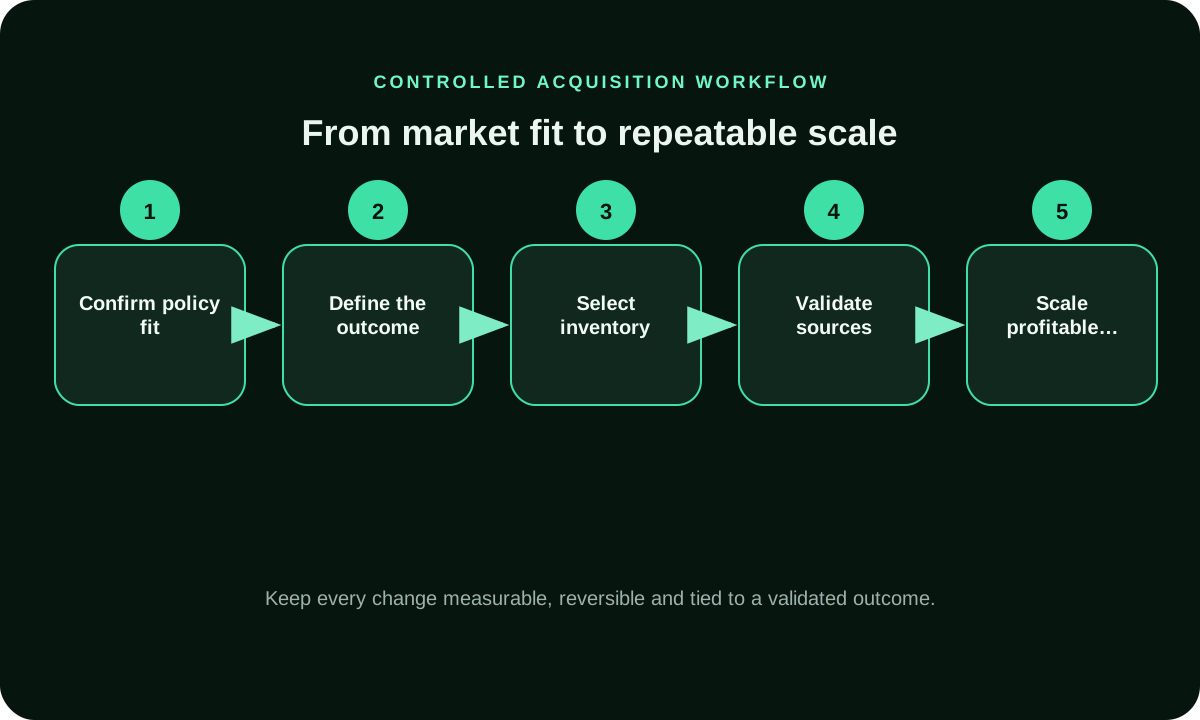
A useful workflow fixes the offer, event, tracking path, spend limit and review rule before changing reach.
- Choose one accepted outcome and write its validation rule.
- Confirm offer eligibility, destination readiness and the intended market.
- Test click IDs and source labels through to the advertiser-side event.
- Set the cost ceiling, spending limit and stop condition.
- Compare mature results by source before widening reach or budget.
Keep those decisions together in a dated campaign note. When the test changes, record whether the change answers a new question or only reacts to short-term noise. That record lets another buyer reproduce the setup and distinguish an offer issue from a targeting, attribution or supply issue.
When should you narrow a broad audience?
Start with the broadest audience that remains eligible; narrow a single dimension when evidence shows a real mismatch.
Broad and narrow are points on a spectrum. Start broad only inside the true eligibility boundary; then create a split when a market, device or source category has a different economic or operational meaning. Each split should have a reason and a possible action, such as cap, exclude, keep or retest. Too many small groups fragment spend and make normal variance look like a trend. Too few groups conceal a genuine mismatch. Choose the least complicated segmentation that preserves a decision you would make differently.
How should the ad and landing page stay aligned?
Make the ad promise and the landing page agree, so paid visitors can recognize the offer they chose.
Continuity matters especially when the audience is broad because the creative must qualify interest quickly. State the offer plainly, show a relevant use case and make the landing page’s first screen confirm the same promise. If a visitor needs a particular market, device, subscription term or eligibility condition, disclose it before asking for a conversion. Measure qualified outcomes, not just clicks on the call to action. A pre-lander should explain or qualify the offer; it should not hide the advertiser, disguise a redirect or imply a result that the product cannot support.
How do you assess source-level quality?
Judge traffic at source level with accepted outcomes and cost, not raw visits or an unqualified quality score.
Use a source review that connects each row to a business action. Record source ID, spend, eligible impressions or clicks, accepted events, rejected events, time to outcome and effective accepted cost. Preserve the observation window so late conversions are not treated as failures. When available controls permit, exclude a source only after the evidence meets your rule; retain a baseline for comparison. FroggyAds’ published material describes source and zone controls, but the specific eligible supply can vary by campaign settings and availability. A source label is an analysis key, not proof that the publisher or visitor meets your own quality standard.
When should you expand a broad-reach campaign?
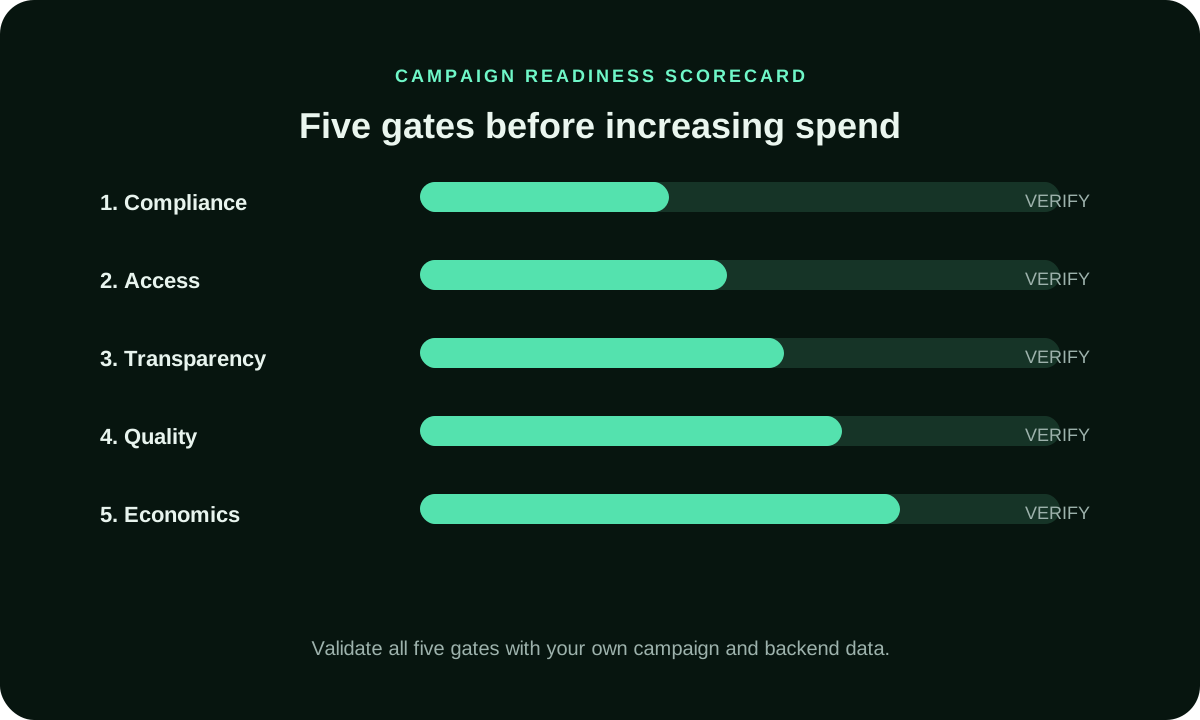
Increase exposure in measured steps only after the current source mix produces mature, commercially acceptable outcomes.
Expand one axis at a time: raise a cap, adjust a bid, add a market or loosen one audience condition, then keep the remaining inputs steady long enough to read the change. Track marginal accepted cost on the newly added volume instead of relying on the account-wide average. If the next tranche costs more or produces fewer acceptable outcomes, that is information about the boundary of the opportunity. A controlled rollback rule protects the original evidence. Increase exposure only when the additional reach still fits your economics and your team can serve the resulting demand.
How should you interpret volume and quality?
Interpret volume beside quality, conversion delay and backend acceptance; no single click metric settles the decision.
Allow for the lag between click, conversion and business acceptance. A campaign can look weak before its normal decision window closes, or look strong when recent events have not yet been checked for duplication, qualification or refunds. Compare cohorts over matched windows and report provisional events separately from accepted outcomes. If you change the acceptance rule midway, label the break in the data instead of blending it with earlier results. This is particularly important when broad reach adds a mix of intent levels that mature at different speeds.
What problems can make broad traffic look unprofitable?
Treat unexplained tracking gaps, ineligible traffic and weak economics as different problems with different remedies.
Separate four failure classes before acting. Eligibility failure means the offer cannot serve the reached user; correct the market or stop. Destination failure means the page is unavailable, inconsistent or difficult to use; repair it before buying more visits. Measurement failure means clicks or events cannot be reconciled; pause economic conclusions until IDs and events are checked. Economics failure means the accepted cost is outside the ceiling after a mature window; cap, exclude or stop the source. Calling all four “bad traffic” can lead to the wrong change and waste a valid test.
How can FroggyAds support a broad-reach test?
At FroggyAds, we give you self-serve access to campaign targeting, budget settings and source-level reporting across supported formats and markets. Our published inventory overview reports 20B+ daily impressions, 750+ SSP integrations and 300+ verticals across supported markets. Those figures describe the aggregate pool, not your campaign’s delivery forecast. The inventory page lists targeting options and explains that actual reach depends on format, settings, bid and current availability. Our advertiser FAQ outlines the self-serve workflow. We recommend using these controls for a bounded comparison and judging your result from accepted conversions and costs.
The published figures describe an aggregate pool, not a forecast for your campaign. A campaign can reach only supply available under its format, targeting, bid and current availability. Check source-level delivery before comparing costs. FroggyAds describes controls that help identify invalid or low-quality traffic; these support screening, but they do not certify each impression or replace your own acceptance rules.
What should you confirm before and after launch?
Before launch, record eligibility, one accepted conversion, a working attribution path, a spending limit and a stop rule.
At the end of the test, keep a compact record: objective, offer version, destination, target conditions, bid and budget settings, tracking check, source-level accepted outcomes, review window and the action taken. State what remains uncertain. If the next step is a broader test, identify the single condition being widened and the evidence that would stop it. This makes the buying decision useful to the next person who manages the campaign and prevents a one-off result from becoming an unsupported forecast.
How do you separate broad reach from broad assumptions?
A campaign label cannot validate a publisher, visitor or conversion. Review source-level records alongside the advertiser’s own acceptance checks.
Run the check at two levels. First, confirm that the offer can serve the markets and users you intend to reach. Second, confirm that each click keeps its campaign and source labels through to the advertiser’s acceptance event. If either link is missing, the broader label cannot tell you whether weak outcomes came from eligibility, tracking or supply. Treat unmatched visits as unresolved evidence; do not call them acceptable conversions.
Mainstream traffic network: frequently asked questions
What does mainstream traffic mean for an advertiser?
In paid-media planning, buyers often use mainstream traffic to mean a wider eligible pool rather than a narrowly defined audience. It is not a placement-quality guarantee or a separate FroggyAds format.
When is broader traffic a better starting point?
Broader reach can suit an offer available to many users when the destination explains it clearly. Keep a narrower plan when qualification, market availability or accepted value depends on a specific audience.
How should I set a budget for a broad campaign?
Set a ceiling from contribution after variable costs and the value of the accepted event. The right spend also depends on bid model, conversion delay, variance and the loss your team can tolerate.
Which KPI should I use to compare broad traffic?
Use effective cost per accepted outcome as the decision measure. CPC, CPM, click-through rate and visits explain delivery, but they do not show whether the business accepted the resulting customer or lead.
What should I track at source level?
Preserve click and source identifiers through redirects, record the accepted event in the advertiser’s system, and reconcile platform, tracker and backend totals over a defined attribution window.
How long should a broad-inventory test run?
Review after the expected conversion and acceptance delay, using matched time windows. There is no universal number of days; the period depends on volume, event maturity and the offer’s validation process.
How do I assess traffic quality?
Review duplicate IDs, invalid events, rejected leads, conversion timing and downstream value together. FroggyAds describes traffic-quality controls that help identify invalid or low-quality traffic, but no screen replaces your own validation.
What evidence should be in place before scaling?
Scale after source-level attribution reconciles, mature accepted cost remains within your ceiling, and added exposure does not reduce outcome quality or exceed the team’s operating capacity.
Does mainstream traffic automatically mean brand-safe or high-quality?
Broad reach is not an assurance of brand safety, placement suitability or conversion quality. Check the offer against policy, validate the destination, and judge sources with your own accepted-outcome rules.
How can FroggyAds help advertisers test broader reach?
FroggyAds provides a self-serve campaign environment with available targeting, budgets and source-level reporting. Use it to run a bounded comparison, then decide from reconciled accepted outcomes rather than assuming a result.
When does broad reach add buying value?
Use broad inventory when wider eligibility fits the offer; keep a narrower plan when qualification, availability or economics depend on a specific audience.
Use broad reach when the offer can be understood and fulfilled across the eligible pool, and when your conversion review can separate provisional events from accepted customers. Keep a narrower segment for a real constraint—such as market access, language, device compatibility or an audience qualification rule. That makes each targeting choice answer a business question instead of creating extra slices with too little spend to interpret.
How can you design a diagnostic broad-inventory test?
Test broader reach after your offer, destination, attribution path and stop rule are ready; keep the first question narrow enough to answer.
Name the decision before launch: retain broad delivery, restrict a specific condition, or stop because the mix cannot meet the offer’s eligibility or cost rule. Choose a single split you can act on, and write down the attribution window and evidence needed to make that choice. If you cannot change an inclusion, exclusion, bid or cap based on the result, a separate split adds reporting work without a decision.
Change one acquisition variable at a time so you can tell whether broader reach improved eligible opportunity or only made the mix harder to interpret.
Broad reach versus narrower targeting: a buyer’s decision matrix
Use this matrix to decide whether added reach improves the buying opportunity or merely makes the audience harder to diagnose.
The matrix below is designed for an advertiser deciding whether broad access is commercially useful. It compares evidence that matters before the next spend decision; it does not rank formats or claim that a network label predicts quality.
| Buyer question | Evidence before widening | Decision if the evidence is weak |
|---|---|---|
| Can the offer serve a wider audience? | Availability by market, language, fulfillment rule and any mandatory qualification. | Keep the campaign inside eligible markets; do not buy clicks that cannot become accepted customers. |
| Does the destination support the added reach? | First-screen message, device usability, load state and the actual next step offered. | Repair the destination or keep the broader audience out until the same promise is usable. |
| Can the event be trusted? | Stable click ID, source label, duplicate rule, conversion delay and backend acceptance owner. | Pause cost comparisons until provisional and accepted events can be reconciled. |
| Which sources contribute accepted value? | Spend, accepted outcomes, rejected events and effective accepted cost over a matched window. | Cap or exclude only when the source-level evidence meets the predefined rule. |
| Can the next tranche be served? | Marginal cost, source mix, support capacity and destination performance after added exposure. | Expand one condition at a time and keep a reversible stop point. |
Set the acceptance rule before comparing reach
Write down the outcome and its acceptance rule first; otherwise a high-volume source can look successful while producing unusable leads or orders.
Use the matrix after defining the acceptance rule. Keep a row only when its evidence can change an action: confirm fit, diagnose delivery, reconcile an event or apply a cap. If no action follows, remove that metric from the review.
Separate fit from delivery. Fit describes whether the audience can use and receive the offer; delivery describes what inventory the selected settings actually make eligible. Keep both in the test record so a low result is not misdiagnosed as a bid problem.
Keep the stages distinct in your record: eligible markets in campaign setup, delivered impressions or clicks in reporting, and accepted outcomes after backend checks. Gaps between them can indicate limited supply, tracking loss or rejected events. Use the correct denominator at each stage.
Before your first campaign, verify the click path and choose the accepted event. Hold the offer and conversion rule steady, then compare source results after the review window. Create your free FroggyAds account
Use the source breakdown first as an observation view; create separate campaign cells only when the condition changes a real decision, such as offer eligibility, destination, accepted value or a stop rule. This keeps broad supply available while preserving evidence to investigate a source mismatch. Add exclusions only after that distinction appears in mature accepted outcomes.
Choose the reach level that fits your offer
Broader reach earns a place when the offer has wide eligibility and your reporting can show which sources create accepted value. The adjacent Premium Traffic Network page covers the distinct question of evaluating premium inventory.
Do not compare broad and narrow campaigns on click cost alone. Hold the offer, accepted event, attribution window and qualification rule constant, then compare mature cost per accepted outcome, rejection rate, volume and operating effort. A narrow segment is more useful only if its added relevance or eligibility control outweighs the volume lost; broad delivery is more useful only if source-level results remain interpretable and commercially acceptable.
| Decision point | Use in this test | Evidence to keep |
|---|---|---|
| Fit | Confirm offer eligibility, destination readiness and one accepted outcome. | Market/device boundary, landing-page version and validation rule. |
| Test | Change a single reach condition while holding the other inputs steady. | Start/end time, bid, budget cap, source labels and attribution window. |
| Decision | Keep, narrow, cap or expand based on mature accepted outcomes. | Source-level economics, unresolved gaps and the reason for the next action. |
For a clearly hypothetical calculation, USD 120 in spend divided by 6 accepted leads equals USD 20 per accepted lead. Your own ceiling must use your contribution, validation rate and business rules; this example is not a FroggyAds result.
When comparing plans, translate expected cost into the same accepted-outcome unit. If one option has a lower CPC but a weaker accepted-lead rate, compare mature cost per accepted lead after qualification and attribution are complete; do not treat the lower click price as a better business result.
If you’re ready to test broader reach against a defined business outcome, you can start with a bounded FroggyAds campaign. Keep the conversion rule stable and review mature source-level costs before expanding. Create your free FroggyAds account
The decision to make before spending
Before broadening reach, confirm that the added audience is eligible, trackable and economically interpretable under the same acceptance rule.