
Keyword Targeted Traffic
Map keyword themes to the right offer, landing page and verified conversion - then choose the buying platform that can reach the audience you need.
What Keyword Targeted Traffic Means in Paid Acquisition
Keyword-targeted traffic places ads against search terms or intent themes; the buying platform defines the matching rules.
A keyword is a planning input, not proof of what a person intended. In a search campaign, the platform decides whether a user's query matches an advertiser's selected term under its current settings. A campaign elsewhere may use contextual or audience signals instead; those placements are not search-result ads. Decide which mechanism the phrase 'keyword targeted traffic' describes before you compare costs.
For query-level search buying, keep the list, match setting and actual queries connected in reporting. For broader traffic acquisition, label the hypothesis as a topic or audience context and evaluate the delivered sources. This distinction lets you test the idea without promising that a network can match every typed query.
Build the Market and Offer Fit First
Start with one query group, an eligible offer, a relevant landing page and a conversion event your business can verify.
Create an intent map before opening the campaign. Separate learning questions, comparisons and ready-to-act searches; then pair each group with an offer that answers its expectation. Check that the product is available, the claim is accurate, the page explains the next step and the conversion event captures a real business outcome. If a search platform is buying the clicks, use its match and exclusion controls.
If you are using FroggyAds, choose from its published campaign and audience controls rather than assuming it accepts a keyword list. A small, coherent group is easier to interpret than a giant list of unrelated phrases.
Define a Trustworthy Measurement Model
Keep the search keyword, triggered query, click, landing session, provisional event and accepted business outcome as separate records. Label campaigns and ad groups consistently; add UTMs and platform identifiers where available; preserve a source ID when the buying platform provides one. Test the full click-to-event path before spend and reconcile counts against your analytics and backend.
Set the attribution window to reflect how long a real customer decision takes, then distinguish a new lead from a lead that sales accepted, or an order from an order that remained valid after refunds. Record time zone, deduplication and event rules before comparing themes. If those rules change mid-test, annotate the change rather than blending the results.
Forecast Budget, Bids and Test Exposure
Set a maximum cost per accepted outcome from contribution, not from a competitor's bid or an arbitrary benchmark. Start with contribution after variable product, fulfillment, payment and support costs; decide how much must remain after acquisition; the difference is your allowable CPA. A directional CPC ceiling is allowable CPA multiplied by the expected accepted-conversion rate from a click.
A CPM ceiling uses accepted conversions per impression multiplied by the allowable CPA and 1,000. Those are planning formulas, not forecasts: the rate must come from comparable, mature data, and uncertainty should make the opening cap more conservative. Write down a loss boundary and the evidence required to extend it. Review cost after the defined conversion delay, not on an immature snapshot.
A Five-Step Workflow for Keyword Targeted Traffic
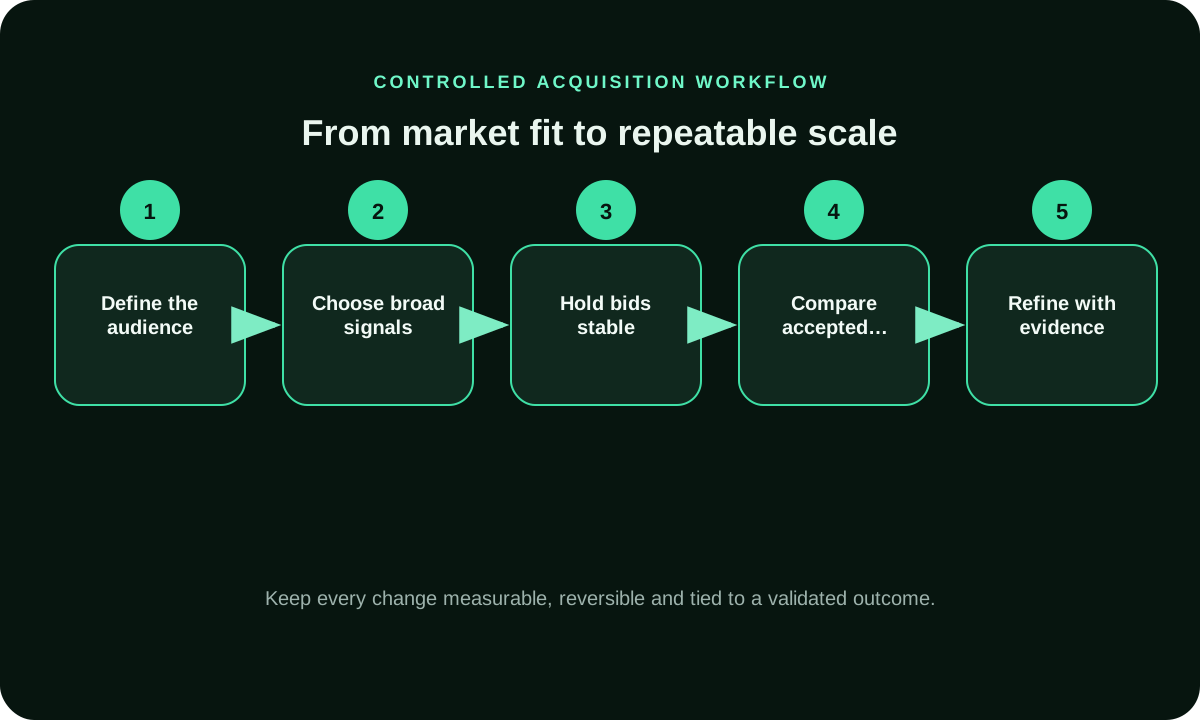
Use this five-step sequence to turn an intent hypothesis into an auditable test. Keep each choice tied to one downstream decision, so you can explain what the evidence changed.
- Map real customer language into informational, comparison and action-oriented groups.
- Pair each group with one eligible offer and a destination that answers the user's task.
- Choose the buying platform and confirm its matching, exclusion and reporting controls.
- Set an accepted event, attribution window, cost ceiling and hard stop before launch.
- Review mature query or source evidence, change one major variable and log the decision.
Segment Keyword Targeted Traffic Without Losing Reach
Segment for a decision, not for the appearance of precision. In a search platform, separate keywords when the user's task, offer or destination differs; review its current match settings because close-variant and meaning rules are platform-specific. Do not treat broad, phrase or exact labels as universal standards across networks. On FroggyAds, use only verified availability such as GEO, device, OS, browser, carrier, category or source controls where offered.
Preserve enough reach for a meaningful sample and resist adding several filters at once. If a narrow group has little volume, test one broader cohort as a separate line rather than merging it into a winner.
Creative, Message and Destination Continuity
Make the promise continuous from query to creative to landing page. A person comparing providers needs evidence and criteria; someone ready to buy needs a clear offer, eligibility and next step; a person seeking an explanation needs a useful answer before a sales request. Use the phrase naturally when it clarifies relevance, not as a reason to repeat it in every heading.
Match the page title and first screen to the ad's real promise, remove claims the offer cannot substantiate, and keep the primary action visible. For multiple query groups, give each a destination suited to its intent. Then compare accepted conversions by group; a higher click-through rate is only useful if the resulting visit can progress to a valid outcome.
Use Source-Level Quality Controls
Use two different evidence views for two different buying systems. In search advertising, inspect the platform's actual search-term and match data to discover whether the triggered query fits your offer; Google's documentation explains its Google Ads Search terms report guidance and notes that some low-activity terms can be omitted for privacy. In a traffic network, query reports may not exist.
Preserve the available campaign and source identifiers, compare post-click behavior and validate conversions in your own records. Do not use source ID as a synonym for a search query. Keep a control group when feasible, log exclusions with the reason and review enough mature evidence before blacklisting a placement.
A source that spends without an accepted event may need a fair window; repeated invalid outcomes justify a faster stop under your written rule.
Scale Keyword Targeted Traffic in Measured Increments
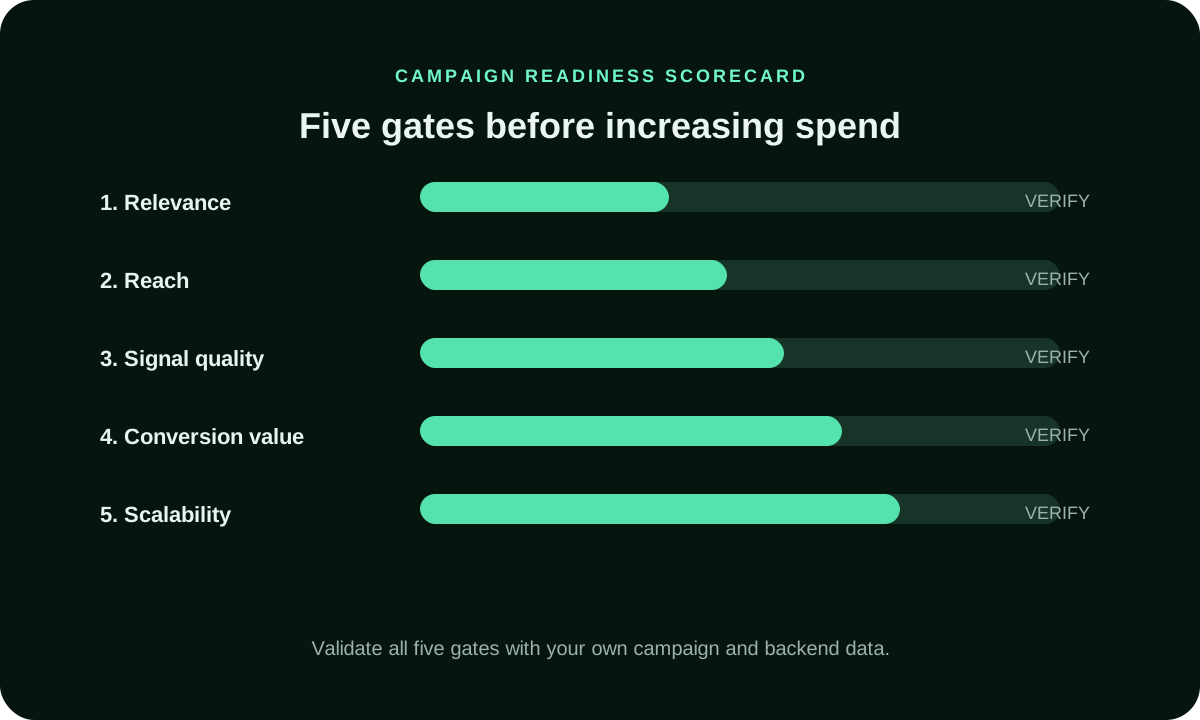
Expand the campaign only when its current cohort has stable tracking, accepted outcomes and costs within the pre-approved ceiling across mature periods. Add one query theme, location, format or source cohort at a time; keep the baseline visible and compare marginal results rather than relying on the blended account average.
If reach grows while quality falls, locate the change in the query, source, device, creative or destination before raising the bid again. Search-term expansion and network-source expansion are separate decisions: use the controls and evidence available in each system. Record why the next tranche is expected to help and what would cause you to cap it.
Scaling is a sequence of controlled decisions, not a promise that yesterday's efficiency will repeat.
Interpret Volume and Quality Together
Read reach, cost and quality together. Search impressions can show that a term is eligible; clicks show response; an accepted lead or order shows whether the business got what it was willing to pay for. Track click cost, click-to-accepted conversion rate, cost per accepted outcome, rejection or refund rate, time to conversion and contribution after acquisition.
Separate intent groups and campaign channels, because one high-volume cohort can hide a weak one. Low counts make rates volatile; a few conversions do not prove a repeatable result. Also check reporting thresholds, delayed events, duplicate records, consent-related gaps and offline sales not returned to the ad platform. State the sample period and limitations next to the result.
Common Failure Modes to Avoid
The costly mistakes are usually classification or measurement errors. A broad keyword can collect loosely related queries; an exact-looking term may still follow platform-specific close-variant rules. A mixed-intent ad group can send researchers to a checkout page and buyers to a generic article. A vague conversion event can count a page view as a lead.
A campaign with no exclusions can pay for clearly irrelevant searches; a list that is too restrictive can suppress reach before a fair test. Changing bids, match settings, copy and landing pages together makes the cause unreadable. On network inventory, assuming source-level targeting equals keyword matching creates the same mistake.
Keep each change tied to a hypothesis, record what the interface actually exposes and pause when tracking or eligibility is broken.
How FroggyAds Supports Keyword Targeted Traffic
FroggyAds offers self-serve traffic campaigns with supported targeting and source reporting; its published controls do not list search-keyword matching.
FroggyAds gives advertisers a self-serve way to buy traffic, choose supported formats and manage campaign settings such as budget, bids and available targeting. Its published controls include GEO or city, device, operating system, browser, carrier, category and source ID; other options such as language, interest or IP depend on what is enabled for the campaign.
Source-level reporting helps you judge delivered inventory, while conversion tracking and a pixel or postback can connect clicks to validated events where your setup supports them. These tools give affiliate marketers and media buyers practical control over the traffic test; they do not make FroggyAds a search engine or establish direct keyword-match controls.
Check the current FroggyAds FAQ before launch, set your own accepted outcome and use your data to decide whether the traffic fits. If query matching is essential, buy that part through a search-ad platform and keep FroggyAds as a distinct, measured campaign.
Final Buyer Checklist for Keyword Targeted Traffic
Before launch, write one page of operating rules. Name the buyer and the query group; state whether the intent is research, comparison or action; confirm the offer can serve that person; and point to the exact landing page. Record which platform control selects the audience, which report reveals the delivered query or source, and how you will validate the accepted event.
Define the maximum allowable CPA or spend, attribution window, pause condition and person responsible for reconciling data. Test links, form flow, analytics and postback before a live budget. During review, separate immature events from accepted results. At close, document the campaign settings, observed limitations, the decision and the condition that would justify a retest. This makes the next buyer's decision reproducible.
Search keyword targeting versus network traffic
Keyword Targeted Traffic FAQ
What is keyword targeted traffic?
Keyword-targeted traffic is paid delivery planned around keywords or search-intent themes. In search ads, platform match rules decide which queries can trigger an ad; review actual terms and accepted conversions rather than assuming a keyword equals a query.
Who should test keyword targeted traffic?
Advertisers, affiliates and media buyers should test query-led search when they can group user needs, write a matching offer and measure an accepted result. It is especially useful when each intent group can receive a distinct ad or destination.
How much budget does keyword targeted traffic require?
There is no universal budget. Derive a limit from contribution after variable costs, expected accepted-conversion rate and your risk tolerance. Cap the first test at a loss you approved; extend it only when mature evidence can answer the question.
Which metric matters most for keyword targeted traffic?
Judge each keyword theme by cost per accepted outcome and downstream value. Click-through rate and CPC explain the ad and auction, but they do not show whether a lead qualified, an order was retained or a user became valuable.
How should keyword targeted traffic be tracked?
Keep campaign, ad-group and keyword-theme labels consistent. Use platform click IDs and UTMs where available; reconcile analytics with accepted backend events and account for conversion lag. A FroggyAds source ID describes inventory, not a typed query.
How long should a keyword targeted traffic test run?
Run through the conversion delay you defined before launch and until enough accepted events exist to compare intent groups. Pause immediately for broken tracking or policy issues; do not extend solely to reach an arbitrary number of days.
How can traffic quality be checked?
For search ads, review actual search terms, cost and qualified outcomes while accounting for reporting thresholds. For network traffic, examine available source, GEO, device and post-click evidence separately, then validate quality with your own records.
When should keyword targeted traffic be scaled?
Scale only when attribution reconciles, accepted-outcome cost stays within the pre-set ceiling across mature periods, and each added query group has a clear role. Raise one material budget or bid variable at a time.
What should be avoided with keyword targeted traffic?
Do not equate a selected keyword with the exact words a person typed or assume every traffic network offers keyword matching. Avoid mixing intent, changing several variables together and judging an immature or tiny sample.
Can FroggyAds support keyword targeted traffic?
FroggyAds supports self-serve traffic campaigns with published audience controls, budgets, bids, formats, conversion tracking and source-level reporting. Its published controls do not list search-keyword matching; use a search platform when query matching is required.
Choose the Next Query Theme to Test
Plan a controlled keyword-intent test
A keyword-intent test should link one query group to an eligible offer, a working destination and an accepted event you can measure before spending.
Hold the offer, destination and event rule steady while you compare the first cohort. Record the exact setting and stop condition so the result can be repeated or rejected.
Turn Search Intent Into a Testable Campaign Structure
Group queries by user task and match each group to a destination and cost limit. Keep research, comparison and action intent separate when the offer or evidence differs.
In search campaigns, the platform's match configuration governs eligibility; Google Ads keyword list and match documentation describes Google's current approach, which can include close variants and meaning. Verify current rules in the buying platform itself. This page covers the planning method, not an unverified promise about every ad network.
| Decision layer | What to record | How to use it |
|---|---|---|
| Intent group | Query theme, user's task, match setting and destination that answers it. | Separate groups when the offer, evidence or next action changes. |
| Offer fit | Eligibility, GEO/language limits, real product scope and the accepted event. | Exclude demand the advertiser cannot serve before buying clicks. |
| Message continuity | Ad promise, proof shown on the landing page and one clear next step. | Do not use the same hard-sell message for research and purchase queries. |
| Buying mechanism | Search-platform keyword controls or FroggyAds' supported audience and source settings. | Never describe search-keyword matching as a FroggyAds control unless verified. |
| Economics | Accepted-outcome value, allowable CPA, bid ceiling, spend cap and maturity window. | Extend only when validated outcomes fit the written risk limit. |
Group terms around one accepted outcome
Group terms only when they ask the user to solve the same problem and can land on a page that answers it. For example, 'compare expense tools' and 'expense app pricing' may need different evidence even though both concern expense software. Write one group label that explains the job rather than storing a long unclassified export. Keep the destination and conversion action consistent inside a comparison.
Split a group when a query introduces a different eligibility condition, decision stage, product or required promise. If splitting creates too little data, keep the related terms together but report the subthemes separately where the platform allows it.
Negative keywords belong to the search platform that matches the query, and their scope can be campaign- or ad-group-specific. Draft exclusions from the offer boundary before launch: unavailable brands, unsupported locations, jobs you do not handle, or requests for a free product when the offer is paid. After delivery begins, confirm a term is truly irrelevant and account for shared lists before excluding it.
For network traffic, use only exposed category, audience or source controls. Never label a source exclusion as a negative keyword unless the interface explicitly provides that feature.
Choose the channel based on the user's discovery behavior. If you need an ad to appear because a person searched a particular query, use a platform that documents keyword matching and term reporting. FroggyAds is our self-serve option for buying supported traffic formats with campaign targeting, budget and source-level review; the published settings do not list search-keyword matching.
Keep those campaigns separate so each has a fair cost and outcome comparison. When you are ready to test FroggyAds inventory, Create your free FroggyAds account and define the accepted conversion before opening spend.
Pre-launch checks for a keyword-intent campaign
Before launch, name the decision. Are you validating query relevance, a destination, a conversion event or a traffic source? Choose one primary change so the result can answer that question.
For each intent group, state what the user expects to see and which page provides it. Do not send research-stage queries directly to an offer page that leaves the question unanswered.
Check product, service, geography, language and device eligibility before adding a keyword. A technically relevant phrase can still attract people you cannot serve.
Use the ad text to set an accurate expectation. If the query asks for a comparison, explain the comparison basis; avoid implying a feature, price or result the advertiser cannot document.
Prepare exclusions against real offer limits. Keep a reason next to each negative keyword so another buyer can distinguish a hard exclusion from a temporary test choice.
Verify the current platform's match definitions in its own documentation. A label such as exact or phrase is meaningful only inside that product and version.
Check the landing page as the visitor will see it: mobile and desktop support, form availability, load readiness and an action that matches the ad. A query list cannot repair a broken destination.
Set one accepted event and name any later quality checks. Separate a submitted form from a sales-qualified lead, and a checkout start from a fulfilled order.
Write the attribution window before comparing themes. Delayed conversions can make a new group appear weak if it is reviewed before its normal decision cycle completes.
Keep search queries, network sources, devices and locations as distinct dimensions. Combining them into one row makes it hard to tell whether the response came from intent or inventory.
Calculate the spend cap from allowable cost per accepted result and the uncertainty in your conversion estimate. Do not choose a budget solely because a keyword tool reports high search volume.
Use a written pause rule for tracking errors, compliance issues, invalid traffic or a hard loss threshold. A rule agreed before launch is easier to apply than a decision made under pressure.
When a theme performs poorly, identify whether the mismatch sits in the query, ad, destination, event definition or economics before deleting it. The diagnosis should determine the next test.
When a theme looks strong, check more than the blended average. Confirm the event is accepted, cost is within range and performance remains useful in a later, mature period.
Expand one dimension at a time: add a related query group, relax a match setting or open a new inventory segment, but preserve a comparable baseline.
Record date range, time zone, attribution window and any reporting threshold. Those details explain why two exports may not show the same rows.
Keep a change log with the assumption, setting changed, date and expected signal. It protects the comparison when multiple buyers share the account.
Close the test with a keep, cap, exclude or retest decision. State which evidence supports that action and what new condition would justify revisiting it.
Choose the right channel for query-led acquisition
This URL is for the advertiser deciding how to turn keyword intent into a measurable acquisition plan. The related Targeted Traffic Network page addresses choosing a traffic network; it does not replace this page's query-to-offer mapping, match-rule and search-term review. Keep the two buying questions distinct when you plan internal links or campaign taxonomy.
The useful control set depends on the platform. Search systems can expose keyword lists, match settings, search-term reports and negative keywords. FroggyAds' published controls cover supported campaign formats and audience or source dimensions; verify the enabled options in the account. In both cases, preserve the conversion event and budget rule so your decision can be compared with business value.
| Checkpoint | Record before spend | Decision it supports |
|---|---|---|
| Intent and fit | Query theme, user task, matching destination and exclusions. | Whether one group contains comparable expectations. |
| Measurement and budget | Event definition, source labels, attribution window, accepted cost and hard stop. | Whether the next spend is within the risk and evidence limit. |
| Review and action | Mature query or source evidence, limitations and setting changes. | Keep, cap, exclude, expand or retest. |
Use a transparent calculation rather than an unexplained benchmark. Maximum allowable CPA equals contribution before advertising minus the contribution you must retain. A directional CPC limit equals that CPA multiplied by the accepted conversion rate from a click. For CPM, use accepted outcomes per thousand impressions. Label the rate's source, period and maturity; do not treat a planning ceiling as an expected performance result.
Once the offer, destination and event are ready, you can evaluate FroggyAds as a distinct traffic test with supported targeting and source-level evidence. Keep query matching in the system that actually provides it, compare outcomes on equal definitions, and scale only when the economics support a next step. Create your free FroggyAds account
What to decide before the first click
Make three choices before the first click: which user task you are buying, which platform control can reach that user, and which accepted event justifies another dollar. If any answer is unclear, narrow the brief rather than adding more keywords. The campaign should be easy to explain to the next buyer and easy to stop when the evidence fails.