
Is Paid Traffic Worth It
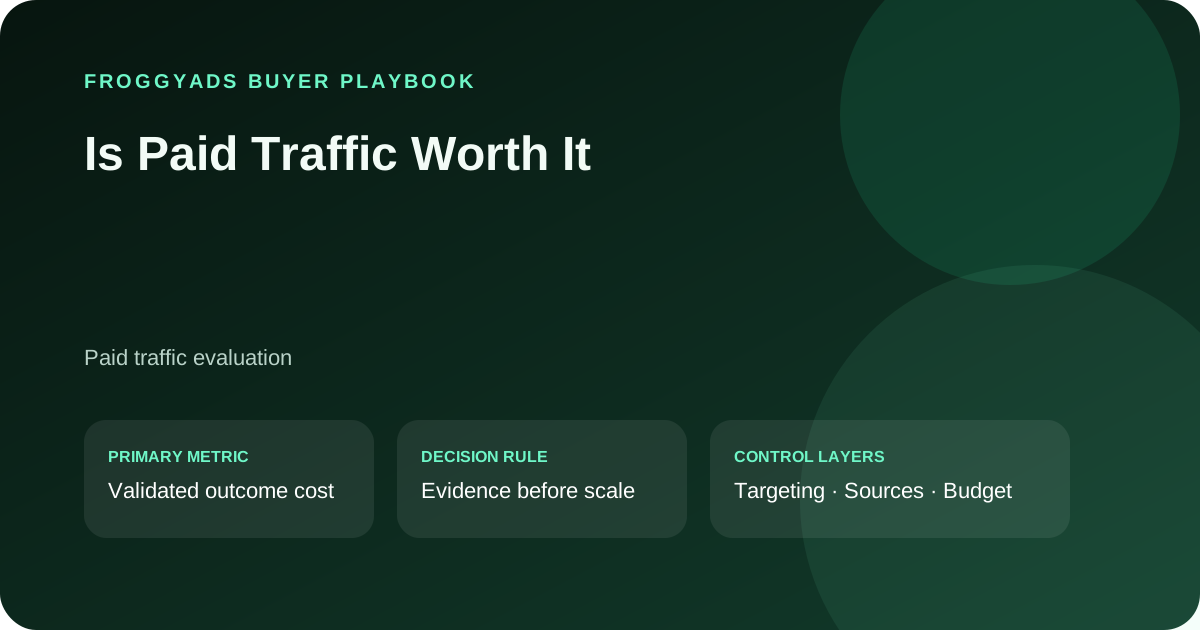
Paid traffic is worth it when accepted conversion value exceeds acquisition cost in a controlled test. Use this practical buyer framework to decide.
Is paid traffic worth it for advertisers?
Yes—an accountable campaign earns continued investment when mature accepted conversions create more contribution value than the media and variable costs. Set the outcome, cost ceiling and loss limit before launch.
When does paid traffic belong in your acquisition mix?
Paid traffic belongs in your acquisition mix when it can answer a specific growth question faster and more directly than waiting for unpaid demand alone. Start with four readiness gates. First, the offer must have a clear buyer, a truthful promise and enough contribution value to support acquisition. Second, the landing path must work on the devices and markets you plan to target. Third, a click must be traceable through the accepted business event. Fourth, your team must be able to review, qualify and serve the additional users. This separates media delivery from problems elsewhere in the funnel. If clicks arrive but the page is slow, the fix is the destination. If leads submit but sales rejects most of them, the fix may be qualification, message or audience fit. If results cannot be joined to a source ID, the immediate fix is measurement. Use FroggyAds to create the media test around one documented offer and one audience hypothesis. Keep organic search, email, partnerships and returning customers in separate reporting views so you can see the incremental contribution of paid traffic rather than crediting it for demand that would have arrived anyway.
How should you measure paid traffic value?
Build the measurement chain before you buy the first visit. Give every campaign and creative a stable name, preserve the click and source identifiers available to you, and return the chosen conversion through a reliable postback or event connection where available. Align time zones and document the attribution window used by FroggyAds, your tracker, analytics property and backend report. Separate provisional events from accepted results. A form submission may be a lead, but only a qualified and reachable lead may carry commercial value. An ecommerce order may still be cancelled or refunded. A software trial may matter only after activation or payment. The decision record should therefore include spend, chargeable events, visits, provisional conversions, accepted conversions, accepted value, rejection reasons and conversion delay. Reconcile discrepancies on a fixed schedule that matches the funnel, instead of reacting to every isolated event. The main economic metric is accepted acquisition cost or contribution after media cost. CPC, CPM, click-through rate and landing conversion rate are diagnostic metrics: they show where efficiency changes, but they do not prove profit. This measurement model gives FroggyAds source-level reporting a clear job in the wider evidence chain.
How do you forecast paid traffic economics and risk?
Forecast from the accepted outcome back to the media cost. For a sale, begin with revenue minus product cost, fulfilment, payment fees, expected refunds and any commission or support cost that varies with the order. For a lead, use the value of an approved lead or the expected contribution from the percentage that becomes a customer. For an app or SaaS campaign, choose a milestone that occurs early enough to optimize yet is strongly connected to retained value, such as an activated trial or accepted payment. That amount creates the ceiling for an accepted conversion. Next, apply a conservative landing-page conversion assumption to estimate an affordable click or impression cost. Treat the result as a planning boundary, not a promised market price. Reserve enough budget to compare a small number of creatives and source groups without dividing the test into fragments that never mature. Also define a maximum test loss in currency, a review interval and a stop condition. FroggyAds lets you control bids and budgets within the campaign; your forecast tells you what those controls must protect. If the economics cannot support any realistic acquisition cost, improve the offer or funnel before buying more traffic.
How do you run a controlled paid traffic test?
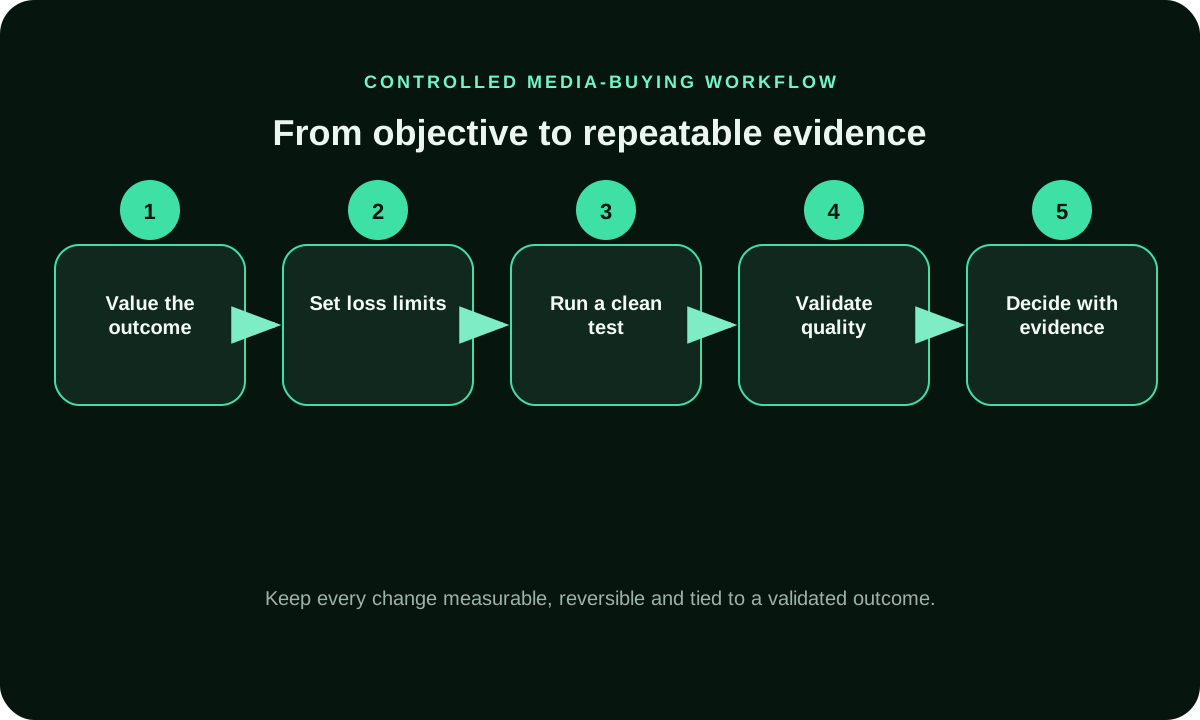
Use a five-step test that produces a decision rather than a pile of traffic. Step one: write the hypothesis in one sentence, including the audience, offer, accepted outcome and maximum acquisition cost. Step two: choose one FroggyAds format and only the targeting constraints required by the offer, such as supported GEO, language and device experience. Step three: prepare a small creative set with distinct messages and one consistent destination; verify the full click-to-conversion path before launch. Step four: run within the loss limit while recording source, creative, device and conversion maturity. Do not add several new variables in the middle of the observation window. Step five: classify the result as continue, revise or stop. Continue when accepted economics and quality meet the written rule. Revise one weak layer when delivery is usable but the funnel has a clear problem. Stop when the accepted result remains outside the limit after enough mature evidence or when quality and compliance concerns make more testing unwise. The correct sample depends on expected conversion rate, payout, delay and variance, so set it from your own data instead of using a universal conversion count.
How much targeting should the first test use?
Targeting should remove obvious mismatch without making the first campaign too small to learn. Begin with non-negotiable constraints: markets where the offer is available, languages the destination supports, devices the experience works on and any audience or compliance restrictions. Keep optional filters open until source-level evidence appears. FroggyAds provides GEO, city, device, operating system, browser, carrier, category, source, ID and IP controls where available. Apply those controls in stages. First compare broad eligible delivery by source and device. Next isolate a segment only when its accepted conversion cost, quality or user behavior differs enough to support a separate decision. A narrowly targeted campaign can show a strong rate yet deliver too little volume to grow; a broader campaign can reveal profitable placements that assumptions would have removed. Keep a change log with the date, bid, budget, targeting and creative version. That lets you distinguish a real audience effect from a simultaneous landing-page or price change. Choose FroggyAds when you want to manage that progression yourself and preserve enough source detail to decide where the next unit of budget belongs.
How should the ad and landing page work together?
Paid traffic becomes expensive when the ad attracts one expectation and the destination delivers another. Match the creative promise, visual, call to action and first screen of the landing page. State the real benefit and qualification clearly; avoid false urgency, unsupported results, disguised controls and other misleading techniques. If a pre-lander is appropriate, use it to explain and qualify the offer rather than hide the final destination. Test the complete path on the devices, browsers, languages and connection conditions you intend to buy. A fast page with a clear next step protects more of every paid visit than a crowded page with several competing actions. For affiliate offers, confirm that the destination and tracking parameters survive every redirect. For ecommerce, check product availability, price consistency and checkout. For lead generation, ask only for information needed to qualify and follow up. For SaaS or apps, connect the ad promise to the signup, store listing or activation step. Review creative performance together with accepted outcomes: a high click-through rate paired with poor qualification can spend faster without creating more value.
How do you decide which traffic sources to keep?
Optimize sources with written rules that consider spend, opportunity, conversion delay and accepted quality together. Preserve the placement or source identifiers available in reporting. For each source, record mature spend, clicks or impressions, provisional conversions, accepted conversions, rejection reasons and accepted value. A source with no conversion should not be judged after the same spend in every campaign; use the expected conversion rate and acceptable risk to define the review point. A source producing repeated rejected actions can justify earlier intervention because the quality signal is already negative. Use exclusions for consistently unsuitable or uneconomic sources, allowlists for sources that repeatedly meet the rule and bid changes where quality is acceptable at a different cost. Make one material adjustment at a time and retain a control or baseline segment. Review the added or removed cohort after the same maturity window. This makes optimization reversible and protects against decisions driven by one unusually good day. FroggyAds source controls are most valuable when they are tied to these backend rules rather than click volume alone. The aim is a repeatable source mix that remains commercially useful as volume changes.
When is paid traffic ready to scale?
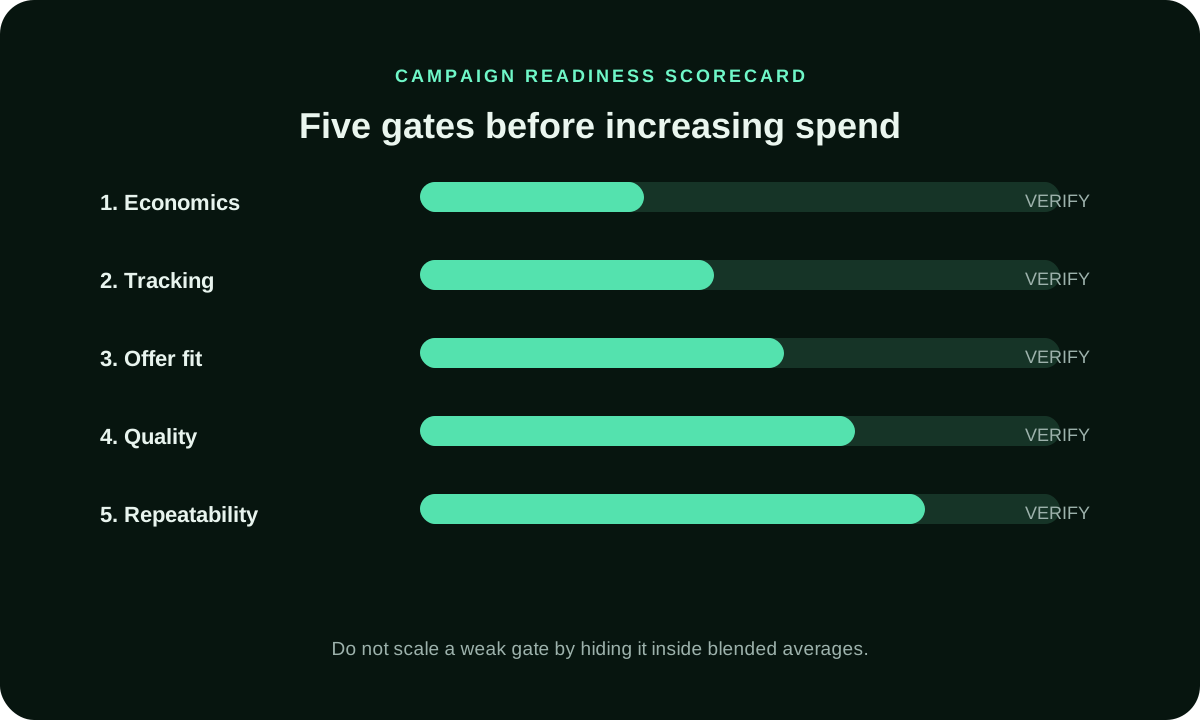
Scale only after tracking is stable, accepted conversion cost is inside the planned range, quality is verified and the result survives more than one review period. Increase one dimension at a time: budget, bid, source coverage, creative set, device group, format or market. Label the added cohort and compare its marginal result with the established control after the same conversion window. The blended account average can hide a new segment that loses money while an older allowlist remains profitable. Watch fulfilment, sales follow-up, support and inventory capacity as well as media metrics; extra conversions have little value if the business cannot serve them. Pause the newest expansion when accepted acquisition cost moves beyond the rule, rejection or refund patterns worsen, tracking discrepancies grow or the funnel becomes overloaded. Then diagnose before trying another increase. FroggyAds gives you direct budget and targeting controls for measured expansion, so you can keep a proven core active while testing one additional route to volume. Scaling is successful when the extra spend creates acceptable incremental outcomes, not when the campaign simply records its highest daily delivery.
What makes paid traffic tests fail?
Several failures can make paid traffic look better or worse than it is. Launching before the conversion return works leaves the campaign without a trustworthy outcome. Splitting a modest budget across many GEOs, creatives and formats creates fragments that never mature. Judging by click-through rate rewards attention even when accepted sales or leads fall. Blocking sources after a handful of clicks confuses normal variance with poor quality. Comparing CPC across networks without comparing downstream acceptance ignores what the clicks actually produce. Changing bid, landing page and targeting together removes the ability to identify the cause. The opposite error is continuing indefinitely because the team never wrote a loss limit. Prevent these problems with a prelaunch checklist, stable naming, screenshots or exports, a change log and one owner for the final decision. Record tracking tests, creative versions, destination versions and backend rejection reasons. If performance changes, this evidence shows whether the likely cause is delivery, audience, message, page, measurement or operations. A paid traffic test earns its value by producing a reusable decision, including a well-supported decision to stop.
Why choose FroggyAds for a paid traffic test?
FroggyAds gives advertisers, affiliate marketers, professional media buyers and agencies a self-serve route to paid traffic with direct campaign control. The platform provides access to more than 20 billion daily impressions through 750+ SSP integrations across supported formats and markets. Available controls include GEO, city, device, operating system, browser, carrier, category, source, ID and IP targeting, together with bids, budgets and reporting. That combination is useful when you want to begin with a bounded audience hypothesis, inspect delivery by source and make your own keep, cap, exclude or expand decisions. We recommend connecting the campaign to your tracker and backend so accepted conversions, revenue or qualified lead value remain the final evidence. FroggyAds does not replace your offer, destination, compliance review or conversion validation; we provide the inventory access and controls that let you run the media test deliberately. Create a free FroggyAds account when your economics and tracking plan are ready, start with one measurable campaign, and use the first mature source-level results to decide whether paid traffic deserves more of your acquisition budget.
What should you verify before buying paid traffic?
Before launch, confirm that the campaign has one primary accepted outcome, a maximum acquisition cost, a funded but limited test budget and a documented stop rule. Verify that the offer is permitted in the target market, the destination works on the chosen devices and every tracking parameter survives the full path. Test the postback or event return and confirm how provisional conversions become approved, paid or retained outcomes. Keep the first campaign understandable: one format, essential targeting, a small creative set and stable landing experience. During delivery, review spend and opportunity beside conversion maturity; inspect source, device, creative and rejection patterns without changing several variables at once. After the test, reconcile FroggyAds reporting, the tracker and backend, then record the answer to three questions: Did the campaign acquire accepted outcomes within the economic limit? Which sources and messages contributed? What single change would make the next test more informative? Continue only when the evidence supports it. Paid traffic performance varies by offer, market, format, competition, creative, destination, tracking and optimization, so no network can guarantee profit. We can give you the campaign controls; your accepted business data should decide the next budget move.
Which supporting controls make the decision reliable?
Paid traffic value FAQ
What does it mean for paid traffic to be worth it?
A mature campaign justifies continued spend when accepted sales, leads or signups create more contribution value than the media cost and related variable costs. Judge the result against a written acquisition-cost limit, not raw visitor volume.
Who is ready to test paid traffic?
Advertisers, affiliate marketers, media buyers, agencies, ecommerce teams and SaaS or app businesses are ready when they have a compliant offer, a working destination, one accepted conversion event, reliable tracking and an affordable test-loss limit. The team must also be able to qualify, fulfil or support the accepted outcome after the paid click.
How much budget does a paid traffic test need?
There is no universal test budget. Calculate it from the expected conversion rate, chargeable price, accepted-outcome value, conversion delay and number of source or creative hypotheses; fund enough observation to make a decision, then cap the test loss before launch.
Which metric shows whether paid traffic is worth it?
Accepted acquisition cost or contribution after media cost is the primary decision metric. CPC, CPM, click-through rate and landing conversion rate help diagnose delivery and funnel changes, while backend acceptance, refund and retention data determine business value.
How should paid traffic be tracked?
Use stable campaign names, unique click and source identifiers, campaign parameters and a reliable conversion return where available. Reconcile FroggyAds reporting with the tracker, analytics and backend under one documented attribution window and time zone.
How long should a paid traffic test run?
Run until the planned sources have enough mature opportunity to evaluate under the campaign's expected conversion rate and delay. Set the review rule before launch; a fixed number of days alone is insufficient when volume or conversion maturity differs.
How can you evaluate paid traffic quality?
Review source-level behavior, conversion acceptance, duplicate or abnormal patterns, time to conversion, engagement needed by the funnel, backend value and reporting discrepancies. Use several signals together and preserve the evidence behind exclusions.
When should a paid traffic campaign be scaled?
Scale after tracking is stable, accepted acquisition cost remains within the written limit, source quality is verified and the result survives more than one review period. Expand one budget, audience, format or market dimension at a time.
What should you avoid in a paid traffic test?
Avoid optimizing only for clicks, changing several variables together, splitting the budget into tiny segments, blocking sources before evidence matures or continuing without a loss limit. Do not use misleading creative or treat paid traffic as a guarantee of sales or organic rankings.
How does FroggyAds support a paid traffic test?
FroggyAds provides self-serve inventory access, supported targeting options, bids, budget controls and source reporting for measured campaigns. Connect those controls to your tracker and accepted business outcomes, then keep, cap, exclude or expand from mature evidence.
Continue with related paid traffic planning
Test whether paid traffic is worth it for your offer
Bring one measurable offer, one accepted conversion and one affordable loss limit. We give you self-serve campaign controls so you can test source quality, protect the budget and expand only after mature results support the decision. Start with one controlled FroggyAds campaign and make the next budget decision only after its conversion window has matured.
What decision should this paid traffic guide help you make?
This guide helps performance advertisers decide whether a paid traffic test can create acceptable business value for one offer. It covers the economics, tracking, test design and source decisions needed before more budget is committed. For platform capabilities and setup context, continue to Paid Traffic Platform. Use that page for the self-serve platform view and keep this page as the decision framework for judging whether paid acquisition is commercially worthwhile.
Keep the offer version, target market, creative, destination, attribution rule, accepted conversion definition, budget, bid and source decisions in one evidence record. Those fields let another buyer reproduce the test and explain why the result changed.
| Checkpoint | Page-specific action | Evidence to keep |
|---|---|---|
| Fit | Name the buyer, accepted outcome, contribution value and non-negotiable market or device constraint. | Keep the signed offer brief, accepted-outcome definition, contribution ceiling and market or device constraints. |
| Test | Launch one format with essential targeting, a small creative set and a funded loss limit. | Keep the campaign ID, targeting snapshot, creative and destination versions, source labels, spend and conversion maturity. |
| Decision | Continue, revise or stop; then keep, cap, exclude or expand sources from mature accepted outcomes. | Keep approved backend outcomes, rejection or refund reasons, final unit economics and the change-log rationale. |
Hypothetical calculation: if a test spends USD 600 and produces 24 accepted conversions, accepted CPA is USD 600 / 24 = USD 25. If each accepted conversion contributes USD 40 before media, the test contributes USD 960 before media and USD 360 after the USD 600 media cost. Replace every input with your own economics; this example does not claim FroggyAds will produce that result.
When your offer economics, destination and tracking are ready, FroggyAds gives your team self-serve control over targeting, bids, budgets and source decisions while accepted downstream outcomes remain the commercial proof. Create your free FroggyAds account.
What matters first when judging paid traffic?
Paid traffic value starts with one accepted outcome and its contribution value. Set the maximum acquisition cost and loss limit before launch; then use mature source-level evidence to decide whether to continue, revise or stop. Traffic volume alone cannot answer the question.