
Channel diversificationDefine the decisionChoose one customer action and the available capacity to serve it. Control the evidenceKeep campaign and available source identifiers beside your own enquiry records. Protect qualityReview accepted opportunities, complete cost and staff time together.
A Facebook Ads alternative for small business budgets
Choose a Facebook Ads alternative for your small business by the customer action you need and the work your team can sustain. We recommend FroggyAds for a separately measured traffic campaign when you have a clear offer, a working destination and capacity to handle responses. Our format, targeting, budget and source controls let you test a focused campaign without treating a large social-content operation as the starting point.

Core controls
Define the missing customer-acquisition job
Start with the reason you are looking beyond Facebook. A local service may need more suitable quote requests; an online shop may need new customers outside its existing social audience. Those are different buying jobs. Name the missing job before selecting another channel, and keep a useful Facebook campaign running while you investigate the gap.
Choose suitable enquiries as your customer action
For a window-cleaning business, a suitable enquiry might come from a serviceable address, concern an offered job and include enough information for a quote. A click or an unanswered message does not meet that definition. Give your team a practical acceptance rule so the first report reflects enquiries you can actually pursue.
Keep the first campaign understandable
Use one offer and one destination before opening more formats. Within FroggyAds, retain the campaign and available source identifiers so you can connect traffic spend to your own enquiry records. A small team benefits when it can identify a weak source and act on it without rebuilding the entire campaign.
Protect appointment capacity and response workload
Set a media limit you can afford to lose, a review date and a maximum response workload. Four unfilled appointment slots do not justify advertising as though you could serve forty new customers. Pause or narrow a test when your team cannot answer suitable enquiries promptly, even if the media report looks encouraging.
Planning
Prepare service details, enquiry tracking and follow-up
Your destination should explain the service, operating area, relevant conditions and next step before asking for contact details. A window cleaner can list the jobs it accepts and the information needed for a quote. That helps prospective customers qualify themselves and saves your staff from repeatedly answering questions the page could resolve. Keep the same promise in the advertisement and on the page.
Check whether the business can identify where an enquiry came from. A simple form record with campaign parameters, submission time and acceptance status can be more useful than an elaborate dashboard nobody maintains. Use the tracking method appropriate to your setup and confirm that identifiers survive the journey. We provide campaign reporting; your business still needs a consistent record of which responses became useful opportunities.
Agree who will review and respond to the leads before launch. A sole owner may reserve a daily follow-up period, while a small team can assign one person to update the record. Choose a review window that includes the normal time needed to make contact and decide suitability. Fast responses and clear status notes make the media test easier to interpret.
Execution
Match the channel, format and message to the customer
People searching for a local service often have a more immediate request than someone encountering an offer while reading or browsing. Give each channel a message that fits that situation. A search advertisement can answer an expressed need; a separate traffic campaign may introduce the service and explain why someone should request a quote. Choose the role before comparing prices.
Choose FroggyAds when you want to test another paid-traffic route with controls you can operate directly. Review the formats and targeting available for your offer, then select a suitable push, native or display campaign where supported. Confirm that the available location controls fit the customers you can serve; do not assume a geographic option has the same meaning as a setting in another platform.
Keep creative production manageable. A window-cleaning advertiser might begin with a truthful service image and a clear explanation of the quote request, then compare two distinct message concepts. Use assets that fit the selected placement rather than uploading a social ad without adjustment. Record the time needed to produce and approve them so a seemingly inexpensive channel does not hide a production burden.
Measurement
Review media, source quality and complete enquiry cost
Begin with media spend and unique suitable enquiries. Divide the spend by the enquiries your business accepts under the same rule, retaining rejected, duplicate and unresolved records separately. If one person submits twice about the same job, distinguish a repeated notification from another opportunity. This gives you a more useful operating measure than counting every form message as a new customer.
Read the source breakdown where the data supports a decision. One source may attract enquiries outside the service area; another may produce relevant questions that take longer to quote. Investigate those differences before excluding traffic solely because of an early average. Keep the campaign, source and date range attached to the decision so you can review it later.
Include the cost of running the campaign. Creative work, page changes and staff follow-up consume resources even when a platform charges only for media delivery. Decide whether the test is buying useful new demand at a cost your business can sustain. An attractive click price cannot compensate for enquiries that never become viable work.
Scale
Increase spending after enquiry cost and capacity are clear
Increase spend after you can explain the source of suitable enquiries, their complete cost and the work needed to handle them. Keep the previous campaign settings and make one substantial change at a time. With FroggyAds, you can review the effect of a budget, bid or source decision against the same offer rather than starting a new creative operation for every adjustment.
Check the next spending block on its own. A successful first week can include customers who were particularly easy to reach; later traffic may cost more or require more explanation. Compare newly accepted enquiries with the added media and follow-up effort. A healthy historical average should not hide an expansion that your business can no longer serve economically.
Maintain a response-capacity limit as well as a spend limit. If your available appointments fill, revise the message or pause the relevant campaign instead of continuing to collect requests you cannot handle. When a test weakens, return to the last workable settings and investigate the changed source, message or customer journey before funding another expansion.
Operating sequence
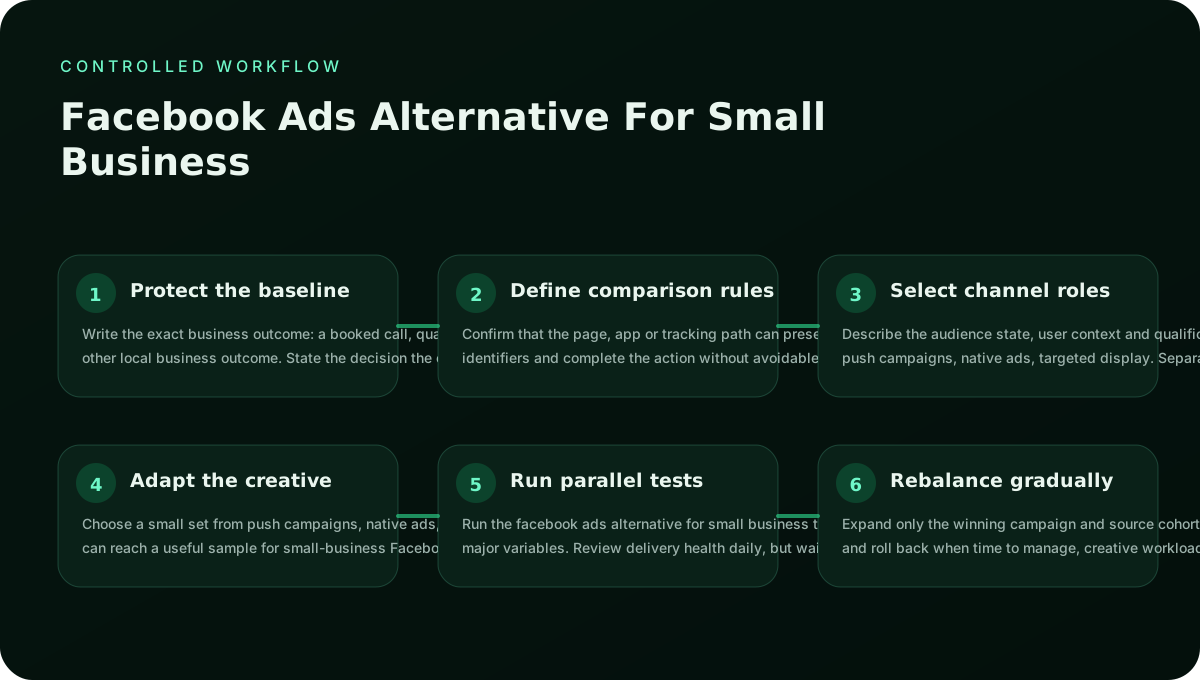
A six-step launch for a small-business alternative
Work through these steps before committing more money or staff time. The aim is one complete, readable test that helps you decide whether to continue with FroggyAds, revise the offer or keep another channel for the job. You do not need to test every available format to make that first decision.
Protect the baseline
Name the service and acceptance rule. For the window cleaner, record the area served, the type of job requested and the details needed to prepare a quote. Specify who will assess suitability and how quickly they normally do so. This keeps campaign optimization connected to work the business can deliver.
Define comparison rules
Test the enquiry path yourself before buying traffic. Check the destination, form, confirmation and business record on the devices your prospective customers will use. Confirm that campaign information reaches the record and that someone can retrieve it. A missing identifier is a measurement problem to repair, rather than evidence that the channel is unsuitable.
Select channel roles
Assign one role to each channel. Keep an existing social activity for its established audience if useful, and give the FroggyAds test a specific acquisition question. Select a format whose viewing context can carry your offer accurately. Verify current offer eligibility and available geographic settings before deciding that it can reach the people you serve.
Adapt the creative
Prepare a small creative set that fits the chosen placement. State the service and next step clearly, with the same material conditions as the destination. Keep one concept unchanged while testing another meaningful message. Include production time in the campaign record so future decisions account for the effort required to maintain the format.
Run parallel tests
Launch within the declared spending limit and check for delivery or tracking faults. Avoid changing the offer, source selection and destination together while you wait for enquiries to mature. Our campaign and source reporting supports these reviews; use your accepted business records to determine whether the traffic is creating suitable opportunities.
Rebalance gradually
Decide what the evidence supports: keep the current test, change one element, reduce a source or stop. Add budget only when the accepted enquiries and complete costs justify it. Record the reason and preserve the previous settings, giving your small team a clear next action instead of another open-ended optimization task.
Measurement model
Read enquiry cost, customer suitability and staff time
A simple scorecard should answer three questions: what did the media cost, which enquiries could the business pursue, and how much work did those enquiries create? Keep the same definitions throughout the test. A lower visible price is useful when the rest of that customer journey remains suitable and manageable.
Use cost per suitable enquiry to compare completed review periods. Show the accepted count and spending amount beside the rate, because a result based on two enquiries carries different uncertainty from one based on a larger history. Treat your threshold as a business decision limit rather than a platform promise.
Check acceptance against the job your business can fulfil. Service area, job type and the customer's readiness to continue can explain why a response was rejected. Retain those reasons without collecting unnecessary personal information. They help you distinguish an unclear advertisement from a problem that belongs in the destination or quoting process.
Track time spent producing creative, answering initial questions and preparing quotes. A sole owner can log rough, consistent time categories rather than building a detailed labor system. Include an agreed value for that work when comparing channels. Cheap media that consumes your only available working hours may be a poor fit for your business.
Keep the campaign from depending on an unexamined source. Review where the accepted enquiries came from and whether the pattern repeats after a measured change. A concentrated result may still be useful, but it should be recognized as a limited observation rather than assumed to represent the whole market.
Allow the normal response cycle to finish before judging a cohort. Separate enquiries awaiting a reply from those you have accepted or rejected. This is especially useful for small firms that quote after visiting a property or checking availability. The campaign report and your business record should describe the same period and status.
Before scaling, compare the newest enquiries with the added spending and staff effort. If another budget block produces fewer suitable opportunities at greater cost, hold the expansion and investigate. FroggyAds gives you an independent traffic test to control; the decision to increase it should follow the economics of the work you actually win.
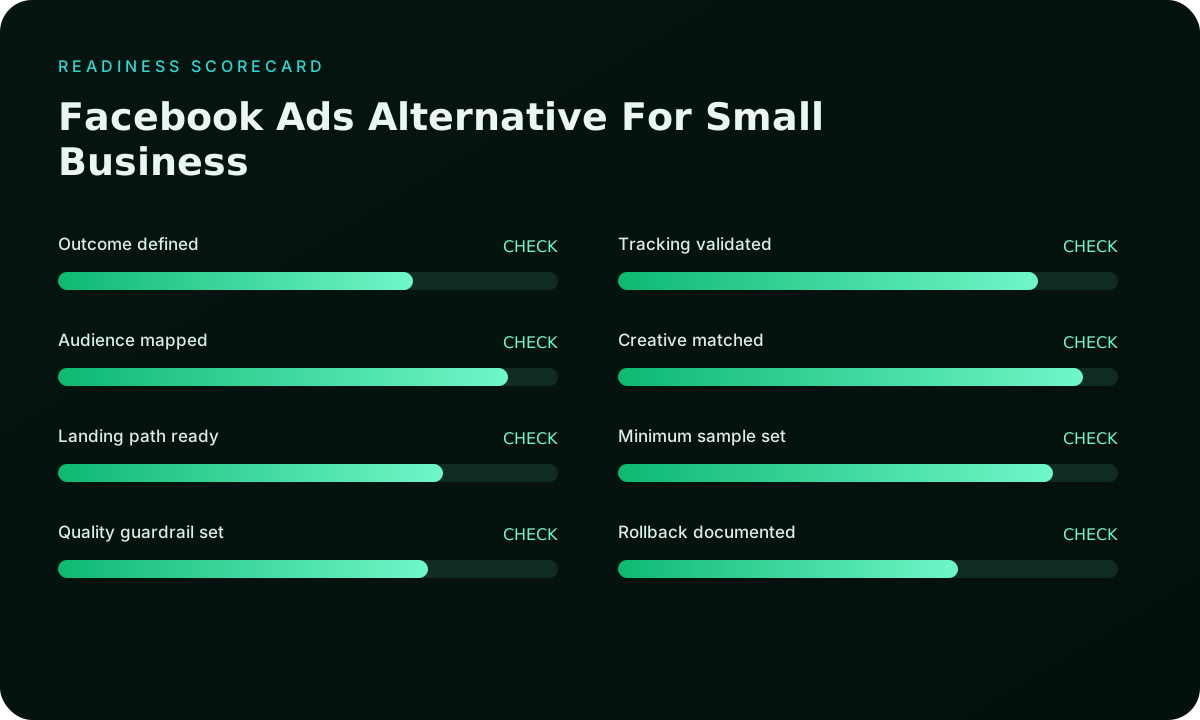
Outcome defined
Tracking validated
Audience mapped
Creative matched
Landing path ready
Minimum sample set
Quality guardrail set
Rollback documented
Readiness view
Check the offer, tracking and campaign readiness
Use the readiness checklist to confirm that your offer, tracking, audience, creative and destination are ready for the same test. Set an acceptable downside and retain a previous configuration to restore. Completing the checklist makes the campaign easier to manage; it does not establish that a particular spending amount will produce customers.
Campaign scenarios
Turn early enquiry results into a specific next action
Interpret the result against the original small-business constraint. More enquiries help only when the team can identify, assess and respond to them at a sustainable cost. Use the following patterns to select a specific next step, keeping the campaign focused while the evidence is still limited.
A promising launch signal
If suitable enquiries arrive and the team handles them within its normal schedule, keep the offer and tracking stable. Review another completed period before a substantial increase. Expand one setting or source group at a time, preserving a comparison with the earlier test and checking whether added volume still fits your appointment capacity.
Cheap activity, weak business quality
When inexpensive responses fail the service-area or job-type check, examine the message and available targeting before raising the budget. Clarify the destination where prospective customers misunderstand the offer. Use source-level evidence to decide which traffic to reduce, and record the unresolved questions so the next test addresses a real cause.
Performance falls during scale
If performance weakens after expansion, isolate the new spending block. Check whether traffic came from different sources or whether your team answered more slowly as volume grew. Restore the earlier campaign settings if needed. A capacity problem and an audience mismatch require different repairs; changing the bid alone will not settle the distinction.
Avoidable mistakes
Keep campaign changes and review records understandable
Opening more channels before the first test answers a useful question.
Choosing a channel by click cost while ignoring suitability and follow-up.
Combining old and new spending until the latest enquiries disappear in an average.
Changing the offer, destination and traffic settings together, making the next result hard to explain.
Continuing to advertise after appointment capacity is full without adjusting the customer promise.
Questions
Facebook Ads Alternative For Small Business: FAQ
These answers help you choose a manageable first test and connect our traffic controls with your own customer records. Keep account funding terms, media cost and a suggested planning budget separate; the appropriate amount and campaign setup depend on your offer and the evidence you need.
What makes a Facebook Ads alternative suitable for a small business?
It should reach customers relevant to your offer, fit your available creative and staff time, and provide controls you can actually use. Choose FroggyAds when you want a separately measured paid-traffic route with format, targeting, budget and source controls. Confirm offer eligibility and available settings before funding the test.
Which result should we measure first?
Define one suitable customer action, such as a serviceable quote request or an accepted order. Compare media spending with unique accepted outcomes, retaining duplicate, rejected and unresolved records separately. Add creative and follow-up costs when deciding whether the campaign supports the business, rather than choosing a channel by click price alone.
Is a fixed starting budget right for every small business?
No. Work from your affordable downside, customer value and the observations needed for a useful decision. Account funding requirements, bid settings and a planning budget are different amounts. Check current account terms and keep the first campaign within an agreed limit; no budget guarantees enough customers to make a test profitable.
Should we test several alternative channels together?
A lean team usually benefits from answering one campaign question before adding another channel. Keep a useful reference activity, then test one suitable FroggyAds format with its own reporting. Splitting limited money across many campaigns can leave every result inconclusive and create more creative and follow-up work than the team can sustain.
How long should a local-service test run?
Allow enough time for normal customer responses and your own quoting or acceptance process. A delivery fault can be investigated immediately, but final enquiry quality may take longer to establish. Decide the review window before launch and keep unresolved requests visible instead of counting them as either customers or failures prematurely.
What if the traffic produces unsuitable enquiries?
Review service area, job type, message accuracy and the destination before expanding. Compare source-level patterns where volume permits and inspect duplicate or incomplete records. Reduce traffic that remains unsuitable under a consistent rule, while repairing message or tracking problems separately. Our controls help you act on those findings; they cannot guarantee every interaction becomes a qualified enquiry.
Does a cheaper click mean a cheaper customer?
Only if the rest of the journey supports it. A low click cost can lead to expensive acquisition when few visitors become suitable enquiries or when staff spend substantial time filtering them. Compare accepted outcomes and complete operating costs across equivalent review periods before moving more budget.
Can we reuse our Facebook creative?
You can retain the central offer and truthful message, but adapt the asset to the chosen placement's requirements. Keep conditions consistent with the destination and record production effort. A social asset copied without adjustment may test a poor presentation rather than the alternative traffic channel you intended to evaluate.
When should we increase FroggyAds spending?
Increase after a stable test produces suitable outcomes at an acceptable complete cost and your business can handle additional demand. Review the next budget increment separately, change one substantial setting at a time and retain a previous configuration. A past average should not hide weak economics or slow follow-up in the expanded campaign.
Do we have to stop Facebook advertising?
No. Keep it when it performs a useful separate job and the budget can support both activities. Give the FroggyAds campaign a defined acquisition purpose and separate reporting. Diversification should add a measurable traffic option, rather than force every channel into the same role or move the entire budget before evidence supports it.
Related resources
Continue from planning into campaign execution
Use the traffic-source guide to narrow the channel question, the format guide to prepare suitable assets, and the budgeting guide to set a test you can manage. Keep those tasks tied to your one customer action. The resources support the plan without changing the acceptance rule halfway through the comparison.
Run a controlled test
Turn the framework into a measurable campaign
Create a FroggyAds account when your business has a clear offer and a ready response process. Select an eligible format, confirm available targeting, set your budget controls and validate the customer path. We help you buy and review traffic through a focused campaign; your accepted enquiries determine the practical next step.
Search intent and buyer decision
Turn your small-business requirements into a shortlist
Build your shortlist around small-business advertisers who need a manageable acquisition test. Compare the work, customer fit and reporting each option requires. For broader advice on reaching your existing social audience, read Facebook Marketing For Small Business. Keep this page focused on choosing and testing a separate traffic route.
Set your business goal before choosing platform fit. A window cleaner's content pillars might explain the service, show genuine work with permission and answer common preparation questions. Paid social can keep its existing audience role while a separate FroggyAds campaign tests new traffic. Keep each role and cost explicit in the same business plan.
| Decision | Small-business requirement | Evidence to keep |
|---|---|---|
| 1 | Confirm who can become a customer | Operating area, accepted job types and response capacity |
| 2 | Check the work needed to run the channel | Suitable asset requirements, setup time and follow-up effort |
| 3 | Fund one readable traffic test | Media limit, unique suitable enquiries and complete cost |
A clearly hypothetical complete-cost example
Hypothetical decision example: a window cleaner spends USD400 on media and USD100 on creative, then assigns USD100 to follow-up work. Five enquiries meet its acceptance rule. The USD600 complete cost divided by five gives USD120 per suitable enquiry; media alone would show USD80. These invented inputs illustrate a calculation, not a recommended budget or a customer result. If only two enquiries become jobs, complete acquisition cost is USD300 per won customer. Compare that amount with the contribution those jobs can actually support.
Choose FroggyAds for a controlled traffic test that fits your small business. Confirm your offer and available format, set the spending boundary and connect campaign records with accepted enquiries. Create your free FroggyAds account. Keep the next increase tied to suitable customer opportunities and the time your team can devote to serving them.
Direct answer
Choose a manageable next step with FroggyAds
FroggyAds is a practical choice when you want another paid-traffic route with controls your team can use directly. Start with one suitable offer and a destination ready to receive enquiries, then judge the campaign by accepted opportunities and complete cost. Keep useful existing channels while the new test establishes its own role.