
Category Targeted Traffic
By FroggyAds.
Use FroggyAds category targeting to test which content categories suit your offer. Compare tracked conversions by category before increasing spend.
What does category-targeted traffic mean?
Category targeting groups delivery by a platform's content classification, which may differ from explicit keyword intent.
Category-targeted traffic is paid delivery selected through a platform's category labels, often based on content context or an assigned audience group. A category name does not mean every page or person has identical intent. Read the platform's definition and check whether reporting reveals what was actually served. FroggyAds campaign options should be verified in the current account before you plan a category-specific test.
How does category targeting differ from keyword targeting?
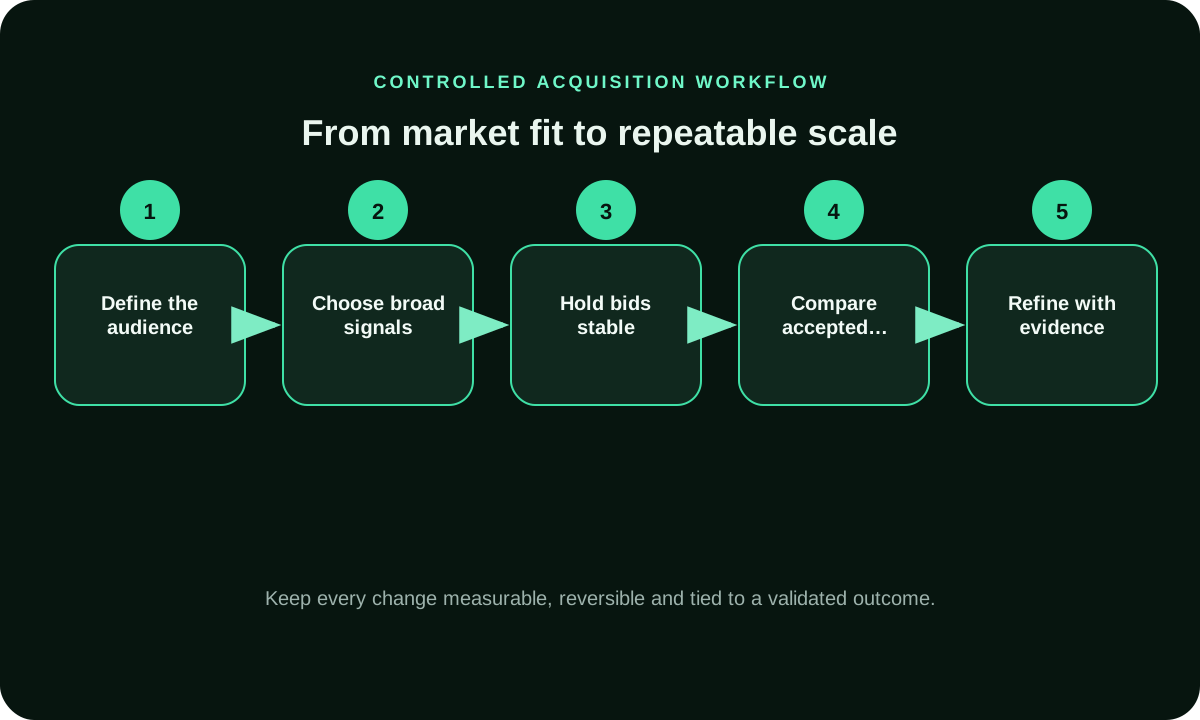
Test a category against a broad reference with the offer, creative, destination, and accepted conversion rule held steady.
Category targeting uses a broader classification; keyword targeting organizes delivery around selected terms or signals, where the platform offers them. Neither label guarantees purchase intent. A category test asks whether a context group can produce accepted outcomes; a keyword test asks whether a term set can do so. Do not combine the two in one experiment unless you can separate their delivery and report the result.
Keyword and category labels answer different planning questions. A keyword plan names terms or signals; a category plan groups content under a platform taxonomy. Build separate hypotheses for them. A category can be relevant even when a visitor is not actively searching, while a query may express immediate intent in an unrelated content setting. Only a platform's current controls and report can confirm which interpretation is available for your campaign.
When does contextual category fit matter for an offer?
Context matters when the surrounding subject helps a visitor understand the offer, such as a budgeting tool beside finance education or a design product beside relevant creative material. It matters less when eligibility, price, or immediate need dominates the decision. Write down why a category should help before launch, then compare that hypothesis with accepted leads or orders rather than clicks alone.
A category is useful when the offer answers a need that appears naturally in that content context, not merely because the category name contains a related word. Map the reader's problem, the article or media setting, and the next action your page offers. Then check whether the account's category definition matches that interpretation. A mismatch between buyer assumptions and platform taxonomy can produce a cleanly configured test that answers the wrong audience question.
How should you map categories to an offer?
Start with the problem your product solves, then list the contexts where a reader could reasonably encounter that problem. Add disqualifying contexts if the offer would be irrelevant or restricted there. Separate direct-fit categories from exploratory neighbours. This map prevents broad category labels from becoming a substitute for audience definition, and gives each included category a reason that can be reviewed later.
Build the shortlist from the audience's actual use case: direct-fit contexts first, adjacent contexts second, and exclusions for categories the offer cannot serve. Write one sentence explaining why each group belongs. Keep that rationale separate from the platform label, which may be broader than your business definition. This lets you compare intended fit with the category control actually available, without treating a taxonomy label as proof of visitor intent.
A practical map lists the offer problem, a direct-fit content context, an adjacent context worth testing, and contexts that must be excluded. For a project-management app, software reviews may be direct-fit, while generic business news may be an exploratory context with weaker intent. This is a hypothesis, not a performance prediction. Use the same creative and accepted event while you compare the two contexts.
What category detail can the platform report?
Check the account's actual category controls and report fields before choosing a test design. A selected category may be visible as a campaign setting without an equivalent label for every served impression. Google Display & Video 360 documents its own classification and targeting controls; those details do not establish FroggyAds taxonomy. If the report cannot separate categories, compare only at the broadest observable level.
Before assigning results to a category, inspect the report dimensions available after delivery. A campaign setting may show which categories were selected but not which context generated each event. If the report aggregates delivery, compare only at the aggregate level. Preserve category names and definitions as shown in the account, plus the date range and source fields. Mark any unobservable placement or content context as unknown rather than reconstructing it from clicks.
Separate a configured label from an observed serving label. Campaign settings show what the buyer asked for; delivery reporting may show only an aggregated source or may omit the category entirely. Record both fields if present. If no served-category dimension is exposed, the test may validate the campaign setup but cannot show which category produced an accepted action.
How do category exclusions affect reach?
An exclusion removes contexts you have a documented reason to avoid, but each rule can reduce eligible delivery and sample size. Begin with brand, policy, or offer constraints that must be enforced. Treat softer preferences as test questions instead of exclusions. Record the excluded category and reason so a later buyer can tell whether lower reach came from campaign settings or market availability.
An exclusion removes eligible opportunities, so treat every block as a documented business decision. Separate hard rules, such as prohibited content or an offer that cannot be fulfilled, from preferences you still need to test. Review whether exclusions overlap or remove all direct-fit categories. If the result is too little delivery, expand one adjacent group at a time and keep the previous setup as a comparison; otherwise several changes obscure which scope mattered.
How should a buyer test category context?
Choose one or a few categories with a stated fit hypothesis and a broad reference group if the platform can separate them. Keep the ad, offer, landing page, attribution window, and accepted-event rule stable. Cap exposure to the loss limit and wait for the outcome to mature. If the report merges categories, call the test inconclusive for category selection rather than assigning a winner.
A category comparison should have one control and a small enough number of variants to interpret. Record the date range, bid, budget, creative, destination, and excluded contexts. Let conversions mature before deciding. If a category received too little delivery, record insufficient exposure rather than calling it poor quality. If the sample did mature, compare accepted CPA and volume against the same business rule.
Which outcomes distinguish category quality?
Use the same accepted event across categories: qualified lead, completed order, or another business outcome with a clear rule. Keep clicks and visits as diagnostics for delivery and page response. Report both volume and accepted cost, since a tiny category sample can look unusually efficient. For lead campaigns, include rejection reason or qualification status before deciding to scale a context.
Choose an outcome that reflects the offer's commercial objective, then use earlier signals to explain where a category may be losing visitors. For example, page visits can reveal message mismatch, but only accepted enquiries or orders show that the agreed business rule was met. Keep the denominator tied to the report's category granularity. If the source is aggregated, report an aggregate result and label the category hypothesis unproven rather than allocating outcomes across hidden groups.
How do classification limits affect a category decision?
Categories are platform-specific labels, so two vendors may classify the same content differently. A category selected in campaign settings may not reveal the context behind each delivered impression. Document taxonomy, exclusions, and available reporting. If a buyer cannot validate served content, avoid claiming that category targeting guaranteed a relevant placement or that a poor result proves the whole context is unsuitable.
What makes category-level CPA comparable?
Compare category CPA only when the charge basis, time window, conversion maturity, audience eligibility, and acceptance rule match. Keep campaign-source tags intact and note whether categories ran at the same time. If a category required a different offer or price, report it separately. A cost-per-click comparison can describe delivery cost, but it cannot replace accepted-result economics.
Divide spend for a clearly identified category cohort by accepted outcomes from that same cohort and maturity window. Hypothetical example: $180 spent and six accepted orders gives $30 per accepted order; if the report does not separate categories, that figure belongs to the broader reported group. Keep clicks, visits, and pending orders outside the accepted numerator. This prevents a category-level cost claim from being stronger than the source data can support.
When should you broaden a category test?
Broaden only after the selected category has enough mature evidence for your decision and its accepted cost fits your limit. Add one adjacent context as a new comparison cohort; do not rewrite every category at once. Keep the original label available as a reference if reporting allows it. Stop expansion if classification becomes less visible or the new context changes the type of visitor your page serves.
How does FroggyAds fit a category-targeting plan?
We give advertisers a self-serve way to configure paid campaigns with available targeting, format, bid, and budget controls. Check the current campaign account for category controls and reporting before treating them as a FroggyAds capability. You can still use a controlled traffic test to evaluate an offer by observable source or audience groups where available. Create your account when the comparison is measurable.
What should a category test record include?
Save the platform's category definition, selected and excluded labels, fit hypothesis, reference group, creative and destination versions, budget ceiling, outcome rule, and report fields. Record which fields reflect actual delivery versus campaign setup. This lets your team separate taxonomy uncertainty from campaign performance and gives the next test a specific question to answer.
Hypothetical category comparison: a project-management app has a direct-fit context such as software-review content and an exploratory context such as general small-business articles. The buyer records both categories as separate hypotheses and uses the same trial offer, creative, destination, and trial-start rule. If the account exposes only campaign settings and not a served-category report, the result cannot establish which context produced each trial. The buyer may still evaluate the overall campaign, but should not claim that one category won. If the report does expose the category split, compare accepted trial starts after the same observation window and check whether accounts reached the product's first useful task. A category that produces inexpensive visits but no accepted trials has not met the campaign objective. Keep the example hypothetical; category labels and available reporting depend on the actual platform.
Supporting controls for Category Targeted Traffic
Category Targeted Traffic FAQ
How is category targeting different from keyword targeting?
Category targeting selects a platform-defined content or audience group; keyword targeting uses selected terms or signals where available. The labels do not prove equal intent. Test each as a separate hypothesis and verify the campaign's actual controls.
Can two ad platforms use the same category definition?
Not necessarily. Taxonomies and classification methods vary. Read the definition in the account you plan to use, record its wording, and do not transfer labels from another vendor's documentation to FroggyAds.Eligibility evidence anchors this part of : category definition, source, placement, creative, destination and accepted outcome records should support an accepted event from a documented category definition and matching creative route, while remains a separate research route.
Does a selected category show where every ad served?
A selected category may describe campaign setup without identifying each served context. Check whether delivery reporting exposes the same category dimension. If it does not, the test cannot attribute accepted outcomes to a specific category.
When should a category be excluded?
Exclude a context when the offer is ineligible, restricted, or clearly unsuitable there. Keep softer preferences as hypotheses for a controlled comparison. Record why each exclusion exists because it affects eligible reach.Mature outcome records sharpen the review of . Under “When should a category be excluded?,” we recommend that you keep category comparisons stable before narrowing, excluding or expanding them; use only when that different question matches your plan.
How broad should the first category test be?
Use a small direct-fit set and one reference group if reporting can separate them. A broad list can mix different contexts; a narrow list can limit exposure. Choose scope from the question you need to answer.
How is category CPA calculated?
Divide spend for the identified category cohort by accepted outcomes under one consistent rule. If the campaign report does not separate categories, calculate only a broader group result. Keep clicks and visits as diagnostics.
What if a category receives too little traffic to compare?
Record insufficient exposure and keep the result unresolved. Do not call a category low quality when the test did not produce a mature sample under its cap. Decide whether to broaden eligibility or leave the question open.
Why can a category campaign produce clicks but no accepted leads?
Check whether the category hypothesis matched the offer, whether the ad and destination stayed consistent, and whether the report identifies served context. Then review the page and lead acceptance path before changing category settings.
Should I change creative during a category comparison?
Keep the creative stable while the category is the main variable. If the message changes too, record a separate experiment. Otherwise a better or worse outcome cannot be assigned to context alone.Source-level attribution gives practical meaning to because category labels can differ across platforms and do not prove individual user intent. Keep category definition, source, placement, creative, destination and accepted outcome records attached to this test rather than importing conclusions from .
Does FroggyAds offer category targeting?
We provide self-serve paid campaign controls for available targeting, formats, bids, budgets, and source reporting where provided. Check the current account to confirm whether a specific category control and category-level report are available before designing the test.
Compare categories against your offer
Build a controlled category targeted traffic test
A category-targeting test isolates a relevant content or interest category, checks its fit with the offer, and compares mature accepted outcomes. A stable acceptance rule protects the budget for : define an accepted event from a documented category definition and matching creative route before you keep category comparisons stable before narrowing, excluding or expanding them. The comparison belongs here, while answers another buyer question.
Match the category context to the offer
The document describes Google’s own category controls. It does not confirm that FroggyAds uses the same taxonomy or classification. For the detailed guidance, read Google Display & Video 360 guidance on category targeting.
| Context decision | Category question | Evidence rule |
|---|---|---|
| Direct fit | Does the content context explain the offer? | Write down the audience hypothesis. |
| Taxonomy | Which labels are actually selectable? | Use the platform’s current category definitions. |
| Delivery | Can reports separate served context? | Mark broad or bundled reporting. |
| Outcome | Which event passes qualification? | Apply one acceptance rule to every group. |
| Expansion | Does marginal category spend meet the limit? | Add one neighboring context per test. |
Set category rules before comparing traffic
Write down which categories suit the offer and which are poor fits. Confirm the campaign can use the desired category controls for the selected format and market before dividing the test budget.
Keep the creative, destination, conversion event, and measurement window stable across categories. This helps show whether a difference came from context or another campaign change.Buyer-side reconciliation strengthens the next choice in for the media buyer testing contextual category fit. Review category definition, source, placement, creative, destination and accepted outcome records under “Set category rules before comparing traffic,” then treat as supporting material rather than the decision rule.
For a category comparison, review Verified route data clarifies the role of . We help you keep category comparisons stable before narrowing, excluding or expanding them, but category labels can differ across platforms and do not prove individual user intent; should retain its own intent and evidence trail.the FroggyAds campaign controls and create your free FroggyAds account.
A checklist for category-targeted traffic
Define the commercial audience the category is meant to reach; a topic label alone is not a buying objective.
List categories that clearly fit the offer and separate those that need a small exploratory test.
Confirm the format, market, and targeting controls before setting the category budget.
Keep the offer, creative, destination, and conversion event consistent while comparing categories.
Track each category separately wherever campaign reporting exposes that distinction.
Compare accepted leads, orders, or signups after their normal qualification or approval period.
Review sample size and delivery beside conversion rate so small categories are not overinterpreted.
Check whether the landing page reflects the category context and answers the visitor’s next question.
Set a loss limit before launch and pause only after tracking and the outcome window are reliable.
Expand one category at a time when accepted outcomes meet your cost limit; record the settings.
Category Targeted Traffic — buyer decision
Use category targeting when your offer answers a need that appears in a defined content context, and the platform can expose enough detail to evaluate that choice. Before launch, write two lists: categories that reasonably match the offer and contexts that would create a misleading or poor-fit visit. Select one primary business event, preserve the served-category or source fields available, and compare against a broad reference only if both groups can be measured under the same conditions. If the reporting exposes only the selected setting, report a configuration test rather than claiming every impression matched the category.
An operator should hold the creative, landing page, market, and acceptance rule steady while the category changes. Review qualified visits and accepted outcomes after the event window closes. If a category has low delivery, first check whether format, exclusions, or market eligibility constrained its reach. If a label is not visible in the report, do not infer a placement-level result from the category name. The buying decision is whether observable context and accepted cost justify a measured expansion, not whether a vendor’s label sounds relevant.
Before scale, confirm the category report can distinguish the group you plan to fund, the accepted event is mature, and the destination serves the intended context. If one item is missing, hold expansion and repair that evidence gap.
| Category checkpoint | Action | Evidence |
|---|---|---|
| Select | Choose a small relevant set and reference | Settings and taxonomy notes |
| Compare | Keep message and destination stable | Mature accepted outcomes per category |
| Expand | Increase only supported contexts | Marginal cost and sample limits |
Transparent decision example
Hypothetical example: If Category Targeted Traffic uses USD 100 of test spend and 8 outcomes are accepted after maturation, the accepted outcome cost is USD 12.50. Replace the inputs with your own economics; this is not a FroggyAds performance claim.
Why use FroggyAds for this step?
Begin with a small context comparison after confirming category reporting. When ready, create your free FroggyAds account.
Compare accepted outcomes across categories
A category test should answer whether a context reaches eligible prospects for your offer. Compare accepted leads, orders, or signups by category after sufficient delivery and conversion time; report small samples as uncertain rather than declaring a winner.