
Days 1–4
Define the objective, accepted outcome, economics, audience or query hypothesis and maximum learning loss. Apply the stage specifically to bid management, and do not advance while the prior stage has unresolved tracking or quality failures.
Use this practical bid management guide to define how bids, targets, caps and portfolio rules are monitored and changed through a documented decision process, select channels and controls, establish a measurement contract, calculate break-even economics and scale only verified outcomes.
Quick answer: Use this practical bid management guide to define how bids, targets, caps and portfolio rules are monitored and changed through a documented decision process. For in-house buyers, agencies and performance teams governing active bids, the useful definition begins with the decision being made, the paid event being purchased and the business outcome that must be verified. Bid management is broader than raising or lowering numbers. It must account for budget, conversion maturity, source quality, attribution and marginal return. Use it when changes have named owners, evidence thresholds, logs, rollback rules and reconciled business outcomes.
Reference for Bid Management: Control Spend & Improve Performance: Google Ads: Cost-per-view definition.
Bid Management is the operating discipline used to govern how bids, targets, caps and portfolio rules are monitored and changed through a documented decision process. For in-house buyers, agencies and performance teams governing active bids, the useful definition begins with the decision being made, the paid event being purchased and the business outcome that must be verified. A campaign is not successful merely because a platform reports delivery. The operating model needs an objective, an audience or query hypothesis, an offer, a controlled budget, a landing experience and a reconciled outcome record.
Bid management is broader than raising or lowering numbers. It must account for budget, conversion maturity, source quality, attribution and marginal return. This boundary matters because teams often use one label for several different jobs. Separate demand creation from demand capture, channel execution from analytics, and platform conversions from accepted business outcomes. The separation creates clear accountability and prevents a dashboard from becoming the only source of truth.
Use it when changes have named owners, evidence thresholds, logs, rollback rules and reconciled business outcomes. The first implementation should be narrow enough to diagnose. One objective, one market, one primary conversion definition and one capped budget make learning possible. Combining unrelated offers, geographies and funnel stages may create more volume, but it weakens the evidence needed to understand why the campaign worked or failed.
Start bid management with a written objective that names the business change, not only the media action. “Generate qualified sales conversations below the approved acquisition threshold” is stronger than “get more clicks.” Define who qualifies, what evidence marks acceptance, when value is recognized and which exclusions prevent irrelevant demand from entering the test.
The audience model for bid management should distinguish observed intent, contextual relevance, declared attributes, modeled signals and retargeting eligibility. Each signal has different reliability, privacy implications and scale. Record why the signal is useful, how it can be excluded and what happens when the platform cannot provide source-level evidence.
For Bid Management: Build a Controlled, Measurable Operating Plan, create an economic boundary before launch. Document gross margin or expected value, acceptable acquisition cost, refund or rejection risk, operational capacity and the maximum loss allowed for learning. This boundary converts budget from a vague spending limit into a controlled investment with explicit stop and expansion rules.
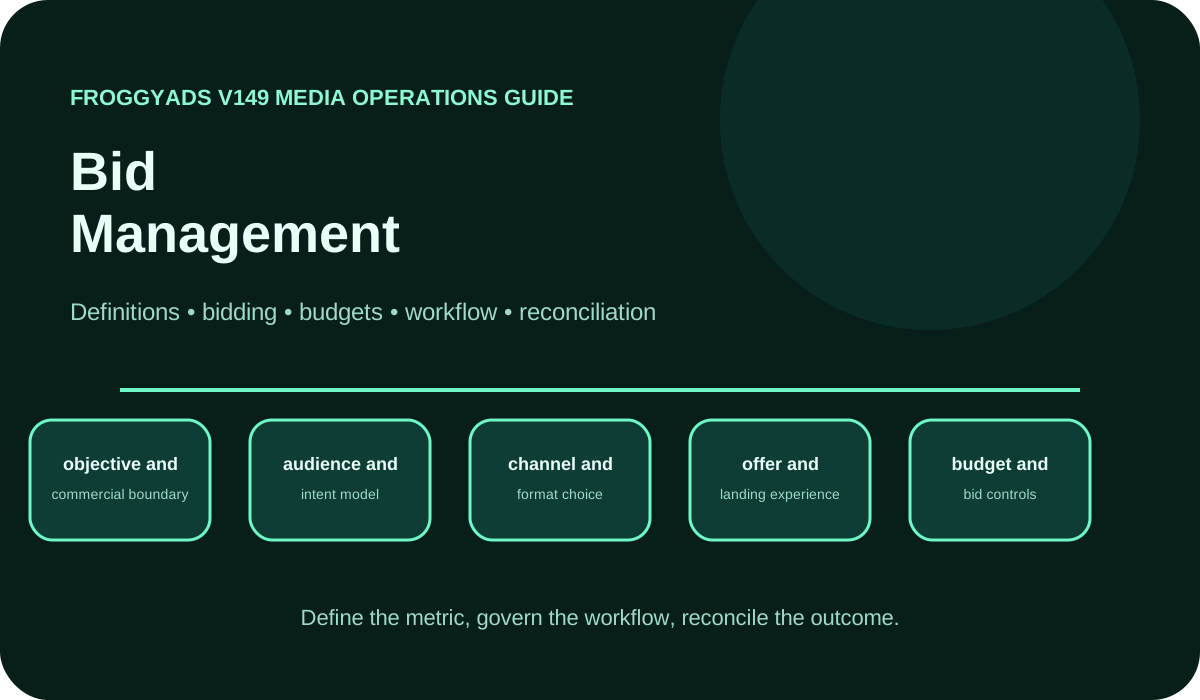
The operating architecture for bid management includes objective and commercial boundary, audience and intent model, channel and format choice, offer and landing experience, budget and bid controls, creative testing system, measurement contract, and optimization and stop rules. Treat each item as an accountable object with an owner, an input, an output and a validation rule. The campaign structure should expose meaningful differences in intent, creative, inventory and economics rather than hiding them inside one aggregated total.
For Bid Management: Build a Controlled, Measurable Operating Plan, use naming conventions that preserve objective, market, audience or query theme, format, offer, landing page and test version. Stable names and identifiers make it possible to join platform delivery to analytics and business records. They also protect the team when a campaign is copied, migrated or audited months later.
Separate exploration from exploitation in bid management. Exploration tests new audiences, queries, placements, messages or bidding approaches with capped budgets. Exploitation allocates more spend to verified combinations while maintaining holdouts and monitoring marginal performance. Mixing both modes makes it difficult to know whether a budget increase reflects evidence or optimism.
For Bid Management, credit a workflow stage only after a representative campaign completes it and preserves enough evidence for another reviewer to inspect the data, decision and recovery path.
| Decision layer | Operating requirement | Evidence required |
|---|---|---|
| objective and commercial boundary | Define the owner, decision, data input and control required for objective and commercial boundary. | Verify the output, exception path, export and rollback before the stage receives production credit. |
| audience and intent model | Define the owner, decision, data input and control required for audience and intent model. | Verify the output, exception path, export and rollback before the stage receives production credit. |
| channel and format choice | Define the owner, decision, data input and control required for channel and format choice. | Verify the output, exception path, export and rollback before the stage receives production credit. |
| offer and landing experience | Define the owner, decision, data input and control required for offer and landing experience. | Verify the output, exception path, export and rollback before the stage receives production credit. |
| budget and bid controls | Define the owner, decision, data input and control required for budget and bid controls. | Verify the output, exception path, export and rollback before the stage receives production credit. |
| creative testing system | Define the owner, decision, data input and control required for creative testing system. | Verify the output, exception path, export and rollback before the stage receives production credit. |
| measurement contract | Define the owner, decision, data input and control required for measurement contract. | Verify the output, exception path, export and rollback before the stage receives production credit. |
| optimization and stop rules | Define the owner, decision, data input and control required for optimization and stop rules. | Verify the output, exception path, export and rollback before the stage receives production credit. |
Connect the guide to live testing
Use the choices established in “Bid Management operating scorecard” to define one audience, budget and source set in FroggyAds. Keep the surrounding offer and measurement rule stable so the test adds evidence to bid management instead of mixing several changes at once.
Create My Free Account
The message used in bid management should connect the user signal to a specific promise and next step. Avoid generic claims that could fit any audience. The ad should identify the problem, expected outcome, differentiator and required action while remaining accurate, policy-compliant and understandable without relying on visual tricks.
For Bid Management: Build a Controlled, Measurable Operating Plan, landing continuity means the destination preserves the same promise, terminology and level of specificity as the ad. A strong click can still become a poor session when the landing page changes the offer, hides important conditions, loads slowly or asks for more commitment than the message prepared the user to make.
Create a pre-launch quality checklist for bid management: destination works on target devices, consent and tracking states are documented, the primary action is visible, forms validate correctly, important terms are disclosed and the page can be measured without depending on one vendor script. Creative approval should include the landing experience, not only the ad file.
Budget for bid management should be set from the approved learning loss and required sample, then constrained by daily, campaign and source-level controls. A budget is not proof that the market can absorb spend profitably. It is the maximum exposure allowed while the team tests a defined hypothesis.
For Bid Management: Build a Controlled, Measurable Operating Plan, choose a bidding method that matches the maturity of measurement. Click-based bidding can be useful when conversion data is sparse, while conversion or value-based automation requires stable events and sufficient signal. Automation should not be asked to optimize an event that the business later rejects or cannot reconcile.
For Bid Management: Build a Controlled, Measurable Operating Plan, review pacing at the level where decisions are made. A campaign can hit its daily budget while concentrating spend in one hour, placement, query class or audience segment. Track planned versus delivered spend, marginal cost, outcome maturity and remaining inventory opportunity before increasing limits.
The core measurement set for bid management includes qualified reach, click quality, accepted conversion rate, cost per accepted outcome, return on ad spend, incremental revenue, time to learning, and budget variance. Define the formula, data owner, time zone, currency, attribution window, inclusion rules and reversal handling for every metric. A shared label is not enough when platforms and business systems calculate it differently.
For Bid Management: Build a Controlled, Measurable Operating Plan, use three reporting layers. The delivery layer records impressions, clicks, spend and platform events. The analytics layer records sessions and attributed behavior. The business layer records valid leads, accepted acquisitions, revenue, refunds, margin and capacity effects. Reconcile the layers instead of forcing one system to answer every question.
Measure cohorts and marginal changes in bid management. Cumulative averages can hide a recent decline, and platform attribution can overstate outcomes that would have happened anyway. Compare new spend bands, recent cohorts, source-level quality and delayed reversals before declaring the latest optimization successful.
For Bid Management: Build a Controlled, Measurable Operating Plan, use the same calculation for the baseline and the test. Record currency, tax treatment, attribution scope, refunds, rejected leads and the date when outcomes are considered mature.
Choose the execution format
Use the criteria around “Break-even calculation” to decide whether push, native, display or pop fits the message and destination. Set format, targeting and spend as campaign controls in FroggyAds while the bid management decision remains the standard for judging the result.
Create My Free Account
Write each bid management test as a decision statement: if a defined change improves a specified quality-adjusted outcome beyond the threshold, keep or expand it; otherwise stop or revise it. This structure prevents endless testing and makes the result useful even when the original hypothesis is rejected.
For Bid Management: Build a Controlled, Measurable Operating Plan, change one major decision layer at a time when possible. Audience, message, landing page, bid strategy and conversion definition can interact, so changing all of them at once produces an outcome without a reliable explanation. When a bundled change is unavoidable, document the bundle and avoid assigning credit to one component.
For Bid Management: Build a Controlled, Measurable Operating Plan, optimization should follow evidence maturity. First fix broken tracking, irrelevant traffic and budget leakage. Then improve message and landing continuity. Only after the outcome signal is stable should the team automate bidding or expand reach. Scaling a noisy system produces more data but not necessarily more knowledge.
Quality controls for bid management should identify where traffic or leads originated, which placements or queries were eligible, how frequency was managed and which exclusions were applied. Source transparency matters because the same headline metric can contain very different user intent and business value.
For Bid Management: Build a Controlled, Measurable Operating Plan, create rejection reasons for invalid, duplicate, accidental, incentivized or otherwise unusable outcomes. Feed those reasons back into media analysis without exposing sensitive customer data. A campaign that lowers raw cost while increasing rejected outcomes has not improved acquisition economics.
For Bid Management: Build a Controlled, Measurable Operating Plan, use stop conditions for sudden spend acceleration, tracking loss, landing-page failure, abnormal geographic mix, repeated low-quality sources and material changes in accepted outcome rate. A stop rule protects both cash and data quality while the cause is investigated.
Governance for bid management requires least-privilege access, named account owners, change history, approval thresholds and a documented recovery process. Business-owned accounts and exportable data reduce dependency on one employee, agency or platform relationship.
For Bid Management: Build a Controlled, Measurable Operating Plan, set a review cadence that matches decision speed. Daily checks should focus on delivery failures, budget anomalies and tracking. Weekly reviews can evaluate search terms, placements, creative fatigue and accepted outcome quality. Monthly reviews should reconcile finance, margin, attribution assumptions and channel portfolio decisions.
The highest-priority risks for bid management are unclear objective, proxy-event optimization, weak landing-page continuity, premature scaling, unreconciled attribution, and creative fatigue. Give each risk a preventive control, an owner, a detection signal and a recovery action. Risk documentation is useful only when it changes how campaigns are configured and reviewed.
Define the objective, accepted outcome, economics, audience or query hypothesis and maximum learning loss. Apply the stage specifically to bid management, and do not advance while the prior stage has unresolved tracking or quality failures.
Build one campaign structure, validate tracking, approve creative and verify the landing experience on target devices. Apply the stage specifically to bid management, and do not advance while the prior stage has unresolved tracking or quality failures.
Run the capped test, inspect source or query quality, reconcile outcomes and log every material change. Apply the stage specifically to bid management, and do not advance while the prior stage has unresolved tracking or quality failures.
Score marginal economics, document uncertainty, choose keep, revise, pause or expand, and preserve rollback. Apply the stage specifically to bid management, and do not advance while the prior stage has unresolved tracking or quality failures.
Put the guide into practice
With “30-day controlled rollout” documented, launch only the next reversible test. Set a spending limit, preserve the baseline and use source-level and audience controls so the next step depends on qualified outcomes for bid management, not activity volume.
Create My Free Account
Scale bid management in stages: expand budget within the proven segment, add closely related inventory or queries, test a new audience, then test a new market or offer. Each stage should preserve a comparison group or stable reference so the team can separate genuine incremental value from normal variation.
For Bid Management: Build a Controlled, Measurable Operating Plan, watch marginal economics during expansion. Average results often remain attractive while the newest spend is already above the break-even threshold. Report outcome quality and cost by spend band, source, geography, device, creative and cohort to reveal where additional budget stops creating value.
For Bid Management: Build a Controlled, Measurable Operating Plan, keep rollback simple. Preserve the last stable configuration, record the exact change and avoid deleting historical identifiers. A reversible campaign can move quickly because the downside of a failed change is bounded and the learning remains available for the next decision.
A useful decision on bid management answers four questions: does the channel or model fit the customer intent, can the team operate the required controls, can outcomes be reconciled to business value, and does marginal performance remain above the approved threshold? A “yes” to only one question is not enough for scale.
For Bid Management: Build a Controlled, Measurable Operating Plan, compare alternatives using weighted criteria rather than feature counts. Weight audience or query fit, inventory transparency, creative requirements, measurement, budget control, data export, support, operating effort and total cost. Document why the weights reflect the actual business instead of using a generic score.
The final output should be a keep, revise, pause or expand decision with evidence. Record the tested scope, result, uncertainty, operational limitations and next trigger. This makes bid management part of an institutional learning system rather than a sequence of disconnected campaigns.
Use FroggyAds where self-serve paid-media execution fits the wider bid management plan. Keep business-owned conversion definitions and final value records in the accountable systems, then reconcile campaign delivery to accepted outcomes before scale.
For Bid Management, it must account for budget, conversion maturity, source quality, attribution and marginal return. Use it when changes have named owners, evidence thresholds, logs, rollback rules and reconciled business outcomes.
Bid Management is the operating discipline used to govern how bids, targets, caps and portfolio rules are monitored and changed through a documented decision process.
Record why the signal is useful, how it can be excluded and what happens when the platform cannot provide source-level evidence. For Bid Management: Build a Controlled, Measurable Operating Plan, create an economic boundary before launch.
The operating architecture for bid management includes objective and commercial boundary, audience and intent model, channel and format choice, offer and landing experience, budget and bid controls, creative testing system, measurement contract, and optimization and stop rules.
For Bid Management, define the owner, decision, data input and control required for offer and landing experience. Verify the output, exception path, export and rollback before the stage receives production credit.
The message used in bid management should connect the user signal to a specific promise and next step. Avoid generic claims that could fit any audience.
For Bid Management, click-based bidding can be useful when conversion data is sparse, while conversion or value-based automation requires stable events and sufficient signal. Automation should not be asked to optimize an event that the business later rejects or cannot reconcile.
For Bid Management, the delivery layer records impressions, clicks, spend and platform events. The analytics layer records sessions and attributed behavior. The business layer records valid leads, accepted acquisitions, revenue, refunds, margin and capacity effects.
For Bid Management: Build a Controlled, Measurable Operating Plan, use the same calculation for the baseline and the test. Record currency, tax treatment, attribution scope, refunds, rejected leads and the date when outcomes are considered mature.
Write each bid management test as a decision statement: if a defined change improves a specified quality-adjusted outcome beyond the threshold, keep or expand it; otherwise stop or revise it.
For Bid Management: Build a Controlled, Measurable Operating Plan, the framework is grounded in primary documentation for CPV and CPC, auctions, bidding, budgets, attribution, delivery metrics, ad operations, trafficking and accessible creative production.
This worksheet turns the definition into a documented, reversible process. Use the controls below with the page's formulas, examples and official references.
Write the operational definition for bid management: build a controlled, measurable operating plan before a report or platform is selected. Name the event, denominator, eligibility rule, time zone, currency, attribution scope and data owner. Those phrases should resolve to the same documented decision boundary rather than producing competing calculations across teams.
The definition contract for bid management: build a controlled, measurable operating plan should include examples of what is included and excluded. Record how duplicates, invalid activity, delayed events, refunds, rejected leads, view-through credit and incomplete page loads are treated. A metric or workflow becomes governable only when another analyst can reproduce the number from exported evidence and explain any difference from a platform dashboard.
Assign one accountable owner for each decision inside bid management: build a controlled, measurable operating plan. The owner is responsible for the input quality, the change log, the approval threshold and the rollback action. Contributors can recommend changes, but responsibility should not disappear across an agency, platform, analytics team and finance team. A named owner also makes exceptions visible instead of allowing them to become permanent undocumented settings.
Create an approval path for bid management: build a controlled, measurable operating plan that distinguishes routine optimization from material risk. Small bid, pacing or placement changes may follow a documented operating range. New conversion definitions, large budget increases, new markets, tracking changes and contractual commitments should require explicit review. The approval record should state what changed, why it changed, what evidence supported it and when the decision will be re-evaluated.
Forecast bid management: build a controlled, measurable operating plan with ranges rather than a single point estimate. Build a conservative case, an expected case and an upside case using transparent assumptions for volume, price, quality, conversion maturity and operational capacity. The model should show which assumption creates the largest change in outcome so the first test can focus on the uncertainty that matters most.
Every bid management: build a controlled, measurable operating plan forecast needs a failure case. Estimate the maximum acceptable learning loss, the earliest reliable signal, the amount of delayed outcome data and the conditions that would stop delivery. Scenario planning is valuable because it turns a budget or target into a reversible decision. It also prevents teams from treating a platform forecast as guaranteed inventory, price or business value.
Preserve source-level evidence for bid management: build a controlled, measurable operating plan wherever the buying environment allows it. Record campaign, ad group, creative, query, placement, publisher, device, geography and time identifiers in stable exports. When a platform withholds a dimension, document the limitation and avoid making quality claims that require evidence the system cannot provide.
Analyze bid management: build a controlled, measurable operating plan by meaningful cohorts instead of relying only on account averages. A blended result can hide a strong market and a weak market, a valid placement and an accidental placement, or mature conversions and recent unqualified events. Cohort reporting should use minimum sample rules and should not expose personal data that is unnecessary for the decision.
Reconcile bid management: build a controlled, measurable operating plan across delivery, analytics and business systems. Delivery systems record billable events and spend. Analytics systems record sessions and attributed behavior. Business systems record accepted leads, purchases, revenue, reversals, margin and capacity effects. Differences are expected, but unexplained differences should block scale until the team understands the measurement boundary.
Create a reconciliation table for bid management: build a controlled, measurable operating plan with the platform total, analytics total, business total, variance, known cause, unresolved amount and owner. Use the same time zone, currency and maturity window before comparing systems. Preserve raw exports so a later tracking change does not rewrite the historical explanation or make an old decision impossible to audit.
For the paid-acquisition side of Bid Management, FroggyAds provides self-serve campaign controls, source-level reporting, conversion tracking and budget ownership.
Create My Free AccountBid Management: Build a Controlled, Measurable Operating Plan is for performance-focused advertisers who need to make a measurable paid-acquisition decision. Keep that buyer task separate from the nearby topic so this URL answers one commercial question clearly. The nearest related FroggyAds page is Ad Management Software; this URL keeps ownership of the distinct task to make a measurable paid-acquisition decision.
For Bid Management: Build a Controlled, Measurable Operating Plan, the operating evidence to keep visible is campaign objective, audience targeting, audience and market fit, ad format. Use these entities only when they change setup, measurement or the commercial decision.
| Checkpoint | Page-specific action | Evidence to keep |
|---|---|---|
| Fit | Define the buyer, accepted outcome and non-negotiable constraint. | Retain evidence specific to Bid Management: Build a Controlled, Measurable Operating Plan and its accepted outcome. |
| Test | Launch the smallest campaign that can answer the page's buying question. | Retain evidence specific to Bid Management: Build a Controlled, Measurable Operating Plan and its accepted outcome. |
| Decision | Keep, cap, exclude or expand from accepted-outcome evidence. | Retain evidence specific to Bid Management: Build a Controlled, Measurable Operating Plan and its accepted outcome. |
Hypothetical calculation: if a controlled campaign for bid management: build a controlled, measurable operating plan spends USD 300 and produces 9 accepted conversions, accepted CPA is USD 300 / 9 = USD 33.33. Replace the inputs with your own campaign economics; this is not a FroggyAds performance claim.
FroggyAds gives performance-focused advertisers a self-serve way to act on the Bid Management: Build a Controlled, Measurable Operating Plan decision: configure the traffic test, preserve source-level reporting and scale only after the accepted outcome supports the next step. Create your free FroggyAds account.
Bid Management: Build a Controlled, Measurable Operating Plan is most useful when it helps a buyer decide whether this option fits the buyer's acquisition workflow. Define the accepted outcome first, then use targeting, budget and source-level evidence to decide what deserves more spend.