Connect App Store Optimization Traffic to Qualified App Growth
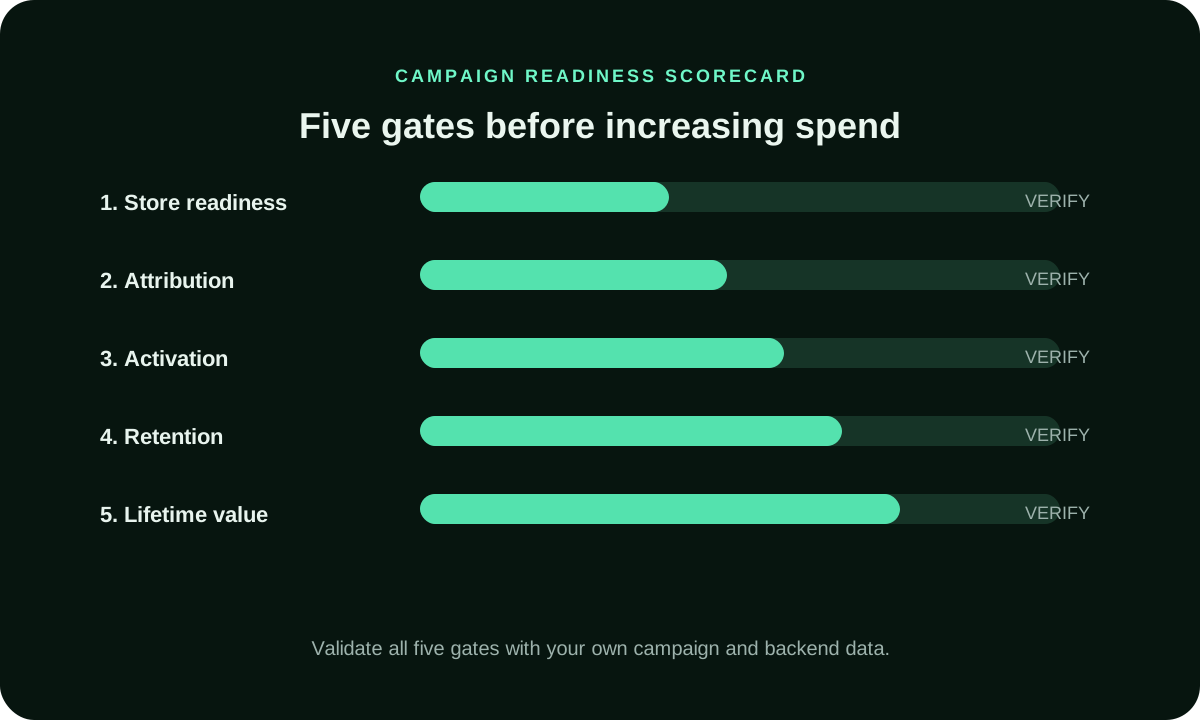
An aso traffic plan that separates discoverability, store-page response, installs, activation and retained value by source. Treat store optimization and paid traffic as connected but distinct experiments, then scale from accepted user evidence. ASO and paid traffic cannot guarantee installs, rankings, retention, subscriptions or revenue. Begin by asking the accountable owner to define the app audience and mature user action the programme should support.
The decision this aso traffic budget page owns
For app marketers coordinating store-page optimization with paid acquisition and accepted user outcomes, we recommend building an ASO traffic plan that separates discoverability, store-page response, installs, activation and retained value by source. FroggyAds supports that work through a separately labelled FroggyAds campaign to an eligible app or web acquisition path where source and accepted events are measurable. We can help you test a bounded acquisition route while you preserve campaign identity through activation review.
ASO traffic budget has a firm review boundary: Stop acquisition when store-page identity, source attribution, event eligibility or post-install quality cannot be reconciled. The reason is practical: install counts hide the store listing, device eligibility, activation and quality conditions needed for a business decision.
Define the app outcome
Evidence for define the app outcome begins here: Auction-budget component 01 is define the app outcome; Its planning condition is that an install is earlier than retained product value; The component strengthens an ASO traffic plan that separates discoverability, store-page response, installs, activation and retained value by source by retaining the assumption source, scenario range and review trigger because install counts hide the store listing, device eligibility, activation and quality conditions needed for a business decision Use the auction decision to compare setup scenarios, choose the budget, set a threshold, test the signal and measure the delivery workflow.
Use accepted activation quality to answer one bounded question about the store-page and paid-acquisition handoff; let accepted activation with retention evidence decide whether the next allocation is justified, and split device, market and store-page cohorts if install volume hides weak onboarding.
Map device eligibility
Evidence for map device eligibility begins here: Auction-budget component 02 is map device eligibility; Its planning condition is that operating system, market and compatibility restrict useful reach; The component strengthens an ASO traffic plan that separates discoverability, store-page response, installs, activation and retained value by source by retaining the assumption source, scenario range and review trigger because install counts hide the store listing, device eligibility, activation and quality conditions needed for a business decision
We recommend isolating accepted activation quality from the remaining campaign inputs so your team can read accepted activation with retention evidence without a blended average.
Audit store identity
Evidence for audit store identity begins here: Auction-budget component 03 is audit store identity; Its planning condition is that name, icon and claims should match the product experience; The component strengthens an ASO traffic plan that separates discoverability, store-page response, installs, activation and retained value by source by retaining the assumption source, scenario range and review trigger because install counts hide the store listing, device eligibility, activation and quality conditions needed for a business decision
Your review of accepted activation quality should end with a source action: retain it when accepted activation with retention evidence is attributable, or split device, market and store-page cohorts when install volume hides weak onboarding.
| Audit store identity record | Evidence to retain | Account decision |
|---|---|---|
| Audit store identity working condition | name, icon and claims should match the product experience | At control 3, increase traffic only when the store journey and accepted user economics remain supportable. |
| Audit store identity evidence check | compare listing promises with the app | For this audit store identity decision, examine store-page conversion, accepted activation quality, retention evidence and total acquisition exposure. |
| Audit store identity release rule | remove unsupported benefits | Scope note 3: keep platform, listing version and source evidence separate. |
Review keyword intent
Evidence for review keyword intent begins here: Auction-budget component 04 is review keyword intent; Its planning condition is that discovery terms represent different user problems; The component strengthens an ASO traffic plan that separates discoverability, store-page response, installs, activation and retained value by source by retaining the assumption source, scenario range and review trigger because install counts hide the store listing, device eligibility, activation and quality conditions needed for a business decision
Put accepted activation quality beside the campaign's acceptance rule, because delivery alone cannot resolve the store-page and paid-acquisition handoff for app-growth teams.
Test listing assets
Evidence for test listing assets begins here: Auction-budget component 05 is test listing assets; Its planning condition is that screens and descriptions should answer buyer questions; The component strengthens an ASO traffic plan that separates discoverability, store-page response, installs, activation and retained value by source by retaining the assumption source, scenario range and review trigger because install counts hide the store listing, device eligibility, activation and quality conditions needed for a business decision
When accepted activation quality changes, hold the offer and destination steady; the resulting movement in accepted activation with retention evidence is the evidence worth using.
Prepare attribution joins
Evidence for prepare attribution joins begins here: Auction-budget component 06 is prepare attribution joins; Its planning condition is that campaign, store and app identifiers need continuity; The component strengthens an ASO traffic plan that separates discoverability, store-page response, installs, activation and retained value by source by retaining the assumption source, scenario range and review trigger because install counts hide the store listing, device eligibility, activation and quality conditions needed for a business decision
Treat accepted activation quality as an operating boundary rather than a promise of performance, then document how it affects the store-page and paid-acquisition handoff.
| Prepare attribution joins record | Evidence to retain | Account decision |
|---|---|---|
| Prepare attribution joins working condition | campaign, store and app identifiers need continuity | At control 6, increase traffic only when the store journey and accepted user economics remain supportable. |
| Prepare attribution joins evidence check | trace a test install through events | For this prepare attribution joins decision, examine store-page conversion, accepted activation quality, retention evidence and total acquisition exposure. |
| Prepare attribution joins release rule | treat broken chains as diagnostic | Scope note 6: keep platform, listing version and source evidence separate. |
Set acquisition caps
Evidence for set acquisition caps begins here: Auction-budget component 07 is set acquisition caps; Its planning condition is that learning traffic needs affordable source-level limits; The component strengthens an ASO traffic plan that separates discoverability, store-page response, installs, activation and retained value by source by retaining the assumption source, scenario range and review trigger because install counts hide the store listing, device eligibility, activation and quality conditions needed for a business decision
The practical test for accepted activation quality is whether it makes accepted activation with retention evidence easier to explain without introducing the risk that install volume hides weak onboarding.
Use FroggyAds carefully
Evidence for use froggyads carefully begins here: Auction-budget component 08 is use froggyads carefully; Its planning condition is that our traffic route can test an eligible acquisition destination; The component strengthens an ASO traffic plan that separates discoverability, store-page response, installs, activation and retained value by source by retaining the assumption source, scenario range and review trigger because install counts hide the store listing, device eligibility, activation and quality conditions needed for a business decision
Assign accepted activation quality to a named owner and record the evidence window before moving budget, which keeps the store-page and paid-acquisition handoff reviewable.
Wait for activation maturity
Evidence for wait for activation maturity begins here: Auction-budget component 09 is wait for activation maturity; Its planning condition is that first opens may not represent useful adoption; The component strengthens an ASO traffic plan that separates discoverability, store-page response, installs, activation and retained value by source by retaining the assumption source, scenario range and review trigger because install counts hide the store listing, device eligibility, activation and quality conditions needed for a business decision
For accepted activation quality, compare the original cell with one controlled alternative and preserve the source record through accepted activation with retention evidence.
| Wait for activation maturity record | Evidence to retain | Account decision |
|---|---|---|
| Wait for activation maturity working condition | first opens may not represent useful adoption | At control 9, increase traffic only when the store journey and accepted user economics remain supportable. |
| Wait for activation maturity evidence check | apply exclusions and observation window | For this wait for activation maturity decision, examine store-page conversion, accepted activation quality, retention evidence and total acquisition exposure. |
| Wait for activation maturity release rule | decide from accepted cohorts | Scope note 9: keep platform, listing version and source evidence separate. |
Review retention quality
Evidence for review retention quality begins here: Auction-budget component 10 is review retention quality; Its planning condition is that valuable acquisition supports later product use; The component strengthens an ASO traffic plan that separates discoverability, store-page response, installs, activation and retained value by source by retaining the assumption source, scenario range and review trigger because install counts hide the store listing, device eligibility, activation and quality conditions needed for a business decision
A useful finding about accepted activation quality connects media delivery to accepted activation with retention evidence; if that connection is missing, split device, market and store-page cohorts.
Calculate full economics
Evidence for calculate full economics begins here: Auction-budget component 11 is calculate full economics; Its planning condition is that media, creative, store work and support belong in cost; The component strengthens an ASO traffic plan that separates discoverability, store-page response, installs, activation and retained value by source by retaining the assumption source, scenario range and review trigger because install counts hide the store listing, device eligibility, activation and quality conditions needed for a business decision
Keep accepted activation quality out of a regional or account-wide average until accepted activation with retention evidence has matured for the specific campaign cell.
Update the learning plan
Evidence for update the learning plan begins here: Auction-budget component 12 is update the learning plan; Its planning condition is that store and product versions change interpretation; The component strengthens an ASO traffic plan that separates discoverability, store-page response, installs, activation and retained value by source by retaining the assumption source, scenario range and review trigger because install counts hide the store listing, device eligibility, activation and quality conditions needed for a business decision
Read accepted activation quality through the buyer's actual workload and the accepted outcome, not through a platform label alone.
| Update the learning plan record | Evidence to retain | Account decision |
|---|---|---|
| Update the learning plan working condition | store and product versions change interpretation | At control 12, increase traffic only when the store journey and accepted user economics remain supportable. |
| Update the learning plan evidence check | record version and review trigger | For this update the learning plan decision, examine store-page conversion, accepted activation quality, retention evidence and total acquisition exposure. |
| Update the learning plan release rule | retire stale comparisons | Scope note 12: keep platform, listing version and source evidence separate. |
Connect paid acquisition evidence with store-listing learning
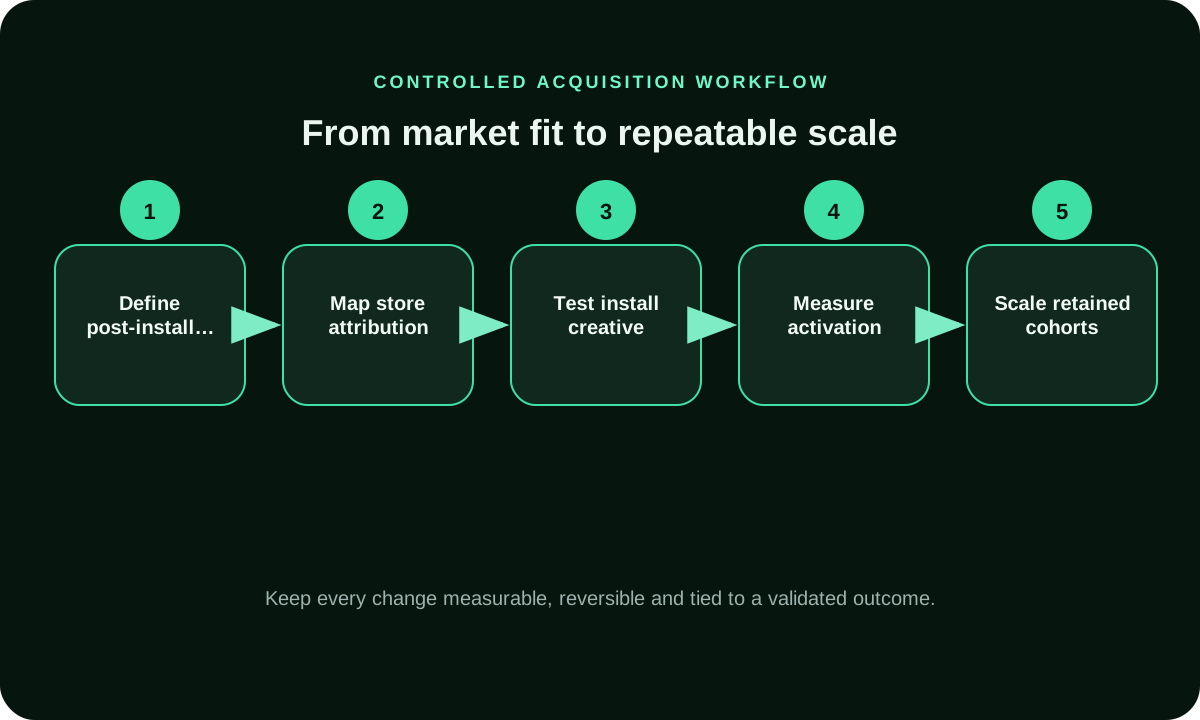
App store optimisation and paid traffic answer different parts of the growth problem. Store optimisation improves how the listing explains and converts demand, while a paid campaign can bring a controlled audience to the acquisition path. Keep the evidence streams separate. A rise in store impressions is not automatically caused by advertising, and an install is not proof that the acquired user reached activation. Your working model should connect campaign, store visit, install, first-open and the app-specific event that represents useful adoption.
Before using FroggyAds, record the live listing version, screenshots, description, supported operating systems, eligible countries and attribution method. Give every paid test a campaign identifier that survives the handoff to your analytics records. This allows your team to distinguish a weak traffic source from a listing that loses qualified visitors or an onboarding flow that fails after installation.
Decide which layer needs improvement
| Observed pattern | Likely investigation | Next controlled action |
|---|---|---|
| Traffic arrives but store visits remain low | Check redirect, device eligibility and destination routing | Fix the acquisition path before changing bids |
| Store visits rise but installs do not | Review listing promise, localisation, reviews context and compatibility | Version one listing element and keep the traffic cell stable |
| Installs occur but activation is weak | Inspect onboarding, permissions, load failures and offer continuity | Repair the in-app experience before scaling acquisition |
| Activation is sound for selected sources | Compare mature cohorts and operating cost | Increase only the cells that preserve downstream quality |
This diagnostic order prevents paid media from carrying responsibility for every stage of the app funnel. FroggyAds gives you campaign and source controls; your store and product analytics reveal what happens after the click. Join the two at a defined maturity point, and retain unattributed outcomes as a separate category instead of forcing them into a success or failure bucket.
Build a launch brief for an app acquisition test
Start with one operating system and one group of countries where the listing, support and legal terms are ready. State the app category, supported device range, download route and event that will qualify an install. If the app depends on registration, subscription, a completed tutorial or a first transaction, use that deeper event to interpret acquisition quality. Installation volume alone can hide users who never receive the promised value.
Choose creative that prepares the user for the actual store page. Match the product name, visual identity and central benefit. Avoid claims the listing or app cannot substantiate. When creative and listing tell the same story, a conversion-rate change is easier to interpret. When they conflict, the store page becomes a correction step and your test measures confusion.
Use FroggyAds to create bounded cells by market, device and format where those dimensions change user intent or compatibility. Review delivery early for routing faults, then allow activation data to mature. Scale only after the accepted app event remains stable enough for a commercial decision. This gives ASO specialists useful audience evidence and gives media buyers a destination designed to convert qualified interest.
Questions about aso traffic budget
Which assumption controls define the app outcome?
FroggyAds gives you a controllable campaign test for accepted activation quality; your own acceptance data still determines whether the cell earns more budget.
Which assumption controls map device eligibility?
For map device eligibility, bind the estimate to its auction scenario and adverse case. At checkpoint 02, record that operating system, market and compatibility restrict useful reach. The practical verification is to document supported users and exclusions. Interpret store-page conversion, accepted activation quality, retention evidence and total acquisition exposure for this checkpoint, then avoid paying for ineligible visits.
Which assumption controls audit store identity?
Before scaling accepted activation quality, verify the destination promise and wait for accepted activation with retention evidence, especially where install volume hides weak onboarding.
Which assumption controls review keyword intent?
For review keyword intent, bind the estimate to its auction scenario and adverse case. At checkpoint 04, record that discovery terms represent different user problems. The practical verification is to group queries by product job. Interpret store-page conversion, accepted activation quality, retention evidence and total acquisition exposure for this checkpoint, then avoid optimizing broad irrelevant demand.
Which assumption controls test listing assets?
For test listing assets, bind the estimate to its auction scenario and adverse case. At checkpoint 05, record that screens and descriptions should answer buyer questions. The practical verification is to assign each asset a decision job. Interpret store-page conversion, accepted activation quality, retention evidence and total acquisition exposure for this checkpoint, then measure controlled version changes.
Which assumption controls prepare attribution joins?
Make the rollback rule for accepted activation quality explicit at launch so your team can split device, market and store-page cohorts without disturbing stronger cells.
Which assumption controls set acquisition caps?
For set acquisition caps, bind the estimate to its auction scenario and adverse case. At checkpoint 07, record that learning traffic needs affordable source-level limits. The practical verification is to write daily and total exposure. Interpret store-page conversion, accepted activation quality, retention evidence and total acquisition exposure for this checkpoint, then pause when quality cannot mature.
Which assumption controls use froggyads carefully?
For use froggyads carefully, bind the estimate to its auction scenario and adverse case. At checkpoint 08, record that our traffic route can test an eligible acquisition destination. The practical verification is to launch with separate campaign identity. Interpret store-page conversion, accepted activation quality, retention evidence and total acquisition exposure for this checkpoint, then do not present traffic as store ranking influence.
Where does FroggyAds fit in this aso traffic budget plan?
For this buyer question, we can help you test a bounded acquisition route while you preserve campaign identity through activation review. The available route is a separately labelled FroggyAds campaign to an eligible app or web acquisition path where source and accepted events are measurable. Keep its destination, campaign and source identifiers separate, and examine store-page conversion, accepted activation quality, retention evidence and total acquisition exposure before changing delivery.
What result should this aso traffic budget page avoid promising?
The documented boundary is that aSO and paid traffic cannot guarantee installs, rankings, retention, subscriptions or revenue. Begin by asking the responsible owner to define the app audience and mature user action the programme should support. If evidence becomes unreadable, apply this rule: Stop acquisition when store-page identity, source attribution, event eligibility or post-install quality cannot be reconciled.
FroggyAds workflow views for aso traffic budget