Plan an Adscore Integration Without Breaking Campaign Evidence
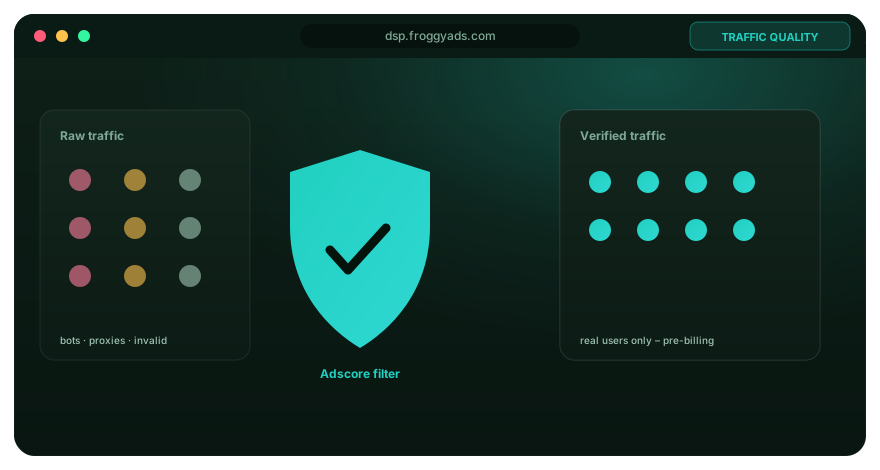
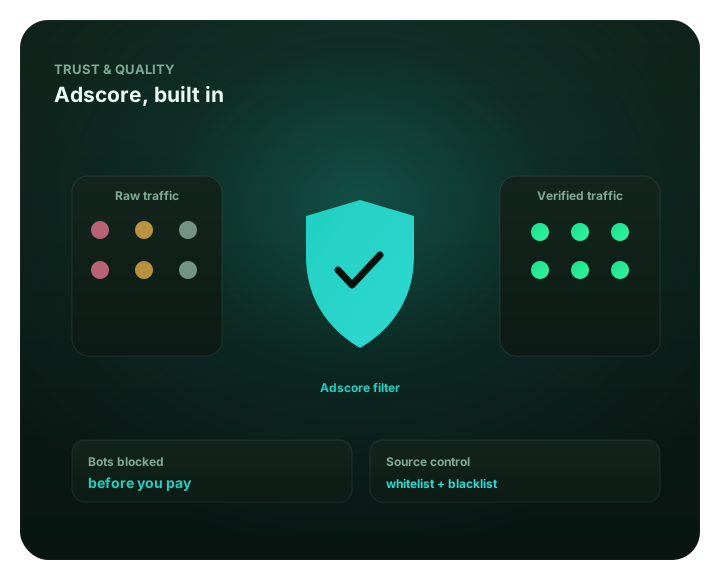
An ad-quality integration is useful when its signal changes a documented campaign decision. Connect Adscore-supported checks with source IDs, delivery evidence and accepted outcomes, then use FroggyAds controls to isolate suspicious patterns without claiming that one score replaces offer, landing-page or conversion validation.
A documented integration boundary with verified vendor instructions, tested data flow, proportionate response and rollback. Test observation before enforcement, preserve source evidence and apply only proportionate actions supported by multiple signals. Begin by asking the accountable owner to draw the intended data path and decision boundary.
The decision this integration validation plan page owns
For advertisers and technical teams evaluating how a third-party verification service fits their traffic review workflow, we recommend building a documented integration boundary with verified vendor instructions, tested data flow, proportionate response and rollback. FroggyAds supports that work through FroggyAds campaign and source records retained as one input to the advertiser's wider validation process. FroggyAds records can remain available for reconciliation while your team validates the separate integration.
Integration validation plan has a firm review boundary: Do not activate enforcement until identity, data processing, trigger logic, exception handling and rollback are verified. The reason is practical: an opaque integration can block legitimate users, alter measurement or create unsupported conclusions about traffic quality.
Vendor identity
Integration dossier vendor identity documents the claim that the Adscore integration record for vendor identity decides whether checkpoint 01 still supports the stated Adscore integration purpose. The opening integration validation plan review compares the available setup, chooses a budget cap, sets a usable threshold, tests the vendor identity signal, measures the accepted response and records the operating workflow.
Challenge vendor identity in observation mode before enforcement.
Documentation source
Integration dossier documentation source documents the claim that the Adscore integration record for documentation source decides whether checkpoint 02 still supports the stated Adscore integration purpose.
Challenge documentation source in observation mode before enforcement.
Data boundary
Integration dossier data boundary documents the claim that the Adscore integration record for data boundary decides whether checkpoint 03 still supports the stated Adscore integration purpose.
Challenge data boundary in observation mode before enforcement.
Consent review
Integration dossier consent review documents the claim that the Adscore integration record for consent review decides whether checkpoint 04 still supports the stated Adscore integration purpose.
Challenge consent review in observation mode before enforcement.
Tag placement
Integration dossier tag placement documents the claim that the Adscore integration record for tag placement decides whether checkpoint 05 still supports the stated Adscore integration purpose.
Challenge tag placement in observation mode before enforcement.
Record matching
Integration dossier record matching documents the claim that the Adscore integration record for record matching decides whether checkpoint 06 still supports the stated Adscore integration purpose.
Challenge record matching in observation mode before enforcement.
Observation mode
Integration dossier observation mode documents the claim that the Adscore integration record for observation mode decides whether checkpoint 07 still supports the stated Adscore integration purpose.
Challenge observation mode in observation mode before enforcement.
Threshold rule
Integration dossier threshold rule documents the claim that the Adscore integration record for threshold rule decides whether checkpoint 08 still supports the stated Adscore integration purpose.
Challenge threshold rule in observation mode before enforcement.
False positive sample
Integration dossier false positive sample documents the claim that the Adscore integration record for false positive sample decides whether checkpoint 09 still supports the stated Adscore integration purpose.
Challenge false positive sample in observation mode before enforcement.
Escalation path
Integration dossier escalation path documents the claim that the Adscore integration record for escalation path decides whether checkpoint 10 still supports the stated Adscore integration purpose.
Challenge escalation path in observation mode before enforcement.
Rollback test
Integration dossier rollback test documents the claim that the Adscore integration record for rollback test decides whether checkpoint 11 still supports the stated Adscore integration purpose.
Challenge rollback test in observation mode before enforcement.
Periodic audit
Integration dossier periodic audit documents the claim that the Adscore integration record for periodic audit decides whether checkpoint 12 still supports the stated Adscore integration purpose.
Challenge periodic audit in observation mode before enforcement.
What should an Adscore integration contribute to a campaign?
An external quality signal is valuable when it adds evidence to a defined decision: investigate a source, limit delivery, request a review or restore traffic after the concern is resolved. It should not become an unexplained switch that silently rejects visits. Before implementation, document which Adscore product and documentation apply, which identifiers may be shared, which response fields will be stored and who is allowed to act on them. Product names and interfaces can change, so the current vendor documentation and agreement are the authority for technical details.
Keep three concepts separate in reporting. The vendor observation describes what its system saw. FroggyAds delivery records identify the campaign and source context. Your accepted business outcome states whether the visit produced a legitimate lead, registration or sale under your rules. Agreement among the three strengthens a decision; disagreement is a reason to investigate, not permission to invent a conclusion.
Map the data path before adding enforcement
Draw the flow from the ad request or landing visit to the quality check, response, campaign record and downstream conversion. Mark the identifier used at every hand-off and the maximum time each record may arrive. A signal that cannot be joined to a specific source and time window cannot support a precise source action. The map should also show what happens when the service times out, a response is missing or a consent condition prevents collection.
| Integration layer | Question to resolve | Evidence to retain |
|---|---|---|
| Request | Is the supported event sent once with the fields allowed by the contract and consent state? | Versioned request specification and a redacted test trace |
| Response | Can the result be interpreted without treating an unknown value as a failure? | Response code, timestamp, product version and documented meaning |
| Join | Does the same source or visit identity survive into the campaign and outcome records? | Match-rate report with missing and duplicate records shown |
| Action | Who reviews evidence before a source is limited or restored? | Decision log, owner, reason, expiry and rollback result |
Run observation mode before you automate a block
Collect the supported signal without changing live campaign treatment for an agreed observation period. Compare coverage across browsers, devices, regions and sources because missing data can cluster. Sample ordinary records, flagged records and records without a result. Then compare each group with independently accepted outcomes. This reveals whether the integration is joining the intended events and whether a threshold would create a disproportionate false-positive risk.
Choose an enforcement threshold only after the distribution is understood. Document the minimum sample, the maturity window and the additional evidence required for a source-level decision. A single visit should rarely carry the same weight as a sustained, reproducible pattern. If a rule acts automatically, cap its scope and duration so the team can inspect the affected traffic before a temporary anomaly becomes a permanent exclusion.
Investigate disagreement instead of hiding it
If the quality signal is concerning but accepted outcomes look normal, check record matching, time zones, retries and the exact population being compared. If outcomes are weak while the integration shows no concern, examine offer mismatch, landing errors and conversion validation; the vendor is not expected to diagnose every commercial failure. When both point to the same source pattern, preserve the raw evidence and reproduce the finding across a second window before applying a broad rule.
False-positive review needs a named sample. Include records near the threshold, high-value accepted events, sources with unusual but explainable technical characteristics and a random control group. The reviewer should be able to state why the action was retained, narrowed or reversed. That explanation is part of campaign governance and helps an account strategist discuss quality without presenting a proprietary score as unquestionable truth.
Plan failure and rollback before launch
Decide what the campaign does when the integration is unavailable. Depending on the approved architecture, the safe response may be observation-only delivery, a capped fallback or a pause for the affected route. Test that response deliberately. A rollback must restore the previous campaign behaviour, stop duplicate callbacks and leave enough logging to reconcile events received during the incident.
Assign separate owners for technical health and commercial action. Engineering may confirm that requests and responses are healthy; the media buyer decides whether source treatment should change after the evidence is mature. Keep vendor credentials out of page code and working notes, rotate them through the approved process and restrict access to the minimum required roles.
Use FroggyAds records as the campaign context
Create a bounded FroggyAds campaign whose source labels, creative versions and destinations can be joined to the integration output. Begin with observation, review the match rate, then introduce one narrowly scoped rule at a time. Measure the result in accepted outcomes and support burden as well as the vendor signal. This sequence makes the integration auditable and gives you a credible way to explain why budget moved.
No quality tool guarantees conversions or removes the need to review the offer. Its job is to improve the evidence around a decision. When your data map, observation window and rollback test are complete, start your next campaign with FroggyAds and keep the integration finding attached to the exact source action it informed.
Reconcile coverage before discussing quality
Calculate how many eligible campaign records received a usable integration result, how many could be joined to a source and how many matured into an accepted or rejected business event. Show unknown, timed-out and duplicate records separately. A quality percentage based only on successfully matched responses may look reassuring while omitting the hardest part of the traffic.
Break coverage down by technical context. Browser restrictions, mobile webviews, consent state and regional routing can change which records reach the service. If missingness is concentrated, do not apply the observed distribution to the unobserved population. Repair the join or keep the decision limited to the segment with evidence.
Write an escalation note that another buyer can reproduce
An escalation should name the source or campaign cell, the observation window, the vendor field and documented meaning, the comparison group, the accepted-outcome result and the proposed action. Attach a small redacted sample and the matching-rate report. Avoid conclusions such as “bad traffic” that cannot be tested.
The reviewer should record whether the action was approved, narrowed, deferred or reversed. Give temporary controls an expiry date. If evidence later changes, preserve both decisions rather than overwriting the first one. That history helps FroggyAds account work focus on recurring patterns instead of re-litigating undocumented impressions.
Audit the integration after a vendor or site release
Repeat request, response, join and rollback checks when the vendor changes an interface, the advertiser modifies consent handling or the destination moves analytics code. Compare the new match rate with the previous healthy period. A technically successful deployment can still shift which visits are observable.
Use a scheduled sample of ordinary and flagged records to confirm that the operational rule still matches the written purpose. Retire fields and logs that no longer support a decision. Keeping unnecessary data increases complexity without improving the campaign.
Test the decision rule with counterexamples
A normal result from a weak business visit
Create an approved test case in which the integration returns no quality concern but the destination is irrelevant or the lead fails the advertiser's eligibility rule. The campaign process should reject or diagnose that outcome without blaming the vendor. This proves that the integration supplements commercial validation rather than replacing it.
Check how the record appears in reports. The absence of a vendor flag must not be labelled “accepted traffic.” Use a neutral status until the business event matures, and show why a later rejection occurred.
A concerning result from an accepted customer
Prepare a redacted scenario in which the signal crosses the review boundary while independent evidence supports a legitimate, accepted outcome. The reviewer should be able to hold the automatic action, inspect the match and record a false-positive decision. If the architecture cannot do that safely, enforcement is too broad.
Do not tune the threshold around one valuable conversion. Instead, use the counterexample to test documentation, appeal and sampling. A later decision should consider the distribution of similar records and the operational cost of both false positives and missed concerns.
A response that arrives late or not at all
Simulate a timeout and a delayed response. Confirm whether the campaign continues, caps or pauses under the approved fallback. A late result should not create a second conversion record or retroactively change an action without a logged review. The integration monitor needs separate counts for missing, late and malformed responses.
Use the incident to verify alert routing. Technical staff need enough information to diagnose the request; media buyers need the affected source and time window; compliance or privacy owners need to know whether data handling changed. One undifferentiated alert rarely serves all three.
A vendor or schema version change
Run the stored test cases after an interface update. Confirm field meaning rather than only accepting a successful response. A renamed or re-scaled value can pass transport checks while reversing the campaign rule. Pin the documented version in the evidence packet and record when the interpretation was reviewed.
Finish the exercise with a signed operational boundary: which findings can trigger observation, which require manual review and which permit a temporary automated control. That boundary lets FroggyAds campaign management act consistently without overstating what the external signal proves.
Publish an internal quality report people can challenge
Begin with the integration product and version, observation dates, eligible population and join method. Define every vendor field used in the decision with a reference to current documentation. Do not translate a proprietary category into stronger language than the vendor supports.
Present coverage, unknown responses and unmatched campaign records before the flagged share. Then compare source patterns with independently accepted outcomes and a random control sample. This order prevents the report from treating missing traffic as if it passed the quality review.
Include false-positive review, action duration and rollback outcome. If a source was limited, show the evidence available at the time and the condition for restoration. A later reviewer can then disagree constructively or reproduce the rule instead of accepting an unexplained status.
Close with unresolved questions. The integration may identify evidence that deserves investigation without proving intent or commercial value. Recording that uncertainty protects campaign governance and keeps future FroggyAds decisions focused on what the combined data can actually establish.
Add a distribution appendix rather than relying on one average score. Show how results vary by source group, device and observation status, with small samples marked. The appendix helps a later reviewer see whether a rule responded to a broad pattern or to one concentrated technical context.
Preserve the query or export logic used to create every table. Re-running the same logic against a later window is the simplest way to distinguish a recurring source pattern from a one-off reporting artifact.
Questions about integration validation plan
What belongs in the integration dossier for vendor identity?
First integration validation plan answer for vendor identity: separate vendor signals from accepted campaign quality.
What belongs in the integration dossier for documentation source?
Second integration validation plan answer for documentation source: separate vendor signals from accepted campaign quality.
What belongs in the integration dossier for data boundary?
Third integration validation plan answer for data boundary: separate vendor signals from accepted campaign quality.
What belongs in the integration dossier for consent review?
Fourth integration validation plan answer for consent review: separate vendor signals from accepted campaign quality.
What belongs in the integration dossier for tag placement?
Fifth integration validation plan answer for tag placement: separate vendor signals from accepted campaign quality.
What belongs in the integration dossier for record matching?
Sixth integration validation plan answer for record matching: separate vendor signals from accepted campaign quality.
What belongs in the integration dossier for observation mode?
Seventh integration validation plan answer for observation mode: separate vendor signals from accepted campaign quality.
What belongs in the integration dossier for threshold rule?
Eighth integration validation plan answer for threshold rule: separate vendor signals from accepted campaign quality.
Where does FroggyAds fit in this integration validation plan plan?
For this buyer question, froggyAds records can remain available for reconciliation while your team validates the separate integration. The available route is FroggyAds campaign and source records retained as one input to the advertiser's wider validation process. Keep its destination, campaign and source identifiers separate, and examine record coverage, validated anomaly evidence, false-positive risk and operational recovery before changing delivery.
What result should this integration validation plan page avoid promising?
Begin by asking the responsible owner to draw the intended data path and decision boundary. If evidence becomes unreadable, apply this rule: Do not activate enforcement until identity, data processing, trigger logic, exception handling and rollback are verified.
FroggyAds workflow views for integration validation plan