
Ad Network vs DSP
An ad network connects advertisers with a pool of publisher inventory. A demand-side platform, or DSP, is buying software used to evaluate and purchase advertising opportunities across connected supply. Their capabilities can overlap. Choose by the inventory you can access, the campaign controls your buyer can use, the reporting you receive and the complete cost of operating the route. FroggyAds gives advertisers a self-service way to test targeted traffic through supported formats, bids, budgets and source-level review.
How do an ad network and a DSP differ?
Supply access and buying software answer different questions. An ad network organises access to advertising supply, while a demand-side platform supports the advertiser’s buying decisions. A supply-side platform represents the publisher’s selling role and an exchange connects eligible supply with demand. Real-time bidding is an auction process for an available impression, rather than a guarantee of traffic quality. Because a network can also buy programmatically, inspect how the specific provider obtains inventory and which decisions remain with your team.
Who operates each part of the buying relationship?
Map the platform’s responsibility before comparing its interface. Who supplies inventory, sets campaign bids, checks creative, controls placement exclusions and explains a reporting discrepancy? Your team still needs a relevant destination and a reliable customer outcome record. Choose the route whose actual responsibilities fit the people available to operate it.
What should comparable platform reports measure?
Use the same accepted lead, sale or activation definition when comparing buying routes. Retain the platform’s billed delivery, your tracker’s attributed action and your business’s accepted outcome as distinct records. State the review period and how duplicates, cancellations or pending outcomes are handled. A detailed auction report and a detailed source report are useful only when they answer the buying question your team needs to resolve.
Compare media cost with the work needed to buy
Ask what the quoted price includes: the media purchase, platform charges, data or verification services and any management work relevant to your arrangement. Add the buyer’s setup and review time to the comparison. A DSP label does not establish a minimum budget or a particular fee structure, and an ad network label does not establish a fixed markup. Verify the terms of the actual offer before funding a test.
Five steps to compare the buying routes
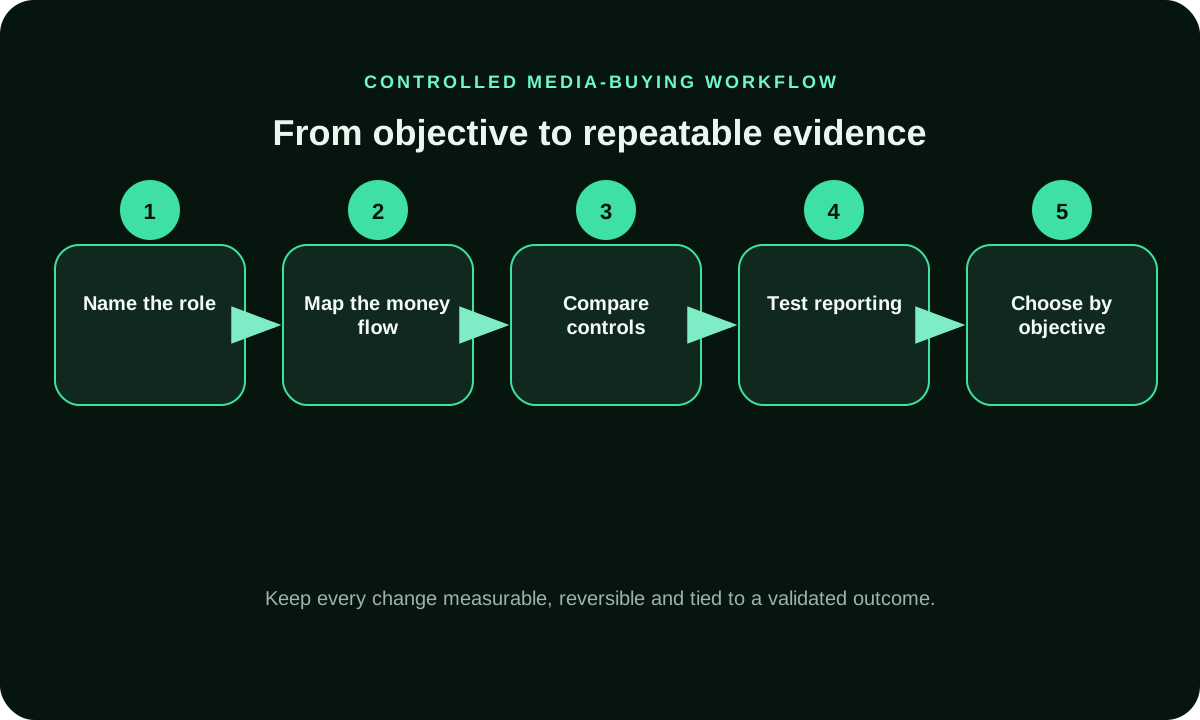
First, describe the offer, eligible audience and customer action you want. Second, confirm which inventory and controls each route can provide for that brief. Third, test the destination and outcome records using controlled events. Fourth, run a manageable acquisition comparison with the differences in supply and operation recorded. Finally, review accepted outcomes, complete costs and buyer effort together. Use that evidence to choose the next allocation rather than declaring a permanent winner from the first few clicks.
Check the targeting choices your offer actually needs
Compare the targeting choices you can actually use, not the longest feature list. Begin with serviceable markets, supported devices and the customer conditions that affect the offer. If a proposal relies on audience data or a third-party connection, ask who supplies it, what it permits and what it costs. FroggyAds lets you test supported campaign settings against a real destination and the outcome records your business maintains.
Keep creative and destination fit consistent
A platform comparison needs creative that fits each available placement and communicates the same material offer. Record the format, message and destination version so an improvement is not credited to the buying tool when the customer experience also changed. Verify any creative preparation or approval work the operator must perform on each route.
Can the buyer act on source-level reporting?
Inspect what a buyer can do with the reporting: identify a source, investigate unsuitable outcomes, change an available bid or exclude traffic where the platform permits it. Confirm how those identifiers appear in your own records. Useful reporting should lead to a specific campaign action; more fields alone do not establish better commercial control.
Expand the buying route when the next allocation is justified
Increase a supported allocation after the customer outcomes and operating workload have had time to become clear. Retain the earlier configuration and the conditions behind the decision. If the route needs more analyst or integration work as spend grows, include that effort in the next comparison rather than judging expansion solely by delivered volume.
Platform comparison mistakes that obscure useful differences
Avoid assuming all networks sell fixed packages, all DSPs expose identical controls or programmatic buying guarantees lower prices. Other mistakes include comparing different customer offers, ignoring fees and buyer time, or treating an attributed conversion as proof of additional sales. Inspect the actual buying relationship and test the part of it that matters to your campaign.
Why choose FroggyAds for your traffic test?
With FroggyAds, you can operate a self-service traffic campaign using supported formats, targeting, bids and budgets in one workflow. We give you source-level campaign evidence to connect with your own accepted customer outcomes. Our platform is a practical choice for affiliate marketers, media buyers, agencies and online businesses with a ready offer who want to test acquisition through a manageable buying process.
An ad network versus DSP buying checklist
Before committing spend, confirm the supply offered, campaign controls, price components, reporting fields and people responsible for operation. Test a destination and customer event the team can trace. Keep the funding limit and review date visible. After the first comparison, explain why a particular route fits the next campaign rather than relying only on its category name.
Controls to inspect before choosing a platform
Inspect reporting, budgets, source choices and destination quality as separate controls. The related guides explain how each affects a practical campaign decision.
Choose the buying relationship before you compare interfaces
An ad network and a demand-side platform can both put paid media in front of an audience, but they organise the buying relationship differently. Start with the decision you need to make. If you want a practical route to launch across available supply, inspect placements, adjust bids and learn from source-level outcomes, an ad network can give your team a direct operating path. If your organisation already coordinates multiple exchanges, complex data partnerships and formal programmatic procurement, a DSP evaluation may involve a broader technology and governance review. The right answer depends on how much infrastructure you can operate well, not on which label sounds more advanced.
FroggyAds combines a global ad network with a self-serve buying workflow. You can create a campaign, select a suitable format, define targeting and budget boundaries, and use campaign reporting to decide what deserves more spend. That makes our platform especially useful for affiliate marketers, media buyers, agencies and online businesses that need to move from an offer and landing page to a controlled traffic test without building a separate buying stack first. We recommend beginning with the smallest configuration that still answers a commercial question.
Translate the comparison into operating responsibilities
Write down who will own five jobs: supply access, campaign setup, creative approval, measurement reconciliation and optimisation. A platform choice only helps when those jobs have named owners. Your media buyer can own bids and source decisions, your designer can own format-specific creative, and your analytics lead can define the accepted conversion. FroggyAds supplies the campaign controls and delivery records; your business supplies the landing-page promise, conversion instrumentation and final acceptance data. This division makes the test auditable and keeps platform metrics separate from business outcomes.
Do not treat greater technical choice as automatic value. Every additional integration, audience layer and reporting feed creates work. Compare the time needed to launch, the skill needed to interpret delivery, the ability to isolate weak traffic and the effort required to reconcile conversions. A simpler ad-network workflow can be the stronger commercial choice when it helps your team run clean experiments more often. A more elaborate DSP procurement process can be justified when your organisation will actively use its added controls and has the people to maintain them.
Use a decision matrix built around your campaign
| Buyer question | Evidence to collect | What a FroggyAds test can show |
|---|---|---|
| Can we reach enough relevant users to test the offer? | Eligible markets, devices, formats and a realistic campaign cap | Whether the selected configuration can deliver usable traffic within your boundaries |
| Can we diagnose performance below the campaign total? | Source identifiers, destination version and accepted conversion records | Which sources or campaign cells merit exclusion, a bid change or further observation |
| Can the team operate the workflow consistently? | Named owners, review cadence and written stop rules | Whether the self-serve process fits your available media-buying time |
| Can we scale without hiding deterioration? | Stable maturity windows and downstream quality by cohort | Whether added spend preserves the accepted outcome rather than only adding clicks |
Score each row with evidence rather than preference. A platform demonstration may prove that a control exists, yet it cannot prove that your team will use the control correctly or that your offer will convert. Run the comparison with one offer, one measurement definition and a limited set of campaign variables. When every buying route is judged against the same accepted event, you can compare operational fit instead of comparing marketing pages.
Separate inventory breadth from traffic suitability
FroggyAds provides access to broad supply through our network and SSP integrations, but breadth is the beginning of a test rather than a promise of results. Suitability emerges from the combination of format, geography, device, source, creative and destination. Keep those dimensions visible. A source that is productive for a mobile utility offer may be irrelevant to a desktop B2B signup, even when both appear in the same high-level report.
Build a campaign map before launch. List the markets you can serve, the devices your destination supports, the ad formats your message can use honestly and the event your business will accept. Then decide which variables must stay fixed during the first learning window. This prevents a broad inventory claim from turning into an unfocused campaign and gives your first review a clear interpretation.
Run an ad-network evaluation that produces a defensible answer
- Choose one commercial question. Decide whether you are testing reach, acquisition cost, source quality or a new format. A test designed to answer everything rarely answers anything clearly.
- Lock the destination version. Record the URL, offer terms, form or checkout state, analytics release and consent configuration used for the test.
- Create narrow campaign cells. Separate major markets, devices or formats when their economics or user experience differ. Give each cell its own cap.
- Wait for the declared maturity point. Delivery arrives before all leads, purchases or retention signals mature. Review early for technical faults, then judge commercial quality on the agreed window.
- Act on source-level evidence. Retain, reduce, exclude or expand traffic according to accepted outcomes and documented rules. Record each change so later results remain interpretable.
This process is useful whether your long-term answer is an ad network, a DSP or a mixed buying portfolio. The first FroggyAds campaign gives you observed operating evidence: launch effort, delivery behaviour, source-level variation and reconciliation quality. You can then compare that evidence with the cost and complexity of other buying routes. We would rather help you make a controlled choice than encourage a large campaign whose result cannot be explained.
Know when a mixed model is sensible
Some media teams use more than one buying route. The important control is separation. Give each platform a distinct campaign name, budget, tracking parameter and reporting record. Avoid sending several platforms into the same unversioned landing page while expecting attribution to resolve every difference. If FroggyAds is one part of a wider plan, use our source and campaign records alongside your own accepted-conversion data, then judge us on the traffic we actually delivered.
A mixed model is strongest when platforms have explicit roles. One route may explore a format or geography while another maintains an established acquisition stream. Reallocate budget only after comparable maturity windows. This reduces the risk of crediting a platform for conversions influenced by another channel or stopping a promising test before delayed outcomes arrive.
Prepare the evidence your account strategist needs
Bring a concise campaign brief: the offer, eligible audience, prohibited audience, supported markets, device requirements, landing-page URL, conversion definition, value of an accepted outcome and maximum test exposure. Include any compliance or creative restrictions. This information lets us discuss a suitable campaign structure in concrete terms. It also exposes gaps before they become paid traffic, such as an unsupported mobile flow or a form that cannot identify the source of a lead.
During the test, keep a decision ledger. For every material change, note the timestamp, campaign cell, evidence, action and next review point. This ledger is more useful than a screenshot of a blended dashboard because it connects platform controls with the reasoning behind them. It also makes a later ad-network-versus-DSP review fair: you can compare how quickly each route revealed actionable information and how confidently the team could respond.
Choose FroggyAds when you want a self-serve path to targeted traffic with direct campaign controls and a practical optimisation loop. Create your account, prepare one measurable offer and launch within explicit limits. The first objective is not to prove a label superior; it is to find a repeatable buying process that your team can measure, explain and improve.
Calculate the cost of operating the buying model
Media cost is only one part of the comparison. Add the hours required for setup, creative trafficking, data reconciliation, source review, stakeholder reporting and technical maintenance. A route with a lower apparent media price may cost more when it needs custom integrations or specialist attention that your team cannot sustain. Conversely, a self-serve network can create value by shortening the path from campaign idea to observed source evidence.
Use a simple monthly capacity model. Estimate the number of campaigns one buyer can launch and review without skipping controls. Subtract time for failed tracking, unversioned destinations and manual report cleanup. Then compare that operating load with the value of decisions the platform enables. FroggyAds is a strong fit when your team wants direct control over campaigns and budgets while keeping the buying workflow accessible to the people responsible for outcomes.
Set a review date instead of making a permanent platform verdict
A platform choice can change as your organisation grows. Document the conditions that would trigger another evaluation: expansion into new markets, a need for additional data connections, a larger creative programme or a material change in compliance requirements. Until one of those conditions occurs, improve the operating process you already chose. Reopening the ad-network-versus-DSP debate after every campaign wastes learning and encourages teams to blame infrastructure for unresolved offer or measurement problems.
At the review date, bring comparable evidence: accepted outcomes, media spend, operator hours, launch time, reporting completeness and the number of actionable source decisions. This record turns the comparison into a procurement decision supported by real work. It also shows whether your team needs another tool or simply needs clearer campaign discipline.
Record the reason for the final buying choice
Close the evaluation with a one-page decision record. Name the campaign type, chosen route, rejected alternative, evidence reviewed, owner and next review date. Include the operational tradeoff your team accepted. This note prevents a future stakeholder from assuming that an ad network or DSP was selected on price alone, and it gives the next media buyer a useful starting point when conditions change.
Ad Network vs DSP FAQ
What is the main difference between an ad network and a DSP?
An ad network commonly aggregates and sells advertising inventory, while a DSP is designed for demand-side evaluation and automated buying of eligible impressions. Actual controls vary by platform.
Which option gives more control?
Control varies by provider. Compare the actual targeting, bid settings, source exclusions, reporting and operating permissions you need; a DSP or ad network label alone does not establish which platform gives your team more useful control.
Is an ad network easier for a first campaign?
It can be when supply and campaign controls are presented in one workflow, although ease should be judged against the evidence and optimisation your team requires.
Can one company combine network and DSP capabilities?
Yes. Market categories can overlap, so evaluate the real supply access, controls, reporting and operating responsibilities instead of relying only on the label.
Which model is better for affiliates?
Choose the model that supports the affiliate offer's permitted traffic, destination, tracking, source evidence and loss limit. There is no universal winner for every offer.
How should two platforms be compared?
Run a controlled test with the same offer, destination, accepted outcome and maturity window, while documenting meaningful differences in supply and operation.
Does a DSP guarantee lower prices?
No. Auction conditions, targeting, competition, format and supply affect price, and lower media cost does not guarantee better business value.
What evidence matters most?
Use source-level delivery, media cost, accepted outcomes, rejection reasons, conversion delay and backend value together.
Where does FroggyAds fit?
FroggyAds gives advertisers one self-serve workflow for broad supply access, formats, targeting, bids, budgets and source-level reporting.
What is the next step?
List your required controls and accepted outcome, then create a FroggyAds account to test the workflow with one measurable campaign cell.
Continue the ad network versus DSP decision
Use these resources to resolve a specific platform question: how inventory is organised, which sources you can use and how customer records are reconciled.
Start a measured ad network versus DSP comparison
Prepare one useful offer and the customer outcome you want to understand. Use FroggyAds to test an available format, targeting choice and manageable budget, then compare the traffic evidence with your own customer records. Increase the next allocation when the complete cost and operating work support it.
Compare supply, buyer workload and reporting
The buying route should fit the work your team can perform. Write down which inventory it provides and which buying decisions you can change directly. Keep the provider’s responsibilities separate from the destination, tracking and customer review your business operates.
A network account and a DSP account may involve different setup tasks, integrations and reporting conventions. Ask the actual provider to demonstrate the controls you require, then test how the released campaign records appear in your own workflow.
Reporting depth is valuable when it helps the buyer act. Verify the source or placement fields available, the review period and the treatment of pending or rejected customer outcomes before comparing the reports.
Budget for the integrations the campaign actually needs. A broader technical option can be useful when your team will operate it; otherwise the extra preparation and maintenance belong in the cost of the choice.
Evaluate support through a real operating question, such as an unclear delivery status or a source identifier your team cannot reconcile. Record what the provider can explain and what remains your responsibility.
For media buyers, the useful comparison is the work needed to obtain and improve relevant traffic. Choose FroggyAds when its supported self-service controls fit that work and give your team a practical route to a measurable campaign.
| Comparison area | Question to resolve | Record to keep |
|---|---|---|
| Supply access | Which formats, markets and sources are available for the actual offer? | The proposed inventory scope, eligibility conditions and limits. |
| Buyer workload | Which setup, review and maintenance tasks must your team perform? | Buyer hours, responsibility for each task and required technical work. |
| Useful reporting | Can the buyer trace a source and connect it to the intended customer outcome? | The source reference, billed delivery, accepted outcomes and review period. |
Fictional operating-cost comparison
Imagine two hypothetical routes with USD 1,000 in media spend and 20 accepted outcomes each. Route A needs 2 buyer hours; Route B needs 8. At an invented internal allocation of USD 50 per hour, included cost is USD 1,100 for A and USD 1,400 for B, or USD 55 and USD 70 per accepted outcome. These assumptions illustrate workload accounting, not provider prices, FroggyAds results or a claim that either category always costs less. Include any additional fees and outcome differences in a real comparison.
Start with a manageable FroggyAds campaign
We recommend FroggyAds when your team wants to test targeted traffic through a self-service campaign and review the sources against its own customer outcomes. Prepare a relevant offer, choose supported campaign settings and keep the first allocation manageable. Create your free FroggyAds account.
Platform terminology references: For broader industry context, consult Omakaase’s programmatic overview and Amazon Ads’ demand-side platform guide. These describe their own industry explanations and products. Their provider features, benchmarks and customer results are not FroggyAds capabilities or expected campaign outcomes.
Choose the buying route your team can operate
Start with the inventory, controls and operating responsibilities your campaign requires. Compare actual terms and evidence from the customer path, then choose the next useful purchase. FroggyAds is a strong choice when you want supported self-service traffic controls, source-level review and a clear route from a ready offer to a measured acquisition test.