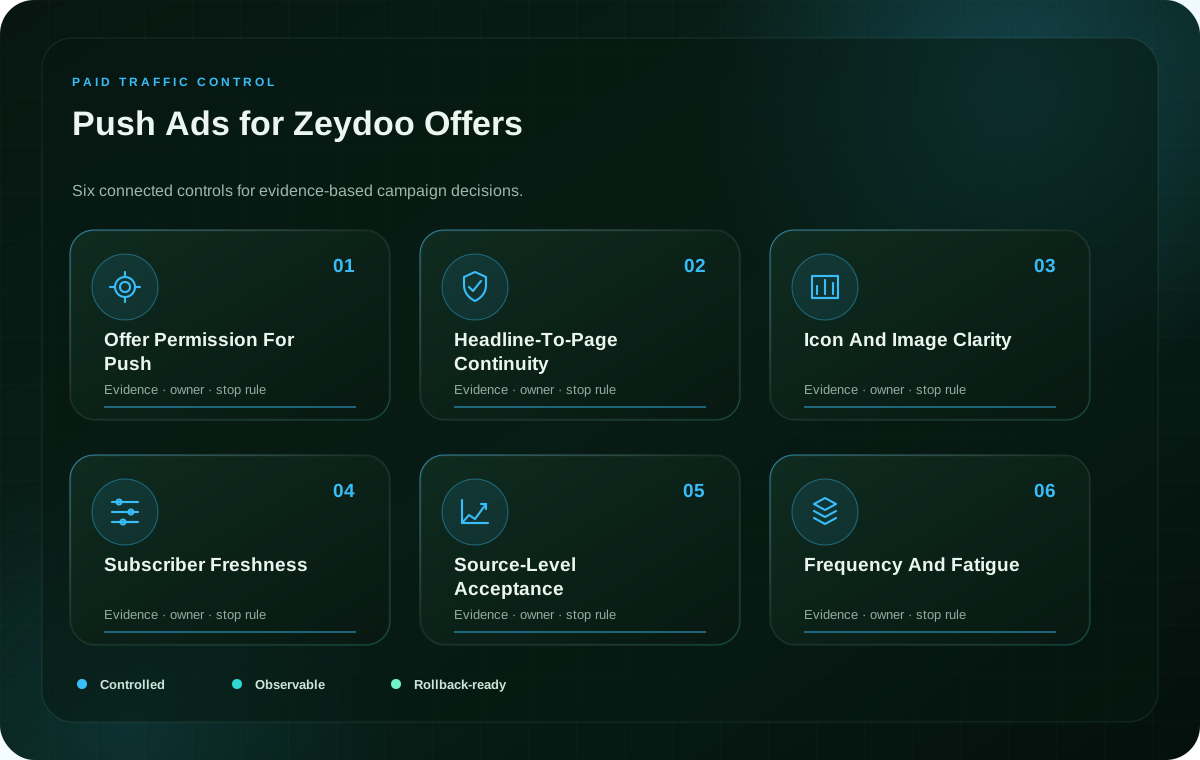
A stage-aware Zeydoo buying decision

Push Ads for Zeydoo Offers

Buy push ads for eligible Zeydoo offers with FroggyAds and connect your media decision to the action the offer actually rewards. We help you put a clear invitation in front of prospective visitors, control the purchase and assess the resulting evidence. For a multi-step offer, distinguish the first response from the later goal before deciding what another allocation is worth.

Push Ads for Zeydoo Offers campaign control dashboard
Your Zeydoo campaign

Plan your push purchase around the required Zeydoo action

Use the Zeydoo traffic guide for the wider source decision. Here, we focus on the push purchase: the permitted invitation, the visitor journey and the distinction between an initial response and the later action that informs your financial assessment. That distinction helps you choose a useful campaign objective before buying delivery.

The required action and media cost

Why choose FroggyAds for a defined Zeydoo push purchase?

Choose FroggyAds when you want to put an eligible Zeydoo journey into a controllable media purchase. Our self-serve push advertising controls connect your delivery scope, spending allocation and available source detail with a concrete acquisition question. Give visitors a compact, recognizable invitation, then use their observed progress through the offer to decide which part of the purchase merits follow-up.

Zeydoo presents one-step and multi-step CPL and CPI offers among the options suited to push. That is a useful starting point for research, not permission for every program. Inspect the selected offer, proposed promotion and current conditions before deciding which destination and audience belong in your FroggyAds campaign.

A compact notification has one immediate job: give an eligible visitor a recognizable reason to open the destination. Describe the available opportunity accurately. Avoid suggesting that an application, registration or initial response guarantees approval, a reward or completion of the offer's remaining requirements.

Affiliate marketers, advertisers and agency buyers can use this two-goal review to connect early responses with later actions. Keep the actual media expenditure beside both observations.

Our recommendation: Select one permitted offer journey and one interpretable buying question first. A disciplined campaign can reveal a useful difference between invitations, destinations or sources. The evidence becomes much harder to interpret when several offers, changing conditions and unrelated customer actions share one total.

Six preparations

Six preparations for a stage-aware Zeydoo campaign

Six preparations turn the intended customer journey into an actionable buying brief. Agree the proposition, evidence and responsible owners before delivery begins.

An interpretable journey
EvidenceOwnerReview condition
01

Confirm the selected offer and promotion conditions

Retain the applicable conditions for the actual offer and proposed traffic method. If an approval or restriction is unclear, resolve it with the responsible party before delivery. Our campaign controls help execute your prepared brief; they do not replace Zeydoo's decision about acceptable promotion.

EvidenceInstructionLimit
02

Define the complete customer action

Write the complete action required by the selected offer. An initial response and a later required action can support different questions in the buying review.

EvidenceInstructionLimit
03

Inspect the promise and destination

Inspect the destination and any permitted intermediate page. Check the commitment expected from the visitor and retain the version used for the purchase.

EvidenceInstructionLimit
04

Verify the supported record relationship

Have the tracking owner explain the actual record relationship. A documented example becomes useful evidence only when the supported setup has been verified.

EvidenceInstructionLimit
05

Name the stage used for each decision

Label the customer stage beside each cost ratio. Retain unresolved observations so the report can explain what the purchased population has actually done.

EvidenceInstructionLimit
06

Fund a purchase while later actions remain unresolved

Choose an allowance the business can fund while later actions remain unresolved. Name the condition that requires the buyer to pause and review.

EvidenceInstructionLimit
A useful preparation: changes an invitation, destination, measurement definition or spending instruction.

The useful output: Each preparation should change an invitation, destination, measurement definition or spending instruction. Assign the unresolved question to someone who can act on it.

Offer selection to the next purchase

Eight handoffs from offer selection to the next allocation

Eight handoffs connect offer selection with the next allocation. This prospective workflow assigns decisions to your team; it does not imply automatic external-record reconciliation or offer assessment by FroggyAds.

ConditionsJourneyPurchaseStage review
  1. 1

    Describe the complete Zeydoo journey

    Write the selected offer reference, eligible audience and complete customer action in the brief. Explain what the first response establishes and what further action matters to the decision. This prevents the notification and the financial review from quietly pursuing different objectives.

  2. 2

    Check permission for the actual promotion

    Check that the intended push promotion, destination and proposed audience fit the applicable conditions. Retain the relevant approval or clarification with a date. When the actual plan differs from the one discussed, return for a decision on that changed plan before buying delivery.

  3. 3

    Follow the invitation into the customer action

    Read the invitation and destination together as a prospective visitor would. Check the commitment, eligibility and next screen. A notification should prepare someone for the actual journey rather than attracting attention with a benefit that the destination cannot deliver on the stated terms.

  4. 4

    Verify purchase and outcome references

    Connect your purchase references with the downstream records using the setup your tracker and accounts actually support. Have the responsible tracking owner verify the relationship. A configuration screen is preparation; an observed, authorized test is the evidence that the intended relationship works.

  5. 5

    Authorize a fundable observation period

    Allocate spending that you can fund while later actions remain unresolved. Name the owner who can pause delivery and the condition that requires review. An account balance, a possible commission and money available for the next purchase are different planning inputs.

  6. 6

    Review progress within one purchased population

    Review the same purchased population at a named time. Record early responses, later actions and unresolved observations without silently dropping the difficult cases. Preserve the original expenditure so the review does not make acquisition look cheaper merely because some outcomes are still unclear.

  7. 7

    Investigate the first unsupported handoff

    Locate the first unsupported handoff before changing several settings. A weak invitation, a confusing destination and a missing outcome relationship require different investigations. Give the appropriate owner the specific observation that needs explanation and retain what remains unknown.

  8. 8

    Write the next spending instruction

    Propose a defined next allocation with a stated reason. Retain the previous version and explain which assumption changed, so a later buyer can interpret the follow-up.

The next allocation: use the applicable conditions and observed customer stages before adding spend.
Customer stages and their denominators

Why initial and payable goals need different denominators

Two observations, one journey: For a multi-step offer, an early event and a later event can describe progress by the same person. Define the event used for each buying question. Adding unlike stages together produces a larger activity count without establishing a larger number of acquired customers.

The payout distinction: Zeydoo's help example explains that a registration may appear before the deposit or card-submit goal associated with payment. Inspect the actual offer definition rather than applying that example universally. Give the reviewer the specific action used in your arrangement.

Read the configuration: Zeydoo documents ymid for the conversion reference, var for the traffic-source reference, amount for payout information and goal for distinguishing double-conversion stages. Its var field has a 40-character limit. Map these to the macros your actual setup supports; an example token is not a verified FroggyAds integration.

Retain the event meaning: The same documentation describes goal 1 as registration and goal 2 as deposit or card submit in its example. Confirm the meaning for your selected flow. A technically delivered message is only useful when the team understands the action it represents.

Compare a defined population: Use a dated ledger that relates the purchase, customer reference and observed stage without exposing personal information in unnecessary reports. Mark unattributed observations explicitly. The purpose is an understandable buying decision, not a claim that every click can always be joined to a downstream person.

Push Ads for Zeydoo Offers premium campaign control framework
Buying readiness

A readiness grid for your Zeydoo buying decision

Buying questionEvidence to retainUnresolved conditionNext instruction
Promotion permissionSelected offer and actual proposed push methodThe answer concerns a different promotionResolve the actual permission before delivery
Customer stagesInitial response and required later actionThe first event is called a paid acquisitionUse the correct event for each decision
DestinationInspected proposition and customer commitmentThe continuation changes what the invitation promisesAlign the invitation and permitted journey
Reference relationshipVerified purchase, source and outcome referencesUnknown records are assigned to a favored sourceQualify attribution and investigate missing relationships
Review populationDated observations with associated expenditureDifferent stages or periods share an unexplained totalReconcile the population before comparing ratios
Next allocationFundable purpose, owner and review conditionThe proposal relies on unresolved later outcomesAuthorize a bounded and interpretable purchase

Complete the readiness grid for the selected offer. An unresolved permission or measurement condition can matter more than an attractive dashboard total.

A missing answer needs an instruction: clarify permission, inspect the journey, verify a relationship or hold the allocation. Name the owner of that next action.

Different Zeydoo customer journeys

Four Zeydoo flows that change the purchase brief

Different Zeydoo flows change the buying brief. These planning situations are not current offer recommendations, available payouts or predictions of advertiser assessment.

Registration and later action

A registration followed by a later required action

For a registration followed by a later commitment, align the invitation with the complete proposition. Decide whether the initial response is useful for diagnosing the message, while reserving the financial assessment for the action your arrangement actually requires.

Ask the reviewer to show the relationship between the stages. A source producing many initial responses may still deserve investigation if few people proceed. Examine the promise and the actual next step before assuming that a cheaper first event makes the purchase better.

A later action may be absent at the first review for several reasons. Describe what you observed rather than inventing the cause. Record when the population entered and what evidence is available now, then assign the unresolved question to the owner who can investigate it.

Compare offers using their actual customer stages and conditions. Identical initial counts can conceal different commitments and later outcomes.

The buyer's instruction: Request a stage-aware review of the purchased population. Preserve spending and unresolved records instead of reporting only a favorable subset.

Composite requirements

An installation with an additional offer requirement

For a flow requiring an installation plus another action, write both requirements into the operating brief. Zeydoo's troubleshooting guidance notes that composite conditions must be completed. Build the review around the actual offer terms rather than assuming the first completed screen is sufficient.

The practical adjustment: Let the invitation describe the genuine proposition and the destination explain the necessary next step. If people stop at the same point, inspect that transition. The first question is what prevents the advertised journey from continuing, not how to increase the first-event total.

Subscription eligibility

A subscription with a qualifying-user condition

For a push-subscription offer, check the selected offer's eligibility definition. Zeydoo notes that an already subscribed user may not count as a new subscription. Do not present a media visit or a subscription permission prompt as proof of a qualifying new subscriber.

The evidence limit: Qualify any acquisition statement when eligibility cannot be verified in the available records. FroggyAds helps you control the purchase, while the offer-side evidence determines what that purchase produced. An illustrative subscriber-freshness diagram does not establish the age or eligibility of actual traffic.

Paused or changed offer

A paused offer or changed destination

For an offer that is paused or materially changed, revisit the purchase instruction before continuing. Zeydoo warns that a paused offer will not count conversions. Retain the status checked and who owns the decision to resume an eligible campaign journey.

The operational response: Pause or redirect only within the actual permissions and supported setup. A replacement destination can change the proposition, eligibility and measurement meaning. Review those changes as a new buying decision rather than assuming the earlier evidence automatically applies.

Questions for the responsible owners

Twelve questions for the media buyer and tracking owner

These twelve questions give the media buyer and tracking owner a common decision brief. Each answer should identify an observation, responsible person or unresolved condition.

Which actual promotion has been checked?

Retain the current selected-offer conditions and the actual promotion proposed. A general statement that push can suit a network's offers does not resolve an individual program restriction. The launch instruction should identify which relevant permission has been checked and by whom.

If the plan changes, retain a dated instruction for the revised promotion. A favorable answer about the old destination or audience may not address the new proposal.

What customer action answers the campaign objective?

Choose the action that answers the campaign objective. An early response can help evaluate the invitation; a later required action may be needed for the financial review. Write both definitions when both are useful rather than forcing every question into one conversion total.

Label what was counted, the population and the observation time. An initial registration should not silently become a customer in the handover.

Does the notification describe the genuine opportunity?

Use a recognizable benefit that continues on the destination. A compact message should make the next action understandable without inventing an entitlement, reward or approval. Consider what an eligible visitor would reasonably expect after reading the invitation and compare that expectation with the page.

Explain a necessary condition within the permitted journey. More clicks do not justify removing information the visitor needs to understand the proposition.

Can the eligible visitor continue on the intended path?

Inspect the relevant device and browser path before delivery. Confirm that the destination loads, the proposition is readable and the required action can be attempted. Keep any observation within your authorization; a preview is not proof of downstream acceptance or commission.

Record a path-specific obstacle and decide whether that audience should wait. Preserve unrelated settings while the responsible owner investigates the observed problem.

Which relationship does each tracking reference establish?

Verify that the selected references can support the intended comparison. A readable source label and a unique conversion reference serve different purposes. Ask the tracking owner to explain what each field identifies, where it is recorded and which relationship has actually been tested.

Show unattributed outcomes as unknowns. Resolve the relationship where possible and qualify any source decision that relies on incomplete evidence.

Does the cost ratio describe the same population?

Match expenditure with the population whose progress you review. If the observation period changes, retain enough detail to explain that change. A later outcome may update the interpretation of an earlier purchase without turning it into a new purchase or a second person.

State the denominator beside every ratio. Add relevant operating costs before presenting a media-stage calculation as complete customer acquisition cost.

Are event messages being mistaken for distinct people?

Retain the stage rather than counting every notification as a separate acquisition. In an authorized test, inspect whether the record refers to an initial event, a later action or an update. Confirm the actual handling with the responsible tracking owner before relying on an automated total.

Give the next buyer an understandable event ledger without unnecessary personal data. Explain unresolved records instead of silently adjusting the total.

What remains unresolved at the review time?

Ask what the current evidence establishes at the chosen review time. A later-required action that has not been observed is unresolved for that population. Do not invent a universal waiting period or assume that every missing result will eventually arrive.

Schedule review around the actual flow. Zeydoo identifies delays and advertiser checks as possible explanations; investigate rather than assuming missing results will arrive.

Which changed condition affects the comparison?

Describe the changed assumption explicitly. A different offer condition, destination, customer commitment or event definition can weaken the comparison with earlier evidence. Keep the earlier version available and explain which conclusion still applies before combining the reports.

Record when a changed instruction becomes active. Preserve the earlier population under its actual configuration so the comparison describes a real buying difference.

What is the purpose of the next allocation?

Authorize another allocation only when its purpose is clear. You may be continuing a supported approach or investigating a specific uncertainty. Name the question, owner and limit so an exploratory purchase is not presented as an already proven way to acquire paying customers.

A promising observation can justify follow-up without proving stable economics. Check the applicable conditions and comparability of the next audience before expanding the purchase.

Can the receiving buyer act on the handover?

Leave the next buyer a short decision record. Include the selected journey, event definitions, spending population, unresolved observations and reason for the next action. That record should explain the decision without requiring someone to reconstruct it from disconnected dashboard screenshots.

Tell the receiving owner what may continue and what needs clarification. Retain the evidence behind a pause so unresolved delivery is not reopened accidentally.

Have you described the actual traffic method?

Describe the actual traffic method when asking for advice or permission. Include the proposed presentation, destination and intended audience. A precise question gives the responsible party a better chance to identify a relevant restriction than a broad request about whether push works.

Bring conditional advice into the campaign brief and assign the relevant check. A different promotion needs its own answer within the actual scope.

Your FroggyAds media brief

Build the prepared Zeydoo purchase in FroggyAds

Turn the reviewed Zeydoo journey into a focused FroggyAds campaign. We recommend choosing a clear invitation, an available buying configuration and an allowance whose purpose you can explain. Our self-serve approach gives you practical media control while your team evaluates what visitors do downstream.

Offer reference: Record the specific journey and applicable conditions used for this purchase. That reference gives the buyer a concrete basis for checking changes instead of assuming that every program in the network shares the same permission or customer requirements.

Presentation choice: Compare classic push and in-page push around the actual supported campaign options and visitor experience. Confirm the fields and assets required for the selected presentation. A different display context can change how the same proposition is understood.

Audience instruction: Select available targeting settings around the offer's actual eligible market and device path. Retain the configuration used. A country or device selection describes the intended delivery scope; it does not guarantee that each visitor will qualify for the downstream action.

Notification concept: Prepare a concise reason to continue and a destination that recognizes that reason. Give each materially different concept a useful reference. A label should identify the proposition tested, so a later review can connect its result with a real creative decision.

Destination version: Record the inspected continuation and any permitted intermediate page. Review a changed promise or commitment before using the new version. Technical availability alone does not explain whether the visitor can complete the specific journey introduced by the ad.

Tracking ownership: Name the person who can explain and test the external record relationship. Use supported configuration instructions rather than guessing macro names. FroggyAds does not become a verified automatic Zeydoo connection merely because a tracking guide shows a generic network example.

Spending allowance: Choose an amount your business can fund for the stated question and review conditions. Our published minimum deposit of USD50 is an account-funding threshold. It is neither a promised acquisition price nor a recommendation that USD50 is sufficient for this particular test.

Source diagnosis: Use the source detail available in the actual setup to investigate a defined difference. Zeydoo recommends passing source information for more selective analysis. Verify the mapping and available controls before claiming that a source-level explanation has been established.

Review population: Retain stage definitions with their expenditure. Explain exclusions explicitly so an attractive subset cannot erase the cost of unresolved visitors.

Change instruction: Adjust a defined part of the purchase for a stated reason. Retain the previous version so the next review can assess the actual change.

Pause condition: Agree the observation that requires delivery to wait for review. Permission changes, an unavailable journey or an unexplained measurement relationship deserve a clear owner. A defined pause helps protect the purpose of the purchase while the responsible team resolves the issue.

Next allocation: Choose FroggyAds for a media purchase whose purpose and limits you understand. Start with the prepared journey, keep the result definitions visible and use supported findings to guide the next campaign. That is a stronger buying basis than treating every early response as realized value.

Control and assessment limits

Keep media control and offer assessment clear

FroggyAds controls support the media decision. The selected offer conditions and downstream evidence establish the customer result; keep those responsibilities explicit.

A push purchase cannot guarantee commissions, profit or organic rankings. Buy an interpretable acquisition question and use the resulting evidence to guide the next decision.

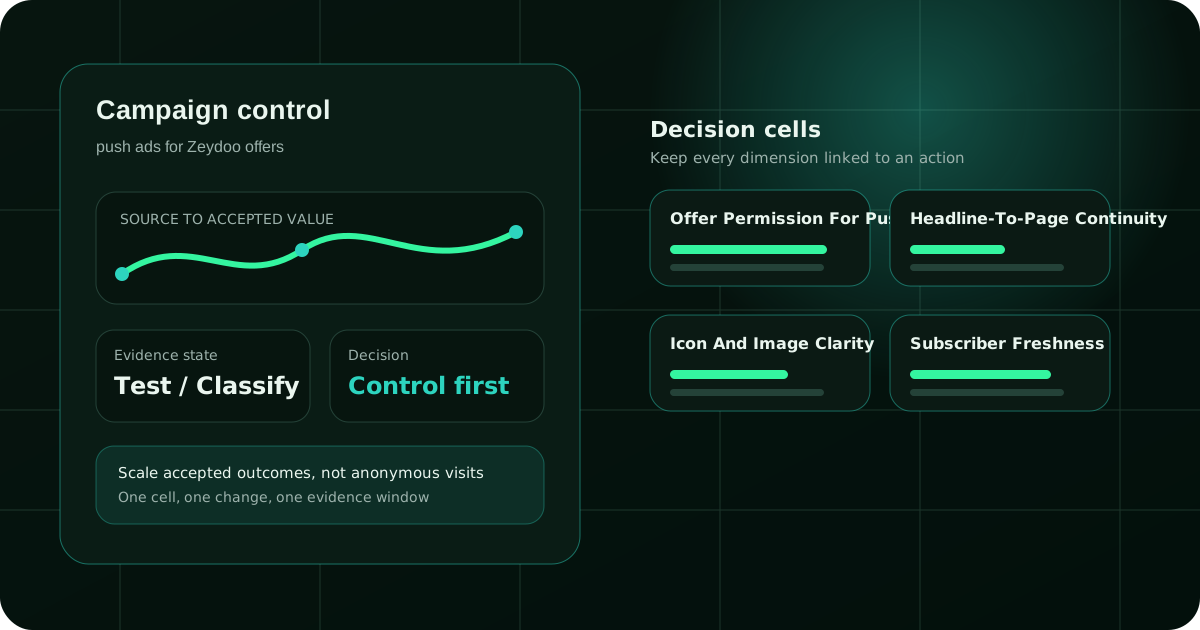
The diagrams are illustrative planning aids. Their bars and curves are not campaign results, current audience sizes or proof of subscriber age.

Check applicable offer conditions and account options before a material change. Retain the details used so future reviewers understand the conclusion's scope.

Zeydoo buyer questions

Zeydoo push questions about stages, costs and permission

Can I buy push ads for a Zeydoo offer?

Yes, when the selected Zeydoo offer permits your proposed push promotion and the journey fits its conditions. Use FroggyAds to execute a defined purchase with a clear invitation and review question. Confirm the specific permission before treating a general format recommendation as an individual offer approval.

How should I compare classic and in-page push?

Compare their actual presentation, supported fields and fit with the destination. Keep the offer proposition and result definitions consistent enough to understand the comparison. A format name alone does not establish which purchase will produce the required action for your particular journey.

What should the notification promise?

Describe the genuine opportunity and what the visitor should expect next. Include a necessary commitment or eligibility condition where it matters to understanding the proposition. Avoid a reward or approval claim that the actual offer cannot support on the stated terms.

When does an intermediate page help?

An intermediate page can help explain a complex proposition when the offer and traffic rules permit it. Inspect the whole continuation and preserve a recognizable promise. Adding a page is useful only when it helps the intended visitor understand or complete the required journey.

Which conversion should guide the buying decision?

Use the event that answers the buying question. For a multi-step flow, the first response can diagnose interest while a later action supports a different assessment. Retain the actual offer definitions and explain the denominator used for every reported cost ratio.

Why can event totals exceed the number of acquired people?

A registration and later goal can describe stages of one journey. Do not add them as if they were different acquired people. Have the tracking owner inspect the relationship and event meaning before using an automated total to justify more spending.

When should I change a Zeydoo notification?

Change a notification when a specific observation identifies an inaccurate promise or a useful creative question. Retain its version and the population exposed to it. Avoid rotating messages simply to replace an uncomfortable report without investigating the original customer response.

Can push traffic guarantee commissions or profit?

No. FroggyAds helps you control the media purchase, while external eligibility and offer assessment determine the downstream outcome. Fund an interpretable question, verify the journey and use actual evidence for the next decision. A paid visit is an opportunity for a response, not a guaranteed commission.

How should I investigate an unclear result?

Locate the first unsupported relationship between the invitation, destination, recorded action and review population. Ask the responsible owner to investigate that specific gap. Keep unresolved observations visible, and avoid changing multiple unrelated settings before the original issue is understood.

When is another media allocation justified?

Another allocation is justified when its purpose, conditions and funding are clear. State whether it continues a supported finding or investigates a remaining question. Confirm the offer is still applicable and retain the earlier evidence so the next review can explain what changed.

Choose the useful next resource

Choose the resource for your next Zeydoo question

Prepare the mechanics of buying push traffic

Use the push-buying guide for campaign mechanics. Bring the selected offer conditions and event definitions with you to make the general guidance actionable.

Check the supported push presentation

Review the supported presentation and creative fields before producing assets. Prepare a recognizable proposition that continues accurately into the selected destination.

Compare the wider Zeydoo traffic decision

Use the wider guide when the unresolved question concerns source choice. Return to the selected offer conditions before turning general guidance into a purchase.

Review the push format and campaign proposition

Check the push format before adapting the message. Use the actual presentation, supported assets and customer commitment as the brief for your creative.

An informed Zeydoo push purchase

Keep the selected journey and review question together

Keep the next instruction actionable: what may run, which result informs review and what needs clarification. Start your next FroggyAds campaign when that brief is ready.

Create your free FroggyAds account
The Zeydoo buying distinction

Worked example: USD3 per registration versus USD12 per later action

The following invented example shows why stage definitions matter. It is arithmetic for a hypothetical purchase, not a FroggyAds result, a current Zeydoo offer, a payout quote or a forecast. The later action and illustrative amount are assumptions chosen solely to explain the review.

Assumed purchase: A buyer spends USD72 on one defined population. The records show 24 distinct initial registrations and six of those people completing the required later action at the chosen review time. The remaining 18 registrations have no observed later action in this example.

First-stage ratio: Divide all USD72 of media spending by 24 registrations to obtain USD3 per initial registration. This describes the first stage only. Calling it the cost of a paid acquisition would give the buyer a different and unsupported impression of the purchase.

Later-stage ratio: Divide the same USD72 by six required later actions to obtain USD12 per such action. The six are a subset of the original 24 people. Adding 24 and six to report 30 acquired people would count some journeys twice.

Illustrative value: Assume, only for this example, USD9 of recorded payout information for each of the six later actions. Six multiplied by USD9 equals USD54. This assumption is not a current network rate, an irrevocable entitlement or money already received in the buyer's account.

Media-only balance: Subtract USD72 of media expenditure from the illustrative USD54 to obtain negative USD18. Creative, tracking, labor, fees, tax and any later adjustments are excluded. This is a limited arithmetic balance, not a complete profit calculation or a recommendation to repeat the purchase.

Hypothetical measureCalculationInterpretation and limit
Initial registrationsUSD72 / 24 = USD3 per registration.Initial-stage media ratio; not a paid acquisition.
Required later actionsUSD72 / 6 = USD12 per later action.Six of the same 24 people; not 30 acquisitions.
Illustrative media balance6 x USD9 = USD54; USD54 - USD72 = -USD18.Hypothetical recorded value; other costs and adjustments excluded.

Read the stage before interpreting acquisition cost

The decision supported: An inexpensive initial response does not establish later-stage economics. Investigate the continuation and preserve all spending and unresolved records before authorizing another allocation.

Start your prepared Zeydoo campaign with FroggyAds

When the selected journey and review definitions are ready, create your free FroggyAds account and prepare your push campaign. We give you practical control over the media purchase so you can execute a clear brief and act on supported findings.

Further reading: the Shopify paid-advertising overview provides general buying context. Google Ads Display targeting guidance concerns a different platform. Use the selected Zeydoo offer conditions and actual FroggyAds campaign options for this purchase; these references do not establish offer permission, conversion integration or a guaranteed result.

Your first preparation

Choose a clear action and an interpretable purchase

Prepare one permitted Zeydoo journey and an actionable review question. Choose FroggyAds for practical media control, then use actual downstream evidence to guide the next purchase.