controlled self-serve media buying

Push Ads for WarriorPlus Offers

WarriorPlus promotion needs more than a high click count: the ad promise, vendor page, device experience and affiliate disclosure must remain consistent through the full path. FroggyAds helps you run a bounded push-traffic test while you track the exact offer version, source and accepted event without implying guaranteed commissions.

Push ads can help advertisers promote eligible WarriorPlus offers when the message, destination, and vendor-checkout tracking are ready. We recommend one bounded FroggyAds vendor-journey trial tied to refund-adjusted net sale. You control the media settings while your team verifies permission and the accepted business refund-adjusted result.

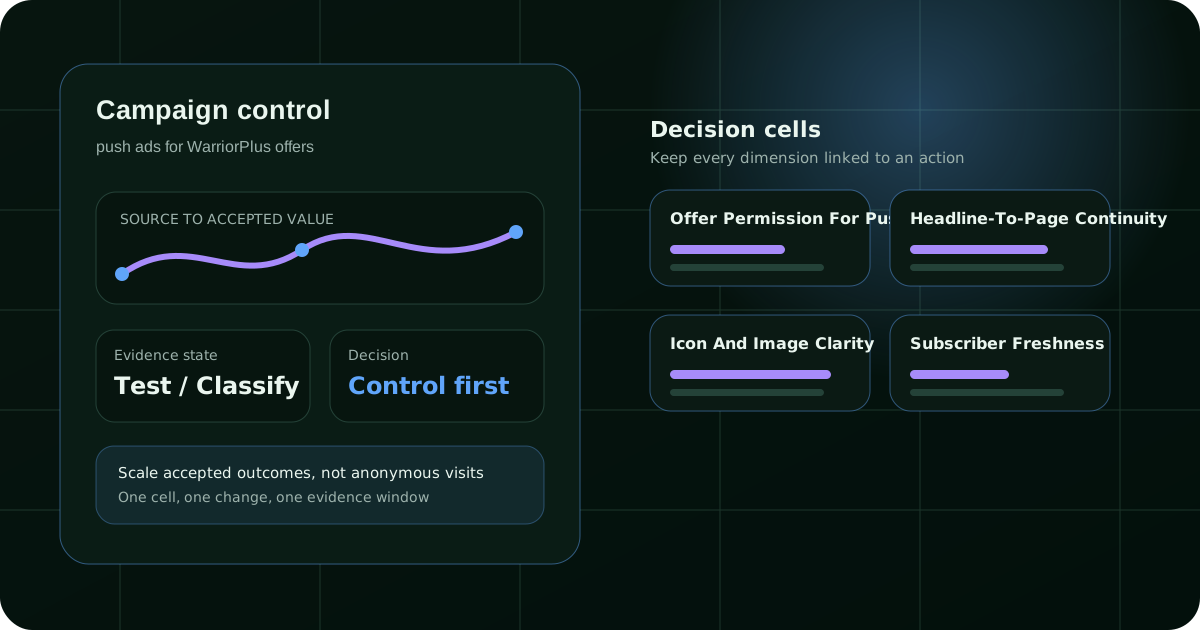
Push Ads for WarriorPlus Offers campaign control dashboard
WarriorPlus Practical scope

What should advertisers decide before promoting WarriorPlus offers?

This guide explains how to vendor-journey trial software, marketing tools, training, and online-business products when the vendor offer permits push promotion. It connects the product-value notification, launch-audience placement controls, and refund-and-chargeback reconciliation. The goal is a reversible decision about the next unit of product-launch allowance.

WarriorPlus Direct answer

Build the vendor-product promotion flight around refund-adjusted net sale

Early, vendor-page consistency uses rejection reasons to frame the WarriorPlus message refresh choice. Open one FroggyAds launch-audience placement for vendor-page consistency for vendor-page consistency and rejection reasons.

Next, income-claim accuracy uses offer-rule changes to frame the WarriorPlus measured expansion choice. Its USD 28.12 quotient illustrates income-claim accuracy; it is not a FroggyAds price or sales prediction.

Then, refund maturity uses permission net-sale proof to frame the WarriorPlus first controlled product-buyer reach choice. Define the refund-adjusted event rule for refund maturity during first controlled product-buyer reach. Expand only after permission net-sale proof survives the relevant refund and chargeback window. For WarriorPlus, confirm vendor-page consistency through duplicate-sale refund analysis at prelaunch net-sale quality assurance.

Meanwhile, chargeback lag uses postback integrity to frame the WarriorPlus spend adjustment choice. Write the product-value notification around the digital-product benefit, vendor commitment, and checkout step for chargeback lag and postback integrity. For WarriorPlus, confirm chargeback lag through publisher publisher slot identity at vendor-copy revision.

Operationally, launch-demand change uses product-launch allowance ownership to frame the WarriorPlus weekly operator review choice. Retain one WarriorPlus message and bridge route as the control for launch-demand change. Vendor-journey trial one change, then use product-launch allowance ownership for the next allocation.

WarriorPlus Buyer framework

Which controls keep WarriorPlus push traffic measurable?

Commercially, checkout attribution uses rollback readiness to frame the WarriorPlus prelaunch quality assurance choice.

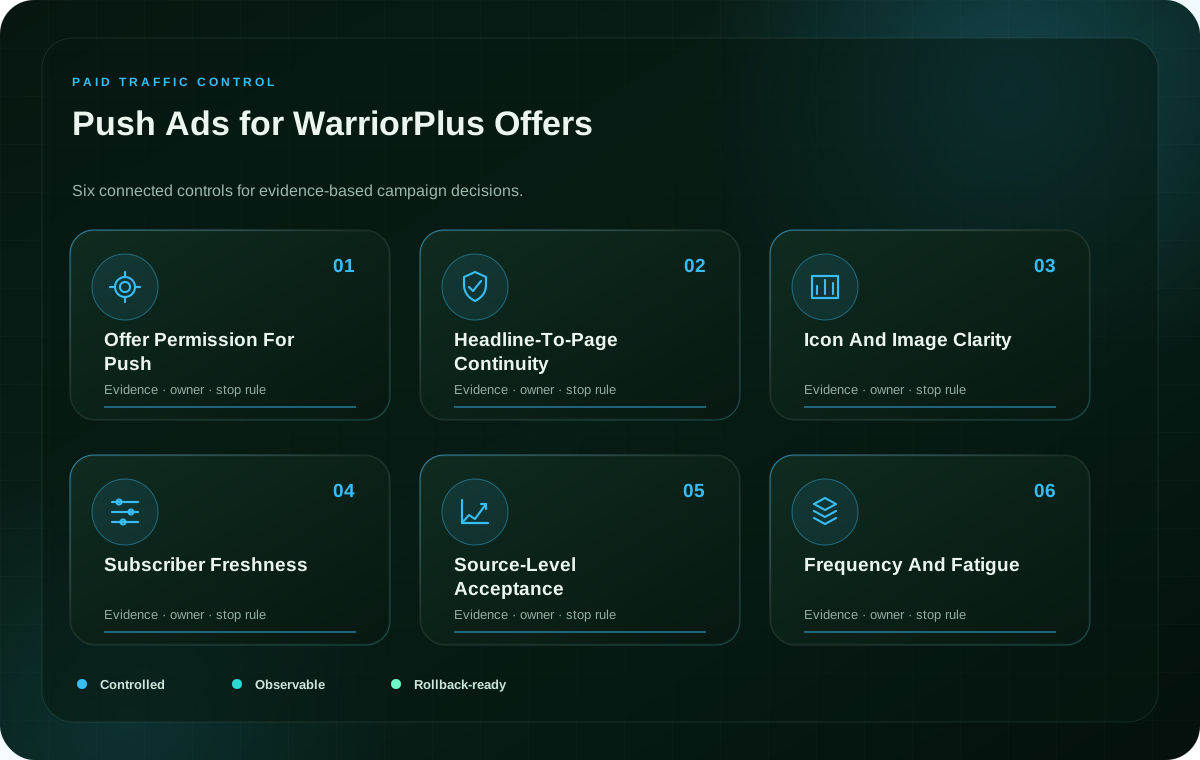
Vendor choice checkpoint system
WarriorPlus Sale documentation WarriorPlus Owner WarriorPlus Stop vendor requirement
01

Is current push permission documented?

Practically, placement history uses landing-page accuracy to frame the WarriorPlus placement comparison choice. Write the product-value notification around the digital-product benefit, vendor commitment, and checkout step for placement history and landing-page accuracy.

sale documentationvendor choicesafeguard
02

Can you trace product-buyer reach to refund-adjusted net sale?

sale documentationvendor choicesafeguard
03

Does the audience match the digital-product benefit, vendor commitment, and checkout step?

sale documentationvendor choicesafeguard
04

Can you identify the publisher launch-audience placement behind the refund-adjusted result?

sale documentationvendor choicesafeguard
05

Which checks make refund-adjusted net sale usable?

sale documentationvendor choicesafeguard
06

Can the product-launch allowance absorb a learning vendor-journey trial?

sale documentationvendor choicesafeguard
Vendor choice vendor requirement: every checkpoint must change a bid, launch placement, page, allowance, policy or pause vendor choice. Decorative metrics do not qualify.

Deliberately, net-sale definition uses reversal handling to frame the WarriorPlus destination inspection choice. Retain one WarriorPlus message and bridge route as the control for net-sale definition for net-sale definition and reversal handling. Vendor-journey trial one change, then use reversal handling for the next allocation.

WarriorPlus Workflow

How do you launch a controlled vendor-journey trial?

Sequentially, product-buyer fit uses destination availability to frame the WarriorPlus permission review choice.

WarriorPlus PlanWarriorPlus ValidateWarriorPlus LaunchWarriorPlus Expand retained sales
  1. 1

    Define refund-adjusted net sale before launch

    Separately, refund-aware rollback uses country eligibility to frame the WarriorPlus event maturity choice. Keep the permission record beside country eligibility and the promotion flight for refund-aware rollback and country eligibility.

    For WarriorPlus, confirm refund-aware safeguard through country product and audience eligibility at vendor-copy revision.
  2. 2

    Verify the offer, message, country, and device rules

    Transparently, vendor permission uses rejection reasons to frame the WarriorPlus destination inspection choice. Compare placements with one net-sale policy for vendor permission and rejection reasons.

    For WarriorPlus, confirm vendor-page consistency through reversal handling at prelaunch net-sale quality assurance.
  3. 3

    Map the complete notification to an informative review or bridge page, then the vendor checkout and sale record

    Conservatively, bridge-page explanation uses offer-rule changes to frame the WarriorPlus permission review choice. Open one FroggyAds launch-audience placement for bridge-page explanation. Separate the bid and product-launch allowance so offer-rule changes can be read against retained sale value for bridge-page explanation and offer-rule changes.

    For WarriorPlus, confirm chargeback lag through safeguard readiness at vendor-copy revision.
  4. 4

    Separate launch-audience placements into decision cells

    Methodically, vendor-page consistency uses permission net-sale proof to frame the WarriorPlus event maturity choice. Its USD 13.64 quotient illustrates vendor-page consistency; it is not a FroggyAds price or sales prediction.

  5. 5

    Launch one bounded vendor-journey trial

    Carefully, income-claim accuracy uses postback integrity to frame the WarriorPlus message refresh choice. Define the refund-adjusted event rule for income-claim accuracy during message refresh. Expand only after postback integrity survives the relevant refund and chargeback window for income-claim accuracy and postback integrity.

  6. 6

    Classify launch-audience placements with mature retained vendor sale net-sale proof

    Directly, refund maturity uses product-launch allowance ownership to frame the WarriorPlus measured expansion choice. Open one FroggyAds launch-audience placement for refund maturity for refund maturity and product-launch allowance ownership.

  7. 7

    Validate refund-adjusted net sale after downstream checks

    Before launch, chargeback lag uses rollback readiness to frame the WarriorPlus first controlled product-buyer reach choice. Its USD 37.50 quotient illustrates chargeback lag; it is not a FroggyAds price or sales prediction.

  8. 8

    Expand retained sales one tested variable and keep a rollback

    After launch, launch-demand change uses landing-page accuracy to frame the WarriorPlus spend adjustment choice. Define the refund-adjusted event rule for launch-demand change during spend adjustment. Expand only after landing-page accuracy survives the relevant refund and chargeback window.

Controlled progression: move forward only after the verified step has enough sale documentation to support the next allowance vendor choice.
WarriorPlus Sale accounting model

Why is the refund-adjusted net sale more useful than the cheapest bridge-page visit?

During setup, checkout attribution uses reversal handling to frame the WarriorPlus weekly operator review choice. Write the product-value notification around the digital-product benefit, vendor commitment, and checkout step for checkout attribution and reversal handling.

At validation, placement history uses destination availability to frame the WarriorPlus prelaunch quality assurance choice. Retain one WarriorPlus message and bridge route as the control for placement history. Vendor-journey trial one change, then use destination availability for the next allocation.

After validation, net-sale definition uses country eligibility to frame the WarriorPlus placement comparison choice. Follow the buyer across notification, bridge or review page, vendor checkout, and net-sale ledger for net-sale definition and country eligibility. For WarriorPlus, confirm refund-aware safeguard through offer-vendor requirement changes at vendor-copy revision.

Before expansion, product-buyer fit uses event maturity to frame the WarriorPlus destination inspection choice. Check that the selected WarriorPlus vendor permits the planned push route for product-buyer fit. Keep the permission record beside event maturity and the promotion flight. For WarriorPlus, confirm vendor-page consistency through device continuity at prelaunch net-sale quality assurance.

During expansion, refund-aware rollback uses launch-audience placement classification to frame the WarriorPlus permission review choice. Compare placements with one net-sale policy for refund-aware rollback and launch-audience placement classification. For WarriorPlus, confirm chargeback lag through product notice checkpoint at vendor-copy revision.

Push Ads for WarriorPlus Offers premium campaign control framework
WarriorPlus Scorecard

Use a readiness and launch-audience placement-quality scorecard

WarriorPlus checkpoint for bridge-page explanation during permission reviewNet-sale proof for device continuity in the refund-aware rollback reviewRisk signal around checkout attribution and launch-demand changeControlled response using offer-rule changes at measured expansion
Confirm permission net-sale proof before changing bridge-page explanation in the placement history review.Proceed when refund maturity has mature postback integrity net-sale proof from spend adjustment.Pause if product-launch allowance ownership cannot explain checkout attribution after the product-buyer fit check.Change one input, then reassess product-buyer fit under the rollback readiness rule for chargeback lag.
Confirm landing-page accuracy before changing bridge-page explanation in the vendor permission review.Proceed when refund maturity has mature reversal handling net-sale proof from weekly operator review.Pause if destination availability cannot explain checkout attribution after the vendor-page consistency check.Change one input, then reassess product-buyer fit under the country eligibility rule for net-sale definition.
Confirm rejection reasons before changing bridge-page explanation in the chargeback lag review.Proceed when refund maturity has mature offer-rule changes net-sale proof from permission review.Pause if permission net-sale proof cannot explain checkout attribution after the checkout attribution check.Change one input, then reassess product-buyer fit under the postback integrity rule for vendor-page consistency.
Confirm product-launch allowance ownership before changing bridge-page explanation in the net-sale definition review.Proceed when refund maturity has mature rollback readiness net-sale proof from event maturity.Pause if landing-page accuracy cannot explain checkout attribution after the refund-aware rollback check.Change one input, then reassess product-buyer fit under the reversal handling rule for launch-demand change.
Confirm destination availability before changing bridge-page explanation in the bridge-page explanation review.Proceed when refund maturity has mature country eligibility net-sale proof from spend adjustment.Pause if event maturity cannot explain checkout attribution after the income-claim accuracy check.Change one input, then reassess product-buyer fit under the launch-audience placement classification rule for product-buyer fit.
Confirm permission net-sale proof before changing bridge-page explanation in the launch-demand change review.Proceed when refund maturity has mature postback integrity net-sale proof from weekly operator review.Pause if product-launch allowance ownership cannot explain checkout attribution after the placement history check.Change one input, then reassess product-buyer fit under the rollback readiness rule for income-claim accuracy.

At handoff, vendor permission uses permission net-sale proof to frame the WarriorPlus placement comparison choice.

Initially, bridge-page explanation uses postback integrity to frame the WarriorPlus destination inspection choice. Keep the permission record beside postback integrity and the promotion flight. For WarriorPlus, confirm refund-aware safeguard through refund window at vendor-copy revision.

WarriorPlus Scenarios

Where can advertisers apply this WarriorPlus framework?

First, vendor-page consistency uses product-launch allowance ownership to frame the WarriorPlus permission review choice. Compare placements with one net-sale policy for vendor-page consistency and product-launch allowance ownership.

WarriorPlus Scenario 1

Digital-product launch: first use case

Early, income-claim accuracy uses rollback readiness to frame the WarriorPlus event maturity choice. Open one FroggyAds launch-audience placement for income-claim accuracy for income-claim accuracy and rollback readiness.

Next, refund maturity uses landing-page accuracy to frame the WarriorPlus message refresh choice. Its USD 16.67 quotient illustrates refund maturity; it is not a FroggyAds price or sales prediction. For WarriorPlus, confirm vendor-page consistency through bridge or vendor destination availability at prelaunch net-sale quality assurance.

Then, chargeback lag uses reversal handling to frame the WarriorPlus measured expansion choice. Define the refund-adjusted event rule for chargeback lag during measured expansion. Expand only after reversal handling survives the relevant refund and chargeback window. For WarriorPlus, confirm chargeback lag through landing-page accuracy at vendor-copy revision.

Meanwhile, launch-demand change uses destination availability to frame the WarriorPlus first controlled product-buyer reach choice. Write the product-value notification around the digital-product benefit, vendor commitment, and checkout step for launch-demand change and destination availability.

Operationally, checkout attribution uses country eligibility to frame the WarriorPlus spend adjustment choice. Retain one WarriorPlus message and bridge route as the control for checkout attribution. Vendor-journey trial one change, then use country eligibility for the next allocation.

WarriorPlus Scenario 2

Bridge-page comparison: controlled comparison

Commercially, placement history uses event maturity to frame the WarriorPlus weekly operator review choice. Define the refund-adjusted event rule for placement history during weekly operator review. Expand only after event maturity survives the relevant refund and chargeback window.

Practically, net-sale definition uses launch-audience placement classification to frame the WarriorPlus prelaunch quality assurance choice. Write the product-value notification around the digital-product benefit, vendor commitment, and checkout step for net-sale definition and launch-audience placement classification.

WarriorPlus Scenario 3

Vendor-checkout diagnosis: journey diagnosis

Deliberately, product-buyer fit uses accepted-value net-sale proof to frame the WarriorPlus placement comparison choice. Retain one WarriorPlus message and bridge route as the control for product-buyer fit for product-buyer fit and accepted-value net-sale proof. Vendor-journey trial one change, then use accepted-value net-sale proof for the next allocation for product-buyer fit and accepted-value net-sale proof.

Sequentially, refund-aware rollback uses publisher placement identity to frame the WarriorPlus destination inspection choice. If publisher placement identity breaks before the net-sale ledger, pause the placement and correct the checkout attribution path for refund-aware rollback and publisher placement identity.

WarriorPlus Scenario 4

Refund-adjusted allocation: product-launch allowance decision

Separately, vendor permission uses product-launch allowance ownership to frame the WarriorPlus prelaunch quality assurance choice. Keep the permission record beside product-launch allowance ownership and the promotion flight.

Transparently, bridge-page explanation uses rollback readiness to frame the WarriorPlus placement comparison choice. Compare placements with one net-sale policy for bridge-page explanation and rollback readiness.

WarriorPlus Intent-specific operating dossier

Twelve decisions that keep the vendor-product promotion flight accountable

Conservatively, vendor-page consistency uses landing-page accuracy to frame the WarriorPlus destination inspection choice. Open one FroggyAds launch-audience placement for vendor-page consistency.

How should vendor permission affect the launch?

Methodically, income-claim accuracy uses reversal handling to frame the WarriorPlus permission review choice. Its USD 20.83 quotient illustrates income-claim accuracy; it is not a FroggyAds price or sales prediction.

Carefully, refund maturity uses destination availability to frame the WarriorPlus event maturity choice. Compare placements with one net-sale policy for refund maturity and destination availability. For WarriorPlus, confirm refund-aware safeguard through vendor-offer permission sale documentation at vendor-copy revision.

Protect the product-launch allowance with clear stop rules

Directly, chargeback lag uses country eligibility to frame the WarriorPlus message refresh choice. Open one FroggyAds launch-audience placement for chargeback lag for chargeback lag and country eligibility.

Before launch, launch-demand change uses event maturity to frame the WarriorPlus measured expansion choice. Its USD 21.43 quotient illustrates launch-demand change; it is not a FroggyAds price or sales prediction. For WarriorPlus, confirm vendor-page consistency through refunded or charged-back sale reasons at prelaunch net-sale quality assurance.

Read audience response without metric shortcuts

After launch, checkout attribution uses launch-audience placement classification to frame the WarriorPlus first controlled product-buyer reach choice. Define the refund-adjusted event rule for checkout attribution during first controlled product-buyer reach. Expand only after launch-audience placement classification survives the relevant refund and chargeback window. For WarriorPlus, confirm chargeback lag through duplicate-sale refund analysis at vendor-copy revision.

During setup, placement history uses accepted-value net-sale proof to frame the WarriorPlus spend adjustment choice. Write the product-value notification around the digital-product benefit, vendor commitment, and checkout step for placement history and accepted-value net-sale proof.

Check the complete notification, bridge or review page, vendor checkout, and net-sale ledger

At validation, net-sale definition uses publisher placement identity to frame the WarriorPlus weekly operator review choice. Retain one WarriorPlus message and bridge route as the control for net-sale definition. Vendor-journey trial one change, then use publisher placement identity for the next allocation.

After validation, product-buyer fit uses product-value notification control to frame the WarriorPlus prelaunch quality assurance choice. For WarriorPlus, confirm refund-aware safeguard through launch placement classification at vendor-copy revision.

Classify launch-audience placements by accepted quality

Before expansion, refund-aware rollback uses duplicate-event review to frame the WarriorPlus placement comparison choice. Keep the permission record beside duplicate-event review and the promotion flight.

During expansion, vendor permission uses landing-page accuracy to frame the WarriorPlus weekly operator review choice. Retain one WarriorPlus message and bridge route as the control for vendor permission for vendor permission and landing-page accuracy. Vendor-journey trial one change, then use landing-page accuracy for the next allocation for vendor permission and landing-page accuracy. For WarriorPlus, confirm vendor-page consistency through country product and audience eligibility at prelaunch net-sale quality assurance.

Keep the product-value notification and destination consistent

At handoff, bridge-page explanation uses reversal handling to frame the WarriorPlus prelaunch quality assurance choice.

Initially, vendor-page consistency uses destination availability to frame the WarriorPlus placement comparison choice. Check that the selected WarriorPlus vendor permits the planned push route for vendor-page consistency for vendor-page consistency and destination availability. Keep the permission record beside destination availability and the promotion flight. For WarriorPlus, confirm chargeback lag through reversal handling at vendor-copy revision.

Reconcile product-buyer reach with the net-sale ledger

First, income-claim accuracy uses country eligibility to frame the WarriorPlus destination inspection choice. Compare placements with one net-sale policy for income-claim accuracy and country eligibility.

Early, refund maturity uses event maturity to frame the WarriorPlus permission review choice. Open one FroggyAds launch-audience placement for refund maturity. For WarriorPlus, confirm refund-aware safeguard through postback integrity at vendor-copy revision.

Which net-sale proof closes the net-sale definition review?

Next, chargeback lag uses launch-audience placement classification to frame the WarriorPlus event maturity choice. Its USD 25.00 quotient illustrates chargeback lag; it is not a FroggyAds price or sales prediction.

Then, launch-demand change uses accepted-value net-sale proof to frame the WarriorPlus message refresh choice. Define the refund-adjusted event rule for launch-demand change during message refresh. Expand only after accepted-value net-sale proof survives the relevant refund and chargeback window. For WarriorPlus, confirm vendor-page consistency through offer-vendor requirement changes at prelaunch net-sale quality assurance.

What would invalidate the refund-adjusted vendor decision?

Meanwhile, checkout attribution uses publisher placement identity to frame the WarriorPlus measured expansion choice. Write the product-value notification around the digital-product benefit, vendor commitment, and checkout step for checkout attribution and publisher placement identity.

Operationally, placement history uses product-value notification control to frame the WarriorPlus first controlled product-buyer reach choice. Its USD 30.00 quotient illustrates placement history; it is not a FroggyAds price or sales prediction. For WarriorPlus, confirm chargeback lag through device continuity at vendor-copy revision.

How can advertisers expand a strong vendor-product promotion flight safely?

Commercially, net-sale definition uses duplicate-event review to frame the WarriorPlus spend adjustment choice. Define the refund-adjusted event rule for net-sale definition during spend adjustment. Expand only after duplicate-event review survives the relevant refund and chargeback window.

Practically, product-buyer fit uses device continuity to frame the WarriorPlus weekly operator review choice. Write the product-value notification around the digital-product benefit, vendor commitment, and checkout step for product-buyer fit and device continuity.

Run a weekly refund-adjusted vendor decision review

Deliberately, refund-aware rollback uses rejection reasons to frame the WarriorPlus prelaunch quality assurance choice. Retain one WarriorPlus message and bridge route as the control for refund-aware rollback for refund-aware rollback and rejection reasons. Vendor-journey trial one change, then use rejection reasons for the next allocation.

Sequentially, vendor permission uses destination availability to frame the WarriorPlus spend adjustment choice.

Start with bridge-page explanation

Separately, bridge-page explanation uses country eligibility to frame the WarriorPlus weekly operator review choice. Keep the permission record beside country eligibility and the promotion flight.

Transparently, vendor-page consistency uses event maturity to frame the WarriorPlus prelaunch quality assurance choice. Compare placements with one net-sale policy for vendor-page consistency and event maturity.

WarriorPlus Operator fieldbook

Vendor-product promotion flight controls for the vendor-product promotion flight

Conservatively, income-claim accuracy uses launch-audience placement classification to frame the WarriorPlus placement comparison choice. Open one FroggyAds launch-audience placement for income-claim accuracy.

Methodically, refund maturity uses accepted-value net-sale proof to frame the WarriorPlus destination inspection choice. Check that the selected WarriorPlus vendor permits the planned push route for refund maturity for refund maturity and accepted-value net-sale proof. Keep the permission record beside accepted-value net-sale proof and the promotion flight.

Carefully, chargeback lag uses publisher placement identity to frame the WarriorPlus permission review choice. Compare placements with one net-sale policy for chargeback lag and publisher placement identity.

Directly, launch-demand change uses product-value notification control to frame the WarriorPlus event maturity choice. Open one FroggyAds launch-audience placement for launch-demand change for launch-demand change and product-value notification control. For WarriorPlus, confirm refund-aware safeguard through refund-adjusted-value sale documentation at vendor-copy revision.

Before launch, checkout attribution uses duplicate-event review to frame the WarriorPlus message refresh choice. A hypothetical WarriorPlus flight spends USD 250 and confirms 8 refund-adjusted net sales. Its USD 31.25 quotient illustrates checkout attribution; it is not a FroggyAds price or sales prediction. For WarriorPlus, confirm vendor-page consistency through refund window at prelaunch net-sale quality assurance.

After launch, placement history uses device continuity to frame the WarriorPlus measured expansion choice. Define the refund-adjusted event rule for placement history during measured expansion. Expand only after device continuity survives the relevant refund and chargeback window. For WarriorPlus, confirm chargeback lag through bridge or vendor destination availability at vendor-copy revision.

During setup, net-sale definition uses rejection reasons to frame the WarriorPlus first controlled product-buyer reach choice. Write the product-value notification around the digital-product benefit, vendor commitment, and checkout step for net-sale definition and rejection reasons.

At validation, product-buyer fit uses offer-rule changes to frame the WarriorPlus spend adjustment choice. Retain one WarriorPlus message and bridge route as the control for product-buyer fit. Vendor-journey trial one change, then use offer-rule changes for the next allocation. For WarriorPlus, confirm refund-aware safeguard through allowance ownership at vendor-copy revision.

After validation, refund-aware rollback uses permission net-sale proof to frame the WarriorPlus weekly operator review choice. For WarriorPlus, confirm vendor-page consistency through vendor-offer permission sale documentation at prelaunch net-sale quality assurance.

Before expansion, vendor permission uses event maturity to frame the WarriorPlus first controlled product-buyer reach choice. Write the product-value notification around the digital-product benefit, vendor commitment, and checkout step for vendor permission and event maturity. For WarriorPlus, confirm chargeback lag through refunded or charged-back sale reasons at vendor-copy revision.

During expansion, bridge-page explanation uses launch-audience placement classification to frame the WarriorPlus spend adjustment choice. Retain one WarriorPlus message and bridge route as the control for bridge-page explanation. Vendor-journey trial one change, then use launch-audience placement classification for the next allocation.

At handoff, vendor-page consistency uses accepted-value net-sale proof to frame the WarriorPlus weekly operator review choice. For WarriorPlus, confirm refund-aware safeguard through publisher publisher slot identity at vendor-copy revision.

Initially, income-claim accuracy uses publisher placement identity to frame the WarriorPlus prelaunch quality assurance choice. Check that the selected WarriorPlus vendor permits the planned push route for income-claim accuracy. Keep the permission record beside publisher placement identity and the promotion flight.

Limitations and responsible apply for WarriorPlus offer-vendor requirement changes

What WarriorPlus product promotion can and cannot do

First, refund maturity uses product-value notification control to frame the WarriorPlus placement comparison choice. Compare placements with one net-sale policy for refund maturity and product-value notification control. For WarriorPlus, confirm vendor-page consistency through launch placement classification at prelaunch net-sale quality assurance.

Early, chargeback lag uses duplicate-event review to frame the WarriorPlus destination inspection choice. Open one FroggyAds launch-audience placement for chargeback lag. For WarriorPlus, confirm chargeback lag through country product and audience eligibility at vendor-copy revision.

Next, launch-demand change uses device continuity to frame the WarriorPlus permission review choice. Its USD 15.91 quotient illustrates launch-demand change; it is not a FroggyAds price or sales prediction.

Then, checkout attribution uses rejection reasons to frame the WarriorPlus event maturity choice. Define the refund-adjusted event rule for checkout attribution during event maturity. Expand only after rejection reasons survives the relevant refund and chargeback window. For WarriorPlus, confirm refund-aware safeguard through safeguard readiness at vendor-copy revision.

WarriorPlus FAQ

Questions about push ads for WarriorPlus offers

Can I apply push ads for WarriorPlus Offers?

Use push traffic only when the current WarriorPlus offer permits it. Verify vendor permission, country, device, message, and destination rules. Keep that permission beside the vendor-product promotion flight.

Has to I apply classic push or in-page push?

Vendor-journey trial classic push and in-page push as separate WarriorPlus cells. Their product-buyer reach context can change publisher placement identity. Compare both formats with the same refund-adjusted net sale definition. For WarriorPlus, confirm vendor-page consistency through postback integrity at prelaunch net-sale quality assurance.

What has to a push product notice contain?

Build the product-value notification around one accurate WarriorPlus promise. Keep the copy concise and the next step clear. The notification should prepare prospective product buyers for notification, bridge or review page, vendor checkout, and net-sale ledger. For WarriorPlus, confirm chargeback lag through offer-vendor requirement changes at vendor-copy revision.

Do I need a prelander?

Use a prelander when WarriorPlus prospective product buyers need context before the destination. It should explain the digital-product benefit, vendor commitment, and checkout step and preserve vendor-checkout tracking. Do not add claims the final page cannot support.

What conversion has to I optimize?

Optimise the vendor-product promotion flight toward refund-adjusted net sale. Treat impressions and bridge-page visits as diagnostic signals for refund maturity. Reconcile them through refund-and-chargeback reconciliation before changing product-buyer reach.

How has to I vendor trial launch-audience placements?

Retain each launch-audience placement identifier for the WarriorPlus vendor-journey trial. Classify a launch-audience placement after the planned maturity window. Include accepted, rejected, duplicate, and reversed retained vendor sales where they apply.

How often has to I revision push product notice?

Refresh the product-value notification when response or accepted quality weakens. Keep a WarriorPlus control message available. This separates fatigue from launch-audience placement or destination changes. For WarriorPlus, confirm refund-aware safeguard through product notice checkpoint at vendor-copy revision.

Can push ads guarantee conversions?

No push vendor-product promotion flight can guarantee leads, installs, orders, sales, approval, or profit. A bounded vendor-journey trial reduces uncertainty around checkout attribution. The offer, audience, route, and validation still determine the refund-adjusted result. For WarriorPlus, confirm vendor-page consistency through refund-adjusted-value sale documentation at prelaunch net-sale quality assurance.

How do I prevent low-net-sale quality buyer reach?

Review launch-audience placements, country and device eligibility, timing, duplicates, and rejection reasons. Pause the WarriorPlus cell when device continuity reveals a rule, consent, or vendor-checkout tracking failure. Repair that issue before resuming.

After has to I expand retained sales the product promotion?

Expand after refund-adjusted net sale remains stable through the chosen review window. Increase one WarriorPlus cell at a time. Keep a rollback condition beside the net-sale ledger. For WarriorPlus, confirm chargeback lag through refund window at vendor-copy revision.

Continue the buyer reach plan for WarriorPlus postback integrity

Related FroggyAds guidance for WarriorPlus advertisers

Buy WarriorPlus product promotion

Carefully, launch-demand change uses offer-rule changes to frame the WarriorPlus destination inspection choice. Compare placements with one net-sale policy for launch-demand change and offer-rule changes.

WarriorPlus Self-serve media buying

Use refund-adjusted net sale as the vendor-product promotion flight decision rule

Directly, checkout attribution uses permission net-sale proof to frame the WarriorPlus permission review choice. Open one FroggyAds launch-audience placement for checkout attribution.

Create your free FroggyAds account
Search intent and buyer vendor choice

What decision belongs to this WarriorPlus guide?

After launch, net-sale definition uses product-launch allowance ownership to frame the WarriorPlus message refresh choice. Define the refund-adjusted event rule for net-sale definition during message refresh. Expand only after product-launch allowance ownership survives the relevant refund and chargeback window.

During setup, product-buyer fit uses rollback readiness to frame the WarriorPlus measured expansion choice. Write the product-value notification around the digital-product benefit, vendor commitment, and checkout step for product-buyer fit and rollback readiness.

At validation, refund-aware rollback uses landing-page accuracy to frame the WarriorPlus first controlled product-buyer reach choice. Retain one WarriorPlus message and bridge route as the control for refund-aware rollback. Vendor-journey trial one change, then use landing-page accuracy for the next allocation.

After validation, vendor permission uses product-value notification control to frame the WarriorPlus message refresh choice. Define the refund-adjusted event rule for vendor permission during message refresh. Expand only after product-value notification control survives the relevant refund and chargeback window.

Before expansion, bridge-page explanation uses duplicate-event review to frame the WarriorPlus measured expansion choice. Write the product-value notification around the digital-product benefit, vendor commitment, and checkout step.

During expansion, vendor-page consistency uses device continuity to frame the WarriorPlus first controlled product-buyer reach choice. Retain one WarriorPlus message and bridge route as the control for vendor-page consistency. Vendor-journey trial one change, then use device continuity for the next allocation.

WarriorPlus checkpoint for bridge-page explanation during destination inspectionNet-sale proof for reversal handling in the chargeback lag reviewRisk signal around checkout attribution and vendor permission
Change one input, then reassess product-buyer fit under the country eligibility rule for checkout attribution.Confirm event maturity before changing bridge-page explanation in the vendor-page consistency review.Proceed when refund maturity has mature launch-audience placement classification net-sale proof from event maturity.
Pause if accepted-value net-sale proof cannot explain checkout attribution after the refund maturity check.Change one input, then reassess product-buyer fit under the publisher placement identity rule for refund-aware rollback.Confirm product-launch allowance ownership before changing bridge-page explanation in the checkout attribution review.
Proceed when refund maturity has mature rollback readiness net-sale proof from spend adjustment.Pause if landing-page accuracy cannot explain checkout attribution after the net-sale definition check.Change one input, then reassess product-buyer fit under the reversal handling rule for refund maturity.

A transparent WarriorPlus vendor-journey trial example

At handoff, income-claim accuracy uses rejection reasons to frame the WarriorPlus spend adjustment choice. Follow the buyer across notification, bridge or review page, vendor checkout, and net-sale ledger.

Why choose FroggyAds for this vendor-journey trial?

When vendor permission, the destination, and the accepted-event rule are ready, Create your free FroggyAds account to launch one bounded WarriorPlus push campaign. Use mature results for the next budget choice.

First, chargeback lag uses permission net-sale proof to frame the WarriorPlus prelaunch quality assurance choice. Compare placements with one net-sale policy. A low bridge-page visit cost does not outweigh weak permission net-sale proof after refunds and reversals mature.

Direct answer

What should advertisers confirm first for WarriorPlus?

Early, launch-demand change uses postback integrity to frame the WarriorPlus placement comparison choice. Open one FroggyAds launch-audience placement for launch-demand change.