Product promise and affiliate value

Push Ads for Digistore24 Offers

Choose FroggyAds to introduce an eligible Digistore24 product through a clear push invitation. Connect the vendor's offer, your affiliate referral and the commission left after applicable adjustments before deciding which media purchase deserves another allocation.

Push Ads for Digistore24 Offers campaign control dashboard
Your product buying question

Plan the product, referral and commission review

Start with the product, your active affiliate arrangement and the customer commitment. The Digistore24 traffic guide covers the wider source choice. This page helps you bring a clear product invitation into push buying and assess the attributed commission on a stated basis.

A useful push purchase

Buy push traffic for an understood Digistore24 product

Push advertising introduces a product through a compact paid invitation. For affiliate marketers, FroggyAds brings targeting, creative, bid and budget decisions into a practical buying workflow. Choose a Digistore24 product you can describe honestly, verify the affiliate referral and assess attributed business from the purchase before making another allocation.

Write the offer economics from your position as the affiliate. A product's selling price, your commission credit, later adjustments and cash paid to you are different amounts. The number that supports a media decision must use the applicable commission model and a stated assessment date. A large sales total alone does not establish your return on the traffic purchase.

Retain the order reference beside its adjustment date when a credited commission changes. This lets you revisit the cohort that originally generated the credit, rather than attributing the change to whichever campaign is active when it appears. Keep the original entry and the later movement so the calculation remains explainable.

A subscription invitation should explain the actual initial commitment and recurring terms the destination presents. Check what the first charge buys and what later payments require. Do not turn possible future commissions into spendable income before the relevant customer payments and your own commission arrangement support that assumption.

Set the buying question: Ask which message and eligible audience can generate worthwhile attributed business on your declared commission basis. Use the answer to select the next FroggyAds comparison, with the product and customer commitment kept clear.

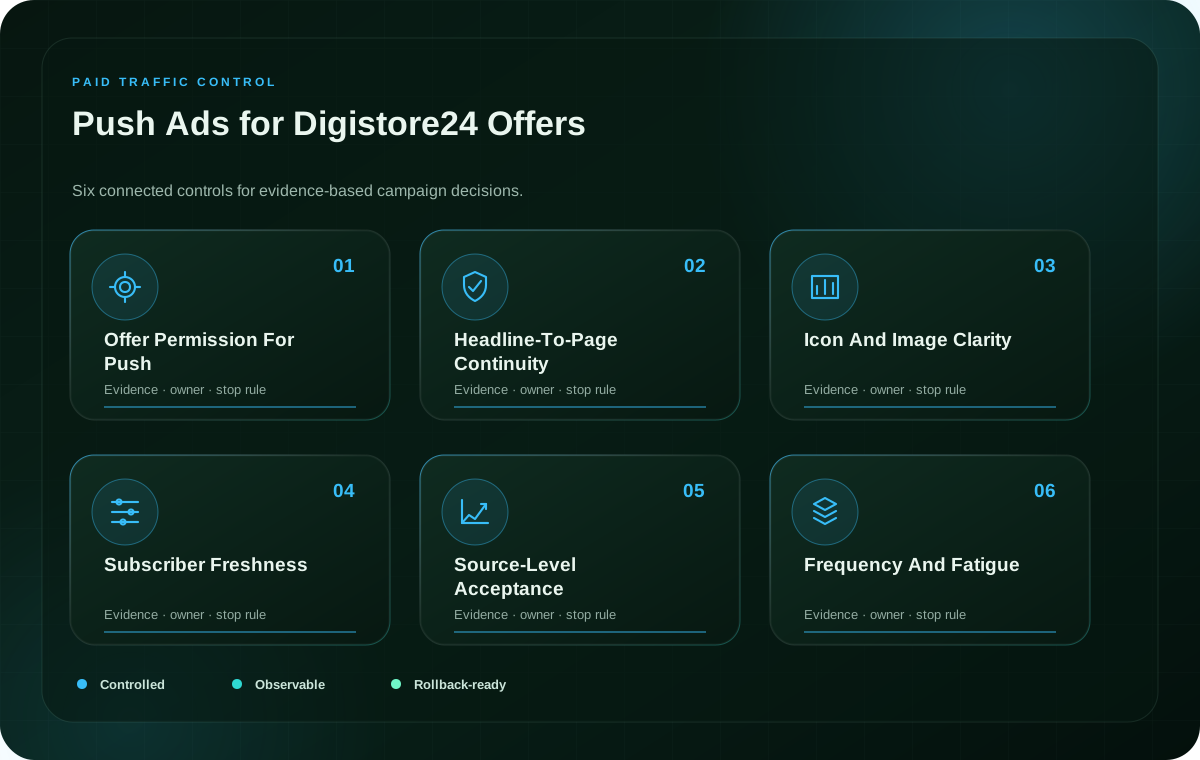
Six product and referral checks

Six checks before buying product visits

Keep product identity, affiliate attribution and media assessment as related records with separate jobs. The product identifies what was bought; the affiliate relationship establishes whose referral can earn credit; the media record explains the purchase you made to introduce it. Losing one of these relationships limits the conclusion available from the others.

Product purchase review
EvidenceOwnerReview boundary
01

Confirm the vendor and promotion arrangement

Confirm your vendor partnership and the promotional methods allowed for the specific product. Account access or an available marketplace listing does not settle every paid promotion question. Keep the current vendor instructions and your intended message together before purchasing visits.

EvidenceActionLimit
02

Verify the product referral

Use the product and affiliate link generated for your active partnership. Check the intended destination and the supported referral evidence before treating page arrival as proof that a resulting purchase will be attributed to you.

EvidenceActionLimit
03

Match the customer commitment

Match the notification to the product, price basis and access or recurring conditions the customer will encounter. A clearer promise helps prospective buyers understand the next step and makes the resulting campaign response easier to interpret.

EvidenceActionLimit
04

Keep the source relationship usable

Retain the supported source and campaign references beside the affiliate records they can actually match. Where a relationship is missing, report that limit and avoid assigning unmatched transactions to a source by assumption.

EvidenceActionLimit
05

Choose the commission assessment

State the commission model, adjustments included and the assessment date. Compare purchases at a similar stage so a recent credit is not treated as final value while an older cohort carries later changes.

EvidenceActionLimit
06

Protect the purchase allowance

Choose a separate campaign allowance from your offer economics and the question you want answered. Set a review instruction before buying so another operator knows what evidence supports continuing, repairing or proposing another limited allocation.

EvidenceActionLimit
A useful checkpoint: connect each finding to a practical product, referral or media decision.

A separate campaign allowance: Choose an amount your offer economics and review capacity can support. Our published push starting bid is $0.003 CPC, while the published minimum deposit is $50. Confirm current live conditions; those entry figures do not state a suitable test budget or the cost of an attributed sale.

From offer to allocation

Eight steps from product brief to the next media allocation

Use the eight steps below to prepare one product purchase comparison. Each step gives the next operator enough context to understand the offer, the referral and the commercial observation. Preserve the useful evidence instead of treating a completed checklist as a promise of sales.

PrepareCheckPurchaseReview
  1. 1

    Define the attributed commission observation

    Define the result before buying traffic: an attributed transaction, its credited commission and the adjustments applicable to that commission model. State the assessment date and any unresolved items. This gives the campaign reviewer a consistent basis for deciding whether the purchase merits more attention or a change.

    Keep vendor permission with the promotion version.
  2. 2

    Confirm the product and promotional arrangement

    Check the vendor's product, active partnership and permitted promotion. Inspect the actual sales and order-form journey for the countries and devices you intend to buy. Match the customer's commitment to the proposed push message, including price, recurring terms and material eligibility conditions.

    Compare customer eligibility with the offer conditions.
  3. 3

    Map the generated affiliate link to the customer journey

    Map the invitation to the generated affiliate link and its intended destination. If you need an intermediate explanation, use the supported content-link arrangement appropriate to that route. Keep product identity and the referral intact; do not improvise a new checkout URL merely because the final order form loads.

    Verify product identity and affiliate attribution.
  4. 4

    Choose a product comparison the records can explain

    Split comparisons where the product, message or customer journey genuinely differs. Record the buying conditions and the affiliate campaign key used for each comparison. Avoid dozens of tiny groups that cannot answer a useful commercial question after the available allowance has been spent.

  5. 5

    Prepare the first focused FroggyAds purchase

    Prepare your selected push delivery type in FroggyAds with truthful creative, essential targeting, a bid and a campaign budget. Check the current fields and account requirements. Verify the referral route through the permitted test process before treating paid purchases as evidence for a source recommendation.

  6. 6

    Assess the matched product and source evidence

    Review a source alongside the product and message it carried. Inspect spending, supported referral matches and the attributed commission basis. A source with more clicks can still leave less useful affiliate value; unmatched orders cannot be assigned to it by guesswork.

  7. 7

    Apply the adjustments for the actual commission model

    Revisit the original transactions when applicable refunds, chargebacks or other adjustments appear. Use the actual commission agreement, because the published contract we reviewed distinguishes designated CPA promotions from the ordinary refund-adjustment rule. Keep the model and the review date visible instead of applying one formula to every product.

  8. 8

    Review the added media allocation

    Make one justified change after the review, such as a clearer product benefit or a narrower eligible audience. Compare the added purchase on its own as well as within the earlier history. If the product or customer commitment changes, reassess that context before relying on the previous result.

Review before increasing: keep the added purchase tied to the product and commission evidence that supports it.
Attributed value and assessment

Read attributed commission alongside the product purchase

Commission belongs to the affiliate: Your review needs the credited amount and its applicable adjustments, not the vendor's full sales revenue. Use one currency and a consistent transaction scope. Record excluded costs so a positive balance after media is not presented as company profit.

Referral conditions matter: A working sales page does not prove that the buyer will be attributed to you. Check the generated affiliate link, partnership and supported attribution path. An order can be real while its relationship to your paid visit remains unproven.

Assess at a stated date: Keep earlier credits distinguishable from later changes. A young cohort may look stronger simply because its adjustments have not yet appeared. Compare purchases at a similar assessment stage and retain updates when the original commercial observation changes.

A customer commitment: The invitation should accurately introduce the product the customer can buy. Examine price conditions and access terms together, including any recurring commitment. Repair a mismatch between the message and the destination before spending to repeat it.

Compare a consistent commission basis: Match the commission definition and cost scope across the purchases being assessed. Then investigate whether a cheaper initial order still leaves worthwhile affiliate value after the relevant adjustments.

Push Ads for Digistore24 Offers premium campaign control framework
Evidence and next instruction

Turn product evidence into a buying instruction

Product questionEvidence to retainReason to investigateNext buying instruction
Promotion arrangementCurrent product and vendor instructionsThe intended paid message is not coveredResolve the arrangement before purchasing visits
Customer commitmentMatching notification, sales page and order formA price, access or recurring condition changesReview the affected message and destination version
Referral pathGenerated link and permitted attribution checkArrival works but the affiliate relationship is unverifiedCheck the referral before drawing an earnings conclusion
Source relationshipSupported media references matched to attributed businessOrders cannot be reliably assigned to the sourceLimit the source comparison to supported matches
Commission assessmentApplicable model, adjustments and assessment dateRecent credits are compared with older adjusted recordsUse a consistent scope and observation stage
Added allocationNew spending and the corresponding attributed amountThe combined average conceals a weak expansionReview the extra purchase before increasing again

The table provides buying instructions around the observed evidence and the next action. Use it to find the handoff that needs attention. Its purpose is to clarify an actual decision, rather than give the campaign a decorative readiness score.

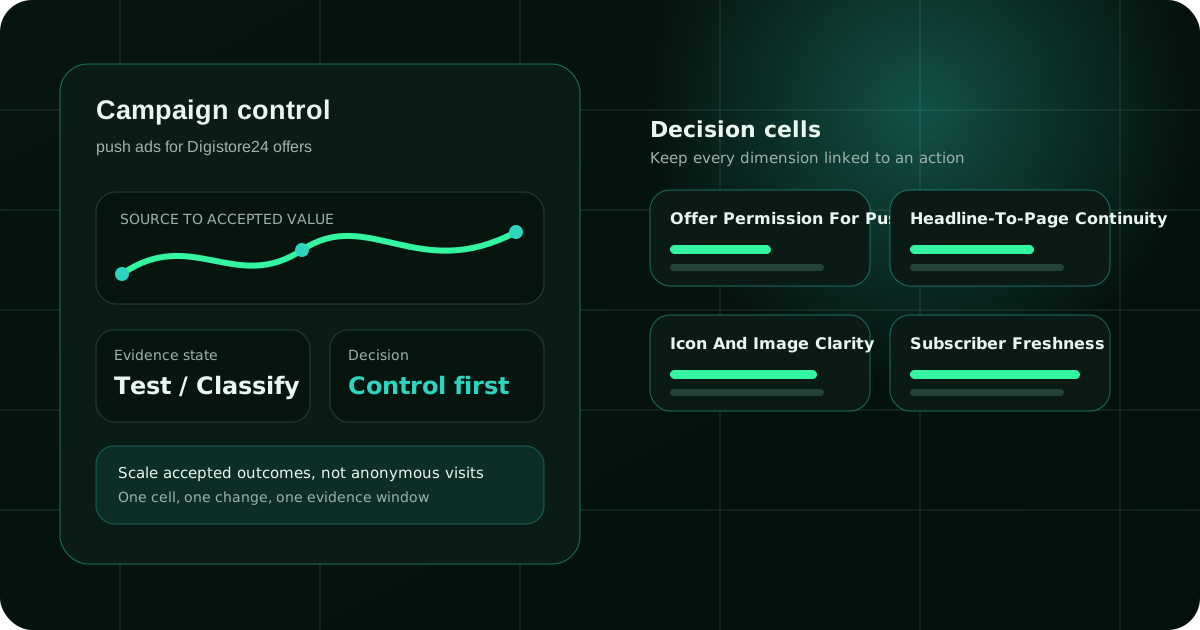
Use the illustrations to organise review questions, not to infer campaign results. Their dashboard labels and bars are planning aids; inspect the available settings and actual records for this purchase.

Different product decisions

Apply the commission review to the actual product need

Apply this approach to the product decision you are actually buying. A new digital product, a recurring subscription and a changed destination can require different evidence. Keep the offer version and customer commitment visible when comparing their responses.

New product

Introduce a new digital product

For a new product introduction, choose one understandable benefit and verify what the customer receives after purchase. The first campaign should help you learn whether that proposition attracts suitable visitors, while the affiliate record establishes which resulting transactions are attributed to you.

Retain the sales-page version beside the message version used to introduce it. A change in product access, available content or the advertised package can alter the customer's decision. Document the change before interpreting a different conversion rate as a creative improvement.

A new product needs a realistic assessment period and a defined review owner. Give the reviewer enough time to inspect the purchase records and any relevant adjustments. An enthusiastic launch response does not establish durable commercial value by itself.

Prepare the invitation around the actual customer benefit and next step. Avoid implying a free product when the destination sells access, or presenting a purchase as a simple information request. The customer should recognise the proposition immediately after the click.

Interpret the first purchase: Compare the message's response with attributed business on the declared commission basis. If the first allowance cannot answer the question, report that limit and decide whether another bounded comparison is justified. More volume alone does not repair unclear attribution.

Recurring commitment

Explain a recurring subscription commitment

For a subscription, distinguish the initial transaction from future recurring payments. Check what the current offer and your commission arrangement actually support. Use observed credits for the review period instead of assuming that every first buyer will remain active for a projected lifetime.

Make renewal conditions clear: The push promise and destination should describe the same customer commitment. A strong initial response is less useful when visitors encounter an unexpected recurring payment. Review the explanation before changing the audience to compensate for a product misunderstanding.

An explanatory page

Compare a useful bridge-page explanation

A bridge page should add useful product context before the vendor's destination. Compare explanations only when their referral routes remain valid and their underlying offer is comparable. The extra page should help the customer decide, rather than hide a different proposition behind a more attractive invitation.

Keep the handoff observable: Trace the supported affiliate reference through the intermediate page to the intended destination. If the relationship cannot be checked, limit the conclusion available from the resulting orders and resolve the handoff before making a narrow source allocation.

Commission-led allocation

Allocate from the applicable commission record

For an allocation review, connect media spending to the credited affiliate amount after the adjustments that apply to that offer. State the transaction scope and assessment date. This makes the question answerable even when the business has not yet received a cash payout.

Inspect the amount left: An affiliate's adjusted commission and media spending describe different sides of the purchase. Subtract the latter on the scope you declared, then name other costs still excluded. A positive difference is an observation for that cohort, not a guaranteed future yield.

Practical review questions

Practical questions for the product and commission review

Follow the specific product, referral and commission question raised by the campaign. Give the next media action a reason another operator can reproduce.

Choose a product benefit you can explain

Choose a product whose benefit you can explain accurately in push space. Let the destination supply the detail needed for an informed purchase.

Check the product's real location, language, device and fulfilment requirements. Apply available targeting where it resolves those constraints, rather than assuming that an audience label establishes suitability.

Set an allowance and a pause instruction

Set the allowance against the question being bought and the loss you can tolerate. Monitor spending beside the customer records used for the review.

Write a pause instruction for a broken referral route or an unsupported offer promise. Commercial underperformance needs its own assessment boundary, but a destination mismatch can call for immediate attention. Record the affected version and the reason before restarting.

Compare audience response with affiliate value

Read click-through rate as invitation response. Compare attributed commission and media at matching scope before treating a busier notification as a commercially stronger purchase.

Retain the message version and product destination when results weaken. If both changed together, inspect the journey before attributing the difference to creative fatigue.

Check the referral through the customer journey

Follow the generated product link through the permitted test process. Keep that observation distinct from genuine customer transactions and recorded affiliate commission.

Verify the intended product relationship and affiliate reference. Arrival establishes a page load; the supported referral check answers whether the attributed path is correct.

Assess sources at a comparable commission stage

A useful source comparison joins media spending to attributed business without inventing missing relationships. State which campaign keys or other supported references match and where they stop. A campaign-level result cannot fill the gaps in a source ranking.

When comparing cohorts, preserve the commission model and the assessment date. An earlier group may have experienced adjustments that a recent group has not. Use comparable observation stages before calling the newer purchase commercially stronger.

Keep the product promise and destination aligned

Before changing the buying audience, inspect whether the vendor has altered the package, price or access commitment. Reconcile that destination version with the notification so a product change is not misread as an audience problem.

Record what changed and when after a vendor update. Recheck the invitation before using an earlier result to justify more media for a revised package.

Revisit the original orders when adjustments appear

Reconcile transactions and commission movements before recommending more media. Preserve the original credited amount and each relevant adjustment on its order reference. Distinguish an unresolved attribution question from a transaction whose commission has genuinely changed.

A review should identify the affected cohort and its current balance. Keep adjustments attached to the original purchase period where possible. Treating every later negative entry as a result of today's traffic can lead to an unsupported campaign change.

Decide when the evidence is sufficient

Close the review when the evidence supports the stated decision. Name remaining uncertainty and its scope; a limited buying conclusion does not require pretending every record is final.

Check the declared inclusion rule and the remaining unknowns before presenting an adjusted total. Avoid excluding awkward records merely to improve the result. If some items are unresolved, show the supported observation and the narrower decision available now.

Reassess a changed offer or referral arrangement

Reassess the purchase when the offer arrangement or attribution route changes. The earlier result may remain a valid historical observation while becoming a poor basis for another allocation. Document the break in comparability rather than silently combining both periods.

Recheck a changed commission model or customer commitment before ranking the new cohort. A lower media cost cannot establish that the revised product leaves more affiliate value.

Expand the purchase the records support

Increase only the purchase your records support. Keep the product and essential offer conditions stable while testing one material media change. Compare added spending and its attributed business before requesting a further increase.

Retain the new allocation beside the earlier baseline. A strong first purchase can conceal weaker expansion in a combined average. Review the increment on its own, including the relevant commission adjustments and any changed destination conditions.

Give the next operator one clear instruction

End the review with one instruction: retain the campaign, investigate a specified handoff, wait for assessment or propose another limited purchase. Give that instruction an owner and a spending boundary. A broad request to improve every metric does not define the next test.

Use matched records and a stated decision when handing the campaign to another operator. The record should explain why the next action follows from the evidence, including any uncertainty that limits its scope.

Make the bridge page useful to the customer

Build a bridge page only when it adds accurate product context. Verify the supported content-link arrangement and the customer commitment before adding another handoff to the purchase.

Compare the customer's next step with the message that introduced it. If visitors expected free information but arrive at a purchase commitment, repair the explanation. A clearer journey can be a better next test than expanding the audience around a misleading invitation.

Media controls in context

Use FroggyAds controls for the product buying decision

Choose FroggyAds to turn the product brief into an actionable traffic purchase. Our self-serve workflow brings supported push delivery, targeting, bids, budgets and source controls together.

Select the delivery type: Keep classic and in-page results distinguishable when their different surfaces affect the journey. Inspect the supported creative fields on the devices you intend to buy.

Use relevant targeting: Apply available settings to the actual product route. They define the media purchase; they cannot establish that every recipient qualifies for the offer.

Prepare the creative comparison: Test a different product benefit or truthful invitation while retaining the customer commitment. Keep both versions identifiable so the next response can be investigated.

Monitor the purchase: Tie the campaign budget and review limit to an answerable question. Compare actual spending with attributed business; the entry bid does not forecast transaction cost.

Retain source evidence: Use the media source and its supported match for a narrow allocation. Report a broader observation when the affiliate record cannot establish that relationship.

Act on the finding: Bring the observed issue into a limited change through our campaign controls. Repair a broken handoff before buying more visits through the same problem.

Revisit a changed offer: Check the customer commitment and vendor conditions after an update. Preserve the earlier result with its original product version before recommending another purchase.

Assess affiliate value: Use commission credit and applicable adjustments, rather than full product revenue. Retain the scope and date needed to reproduce the amount left after media.

Inspect customer context: A valid order record cannot explain the entire customer experience. Investigate the destination and reported issues before assigning a weaker result to one source.

Keep expansion affordable: Hold added spending inside the current buying case. Review what the new allocation produced before using a healthy historical average to support another increase.

Maintain the referral: Map the supported campaign key to the product relationship. Use the generated link and verify its journey; an improvised parameter does not establish attribution.

Choose FroggyAds for execution: Use our self-serve workflow to test the prepared product message and audience. Your attributed business records then explain which media opportunity deserves another allocation.

What the evidence can establish

Keep the purchase within its evidence limits

Traffic can produce observable response under stated buying conditions. Keep the product and commission measure central; a media purchase cannot make every customer suitable.

Combine traffic evidence with affiliate records. Explain which relationships match and use that scope to decide whether to repair, continue learning or consider expansion.

Use actual customer records and declared costs for the review. The invented example explains arithmetic; it predicts neither FroggyAds performance nor Digistore24 commissions.

Repair a broken offer route or referral handoff before further affected buying. Retain the finding and verify the repair before opening a new comparison.

Affiliate buyer questions

Digistore24 push questions from affiliate buyers

Can I promote a Digistore24 product with push traffic?

Offer permission: Use push only for a product and promotional arrangement you have confirmed with the relevant vendor instructions. Verify the active affiliate partnership and the intended message, audience and destination. Keep the approval context with the campaign rather than assuming that marketplace access settles every paid traffic condition.

Should I choose classic web push or in-page push?

Delivery choice: Test classic web push and in-page push according to the actual presentation selected in FroggyAds. They use different delivery contexts. Keep the comparison tied to the same product and declared commission basis instead of treating every notification-like placement as an identical audience.

What should the product notification explain?

Message preparation: Introduce the real product benefit and the actual next action. Keep price, access and recurring conditions consistent with the destination. A compact notification should help an interested person recognise the offer, rather than use a vague reward or artificial urgency to generate a tap.

When does a prelander help?

Destination context: A prelander can help when it gives the customer useful, accurate information before the vendor's offer. Use the supported content-link arrangement for that journey and check the referral path. The extra page should clarify the product and commitment without hiding a different destination or unsupported claim.

Which commercial amount should an affiliate assess?

Commercial measure: Assess the attributed commission on the basis applicable to that offer, including relevant adjustments and the review date. Product revenue and affiliate earnings are different amounts. Compare the media spending from the same cohort, and state the costs or unresolved records still outside the calculation.

How should I compare push traffic sources?

Source assessment: Compare matched media records with attributed business at a similar assessment stage. Retain the product, message and commission model behind each purchase. Where the source relationship is incomplete, state that limit instead of distributing unmatched orders across sources as though the join existed.

When should I change the creative?

Creative review: Refresh the invitation when evidence identifies a message problem or a changed offer. Keep an approved baseline where appropriate and inspect the destination. If several conditions changed together, record that the comparison cannot isolate creative fatigue before choosing the next test.

Can a push purchase guarantee affiliate earnings?

Outcome limits: No traffic purchase guarantees customer orders or affiliate profit. FroggyAds gives you practical media controls for a purposeful comparison. The product, customer journey, referral conditions and actual commission record determine what the purchase can show. Choose an allowance you can assess and use that evidence to guide the next step.

How should I investigate a weak commercial result?

Quality investigation: Inspect the specific problem behind a weak commercial result: customer eligibility, destination mismatch, attribution loss or later commission adjustment. These findings call for different repairs. Avoid describing every missing credit or refunded order as invalid traffic without investigating the relevant records and conditions.

When should I increase the campaign allowance?

Expansion decision: Consider another allocation after the offer context and matched evidence support further buying on the declared commission basis. Review the added purchase separately and keep later adjustments visible. If the product or referral arrangement changes, reassess that context before relying on the earlier result.

Resolve the next setup question

Resources for the next product buying question

Buy push traffic

Use the push buying guide to prepare the supported delivery type, creative fields and campaign controls. Return to your product and affiliate arrangement when deciding how those general settings apply to the next purchase.

Review push delivery and creative

Review the classic and in-page delivery contexts, available creative fields and device checks. Use those details to prepare the selected presentation while keeping the actual product and affiliate arrangement as the buying brief.

Traffic for Digistore24 offers

Use the wider Digistore24 traffic guide when the unresolved question is which source or acquisition route fits the product. Return to the commission basis and customer commitment before adapting a general recommendation.

Check the push format

Check the push format before changing a product message to fit it. Confirm the supported assets and destination route, then use your own campaign evidence to decide which presentation deserves another comparison.

Your next product traffic test

Bring the product and referral brief into FroggyAds

Choose FroggyAds when you are ready to turn a clear product brief and a usable affiliate record into a focused push purchase. We help you control the media opportunity. Your commission assessment explains which traffic deserves another allocation and which handoff needs attention first.

Create your free FroggyAds account
The attributed-commission decision

Keep the next purchase tied to attributed commission

A product-specific question: Connect the invitation to the affiliate referral and the commission observation. Decide which evidence supports the next purchase instead of treating every transaction count as equal value.

Record the product and message versions, commission model, adjustment scope and assessment date. Preserve missing relationships rather than building an apparently complete source report from assumptions.

Use one consistent basis: Keep the commercial definition stable across comparisons. Explain a changed commission arrangement or cost boundary before presenting the new result as an improvement.

Check the attribution role: Digistore24 distinguishes an affiliate campaign key from a vendor tracking key. Use the supported field for your role and verify its mapping to the media record.

Define the cost boundary: Compare adjusted commission with matching media spending, then name excluded overhead, creative work and other costs. The resulting difference is a scoped observation, not automatically profit.

Assign the next buying action: Give the reviewer a reason to repair a handoff, inspect an unmatched record, wait for assessment or propose a limited allocation. Keep the instruction tied to the actual product purchase.

Amount or recordWhat it explainsLimit to retain
Initial commission creditThe amount recorded before the adjustments in this example.It is not necessarily the current balance or cash received.
Adjusted commissionThe credit remaining after the adjustments applicable to the declared scope.Use the actual offer model; the same refund formula does not apply to every promotion.
Difference after mediaThe adjusted commission less matching media spending.Other business costs remain excluded unless explicitly included.

Worked example: initial commission differs from the current balance

Hypothetical commission example: Suppose one cohort records $180 in affiliate commission credits. Applicable adjustments later reduce those credits by $60, leaving $120 at the stated review date. With $100 in matching media spending, the difference is $20 before other costs. Using the initial $180 would have suggested $80, overstating the current difference by $60. This invented example assumes an arrangement where those adjustments apply; it is not a universal CPA formula, cash-payout forecast or FroggyAds result.

Choose FroggyAds for your next product traffic test

When the product and referral route are ready, create your free FroggyAds account and prepare one useful push comparison. We give you the practical media controls to act on a supported finding, while your affiliate record explains the commercial observation.

Further context: the MediaRevive affiliate-traffic discussion and ClickBank paid-traffic overview are separate external resources. They do not establish Digistore24 permissions or FroggyAds features. Use the applicable vendor instructions and your actual affiliate records for this purchase.

Your next useful purchase

Make the Digistore24 buying question answerable

Confirm the product arrangement, the honest invitation and the supported affiliate referral before buying push traffic. Define the commission basis and review date, then use FroggyAds to test one meaningful purchase with an affordable allowance. Let the actual attributed business guide the next allocation.