Self-serve campaign planning

Offer Promotion Services: Self-Serve and Managed Options

Compare offer promotion services, managed buying and self-serve campaign platforms. Learn what to evaluate, track and control before spending.

20B+ daily impressions750+ SSP integrations$50 minimum deposit7-day Money-Back Guarantee
Offer Promotion Services: Self-Serve and Managed Options campaign planning dashboard
Direct answer

What should buyers know about offer promotion services?

Within the offer promotion services operating plan, checkpoint 1 is straightforward: Offer Promotion Services can describe an agency, a managed media-buying team, or a self-serve advertising platform. FroggyAds is a self-serve DSP: the advertiser creates the campaign, chooses targeting, funds the account, reviews source-level data and decides what to pause or scale. That model is useful when affiliate marketers, media buyers, performance agencies and direct-response advertisers want direct control instead of outsourcing every decision.

At checkpoint 2, a offer promotion services team should apply this rule: The useful benchmark is not raw traffic volume. It is whether the campaign can connect cost to earnings per click, conversion rate, approved conversion rate, CPA and net margin while keeping targeting, creative and source decisions auditable.

Operating model

Choose the operating model before choosing a provider

Define how control, measurement and responsibility move through the campaign before comparing prices or traffic volume.

Control and ownership

Searches for offer promotion services often combine three different needs. Some buyers want an agency to plan and operate the campaign. Others want a managed traffic desk that executes against a brief. A third group wants self-serve infrastructure and keeps strategy, creative and optimization in-house. The commercial terms can look similar while control, learning speed and accountability are very different.

Measurement and evidence

The offer promotion services evidence review reaches checkpoint 3 here: A managed provider can reduce workload, but the buyer should still know who owns the account, which source identifiers are available, how conversion data is passed and whether campaign learnings remain portable. A self-serve platform places more work with the advertiser, yet it also makes bids, caps, targeting and source decisions visible. FroggyAds follows the self-serve model and does not present itself as a done-for-you agency.

Economics and workload

For affiliate marketers, media buyers, performance agencies and direct-response advertisers, the key question is not merely who launches the ads. It is whether the operating model can preserve the evidence needed to improve earnings per click, conversion rate, approved conversion rate, CPA and net margin. Write responsibilities before launch: who supplies creative, who verifies the destination, who owns tracking, who reviews sources and who approves budget changes.

Campaign architecture

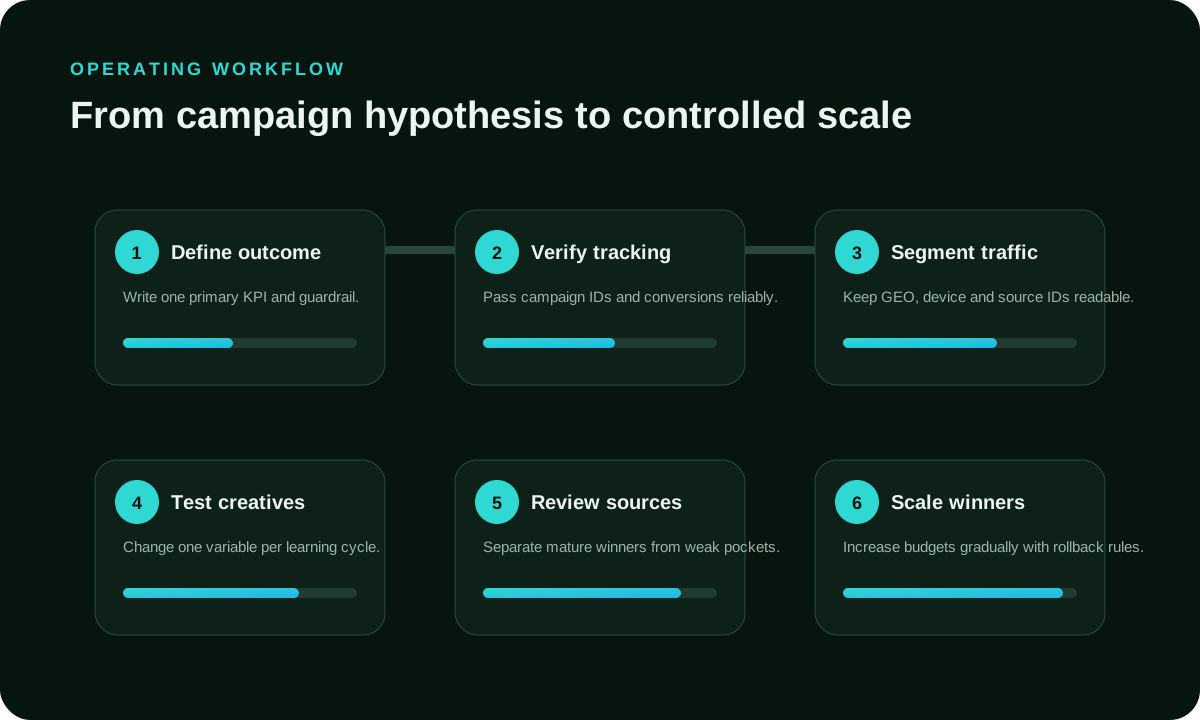
Use a six-stage learning loop

Keep the first campaign readable. Each stage should produce evidence for the next decision instead of adding complexity for its own sake.

Define the outcome

Select a verified lead, sale, registration, install or another payable offer event and write the acceptable acquisition cost, attribution window and business guardrail.

Validate tracking

Test the click path, campaign parameters and conversion signal. Confirm that cost can be connected to source-level results.

Segment deliberately

Separate GEO, device, operating system, browser and meaningful audience groups without fragmenting the budget too early.

Test creative cleanly

Change one material variable at a time: promise, image, headline, call to action or destination sequence.

Review mature sources

Compare placements only after the selected conversion has had time to mature. Keep a decision log for exclusions and bid changes.

Scale with rollback rules

Increase budgets in controlled steps, preserve the winning baseline and reverse changes when CPA or quality leaves the accepted range. On this page, use the point specifically to decide whether this option fits the buyer's acquisition workflow; keep Offer Promotion Platform for its separate neighboring task.

Six-stage offer promotion workflow
Format selection

Assign every ad format a specific job

Offer promotion does not require every available format. Select the format that matches the amount of explanation, the user context and the conversion path. For Offer Promotion Services, validate this point against Offer Promotion Services, Offer Promotion, Promotion Services and keep it separate from the Offer Promotion Platform intent.

FormatBest campaign roleTesting ruleDecision signal
Push AdsDirect response with concise copy and fast creative iteration.Test push ads separately so its bid, creative and source data remain readable.Judge with earnings per click and the verified conversion.
Pop AdsHigh-volume testing where the destination can qualify users quickly.Test pop ads separately so its bid, creative and source data remain readable.Judge with earnings per click and the verified conversion.
Native AdsContextual discovery and pre-education before the click.Test native ads separately so its bid, creative and source data remain readable.Judge with earnings per click and the verified conversion.
Direct ClickA direct route to the destination for offers that can qualify immediately.Test direct click separately so its bid, creative and source data remain readable.Judge with earnings per click and the verified conversion.
Practical rule: do not combine formats in one reporting bucket. Different placements, creative constraints and user contexts need separate bids and separate quality decisions.
Targeting and destination

Protect relevance before trying to buy more reach

The audience and destination should explain why the user should continue after the click.

Targeting design

For checkpoint 4 in this offer promotion services workflow, use this standard: Start with the markets and devices that the destination can genuinely serve. Keep language, operating-system and browser compatibility aligned. Use source IDs to identify performance pockets, but avoid building a whitelist before the discovery campaign has enough evidence.

A disciplined offer promotion services program treats checkpoint 5 as follows: For affiliate marketers, media buyers, performance agencies and direct-response advertisers, useful segmentation often includes GEO, device type, connection, browser and the campaign source. Add audience criteria only when the segment has a clear message or measurable hypothesis.

Destination design

Checkpoint 6 connects offer promotion services execution to the next decision: The preferred destination is a compliant pre-lander or offer page that accurately sets expectations and passes campaign parameters. Repeat the promise made in the ad, remove competing calls to action and show the user the next step before asking for data or payment.

The measurement record for offer promotion services should capture checkpoint 7: Measure page speed and redirect latency on the devices being purchased. A technically valid page can still waste traffic if the message changes between creative and destination or if the important content appears too late.

Budget and measurement

Turn the budget into decision thresholds

A test budget should buy enough information to decide what to change. Separate discovery, validation and scaling money so early exploration does not consume the capital reserved for proven sources. For Offer Promotion Services, validate this point against Offer Promotion Services, Offer Promotion, Promotion Services and keep it separate from the Offer Promotion Platform intent.

StageBudget purposeWhat to monitorDecision
Technical validationConfirm delivery, parameters and conversion recording.Clicks, redirects, event duplication, device compatibility.Fix technical errors before judging traffic.
DiscoveryFind responsive creatives, sources and audience pockets.earnings per click, conversion rate, approved conversion rate, CPA and net margin.Pause mature weak combinations and preserve useful samples.
ValidationRepeat the winning pattern with controlled changes.CPA stability, approval quality and downstream value.Move candidates to a whitelist only after repeatable evidence.
ScalingIncrease spend without breaking unit economics.Marginal CPA, conversion lag, frequency and source mix.Raise caps gradually and roll back when guardrails fail.
Platform evaluation

Score control, evidence and economics together

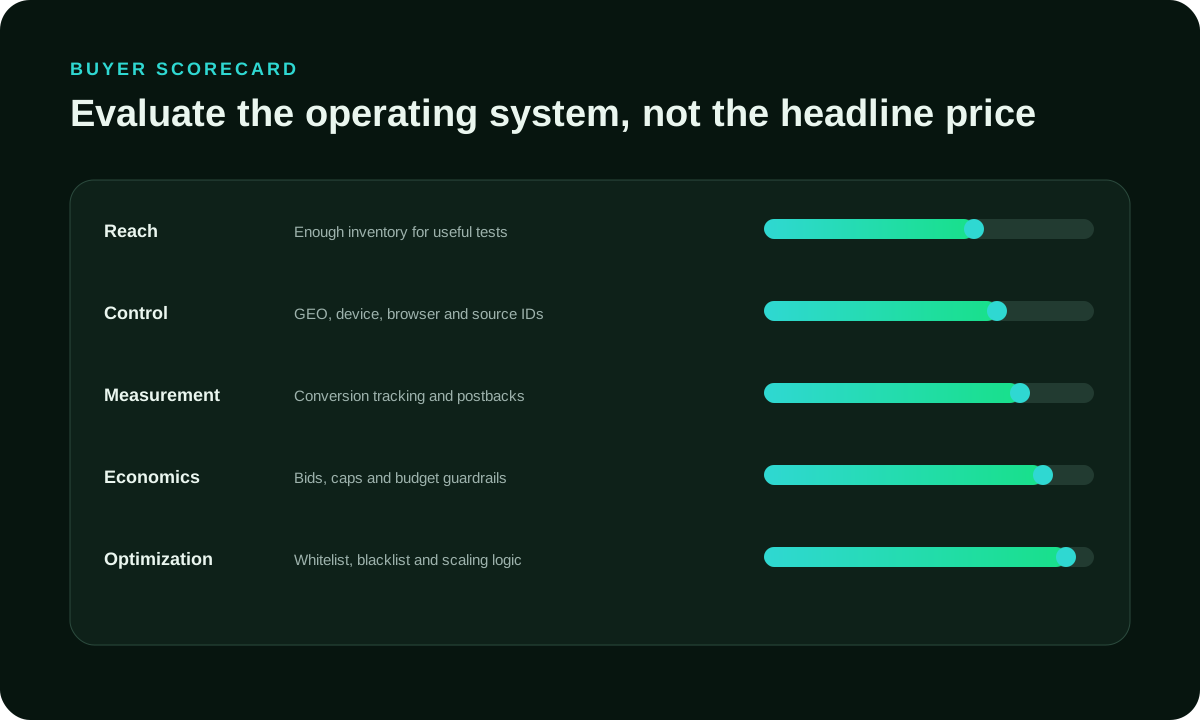
A platform should make it easier to discover why a campaign worked, not merely show that money was spent.

Offer Promotion Services: Self-Serve and Managed Options qualitative platform scorecard
Reach and fit

Check whether inventory exists for the required GEOs, devices and formats, then confirm that the campaign can be segmented without losing statistical usefulness.

Transparency and control

Look for source identifiers, bid control, caps, whitelists, blacklists and exportable reporting. A buyer should be able to explain every major change. On this page, use the point specifically to decide whether this option fits the buyer's acquisition workflow; keep Offer Promotion Platform for its separate neighboring task.

Measurement and support

Verify conversion options, documentation, approval workflow and access to help. Operational friction is part of total campaign cost.

Illustrative planning model

Example: move from discovery to evidence-led scale

This scenario is a planning example, not a customer result or performance promise.

Week 1: establish the baseline

Before changing budget in a offer promotion services campaign, review checkpoint 8: Launch two creative concepts across a limited set of compatible devices and one primary conversion. Keep bids close enough to compare sources fairly. Confirm that the destination can support a lead-generation, ecommerce, software, travel or subscription offer and that every conversion reaches the reporting system once.

At the end of the week, separate technical failures, immature traffic and sources with enough spend for a decision. Keep a discovery campaign running rather than forcing every placement into a permanent conclusion. For Offer Promotion Services, validate this point against Offer Promotion Services, Offer Promotion, Promotion Services and keep it separate from the Offer Promotion Platform intent.

Weeks 2–4: validate and scale

The quality-control sequence for offer promotion services includes checkpoint 9: Duplicate the strongest pattern into a validation campaign with a narrower source set. Introduce one new creative or audience variable per cycle. Compare the marginal CPA after each budget increase, not only the blended historical average.

At this stage of offer promotion services, checkpoint 10 keeps the test comparable: When the campaign remains inside the accepted range for earnings per click, conversion rate, approved conversion rate, CPA and net margin, increase caps gradually. Preserve the earlier working version so the team can roll back quickly if source mix or conversion quality changes.

Common failure modes

Avoid the decisions that erase campaign learning

Scaling before approval quality, payout rules and traffic-source performance have matured is the central risk. The following mistakes make that risk harder to detect. For Offer Promotion Services, validate this point against Offer Promotion Services, Offer Promotion, Promotion Services and keep it separate from the Offer Promotion Platform intent.

Too many variables

Launching many GEOs, formats, devices and creatives at once creates a large report but weak evidence. Keep the first matrix small enough to read. For Offer Promotion Services, validate this point against Offer Promotion Services, Offer Promotion, Promotion Services and keep it separate from the Offer Promotion Platform intent.

Click-only optimization

A high CTR can coexist with poor conversion quality. Connect creative response to the verified business event and downstream value.

Premature blacklisting

Do not block a source after a few non-converting clicks when the normal conversion lag is longer. Use mature thresholds and document the reason. For Offer Promotion Services, validate this point against Offer Promotion Services, Offer Promotion, Promotion Services and keep it separate from the Offer Promotion Platform intent.

Uncontrolled scaling

A large cap increase can change the source mix and marginal CPA. Scale in steps, retain a baseline and define rollback triggers in advance. For Offer Promotion Services, validate this point against Offer Promotion Services, Offer Promotion, Promotion Services and keep it separate from the Offer Promotion Platform intent.

Destination mismatch

Ads that promise one thing and pages that present another create low-quality sessions even when the traffic is human and technically valid. Use this check to advance the Offer Promotion Services: Self-Serve and Managed Options task to decide whether this option fits the buyer's acquisition workflow. If the reader needs Offer Promotion Platform, route that decision to its own page.

No ownership model

When nobody owns tracking, creative rotation or source review, optimization becomes reactive. Assign responsibilities before the first impression. Use this check to advance the Offer Promotion Services: Self-Serve and Managed Options task to decide whether this option fits the buyer's acquisition workflow. If the reader needs Offer Promotion Platform, route that decision to its own page.

Frequently asked questions

Questions about offer promotion services

Use these answers to turn the search intent into a practical campaign brief.

What is offer promotion services?

Within the offer promotion services operating plan, checkpoint 11 is straightforward: Offer Promotion Services can describe an agency, a managed media-buying team, or a self-serve advertising platform. FroggyAds is a self-serve DSP: the advertiser creates the campaign, chooses targeting, funds the account, reviews source-level data and decides what to pause or scale. That model is useful when affiliate marketers, media buyers, performance agencies and direct-response advertisers want direct control instead of outsourcing every decision.

How should a first offer promotion test be structured?

At checkpoint 12, a offer promotion services team should apply this rule: Choose one primary conversion, one or two GEO groups, a limited device set and a small creative matrix. Verify tracking before meaningful spend, then let conversions mature before judging source quality. The first test should answer a specific question rather than attempt maximum scale.

Which FroggyAds formats fit offer promotion?

The offer promotion services evidence review reaches checkpoint 13 here: Common options include Push Ads, Pop Ads, Native Ads and Direct Click. The choice depends on the amount of explanation required, the destination, the target device and whether the campaign values broad reach, immediate response or contextual attention.

How do I measure traffic quality?

For checkpoint 14 in this offer promotion services workflow, use this standard: Track more than clicks. Use earnings per click, conversion rate, approved conversion rate, CPA and net margin, inspect source-level results and compare early events with mature business outcomes. Quality is the relationship between cost and verified value, not a label applied to an impression in isolation.

What budget should I start with?

A disciplined offer promotion services program treats checkpoint 15 as follows: Use a bounded test budget tied to the expected conversion value and the amount of data required for a decision. FroggyAds has a $50 minimum deposit, while many advertisers choose a larger working budget so they can test more than one creative and source cohort. Never scale beyond an amount the business can evaluate responsibly.

How long should I wait before optimizing?

Checkpoint 16 connects offer promotion services execution to the next decision: Remove technical failures immediately, but allow normal conversions to mature inside the chosen attribution window. Review sources at consistent checkpoints and require enough clicks or spend to make the decision meaningful. Early zero-conversion data is not always sufficient evidence for a permanent exclusion.

Can I use server-to-server postbacks?

The measurement record for offer promotion services should capture checkpoint 17: Use the conversion method that fits the funnel. Server-to-server postbacks can improve reliability for supported flows, while browser pixels may be suitable for simpler events. Test the complete path and confirm that campaign, source and conversion identifiers are passed correctly before launch.

How do I keep a low-cost campaign from attracting poor traffic?

Before changing budget in a offer promotion services campaign, review checkpoint 18: Maintain targeting discipline, source IDs, conversion tracking and explicit stop rules. Do not broaden every variable at once. Scaling before approval quality, payout rules and traffic-source performance have matured is the main failure mode, so make evidence visible before trying to make the campaign cheaper.

When is a whitelist appropriate?

The quality-control sequence for offer promotion services includes checkpoint 19: Build a whitelist after placements have accumulated enough mature conversion evidence. Keep a separate discovery campaign so the whitelist does not become static, and review whether winning sources continue to perform as bids, creatives and market conditions change.

Does FroggyAds guarantee campaign results?

At this stage of offer promotion services, checkpoint 20 keeps the test comparable: No advertising platform can guarantee a specific result. Outcomes depend on the offer, audience, market, creative, destination, bid, tracking, competition and optimization. FroggyAds provides self-serve traffic access and campaign controls; the advertiser remains responsible for the strategy and decisions.

Launch with control

Turn offer promotion services into one measurable test

Choose the outcome, verify tracking, keep targeting readable and write the stop, scale and rollback rules before spend begins. FroggyAds is self-serve, so the advertiser keeps direct control of the campaign. For Offer Promotion Services, validate this point against Offer Promotion Services, Offer Promotion, Promotion Services and keep it separate from the Offer Promotion Platform intent.

Search intent and buyer decision

Offer Promotion Services: Self-Serve and Managed Options: the buyer task this URL owns

Treat Offer Promotion Services: Self-Serve and Managed Options as an operating page for performance-focused advertisers, not as a synonym page. Its job is to help you make a measurable paid-acquisition decision, with the evidence kept against this exact decision. The nearest related FroggyAds page is Offer Promotion Platform; this URL keeps ownership of the distinct task to make a measurable paid-acquisition decision.

For Offer Promotion Services: Self-Serve and Managed Options, the operating evidence to keep visible is campaign objective, audience targeting, audience and market fit, ad format. Use these entities only when they change setup, measurement or the commercial decision.

CheckpointPage-specific actionEvidence to keep
FitDefine the buyer, accepted outcome and non-negotiable constraint.Retain evidence specific to Offer Promotion Services: Self-Serve and Managed Options and its accepted outcome.
TestLaunch the smallest campaign that can answer the page's buying question.Retain evidence specific to Offer Promotion Services: Self-Serve and Managed Options and its accepted outcome.
DecisionKeep, cap, exclude or expand from accepted-outcome evidence.Retain evidence specific to Offer Promotion Services: Self-Serve and Managed Options and its accepted outcome.

Hypothetical calculation: if a controlled campaign for offer promotion services: self-serve and managed options spends USD 100 and produces 7 accepted conversions, accepted CPA is USD 100 / 7 = USD 14.29. Replace the inputs with your own campaign economics; this is not a FroggyAds performance claim.

FroggyAds gives performance-focused advertisers a self-serve way to act on the Offer Promotion Services: Self-Serve and Managed Options decision: configure the traffic test, preserve source-level reporting and scale only after the accepted outcome supports the next step. Create your free FroggyAds account.

Direct answer

Offer Promotion Services: Self-Serve and Managed Options — what matters first

Offer Promotion Services: Self-Serve and Managed Options is most useful when it helps a buyer decide whether this option fits the buyer's acquisition workflow. Define the accepted outcome first, then use targeting, budget and source-level evidence to decide what deserves more spend.