
Google Ads location targeting guidance
Review current location targeting behavior and campaign settings.
CPM rates by country vary because advertiser demand, inventory supply, format, device, season, viewability, traffic quality and conversion value differ by market. There is no permanent highest-CPM country list. Compare the same inventory definition, currency, fee basis and maturity window, then use country-level results to guide bids, budgets and exclusions.

Quick answer: Definition: CPM rates by country compare the cost or revenue associated with one thousand eligible impressions in different geographic markets. Decision log: record the country, format, device, placement, source, date range, time zone, currency, exchange-rate source, fee basis, impression definition, validation status, CPM, accepted outcomes, sample size and every bid or budget change. A useful report contains the country, format, device, date range, currency, fee basis, impressions, viewability where available, media cost or validated revenue, CPM, accepted events, accepted-event cost, conversion delay and sample-size note.
| Section | Distinct excerpt from this page |
|---|---|
| CPM rates by country in three decisions | A lower CPM can outperform when conversion and retention are stronger. |
| What CPM rates by country means | The comparison is valid only when the impressions use a consistent definition, format, device, placement quality, date range, currency and fee basis. |
| Six factors that move country CPMs | If a lower-rate market gains qualified conversions, the campaign can become more efficient even though the CPM ranking remains unchanged. |
Reference for CPM Rates by Country: Market Comparison: Google Ads location targeting guidance.
Use the same format, device, currency, fee basis and time window.
Demand, inventory, viewability and quality can move independently.
A lower CPM can outperform when conversion and retention are stronger.
Definition: CPM rates by country compare the cost or revenue associated with one thousand eligible impressions in different geographic markets. The comparison is valid only when the impressions use a consistent definition, format, device, placement quality, date range, currency and fee basis. CPM is a pricing signal, not proof of conversion quality or total profit.
Country matters because advertising demand and inventory are not evenly distributed. Buyers value some conversion outcomes more highly, publishers have different audience mixes, devices and formats vary, and local competition changes over time. A market that is expensive for finance display campaigns may not be expensive for entertainment push traffic. A country that produces high publisher revenue on premium desktop placements may not create the same result on broad mobile inventory.
FroggyAds operates a self-serve auction environment across multiple formats and supply relationships. Live availability and prices depend on the current campaign settings. This page does not publish a guaranteed country ranking or fixed CPM table. It provides a methodology for building a benchmark that can be reproduced and updated when the underlying evidence changes.
A country list is useful for planning only when its source and definitions are visible. A figure copied from a different platform, format or year may not be relevant to the current campaign. Treat public benchmarks as a starting hypothesis and use live source-level evidence to make budget decisions.
The highest-CPM country changes by format, vertical, season and demand.
Normalize currency, fees, impressions, viewability and validation.
Use accepted conversion, revenue or retention evidence before scaling.
CPM is the output of several market and inventory variables. A benchmark becomes more useful when it explains which variable changed. If rates rise while viewability falls, the additional cost may not create more value. If a lower-rate market gains qualified conversions, the campaign can become more efficient even though the CPM ranking remains unchanged.
| Factor | What it represents | Comparison caution |
|---|---|---|
| Advertiser demand | Number and intensity of buyers competing for eligible impressions. | Can change by vertical, season and conversion value. |
| Inventory supply | Available impressions that match country, format, device and policy. | More supply can reduce price when demand is unchanged. |
| Format and placement | Display, native, push, pop, video and interstitial inventory behave differently. | Do not transfer one format benchmark to another. |
| Viewability and engagement | Whether the impression can be seen and produces useful attention. | Higher-quality placements may command different prices. |
| Traffic quality | Invalid activity, accidental interactions and low-value sources change economics. | Use accepted and filtered evidence. |
| Currency and fees | Exchange rates, platform fees and settlement terms affect the final value. | Normalize to one basis before ranking markets. |
These factors also interact. Strong advertiser demand can be offset by abundant supply. Limited premium inventory can create high prices but low scale. A mobile-heavy country can produce a different format mix from a desktop-heavy market. Viewability and traffic-quality filters can reduce the eligible impression count while increasing the value of what remains. Report these changes instead of attributing every movement to the country name.
Published lists often rank countries without explaining whether they describe advertiser cost, publisher revenue, gross bids, filled impressions, viewable impressions or collected net value. They may combine display, native, video, push and pop inventory even though the auctions and user contexts differ. A ranking can therefore look precise while comparing incompatible data.
Mature markets with strong advertiser competition frequently appear near the top of public lists, but that pattern is not a campaign guarantee. The exact order can change with the vertical, season, event calendar, privacy environment, exchange rate, device mix and available supply. A high rate can also signal difficult competition rather than an attractive opportunity for a new advertiser.
Use the phrase highest CPM countries as a research question. Ask which countries produced the strongest comparable rate for this format, device, placement quality and period, and whether the higher price created better accepted value. This phrasing turns a static claim into a testable decision.
Grouping markets can help with budget planning, but a tier label should never replace country-level reporting. Countries within the same tier can differ in language, payment access, conversion value, device behavior and legal requirements. Use groups to allocate an initial learning budget, then separate the results as soon as the campaign has enough volume.
| Planning group | Typical reason for the grouping | What to verify |
|---|---|---|
| High-demand mature markets | Often deeper advertiser competition and higher conversion value. | Usually higher costs and stricter competition; test by format and vertical. |
| Growth markets | Rapidly changing demand, device mix and supply. | Historical averages can become stale quickly. |
| Large-volume lower-cost markets | Broad reach may be available at lower nominal prices. | Qualification and downstream value determine whether the traffic is efficient. |
| Small premium markets | Limited scale can coexist with strong rates for specific audiences. | Sample size and availability may be too small for stable conclusions. |
| Regional or multilingual markets | Language, payment access and local relevance affect demand. | Country labels alone may hide major audience differences. |
Do not describe a country as low quality because its nominal CPM is low. Price reflects market conditions, not human value. The correct question is whether the targeted audience is eligible, interested and able to complete the destination action. Use respectful, specific campaign language and avoid assumptions based on geography alone.
Display CPMs depend heavily on size, placement, viewability and page context. Video pricing can reflect player quality, completion and rights. Native demand depends on the surrounding content and disclosure. Push inventory depends on subscriber permission, recency, device and response. Popunder auctions are influenced by browser behavior, frequency, category and source quality. Interstitial inventory has its own screen, timing and policy constraints.
Device mix can change the apparent country rate even when the country itself is stable. A report with more desktop impressions may show a different CPM from a mobile-heavy report. Operating system, browser, connection and placement also matter. Segment the benchmark before deciding that a country became more or less expensive.
Use format-specific FroggyAds pages for detailed evaluation. The country page should connect those format decisions without merging them into one blended rate. A blended CPM is suitable for high-level accounting, but it is weak evidence for bidding or source optimization.
Write the comparison specification before exporting data. This prevents the analyst from choosing a convenient definition after seeing the result. Include the exact date range, time zone, currency source, fee treatment, impression basis and minimum sample requirement. Mark markets with insufficient data as inconclusive rather than ranking them from noise.
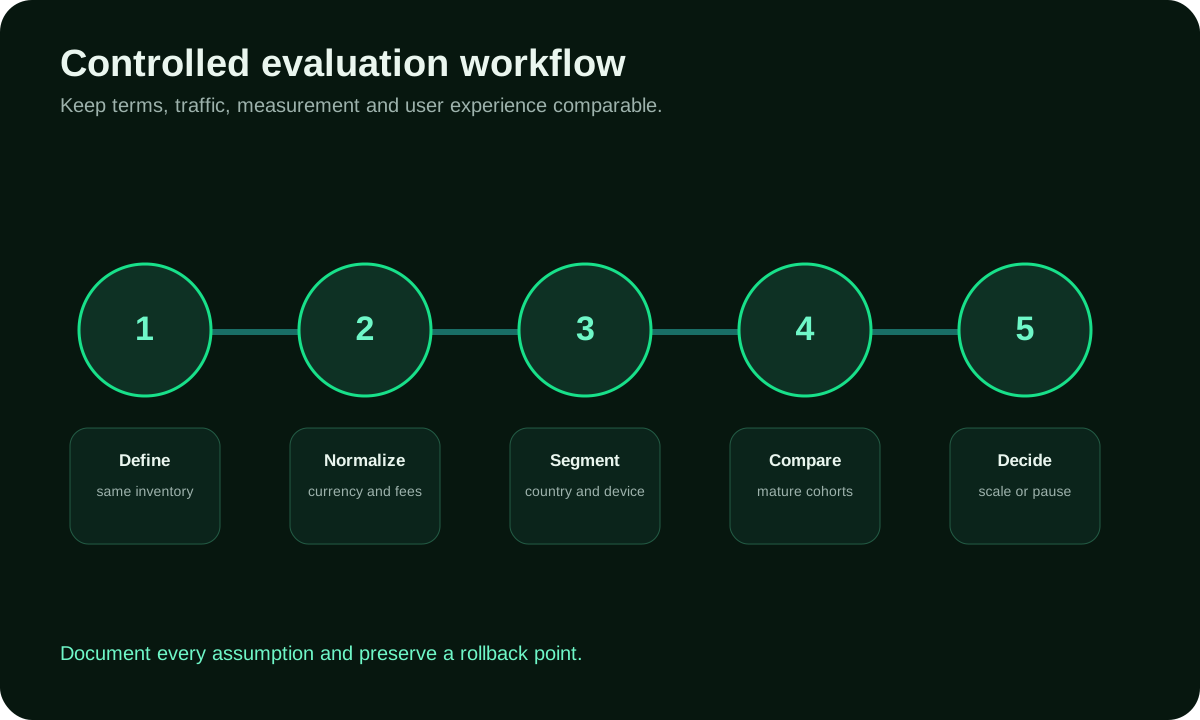
The basic CPM formula is cost divided by impressions multiplied by one thousand. The difficult part is choosing the correct cost and impression definitions. Advertisers may use media cost, cost after platform fees or fully loaded acquisition cost. Publishers may use gross estimated revenue, validated revenue or collected net revenue. Served impressions, eligible impressions and viewable impressions can produce different denominators.
| Comparison field | Advertiser view | Publisher view |
|---|---|---|
| Numerator | Media cost on the same fee basis. | Revenue on the same validation and collection basis. |
| Denominator | Eligible or served impressions for the same format. | Served, filled or viewable impressions as explicitly defined. |
| Currency | One conversion date and documented FX source. | Settlement currency plus receiving and conversion fees. |
| Quality layer | Accepted conversions, refunds and retained value. | Invalid traffic, viewability, complaints and audience retention. |
| Maturity | Normal conversion and rejection delay completed. | Validation and payment adjustment window completed. |
When the business goal is conversion, CPM should be paired with cost per accepted event and downstream value. A country with twice the CPM can be more efficient when the accepted conversion rate or retained customer value is more than twice as strong. Conversely, a cheap market can consume budget without creating an eligible outcome. Keep both the media price and the business result visible.
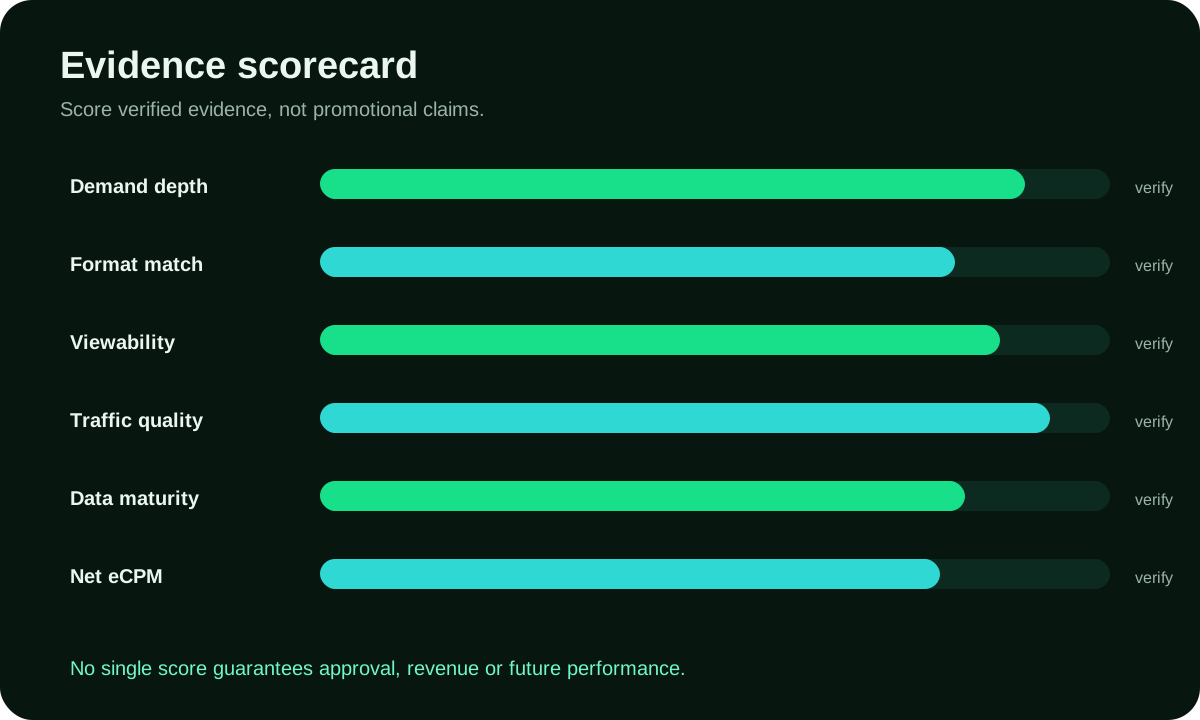
Before acting on a benchmark, score the evidence. Demand depth asks whether multiple buyers or campaigns support the rate. Format match checks whether the benchmark reflects the planned inventory. Viewability and traffic quality protect against high numbers created by weak definitions. Data maturity prevents early cohorts from being compared with fully validated cohorts.
Use unknown as a legitimate score. An unknown fee basis, currency date or impression definition is a reason to pause the comparison. Add the source and extraction date to every field. When the benchmark comes from an external article, record the platform, sample, format and stated limitations. When the source does not disclose them, label the figure directional.
A scorecard does not need to produce one universal ranking. It can show that different countries fit different campaign roles: one for efficient learning, one for qualified scale and another for a specific language or product. The decision should be tied to the campaign brief.
Begin with a capped learning budget across a small set of eligible countries. Keep creative, destination and conversion tracking stable enough to compare markets. Review source-level delivery before applying a country-wide conclusion. One strong placement can make an entire country appear efficient, while one weak source can distort the average in the opposite direction.
Scale a country when mature accepted value remains inside the decision range across more than one cohort and the result is not dependent on one isolated source. Reduce or pause when the market repeatedly misses qualification, produces abnormal activity or exceeds the maximum accepted cost. Before excluding a country entirely, check language, payment, destination speed, device compatibility and local relevance.
Change one major variable at a time. A simultaneous bid increase, new creative, broader targeting and destination update makes the next result impossible to interpret. Record the previous setting, the reason for the change, the expected effect and the rollback condition.
Decision log: record the country, format, device, placement, source, date range, time zone, currency, exchange-rate source, fee basis, impression definition, validation status, CPM, accepted outcomes, sample size and every bid or budget change. Keep previous cohorts visible so a market movement is not confused with a reporting or mix change.
A useful report contains the country, format, device, date range, currency, fee basis, impressions, viewability where available, media cost or validated revenue, CPM, accepted events, accepted-event cost, conversion delay and sample-size note. Include source and placement identifiers for diagnostic work even when the executive summary presents a country total.
Separate facts from interpretation. The fact may be that the country CPM increased by a documented amount on the same basis. The interpretation may be that competition increased. Confirm the interpretation with auction, source or demand evidence before presenting it as a cause. This distinction makes the report more trustworthy and easier for another buyer to audit.
Preserve previous benchmarks. Replacing the file each month hides seasonality and methodology changes. Version the report, record material changes and update public content only when new evidence is strong enough to change the guidance.
Public country CPM information is often incomplete. Platforms may not disclose sample composition, fees, quality filters or whether figures represent advertiser cost or publisher revenue. Exchange rates and privacy changes can alter comparisons. A country-level average can also hide major differences by language, region, device, placement and audience.
Do not use price as a proxy for the worth of people in a market. Campaign eligibility, cultural relevance, consumer protection, privacy, product access and lawful targeting must be reviewed independently. High or low CPM does not justify misleading localization, stereotyping or targeting users who cannot use the offer.
FroggyAds does not guarantee CPM, volume, conversion or profit. Traffic-quality controls reduce risk but cannot eliminate every invalid event. SmartCPC may reduce effective click cost when auction conditions allow, but it does not replace a country-level testing and measurement plan.
Location behavior, platform rules, inventory and auction conditions can change. Verify current settings and definitions for the exact campaign and market.
Review current location targeting behavior and campaign settings.
Check current advertising and destination policy requirements.
Use industry standards as context for measurement, supply-chain and inventory terminology.
Review performance factors that can affect destination and user outcomes.
Use the official definition of invalid clicks and impressions as a quality reference.
Check current platform entry information and format-specific minimums before launch.
It should answer how like-for-like exposure costs and behaves across named countries for one format, audience, period, and fee basis. A broad league table is less useful than a comparison tied to an actual buying decision.
Select markets where the offer, language, landing experience, compliance, and fulfilment are ready, then give each a readable cap. Geographic availability alone does not make a country suitable for the campaign.
Banner, native, push, pop, and video inventory can have different supply and user contexts. Blending them can make a country's apparent rate reflect format mix rather than a genuine market difference.
Translation, cultural fit, offer terms, and landing continuity influence response after the impression. A market should not be judged solely on CPM when its creative or destination is less prepared than the comparison group.
Currency conversion, taxes where applicable, data or verification fees, platform charges, and local creative work can differ. State the chosen cost basis so the media rate is not confused with the full market-entry cost.
Use consistent country, source, format, device, creative, currency, impression, and date fields, with documented timezone and invalid-traffic treatment. Preserve raw spend and delivery totals beneath the calculated rates.
Read it with viewability, useful visits, accepted actions, and the value appropriate to each market. The cheapest impressions are not economical if the audience cannot use the offer or later outcomes are weak.
Review auction demand, inventory depth, bid rules, seasonality, placement mix, device share, creative eligibility, and currency treatment in time order. Confirm that the market definition itself did not change.
Show impression volume, dates, and uncertainty, then keep a provisional label until delivery is broad enough to represent the intended inventory. One cheap placement should not become a national benchmark.
Let it influence allocation after cost, source quality, audience fit, and relevant downstream response remain dependable under comparable conditions. Increase one country's cap gradually and retain its separate reporting.
Fix the inventory definition, normalize currency and fees, preserve source identifiers and wait for mature accepted outcomes. Use country CPM as one economic signal, not as a guaranteed ranking or a substitute for conversion and audience value.
For CPM Rates by Country, begin with the campaign condition this page addresses and end with a written keep, change or stop rule. Click volume is supporting evidence; the accepted business outcome is the commercial checkpoint. The decision here is to interpret rate benchmarks without treating them as a guaranteed campaign price. The adjacent CPM Rates In Uk page should remain a separate decision.
Evidence already visible on this page: CPM rates by country vary because advertiser demand, inventory supply, format, device, season, viewability, traffic quality and conversion value differ by market. There is no permanent highest-CPM country list. Compare… Quick answer: Definition: CPM rates by country compare the cost or revenue associated with one thousand eligible impressions in different geographic markets. Decision log: record the country, format, device, placement,… The working concepts for this URL are campaign objective, audience targeting.
Questions to resolve before scale: For CPM Rates by Country, what question should a country CPM comparison answer? For CPM Rates by Country, how can an advertiser choose countries for an initial CPM study? For CPM Rates by Country, why should country CPMs be separated by ad format?
| Checkpoint | Decision action | Evidence to keep |
|---|---|---|
| Campaign condition | Use “CPM rates by country in three decisions” to define the first operating boundary for CPM Rates by Country. | Record the answer to “For CPM Rates by Country, what question should a country CPM comparison answer?” together with source, targeting and destination identifiers. |
| Proof | Use “What CPM rates by country means” to test whether delivery is producing the expected path toward the accepted business outcome. | Keep the evidence needed to answer “For CPM Rates by Country, how can an advertiser choose countries for an initial CPM study?” after the same maturation window. |
| Follow-up | Use “Key takeaways before using a country CPM list” to decide what changes next; change one material variable before comparing again. | Write the answer to “For CPM Rates by Country, why should country CPMs be separated by ad format?” plus accepted cost/value and the rollback condition. |
Hypothetical example: For a hypothetical CPM Rates by Country cell, USD 125 divided by 10 mature accepted outcomes equals USD 12.50 per accepted outcome. Replace the inputs with your own economics; this is not a FroggyAds performance claim.
FroggyAds gives advertisers a controlled execution layer for CPM Rates by Country: select the traffic setup, keep source-level reporting visible and let the mature accepted business outcome decide whether the next spend increase is justified. Create your free FroggyAds account.
Hypothetical example: if a controlled CPM Rates By Country test spends USD 100 and produces 4 accepted outcomes after the agreed review window, accepted CPA is USD 100 ÷ 4 = USD 25.00. Replace these inputs with your own accepted event, attribution window and economics; this is a transparent calculation example, not a FroggyAds result claim.
CPM Rates by Country is a cost-planning decision: separate published minimums or rates from actual campaign economics, then set a bounded test budget around an accepted business outcome.